Study of Surface and Subsurface Defects in Materials
by Photothermal Deflection Technique:
Theory and Experience
A. Dhouib, A. Hamdi, N. Yacoubi
Photothermal Laboratory, University of Carthage, Tunis, Tunisia Email: [email protected]
Received January 3, 2013; revised February 2, 2013; accepted February 12,2013
ABSTRACT
Photothermal deflection is widely used to study defects in materials. Both high spatial resolution and high sensitivity are required to detect them. In order to improve the theoretical model in the case of uniform heating (one dimensional heat treatment) we have chosen to heat the sample by a halogen lamp. The sample which contains a known surface and subsurface defects is first covered by a thin graphite layer and placed in air. The sample fixed on a vertical holder is able to move in the x and y directions thanks a two stepper motors. The measurement showed excellent agreement be-
tween experimental and simulation results.
Keywords: Photothermal Deflection Technique; Surface Defect; Subsurface Defect; Thermal Wave
1. Introduction
Photothermal imaging is well known as one of the most powerful techniques for the non-destructive test. This technique is based on detecting the thermal wave gener- ated by the periodic heating of a sample with modulate pump beam. A wide variety of methods for the non-de- structive study of surface, subsurface defects and struc- tures in solids have been developed rapidly. Among these methods include the photo acoustic method [1,2], the photothermal radiometry method [3], a piezoelectric trans- ducer method [4] and photothermal deflection (mirage detection) method [5,6]. R. Ritter and B. Schmitz [7] use the photothermal radiometry method to investigate the lack of adhesion between surface layer and base material. These delaminations may be caused by defective boun- daries between coating and substrate or by varied com- position and porosity of the coating material. Some Au- thors have studied surface and sub-surfaces defects [8] by scanning the sample surface but it fails to be com- pared to a theoretical model.
In this work we have scanned samples containing sur- face and subsurface defects and we have shown the effect of these defects on the amplitude and the phase of the photothermal detected signal. For these investigations the sample, covered by a thin graphite layer, is slowly step- ped in respect to the pump beam and the detected photo- thermal signal is plotted versus the scanning distance. In order to establish the efficiency of photothermal imaging, we compare the theoretical model with experimental re-
sults.
In this paper, we start by presenting theoretical model based on resolving heat equations on one dimension for a sample with surface defect, these results will be used for drawing the theoretical curves of amplitude and phase of the signal versus displacement, then we will show the ex- perimental set up which is used, finally we will compare theoretical results with experimental ones. The best agree- ment between the two results makes us validate experi- ence and theory.
2. Theory
We will consider the geometry presented in Figure 1, where the solid sample is covered with a thin graphite layer fixed on a backing. f, , ,c s b are respectively the thicknesses of the fluid, graphite, sample and backing.
l l l l
The fluid could be either the air or another medium such as the paraffin oil. In our case we are going to con- sider the air, and the whole system of the four layers is heated by a modulated light beam of intensity
1 cos
II0 wt . The optical absorption of the graphite
layer will generate a thermal wave that will propagate into the sample and the surrounding fluid inducing a temperature gradient then a refractive index gradient in the fluid [9].
Figure 1. Geometry of the four layers system of photother- mal deflection effect.
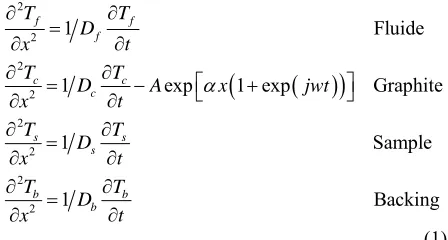
solving the heat equations in each medium. If we assume that only the graphite layer absorbs incident light with the absorption coefficient , the heat equations could be written on Equation (1) [10].
2 2 2 2 2 2 2 21 exp 1 exp
1 1 f f f c c c s s s b b b T T D t x T T
D A x j
t x T T D t x T T D t x 1 Fluide Graphite Sample Backing wt
exp exp x jwt (1)Ti and Di are, respectively, the temperature and the
thermal diffusivity of the medium i. After solving these
equations, we obtain the expressions of periodic tem- perature in each medium as written on Equation (2)
0, exp exp
,
exp exp exp
,
exp exp
, exp exp
f f
c
c c
s
s c s c
b b c s
T x t T x jwt
T x t
U x V x E
T x t
X x l Y x l
T x t W x l l jw
jwt t
e fzej t
T T
(2)
Applying the conditions of continuity of temperature and heat flux at different interfaces, we could determine the constants and we obtain the expression of the tempera- ture T0 on the surface of the sample which is written on
Equation (3).
Since air is not assumed absorbing the incident light and the probe beam skims the surface of the sample at a distance of about 100 micrometers, the temperature in the fluid can be written as f 0
where “z” is the
distance between the probe beam axis and the sample surface. So the deflection may be written as:
d d d d f f T a n
n T z
.
The amplitude and the phase of the deflection are re- spectively:
0
2 d 5π
e ,
d 4
f
z
f f f
L n z
T n T 0 a x
As already reported, we will start by studying theore- tically the case of a sample with a rectangular groove on the surface. The geometry of the sample is presented on Figure 2.
Using the expressions of the temperatures on the theo- retical program on maple 9.5, we could draw the curves representing the amplitude and the phase variations of the photothermal signal at the sample surface. Figures 3 and 4 are the theoretical curves for the two following cases: and a at different modulations fre-
quencies. 0
x
01 exp 1 1 exp 1 1 exp 2 1 exp
1 exp 1 1 exp 1 1 exp 2 1 exp
1 exp 1 1 exp 1 1 exp
1 exp 1 1 exp 1 1
s s c c c c c
s s c c c c c
s s c c c c
s s c c
b l r c l r c l rc l
b l r c l r c l rc l
T
b l g c l g c l
b l g c l g
3. Experimental Set-Up
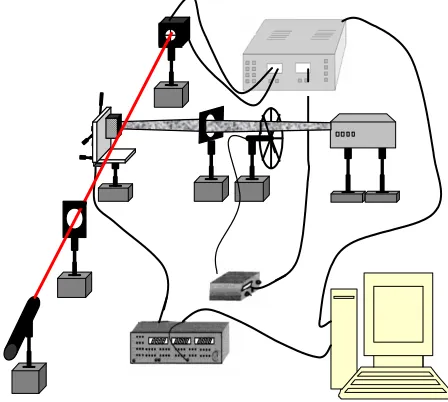
The experimental set-up is described in Figure 5. In our case, the pump beam is a halogen lamp (50 W of power) focused on the sample surface with an optical lens of 50 mm focal length. The light is modulated using a me- chanical chopper (SR540). The laser probe beam (He-Ne) skimming the sample surface will be deflected. The sam- ple is fixed on X-Y table (two stepper motors Newport
Miniature linear stages MFA) commanded by an Uni- versal Motion Controller/Driver ESP300 which gives the
exp
, , ,
c c
b b s s c c s s f f c c c
c l
b K K c K K g K K r
π 1 i i f j D
[image:2.595.64.288.306.426.2]
Figure 2. Geometry of a sample with a rectangular surface defect. x0: width of the defect; a: diameter of the pump
[image:3.595.58.289.88.167.2]beam.
Figure 4. Theoretical amplitude and phase variations for
Figure 3. Theoretical amplitude and phase variations for a < x0.
possibility of displacement horizontally and vertically. A program in Visual Basic makes automatic measurements of the photothermal signal. The system works in such a way that it measures the signal at one point, and then moves to the next. The deflection of the probe beam is measured thanks to a silicon photodetector of four quad- rants (QD50T) linked to a lock-in amplifier (EG&G Mo- del 5209) giving the amplitude and the phase of the pho- tothermal signal. A personal computer was used to store the amplitude and the phase of the signal and draw their variations with the displacement.
4. Experimental Results and Discussion
a > x0.
Figure 5. Experimental set up.
rface is focused, at the beginning, outside of the defect.
fully focused at the defect, the signal becomes again con- su
[image:3.595.58.288.214.523.2] [image:3.595.309.533.436.637.2]stant and we observe the same phenomenon on the other side.
As a first step, we have study a known surface defect, consisting of a groove hollowed into Plexiglas. The shape of
urface defect identical to the pr
ple, on the second A
al results of amplitude and phase. We remark fr
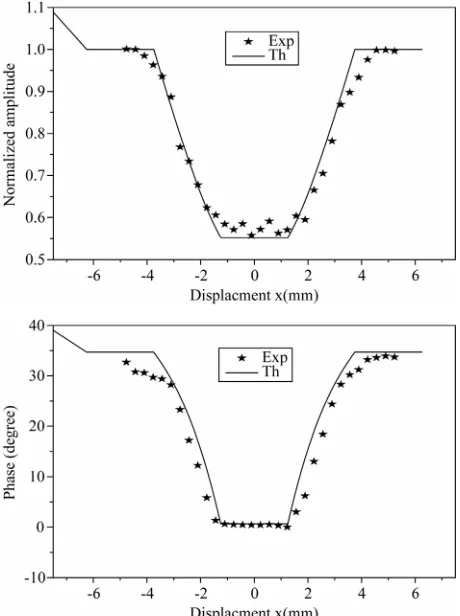
the defect is 5 mm of width which is greater than the pump beam size (a = 3 mm) and a depth of 150 µm. One
can observe in Figure 6 the good agreement between ex- perimental and theory curves which proves the validity of our theoretical model.
In a second study, we consider two samples of Alu- minum the first having a s
150μm
5 mm
evious Plexiglas one and the second presenting a sub- surface defect shown in Figure 7.
On Figure 8 are drawn the theoretical and experimen- tal curves of the first aluminum sam
[image:4.595.347.495.82.252.2]
Figure 7. Geometry of subsurface defect n an aluminium sample.
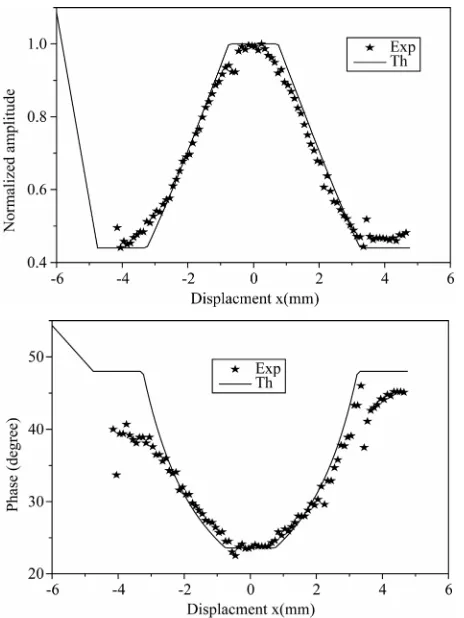
luminum sample, the defect was carved on the back face of the sample by keeping the material to a thickness of about 100 microns. The sample presents a cylindrical defect of about 5 mm of diameter. The scan is effected in a direction perpendicular to the axis of the cylindrical hole.
In Figure 9 are presented the experimental and the theoretic
om this figure that the amplitude of the photothermal signal increases when the pump beam passes above the
i
Figure 8. Experimental and theoretical variations of ampl tude and phase for a surface defect on aluminium sample.
e ermal diffusivity is much slower in a cavity filled with
geometry of the i-
hole. The increase of signal is due to the fact that th th
air than in solid aluminum. Also, in this case, we show the good agreement between experimental and theoreti- cal curves so we could consider that our theoretical model is suitable with this problem.
[image:4.595.308.537.288.599.2]The little disagreement between the theoretical and experimental curves is due, in fact, to the
[image:4.595.58.288.396.704.2]Figure 9. Experimental and theoretical variations of ampli- tude and phase for a subsurface defect in an aluminium
at is not perfectly rectangular.
tested the one dimensional theo-we developed in the uniform heating
REFERENCES
[1] A. Rosencwai hotoacoustic
Spec-ng, R. L. Thomas and G. F. Hawkins, “Subsur-
sample.
defect th
5. Conclusion
In this work we have retical model that
case, this case can be experimentally realized by heating the sample using a halogen lamp. We have considered in a first study a surface defect illustrated by a rectangular groove cut into Plexiglas and another in aluminum. A subsurface defect described by a hole of cylindrical shape situated at a depth of 100 µm and whose axis is parallel to the aluminum surface sample. The good agree- ment between the experimental and the theoretical curves of amplitude and phase of the photothermal signal, prove
the validity of our theoretical model. Our future project will be to characterize some unknown subsurface defects in order to obtain information about their size, depth and nature.
g, “Photoacoustics and P
troscopy,” Wiley Interscience, New York, 1980, pp. 170 and 295
[2] Y. H. Wo
face Structures of Solids by Scanning Photoacoustic Mi- croscopy,” Applied Physics Letters, Vol. 35, No. 5, 1979,
pp. 368-369. doi:10.1063/1.91153
[3] P. E. Nordal and S. O. Kanstad, “Photothermal Radiome- try,” Physica Scripta, Vol. 20, No. 5-6, 1979, p. 659.
doi:10.1088/0031-8949/20/5-6/020
[4] A. Rosencwaig and G. Busse, “High-Resolution Photo- acoustic Thermal-Wave Microscopy,” Applied Physics Letters, Vol. 36, No. 9, 1980, pp. 725-727.
doi:10.1063/1.91646
[5] A. C. Boccara, D. Fournier and J. Badoz, “Thermo-Op- tical Spectroscopy: Detection by the ‘Mirage Effect’,”
Applied Physics Letters, Vol. 36, No. 2, 1980, pp. 130-
132. doi:10.1063/1.91395
[6] J. C. Murphy and C. Aamodt, “Photothermal Spectros- copy Using Optical Beam Probing: Mirage Effect,” Jour- nal of Applied Physics, Vol. 51, No. 9, 1980, pp. 4580-
4588. doi:10.1063/1.328350
[7] R. Ritter and B. Schmitz, “Photothermal Inspections of
A. Le
actérisation Thermique et Optique des Ma-
adallah, “Simultaneous Adhesion Strengths and Detection of Delaminations,” QIRT96-Eurotherm Series50-EdizioniETS, 1997
[8] J. L. Bodnar, M. EgCe, C. Menu, R. Besnard, Blanc, M. Pigeon and J. Y. Sellier, “Cracks Detection by a Moving Photothermal Probe,” Journal de Physique IV Colloque C7, Supplément au Journal de Physique 111,
Vol. 4, 1994. [9] G. Imen, “Car
tériaux Semi-Conducteurs par la Technique de Déflexion Photothermique,” Ph.D. Thesis, Faculté des Sciences de Tunis Université el Manar, 2011.
[10] T. ghrib, N. Yacoubi and F. sa
Determination of Thermal Conductivity and Diffusivity of Solid Samples Using the ‘Mirage Effect’ Method,”
Sensors and Actuators, Vol. A135, No. 2, 2007, pp. 346-