Crossover to Quantized Thermal Conductance in
Nanotubes and Nanowires
Kohei Yamamoto1, Hiroyuki Ishii1, Nobuhiko Kobayashi1*, Kenji Hirose2
1Institute of Applied Physics and Tsukuba Research Center for Interdisciplinary Materials Science, University of Tsukuba, Tsukuba, Japan; 2Green Innovation Research Laboratory, NEC Corporation, Tsukuba, Japan.
Email: *[email protected]
Received February 28th, 2013; revised March 28th, 2013; accepted April 18th, 2013
Copyright © 2013 Kohei Yamamoto et al. This is an open access article distributed under the Creative Commons Attribution License, which permits unrestricted use, distribution, and reproduction in any medium, provided the original work is properly cited.
ABSTRACT
Using the non-equilibrium Green’s function techniques with interatomic potentials, we study the temperature depend-ence and the crossover of thermal conductance from the usual behavior proportional to the cross-sectional area at room temperature to the universal quantized behavior at low temperature for carbon nanotubes, silicon nanowires, and dia-mond nanowires. We find that this crossover of thermal conductance occurs smoothly for the quasi-one-dimensional materials and its universal behavior is well reproduced by the simplified model characterized by two parameters.
Keywords: Carbon Nanotube; Nanowire; Thermal Transport; Quantum Conductance; Non-Equilibrium
Green’s Function
1. Introduction
Recently, phonon thermal transport properties of quasi- one-dimensional materials, such as carbon nanotubes (CNTs) and silicon nanowires (SiNWs), have attracted much attention in the fields of nanometer-scale electron devices and thermoelectric devices. The high thermal conductance opens the way to reduce the heating prob-lems in nanometer-scale electron devices, while low thermal conductance leads to high efficiency of ther-moelectric devices [1]. Consequently, it is very important to know how the quasi-one-dimensional materials con-duct heat. It is predicted that thermal concon-ductance is quantized as 0 B at low
tem-perature and this quantization dose not depend on kinds of materials and carriers [2]. Indeed, this 0
2
2( ) π / 3 /
G T g k T h
g is
experi-mentally measured for phonons [3], electrons [4], and even photons [5]. However, it is known that this quanti-zation breaks at high temperature. Moreover, in macro-scopic, the conductance should be proportional to the cross-sectional area of wires [6]. We investigate this re-gion between quantized and macroscopic thermal con-duction. For such studies, including quantized thermal conductance, we need the computational approach taking the quantum effects explicitly into account. The Lan-dauer formula [7] or the non-equilibrium Green’s
func-tion (NEGF) technique [8] has been widely studied. In addition to electron transport [9,10], these methods have recently been applied to the thermal transport [11] and the thermal conductance is calculated for SiNWs [12] and CNTs [13]. Recently using the NEGF technique, the quantized thermal conductance has been analyzed for SiNWs [14]. According to the calculation, thermal con-ductance is quantized not proportional to diameter at all at low temperature and has a diameter dependence gradually as the temperature increases. Over the tem-perature 100 K, the thermal conductance becomes pro-portional to cross-sectional area of nanowires.
Here, we report the thermal conductance of the quasi- one-dimensional systems, in particular, diameter depen- dence for materials such as CNTs, SiNWs, and diamond nanowires (DNWs) at various temperatures. Using a simplified model based on the assumption for the phonon dispersion relations, we first show the general behaviors of the crossover to quantized thermal conductance from the usual behavior, proportional to the cross-sectional area, to the unusual “quantum-type”, not dependent on the cross-sectional area or the diameter with decreasing temperature. Especially, we consider the following mo- del. Since the quasi-one-dimensional materials have four acoustic phonon modes; one longitudinal mode, two flexural modes, and one torsional mode, we propose the model that these modes are well separated in the phonon
dispersion relation from the other optical modes, the number of which is proportional to the number of atoms in cross-section of materials. We can obtain the universal thermal conductance behavior with only two parameters to describe the present simplified model. Then, we pre-sent the elaborate atomistic calculations for the thermal conductance of various realistic systems using the NEGF technique. We explain the difference of the temperature dependence of thermal conductance by comparing with those for the simplified model and clarify the important two parameters to account for the crossover to the quan-tized thermal conductance.
2. Simplified Model
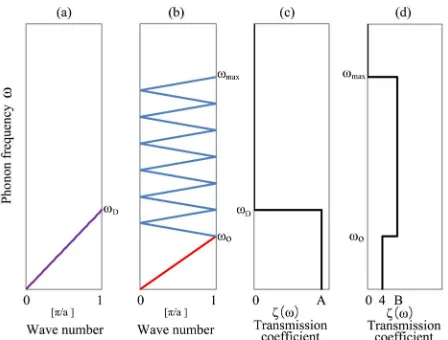
First, we introduce a simplified model to discuss the temperature dependence of thermal conductance of quasi-one-dimensional systems. In particular, we try to analyze qualitatively the crossover to quantized thermal conductance from the usual conductance, which is pro-portional to its cross-sectional area. Here we note that in the Debye approximation where the phonon dispersion relation for the quasi-one-dimensional model composed of mono-atomic chain is approximated by the simple linear dispersion as shown in Figure 1(a), there
appar-ently shows no crossover of thermal conductance since the transmission coefficient exists only for that phonon
Figure 1. (a) Phonon dispersion relation of a quasi-one-dimensional mono-atomic model for the acoustic mode in the debye approximation; (b) Schematic picture of phonon dispersion relation in the present simplified model, which is composed of four acoustic phonon modes for 0 and the other uniform phonon modes for 0 m
mode (Figure 1(c)).
Instead, we consider a system for the phonon thermal transport which is described by two dimensionless pa-rameters and . Here indicates the ratio of
0 max
/
, where max is the maximum phonon
fre-quency for all the phonon modes and 0 is the phonon frequency under which only four acoustic phonon modes exist. It should be noted that the torsional mode appears in the quasi-one-dimensional systems in addition to the one longitudinal mode present typically in one-dimen- sional system as in Figure 1(a) and two flexural modes
present for bulk system. Important point is that we con-sider these four modes are well separated from the other phonon modes which exist in the higher energies and play the important role for the quantized thermal con-ductance at low temperature. As the temperature in-creases, various phonon modes are excited beyond these acoustic modes. In general, the degrees of the freedom increase linearly with the number of the atoms and the number of the phonon bands increases correspondingly.
In the region of frequencies between 0 and max,
we assume for simplicity that the number of the phonon modes becomes uniform and is proportional to the num-ber of atoms in the cross-sectional area. Since the transmission coefficient
N
corresponds to the num-ber of phonon modes for ballistic transport, we obtain
N
, where we introduce the parameter as the proportional constant. As an example of the simplified model, we show a schematic phonon dispersion relation and the corresponding transmission function ( ) in
Figures 1(b) and (d), respectively.
The thermal current Jth for the system is expressed
in the Landauer’s type as follows, [2]
0 2π , ,
th BE L BE R
d
J
n T n T
, (1)where nBE
,TL R( )
is the Bose-Einstein distributionfunction of equilibrium phonons with an energy of
in the left (right) lead at temperature L R( ). For adiabatic contact between the wire and the leads, T
is ex-pressed in the present model as follows,
0
0 max
max
4 ( )
0 .
N
(2)In the limit of small temperature difference between the left and right leads, the temperature dependence of thermal conductance G T
is given byax
; (c) Typical transmission coefficient
as a function of pho- non frequency for the one-dimensional monoatomic model in (a); (d) Transmission coefficient
in the simplified model. B
N
is the number of phonon modes at , where we assume is proportional to the number of atoms in the cross-sectional area.B N
0
max 0
0
d d
4 d 2π
d 2π
th
BE B
B
BE B
B
J G T
T
n T
k
k T
n T
k N
k T
[image:2.595.61.285.407.577.2]The thermal conductance G T
G T
G T
N
shows explicitly the size dependence for in addition to the temperature dependence. At low temperature the first term dominates the thermal conductance and shows the quan-tized thermal conductance, without any dependence of
, a universal features as 0. As the tem-perature increases, the contribution from the second term having the size dependence plays a dominant role. Since this term is proportional to , that is, its cross-sectional area, it represents the usual thermal conductance. With use of these expressions, we calculate the temperature dependence of the thermal conductance to discuss the crossover region between the quantized conductance and the usual conductance.
N
N 4g
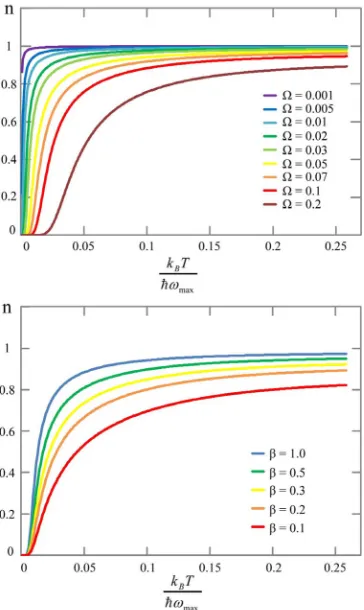
In order to express the characteristic feature on the temperature dependence of thermal conductance explic-itly, let us extrapolate the thermal conductance by the power-law as . This enables us to discuss the crossover from to for various temperatures. Figure 2 shows the exponent
as a function of the temperature. The temperature is measured in units of
nG T N 0 n T
max
/
0 n1
T
n
B k
. The horizontal axis cor-
Figure 2. (Top) Exponent n of thermal conductance
nG T N as a function of temperature for various parameters of with
max / B
k T 1 0/
max
max
; (Bottom) Exponent n as a function of k TB / for various parameters of with 0.05.
responds to the temperatures from 0 to 300 K for the maximum phonon energy of typical parameter of max
of 100 meV. We note that this parameter value would be different from material to material in the realistic systems. It is observed that smooth transition curves from the quantized conductance regime to the usual thermal conductance regime are obtained. The upper panel shows the exponent for various
n0
1
n
n
with
1
. The onset temperature is determined by be-cause only four phonon modes exist under the frequency
0
leading to the quantized conductance. With an in-crease of temperature, the second term dependent on in Equation (3) enhances and approaches to one. The lower panel shows the exponent for various
N
n
with
0.05
. As the parameter becomes smaller or
becomes larger, the asymptotic behavior of the exponent to approach the value of becomes slower. This is because the first term which is independent of in Equation (3) becomes not negligible in this case.
n n1
N
These calculations suggest that qualitative general be-haviors might be elucidated using a simplified model based on the assumption of simple phonon dispersion relation. We note that these characteristic features are represented by only two critical parameters, and . Realistic materials have more complex phonon disper-sions. In the next section, we perform more elaborate atomistic calculations for the phonon dispersion and the thermal transport to investigate the details of crossover to the quantized thermal conductance and study the validity of the present simplified model.
3. Realistic Atomistic Calculations
Next, we consider the temperature dependence of ther-mal conductances of realistic quasi-one-dimensional ma-terials. As typical examples, we take SiNWs, DNWs, and CNTs, and analyze the phonon transport properties from an atomistic viewpoint. The Hamiltonian H for the
present phonon transport is expressed as follows:
2
, ,
, , , , ,
1 1
( ) ( ) ( ) .
2 i 2 i i j
i sys i i j sys
x y z x y z
j
H p t u t K u t
M
(4)Here Mi is a mass of -th atom and is an
op-erator for displacement of -th atom along
i ui
ti direction
from equilibrium position, respectively. We split the total Hamiltonian into four pieces:
int
L S R
HH H H H ,
where L R is the Hamiltonian for the left (right) lead,
S H
H is for the scattering region, and Hint is for the
in-teraction between the scattering region and the left (right) lead. Using the NEGF technique [11], the thermal current
th
J and the thermal conductance from the left
lead to the scattering region can be expressed in the similar form as Equations (1) and (3) such as
[image:3.595.82.264.356.661.2]
0
d
, ,
2π
th L
BE L BE R
J H
n T n T
The dynamical matrix K which is contained in the
total Hamiltonian is constructed from the force constants between the atoms. The matrix elements of Ki ,j
i
are calculated by finite difference of the force F with
respect to rj as
0
( ) d .
2π
B BE
B
k n
G T
k T
(5)
2
,
2
i j i j
i j
i j j
F R F R E
K
r r R
(9)
Here the bracket denotes the non-equilibrium sta-tistical average of the physical observable and
is the transmission coefficient for the phonon transport through the scattering region given by
r a .L R
Tr G G
(6)
The force Fi is obtained from the derivative of
with respect to i
E
r, where is the total energy of the
system and
E
i
r is the atomic coordinate of the -th atom
along the
i
direction. Therefore Fi
RjHere, r a/
G is the retarded/advanced Green’s
func-tion for the scattering region and L R/
is thecou-pling constant. For the ideal ballistic limit without any scatterings,
is equal to the number of phonon subbands at frequency .The retarded/advanced Green’s function for the scat-tering region is given by
1/ 2 / / ,
r a r a r a
L R
G M K (7)
indi-cates the force of the -th atom along the i direction
generated by the j-th atom along the direction with a displacement of R from the pristine wire’s
equi-librium positions. Here R is a displacement, for
which we take 2 104
R
Å in the present work. As for the total energy formula , we use the interatomic Tersoff potential [16] for silicon systems and Brenner potential [17] for carbon systems. These potentials de-scribe the interatomic potentials with only elementary functions of atomic coordinates. The Tersoff (Brenner) potential describes total energy as follows:
E
where M is the diagonal matrix whose element is a
mass of a silicon or a carbon atom and /
/ r a L R
is the retarded/advanced self-energy due to the coupling to the left/right semi-infinite lead with the scattering region, which is obtained independently from the atomistic structure of the lead. We use a quick iterative scheme with the surface Green’s function technique [15] to cal-culate the self-energy for complex atomic structures of nanowires. The coupling constant L R/ in Equation
(6) is then obtained from
1 2
i i i j
E E V
ij (10)1 2
( )[ rij ij] .
ij c ij ij ij
V f r a Ae b Ber (11) Here, A, B, 1 and 2 are constants, rij is a
dis-tance between the -th and -th atoms and and are determined by only atomic coordinates.
i j aij
ij
b
/ / / .
r a
L R i L R L R
(8) Figures 3(a)-(c) show the phonon dispersion relations
Figure 3. Phonon dispersion relations of (a) 100 -SiNW with 1.5 nm in diameter; (b) 100 -DNW with 1 nm in diameter;
and (c) (5,5)-CNT. Here, =5.362 Å, =3.567 Å, and =2.49 Å are unit vectors of the SiNW, DNW, and CNT,
respec-tively; (d) Transmission function
1
a a2 a3
of a 100 -SiNW with a diameter of 1.5 nm, a 100 -DNW with a diameter of 1.0 nm, and a (5,5)-CNT respectively. Since the SiNW and the DNW have the same atomic configurations with the same numbers of atoms in cross-sectional areas, these two phonon bands have similar structures with a difference of the phonon energy range, for which DNW has a larger value due to the stronger interatomic force acting between carbon atoms. On the other hand, the CNT has a cylindrical shape and each band of the CNT tends to have disper-sions with a wide energy range, which induces large thermal conductance. Figures 3(d) and (g) show the
transmission function
for the CNT and the dif-ferentials of the distribution functions as a function of the phonon energy. The integral of these products corresponds to the thermal conductance
,BE
n T
G T .
At small phonon energy regime, we see that all quasi- one-dimensional structures have four acoustic modes, one longitudinal, two flexural, and one torsional modes, which do not depend on the detailed structures of nanowires. When only these four modes conduct heat, thermal conductance shows a universal feature for any material or diameter. This accounts for the quantized thermal conductance at low temperature regime [2]. As the temperature increases, various phonon modes begin to contribute to the thermal transport.
Here, we compare the behaviors of thermal conduc-tance for SiNWs and CNTs, which have completely dif-ferent atomic configurations as nanowires. The bottom panels of Figure 4 show the temperature dependences of
Figure 4. (Top) Exponent for several temperatures ex-trapolated from the thermal conductance as described by
, where is the number of atoms in the cross- section area. (Bottom) Thermal conductance as a function of the diameter
n
n
GN N
D for several temperatures in cases of the SiNW (left) and the CNT (right).
the calculated thermal conductances as a function of the diameter for the SiNW (left) and the CNT (right). At 300K the thermal conductances are proportional to the square of the diameter for SiNWs (left) and to the diameter for CNTs (right). Since the SiNWs have columnar shapes and the CNTs have cylindrical shapes, for the SiNWs and for the CNTs. This indicates that the thermal conductance is propor-tional to the cross-secpropor-tional area at high temperature. As the temperature decreases from 300 K, the behaviors of thermal conductances to the diameter dependence are seen to change gradually. At enough low temperature, we see no dependence on a diameter for the thermal conductance
D
D
2
D
2
ND ND
D
G T for both cases.
To analyze the temperature dependence of the thermal conductance, as we did in the previous section, we ex-trapolate the exponents for the thermal conductance n
nG T N for the SiNWs, DNWs and CNTs, which
are shown in the top panel of Figure 4. At 300 K, the
exponents of wires are nearly equal to 1 which corre-spond to usual thermal conductance and the exponents approach to 0 which correspond to “quantum-type” thermal conductance as the temperature decreases. We see that the crossover to n0 from n1 differs
slightly according to the kinds of materials. The rapid decrease of the exponent from the saturation appears at the lowest temperature for SiNWs. This can be under-stood from the scaling of the temperature by max
n
/kB
as shown in Figures 3(e) and (f), where max are 70
meV for SiNWs, 180 meV for DNWs, and 210 meV for CNTs. Among these materials the normalized tempera-ture of SiNWs is the lowest, which is also related to the Debye temperature in the specific heat. To compare the behaviors of thermal conductance between DNWs and CNTs which have similar max, we see that the onset
temperature of CNTs is lower. This can be understood because 0/ max is smaller for CNTs than DNWs.
We note that another parameter of the proportional con-stant is determined so that
in the simplified model has the same area as that in the realistic atomic system.These data show that the simplified model as intro-duced in the previous section is effective to understand the behaviors of crossover to quantized thermal conduc-tance, even if it is expressed with two parameters by the abbreviation of the precise transmission coefficients
to the simplified ones as shown in Figures 3(e)
and (f). Here we note that, in the present theoretical
Phonon-phonon scattering effect is not taken into ac- count here. Experimentally it has been observed that for nanowires less than 37 nm thick, the effect of anhar- monicity on the thermal conductivity is not significant up to room temperature. Instead, the phonon boundary scat- tering due to surface roughness becomes important for the nanowires [18]. The effect is also discussed theoreti- cally [12]. It is shown that anharmonicity is suppressed for nanowires shorter than tens of nanometers. We con- sider the clean wire case, where no edge or internal scat-terings are present simply. However, note that such scat- terings have the effects on the thermal conductance in the length direction . We have checked the effects of the boundary scattering due to surface roughness in the SiNW on the exponent . We remove 5% atoms from the surface randomly with 10 different configurations and treat the results statistically. As a result, we find that the trend of the exponential behavior of the conductance from to 0 remains for the boundary scattering although the conductance reduces.
L
n
1
n
4. Conclusion
We have proposed a simplified model to discuss the crossover to universal quantized thermal conductance of the quasi-one-dimensional systems. From the calcula-tions of the temperature dependence of thermal conduc-tance for the realistic atomistic systems of CNTs, SiNWs, and DNWs, for which the crossover from the usual be-havior at room temperature to the universal “quan-tum-type” behavior at low temperature is obtained by using the non-equilibrium Green’s function techniques with interatomic potentials, we find that this crossover occurs smoothly for the quasi-one-dimensional materials and its universal behavior is well reproduced by the sim-plified model characterized by two parameters.
5. Acknowledgements
This work is supported in part by a Grant-in-Aid for Scientific Research from the Ministry of Education, Cul-ture, Sports, Science and Technology of Japan.
REFERENCES
[1] A. I. Boukai, Y. Bunimovich, J. T. Kheli, J.-K. Yu, W. A. Goddard III and J. R. Heath, “Silicon Nanowires as Effi- cient Thermoelectric Materials,” Nature, Vol. 451, 2008, pp. 168-171. doi:10.1038/nature06458
[2] L. G. C. Rego and G. Kirczenow, “Fractional Exclusion Statistics and the Universal Quantum of Thermal Con- ductance: A Unifying Approach,” Physical Review B, Vol. 59, No. 20, 1999, pp. 13080-13086.
doi:10.1103/PhysRevB.59.13080
[3] K. Schwab, E. A. Henriksen, J. M. Worlock and L. Rou- kes, “Measurement of the Quantum of Thermal Conduc-
tance,” Nature, Vol. 404, 2000, pp. 974-977. doi:10.1038/35010065
[4] O. Chiatti, J. T. Nicholls, Y. Y. Proskuryakov, N. Lump- kin, I. Farrer and D. A. Ritchie, “Quantum Thermal Con- ductance of Electrons in a One-Dimensional Wire,” Phy- sical Review Letters, Vol. 97, 2006, Article ID: 056601. doi:10.1103/PhysRevLett.97.056601
[5] M. Meschke, W. Guichard and J. P. Pekola, “Single-Mode Heat Conduction by Photons,” Nature, Vol. 444, 2006, pp. 187-190. doi:10.1038/nature05276
[6] Y. Dubi and M. Di Ventra, “Colloquium: Heat Flow and Thermoelectricity in Atomic and Molecular Junctions,” Reviews of Modern Physics, Vol. 83, No. 1, 2011, pp. 131-156.
[7] M. Büttiker, Y. Imry, R. Landauer and S. Pinhas, “Gen- eralized Many-Channel Conductance Formula with Ap- plication to Small Rings,” Physical Review B, Vol. 31, 1985, pp. 6207-6215. doi:10.1103/PhysRevB.31.6207 [8] L. V. Keldysh, “Diagram Technique for Nonequilibrium
Processes,” Soviet Physics—JETP, Vol. 20, No. 4, 1965, pp. 1018-1026.
[9] C. Caroli, R. Combescot, P. Nozieres and D. Saint-James, “Direct Calculation of the Tunneling Current,” Journal of Physics C: Solid State Physics, Vol. 4, No. 8, 1971, p. 916. doi:10.1088/0022-3719/4/8/018
[10] Y. Meir and N. S. Wingreen, “Landauer Formula for the Current through an Interacting Electron Region,” Physi- cal Review Letters, Vol. 68, No. 16, 1992, pp. 2512-2515. doi:10.1103/PhysRevLett.68.2512
[11] A. Ozpineci and S. Ciraci, “Quantum Effects of Thermal Conductance through Atomic Chains,” Physical Review B, Vol. 63, No. 12, 2001, Article ID: 125415.
doi:10.1103/PhysRevB.63.125415
[12] N. Mingo and L. Yang, “Phonon Transport in Nanowires Coated with an Amorphous Material: An Atomistic Green’s Function Approach,” Physical Review B, Vol. 68, No. 24, 2003, Article ID: 245406.
doi:10.1103/PhysRevB.68.245406
[13] T. Yamamoto and K. Watanabe, “Nonequilibrium Green’s Function Approach to Phonon Transport in Defective Car- bon Nanotubes,” Physical Review Letters, Vol. 96, No. 25, 2006, Article ID: 255503.
doi:10.1103/PhysRevLett.96.255503
[14] K. Yamamoto, H. Ishii, N. Kobayashi and K. Hirose, “Effects of Vacancy Defects on Thermal Conduction of Silicon Nanowire: Nonequilibrium Green’s Function Ap- proach,” Applied Physics Express, Vol. 4, 2011, Article ID: 085001. doi:10.1143/APEX.4.085001
[15] M. P. Lopez-Sancho, J. M. Lopez-Sancho and J. Rubio, “Quick Iterative Scheme for the Calculation of Transfer Matrices: Application to Mo (100),” Journal of Physics F: Metal Physics, Vol. 14, No. 5, 1984, p. 1205.
doi:10.1088/0305-4608/14/5/016
[16] J. Tersoff, “Empirical Interatomic Potential for Silicon with Improved Elastic Properties,” Physical Review B, Vol. 38, No. 14, 1988, pp. 9902-9905.
doi:10.1103/PhysRevB.38.9902
Use in Simulating the Chemical Vapor Deposition of Dia- mond Films,” Physical Review B, Vol. 42, No. 15, 1990, pp. 9458-9471. doi:10.1103/PhysRevB.42.9458