4-Nitrobenzoic acid–2,2
000-biimidazole
(2/1)
Xin Liu and Weiqun Zhu*
School of Chemistry and Chemical Engineering, Shandong University, Jinan 250100, People’s Republic of China
Correspondence e-mail: [email protected] Received 20 April 2010; accepted 28 April 2010
Key indicators: single-crystal X-ray study;T= 296 K; mean(C–C) = 0.003 A˚;
Rfactor = 0.045;wRfactor = 0.134; data-to-parameter ratio = 11.7.
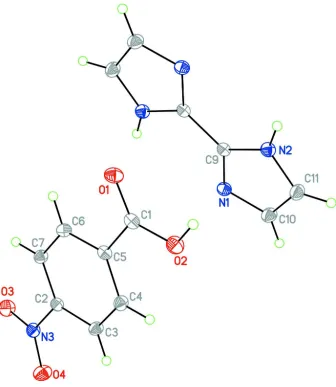
In the title adduct, C7H5NO40.5C6H6N4, the complete
biimidazole molecule is generated by a crystallographic inversion centre. In the crystal, N—H O and O—H N hydrogen bonds connects the 4-nitrobenzoic acid and 2,20
-biimidazole units, affording multi-dimensional frameworks with graph-set descriptorR22(9).
Related literature
For the potential applications of coordination complexes as functional materials and enzymes, see: Zhanget al.(2003) For hydrogen-bond motifs, see: Bernsteinet al.(1995).
Experimental
Crystal data
C7H5NO40.5C6H6N4
Mr= 234.19
Monoclinic,P21=c
a= 4.852 (1) A˚
b= 10.9245 (10) A˚
c= 19.7981 (10) A˚
= 90.496 (1)
V= 1049.4 (2) A˚3
Z= 4
MoKradiation
= 0.12 mm1
T= 296 K
0.120.100.08 mm
Data collection
Bruker APEXII CCD diffractometer
Absorption correction: multi-scan (SADABS; Bruker, 2001)
Tmin= 0.986,Tmax= 0.991
5185 measured reflections 1849 independent reflections 1264 reflections withI> 2(I)
Rint= 0.034
Refinement
R[F2> 2(F2)] = 0.045
wR(F2) = 0.134
S= 1.00 1849 reflections 158 parameters 1 restraint
H atoms treated by a mixture of independent and constrained refinement
max= 0.25 e A˚
3
min=0.15 e A˚
3
Table 1
Hydrogen-bond geometry (A˚ ,).
D—H A D—H H A D A D—H A
O2—H2A N1 0.85 (1) 1.75 (1) 2.580 (2) 168 (3) N2—H2 O1i
0.86 1.89 2.742 (2) 173
Symmetry code: (i)xþ2;yþ2;zþ1.
Data collection:APEX2(Bruker, 2004); cell refinement: SAINT-Plus(Bruker, 2001); data reduction:SAINT-Plus; program(s) used to solve structure: SHELXS97(Sheldrick, 2008); program(s) used to refine structure:SHELXL97(Sheldrick, 2008); molecular graphics: SHELXTL(Sheldrick, 2008); software used to prepare material for publication:SHELXTL.
The authors thank Shandong University for support.
Supplementary data and figures for this paper are available from the IUCr electronic archives (Reference: BX2278).
References
Bernstein, J., Davis, R. E., Shimoni, L. & Chang, N.-L. (1995).Angew. Chem. Int. Ed. Engl.34, 1555–1573.
Bruker (2001). SAINT-Plus and SADABS. Bruker AXS Inc., Madison, Wisconsin, USA.
Bruker (2004).APEX2. Bruker AXS Inc., Madison, Wisconsin, USA. Sheldrick, G. M. (2008).Acta Cryst.A64, 112–122.
Zhang, X. T., Lu, C. Z., Zhang, Q. Z., Lu, S. F., Yang, W. B., Liu, J. C. & Zhuang, H. H. (2003).Eur. J. Inorg. Chem.pp. 1181–1185.
Acta Crystallographica Section E
Structure Reports Online
supporting information
Acta Cryst. (2010). E66, o1245 [https://doi.org/10.1107/S1600536810015643]
4-Nitrobenzoic acid
–
2,2
′
-biimidazole (2/1)
Xin Liu and Weiqun Zhu
S1. Comment
Recently, the design and synthesis of coordination complexes have attracted much attention due to their diversity structures as well as potential applications as functional materials and enzymes (Zhang et al. , 2003). Here, we report one by-product of the hydrothermal reaction of FeCl3 with 4-nitrobenzoic acid and biimidazole. The asymmetric unit of (I)
consists of a 4-nitrobenzoic acid molecule and half biimidazole molecule, Fig 1. In the 4-nitrobenzoic acid molecule, the nitro group is rotated 10.6 (3)° from aromatic ring. N—H···O and O—H···N hydrogen bonds connects the C7H5NO4 .
0.5C6H6N4 units to affords a macrocycle with graph-set descriptor R22(9) (Bernstein et al., 1995), Fig2.
S2. Experimental
A mixture of 4-nitrobenzoic acid (1 mmoL, 0.17 g), biimidazole (1 mmoL, 0.14 g), and iron trichloride (1 mmoL, 0.27 g) in 12 ml distilled water sealed in a 25 ml Teflon-lined stainless steel autoclave was kept at 433 K for three days. Colorless crystals suitable for the single X-ray diffraction were obtained.
S3. Refinement
All H atoms were placed in calculated positions with C—H = 0.93Å and refined as riding with Uiso(H) = 1.2Ueq(carrier).
Figure 1
The molecular structure of (I), showing the atom-labelling scheme and with displacement ellipsoids at the 30% probability level. Unlabeled atoms are related to labeled atoms by the symmetry code (-x, 2-y, 1-z).
4-Nitrobenzoic acid–2,2′-biimidazole (2/1)
Crystal data
C7H5NO4·0.5C6H6N4 Mr = 234.19
Monoclinic, P21/c
Hall symbol: -P 2ybc
a = 4.852 (1) Å
b = 10.9245 (10) Å
c = 19.7981 (10) Å
β = 90.496 (1)°
V = 1049.4 (2) Å3
Z = 4
F(000) = 484
Dx = 1.482 Mg m−3
Mo Kα radiation, λ = 0.71073 Å Cell parameters from 1230 reflections
θ = 2.8–22.0°
Data collection
Bruker APEXII CCD diffractometer
Radiation source: fine-focus sealed tube Graphite monochromator
phi and ω scans
Absorption correction: multi-scan
(SADABS; Bruker, 2001)
Tmin = 0.986, Tmax = 0.991
5185 measured reflections 1849 independent reflections 1264 reflections with I > 2σ(I)
Rint = 0.034
θmax = 25.0°, θmin = 2.1° h = −5→5
k = −12→9
l = −23→20
Refinement
Refinement on F2
Least-squares matrix: full
R[F2 > 2σ(F2)] = 0.045 wR(F2) = 0.134 S = 1.00 1849 reflections 158 parameters 1 restraint
Primary atom site location: structure-invariant direct methods
Secondary atom site location: difference Fourier map
Hydrogen site location: inferred from neighbouring sites
H atoms treated by a mixture of independent and constrained refinement
w = 1/[σ2(F
o2) + (0.078P)2]
where P = (Fo2 + 2Fc2)/3
(Δ/σ)max < 0.001
Δρmax = 0.25 e Å−3
Δρmin = −0.15 e Å−3
Extinction correction: SHELXL97 (Sheldrick, 2008), Fc*=kFc[1+0.001xFc2λ3/sin(2θ)]-1/4
Extinction coefficient: 0.013 (4)
Special details
Geometry. All esds (except the esd in the dihedral angle between two l.s. planes) are estimated using the full covariance matrix. The cell esds are taken into account individually in the estimation of esds in distances, angles and torsion angles; correlations between esds in cell parameters are only used when they are defined by crystal symmetry. An approximate (isotropic) treatment of cell esds is used for estimating esds involving l.s. planes.
Refinement. Refinement of F2 against ALL reflections. The weighted R-factor wR and goodness of fit S are based on F2,
conventional R-factors R are based on F, with F set to zero for negative F2. The threshold expression of F2 > 2sigma(F2) is
used only for calculating R-factors(gt) etc. and is not relevant to the choice of reflections for refinement. R-factors based on F2 are statistically about twice as large as those based on F, and R- factors based on ALL data will be even larger.
Fractional atomic coordinates and isotropic or equivalent isotropic displacement parameters (Å2)
x y z Uiso*/Ueq
C1 0.3475 (4) 0.7795 (2) 0.58109 (11) 0.0548 (6)
C2 −0.2424 (4) 0.54924 (18) 0.67279 (9) 0.0493 (5) C3 −0.1097 (4) 0.5072 (2) 0.61681 (10) 0.0577 (6)
H3 −0.1475 0.4298 0.5995 0.069*
C4 0.0825 (4) 0.5826 (2) 0.58629 (11) 0.0586 (6)
H4 0.1753 0.5557 0.5482 0.070*
C5 0.1368 (4) 0.69760 (19) 0.61233 (10) 0.0502 (5) C6 −0.0063 (4) 0.7371 (2) 0.66845 (10) 0.0565 (6)
H6 0.0283 0.8148 0.6858 0.068*
C7 −0.1990 (4) 0.66362 (19) 0.69917 (11) 0.0551 (6)
H7 −0.2963 0.6908 0.7366 0.066*
C9 0.9965 (4) 0.95887 (18) 0.47185 (10) 0.0468 (5) C10 0.8856 (5) 0.8140 (2) 0.40287 (11) 0.0676 (7)
H11 1.1813 0.8580 0.3342 0.081*
H2A 0.566 (4) 0.7886 (19) 0.5083 (11) 0.080*
N1 0.8218 (3) 0.86605 (16) 0.46396 (9) 0.0549 (5) N2 1.1672 (3) 0.96604 (16) 0.41881 (8) 0.0550 (5)
H2 1.2968 1.0188 0.4135 0.066*
N3 −0.4451 (4) 0.46869 (19) 0.70582 (9) 0.0596 (5) O1 0.4057 (3) 0.87721 (14) 0.60756 (8) 0.0689 (5) O2 0.4566 (3) 0.73838 (16) 0.52653 (8) 0.0739 (5) O3 −0.5946 (4) 0.50989 (16) 0.74887 (10) 0.0873 (6) O4 −0.4548 (4) 0.36262 (17) 0.68800 (10) 0.0926 (6)
Atomic displacement parameters (Å2)
U11 U22 U33 U12 U13 U23
C1 0.0442 (12) 0.0579 (14) 0.0621 (14) −0.0011 (10) −0.0014 (10) 0.0114 (11) C2 0.0449 (11) 0.0507 (12) 0.0522 (12) −0.0036 (9) 0.0044 (9) 0.0051 (10) C3 0.0628 (14) 0.0509 (12) 0.0595 (13) −0.0100 (10) 0.0119 (11) −0.0058 (10) C4 0.0577 (14) 0.0624 (14) 0.0559 (13) −0.0052 (11) 0.0124 (10) −0.0028 (11) C5 0.0427 (12) 0.0505 (13) 0.0574 (12) −0.0028 (9) −0.0024 (10) 0.0076 (10) C6 0.0561 (13) 0.0481 (13) 0.0653 (13) −0.0028 (10) 0.0007 (11) −0.0026 (10) C7 0.0543 (13) 0.0554 (13) 0.0556 (12) 0.0002 (10) 0.0060 (10) −0.0031 (10) C9 0.0399 (11) 0.0483 (12) 0.0523 (11) 0.0004 (9) 0.0024 (9) 0.0056 (9) C10 0.0701 (16) 0.0621 (15) 0.0705 (15) −0.0161 (12) 0.0037 (12) −0.0095 (12) C11 0.0719 (16) 0.0709 (16) 0.0609 (14) −0.0068 (13) 0.0132 (12) −0.0095 (13) N1 0.0520 (11) 0.0516 (10) 0.0610 (11) −0.0074 (8) 0.0014 (8) 0.0017 (9) N2 0.0500 (10) 0.0544 (11) 0.0609 (11) −0.0053 (8) 0.0088 (9) 0.0025 (9) N3 0.0581 (12) 0.0634 (13) 0.0573 (11) −0.0071 (10) 0.0092 (9) 0.0029 (9) O1 0.0602 (10) 0.0563 (10) 0.0904 (11) −0.0113 (8) 0.0095 (8) 0.0033 (9) O2 0.0713 (12) 0.0737 (12) 0.0769 (11) −0.0217 (9) 0.0177 (9) 0.0076 (9) O3 0.0907 (13) 0.0871 (13) 0.0849 (12) −0.0056 (10) 0.0419 (10) 0.0034 (10) O4 0.1113 (16) 0.0649 (12) 0.1021 (13) −0.0320 (10) 0.0356 (11) −0.0089 (10)
Geometric parameters (Å, º)
C1—O1 1.222 (3) C7—H7 0.9300
C1—O2 1.288 (3) C9—N1 1.330 (2)
C1—C5 1.496 (3) C9—N2 1.345 (2)
C2—C3 1.366 (3) C9—C9i 1.432 (4)
C2—C7 1.370 (3) C10—C11 1.347 (3)
C2—N3 1.476 (3) C10—N1 1.374 (3)
C3—C4 1.387 (3) C10—H10 0.9300
C3—H3 0.9300 C11—N2 1.355 (3)
C4—C5 1.382 (3) C11—H11 0.9300
C4—H4 0.9300 N2—H2 0.8600
C5—C6 1.384 (3) N3—O3 1.211 (2)
C6—C7 1.377 (3) N3—O4 1.212 (2)
O1—C1—O2 124.7 (2) C2—C7—H7 121.1
O1—C1—C5 120.1 (2) C6—C7—H7 121.1
O2—C1—C5 115.2 (2) N1—C9—N2 110.41 (18)
C3—C2—C7 122.95 (19) N1—C9—C9i 125.5 (2)
C3—C2—N3 118.65 (19) N2—C9—C9i 124.1 (2)
C7—C2—N3 118.40 (18) C11—C10—N1 109.3 (2)
C2—C3—C4 118.5 (2) C11—C10—H10 125.3
C2—C3—H3 120.7 N1—C10—H10 125.3
C4—C3—H3 120.7 C10—C11—N2 106.98 (19)
C5—C4—C3 120.3 (2) C10—C11—H11 126.5
C5—C4—H4 119.9 N2—C11—H11 126.5
C3—C4—H4 119.9 C9—N1—C10 105.70 (18)
C4—C5—C6 119.17 (19) C9—N2—C11 107.60 (17)
C4—C5—C1 121.2 (2) C9—N2—H2 126.2
C6—C5—C1 119.7 (2) C11—N2—H2 126.2
C7—C6—C5 121.3 (2) O3—N3—O4 122.56 (19)
C7—C6—H6 119.3 O3—N3—C2 119.7 (2)
C5—C6—H6 119.3 O4—N3—C2 117.72 (18)
C2—C7—C6 117.76 (19) C1—O2—H2A 113.3 (17)
C7—C2—C3—C4 1.6 (3) C5—C6—C7—C2 0.7 (3)
N3—C2—C3—C4 −179.36 (18) N1—C10—C11—N2 −0.4 (3)
C2—C3—C4—C5 −0.1 (3) N2—C9—N1—C10 −0.6 (2)
C3—C4—C5—C6 −1.1 (3) C9i—C9—N1—C10 178.9 (2)
C3—C4—C5—C1 178.72 (18) C11—C10—N1—C9 0.6 (3)
O1—C1—C5—C4 −175.01 (18) N1—C9—N2—C11 0.4 (2)
O2—C1—C5—C4 4.7 (3) C9i—C9—N2—C11 −179.1 (2)
O1—C1—C5—C6 4.8 (3) C10—C11—N2—C9 0.0 (2)
O2—C1—C5—C6 −175.56 (18) C3—C2—N3—O3 −168.9 (2)
C4—C5—C6—C7 0.7 (3) C7—C2—N3—O3 10.2 (3)
C1—C5—C6—C7 −179.06 (18) C3—C2—N3—O4 10.8 (3)
C3—C2—C7—C6 −1.9 (3) C7—C2—N3—O4 −170.2 (2)
N3—C2—C7—C6 179.04 (18)
Symmetry code: (i) −x+2, −y+2, −z+1.
Hydrogen-bond geometry (Å, º)
D—H···A D—H H···A D···A D—H···A
O2—H2A···N1 0.85 (1) 1.75 (1) 2.580 (2) 168 (3)
N2—H2···O1i 0.86 1.89 2.742 (2) 173