A scoping study to identify how research on
workforce issues has been used to inform practice
within services for children and young people
A pilot study
Katherine Pollard
Cathy Benjamin
Tillie Curran
Saville Kushner
Pam Moule
1
The research team would like to thank all the individuals working in organisations
delivering services to children and young people who gave generously of their time to
participate in this study.
We would also like to thank the members of the Research Advisory Group:
Other names *****
Malcolm Corrie, Service User
Cathy Rice, Service User
Our special thanks go to Barry Percy-Smith for his help and support with the project,
also to our excellent administrative team – Matthew Dunn, Caroline Foyle and Leigh
2
Contents
1 Introduction 3
2 Policy context 5
3 Methodology 11
4 Survey findings 17
5 Case study findings 25
5.1 Case study 1 25
5.2 Case study 2 31
5.3 Case study 3 37
6 Cross-case analysis 42
7 Lessons learned and key messages 46
8 References 51
9 Appendices 54
I. Interview schedule 54
II. Sampling framework 55
III. Template for recording survey data 56
Tables
1. Table 1 – Research design 11
2. Table 2 – Research typology 14
3. Table 3 - Interviewee role, organisation sector, setting and size,
scope of practice, and type of research/evidence used 18
3
1. Introduction
Considerable investment has been made in recent times into the field of research and evaluation in the children’s workforce (see, for example, Childrens Workforce Development Council (CWDC), 2010a; Department of Children, Schools and Families (DCSF), 2009; DCSF, 2007a). Developing research and evidence informs practitioners who have a professional obligation to ensure that their practice is evidence-based (DCSF, 2008a). The evidence base for practice within the children’s services extends beyond that focusing on professional practice per se, and includes research and evidence about workforce issues which concern the development of the workforce and its capacity to provide a service.
For the purpose of this report, research/evidence, workforce issues and workforce research are defined as follows:
Research/evidence:the interpretation of what constitutes research or evidence
is broad. Included within it are published or accredited academic research and
evaluation studies, evidence produced by government agencies and knowledge
disseminated through Higher Education courses, as well as information arising
from practitioners’ reflection on their own practice. For the purposes of this
study, a typology of research/evidence (see p14) was developed.
Workforce issues: workforce issues are considered to be those which influence
the way that individuals working within services for children and young people
acquire and develop necessary knowledge and skills; or which affect the way
that agencies and services are organised or structured.
Workforce research: research or evaluation studies conducted about workforce
4
This report presents findings from a pilot study that included two phases of data collection. The first phase involved nine agencies delivering services for children and young people. One manager from each of two local authority and seven voluntary sector organisations was interviewed. In the second phase, three of these organisations (one local authority and two voluntary sector) also participated in the pilot as case study sites. In each of these three sites between five and seven individuals from a range of roles and differing seniority took part.
The pilot study was commissioned by the Children’s Workforce Development Council (CWDC) to provide an insight into how agencies delivering services for children, young people and their families use research and evaluation about workforce issues to develop and enhance their professional practice. The purpose of the pilot study was to develop and test a methodology for possible use in future research exploring the way that workforce research/evidence is used in relevant organisations. The objectives of the study were:
• to identify agencies which support the adoption of research and evaluation about
workforce issues to develop professional practice;
• to explore how agencies apply research and evaluation about workforce issues to the
development of everyday professional practice;
• to construct case studies from identified agencies, detailing where there have been
particular initiatives developed as a result of existing research and/or evaluation about workforce issues.
5
2. Policy context – the development of the integrated workforce
2.1 The Children’s Workforce
The government defines the Children’s Workforce as ‘everyone who works with children, young people and their families, or who is responsible for improving their outcomes’ (DCSF, 2008b, p9). The workforce includes both the ‘core’ of people whose primary purpose is to work with children, young people and their families and the ‘wider workforce’ of people who work only partly with these groups or who have responsibility for their outcomes as part of a wider role (CWDC, 2010b, pp4-5). This workforce, therefore, comprises a range of professions and occupations and is diverse across a range of dimensions:
• Organisational sector – practitioners working with children, young people and families are
to be found within statutory, voluntary, private and community sectors.
• Terms and conditions of ‘employment’ – workers may be full time, part time and either
paid or unpaid, many working on a sessional and/or voluntary basis.
• Practitioners have different professional specialisms that include social care, childcare,
play, health care, youth work, youth justice, sport, culture and education. In addition, they may be located within services that have different aims, purposes and philosophies with regard to their work with children and young people.
• The level of entry qualification on entering the sector varies significantly. Many people
enter the workforce with a professional qualification at honours degree level or higher, for example as a social worker, teacher or health visitor. However, many others enter the workforce with few or no qualifications and start their basic training as part of their role in the setting.
• Many practitioners work in universal settings such as youth centres, breakfast clubs or
6
2.2 Change within services for children, young people and families
The last few years have seen a transformation of the children’s workforce, largely following publication of the government green paper, Every Child Matters (Department for Education and Skills (DfES), 2003). This document was published shortly after the inquiry into the death of Victoria Climbié (Laming, 2003) and used evidence from the report of the inquiry to support its case for systemic change within services for children and young people. Laming concluded that children’s needs were being neglected or overlooked through a lack of ‘joined-up’ working, poor systems for information sharing and too great a reliance on professional and agency boundaries.
Every Child Matters advocated the development of integrated practice and collaborative organisational arrangements that would seek to address gaps in service delivery carrying potentially harmful and even fatal consequences for vulnerable children, as exemplified in the case of Victoria. All services should work together and focus on outcomes for the child rather than the particular interests of organisations or professionals.
Every Child Matters advocated early intervention, prevention and co-location of services. Significantly, it also described a workforce reform strategy to address recruitment and retention and to improve skills and effectiveness, whilst requiring a new strategic infrastructure that would support the development and embedding of the new integrated working arrangements. It
7
included a set of national standards for children’s health and social care. These standards mirrored many of the ideas within Every Child Matters (DfES, 2003).
2.3 Developments for the children’s workforce
Since the publication of Every Child Matters and the associated document for young people’s services, Youth Matters (DCSF, 2005), the detail of the workforce strategy aiming to meet government aspirations has been progressively researched and refined in the Children’s Plan – Building Brighter Futures (DCSF, 2007b), Building Brighter Futures: Next Steps for theChildren’s Workforce (DCSF, 2008b) and finally in the 2020 Children and Young People's Workforce Strategy
(DCSF, 2008a). This last document requires children’s trusts to develop their own local workforce strategy as part of their Children and Young People’s Plan.
The task now is for national policy to be interpreted within a local context – a process that involves considerable change and learning for both managers and front line practitioners. However, across the workforce it is possible to describe a number of characteristic features:
2.3.1 Integrated processes
All local areas are developing their integrated working practices – sometimes described as becoming the One Children’s Workforce (CWDC, 2010c). These processes are associated with the development of common values, knowledge and skills and local agreements around the use of CAF, information sharing protocols and the lead professional role. Specific cross-disciplinary training supports these developments alongside a common induction programme that draws upon a common core of skills and knowledge (CWDC, 2010b).
2.3.2 Inter-disciplinary teams
8
teams that come together for a particular purpose, such as a ‘team around the child’ (CWDC, 2009).
2.3.3 Safeguarding
Safeguarding is central to the role of all those who work with children and young people and all are required to undergo initial training and to update this regularly. The requirement for this has been further strengthened in Laming’s second report (2009). This report also highlights the importance of support for newly qualified workers and high quality supervision, a culture of supervision being recognised as a potentially important driver of change within the workforce (see for example, Anning and Edwards, 2006).
2.3.4 New roles
The focus on outcomes and early intervention has highlighted the need for new roles within the workforce – for example, family support workers or learning mentors. These roles are attractive to people entering the workforce and are clearly filling a gap in service delivery; however, there remains a need to ensure that appropriate support and training are in place for these
practitioners.
2.3.5 Leadership
The development of a ‘world class workforce’ needs inspirational leadership and a strategy for developing the leaders of the future. To meet this need there has been a range of leadership programmes delivered by the National College as well as leadership programmes for specific areas of the workforce, for example, those in integrated youth support services.
2.3.6 Commissioning
9
are better positioned to participate within the commissioning process (see, for example, Audit commission, 2007).
2.3.7 Professionalisation
The professionalisation of the children and young people’s workforce has resulted in raised thresholds for entry into the professions and the requirement for qualified staff in every setting. For example, professional youth workers are now required to have an honours degree and all those working in Early Years have to work towards National Vocational Qualifications (NVQ) Level 3. In addition continuing professional development opportunities help to broaden skills and knowledge and develop reflection.
2.3.8 Research
Funding for workforce development and research to contribute to evidence-based practice has been increasing. Organisations supporting and developing this work include the CWDC, Research in Practice (RiP), Making Research Count and the Centre for Excellence and Outcomes in Children and Young People's Services (C4EO). However, there is limited understanding of how findings from workforce research/evidence are translated and used in practice.
2.3.9 Participation of children and young people
The participation of children and young people has been a developing feature of children’s services since the Children Act 1989 and the UK ratification of the United Nations Convention on the Rights of the Child in 1991. This has been further encouraged through the Learning to Listen
10 2.4 Workforce change and the use of evidence
Overall, it is apparent that this is a time of considerable change for the children and young people’s workforce. This change is signalled in national policy documents and guidance, but managers and practitioners engaged in the process have the task of making it a local reality. The process can be visualised as a journey where it is not always clear:
• where one might be going; • which road maps are available;
• which route might be the best to follow; • what transport to use;
• which tools and resources might be helpful along the way; • how one might recognise the destination on arrival.
This journey is further complicated by the different starting points of participants and the multiple perspectives they may have on routes, tools, resources and destinations. In addition, there will in reality be many intersecting journeys, which may complement each other, run in parallel or in some cases interfere with each other and lead to hold-ups.
This small study aims to test out methodology designed to investigate whether and how evidence and research can help people negotiate these complex journeys. If it can help, then which
11
3. Methodology
The project aims were best addressed by adopting a qualitative research approach. This research approach is most useful when looking at research questions around experiences, beliefs and perceptions. Researchers working within qualitative research approaches use interactive methods of data collection, participants may be involved in verifying data interpretation and findings can be presented as descriptions, themes, theories and frameworks or models for practice (Moule and Goodman, 2009). In this research using a qualitative approach allowed the team to gain in-depth information about the context and underpinning strategies involved in the selection and implementation of evidence and research findings to support workforce issues. The timescale for the project was very short (three months from inception to completion) and the project therefore essentially constituted a pilot study in which methods for addressing the project aims were tested.
3.1 Research design
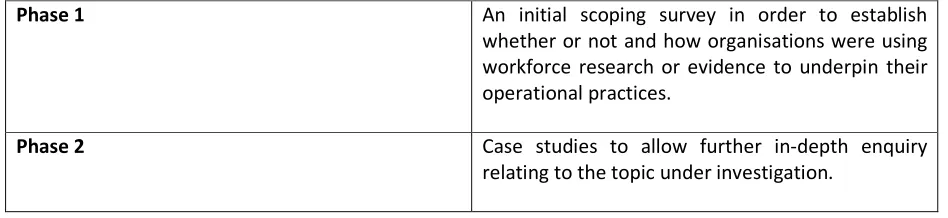
[image:12.595.62.536.537.646.2]The research design selected had been used with positive effect in previous scoping research undertaken by members of the team (Moule et al, 2008). The design included two phases, as set out in Table 1. Both phases were planned in order to gain a picture of how findings from research/evidence were used in a variety of organisations.
Table 1 Research design
Phase 1 An initial scoping survey in order to establish whether or not and how organisations were using workforce research or evidence to underpin their operational practices.
Phase 2 Case studies to allow further in-depth enquiry relating to the topic under investigation.
12
research. Data collection in the case study sites yielded in-depth data about the processes and the effects of using findings from research/evidence in practice. The combination of the two phases therefore provided both breadth and an opportunity to achieve depth in the study.
3.2 Study instruments and data sources
Following consideration of the literature and discussion among the team, a schedule was developed for the Phase 1 survey, through which interviewees were asked about the following areas:
• what workforce research/evidence is used in the organisation and how?
• who makes decisions about what and how this research/evidence is implemented? • what training and development opportunities and processes related to workforce
research/evidence are there for staff within the organisation?
• what impact does the use of workforce research/evidence have on the operation of the
organisation and on service delivery?
• are children, young people and families involved in learning, research or evaluation
activity? If so, how?
The interviewees were also asked for information about the profile of the organisation (size, location, scope of practice). The full interview schedule can be found in Appendix I.
The interview schedule was also used to explore issues in more depth with staff members in the case study sites. Further questions were developed in light of initial answers to this schedule, such as:
• Who decides what training is offered to staff, and how are those decisions made?
• In what way does research/evidence inform the training and development opportunities
13
As is the convention in qualitative research, the interview schedule in each case study site continued to develop during the period of data collection, in response to the specific context of research/evidence use in the organisation (Holloway and Wheeler, 1996).
3.3 Ethics
The project was approved by a UWE research ethics sub-committee and was conducted in accordance with the university guidelines for ethical research. Data collected were managed and stored in line with the 1998 Data Protection Act. The researchers sought informed consent from each participant in both the survey and case study interviews. The findings are presented so as to protect the confidentiality and anonymity of participants. The link person in each of the case study sites was provided with a summary of the analysis for their organisations, and had the opportunity to comment before the submission of the final report to the CWDC.
3.4 Sampling
In view of the short time frame for the study, sampling for Phase 1 involved using a convenience sample of nine organisations, including those from the public and voluntary sectors, but limited to two local authorities. Sampling focused on the South West of England in the first instance, to maximise recruitment through using the research team’s existing contacts. The project team also employed administrative support for the recruitment phase and an online search was undertaken to identify additional potential participants. The online search strategy was based on identifying organisations with staff that had specific roles and responsibilities in research and development, training and workforce development. The use of dedicated administrative support was crucial to the success of the sampling strategy, as it required considerable time firstly to identify suitable individuals to approach within organisations, and then to arrange data collection.
14
The data from the scoping survey were used to inform the development of a sampling framework for Phase 2 (Appendix II), through which to select case study sites. However, due to the limited time available, the framework was not used in the pilot study. A convenience sample of three case studies was drawn from the South West and the South East of England, using research team members’ pre-existing contacts. Urban, coastal and rural localities were represented across the three sites.
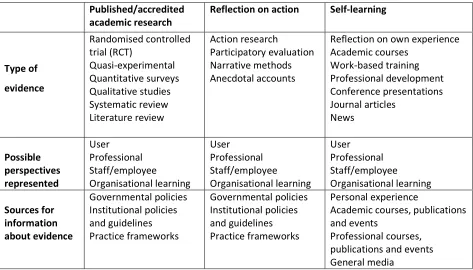
3.5 Research typology
[image:15.595.71.544.380.650.2]In order to aid a systematic exploration of the types of research and evidence about the workforce utilised within different organisations, the research team devised a research typology through which different forms of evidence could be categorised (Table 2).
Table 2. Research typology
Published/accredited academic research
Reflection on action Self-learning
Type of evidence Randomised controlled trial (RCT) Quasi-experimental Quantitative surveys Qualitative studies Systematic review Literature review Action research Participatory evaluation Narrative methods Anecdotal accounts
Reflection on own experience Academic courses Work-based training Professional development Conference presentations Journal articles News Possible perspectives represented User Professional Staff/employee Organisational learning User Professional Staff/employee Organisational learning User Professional Staff/employee Organisational learning Sources for information about evidence Governmental policies Institutional policies and guidelines Practice frameworks Governmental policies Institutional policies and guidelines Practice frameworks Personal experience
Academic courses, publications and events
Professional courses, publications and events General media
15 3.6 Data collection and analysis
The nine Phase 1 interviews were arranged at times convenient to the participants, each lasting between 30 and 45 minutes. Six were conducted by telephone, while three were carried out face-to-face. With participants’ consent, the interviews were audio recorded. Individual researchers listened to the interviews, and recorded relevant data within a template developed specifically for the project (Appendix III). This template facilitated the recording of responses in a format that allowed team analysis. The survey responses were analysed by two team members working individually to identify key findings and messages. These were used as a basis from which to develop the sampling framework for case study sites (Appendix II).
Within Phase 2, the itinerary for case study visits was pre-arranged and agreed with a local manager or research lead to maximise the opportunities for data collection within a two day visit. Participants fulfilling a range of roles and levels reflecting the areas of research and development, training and workforce development were included. Examples include research leads within agencies and service leads in mental health, social work and public health nursing, as well as family support staff and early years workers. Details of individuals interviewed are not provided in this report, in order to maintain anonymity. In each site, between five and seven face-to-face interviews were conducted in the workplace setting over a 30 to 50 minute time period. They were audio recorded, following an informed consent process, and transcribed verbatim.
Case study data were analysed thematically by the team members leading the case study visit. An initial account of each case study site was compiled, drawing on both the interview and public sources such as organisational websites. These were structured around three areas, namely, the context of the case study site, key emergent themes from the data and identified evidence of areas of good practice.
16
17
4. Survey findings
Nine interviews were conducted for the survey. These comprised one interview with a senior level manager from each of the participating organisations, this person being asked to comment on the learning environment for all staff. As there was no verification of these views some findings are necessarily tentative.
The organisations were of varying size. Two were local authority organisations (LAOs), and seven were voluntary sector organisations (VSOs). One small VSO was based in an urban setting, while the other eight organisations covered both rural and urban settings. One VSO worked with vulnerable families, one focused on early years (0-5 years), and another two focused on youth support; the remainder of the sample provided a variety of services for children and young people covering a range of ages. One VSO also offered workforce development training to other
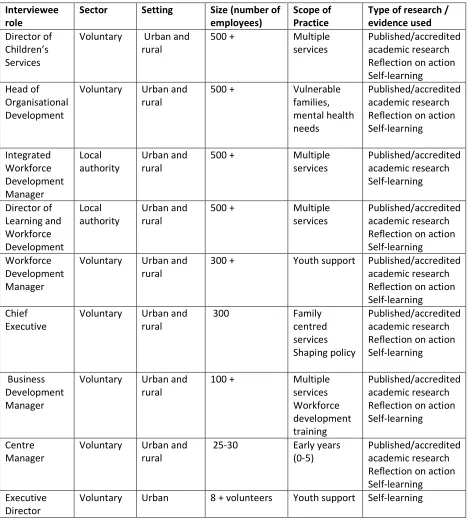
organisations within both the voluntary and public sectors. Another VSO had a long history of involvement in shaping national policy concerning the structure and operation of services for children and young people. Eight of the organisations used all three types of evidence identified in the Research typology on p14. See Table 3 below for information about the sample in terms of interviewees’ roles; organisational sector, setting and size; scope of practice; and type of
research/evidence used. When considering the findings, it should be remembered that this was a pilot study, and the findings have emerged from a small evidence base.
4.1 Workforce development and training
18
[image:19.595.65.535.193.717.2]in-house training for service users as well as for staff, and also was involved in multi-agency training initiatives.
Table 3. Interviewee role, organisation sector, setting and size, scope of practice, and type of research/evidence used.
Interviewee role
Sector Setting Size (number of employees)
Scope of Practice
Type of research / evidence used Director of
Children’s Services
Voluntary Urban and rural
500 + Multiple
services
Published/accredited academic research Reflection on action Self-learning Head of
Organisational Development
Voluntary Urban and rural
500 + Vulnerable
families, mental health needs
Published/accredited academic research Reflection on action Self-learning Integrated Workforce Development Manager Local authority Urban and rural
500 + Multiple
services Published/accredited academic research Self-learning Director of Learning and Workforce Development Local authority Urban and rural
500 + Multiple
services
Published/accredited academic research Reflection on action Self-learning Workforce
Development Manager
Voluntary Urban and rural
300 + Youth support Published/accredited academic research Reflection on action Self-learning Chief
Executive
Voluntary Urban and rural
300 Family
centred services Shaping policy
Published/accredited academic research Reflection on action Self-learning
Business Development Manager
Voluntary Urban and rural
100 + Multiple
services Workforce development training Published/accredited academic research Reflection on action Self-learning
Centre Manager
Voluntary Urban and rural
25-30 Early years (0-5)
Published/accredited academic research Reflection on action Self-learning Executive
Director
19
All the organisations were involved in disseminating good practice and learning through various media, the most popular being conferences. In one of the LAOs, findings from an in-house consultation with children and young people about what they wanted from service workers served as the basis for a DVD which was subsequently used for in-house staff training. One of the large VSOs hosted a Young Carers’ festival planned by children and young people, offering play, media activities and opportunities for voice. Two other large VSOs were involved in conducting research studies, and findings of these were disseminated through their websites.
A common factor among four organisations (three VSOs and one LAO) was a clear and active link with Higher Education institutions (HEIs). In the VSOs, this took the form of developing work-based and foundation level degree training for emergent managers and support staff, many of whom did not have professional qualifications. In the LAO, staff at junior managerial level and below were encouraged and supported to undertake postgraduate diplomas and degrees. In one large VSO, individual staff were also supported to study at postgraduate level, and a Knowledge Transfer Partnership was being jointly conducted with its HEI partner.
The HEI links had also been used to support organisations to engage in their own research activity. For example, one VSO providing youth support had won a successful bid from the CWDC in
partnership with a university to develop a Foundation Degree and also reported opportunities to bid for money for small research based projects for various funding sources.
20 4.2 Research use and activity
The survey fulfilled the objectives of identifying agencies which supported the adoption of workforce research/evidence, and of facilitating exploration of how agencies apply worforce research/evidence to the development of everyday professional practice. Where present,
adoption and application of research/evidence took a variety of forms. Written research strategies were not the norm within the sample and indeed one respondent commented that ‘you can have as many strategies as you like but culture eats strategy for breakfast’. However, several
organisations approached research from a strategic perspective and saw it as a central tool to enable their practice and workforce development. For example, research data were used to support funding bids and to investigate potential practice. Organisations described linking their own local contextualised research evidence with more generalised evidence from other sources. They also developed projects strategically across the organisation if pilot activity appeared to have impact for the workforce. Self-generated findings were reflected upon and tested out within organisations alongside evidence from elsewhere and respondents described an interplay
between the needs of the local environment, policy directives, the views of users and practitioners and published research.
A clear link with the CWDC and with Research in Practice (RiP) was evident in one LAO and three VSOs, but in the remainder of the sample there was no demonstrated awareness of these (or any other comparable) organisations and their functions. National policy and local evidence were prominent in informing practice and sometimes these would act as a catalyst to extend the evidence base used by the organisation. In one of the VSOs, the implementation of workforce research/evidence appeared to operate implicitly, in that staff were only offered external training with a sound evidence base, for example, the ‘Parents Involved in Children’s Learning’ (PICL) course (Pen Green Research, 2010).
21
surrounding research/evidence. For example, the interviewee from one VSO was a member of a national research board and another agency had a prominent researcher on their own
management board. It was apparent that all evidence drawn from external sources needed to be contextualised within the local environment.
The most structured use of research evidence was apparent in the LAO linked with an HEI, in which a system had been set up to facilitate the implementation of workforce research. In this case, staff members were supported to undertake postgraduate research degrees, for which they agreed a research topic with senior managers. The results of their academic work were then fed back into the organisation to inform practice and staff development through dedicated staff training events. The manager interviewed in this case stated that knowledge from wider sources of evidence was channelled back into the organisation through staff’s academic outputs.
In contrast, more ‘organic’ approaches to research seemed to reflect the ‘messiness’ of the practice environment. In these organisations, the process was not systematically managed but research appeared in parts of the organisation as part of reflective learning activity where people took up opportunities to share ideas and practice, identify issues, read about them, have debates, test ideas out in practice and listen to feedback.
Not surprisingly, it seemed that practitioners tended to use research to support their current context, one that for all the organisations in the survey appeared to be driven by a move towards integrated working. It was hard for practitioners and managers to think outside this context even within an educational environment, especially when much of the available research and evidence reflected a similar policy environment.
4.3 Support for research use
22
practice. In that organisation, the establishment of a transparent and supportive organisation culture was also thought to encourage staff members to source and implement research findings. Similar perceptions about the importance of the culture of the working environment in this regard were also voiced by interviewees from two VSOs. Ideas such as learning sets, space for reflection and debate and working and learning in multi-agency settings were frequently mentioned. The culture of the organisation was thought to be particularly relevant where research findings could be seen to be criticising established processes. Interviewees stated that it was necessary for the organisation to be willing to examine its own processes, and to support staff in changing attitudes and/or ways of working where necessary, in order for findings to be implemented constructively. Links with HE institutions were thought to make it easier for organisations to access relevant research/evidence.
4.4 Barriers to research use
In four of the organisations sampled, interviewees suggested that lack of time had a detrimental impact on the capacity of staff to access or implement evidence and research, and three also mentioned the effect of a restrictive financial climate. In three cases, the difficulty of feeding back research results which could be seen as criticising the organisation was cited as being potentially problematic, needing careful handling. For example, if individuals disagreed with the findings of a
Factors supporting the use of workforce research/evidence in organisations:
• Commitment from senior level managers – encourages use of
research/evidence as part of ‘normal’ processes.
• Supportive and transparent culture – allows examination and alteration
of established working processes.
• Spaces for reflection – allow consideration of possibilities for change.
• Links with Higher Education institutions – facilitate access to, and
23
study that required them to change their practice, considerable time and sensitivity could be required to support these individuals in both emotional and practical ways. Conversely, if people were involved in the generation of knowledge or learning then they were likely to be enthused and motivated. The way that research/evidence was reported could also cause difficulties. One organisation mentioned their reliance on external bodies such as CWDC or the Office of Public Management to translate and report research findings in a user-friendly form that identified relevance and importance.
4.5 Involvement of children and young people
Seven organisations routinely included children and young people’s views in workforce development programmes. In some cases, this took the form of consultation about services, training needs of staff and service provision. In one of the large VSOs this consultation was extensive, involving canvassing over 1600 children and young people for their views about what sort of services and workforce were required. Feedback from some of these activities was used in staff training events, as exemplified by the production and use of the DVD within the LAO
mentioned in 4.1 above. Two VSOs included young people on recruitment panels for new staff and on a board of Trustees. One LAO was training them as ‘mystery shoppers’ in order to evaluate
Barriers to using workforce research/evidence in organisations:
• Lack of time/funding – can restrict staff’s ability to access or implement
relevant findings.
• Lack of capacity (skills/knowledge/ability) - can restrict staff’s ability to
access or implement relevant findings.
• Non-supportive culture – can make it difficult to implement research/
evidence where individual staff members disagree with the findings.
• Complex or overly academic presentation of research findings - can
24
some of their services. This meant that, as well as completing any routine evaluation forms about the service, these young people would be asked to conduct a more in-depth evaluation. At the time of this activity, staff might know that ‘mystery shoppers’ would be using the services, but would not know who they were, or when they would be visiting. One of the VSOs was training parents as ‘mystery shoppers’ for their services targeting very young children.
4.6 Impact of research use on practice
None of the organisations in the survey were able to measure systematically the impact of workforce research on outcomes for children, young people and families to any great extent. However, impact for the workforce was reported, in the form of new skills, confidence, morale and relationships, which, in turn, were expected to affect service delivery and reception. In some cases, particular service developments could be linked to the use of evidence, for example, the introduction of generic multi-agency induction for all staff in one of the large LAOs. However, it was generally thought that, given the complexity of the service delivery context, it would be very difficult to reach any definitive conclusions about the impact on practice of any particular set of research findings or evidence.
Ways of involving children and young people in workforce development:
• Embedded in routine processes – children and young people
represented on boards of Trustees and recruitment panels for new staff.
• Feedback in staff training events – findings from consultation
events with children and young people used to inform relevant staff training.
• Innovative roles – enabling children and young people’s
25
5. Case study findings
In this section of the report, findings from the three case study sites are presented. Each case includes exemplar projects, categorised according to the Research typology on p14.
5.1 Case Study 1 – Local Authority Children’s Services in a Children’s Trust
5.1.1 Context
The local authority in which the Children’s Trust was situated covered a large area with urban, rural and coastal localities. A commissioning model of workforce planning had been introduced for in-house and contracted services for a ‘whole workforce’ approach, and to tie workforce
development directly to the achievement of targets in the Children’s Plan. A commissioning board with membership of lead managers from each area of Children’s Services used standard questions to identify job roles and activities for each target, to plan workforce capacity and development needed to deliver these activities. This commissioning model was viewed as a significant move away from performance management and a separation of training and practice. There was a strong commitment to the development of a learning culture and critical best practice, through using appreciative inquiry models and the development of reflective practice, and by encouraging links with Higher Education providers.
5.1.2 Themes
A research culture
“The whole culture of the workforce is actually the most important resource
we’ve got.”
26
• Research reports that were context relevant (for example, CWDC, RiP, Local Authority
Research Council (LARC) and Office of Public Statistics reports).
• Extensive use of One Children’s Workforce Toolkit (CWDC, 2010c) and consultation
exercises with all involved.
• Planned responses to OFSTED outcomes (for example, induction and programme for newly
qualified social workers).
• Involvement in LARC and RiP (events, seminars, web access to research, funds for small
projects).
• HEI partnership links (qualifications and continuing professional development (CPD),
service evaluations, joint funded PhD post, library access).
• CWDC One Childrens’ Workforce Toolkit in group discussion (for example, values and
vision, common language, the ability to safeguard children).
• Integrated training sharing learning cultures (for example, supervision and journal clubs). • Personalised supervision contracts to include learning and access to a range of training
options.
• The involvement of children and young people.
A wider culture of reflection across senior management was sought for quality assurance to be more meaningful. It was suggested that quality assurance needs to be a cycle that involves the people who have provided the information. Stronger links were wanted with HEI to secure opportunities and funding for students and academics to undertake research in priority areas.
Research use as a change process
Research – “the thing that actually shifts the focus”.
27
curriculum to young people. Researchers were working on a project bringing indicators together from different strategies to inform the remodelling of social care and social work, to reduce the highest levels of vulnerability and support through earlier intervention with children and young people. An action research project to develop Core Skills had been designed to build integrated working through locality based group activities that engaged participants in the skills of
networking, play and case study discussion. Hay Group research studies (Hay Group Holdings, Inc, 2010) had informed the development of leadership and the requirement to build a resilient workforce. Directors were consequently required to ensure that indicators for such a workforce were embedded in the change processes. This development was viewed as recognition of the value and potential fragility of staff and the need for support at emotional and personal levels.
Research for transformative practice
“It’s not that you have done the review within the six days you had, it’s what you learn from doing that review and how that will, how that is really facilitating that child in that situation.”
Reflective practice was recognised as a necessity to maintain the child at the heart of professional practice. Practitioners with higher degree qualifications developed skills in critical appraisal of research. It was part of consolidation and post-qualifying training, evidenced in observation of practice and in assignments. Students were also taught to seek feedback from children and young people and to understand the tensions involved in their roles. Action learning sets were provided for newly qualified social workers to review practice and develop their critical thinking.
28
The involvement of children and young people
The involvement of children and young people included consultation, selection and recruitment. The Hear by Right (undated) research based framework had been applied to identify participation throughout the Trust. A two year evaluation of participation led by a senior academic had received funding from the National Youth Agency:
“It opened my eyes to the use of research ... to have a really clear steer on direction for where we go next and that shaped my part of the Children’s and Young People’s Plan so our measures are influenced by external research.”
Participation was consequently at a stage to make progress on depth, continuity and impact. Recent initiatives had included:
• Young researchers supported to investigate specific issues through their own networks. • Training for young people on how to work with adults in adult environments effectively. • A joint HEI project creating a web site presenting and tracking children and young people’s
priorities to avoid inaction or reinvention.
Integrity in research application was considered key to ascertain the benefit for children and young people, to challenge research presenting young people in negative terms and to avoid bombardment of opposing directives.
5.1.3 Exemplars
Emotional well being of children and young people (reflection on action)
An independent provider was commissioned to provide an action research programme in 40 infant, primary, secondary and special schools and pupil referral units to improve the emotional wellbeing of children and young people. The project included children, staff and parents in a process of identifying behaviour that was found difficult, and looked into roots of the behaviour and its meaning for the child. Home strategies with parents and school strategies with staff were produced that linked directly to CAF. The framework drew on transactional analysis and
29
Integrated supervision project (reflection on action, self-learning)
The project aimed to develop team leaders’ supervision skills in response to Social Care Task Force recommendations for improving safeguarding practices. The approach drew on appreciative inquiry and neuroscience to increase staff resourcefulness. It helped people learn by looking at what had worked so far and at what was missing and could be brought to the situation to help change. It focused on ways of working in partnership using social emotional skills on a practical level to develop abilities in integrated working, such as relationship building and networking. Independent evaluation and dissemination through conferences and publication were planned.
5.1.4 Assessing the impact of research use
All interviewees regarded the identification of the impact of workforce research/evidence in terms of outcomes for children and young people as a challenge due to the complexity of their needs. It was also difficult due to the different stages staff groups had reached with respect to integrated working. However, there was a strong commitment to tracking impact as part of the
commissioning cycle in order to review the benefit of services for children and young people. The National Foundation for Educational Research (NFER) impact measure was to be used in readiness for OFSTED inspection, to show the whole story in the involvement of children and young people in terms of communities of interests, themes and gaps.
The following practices were illustrations of impact in terms of implementation of research outputs:
• Materials produced by children and young people were used in recruitment and practice
meetings (CAF experience DVD, illustrated statement cards about valued practitioner behaviour).
• Practitioners’ applied appreciative inquiry methods to support families’ resourcefulness. • Team leaders had successfully changed to a formal standard form used in youth justice in
30
Limited impact was illustrated by degrees of engagement. It was acknowledged that social work was under considerable pressure of work and was least able to contribute to integrated learning opportunities.
Key Messages
• A research culture in the organisation promotes within it the influence of children and
young people, as well as more in-depth understanding of their needs.
• Resources for appreciative inquiry and reflection support innovation and encourage
transformative practice with children young people and their families.
• Workforce research contributes to the achievement of targets identifying staff
31
5.2 Case Study 2 – Large national voluntary organisation
5.2.1 Introduction
This case study concerns a large national ‘outward facing’ voluntary organisation that delivers a range of services to children and young people of all ages. It is also concerned with policy
development, support and advocacy. The organisation is committed to a reflective ‘virtuous circle’ of policy and practice where delivery informs policy development and vice versa. It works across the country and has 23 children’s centres, six nurseries and five After School Clubs. It also employs consultants who offer support to local authorities.
5.2.2 Context
The organisation is funded by contracts from DCSF, from local authorities and through its delivery of front line services. It contributes to policy development through campaigns, takes on
commissioned research projects and carries out its own research in areas of policy and practice that are of interest. It develops campaigns around practice and workforce themes that are informed by the research of others, the research that takes place within the organisation and the conversations that take place with practitioners and policy makers. Through direct delivery the organisation has an opportunity to demonstrate how the ideas advocated within it work in practice. It was acknowledged that there can be a tension between the different roles of the organisation – for example, producing research that is reflective but that still fulfils the needs of the organisation for publicity or lobbying activity.
5.2.3 Themes
Reflective cycles of engagement with ideas
32
It was reported that the organisation consciously used its own research and learning from practice to feed into its policy and advocacy activity in the belief that its assertions would bear significantly more weight if they were backed up with evidence from delivery. At the same time, the
organisation’s delivery model was based on their conclusions from research and policy
development that services for children, young people and families were more effectively delivered as a continuum. The ideas of those in the workforce – both the internal workforce and the
external workforce – were taken into account alongside the views of children and parents.
“We see the workforce as being very important ….. how they feel about their job, their morale - all those issues that are workforce issues that are very central to the experience that children and families have ….”
Those within the organisation were encouraged to make connections between policy and practice – for example by ensuring that Head Office staff visited settings and met staff, parents and
children within those settings.
Research as an ongoing process
“There is a lot of feedback comes back that is not what you would call classic research but it is jolly useful information and it is perfectly valid.”
There was a sense within the organisation that research could take a number of forms. There were large formal studies taking place alongside small evaluations of partnership practice. There was also intense interest in policy development, debate with internal and external colleagues and in research and evidence that was being generated elsewhere. All of this added up to a sense of ‘forensic interrogation wherever we go’ – the organisation describing itself as constantly on the lookout for examples of innovative research and practice.
Constant learning and sharing
“I buy lots of books – I read lots of different books – I don’t necessarily use the web – I tend to be a book person more than anything and I have a library here – I’ve created a library …. – I always say that everyone must have a book being read of some kind.”
33
frontline staff, partnership working where skills were exchanged, the cascading of information and learning from courses, collaborative responses to consultations and a culture of open
communication.
“…..is a group of passionate people involved in everything – there is not enough time to think. I love the days with the consultants looking at current research and legislation and their impact.”
All frontline staff and managers were supported to undergo NVQ and Higher Education undergraduate and post graduate qualifications as appropriate and staff members were encouraged to take note of and participate in the organisation’s own research and campaigns.
A belief in the importance of culture
“You can have as many workforce strategies as you like but if the culture is one of anxiety and not having the confidence to be able to operate that’s what leads people to risk averse places where they are not really maximizing their potential.”
Senior personnel within the organisation had clear beliefs about what works for children and young people and families. Personnel interviewed had an equally clear conviction about the need for change and the need for knowledge generation to support this change. They were putting together a five year plan which included research targets and had developed their delivery arm in order to ‘put our reputation where our mouth is.’ They described themselves as looking for ‘solutions’ at all levels of the organisation and had embedded this philosophy within job
descriptions and selection processes. The organisation had increased in size with the development of the delivery arm but there was a desire to retain a personal approach and a sense of creative dynamism.
5.2.4 Exemplars
Collaborative health project (reflection on action)
The Head of Children’s Services was part of a collaborative project with the local PCT. The project had three parts to it:
• A breastfeeding project to train mothers to be peer supporters
34
• A workforce integration project
The breastfeeding project had resulted in one third of the parents saying that they breast fed for longer than they would have done otherwise. Health visitors, mothers and peer supporters had all benefited from the development of the new service. Health visitors were able to achieve targets with less input, parents preferred the support of other mothers and the peer supporters felt that they learned through the experience.
The one stop shop had resulted in health visitors spending time in children’s centres twice a week and also had introduced a facility for parents to weigh their babies themselves outside of formal clinic times.
The workforce integration project identified shared targets between health practitioners and children’s centres, leading to duplication of work. They were then able to work out how they might reduce this duplication.
Family support workers (published research, reflection on action)
The organisation had produced interim findings of a large scale research project looking at the experience and support needs of families. The research included surveys, focus groups and study visits talking to families and professionals working with them. This project had highlighted that there was a set of families that were not in crisis, but who were only just coping. These families would have liked support from people that they could trust but who would also offer some challenge; a description that fitted with the model of outreach worker that the organisation was developing and testing out within its own centres.
Prior to this, the organisation had carried out externally funded research into the expectations and skills base necessary for outreach workers. Findings from the research were being taken forward by the funders. Meanwhile the organisation had applied learning from the project to the
35
played out in practice. They had therefore been able to verify that this was a central workforce role but that there was a need for more work to assess properly the support and training needs of such workers. This provided an example of evidence from a variety of sources coming together to demonstrate a workforce need.
Targeted team (reflection on action, self learning)
36
Key messages
• Attention to organisational culture is important in the development of a vibrant and
creative learning environment. A culture that encourages innovation, sharing and
interrogation is more likely to respond to and to generate research.
• Reflective activity that highlights issues, draws upon existing evidence, encourages
spaces for debate and tests and evaluates ideas in practice, will contribute to a virtuous
cycle that connects research, policy and practice.
• Stakeholders from across the organisation have a contribution to make to the generation
of evidence and the search for solutions. This can be encouraged through active
involvement and support and access to appropriate and collaborative learning
37 5.3 Case study 3 – Sure Start Children’s Centre
5.3.1 Context
This Sure Start Children’s Centre (SSCC) offers services to children between 0 and 5 years in both urban and rural communities, including some in which indicators of need are below national and county averages. The SSCC is operated by a national charity which has been commissioned by a County Council to run a number of Children’s Centres. At a national level, the charity produces research concerning issues affecting children’s wellbeing, as well as evaluations of individual centres. At the local level, staff are employed by the charity, but there is considerable dovetailing and co-operation with the Council, which also offers a range of children’s services through local authority organisations and Children’s Trusts.
There are approximately 25 members of staff working within the SSCC, making up four teams with different foci: Health Care, Family Support, Early Years and Administration. Health Care is the smallest team with only one part-time individual, while Early Years is the largest, with
approximately eight full-time equivalent members of staff.
5.3.2 Themes
38
Training and development
Staff were offered formal training and development either because it was mandatory within the charity, such as training about basic safeguarding or domestic violence; or because it was
considered that staff needed to attend a course in order to equip themselves with necessary skills and information. These choices were guided by both national and county agendas, as well as concern to provide staff with evidence-based training:
“County is saying that it wants all its staff to work with parents to have national standards, so I’ve put two members of staff through that course ….. County has a targeted mental health in schools project initiative and … one of the arms of that is this programme called Thrive … our staff have just done the early years model of Thrive1 …we choose some of the training because obviously there’s government guidance … the government is saying it wants its children’s centre leaders to have NPQICL2 …we always try and validate by making sure that we’re choosing a programme that’s got validity, it’s got experience, has already got its evidence-informed outcomes, so that we know that we’re investing in something that makes sense.”
Staff had undergone training with recognised models for early years working, such as the Solihull approach (Solihull NHS Care Trust, 2009), PICL (Pen Green Research, 2010) and the Webster-Stratton ‘Incredible Years’ (The Incredible Years, 2009) programmes, which was thought to equip them with skills in line with both relevant research findings and current agendas concerning early years workers. Two interviewees had completed the NPQICL, and it was felt that this had enabled them to use relevant evidence to ‘develop the work of the Children’s Centre’.
Knowledge transfer and generation
There was evidence of individuals transferring knowledge from one context to another, using what they had learned and applying it to their own particular set of circumstances, as well as teaching other colleagues where appropriate:
“Our Early Years is very much framed around Pen Green... because very much their research has been all around how they’ve worked with parents and children together and that’s key to the Children’s Centre really… also we have been quite influenced by Reggio Emilia3… about the environment and how we see the child … it was really important right at the beginning, as a
1
Fronting The Challenge Projects Ltd (2009) 2
National Professional Qualification in Integrated Centre Leadership 3
39
whole team we owned that philosophy if you like, so we did quite a lot of in-house stuff and soon I delivered a lot of that. “
Informal learning played a significant role among the SSCC staff, as it was expected that
individuals who attended courses would cascade their learning to their colleagues. This was not restricted to staff within the SSCC: for example, negotiations were under way with local private childcare providers to enable SSCC staff members who were undertaking the Early Years Thrive training to disseminate their learning to workers in those settings.
Knowledge was also generated in the SSCC through reflection, both at an individual and collective level. All members of staff received regular supervision (a mandatory condition of employment), and a prime purpose of this was for individuals to reflect on their practice and on their working conditions, so as to address any problems, to enhance the way that they worked and to identify training needs. Regular team meetings were also held, during which the staff had the opportunity to reflect on how the SSCC was functioning as an organisation.
Partnership working
The SSCC staff liaised with a number of different agencies and organisations, including health care, social services, schools and police. There was acknowledgement that some of these relationships had been difficult at times, particularly that with health care staff, and some of the interviewees spoke about having to ‘chip away’ at this problem. With the exception of the individuals who had completed the NPQICL, most of the interviewees were not aware of evidence relating to
40
Working in partnership with parents was considered a key feature of the way that the SSCC operated. When the centre was being built, parents had been consulted about the physical environment, including materials for floors, walls and furniture. Parents helped to facilitate La Leche breastfeeding groups (La Leche League Great Britain, 2009), and a few had done the ‘Incredible Years’ course (The Incredible Years, 2009), and so had been involved with facilitating groups within the SSCC. They were also being recruited as ‘mystery shoppers’ to help evaluate a range of services offered by the SSCC.
5.3.4 Exemplars
Supporting families with mental health problems (reflection on action)
At the regional level, discrete projects conducted by the charity, including some action learning sets, generated knowledge. A project was described which was being undertaken in another Children’s Centre run by the charity to support families with mental health problems. This involved that Centre’s staff and the local mental health worker working together. It was
anticipated that, should the outcomes of that project be positively evaluated, the model could be rolled out to other Children’s Centres in the area, including the SSCC. This would entail staff needing to bring their specialist skills to bear within a new framework:
“It involves … elements of the family therapy work that the mental health worker does
combined with the family support work that the Sure Start member of the team does with play workers working alongside. So it’s a sort of next move on from the targeted family support that we’ve been delivering but with an even more targeted and specific focus.”
Multi-agency partnership training (self-learning)
One interviewee was currently enrolled in a multi-agency partnership training course, run by
41
“I’ve really sort of like tuned into this....about training and I’m finding it really good. So I’ve made an appointment to actually do a ‘shadow’ visit with one of the PCSOs4.”
5.3.4 Impact
With any attempt to implement research findings in practice, impact is of prime interest. However, as there was little explicit emphasis on workforce research within the organisation, concern with impact was focused on evaluating services themselves, rather than on the way in which evidence or research concerning the workforce impacted upon them. As the SSCC selected and adhered to training for staff that was invariably evidence-based, it was thought that
evaluation was only significant where it concerned families’ responses to the services based upon it:
“We don’t need to prove to you that that course works, that’s already been proved [over and over again]. I need to prove to you what difference it’s making to my local families … one of the ways that we evaluate is by using systems that work and having staff who are trained in doing it … we don’t water it down.”
4
Police Community Support Officers
Key messages
• Selection of training courses with a proven evidence base can help ensure
that staff have the skills they need to deliver services effectively.
• Learning derived from one context can be transferred and adapted to specific
circumstances in a way which enhances staff capacity to deliver services
effectively.
• Informal learning that agrees with formal knowledge about workforce issues
42
6. Cross-case analysis
The case study site agencies emerged from the data as knowledge-based organisations. The dual challenge of service integration and understanding children and young people’s lives created a need to expand their knowledge base.
6.1 Types of research/evidence used
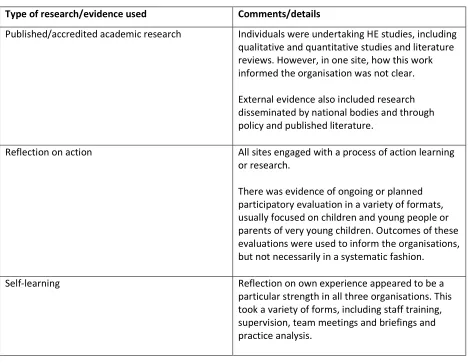
[image:43.595.65.541.338.701.2]Information about the types of research/evidence (as set out in the Research typology on p14) used in all three case study sites is provided in Table 4:
Table 4. Types of research/evidence used in all the case study sites
Type of research/evidence used Comments/details
Published/accredited academic research Individuals were undertaking HE studies, including qualitative and quantitative studies and literature reviews. However, in one site, how this work informed the organisation was not clear.
External evidence also included research disseminated by national bodies and through policy and published literature.
Reflection on action All sites engaged with a process of action learning or research.
There was evidence of ongoing or planned participatory evaluation in a variety of formats, usually focused on children and young people or parents of very young children. Outcomes of these evaluations were used to inform the organisations, but not necessarily in a systematic fashion.
43
All the organisations engaged widely in professional development through formal education and training, including academic courses. Integrated working processes were used to promote integrated working.
6.2 Use of research/evidence in practice
6.2.1 Change contexts
A consistent theme running through the data was change as a context for research. While there was a sense of struggle and occasional scepticism, there was no sense of resistance to change. This observation has to be qualified by the fact that we spoke often with people carrying change responsibilities (strategic leads, research officers, trainers). However, the use of research in the change process appeared to allow people to find meaning in and respond to changes. Where change agendas were perceived as having a purpose, relevant workforce research was valued as making a useful contribution to support practitioners, through enhancing their capacity to deliver innovative and effective services to children and young people.
Across all the case study sites, leadership responsibility for engagement with research, whether explicit or implicit, appeared to be pivotal. Individuals in management and workforce
development posts regarded this responsibility as an integral part of their role, which in turn enhanced their own effectiveness as managers. They displayed evidence of innovative thinking and willingness to consider new ideas. This strong leadership fostered and supported enthusiasm among other colleagues for change and in-depth learning.
6.2.2 Research and learning culture
44
The success of research engagement within the organisations did not depend entirely on key individuals responsible for workforce development, working in isolation. Some indicated that they had ongoing relationships with professional and national research bodies, through which they were supported in their own learning and ability to make decisions about workforce research implementation.
Although individuals in strategic roles appeared key in all the organisations, there was wider engagement with research amongst the organisations. For example, through personal reflection and self-learning, individuals fulfilling different roles initiated their own learning to inform their practice, which appeared to increase their job satisfaction, despite an often stressful working environment.
Relationships between staff members within individual organisations were important for research dissemination. A culture of openness and transparency promoted spaces for debate and
receptiveness to new ideas and ways of working.
6.2.3 Partnership working
A strong finding emerging from the data was the commitment to involving children and young people or parents as partners in development of the workforce. The practitioners were keen to engage them in a continuous process of evaluation and reflection on the service, with a focus on improving practice. This included consultation about what sort of workforce the children, young people and parents thought was appropriate.
Through participatory approaches, the aims of practitioners and children, young people and parents appeared to be knitted together and resulted in a closer relationship between the organisations and those for whom the services were designed.
45
philosophical choice. Nevertheless, there was evidence of willingness to learn about other disciplines and agencies, to develop necessary skills and to engage in effective multi-agency training and integrated working.
6.3 Emerging issues
From two of the case studies, it appeared that, although strategic decisions were often being made about the use of workforce research/evidence, there was little explicit strategy in place concerning research use. In some cases, the effect of a particular individual in a specific role seemed to be the pivotal factor (see 6.2.1 above). This meant that, despite statutory obligations in this regard, these organisations appeared to be potentially vulnerable to changes of personnel. Where there seemed to be greater organisational awareness about the use of workforce research (Case study 2), it is notable that a degree of flexibility was built in to the organisational processes, which enabled a rich and varied research culture to flourish.