3-(2-Acetamidophenyl)sydnone
David A. Grossie,* Kenneth Turnbull, Sandra Felix-Balderrama and Shravanthi Raghavapuram
Department of Chemistry, Wright State University, 3640 Colonel Glenn Hwy, Dayton, Ohio 45435, USA
Correspondence e-mail: [email protected]
Received 5 February 2009; accepted 11 February 2009
Key indicators: single-crystal X-ray study;T= 173 K; mean(C–C) = 0.001 A˚;
Rfactor = 0.038;wRfactor = 0.108; data-to-parameter ratio = 20.4.
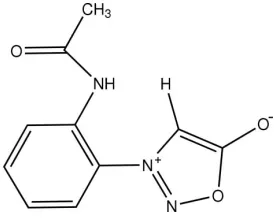
Sydnones are unusual mesoionic compounds containing a five-membered heterocyclic ring. Generally for stability, substitu-tion at the N-3 posisubstitu-tion by an aromatic fragment is necessary. In the title compound, C10H9N3O3, the aromatic substitutent is 2-acetamidophenyl. The two planar ring fragments are twisted relative to one another, with a interplanar angle of 63.13 (5).
The molecules are packed into the unit cell via – interactions between the phenyl rings [interplanar separation = 3.4182 (4) A˚ ] and between the sydnone rings [interplanar separation = 3.2095 (4) A˚ ]. N—H O and C—H O hydrogen bonding is also found internally and externally to the molecule.
Related literature
For more information on the sydnone family of compounds, see: Ohta & Kato (1969). For the synthesis and structural information, see: Grossieet al.(1992, 2001, 2007); Riddleet al.
2004a,b,c; Hope & Thiessen (1968); Hodson & Turnbull (1985); Baker & Ollis (1957). For a description of the Cambridge Structural Database, see: Allen (2002). For related literature, see: Kier & Roche (1966); Matsunaga (1957); Ollis & Ramsden (1976).
Experimental
Crystal data
C10H9N3O3 Mr= 219.20
Monoclinic,P21=c a= 7.7348 (4) A˚ b= 13.7212 (7) A˚ c= 9.6698 (5) A˚ = 106.083 (1)
V= 986.10 (9) A˚3 Z= 4
MoKradiation = 0.11 mm1 T= 173 K
0.450.400.26 mm
Data collection
Bruker SMART APEXII diffractometer
Absorption correction: multi-scan (SADABS; Bruker, 2003) Tmin= 0.895,Tmax= 0.970
8741 measured reflections 3053 independent reflections 2711 reflections withI> 2(I) Rint= 0.017
Refinement
R[F2> 2(F2)] = 0.038 wR(F2) = 0.108 S= 1.05 3053 reflections 150 parameters
H atoms treated by a mixture of independent and constrained refinement
max= 0.44 e A˚3
[image:1.610.102.239.587.696.2]min=0.24 e A˚3
Table 1
Hydrogen-bond geometry (A˚ ,).
D—H A D—H H A D A D—H A
N12—H12 O17Ai
0.876 (15) 2.056 (15) 2.9272 (10) 173.2 (14) C4—H4 O5ii
0.96 2.28 3.1860 (12) 156
C13—H13 O17A 0.96 2.29 2.8587 (14) 117
C15—H15 O5iii
0.96 2.41 3.3612 (14) 173
C16—H16 O5iv 0.96 2.57 3.4700 (13) 157
C18—H18B O17Ai
0.98 2.54 3.3201 (12) 136
Symmetry codes: (i)x;yþ1 2;zþ
1
2; (ii)x;yþ 1 2;z
1
2; (iii)xþ2;y 1 2;zþ
1 2; (iv)
xþ2;y;zþ1.
Data collection:SMART(Bruker, 2003); cell refinement: SAINT-Plus(Bruker, 2003); data reduction:SAINT-Plus; program(s) used to solve structure: SHELXS97(Sheldrick, 2008); program(s) used to refine structure:SHELXL97(Sheldrick, 2008); molecular graphics: Mercury (Macrae et al., 2008) and OSCAIL X, (McArdle, 2008); software used to prepare material for publication:enCIFer(Allenet al., 2004),publCIF(Westrip, 2009) andPLATON(Spek, 2009).
The authors acknowledge the diffractometer time granted by A. Hunter, Youngstown State University.
Supplementary data and figures for this paper are available from the IUCr electronic archives (Reference: RK2130).
References
Allen, F. H. (2002).Acta Cryst.B58, 380–388.
Allen, F. H., Johnson, O., Shields, G. P., Smith, B. R. & Towler, M. (2004).J. Appl. Cryst.37, 335–338.
Baker, W. & Ollis, W. D. (1957).Q. Rev. Chem. Soc.11, 15–29.
Bruker (2003). SADABS, SMART and SAINT–Plus, Bruker AXS Inc., Madison, Wisconsin, USA.
Grossie, D. A., Sun, L. & Turnbull, K. (2007).Acta Cryst.E63, o2042–o2043. Grossie, D. A. & Turnbull, K. (1992).Acta Cryst.C48, 377–379.
Grossie, D. A., Turnbull, K. & Krein, D. M. (2001).Acta Cryst.E57, o985–o987. Hodson, S. J. & Turnbull, K. (1985). InBromination of 3-(2-Aminophenyl)-sydnone and Related Compounds. Department of Chemistry, Wright State University, Dayton, Ohio, USA.
organic compounds
o554
Grossieet al. doi:10.1107/S1600536809005066 Acta Cryst.(2009). E65, o554–o555Acta Crystallographica Section E
Structure Reports
Online
Hope, H. & Thiessen, W. E. (1968). InThe Structures of 4,40
-Dichloro-3,30 -ethylenebissydnone and 3,30-Ethylenebys-sydnone. Department of Chem-istry, University of California, USA.
Kier, L. B. & Roche, E. B. (1966).J. Pharm. Sci. 55, 807–12.
Macrae, C. F., Bruno, I. J., Chisholm, J. A., Edgington, P. R., McCabe, P., Pidcock, E., Rodriguez-Monge, L., Taylor, R., van de Streek, J. & Wood, P. A. (2008).J. Appl. Cryst.41, 466–470.
Matsunaga, Y. (1957).Bull. Chem. Soc. Jpn,30, 227–230.
McArdle, P. (2008).OSCAIL X. National University of Ireland, Ireland. Ohta, M. & Kato, H. (1969).Nonbenzenoid Aromatics, edited by J. P. Snyder,
pp. 117–248. New York: Academic Press. .
Ollis, W. D. & Ramsden, C. A. (1976).Adv. Heterocycl. Chem.19, 1–122. Riddle, G. B., Grossie, D. A. & Turnbull, K. (2004a).Acta Cryst.E60, o977–
o978.
Riddle, G. B., Grossie, D. A. & Turnbull, K. (2004b).Acta Cryst.E60, o1568– o1570.
Riddle, G. B., Grossie, D. A. & Turnbull, K. (2004c).Acta Cryst.E60, o258– o259.
supporting information
sup-1
Acta Cryst. (2009). E65, o554–o555supporting information
Acta Cryst. (2009). E65, o554–o555 [doi:10.1107/S1600536809005066]
3-(2-Acetamidophenyl)sydnone
David A. Grossie, Kenneth Turnbull, Sandra Felix-Balderrama and Shravanthi Raghavapuram
S1. Comment
Sydnones are the most widely studied members of the general class of mesoionic compounds (Ohta & Kato, 1969). They
are the products of dehydration of N–nitroso–α–aminoacids (Hope & Thiessen, 1968), and they undergo facile
electrophilic aromatic subtitution on the sydnone ring. The selectivity on the sydnone ring (and not the aryl ring) can be
attributed to the activated nature of the sydnone ring (Matsunaga, 1957) and its deactivating effect upon the attached aryl
ring (the N3 position bears a considerable fractional positive charge (Kier & Roche, 1966)).
The 3–(2–acetamidophenyl)sydnone was synthesized to investigate its bromination and to probe the parameters
controlling the site of electrophilic attack, both from mechanistic and synthetic standpoints. The sydnone ring is found to
be planar. The ring bond distances O–N, N–N, N–C and C–C are similar to those of related compounds. However, the C
—O bond distance of 1.4158 (12)Å, is longer than that of the C—O bond in a furane ring. As mentioned in previous
paper (Hodson & Turnbull, 1985), the exocyclic C═O distance (1.2181 (12)Å) does not support the formulation of Baker
& Ollis (1957), which involves the delocalization of a positive charge on the ring, and a negative charge on the exocyclic
oxygen.
The molecules pack along the body diagonal within the unit cell, in symmetry related pairs with the phenyl rings lying
parallel to each other, separated by a distance of 3.4182 (4)Å. The pairs of molecules are further paired through
interaction of the sydnone rings in adjacent molecules, which are positioned parallel to each other at a distance of
3.2095 (4)Å. The molecules are connected laterally through hydrogen bonding between the sydnone and acetamide O
atoms and phenyl, and amide H atoms. Hydrogen bond parameters are tabulated in Table 1.
As expected the sydnone ring was similar in metrical parameters to sydnone structures previously determined, in this
laboratory (Grossie et al., 1992, 2001, 2007; Riddle et al. 2004a,b,c) and as found in the Cambridge Structural Database
vers. 5.30 (Allen, 2002).
S2. Experimental
3–(2–Aminophenyl)sydnone (0.5 g, 2.82 mmol) was dissolved in acetic anhydride (10 ml) and stirred for 20 h.
Evaporation on standing overnight gave a light yellow oil which was crystallized from methylene chloride/petroleum
ether to give 3–(2–acetamidophenyl)sydnone (0.42 g, 68%), mp 349–351 K; IR–spectra: 3310, 3290 (N—H str), 3130
(sydnone C—H str), 1740 (sydnone C═O str) cm-1. The 1H NMR (CDCl
3): δ 2.0 (s, 3H), 6.83 (s, 1H), 7.65 (m, 4H), 9.65
(s, 1H). Anal. Calcd. for C10H9N3O3: C, 54.79; H, 4.11; N, 19.18. Found; C, 54.90; H, 4.17; N, 18.89.
S3. Refinement
The amide H atom was located in a different Fourier map and refined with an isotropic displacement parameter. The
positional parameters were allow to refine freely. The methyl and benzene H atoms were included in geometrically
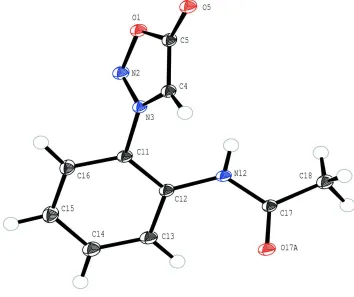
Figure 1
Molecular structure of title compound with the atom numbering scheme. The displacement ellipsoids are drawn at 50%
probability level. The H atoms are presented as a small spheres of arbitrary radius.
3-(2-Acetamidophenyl)sydnone
Crystal data
C10H9N3O3
Mr = 219.20
Monoclinic, P21/c
Hall symbol: -P 2ybc a = 7.7348 (4) Å b = 13.7212 (7) Å c = 9.6698 (5) Å β = 106.083 (1)° V = 986.10 (9) Å3
Z = 4
F(000) = 456 Dx = 1.477 Mg m−3
Mo Kα radiation, λ = 0.71073 Å Cell parameters from 4272 reflections θ = 2.7–31.7°
µ = 0.11 mm−1
T = 173 K Block, white
0.45 × 0.40 × 0.26 mm
Data collection
Bruker SMART APEXII diffractometer
Radiation source: Fine–focus sealed tube Graphite monochromator
ω scans
Absorption correction: multi-scan (SADABS; Bruker, 2003) Tmin = 0.895, Tmax = 0.970
8741 measured reflections 3053 independent reflections 2711 reflections with I > 2σ(I) Rint = 0.017
θmax = 32.0°, θmin = 2.7°
supporting information
sup-3
Acta Cryst. (2009). E65, o554–o555Refinement
Refinement on F2
Least-squares matrix: Full R[F2 > 2σ(F2)] = 0.038
wR(F2) = 0.108
S = 1.05 3053 reflections 150 parameters 0 restraints
Primary atom site location: Direct
Secondary atom site location: Difmap Hydrogen site location: Geom
H atoms treated by a mixture of independent and constrained refinement
w = 1/[σ2(F
o2) + (0.058P)2 + 0.315P]
where P = (Fo2 + 2Fc2)/3
(Δ/σ)max < 0.001
Δρmax = 0.44 e Å−3
Δρmin = −0.24 e Å−3
Special details
Geometry. All s.u.'s (except the s.u. in the dihedral angle between two l.s. planes) are estimated using the full covariance
matrix. The cell s.u.'s are taken into account individually in the estimation of s.u.'s in distances, angles and torsion angles; correlations between s.u.'s in cell parameters are only used when they are defined by crystal symmetry. An approximate (isotropic) treatment of cell s.u.'s is used for estimating s.u.'s involving l.s. planes.
Least–Squares Planes. Sydnone Ring. Defining atoms: O1 0.004 (1)Å, N2 -0.003 (1)Å, N3 0.000 (1)Å, C4 0.003 (1)Å, C5 -0.004 (1)Å; other atoms: O5 0.002 (1)Å, C11 0.081 (1)Å. Phenyl Ring. Defining atoms: C11 0.009 (1)Å, C12 -0.004 (1)Å, C13 -0.003 (1)Å, C14 0.006 (1)Å, C15 -0.002 (1)Å, C16 -0.006 (1)Å; other atoms: O17A 0.710 (1)Å, N12 -0.120 (1)Å, C17 0.159 (1)Å, C18 -0.233 (1)Å.
Refinement. Refinement of F2 against ALL reflections. The weighted R–factor wR and goodness of fit S are based on F2,
conventional R–factors R are based on F, with F set to zero for negative F2. The threshold expression of F2 > σ(F2) is
used only for calculating R–factors(gt) etc. and is not relevant to the choice of reflections for refinement. R–factors based on F2 are statistically about twice as large as those based on F, and R–factors based on ALL data will be even larger.
Fractional atomic coordinates and isotropic or equivalent isotropic displacement parameters (Å2)
x y z Uiso*/Ueq
O1 0.84105 (9) 0.07745 (5) 0.51445 (7) 0.01803 (16) N3 0.82573 (10) 0.08267 (6) 0.29241 (8) 0.01461 (16) N2 0.76980 (11) 0.03010 (6) 0.38528 (9) 0.01838 (18) C4 0.92672 (12) 0.16064 (7) 0.34726 (10) 0.01603 (18)
H4 0.9791 0.2067 0.2959 0.021*
C5 0.94005 (12) 0.16089 (7) 0.49604 (10) 0.01573 (18) O5 1.01261 (10) 0.21147 (6) 0.59934 (8) 0.01993 (16) C11 0.78190 (12) 0.04762 (7) 0.14601 (9) 0.01569 (18) C12 0.67371 (12) 0.10348 (7) 0.03402 (10) 0.01569 (18) N12 0.59485 (11) 0.19068 (6) 0.06408 (8) 0.01579 (16) H12 0.579 (2) 0.1987 (11) 0.1492 (16) 0.024 (3)* C13 0.63770 (14) 0.06464 (8) −0.10516 (10) 0.0210 (2)
H13 0.5644 0.1005 −0.1853 0.027*
C14 0.70713 (15) −0.02531 (8) −0.12794 (11) 0.0231 (2)
H14 0.6820 −0.0503 −0.2242 0.030*
C15 0.81211 (14) −0.08014 (8) −0.01474 (11) 0.0219 (2)
H15 0.8582 −0.1425 −0.0322 0.028*
C16 0.84924 (13) −0.04322 (7) 0.12408 (11) 0.01917 (19)
H16 0.9207 −0.0800 0.2040 0.025*
H18A 0.5042 0.3972 0.0544 0.025*
H18B 0.3858 0.3162 0.1050 0.025*
H18C 0.3184 0.3615 −0.0534 0.025*
Atomic displacement parameters (Å2)
U11 U22 U33 U12 U13 U23
O1 0.0216 (3) 0.0193 (4) 0.0135 (3) −0.0025 (3) 0.0055 (2) 0.0016 (2) N3 0.0158 (3) 0.0144 (4) 0.0133 (3) 0.0005 (3) 0.0036 (3) 0.0016 (3) N2 0.0218 (4) 0.0187 (4) 0.0148 (3) −0.0033 (3) 0.0053 (3) 0.0015 (3) C4 0.0183 (4) 0.0157 (4) 0.0143 (4) −0.0019 (3) 0.0049 (3) 0.0007 (3) C5 0.0166 (4) 0.0155 (4) 0.0155 (4) 0.0016 (3) 0.0051 (3) 0.0020 (3) O5 0.0242 (3) 0.0201 (4) 0.0155 (3) −0.0006 (3) 0.0055 (3) −0.0021 (3) C11 0.0169 (4) 0.0170 (4) 0.0130 (4) −0.0004 (3) 0.0038 (3) −0.0013 (3) C12 0.0174 (4) 0.0159 (4) 0.0137 (4) 0.0007 (3) 0.0043 (3) −0.0008 (3) N12 0.0201 (4) 0.0167 (4) 0.0108 (3) 0.0029 (3) 0.0047 (3) 0.0003 (3) C13 0.0250 (5) 0.0219 (5) 0.0144 (4) 0.0030 (4) 0.0027 (3) −0.0028 (3) C14 0.0282 (5) 0.0223 (5) 0.0186 (4) 0.0013 (4) 0.0060 (4) −0.0062 (4) C15 0.0243 (5) 0.0175 (5) 0.0244 (5) 0.0015 (3) 0.0074 (4) −0.0042 (4) C16 0.0201 (4) 0.0160 (5) 0.0208 (4) 0.0016 (3) 0.0047 (3) 0.0004 (3) C17 0.0148 (4) 0.0163 (4) 0.0130 (4) −0.0016 (3) 0.0037 (3) 0.0000 (3) O17A 0.0294 (4) 0.0199 (4) 0.0130 (3) −0.0011 (3) 0.0084 (3) 0.0009 (3) C18 0.0219 (4) 0.0201 (5) 0.0174 (4) 0.0059 (3) 0.0078 (3) 0.0027 (3)
Geometric parameters (Å, º)
O1—N2 1.3801 (10) N12—H12 0.871 (15)
O1—C5 1.4158 (12) C13—C14 1.3878 (15)
N3—N2 1.3150 (11) C13—H13 0.9600
N3—C4 1.3440 (12) C14—C15 1.3897 (15)
N3—C11 1.4437 (12) C14—H14 0.9600
C4—C5 1.4136 (12) C15—C16 1.3883 (14)
C4—H4 0.9600 C15—H15 0.9600
C5—O5 1.2181 (12) C16—H16 0.9600
C11—C16 1.3897 (14) C17—O17A 1.2314 (11)
C11—C12 1.3994 (13) C17—C18 1.5041 (14)
C12—C13 1.4018 (13) C18—H18A 0.9800
C12—N12 1.4093 (12) C18—H18B 0.9800
N12—C17 1.3649 (12) C18—H18C 0.9800
N2—O1—C5 111.17 (7) C14—C13—H13 119.7
N2—N3—C4 115.61 (8) C12—C13—H13 119.7
N2—N3—C11 117.04 (8) C13—C14—C15 121.59 (9)
C4—N3—C11 127.23 (8) C13—C14—H14 119.2
N3—N2—O1 103.62 (7) C15—C14—H14 119.2
N3—C4—C5 105.91 (8) C16—C15—C14 118.90 (9)
N3—C4—H4 127.0 C16—C15—H15 120.6
supporting information
sup-5
Acta Cryst. (2009). E65, o554–o555O5—C5—C4 136.32 (9) C15—C16—C11 119.27 (9)
O5—C5—O1 120.00 (8) C15—C16—H16 120.4
C4—C5—O1 103.68 (8) C11—C16—H16 120.4
C16—C11—C12 122.84 (9) O17A—C17—N12 123.33 (9) C16—C11—N3 116.89 (8) O17A—C17—C18 121.46 (9) C12—C11—N3 120.26 (8) N12—C17—C18 115.21 (8) C11—C12—C13 116.86 (9) C17—C18—H18A 109.5 C11—C12—N12 120.37 (8) C17—C18—H18B 109.5 C13—C12—N12 122.58 (8) H18A—C18—H18B 109.5 C17—N12—C12 126.20 (8) C17—C18—H18C 109.5 C17—N12—H12 114.7 (10) H18A—C18—H18C 109.5 C12—N12—H12 118.8 (10) H18B—C18—H18C 109.5 C14—C13—C12 120.52 (9)
C4—N3—N2—O1 −0.25 (11) N3—C11—C12—C13 179.79 (9) C11—N3—N2—O1 176.13 (7) C16—C11—C12—N12 173.82 (9) C5—O1—N2—N3 0.65 (10) N3—C11—C12—N12 −5.04 (14) N2—N3—C4—C5 −0.24 (11) C11—C12—N12—C17 163.84 (9) C11—N3—C4—C5 −176.19 (8) C13—C12—N12—C17 −21.28 (15) N3—C4—C5—O5 179.52 (11) C11—C12—C13—C14 0.22 (15) N3—C4—C5—O1 0.61 (10) N12—C12—C13—C14 −174.83 (10) N2—O1—C5—O5 −179.93 (8) C12—C13—C14—C15 0.73 (17) N2—O1—C5—C4 −0.80 (10) C13—C14—C15—C16 −0.59 (17) N2—N3—C11—C16 −60.99 (12) C14—C15—C16—C11 −0.50 (16) C4—N3—C11—C16 114.91 (11) C12—C11—C16—C15 1.51 (15) N2—N3—C11—C12 117.94 (10) N3—C11—C16—C15 −179.60 (9) C4—N3—C11—C12 −66.16 (13) C12—N12—C17—O17A −9.29 (15) C16—C11—C12—C13 −1.34 (15) C12—N12—C17—C18 171.74 (9)
Hydrogen-bond geometry (Å, º)
D—H···A D—H H···A D···A D—H···A
N12—H12···O17Ai 0.876 (15) 2.056 (15) 2.9272 (10) 173.2 (14)
C4—H4···O5ii 0.96 2.28 3.1860 (12) 156
C13—H13···O17A 0.96 2.29 2.8587 (14) 117 C15—H15···O5iii 0.96 2.41 3.3612 (14) 173
C16—H16···O5iv 0.96 2.57 3.4700 (13) 157
C18—H18B···O17Ai 0.98 2.54 3.3201 (12) 136