Copyright © 200x Inderscience Enterprises Ltd.
Bridging the gap between business process models and Service Oriented
Architectures with reference to the Grid Environment
Zaheer Khan*
Centre for Complex Cooperative Systems, Dept. of CSCT, FET, University of the West of England,
BS16 1QY, Bristol, United Kingdom Email: [email protected] * Corresponding Author
Mohammed Odeh
Centre for Complex Cooperative Systems, Dept. of CSCT, FET, University of the West of England,
BS16 1QY, Bristol, United Kingdom Email: [email protected]
Richard McClatchey
Centre for Complex Cooperative Systems, Dept. of CSCT, FET, University of the West of England,
BS16 1QY, Bristol, United Kingdom Email: [email protected]
Abstract: In recent years organisations have been seeking technological solutions for enacting their business process models using ad hoc and heuristic approaches. However, limited results have been obtained due to the expansion of business processes across geographical boundaries and the absence of structured methods, frameworks and/or Information Technology (IT) infrastructures to enact these processes. In an attempt to enact business process models using distributed technologies, we introduce a novel architectural framework to bridge the gap between Business Process Models and Grid-aware Service Oriented Architectures (GSOA). BPMSOA framework is aligned with the Model Driven Engineering (MDE) approach and is instantiated for role-based business process models, (in particular Role Activity Diagramming (RAD)) using mobile process languages such as pi-ADL. The evaluation of the BPMSOA framework using the Submission process from the digital libraries domain has revealed that role-based business process models can be successfully enacted in GSOA environments with certain limitations.
Key words: Service Oriented Architecture, RAD business process models, Metamodels, pi-ADL, Process Enactment, Model Driven Engineering, Model Transformation
Bibliographic Notes: Dr. Zaheer Khan is a postdoctoral research fellow in the Faculty of Environment and Technology of UWE, Bristol, UK. He has over seven years of teaching and research experience in system analysis and design, databases, distributed systems, etc. He has been actively working in large scale EU and non-EU collaborative computing research projects: Health-e-Child, HUMBOLDT, LifeWatch, SAGE. His main research interests are in distributed computing, software engineering, business process management, data interoperability and management, software agents, and geospatial information systems.
Dr. Mohammed Odeh is a senior lecturer and leading the Software Engineering Research Group in the Centre for Complex Cooperative Systems of UWE, Bristol, UK. He has over twenty years of experience of working in industry and academia. His areas of interest are software and requirement engineering, intelligent systems, business process management.
1. INTRODUCTION
Business process modelling is the process of visualising business processes in order to understand, improve and/or enact these processes in a particular computing environment. The availability of different business process modelling approaches (such as role-based modelling) and their associated process modelling languages (Giaglis, 2001; Curtis, 1992; Aguilar-Saven, 2003; Havey, 2005) enable organisations to capture and model different perspectives of their business processes. In the presence of such diverse process modelling approaches, the homogeneous enactment and execution of business processes is not straightforward. Furthermore, such enactment becomes more complicated when businesses expand across geographical boundaries. Thus, it becomes challenging to find solutions from Technological Spaces (TS) (Kurtev, et. al, 2002) in the absence of homogeneous and structured methods or frameworks that can provide mechanisms to enact these business processes using distributed technologies.
It is envisaged that environments that adopt the Service Oriented Architecture (SOA) (Krafzig, et. al, 2004) model of computing are increasingly becoming the de facto environment for executing business processes represented by their visual models (BEA Systems, 2007). Service oriented computing can utilise the characteristics of both Object-oriented and Component-based (Breivold, et. al, 2007) computing models in an open environment. However, the enactment and execution of business process models in service-oriented environments is not straightforward since it requires appropriate mappings and translations of business process models into system models for their execution in such environments, with the objective of utilising application domain specific services and also for facilitating business-to-business (B2B) process integration.
In this context, the research here presented is an attempt to bridge the gap between business process models and service oriented environments (such as the grid-aware SOA (GSOA) environment). This gap can be mainly attributed to the following challenges:
a. As there exist several business process modelling approaches (e.g. role-based, functional, activity-based, etc) and their associated business process modelling languages (e.g. Role Activity Diagrams (Ould, 1995), Business Process Modelling Notations (BPMN 2007), UML Activity Diagrams, etc) with different syntactic and semantic notations, a structured approach is needed to uniformly handle the instantiation and execution (i.e. enactment) of business process models;
b. As business process models are mainly intended for domain experts and system models are for IT experts, an autonomy between business process models and system models should be maintained;
c. Not all graph-based visual process models can be directly translated into block-structured models due to conceptual differences between graph-based and block-structured process models which restrict one-to-one mappings and translations from former to later; and
d. Reusable transformation of visual business process models into executable workflow specifications and/or code that can be instantiated in distributed environments and in particular GSOA.
As a first step in bridging the gap between business process models and GSOA, application domain specific services (e.g. utility services) can be deployed on top of grid core services in order to access grid resources by encapsulating the complexity of low level grid-specific tasks and facilitating business applications for executing their business processes as envisioned in (NGG, 2006; SOKU, 2006). Such application domain specific services can be referred to as grid-aware services or utility services. For example, Web Service Resource Framework (WSRF) based application services are capable of accessing grid infrastructure services (Grid Resource Allocation Manager - GRAM, Monitoring and Discovery Service – MDS, etc.) and resources when deployed using the Globus Toolkit 4 (Sotomayor, 2005). As a second step business process models would then require rigorous mappings and translations into the source code of executable programming models and/or languages capable of accessing grid resources. Such an approach necessitates homogeneous structured methods and tools to avoid complexity in performing the aforementioned translations.
BPMSOA framework and its role-based instantiation using the RADpiADL specifications provide novel contributions in bridging the above gap.
In the remainder of this paper we briefly present background and related work in the following section. In Section 3, an overview of the BPMSOA framework is presented followed by its role-based instantiation. In Section 4, we present the application of the role-based BPMSOA framework to the Submission process from the domain of digital libraries (DL) (Khan, et. al., 2006a). This application is evaluated using the static verification and dynamic validation described in Section 5, followed by critical analysis and reflection on the usefulness and limitations of the BPMSOA framework, role-based modelling approaches and pi-ADL in Section 6. Then in section 7 we draw conclusions and provide directions for future work.
2. BACKGROUND AND RELATED WORK
There are two aspects covered in this paper: i) mappings and translations between business process models and executable models, and ii) applying a homogeneous and structured approach to accomplish the (i) aspect. In relation to the first aspect, there have been efforts to map business process models, and in particular RADs (Ould, 1995), into system models using heuristics (Odeh, et. al, 2002; Odeh, et. al, 2003), simulations (Martinez-Garcia, et. al, 2002) and formal representations (Badica, et. al, 2001). However, such approaches require tools and technological support for enacting and evaluating the given business processes. For example, no tools have been identified to actually instantiate and execute business process models based on these approaches. Also, these approaches are not based on the SOA paradigm (i.e. web or grid services) which is considered to be a key shortcoming in dealing with business process management aspects. In this regard, many eXtensible Markup Language (XML) based business process modelling languages such as Business Process Modelling Language (BPML) (Arkin, 2002) and Business Process Execution Languages (BPEL) (Juric, et. al, 2004; Blanvalet, et. al, 2006) have been widely utilised to execute business processes using web services. However, the non-visual or non-diagrammatic nature of such languages (i.e. BPML, BPEL) makes them less suitable to understand, analyse and improve business processes by business analysts. In addition, these languages are designed for machine processing rather than for human understanding. This limitation has been overcome by mapping visual and graphical business process modelling language constructs to descriptive executable constructs, for example mappings between Fundamental Business Process Modelling Language (FBPML) and the Ontology Web Language for Services (OWL-S) (The OWLService Coalition, 2005; Guo, et. al, 2004), and translating Business Process Modelling Notations (BPMN) constructs into BPEL (White, 2005; Owen, et. al, 2007; White, 2007). These mappings and translations are not, however, straightforward and lack one-to-one construct mappings, which may become difficult to verify and validate. For example, researchers (Ouyang, et. al, 2006; Recker, et. al, 2006; BPMN, 2007) have identified limitations in translating graph-based BPMN models into block-structured BPEL and suggested various solutions. They argued that due to the conceptual difference between block-structured and graph-based models, it may not be possible to map all visual process topologies of BPMN and FBPML based process models to BPEL and OWL-S process descriptions, respectively (Guo, et. al, 2004; BPMN, 2007; Shapiro, 2002). RAD is another graph-based business process modelling language that we have attempted to map and translate into block-oriented pi-ADL using the BPMSOA framework, with the objective of assessing to what extent the channel unification and mobility characteristic of pi-ADL can facilitate mappings of graph-based models. It is important to mention here that we are not after comparing the strengths and weaknesses of different business process modelling languages and suggesting the suitability and appropriateness of a particular business process modelling language. Rather, we aim to experiment on selected case studies using the simplest approach such as RAD and provide an evidence of suitability of mobile process languages such as pi-ADL for enacting business process models in GSOA environments.
With respect to distributed computing and in particular grid SOA environment, mostly related work is in the domain of scientific workflow and there exist several tools and environments which facilitate execution of scientific workflows in grid SOA. For example, (Yu and Buyya 2006; Curcin and Ghanem 2008; Deelman et. al. 2009) have presented a comprehensive overview and taxonomy of workflow systems in distributed environments and in particular grid SOA such as Discovery Net, DAGMan, Pegasus, Traverna, Triana, Kepler, etc and languages such as UML and XML-based BPEL and SCUFL, etc. All these tools and respective languages support different programming models and can be used depending on the requirements of scientific applications.
graph-oriented and block-structured conceptual difference between various modeling and workflow languages as discussed above. Among other approaches, (Blythe et. al. 2004) focused on artificial intelligence methods to automatically compose scientific workflows by applying semantic annotations. Similarly, (Brandic et. al. 2008) provide a holistic approach for QoS-aware workflows which enables scientific community to specify workflows using UML based graphical notations (and constraint annotations) in Tueta application (Pllana et. al. 2004), transform the workflow to XML-based language namely QoWL for workflow planning and execution in QoS-aware Grid Workflow Execution Engine to fulfill the user requirements. All stages of QoS-aware workflow are implemented and evaluated for Amadeus framework that provides a service-oriented environment but only supports acyclic workflow graphs. Manset et al (Manset et al. 2006) introduced gMDE architectural style that adopts Model Driven approach to generate programming models for IT experts to write and reuse modelled applications for grid environment. In contrast to the above approaches, A-WARE project (A-WARE 2008) enables domain/scientific experts to draw workflow using BPMN and transforms it into BPEL which is then handled by IT experts for service grounding and enactment of a scientific workflow in SOA grid environment (e.g. OGSA) and in particular UNICORE 6.
However, the above approaches are mostly intended for the IT experts but not for business domain experts or do not capture the full spectrum of various business process modelling approaches and languages. Further, despite some similarities there is a fine distinction between business process modelling and workflows. For example, (Dehnert and Van Der Aalst 2008) argued that workflows specifications are mostly intended for IT experts and may not be as intuitive as is a business process model for a business domain expert. Similarly, (Brandic et. al. 2007) distinguish scientific workflows for grid and business workflows based on the long execution time and large amount of data transfers in grid environment. This suggests that in order to maintain autonomy between business models and system models, a business process model requires mappings and transformation into workflow specifications for enactment in a GSOA environment. The BPMSOA framework handles the above limitations and requirement mostly from the business domain perspective and enables the transformation of a platform independent business process model into a concrete platform specific model using pi-ADL – an executable mobile process language - that can utilise grid enabled utility services. However, at the moment the lower-level grid based programming models, resource scheduling and monitoring are beyond the scope of the BPMSOA framework and handled as future research direction.
3. THE BPMSOA FRAMEWORK
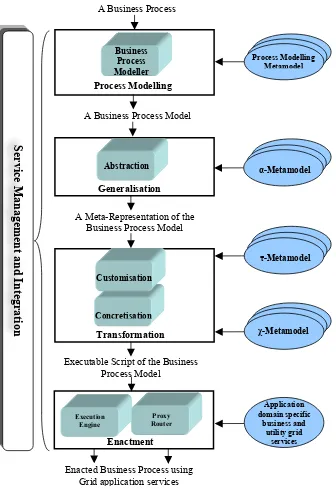
This section briefly presents the BPMSOA framework (Khan, 2009). It consists of five logical layers as depicted in Figure 1. These are: (i) Process Modelling, (ii) Generalisation, (iii) Transformation, (iv) Enactment and (v) Service Management and Integration. Each layer (in particular the first four layers) takes a specific input and processes it using its internal computational components to generate a specific output which is then consumed by the subsequent lower layers. Further, each layer is provided with catalytic artefacts (i.e. Metamodels) to support the layered components in the intermediary translations of business processes. The role of the fifth layer (orthogonal to the other layers) is to manage and monitor the process of translating and enacting business processes.
The layered architecture of the BPMSOA framework is aligned with the separation of concerns design principle (Sommerville, 2006). These layers enable loose coupling between the activities of process modelling, generalisation, transformation and enactment for the objective of executing a business process model using application domain specific grid services. Below we briefly discuss each layer.
• The Process Modelling layer deals with process modelling view only. In addition, the PM-Metamodel is used to mask the
syntactic heterogeneity of different business process modelling languages of a specific modelling approach by generalising the common modelling constructs, as briefly presented in (Khan et. al, 2008a). In this layer, a business process description can be modelled using a particular process modelling language. This process model can be used for comprehension, analysis and improvement purposes in addition to enactment.
• Similarly, the Generalisation layer translates a business process model into a machine-readable XML form whereas rules
for mapping a process model into generic XML elements are defined in the associated instance of α-Metamodel (Khan et. al, 2008a) which is defined using a particular instance of PM-Metamodel. The output from the Generalisation layer can be used to exchange process information among different tools.
• The Transformation layer takes the above XML representation of the business process as an input to interpret and
Figure 1: The BPMSOA Architectural Framework
• The Enactment layer takes the pi-ADL based executable script of the business process as an input and enacts it into an
execution environment, in particular the ArchWare (ArchWare, 2005) virtual machine. The proxy router component enables the enacted process description to communicate with the external world. For example, it integrates the enacted process activities with respective application domain specific grid services using Java-based implementation of the proxy router (Khan, et. al., 2008b).
• The Service Management and Integration orthogonal architectural layer is supposed to bring higher levels of automation
into the BPMSOA architectural framework i.e. facilitating the automated flow of information between the other four layers. Furthermore, this layer can also be utilised to keep track of the transformations of the business process at different levels of the BPMSOA framework and state transitions while in execution. However, the implementation of this layer is not within the scope of this paper and referred as future research direction.
Business Process Modeller
Abstraction
Concretisation Process Modelling
A Business Process
A Business Process Model
Generalisation
A Meta-Representation of the Business Process Model
Transformation
Executable Script of the Business Process Model
Enactment
Enacted Business Process using Grid application services
Application domain specific
business and utility grid
services Process Modelling
Metamodel
α-Metamodel
τ-Metamodel
Proxy Router Execution
Engine
χ-Metamodel Customisation
Table 1: Summary of the RAD Constructs Mappings at different Levels of BPMSOA
RAD
Notation PM-Metamodel Meta-representation
α-Metamodel τ-Metamodel χ-Metamodel Specifications and pi-ADL
Abstractions Intra-Role
Mapping Role
Role
Composition Element
(CE) Role (SP, IP)
Composed
Element (SP) Inter-Role Mappping IRegistry_Process Interaction_Repository Registry_Filler Router_Role_Connect Part interaction Receiver (FE), Interaction (IE) Receiver_Part , Interaction, Role (SP, IP) Interaction
Element (SP) Part_Interaction
Driver part interaction Sender (FE), Interaction (IE) Sender_Part, Interaction, Role (SP, IP) Interaction Element (SP)
Intra and Inter-Role Mappings
Driver_Part_Interaction
Trigger
Trigger – (Timer, Message, Error) (FE) Trigger- (Timer, Message, Error) (SP) Flow Element
(SP) Trigger_External_Code RAD_Trigger,
State/Goal State (FE) State (SP)
Flow Element (SP) Abst_Goal_State, Abst_State_Action Part Refinement Gateway– Concurrency (FE) Gateway - Concurrent (SP, FP) Flow Element (SP) Part_Refinement, Part_Synchronisation, Part_Split, Part_Thread Activity
Activity – Action
(FE) Activity - Action (SP) Flow Element (SP)
RAD_Activity, Activity_External_Code
Proxy_Router (for grid services) Case Refinement Gateway-Conditional (FE) Gateway - Conditional (SP, FP) Flow Element (SP) Case_Activity, Case_Refinement, Case_Synchronisation, XOR_Split, Case_Thread Role Instantiation Activity – Instantiation (FE)
Activity - Role-Instantiation (SP)
Flow Element
(SP) Instantiate_Role
State State (FE) State (SP)
Flow Element (SP)
Using in_trig and out_trig
channels by applying unifications
Loop
Gateway-Iterative (FE)
Gateway-Iterative (SP, FP)
Flow Element (SP) Intra-Role Mapping Iterative_flow, normal_flow, Loop_handling_with_Activity (inside Case_Thread)
Inter-Process Enactment Engine
Process CE, IE, FE SP, IP, FP SP, NFP, CP, AIP
Intra-Process Process Controller
Hence, BPMSOA’s layered architecture follows a general to specific model translation of business processes, which suggests that BPMSOA is closely aligned with the MDE approach i.e. that of transforming platform independent business process models into concrete platform dependent models. Moreover, the PM-, α-, τ- and χ-Metamodels (as depicted in Figure 1) play two important roles according to the needs of metamodels in MDE (Stuart, 2002). Firstly, they provide syntactic and semantic guidelines to translate a given business process model at respective layers of the BPMSOA framework. Without these guidelines, the BPMSOA components cannot dynamically translate different process designs. Each metamodel is associated with a specific component of a particular layer, for example the α-Metamodel provides translation rules and guidelines for the abstraction component. Similarly, the τ-Metamodel and the χ-Metamodel are associated with the customisation and concretisation components respectively. Secondly, there can be multiple implementations of associated metamodels at the respective layers, for example one implementation of PM-Metamodel can be used to capture the role-based perspective whereas another one can consider the functional view of business processes.
enable the BPMSOA framework to be general, extensible and flexible, this framework can become rigid and thus requires proper information flow between layers in addition to coordination. In this regard, the orthogonal Service Integration and Management layer is introduced which can be used to coordinate the information flow at the appropriate levels and verify the correctness of respective translations.
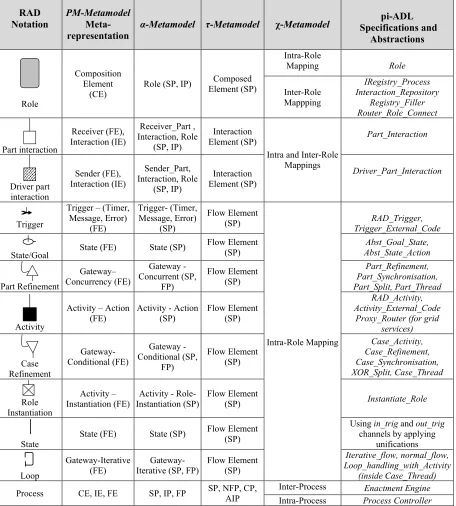
In this paper, the role-based business process modelling approach (and in particular Role Activity Diagramming (Ould, 1995) is adopted, which provides a distinctive modelling approach because of its intuitiveness, and its increased visibility by depicting flexible process topologies and event-driven and collaborative perspectives (Harrison-Broninski, 2007). Hence the role-based BPMSOA is instantiated and role-based metamodels and components of BPMSOA framework have been published elsewhere and can be accessed from (Khan, 2009; Khan, et. al, 2007; Khan, et. al, 2008a; Khan, et. al, 2008b; Khan, et. al, 2008c). These metamodels capture different perspectives built using different elements as depicted in Annex-I. All perspectives (i.e. Structural, Interaction, Flow, Control, Non-Functional and Application Integration Perspectives (SP, IP, FP, CP, NFP, AIP respectively)) and their elements (i.e. Composition, Flow and Interaction Elements (CE, FE, IE respectively)) have been presented in detail in (Khan, 2009). Due to space limitations, in Table 1 we summarise just the mappings of the different RAD constructs while being processed at the different role-based BPMSOA layers and facilitated by the respective layer’s metamodels.
4. THE CASE-STUDY: APPLYING THE ROLE-BASED BPMSOA FRAMEWORK ON THE DL SUBMISSION PROCESS
In order to aid understanding of the functionality of BPMSOA, an enactment process (as detailed below) is applied on the Submission process from the digital libraries (DL) domain. The Submission process is introduced to enact more complex RAD process models with control flow structures such as loops, case and part refinements, and hanging threads, etc. The Submission process is concerned with submitting an article or manuscript for publishing in a particular digital library. The manuscript is submitted to the Editor (role) by the Author (role). The Editor, after having performed the initial evaluation, notifies the Author, if the manuscript is not accepted, to proceed to peer-review. The Author subsequently then may consider resubmitting the same article after a further review of the initial feedback received. The articles which are accepted for peer-review are properly managed (i.e. assigned an ID, etc.) and forwarded for peer-peer-review process. Finally, the Author is notified of progress while the article is being reviewed. The following is a step-by-step progression of above mentioned enactment process when applied on the Submission process.
• Step 1: Modelling the Submission Process: Using the above description, the RAD model of the Submission process that
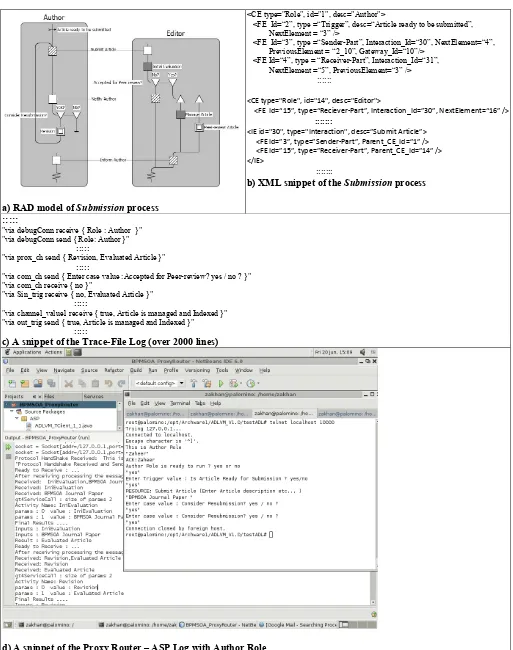
captures the basic flow of activities is depicted in Figure 2(a). RADModeller Ver. 1.1.0 (RADModeller, 2006) is used as the process modeller component of the Process Modelling layer. There are two roles involved in this process: Author and Editor. Activities such as “Peer-review Article” in the Editor role is shown as an encapsulated activity, as it may involve other roles such as a Reviewer role that does not fall within the region of the Submission process.
• Step 2: Generating the generalised XML representation of the Submission Process: Using BPMSOA’s role-based α
-Metamodel and abstraction component, the XML representation of the Submission process is generated and a snippet is represented in Figure 2(b). Once again, RADModeller Ver 1.1.0 is used as the abstraction component of the Generalisation layer.
• Step 3: Translating the process model into pi-ADL specifications: Using the role-based τ-Metamodel and customisation
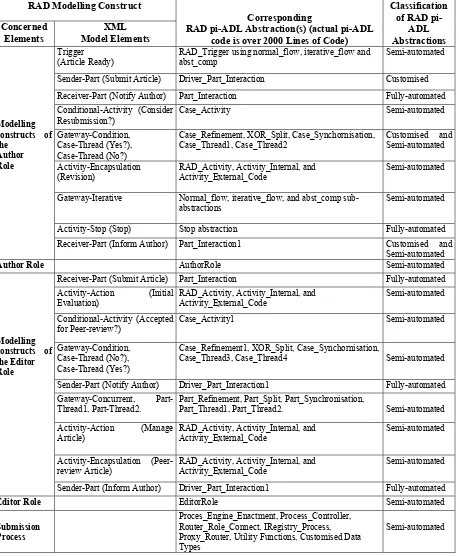
component, the XML representation of the Submission process is translated to the Java programming language, which can facilitate the concretisation component in translating it into pi-ADL. Using the role-based χ-Metamodel, the RAD pi-ADL specifications have been generated (Khan 2009) which can be utilised to program role-based business process models into pi-ADL. Due to space limitations these RAD pi-ADL specifications cannot be presented here but a small example is depicted in Annex-II. Using these RAD ADL specifications, the Submission process is translated into pi-ADL (over 2000 lines of code)* and accessible from (Khan 2009). The signatures of more specific pi-ADL abstractions from the RAD pi-ADL specifications, which have been used to translate specific RAD constructs of the Submission process model, have been presented in Table 2. In Table 2, the application of the RAD-based pi-ADL specifications for the different modelling constructs can be classified into the following three categories:
• Fully-automated: reflects that a RAD modelling construct can be automatically translated into the corresponding pi-ADL abstractions. For example, Proxy_Router, IRegistry_Process, Interaction_Registry, Router_Role_Connect, Process_Engine_Enactment, Driver_Part_Interaction, Part_Interaction, Part_Registry, and utility functions, etc;
• Semi-automated: shows that a RAD modelling construct requires human intervention to add specific elements to the corresponding RAD pi-ADL abstractions, such as Role, Activity_External_Code, Case_Activity, RAD_Trigger, etc.
*
Due to space limitations, the pi-ADL code for the Submission process is either accessible from (Khan 2009) or downloadable from
For example, defining parameters and their values for a specific instance of Activity_External_Code of a process activity which are required to invoke a specific grid service. In addition, Case_Activity, RAD_Trigger, Instantiate_Activities (sub-abstraction or Role for handshaking protocols), etc. need to declare global channels which can be utilised for human user interaction for specific roles. Similarly, in order to handle loops, Loop_handling_with_Activity and iterative_flow abstractions are defined which utilise global channels to demonstrate iterative behaviour; and,
• Customised: represents a RAD modelling construct which requires humans (i.e. pi-ADL programmers) to define the
required behaviour of that modelling construct in the respective pi-ADL specification. For example, a driver part interaction may receive a resource value from a human user and may compose it into Resource_Abst which would require behavioural changes in the default Driver_Part_Interaction abstraction.
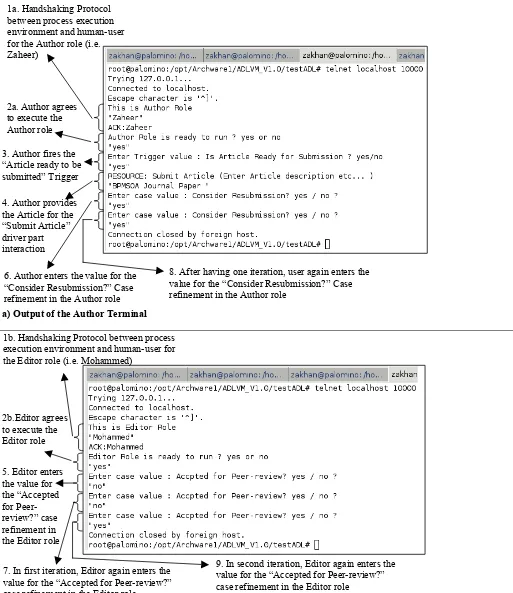
• Step 4: Executing the pi-ADL specification of the Submission Process: When the pi-ADL specification of a business process model is enacted using the ArchWare environment (ArchWare, 2005), the direct and indirect outputs are obtained. The direct output (i.e. human-based activities) of the execution of the Author and the Editor roles of the Submission process is depicted in Figure 3. In Figure 3, human users enter input values for specific activities within quotes (i.e. “ ”), whereas the system generated output is depicted without any quotes. Also, both the Author and the Editor roles are executed in the required order as labelled with the sequence numbers and associated descriptions. The handshaking protocol is used to ensure that the human user is connected with a user interface to interact with the required process activities at run-time. Furthermore, it is also depicted in Figure 3 that both of these roles execute loop, case refinements and nested part refinement constructs. The execution output also reveals that the pi-ADL based process activities successfully communicate with the ASP component of the proxy router (Khan, 2009), which enables them to be integrated with the respective grid-aware services, for example being deployed using the Globus Toolkit 4 (Sotomayor, 2005). In contrast, the indirect outputs (i.e. the detailed execution and communication logs of the Submission process and the ASP component of the proxy router) are used for the evaluation of the dynamic behaviour of the Submission process model as discussed in the following section.
5. EVALUATION AND DISCUSSION
In order to evaluate the BPMSOA framework, a structured evaluation methodology has been derived from the research hypothesis (section 1) (Khan, 2009) and is briefly presented below. In general, this evaluation is mainly concerned with the static verification of the correct syntax of the translations which take place at the different layers of the BPMSOA framework. In addition, it also performs the dynamic validation of the correct behaviour of the given business process when enacted. The overall goal of the combined static verification and dynamic validation is to assess and reflect on the extent to which the BPMSOA framework can be utilised to bridge the gap between business process models and GSOA environments. Both static verification and dynamic validations are based on the Kotonya and Sommerville’s concern-based approach (Kotonya, et. al, 2002) to derive main concerns which are verified and validated using the checklist questionnaires and walkthrough techniques (Sommerville, 2006).
5.1. Static Verification
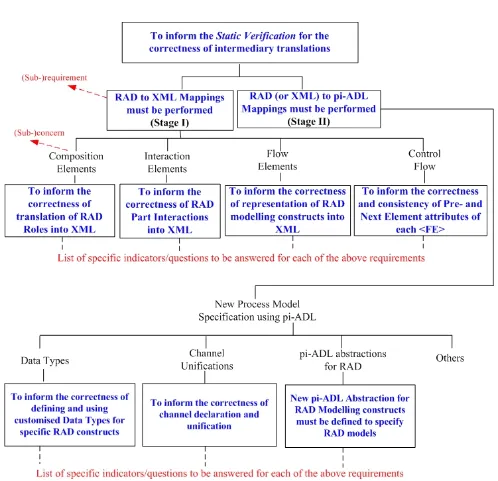
Static verification is performed in two stages. In the first stage, the translation from a business process model to the respective abstract generalised form (i.e., RAD to XML) is verified with respect to the role-based α-Metamodel. In the second stage, the translation from the generalised process form to the concrete and executable form (i.e., XML to pi-ADL) is verified with respect to the pi-ADL specifications of RADs. In general, the above two verification stages conform to the expression ‘Are we building the product right?’ (Sommerville, 2006) i.e. do the respective translations conform to the guidelines of the respective metamodels at the different layers of BPMSOA? Using the concern-based approach (Kotonya, et. al, 2002), Figure 4 depicts the main concerns related to static verification. In Figure 4, verification stage I requires the quantitative analysis of RAD business process models, with the objective of cross-verifying that the modelling in a given RAD process model tallies with its respective XML modelling elements. Figure 4 also derives the main requirements and associated questionnaires for verifying the correctness of the resultant pi-ADL specifications of the translated RAD XML constructs. Based on these concerns different RAD pi-ADL abstractions, newly defined data types and channel unifications are verified using walkthrough/inspection technique (Sommerville, 2006).
a) RAD model of Submission process
<CE type="Role", id="1", desc="Author">
<FE Id=“2”, type =“Trigger”, desc=“Article ready to be submitted”, NextElement = “3” />
<FE Id=“3”, type =“Sender-Part”, Interaction_Id=“30”, NextElement=“4”,
PreviousElement = “2_10”, Gateway_Id=“10”/> <FE Id=“4”, type = “Receiver-Part”, Interaction_Id=“31”,
NextElement =“5”, PreviousElement=“3” />
::::::
<CE type="Role", id="14", desc="Editor">
<FE Id=“15”, type=“Reciever‐Part”, Interaction_Id=”30”, NextElement=“16” />
:::::::
<IE id="30", type="Interaction", desc=”Submit Article”> <FE Id=”3”, type=”Sender‐Part”, Parent_CE_Id=”1” /> <FE Id=”15”, type=”Receiver‐Part”, Parent_CE_Id=”14” /> </IE>
:::::::
b) XML snippet of the Submission process
:::::
"via debugConn receive { Role : Author }" "via debugConn send { Role: Author }" :::::
"via prox_ch send { Revision, Evaluated Article }" :::::
"via com_ch send { Enter case value :Accepted for Peer-review? yes / no ? }" "via com_ch receive { no }"
"via Sin_trig receive { no, Evaluated Article }" :::::
"via channel_value1 receive { true, Article is managed and Indexed }" "via out_trig send { true, Article is managed and Indexed }"
:::::
c) A snippet of the Trace-File Log (over 2000 lines)
[image:9.595.46.559.81.731.2]
d) A snippet of the Proxy Router – ASP Log with Author Role
Table 2: pi-ADL Abstractions of the Submission Process RAD Modelling Construct
Concerned Elements
XML Model Elements
Corresponding
RAD pi-ADL Abstraction(s) (actual pi-ADL code is over 2000 Lines of Code)
Classification of RAD
pi-ADL Abstractions Trigger
(Article Ready)
RAD_Trigger using normal_flow, iterative_flow and abst_comp
Semi-automated
Sender-Part (Submit Article) Driver_Part_Interaction Customised
Receiver-Part (Notify Author) Part_Interaction Fully-automated Conditional-Activity (Consider
Resubmission?)
Case_Activity Semi-automated
Gateway-Condition, Case-Thread (Yes?), Case-Thread (No?)
Case_Refinement, XOR_Split, Case_Synchornisation, Case_Thread1, Case_Thread2
Customised and Semi-automated
Activity-Encapsulation
(Revision) RAD_Activity, Activity_Internal, and Activity_External_Code Semi-automated
Gateway-Iterative Normal_flow, iterative_flow, and abst_comp sub-abstractions
Semi-automated
Activity-Stop (Stop) Stop abstraction Fully-automated
Modelling constructs of the
Author Role
Receiver-Part (Inform Author) Part_Interaction1 Customised and Semi-automated
Author Role AuthorRole Semi-automated
Receiver-Part (Submit Article) Part_Interaction Fully-automated Activity-Action (Initial
Evaluation) RAD_Activity, Activity_Internal, and Activity_External_Code Semi-automated Conditional-Activity (Accepted
for Peer-review?) Case_Activity1 Semi-automated
Gateway-Condition, Case-Thread (No?), Case-Thread (Yes?)
Case_Refinement1, XOR_Split, Case_Synchornisation,
Case_Thread3, Case_Thread4 Semi-automated
Sender-Part (Notify Author) Driver_Part_Interaction1 Fully-automated Gateway-Concurrent,
Part-Thread1, Part-Thread2.
Part_Refinement, Part_Split, Part_Synchronisation,
Part_Thread1, Part_Thread2. Semi-automated
Activity-Action (Manage Article)
RAD_Activity, Activity_Internal, and Activity_External_Code
Semi-automated
Activity-Encapsulation (Peer-review Article)
RAD_Activity, Activity_Internal, and Activity_External_Code
Semi-automated Modelling
constructs of the Editor Role
Sender-Part (Inform Author) Driver_Part_Interaction1 Fully-automated
Editor Role EditorRole Semi-automated
Submission Process
Proces_Engine_Enactment, Process_Controller, Router_Role_Connect, IRegistry_Process, Proxy_Router, Utility Functions, Customised Data Types
Semi-automated
5.2. Dynamic Validation
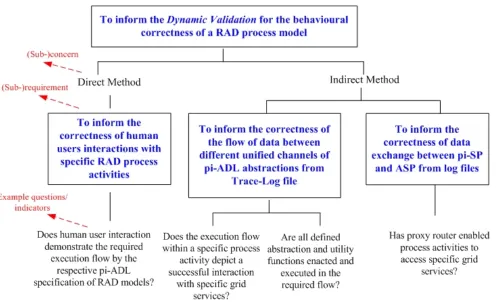
model. Based on these concerns, checklist questions have been derived (a few question are depicted in Table 5) and utilised in dynamically validating the behaviour of RAD process models.
[image:11.595.52.486.230.365.2]The pi-ADL specification of the Submission process is enacted and executed using the execution engine component and an execution log (i.e. indirect output) is stored in a trace-file (only a snippet is shown in Figure 2(c) as the actual log is over 2000 lines and accessible from Khan 2009). This execution log is made more expressive by using a debugger channel (i.e. debugConn) that records the communication between the different channels of the RAD pi-ADL abstraction instances. Furthermore, the ASP component of the proxy router stores the log of the communication between the RAD process activities and the respective services (a snapshot of ASP log is shown in Figure 2(d)). Both of the above logs serve as indirect outputs for the process being executed. In addition, the output generated to have human-user interaction during the execution of the Submission process model is used as a direct output and has been presented in Figure 3.
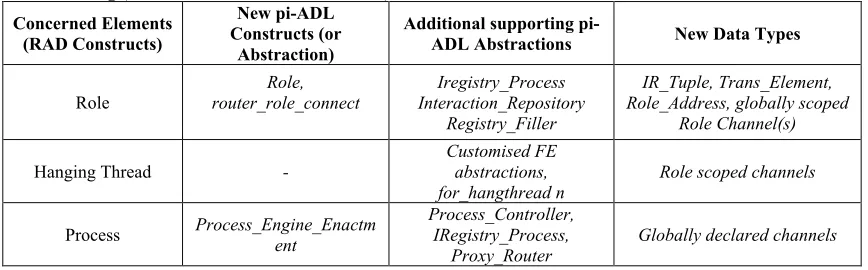
Table 3: pi-ADL Abstractions and Data Types for some of the Role, Hanging Thread and Process Modelling Constructs of RAD Modelling (Khan, 2009; Khan, et. al, 2008c)
Concerned Elements (RAD Constructs)
New pi-ADL Constructs (or
Abstraction)
Additional supporting
pi-ADL Abstractions New Data Types
Role router_role_connectRole, Interaction_Repository Iregistry_Process Registry_Filler
IR_Tuple, Trans_Element, Role_Address, globally scoped
Role Channel(s)
Hanging Thread - Customised FE abstractions, for_hangthread n
Role scoped channels
Process Process_Engine_Enactment
Process_Controller, IRegistry_Process,
Proxy_Router Globally declared channels
Table 4: A Few Static Verification Checklist Questions for Role Modelling Construct of RAD (Khan, 2009; Khan, et. al, 2008c)
Modelling constructs and
additional pi-ADL abstractions
Concerned Checklist Questions
Role
1. Does each role abstraction consist of abstractions of individual RAD constructs? 2. Have RAD constructs inside the role abstraction been enacted?
3. Have the channels of RAD constructs inside a role been unified as per the order depicted in the RAD process model?
4. Have the mechanisms in a role abstraction been defined to handle more than one hanging threads?
5. Has a global role_channel been declared for each role to communicate with human actors? E.g. trigger value, Case_Activity value etc.
6. Has a protocol been defined to start role processing?
7. Has a Part_Registry been enacted within a role abstraction to handle part interactions? 8. Have all roles registered their names and channels to Interaction Registry at
[image:11.595.49.492.590.743.2]bootstrapping so that they can receive transmission element?
Table 5: Dynamic Validation Checklist Questions For a few RAD Modelling Constructs (Khan, 2009; Khan, et. al, 2008c) Modelling
Constructs Concerned Questions for the Expected Behaviour Role 1. Has the role performed the required behaviour during execution?
2. Has the topological formation within role correctly executed? i.e. flow of activities. 3. Have all the hanging threads executed properly?
Activity and Encapsulation
4. Has the activity performed the required behaviour during execution? 5. Has the activity properly linked with its corresponding grid service? Trigger 6. Has the trigger performed the required behaviour during execution? Stop 7. Has stop activity provided the required behaviour during execution? Driver-part
interaction
8. Has the driver part interaction transmitted the resource and transmission element to its corresponding receiver-part interaction in another role?
Receiver-part interaction
a) Output of the Author Terminal
[image:12.595.38.551.77.670.2]a) Output of the Editor Terminal
Figure 3: Execution Output of the Submission Process 1a. Handshaking Protocol
between process execution environment and human-user for the Author role (i.e. Zaheer)
3. Author fires the “Article ready to be submitted” Trigger
2a. Author agrees to execute the Author role
4. Author provides the Article for the “Submit Article” driver part interaction
6. Author enters the value for the “Consider Resubmission?” Case refinement in the Author role
8. After having one iteration, user again enters the value for the “Consider Resubmission?” Case refinement in the Author role
1b. Handshaking Protocol between process execution environment and human-user for the Editor role (i.e. Mohammed)
2b.Editor agrees to execute the Editor role
5. Editor enters the value for the “Accepted for Peer-review?” case refinement in the Editor role
9. In second iteration, Editor again enters the value for the “Accepted for Peer-review?” case refinement in the Editor role
5.3. Evaluation Outcomes
Both static verification and dynamic validation have identified a number of issues related to RAD process model translation and enactment using the BPMSOA framework, for example:
• Stage I verification verifies that the RAD model of the Submission process is correctly translated into its corresponding
[image:13.595.59.557.228.709.2]XML representation since the number of elements, their description and order in the XML representation is consistent with the corresponding RAD model (Khan, 2009). Also, inspecting the respective pi-ADL specifications of a RAD process model based on the stage II criteria verifies that the required functionality is correctly specified in the pi-ADL abstractions of the specific modelling constructs. However, stage II verification reveals that translating a RAD modelling construct into the respective pi-ADL specification is not straightforward since it requires customisation during translations for specific modelling constructs, for example, parametric values for RAD activities, resource elements (i.e. messages, e.g. ‘Submit Article’ driver part interaction of the Submission process), variation of control structures (i.e. loops, case and part refinements), human-user based activities, etc. (Khan, 2009). Such translation customisations lessen the extent to which RAD process models can be automatically translated into the respective pi-ADL specifications.
• In addition, the static verification (using inspections) of the pi-ADL specifications of the Submission process reveals that all the channel unifications have been correctly performed. An invalid channel unification between different abstractions may result in an unexpected process behaviour (e.g. halting the process). Such an error may be caused due to improper design of process abstractions or an incorrect channel qualifier name checking (i.e. syntactic checking), which cannot be detected at compile time. This indicates that channel unifications must be verified for process abstractions such as process activity, proxy router, case-refinements, loops, etc.
In general, the static verification of the role-based BPMSOA instantiation verifies that the translation of the Submission process from RAD process models to the respective pi-ADL specifications (through the intermediate XML translation steps) is syntactically correct with respect to the checklist questions derived using the adopted concern based approach. Stage II verification has revealed a number of issues which restrict the extent to which an XML representation of a RAD process model can be automatically translated into the respective pi-ADL specification. These issues can be mainly attributed to coarse grained RAD process models with poor execution semantics, and the restrictions in designing specific modelling constructs such as nested gateways (Khan, 2009).
Similarly, based on the above dynamic validation for the Submission process (Khan, 2009), the following few observations and results can be briefly reported and reflected on:
• Pi-ADL has the capability to capture and model different execution semantics, but to automate the correct interpretation
of a coarse-grain RAD process model is not a straightforward procedure. The dynamic validation of the Submission process reveals that pi-ADL can model the structural, informational, flow and behavioural aspects of a business process (Khan, 2009). However, it has been observed that the more enriched RAD business process models are the more they can lead to correct and clear execution semantics. The following few scenarios highlight the uncertainty in determining the required execution behaviour for a particular modelling construct due to the unavailability of certain information in the corresponding RAD process models which may result in unwanted behaviour.
• It is difficult to automatically determine at run-time whether the resource element of a driver-part interaction needs to
be entered by a human-user of that role or that resource received from a previous activity or modelling construct. This reveals that there should be an application domain specific data model associated with the business process models that can be utilised during the process model execution. However, current models’ representations (i.e. XML and pi-ADL specification of RADs) at different levels of BPMSOA cannot automatically generate such resources.
• Similarly, a goal-state and/or merging two states does not provide clear execution semantics that can be automatically
determined from the respective RAD model. For example, in the part refinement segment (in the Editor role of the Submission process model), all threads produce some state values which may need to be passed to an activity after the part refinement segment. However, the RAD model of the Submission process does not indicate how to synthesize these multiple state values generated by the part refinement threads before these are passed on to the next activity.
Figure 5: Dynamic Validation using the Concern-based Approach
In general, the execution behaviour of the Submission process has been dynamically validated and revealed the correct behaviour. This reflects on the suitability of pi-ADL as an execution language to be used in the BPMSOA framework to enact and execute a business process using application domain specific grid services (Khan, 2009). In addition, the pi-ADL specifications for RADs are still not complete and require further investigation since they currently cannot handle errors, exceptions, and are lacking in automating the proper identification of resources required for inter-role interactions at run-time.
6. ANALYSIS OF THE RESEARCH OUTCOMES
In this section, we briefly reflect on the BPMSOA’s layered architecture, the use of metamodels, pi-ADL, and the respective model mappings at different layers.
• Business process models can be enacted in GSOA environments using the BPMSOA framework as demonstrated using the Submission process. The BPMSOA framework uses special purpose designed instantiation and application processes which facilitate the enactment of a role-based business process model into the GSOA environment via intermediary model translations. The orthogonal layers of the BPMSOA framework can be used to manage intermediary translated models as artefacts which can be reused for later process model enactment.
• The above characteristic suggests that the BPMSOA framework is closely aligned with the MDE approach as each layer generates a particular model of a given business process in accordance with its respective metamodels. Further, a top-down translation of Platform Independent Models (PIM) e.g. RAD, to Platform Specific Models (PSM) e.g. pi-ADL and its enactment is facilitated with a structured process. In addition, each associated metamodel has specific perspectives which capture different model dimensions such as structural, flow, non-functional, etc.
• There is a direct relationship between the particular instances of the BPMSOA metamodels, where each metamodel instance directs its associated layered component to perform specific model translation steps. For example, in (Khan 2009), the role-based α-Metamodel (i.e. at the Generalisation layer) is defined using the meta-concepts introduced in the Process Modelling Metamodel (i.e. at the Process Modelling layer). Similarly, the role-based instances of the τ -Metamodel and the χ-Metamodel (i.e. at the Transformation layer) are based on the concepts introduced in the role-based
different process modelling approaches, and hence this suggests that BPMSOA can be a generalised framework. In addition, each metamodel is concerned with different perspectives (e.g. α-Metamodel consists of Structural, Flow and Interaction perspectives), where each is realised using a number of elements (e.g. Structural perspective of α-metamodel consists of Composition, Flow and Interaction elements). The modular design of these metamodels is flexible enough to accommodate new perspectives (for example, a Functional perspective) and elements (such as Control elements, etc.), which suggests that BPMSOA can also be an extensible framework.
• The extent to which the intermediary translations can be automated in the BPMSOA framework is subject to generic
mappings between different technological spaces such as role-based business process modelling languages, XML and pi-ADL. The application of the role-based BPMSOA framework on the Submission process of the DL domain has yielded that it is not straightforward to have such generic mappings because it requires bespoke design of the intermediary model representations and, in particular, the pi-ADL specifications associated with the dynamic behaviour of different business process modelling constructs. These limitations can be attributed to the restricted capability of these technological spaces (e.g. the business process modelling language space and architectural description languages such as pi-ADL) to be mapped and translated fully from one to the other. Hence, this reveals that the extent to which the BPMSOA framework can bridge the gap between business process models and service oriented environments depends on the capability to correctly map and translate business process models into their respective XML and pi-ADL specifications.
• Furthermore, the limitation of the translation automation may also be attributed to coarsely defined process models,
ad-hoc, randomly presented resources or to data elements, and the associated human user responsibilities within the specific roles of the business process models. In addition, these limitations are not straightforward to identify automatically by intermediary translation tools. In contrast, humans are capable of handling the above limitations in real time and can make non-deterministic decisions to understand the semantics of specific process activities and the need for the required resources/data elements of particular business process models. However, software tools are constrained without human support in terms of correctly identifying and translating the syntactic representations and the semantic behaviour of coarsely grained process models into executable code. Hence, this suggests that role-based business process models can be enacted in GSOA environment but the translations for these process models into executable programs must be partially facilitated by programmers to aid undefined or coarsely grained execution semantics with additional resource or data requirements (Khan, 2009).
• The use of pi-ADL and its associated ArchWare tools play a major contribution in bridging the gap between business
process models and GSOA environments. Although pi-ADL is considered a block-structured architectural description language, its channel unification and mobility features enable it to also capture graph-based models such as RAD, etc. For example, RAD modelling constructs are represented as abstractions using pi-ADL, which can embody the required programming expressions, statements, etc. related to the behavioural requirement for that particular modelling construct. When these abstractions are enacted, execution control can be passed from one abstraction instance to another using the unified and mobile channels between these instances through the send and receive action prefixes. These features enable the pi-ADL specification of a business process model to adhere to the specified control flow (Khan, 2009). However, the use of channel unification and mobility may result in erroneous process execution and/or halt process execution due to input/output (I/O) blocking (i.e. synchronous behaviour of send and receive prefixes), if improper channel unification is performed. As a consequence, this raises the need to incorporate advanced debugging facilities in order to identify possible erroneous channel unification to be applied for correct utilisation. Also, new design mechanisms can be investigated to facilitate asynchronous channel based communication in order to avoid limitations which can be caused due to I/O blocking prefixes.
• The pi-ADL specification of the Submission process (and in particular loop handling) shows that pi-ADL can execute the
graph-based process structures using its channel based mobile communication characteristics. For example, the BPMSOA pi-ADL iterative_flow and abst_comp abstractions are activated using such characteristics. Thus, in the absence of such characteristics, it will be difficult to achieve such graph-based (e.g. loops) behaviour let alone designing pi-ADL specifications for RAD process models (Khan, 2009).
• Human roles or activities (i.e. activities with human intervention) can be simulated and executed in pi-ADL using a
terminal node. Such roles and activities need to be distinguished from the outset in the Process Modelling and Generalisation layers since the BPMSOA and its respective role-based pi-ADL specifications do not cater for such a need unless it is identified in the above mentioned two layers.
• The application of the Submission process using the BPMSOA framework leads us to strongly conclude that pi-ADL can
capture different dimensions (as envisaged in the MDE approach (Stuart, 2002)) of the original business process model such as platform specific executable specifications which can also include:
• a subject area dimension such as human user based roles (e.g. the Author and the Editor roles in the Submission
• an aspect dimension such as process flow (within a role or process model) which may include sequence, concurrency,
iteration, distribution, information and data. This enables programmers to program both block-structured as well as graph-based business process models in pi-ADL.
• The application of the separation of concerns design principle has yielded a logical separation between sub components of
BPMSOA layers. For example, the proxy router component enables pi-ADL based process activities to communicate with respective grid services without interfering with the associated pi-ADL based process execution (Khan, 2009; Khan, et. al, 2008b). Furthermore, the design of the proxy router sub-components can be extended to introduce a Universal Description Discovery and Integration (UDDI) like mechanism and can also access the required functionality from other IT applications, e.g. web-services, P2P, etc.
• The above model of enacting a business process using the BPMSOA framework further suggests its suitability for process
agility (Khan, 2009). For example, while the execution behaviour of RAD modelling activities may not be determined using its respective RAD model, this execution behaviour is acquired from the respective application domain specific grid services. This approach demonstrates that the actual process workflow is translated into respective pi-ADL specifications and is executed in the ArchWare Virtual Machine (ADLVM) (ArchWare, 2005). However, the behavioural functionality of the executing process activities is acquired from the application domain specific grid services using the proxy router component. On the one hand, a change in the process design topology (i.e. its workflow or structure) is not affected by the behavioural functionality of the respective process activities since it can be accessed from specific application services. On the other hand, binding a new application domain specific grid service (i.e. with different functionality) with the specific executing process activity can also accomodate the required behavioural changes.
In addition, the following limitations have been revealed which will be dealt as future research work:
• The absence of an application domain specific resource data model can make it difficult to automatically specify a
business process in pi-ADL, because it is not possible to automatically determine from the given RAD model of a business process the data elements or resources which need to be exchanged during inter-role interactions, for example, an article or manuscript in the case of the Submission process. This indicates that an application domain specific data model needs to be introduced in the BPMSOA framework that can be associated with business process representations at different layers, which can be considered as a step towards handling this shortcoming.
• Designing and customising the pi-ADL specification for complex RAD process models is not a straightforward task. For
example, as the level of control flow complexity (e.g. with nested gateways, overlapping loops, loops with hanging thread fragments and replicate refinement) increases in a RAD business process model, this may require refinements in the current RAD pi-ADL specifications. For example, in a RAD model a replicate refinement (indefinite part-refinement) can be represented. This however, cannot be accommodated by the current RAD pi-ADL specifications due to the need to specify the required number of part threads with their constructs and channel unifications. Hence, more case studies with complex control flows need to be conducted in order to find remedies for such shortcomings.
• Errors and Exceptions can lead to the unexpected execution behaviour of a given business process. The current pi-ADL
specifications for RAD models do not cover exception and error handling, mainly due to the non-existence of any asynchronous channel communication in pi-ADL. This indicates that the current RAD pi-ADL specification needs to incorporate additional mechanisms to handle errors and exceptions by incorporating asynchronous communication design.
7. CONCLUSION
In conclusion and despite the above issues discussed in section 6, the evaluation outcomes reflect on the usefulness of BPMSOA as a framework that has been instantiated using the role-based process modelling paradigm and in particular using RADs as a step towards bridging the gap between role-based business process models and service oriented environments. In particular, the use of pi-ADL as a process execution language demonstrates its capability to specify, enact and execute complex business process models. We used a simple case study from digital libraries domain to establish a foundation for conducting the experiments. The same approach (i.e. by using the BPMSOA framework) could be adopted for other application domains (e.g. finance, etc.) to integrate business process activities with grid utility services. However, the RAD pi-ADL specifications need further extensions (for example, handling run-time errors) and refinements (for example, static parametric requirements to invoke respective grid services), which are anticipated to increase the usability of the BPMSOA framework when validated using different other process modelling paradigms and complex designed business processes.
REFERENCES
Curtis, B., (1992), Process Modelling, Communications of the ACM, 35(9), pp. 75-90.
Aguilar-Saven, R. S., (2003), Business process modelling: Review and Framework, International Journal of Production Economics, 90(2), pp. 129-149.
Havey, M., (2005), Essential Business Process Modelling, ISBN. 0-596-00843-0, O'Reilly Publishers.
Kurtev, I., Bezivin, J. and Aksit, M., (2002), Technological Spaces: an Initial Appraisal, Federated Conferences: Cooperative Information Systems (CoopIS) - International Symposium of Distributed Objects and Applications (DOA), Industrial Track, Irvine, California.
Krafzig, D., Banke, K. and Slama, D., (2004), Enterprise SOA: Service-Oriented Architecture Best Practices, ISBN. 0-13-146575-9, Prentice Hall PTR.
BEA Systems, (2007), The Integration Journey - a Field Guide to Enterprise Integration for SOA [online], BEA White Paper, Available from: http://contact2.bea.com/bea/www/soa_mom/mom3.jsp?PC=56TU3GXXWPBE [Accessed 10/07/2007].
Breivold, H.P. and Larsson, M., (2007), Component-Based and Service-Oriented Software Engineering: Key Concepts and Principles, 33rd EUROMICRO Conference on Software Engineering and Advanced Applications, pp. 13-20.
Oquendo, F., (2004), pi-ADL: An Architecture Description Language based on the Higher-Order Typed pi-Calculus for specifying Dynamic and Mobile Software Architectures, ACM Software Engineering Notes, 29(4).
Oquendo, F., (2005), Tutorial on ArchWare ADL - Version 2 - Pi-ADL Tutorial - Project Deliverable D1.9 [online], Available from: http://www.arch-ware.org/ [Accessed 15/05/2006].
Milner, R., (1999), Communicating and mobile systems: the pi calculus, ISBN. 052164320, Cambridge University Press. NGG - Next Generation Grids, (2006), Future for European Grids: GRIDs and Service Oriented Knowledge Utilities: Vision
and Research Directions 2010 and Beyond [online], NGG Expert Report, Available from: URL Access: ftp://ftp.cordis.lu/pub/ist/docs/grids/ngg3_eg_final.pdf [Accessed 15/6/2008].
SOKU, (2006), From Grids to Service-Oriented Knowledge Utilities: A critical infrastructure for business and the citizens in the knowledge society [online], EC Report ISBN: 92-79-02116-8, Available from: ftp://ftp.cordis.europa.eu/pub/ist/docs/grids/soku-brochure_en.pdf.
Sotomayor, B., (2005), The Globus Toolkit 4.0 [online], Available from: http://gdp.globus.org/gt4-tutorial/multiplehtml/index.html [Accessed 14/12/2007].
Manset, D., Verjus, H., McClatchey, R. and Oquendo, F., (2006). A Formal Architecture-centric model-driven approach for the automatic generation of Grid applications, ICEIS06, Paphos, Cyprus.
Stuart, K., (2002), Model Driven Engineering, In Book: Integrated Formal Methods - Lecture Notes in Computer Science, Springer Berlin/Heidelberg, ISBN: 978-3-540-43703-1, vol. 2335/2002, pp. 286-298.
Fondement, F. and Silaghi, R., (2004), Defining Model Driven Engineering Processes [online], 3rd Workshop in Software Model Engineering/the 7th International Conference on the UML (WiSME@UML2004), Lisbon, Portugal. Available from: http://www.metamodel.com/wisme-2004/papers.html [Accessed 04/02/2008].
Khan, Z. A., (2009), Bridging the gap between business process models and service oriented architectures with reference to the Grid environment, PhD Thesis, Bristol Institute of Technology, University of the West of England, Bristol, UK. British Library EThOS Persistent ID: uk.bl.ethos.501099
Ould, M., (1995), Business Processes: Modelling and Analysis for Re-engineering and Improvement, ISBN. 0-471-95352-0, Wiley.
Khan, Z.A., Odeh, M. and McClatchey, R., (2006a), Digital Libraries: From Process Modelling to Grid-based Service Oriented Architecture, Proceedings of the 2nd Int. Conference on Information & Communication Technologies from Theory to Application (ICTTA'06), Damascus, Syria, vol. 1, pp. 280-285.
Odeh, M., Beeson, I., Green, S. and Sa, J., (2002), Modelling Processes Using RAD and UML Activity Diagrams: an Exploratory Study, The 3rd International Arab Conference on Information Technology, ACIT2002, Doha, Qatar. Odeh, M. and Kamm, R., (2003), Bridging the Gap between Business Models and System Models, Information and Software
Technology, 45(15), pp. 1053-1060.
Badica, C. and Fox, C., (2001), Business Process Modelling Using Process Algebras, OR'43 (BPCME'01), Bath, UK.
Arkin, A., (2002), Business Process Modelling Language [online], BPMI.org, Available from: http://xml.coverpages.org/BPML-2002.pdf [Accessed 11/08/2007].
Juric, M. B., Mathew, B. and Sarang, P., (2004), Business Process Execution Language for Web Services, ISBN. 1-904811-18-3, PACKT Publishing.
Blanvalet, S., Bolie, J. and et. al., (2006), BPEL Cookbook: Best Practices for SOA-based Integration and Composite Applications Development, ISBN. 1-904811-33-7, PACKT Publishing.
The OWLService Coalition, (2005), OWL-S: Semantic Markup for Web Services [online], Available from: http://www.daml.org/services/ [Accessed 01/10/2005].
Guo, L., Chen-Burger, Y.H. and Roberston, D., (2004), Mapping a Business Process Model to a Semantic Web Service Model, Proceedings of the Third International Conference on Web Services, ICWS 2004, San Diego, California, USA.
White, S.A., (2005), Using BPMN to Model a BPEL Process, BPTrend.
Owen, M. and Raj, J., (2007), BPMN and Business Process Management: Introduction to the New Business Process
Modelling Standard [online], Available from:
http://www.bpmn.org/Documents/6AD5D16960.BPMN_and_BPM.pdf [Accessed 17/07/2007].
White, S.A., (2007), Using BPMN to Model a BPEL Process [online], Available from: http://www.bpmn.org/ [Accessed 10/07/2007].
Ouyang, C., Aalst, W. M., Dumas, M. and Hofstede, A. H., (2006), Translating BPMN to BPEL [online], Available from: http://eprints.qut.edu.au/archive/00003615/ [Accessed 10/08/2007].
Recker, J. and Mendling, J., (2006), On the Translation between BPMN and BPEL: Conceptual Mismatch between Process Modelling Languages, CAiSE 2006 Workshop Proceedings - Eleventh International Workshop on Exploring Modelling Methods in Systems Analysis and Design, pp. 521-532.
BPMN, (2007), Business Process Modelling Notation (BPMN) [online], Available from: http://www.bpmn.org/ [Accessed 10/07/2007].
Shapiro, R., (2002), A comparison of XPDL, BPML, and BPEL4WS [online], ebPML.org, Available from: http://xml.coverpages.org/bpml.html [Accessed 10/05/2008].
Khan Z. A. and Odeh, M., (2007), A Framework for Translating RAD business process models into π-adl, in proceedings of Arab Conference of IT (ACIT2007), Syria.
Khan Z. A. and Odeh, M., (2008a), Business Process Modelling: Coarse to Fine Grain Mapping Using Metamodels, Proceedings of IASTED Software Engineering, Innsbruck, Austria.
Khan Z. A. and Odeh, M., (2008b), The BPMSOA: Linking Utility Grid Services with Executable Business Processes using the p-ADL based Proxy Router, Proceedings of the 3nd Int. Conference on Information & Communication Technologies from Theory to Application (ICTTA'08), Damascus, Syria.
Khan Z. A., Odeh, M., Solomonides, T. and Oquendo, F., (2008c), The BPMSOA: evaluating the enactment of a business process using application domain specific grid services, Proceedings of the 10th International Conference on Information Integration and Web-based Applications Services (iiWAS2008), ISBN 978-1-60558-349-5, p.p. 232-239. Linz, Austria.
Sommerville, I. (2006), "Software Engineering", ISBN. 9780321313799, Addison-Wesley.
ArchWare, (2005), ArchWare EmptyStore Repository [online], Available from: http://intranet.cs.man.ac.uk/ipg/research/projects/AW/ [Accessed 26/03/2008].
Harrison-Broninski, K., (2007), A Role-Based Approach To Business Process Management [online], Accessed from: http://human-interaction-management.info.
RADModeller, (2006), RADModeller: Instream Tools [online], Available from: http://www.instream.co.uk/radmodeller.html [Accessed 10/09/2006].
Kotonya, G. and Sommerville, I., (2002), Requirements Engineering: Processes and Techniques, ISBN. 0-471-97208-8, John Wiley & Sons. Inc.