1
Empirical evidence of an integrative knowledge competence framework
for ERP systems implementation in UK industries
Abstract
Enterprise Resource Planning (ERP) systems can greatly improve business productivity and better serve customers by creating values through integrating business processes and sharing current information. Knowledge management (KM) is crucial for ERP systems implementation, but is particularly demanding task. This paper discusses ERP systems implementation in UK manufacturing and service sector organisations, focusingon empirical evidence of an innovative KM approach for improving knowledge competence for ERP success. Qualitative research was conducted, using semi-structured interviews with ERP experts. Data analysis used a combination of thematic and comparative analysis. The findings suggest that the integrative knowledge competence framework can provide ERP practitioners with useful guidance on what the key knowledge determinants are and how the relationships between knowledge components should be best managed to achieve ERP systems implementation success in real life business situations.
Keywords: innovative KM approach, knowledge competence wheel, knowledge network model,
ERP implementation success
1. Introduction
2
uniform reporting based on global standards and better information security protocols. ERP systems implementation requires a substantial amount of financial, human and technical resources to succeed in business reality. As a result, ERP implementation is classified as one of the most expensive business information technologies in the corporate world (Kumar and van Hillegersberg, 2000; Jones et al., 2006), with most resources consumed in the implementation stage, rather than the pre and post implementation stages (Parthasarathy and Sharma, 2014; Ahmadi et al., 2015). Therefore, this study specifically focuses on the implementation stage.
The complexity of ERP system packages provided off-the-shelf, along with the huge number of stakeholders involved in ERP systems implementation, create high levels of uncertainty and risk that can result in ERP failure (Wong et al, 2005). One of the main reasons for ERP failure is the lack of sufficient support from knowledge management (KM) approaches throughout the ERP project lifecycle (Jayawickrama et al., 2013). Sedera and Gable (2010) identified the importance of KM in order to achieve enterprise system success. ERP systems require complex and detailed knowledge to implement within an organisation, in order to provide measurable business benefits. Effectively managing a wide range of knowledge, which resides in multiple stakeholders including experienced implementation consultants and business users/representatives, has been identified as a crucial factor for ERP project success (Xu and Ma, 2008). The implementation consultants mainly possess knowledge of ERP system functionalities and configurations, whereas business users hold knowledge of the business processes of the client company and industry specific knowledge (Sedera and Gable, 2010). Hence, it is important to discover innovative methods, techniques and approaches that can integrate such knowledge among individuals and across stakeholder groups.
For clarity, there are six definitions related to knowledge management used in this study which will be useful in understanding the contents of this paper. These are presented in Table 1.
Table 1: Definitions of KM related terms
No. Term Definition References
1 Knowledge competence
The processes that generate and integrate knowledge of a particular domain, thus generating knowledge stock of that particular domain.
3
Johnson et al. (2009),
Ozkaya et al. (2015)
2 Knowledge types
K-types are categories of knowledge pertaining to a pool of knowledge in a particular domain.
O’Leary (2002), Parry and Graves (2008), Liu (2011)
3 Knowledge layers
K-layers are different aspects of the knowledge pertaining to a certain subject such as know-what (declarative knowledge), know-how (procedural knowledge), know-why (knowledge reasoning) and know-with (knowledge integration).
Siegel and Shim (2003), Chen (2010), Liu et al. (2012)
4 KM lifecycle A continuous process of creation, transfer, retention and application of the right level of knowledge, at the right time, with the right people.
Metaxiotis (2009), Hung et al. (2012), Newell (2015)
5 Knowledge determinants
K-determinants are the factors that drive knowledge creation, transfer, retention and application activities.
Vandaie (2008), Xu and Ma (2008), Jeng and Dunk (2013)
6 Knowledge components
Knowledge components are k-types, k-layers, KM lifecycle and k-determinants which are also known as knowledge perspectives.
Gable (2005), Sedera and Gable (2010), Candra (2014),
Knowledge competence is a strategic asset of an organisation which brings competitive
advantage (Yeniyurt et al., 2005; Atuahene-Gima et al., 2011). ERP implementations
demand complex and detailed knowledge for successful implementation (Gable, 2005;
Jeng and Dunk, 2013). This includes aspects such as; knowledge of best business
practices, ERP system functions and features, system configurations, current business
processes, implementation methodology, business requirements, etc. By integrating
various knowledge components such as knowledge types, knowledge layers and KM
lifecycle, new knowledge can be generated in a particular context and in this case, in its
ERP implementation context. Therefore, knowledge competence is essential in creating,
transferring, retaining and applying a stock of ERP knowledge to the right individuals,
groups and departments at the right time during ERP implementations (Parry and Graves,
2008; Sedera and Gable, 2010).
The purpose of this study is determine the integrative effects of various knowledge
components to achieve ERP implementation success. Knowledge competence attempts to
integrate different knowledge components together, in order to generate stock of
4
questions: (1) What are the key knowledge components required to increase knowledge competence in ERP systems implementation? (2) How can the relationships between different knowledge components be managed to achieve ERP systems implementation success? (3) How can knowledge flows between various stakeholders be facilitated to create competitive advantage? To answer these research questions, there is an urgent need
to explore innovative approaches to addressing interdisciplinary issues across the ERP and KM domains. KM itself is a well-established area with a clear lifecycle defined in existing research, which includes knowledge creation, knowledge transfer, knowledge retention, and knowledge application (Alavi and Leidner, 2001). Similarly, ERP has also advanced to become a significant area of business information systems. The prospect of synergies between the KM and ERP areas makes it an attractive area for many researchers. Existing research has typically addressed the issue of ERP knowledge management by treating different ERP knowledge components in an isolated manner, without integrating the knowledge components through the exploration of the relationships between different ERP knowledge components (Parry and Graves, 2008; Sedera and Gable, 2010). To fill this gap in the literature, this paper develops an integrative knowledge competence framework dedicated to ERP systems implementation, based on empirical evidence from 14 UK companies in both manufacturing and service industries. There are three key contributions to the existing body of knowledge from this study. They are: (1) the identification of important determinants that drive ERP knowledge creation, transfer, retention, and application during ERP systems implementation; (2) the creation of a “knowledge network model” that elaborates the knowledge flows based on the relationships between knowledge components and ERP project stakeholders; and. (3) empirical evidence of an innovative knowledge competence framework that integrates knowledge from multiple complementary perspectives (knowledge layer, knowledge type and knowledge lifecycle) to achieve ERP systems implementation success.
5 2. Related literature
ERP systems is one of the most important business information systems in the modern business world that can seamlessly integrate different business processes across departments and function area into a coherent system (Davenport, 1998; Li and Li, 2000). Many studies related to ERP systems are largely focused on ERP implementation success factors (Nah et al., 2001; Somers and Nelson, 2001; Hong and Kim, 2002), failure factors (Wong et al., 2005), selection of ERP packages (Chau, 1995; Tsai et al., 2012) and factors affecting ERP implementation in general (Huang et al., 2004; Upadhyay et al., 2011). There are relatively few studies that specifically focus on issues relating to the management of knowledge during ERP systems implementation.
Similarly, KM has emerged as a distinct field of research and matured gradually by combining with other fields such as human resource, organisational behaviour, information systems, and so on (Sedera and Gable, 2010). It has only been in the last two decades that some researchers have started to link KM with ERP systems. This section will critically review on the work that specifically concerns the KM issues in ERP context, discover the trends in this inter-disciplinary area and identify research gaps in the literature.
The next three sub-sections attempt to provide a clear view of the past studies that have been carried out closely related to KM and ERP domains, with an intention to provide a theoretical foundation for the integration of KM with ERP. For the ease of understanding and introducing the main aspects of KM for ERP step by step, this section classifies literature into three streams: (a) the concept of knowledge competence and its links with knowledge layers and KM lifecycle; (b) knowledge flows and knowledge networks; (c) KM influence on ERP success. Finally, section 2.4 presents the theoretical framework and summarises research gaps.
2.1 Knowledge competence and its links with knowledge components
The concept of knowledge competence is defined as the processes that generate
and integrate knowledge of a particular domain, thus generating knowledge stock of that
particular domain. Ozkaya et al. (2015) used knowledge competence in the context of
marketing. They focus on market knowledge competence which comprisescustomer and
6
mediator of the relationships between market orientation and market-based innovations.
The literature indicates that market knowledge competence has a direct positive effect on
organisational performance (Li and Calantone 1998; Johnson et al. 2009). Market
knowledge competence has been used in new product development (Atuahene-Gima et
al., 2011). Knowledge about markets and its behaviour are essential in order to develop
goods and services to satisfy customer requirements (Yeniyurt et al., 2005). It is evident
that from design to production of a product, market knowledge competence is vital. These
studies have mainly investigated market knowledge competence, but not ERP-related
knowledge competence.
Sedera and Gable (2010) are the only authors to investigate on ERP knowledge
competence in-depth, based on a quantitative survey. They integrate knowledge types and
the KM lifecycle (creation, transfer, retention and application) in order to enhance the
knowledge competence of ERP implementation. They discover the positive influence of
ERP knowledge competence to achieve ERP implementation success. However, this
study was unable to explain how, why and with-what (knowledge layers) specific types
of ERP knowledge need to be created, transferred, retained and re-used during ERP
implementations.
2.1.1 Knowledge layers
7
with new definitions of the meanings) in order to investigate the knowledge required for supply chain management in the automotive industry. However, knowledge layers have not been discussed in conjunction with KM lifecycle phases or knowledge types (k-types) related to ERP systems implementation in the literature.
2.1.2 Knowledge lifecycle and stages
Knowledge creation and knowledge transfer have been recognised as distinctive stages during the KM process (Lech, 2014; Newell, 2015). Maditinos et al. (2012) present a conceptual framework that investigates the way that human inputs are linked to communication effectiveness, conflict resolution and knowledge transfer. A study carried out by Xu and Ma (2008) revealed four sets of factors (characteristics of knowledge to be transferred, source, recipient and context) which have different effects on ERP knowledge transfer from implementation consultants to key users and vice versa. Hung et al. (2012) investigate the factors that produce a positive knowledge transfer climate during ERP implementation. They identified that top management support and the internal incentives of the client organisation have a positive impact on knowledge transfer. These studies have only concentrated on knowledge transfer without considering other phases of KM lifecycle.
Jones et al. (2006) examined eight dimensions of culture and their impact on how the ERP implementation team is able to share knowledge effectively during implementation. This study shows ways to overcome the cultural barriers to knowledge sharing. In a later study, Vandaie (2008) identifies two major areas of concern regarding the management of knowledge in ERP projects through the developed framework; managing tacit knowledge, and issues concerning the process-based nature of organisational knowledge. Jeng and Dunk (2013) investigate knowledge creation and its relationship to ERP success particularly in footwear and apparel industries. The empirical findings indicate that knowledge creation has an impact on ERP success. However, these studies have only considered a single KM phase i.e. knowledge transfer in first three studies and knowledge creation in latter three studies, and lack the integration of different knowledge dimensions such as knowledge-layers, knowledge-types and multiple KM phases.
8
(Horwitch and Armacost, 2002). Most of the studies have considered the KM lifecycle with the four phases (Stein and Zwass, 1995; Alavi and Leidner, 2001). The four-phase KM lifecycle model has been widely explored, including in general KM (Wiig, 1997; Horwitch and Armacost, 2002), process improvement (Szulanski, 1996; Bartezzaghi et al., 1997) and organisational learning (Huber, 1991; Argote, 1999). There are very few studies that specifically explore KM lifecycle with ERP systems. Sedera and Gable (2010) discovered the significant and positive relationship between knowledge competence and enterprise success.
2.2 Knowledge flows and knowledge networks
Knowledge networks show knowledge flows between various stakeholders of an
organisation, group or set of individuals (Phelps et al., 2012). Knowledge flows are
comprised of different knowledge types pertaining to a particular domain. Laihonen
(2015) discusses managerial knowledge flows related to a health-care system and
identifies three main categories of knowledge flows: (1) national information steering, (2)
regional information steering, and (3) internal control information. From this, he develops
a knowledge network structure in order to demonstrate the knowledge flows between
numerous stakeholders such as health-care administrators, specialists, elected officials,
etc. Williams and Lee (2016) develop and test a new network model of knowledge flows
in emerging market multinational corporations (MNC), based on the way people are
managed in its foreign subsidiaries. They found human resource management practices
based on formalised procedures weaken the effect of socialisation, but strengthen that of
human capital, while empowering practices within the subsidiary weaken the effect of
human capital, but strengthen the effect of socialisation. Kaminska and Borzillo (2016)
explored knowledge creation and integration through effective knowledge flows within
and between the different organisational communities; drawing on a longitudinal case
study of a large firm operating in the highly competitive Specialty Chemicals industry.
However, these studies have not discussed knowledge flows and knowledge networks
related to ERP implementations. This is a new concept for ERP implementation.
2.3 Knowledge competence and its impact on ERP success
9
processes that generate and integrate knowledge of ERP implementation, thus generating
ERP knowledge stock. The model proposed by Sedera and Gable (2010) demonstrates the
10
what the different types of knowledge have been created, transferred, retained and
applied to achieve ERP implementation success.
2.4 Theoretical framework and research gaps
A theoretical framework has been proposed based on the literature reviewed in section
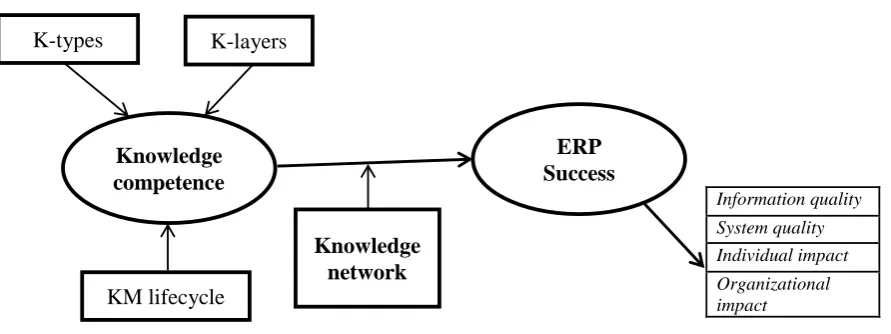
two. Figure 1 demonstrates the relationship between knowledge competence and ERP
implementation success in the theoretical framework. Knowledge networks facilitate
knowledge flows among various stakeholders by enhancing knowledge competence to
achieve ERP implementation success. In this context, stakeholders could be any
individual, group or organisation involved in ERP project implementations.
Information quality System quality Individual impact Organizational impact Knowledge
competence
ERP Success
KM lifecycle K-layers K-types
[image:10.595.86.532.285.452.2]Knowledge network
Figure 1: Theoretical framework
There are three knowledge components to enhance knowledge competence as shown in
the theoretical framework; knowledge types, knowledge layers and KM lifecycle. ERP
success is measured through information quality, system quality, individual impact and
organisational impact. Based on the above discussion of the related literature (section
two), research gaps in the context of KM for ERP have been identified and summarised
in Table 2. This is the basis of the theoretical framework for knowledge competence in
ERP success. The table focuses on the usage of key knowledge components in the context
of ERP implementation., Existing work has been classified topically into six clusters in
order to reveal the key research gaps. The “X” symbol in the Table clearly indicates the
gaps in the literature.
Table 2: Literature review summary and research gaps
Clus ter
Cluster name References Knowledge
layers
Knowledge types related
11
No. to ERP
1 Only k-layers Dhar and Stein (1997), Alavi and Leidner (2001), Siegel & Shim (2003), Chen (2010), Turban et al. (2011), Liu et al. (2012)
Between one to four
k-layers X X
2 Both k-types and KM lifecycle
Gable (2005), Parry and Graves (2008), Sedera and Gable (2010)
X
Two k-types Four phases
3 Only KM lifecycle
Wiig (1997), Argote (1999), Alavi and Leidner (2001), Horwitch and Armacost (2002),
Metaxiotis (2009), Candra (2014)
X X
Four phases
4 One k-type O’Leary (2002), Newell et
al. (2003), Liu (2011) X
One k-type, ERP package knowledge
X
5 Only k-transfer
Jones et al. (2006), Xu and Ma (2008), Hung et al. (2012), Maditinos et al.(2012)
X X
One phase, knowledge transfer
6 Only k-creation
Vandaie (2008), Jeng and
Dunk (2013) X X
One phase, knowledge creation
12
knowledge transfer and Cluster 6 covers knowledge creation). The limitations of all the studies that have been carried out on KM in the ERP domain share the common issue of not being able to examine the impact of integrating multiple perspectives of KM in their studies.
It can be seen that the studies discussed in this section have explored a limited number of knowledge types, knowledge layers and KM lifecycle phases in an isolated way (see Table 2). In addition, the majority of existing research has been restricted to theoretical research and conceptual models. None of the studies has been able to explore the KM from multiple perspectives, to simultaneously consider knowledge types, knowledge layers and KM lifecycle phases, in particular the relationships between the knowledge components, for ERP systems implementation, in order to resolve the complex issues related to the phenomenon. Although effective KM has been recognised as one of the key drivers for successful ERP systems implementation in real business world, there has been a significant shortage of empirical research on the management of knowledge related to ERP systems implementation (Gable, 2005). Therefore, it is evident that the domain of knowledge competence for ERP success demands more research, especially empirical evidence, to answer the three research questions defined in Section 1.
3. Research methodology
It is vital to select carefully appropriate research instruments when conducting scientific
research (Yin, 2003; Creswell, 2009). The nature of the research questions advocated a
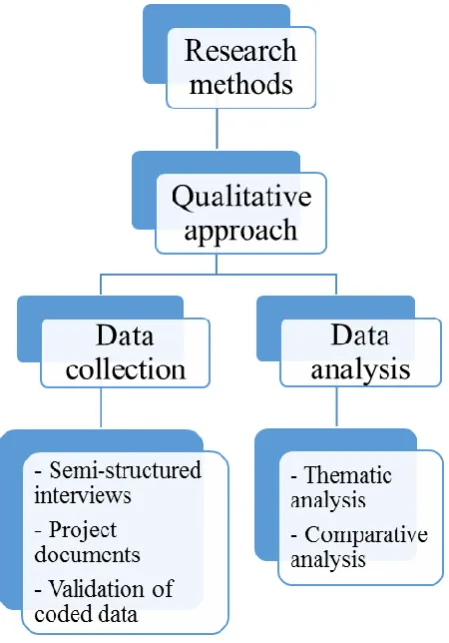
qualitative approach for this study. Figure 2 demonstrates the research instruments used
13
Figure 2: Research methods adopted
The company case implementations were investigated with three different sources of
evidence: (1) to complement the data collected from one-to-one semi-structured
interviews, (2) ERP project related documents have been analysed and (3) the coded data
obtained from interviews have been validated with the respective companies. The 14 case
implementations comprise SAP and Oracle ERP system implementations across both the
manufacturing and service sectors. More details about case implementations such as the
number of modules implemented, the scope of the project, implementation duration, the
nature of the business, etc can be found in Appendix 1. Semi-structured interviews were
helpful to confirm what was already known and reveal new themes by allowing
interviewees the freedom to express their views in their own terms (Baskerville et al.,
2000). Usually, interview participants are not willing to share their personal project
experiences in front of superiors, peers and subordinates; thus, adopting one-to-one
semi-structured interviews is appropriate for this study (Kraemmerand et al., 2003). Having a
one-to-one interview provides the ability to obtain in-depth individual ERP
implementation experience with respect to a particular project (McAdam and Galloway,
14
In order to eradicate the limitations of only using semi-structured interviews, ERP project
documents and validation of coded data were used as additional data sources to achieve
triangulation. ERP project documents from case implementation companies include As-Is
process documents, solution designs, To-Be process documents, customisation
documents, project hierarchy documents and functional documents. After coding, all
coded data were validated by the respective case implementation company in order to
ensure the integrity of the results derived from the semi-structured interviews and the
ERP project documents.
3.1 Empirical data collection
This research attempts to collect empirical evidence from experienced people who have been directly involved in off-the-shelf ERP systems implementation. A qualitative rather than quantitative approach was adopted, because it attempts to obtain ERP experts’ opinion on how, why and with-what knowledge has been created, transferred, retained and applied in relation to different types of knowledge during ERP systems implementation. Such opinions from participants cannot be elicited using quantitative methods. Hence, the main method of data collection was through semi-structured interviews with ERP experts in respect of implementations. More specifically, one-to-one semi-structured interviews were selected over other data collection methods (Baskerville et al., 2000; Kraemmerand et al., 2003; McAdam and Galloway, 2005; Liu et al., 2014). Therefore, they were also able to discover the determinants for each KM lifecycle phase in order to focus on specific aspects of KM during ERP projects by industry practitioners.
Specific criteria for recruiting suitable interview participants for this study have been defined based on the nature of the research demands (Newell et al., 2003; Jones et al., 2006). The criteria are: (1) The participants must have directly involved in off-the-shelf ERP systems implementation (such as SAP and Oracle) but not in-house developed systems/bespoke systems, including the respective case implementation in the UK. This is because the-shelf ERP systems are very different from bespoke systems in that off-the-shelf systems are more standardised, hence the empirical evidence collected would offer guidance to a wider range of beneficiaries. (2) The participants must have at least 10 years of experience in ERP field, to ensure that the participants have high level of skill
15
carried out with ERP experts from 14 companies in the UK which have implemented off-the-shelf ERP systems. Appendix 1 provides an overview of the companies, interviewees and ERP systems implemented. Each interview lasted for 2 hours on average to allow participants plenty of time to elaborate on their opinions. The experts largely held senior management positions in ERP client and vendor companies and this helped to obtain the fine details of what happened during the ERP projects.
An interview template (see Appendix 2) was developed and questions were focused around obtaining the participant’s opinion on how, why and with-what knowledge had been created, transferred, retained and applied in relation to the four types of knowledge during the ERP systems implementation. However, there was also freedom for participants to express ideas with respect to the context being discussed, and the interview template was used as a guide to keep the focus of the discussion on the subject. Many probing questions were asked to get participants to clarify their answers as necessary.
3.2 Data analysis approach
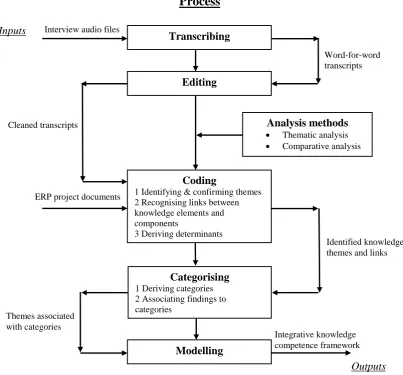
16
between different knowledge elements and components, and deriving the determinants for each KM lifecycle phase based on the prevalence of knowledge activities and the strength of empirical support from the 14 ERP case implementations. Finally, the integrative knowledge competence framework was developed in the modelling stage, based on the empirical findings, by refining the theoretical framework.
Transcribing
Editing
Analysis methods
Thematic analysis
Comparative analysis
Coding
1 Identifying & confirming themes 2 Recognising links between knowledge elements and components
3 Deriving determinants
Categorising 1 Deriving categories 2 Associating findings to categories
Interview audio files
Cleaned transcripts
Word-for-word transcripts
ERP project documents
Identified knowledge themes and links
Inputs
Outputs
Modelling Themes associated
with categories
Integrative knowledge competence framework
[image:16.595.97.501.188.563.2]Process
Figure 3: Data analysis approach
Analysis methods
17
Descriptive coding (first-order codes): the researcher identifies those parts of the
transcript data that address the research questions and allocates descriptive codes throughout the whole transcript.
Interpretative coding (second-order themes): the researcher groups together
descriptive codes that seem to share some common meaning and create an interpretative code that captures this.
Defining overarching themes (aggregate dimensions): the researcher identifies a
number of overarching themes that characterise key concepts in the analysis. The second-order themes were identified using first-order codes, and they were categorised as aggregated dimensions to reveal the knowledge components and enhance knowledge competence and interaction between them to achieve ERP success.
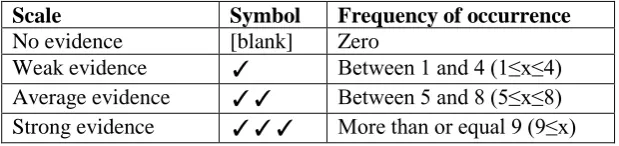
[image:17.595.147.457.542.615.2]The comparative analysis is closely connected to thematic analysis (Dawson, 2002) and used with thematic analysis in this study. Using this method, data from different people is compared and contrasted and the process continues until the researcher is satisfied that no new issues are arising. Comparative analysis was used to confirm the second-order themes revealed through thematic analysis when there was less literature support. In this case, comparative analysis was used particularly to confirm the discovery of knowledge determinants and knowledge flows (in the knowledge network model) revealed through the thematic analysis. Comparative analysis counts how frequently a particular second-order theme is referred in data collected for the 14 case implementations. The frequency scales were developed using the guidelines by Rihoux and Ragin (2008) to denote empirical evidence in each case implementation and those have been shown in Table 3.
Table 3: Scales used for comparative analysis
Scale Symbol Frequency of occurrence
No evidence [blank] Zero
Weak evidence ✓ Between 1 and 4 (1≤x≤4) Average evidence ✓✓ Between 5 and 8 (5≤x≤8) Strong evidence ✓✓✓ More than or equal 9 (9≤x)
4. Empirical analysis and findings
18
“knowledge network model” that facilitates interactions between the knowledge components is developed.
4.1 Evaluation of knowledge determinants and their interaction with knowledge
types and KM lifecycle phases
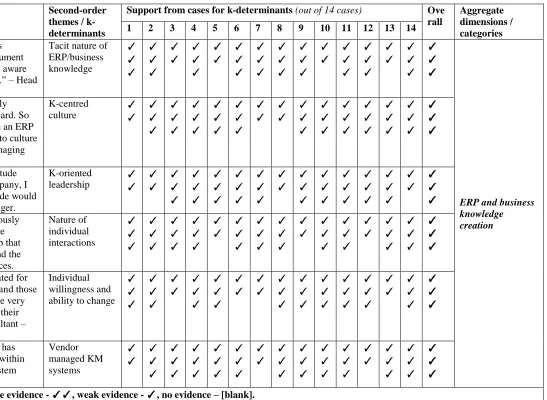
This section explains how the knowledge determinants were evaluated and examines their interaction with knowledge types and KM lifecycle phases. Table 4 offers a sample of the empirical evidence which was used to derive the knowledge determinants for each KM lifecycle phase, with the support of knowledge-layers and knowledge-types. It also shows the interaction of knowledge determinants with knowledge types and KM lifecycle phases. The full version of Table 4 can be found in Appendix 3. The knowledge determinants were identified through the first-order codes (see column one and two) based on thematic analysis. After this, the knowledge determinants (second-order themes) were validated with respect to each case implementation (see column three) using comparative analysis. The comparative analysis was used to work back and forth between the 14 case implementations and establish the empirical support from the case implementations for knowledge determinants. Column four illustrates the overall strength of the empirical evidence from the 14 cases. Finally, aggregate dimensions revealed the knowledge determinant’s interaction with knowledge types and KM lifecycle phase (see column five). Column five of Table 4 shows the aggregate dimensions a particular determinant falls into, and those dimensions show knowledge integration through the knowledge types and KM lifecycle phases to enhance knowledge competence, thereby achieving ERP project success:
The first category is ‘ERP and business knowledge creation’ and the determinants
that fall into this category are applicable for the creation of both knowledge types.
The second category is ‘Business knowledge creation’ and the determinants that
fall into this category are only applicable for the creation of business process knowledge.
The third category is ‘ERP knowledge transfer’ and the determinant that falls into
this category is only applicable for the transfer of ERP package knowledge. The fourth category is ‘ERP and business knowledge transfer’ and the
19
The fifth category is ‘ERP and business knowledge retention’ and the
determinants that fall into this aggregate dimension are applicable for the retention of both knowledge types.
The sixth category is ‘ERP and business knowledge application’ and the
20
Table 4: Empirical evidence in discovering knowledge determinants
First-order codes Second-order
themes / k-determinants
Support from cases for k-determinants (out of 14 cases) Ove
rall
Aggregate dimensions / categories
1 2 3 4 5 6 7 8 9 10 11 12 13 14
“It is very very difficult to codify someone’s knowledge… However, it is possible to document how the modules work and make everybody aware of how the modules interact with each other.” – Head of business solutions.
Tacit nature of ERP/business knowledge ✓ ✓ ✓ ✓ ✓ ✓ ✓ ✓ ✓ ✓ ✓ ✓ ✓ ✓ ✓ ✓ ✓ ✓ ✓ ✓ ✓ ✓ ✓ ✓ ✓ ✓ ✓ ✓ ✓ ✓ ✓ ✓ ✓ ✓ ✓ ✓ ✓ ✓ ✓ ✓ ✓
ERP and business knowledge creation
“It’s not like a security system where the only business interaction is when you swipe the card. So that is a real technical implementation. With an ERP you are into business process and you are into culture change where it is to standardisation.” - Managing director. K-centred culture ✓ ✓ ✓ ✓ ✓ ✓ ✓ ✓ ✓ ✓ ✓ ✓ ✓ ✓ ✓ ✓ ✓ ✓ ✓ ✓ ✓ ✓ ✓ ✓ ✓ ✓ ✓ ✓ ✓ ✓ ✓ ✓ ✓ ✓ ✓ ✓ ✓ ✓ ✓ ✓ ✓ ✓
“I strongly believe knowledge capturing attitude should come from the leadership of the company, I mean managers, and then that positive attitude would pass on to the subordinates.” – Project manager.
K-oriented leadership ✓ ✓ ✓ ✓ ✓ ✓ ✓ ✓ ✓ ✓ ✓ ✓ ✓ ✓ ✓ ✓ ✓ ✓ ✓ ✓ ✓ ✓ ✓ ✓ ✓ ✓ ✓ ✓ ✓ ✓ ✓ ✓ ✓ ✓ ✓ ✓ ✓ ✓ ✓ ✓ ✓
“Not just in the formal workshops, but obviously informal coffee charts, the corridor charts are important because you’re starting to build up that rapport between the functional consultant and the business representative.” – Head of IT services.
Nature of individual interactions ✓ ✓ ✓ ✓ ✓ ✓ ✓ ✓ ✓ ✓ ✓ ✓ ✓ ✓ ✓ ✓ ✓ ✓ ✓ ✓ ✓ ✓ ✓ ✓ ✓ ✓ ✓ ✓ ✓ ✓ ✓ ✓ ✓ ✓ ✓ ✓ ✓ ✓ ✓ ✓ ✓ ✓
“The end users the people who were nominated for the project team, the project team members and those that participated in the design blueprint, were very willing and able and very knowledgeable in their particular processes…” - Independent consultant – freelance.
Individual willingness and ability to change
✓ ✓ ✓ ✓ ✓ ✓ ✓ ✓ ✓ ✓ ✓ ✓ ✓ ✓ ✓ ✓ ✓ ✓ ✓ ✓ ✓ ✓ ✓ ✓ ✓ ✓ ✓ ✓ ✓ ✓ ✓ ✓ ✓ ✓ ✓ ✓ ✓ ✓ ✓ ✓ ✓
“What we observed was vendor KM system has supported for knowledge creation activities within the project team members...” – Financial system manager. Vendor managed KM systems ✓ ✓ ✓ ✓ ✓ ✓ ✓ ✓ ✓ ✓ ✓ ✓ ✓ ✓ ✓ ✓ ✓ ✓ ✓ ✓ ✓ ✓ ✓ ✓ ✓ ✓ ✓ ✓ ✓ ✓ ✓ ✓ ✓ ✓ ✓ ✓ ✓ ✓ ✓ ✓ ✓ ✓
21
4.2 Knowledge competence impact on ERP success
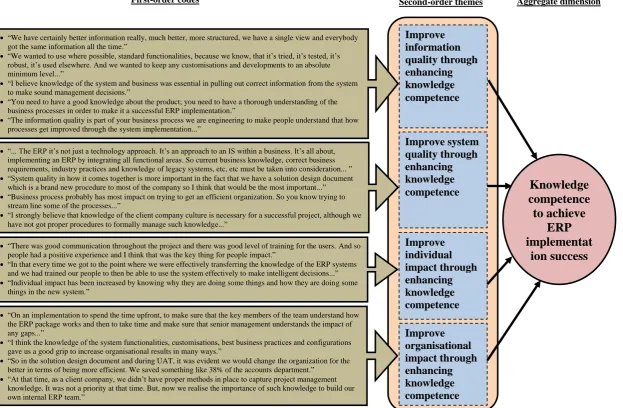
This sub-section discusses how knowledge competence helps to achieve ultimate ERP success by examining the four ERP success variables: information quality, system quality, individual impact and organisational impact. Figure 4 demonstrates how the relationship between knowledge competence and ERP implementation success was discovered with the use of different knowledge components based on the empirical data collected for this study.
(1) Knowledge competence to improve information quality
22
“We have certainly better information really, much better, more structured, we have a single view and everybody got the same information all the time.”
“We wanted to use where possible, standard functionalities, because we know, that it’s tried, it’s tested, it’s robust, it’s used elsewhere. And we wanted to keep any customisations and developments to an absolute minimum level...”
“I believe knowledge of the system and business was essential in pulling out correct information from the system to make sound management decisions.”
“You need to have a good knowledge about the product; you need to have a thorough understanding of the business processes in order to make it a successful ERP implementation.”
“The information quality is part of your business process we are engineering to make people understand that how processes get improved through the system implementation...”
“... The ERP it’s not just a technology approach. It’s an approach to an IS within a business. It’s all about, implementing an ERP by integrating all functional areas. So current business knowledge, correct business requirements, industry practices and knowledge of legacy systems, etc, etc must be taken into consideration... ”
“System quality in how it comes together is more important in the fact that we have a solution design document which is a brand new procedure to most of the company so I think that would be the most important...”
“Business process probably has most impact on trying to get an efficient organization. So you know trying to stream line some of the processes...”
“I strongly believe that knowledge of the client company culture is necessary for a successful project, although we have not got proper procedures to formally manage such knowledge...”
“There was good communication throughout the project and there was good level of training for the users. And so people had a positive experience and I think that was the key thing for people impact.”
“In that every time we got to the point where we were effectively transferring the knowledge of the ERP systems and we had trained our people to then be able to use the system effectively to make intelligent decisions...”
“Individual impact has been increased by knowing why they are doing some things and how they are doing some things in the new system.”
“On an implementation to spend the time upfront, to make sure that the key members of the team understand how the ERP package works and then to take time and make sure that senior management understands the impact of any gaps...”
“I think the knowledge of the system functionalities, customisations, best business practices and configurations gave us a good grip to increase organisational results in many ways.”
“So in the solution design document and during UAT, it was evident we would change the organization for the better in terms of being more efficient. We saved something like 38% of the accounts department.”
“At that time, as a client company, we didn’t have proper methods in place to capture project management knowledge. It was not a priority at that time. But, now we realise the importance of such knowledge to build our own internal ERP team.”
Improve information quality through enhancing knowledge competence
Improve system quality through enhancing knowledge competence
Improve individual impact through enhancing knowledge competence
Improve organisational impact through enhancing knowledge competence
Knowledge competence to achieve
ERP implementat
[image:22.842.114.738.79.487.2]ion success First-order codes Second-order themes Aggregate dimension
23
(2) Knowledge competence to improve system quality
The findings confirm that the smooth operation of the system depends on the amount of knowledge that the company has retained during the implementation. With the knowledge of the ERP system, users have been able to increase business efficiency through the new system; for instance, close down month ends sooner, cash collection is more efficient, paying suppliers is quicker and there is a better understanding of management information. On the other hand, this study also finds that knowledge of current business processes is the foundation of the whole implementation, because all system configurations are based on the business requirements that need to be achieved by the ERP system. Failing to correctly understand the current processes might end up with system failure. According to all the case implementations, changing the way the company operates has had a big impact in implementing a better system with best industry practices by eliminating non-value adding business activities. For example, one user might go through several screens to enter some data onto the system than entering the same data in the old system, however the additional minutes spent entering the data will result in reduced time in other activities by lowering costs.
(3) Knowledge competence to improve individual impact
The knowledge of the ERP system was important to gather the exact business requirements and to manage the expectations of the stakeholders during implementation. The study reveals that the roles and responsibilities of individuals have been changed significantly and they have become analytical, rather than simply data entry users, with the use of new ERP system. Good communication throughout the project and a high level of training has always given users a positive experience in their careers. If the users are not confident in using the system, it can negatively impact the company after go-live. Therefore, self-confidence in system use will increase by staff knowing why they are doing something and how they should do it in the new system. The empirical evidence shows that keeping the right users from the start to end of the project without pulling them at the middle of the project for business activities helped them to gradually develop their skills to operate the system effectively.
(4) Knowledge competence to improve organisational impact
24
system. The direct organisational results mainly include profit maximisation and cost reduction through the system. With an integrated off-the-shelf ERP system in-place, it has been possible to save money on business activities as well as being easier to maintain the system. In addition, wider use of correct system features and functionalities have improved organisational results along with sound decision making.
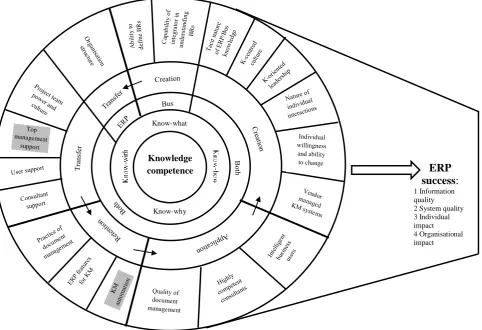
4.3 The “knowledge competence wheel”
Based on the data analysis approach, a “knowledge competence wheel” was developed to highlight the empirical findings of this study, as shown in Figure 5. It has been modelled by taking knowledge components and their interactions into consideration, as discussed in the previous sections through the empirical evidence. In other words, the aggregate dimensions in Table 4 and Figure 4 were used in modelling the wheel. This integrative “knowledge competence wheel” illustrates the key knowledge determinants identified, the knowledge components viewed from multiple perspectives, and their relationships during ERP systems implementation, to enhance knowledge competence. The integrative “knowledge competence wheel” is structured with four levels:
The first level of the “knowledge competence wheel” comprises the four knowledge-layers
(i.e. know-what, know-how, know-why and know-with).
Knowledge types are in the second level (ERP package knowledge, business process
knowledge, and both ERP package and business process knowledge).
The third level shows the four KM lifecycle phases (i.e. creation, transfer, retention and
application).
The fourth level displays the key knowledge determinants which are then assigned to
corresponding KM lifecycle phases, knowledge types and knowledge layers, that are defined in the first three levels. Follow the spoke lines on the “wheel” to cross different levels.
The four variables to measure the success of the ERP systems implementation through the advancement of knowledge competence are positioned to the right hand of the “wheel”. Between the second level and forth level, it can be observed that certain determinants are only applicable to a specific knowledge type. They are as follows:
25
Knowledge-transfer -> the determinant of ‘Organisation structure’ is only applicable to ERP package knowledge.
The rest of the determinants are applicable to both ERP package knowledge and business process knowledge. The four knowledge-layers are not restricted to a specific component, and the four k-layers have been used to identify the determinants for each KM phase for both ERP package and business process knowledge types. Moreover, there is no priority for one determinant over another, but less applicable determinants (two determinants: top management support for knowledge transfer and KM automation) have been highlighted in the framework.
ERP success:
1 Information quality 2 System quality 3 Individual impact 4 Organisational impact
Knowledge competence
Know-what
[image:25.595.52.535.303.633.2]Know-why
Figure 5: Integrated “knowledge competence wheel”
26
for each KM lifecycle phase which drive the KM activities in respective phases. Therefore, it increases knowledge competence within the organisation by effectively managing the relevant knowledge elements during ERP systems implementation. Out of the four knowledge types discussed in the literature, only two have been formally managed during implementations i.e. ERP package knowledge and business process knowledge. The organisational cultural and project management knowledge have not been formally managed through the use of KM lifecycle phases according to empirical evidences (Jayawickrama et al., 2013). It is also evident from Appendix 3 that organisational cultural knowledge and project management knowledge have not been identified as
aggregate dimensions in column five. Lack of empirical evidence with respect to these two
knowledge types demonstrate the smaller contribution of such knowledge towards a successful
implementation. The knowledge pertaining to organisational culture and project management have
not been created, transferred, retained and applied during ERP implementations as with ERP package
knowledge and business process knowledge. Therefore, organisational cultural and project management knowledge types have not been shown in the integrative “knowledge competence wheel”. The knowledge layers were only used to discover the determinants for each KM lifecycle phase which were applicable for ERP package and business process knowledge.
4.4 The “knowledge network model”
In order to understand how the knowledge determinants drive the ERP knowledge lifecycle activities and how the knowledge components interact with each other, a “knowledge network model” has been developed. The model is a much larger component than that shown in the theoretical framework (see Figure 1), based on the empirical evidence. As a result, it was developed as a separate model, in order
to understand the integration of the various knowledge components in the knowledge competence
wheel. The model was developed by identifying the stakeholders and studying the flow of knowledge
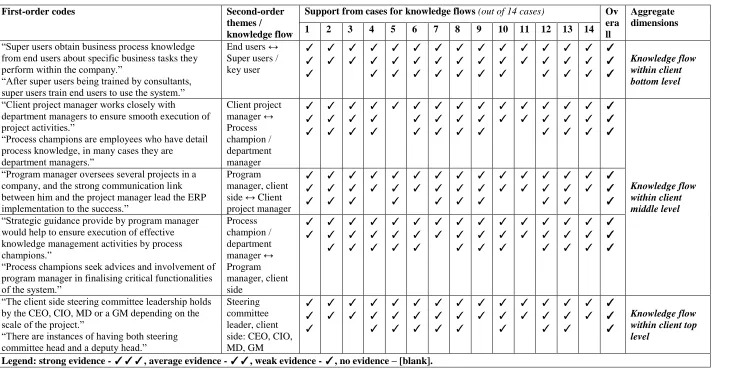
between stakeholders during ERP implementations. Table 5 shows the empirical evidence from ERP project documents and interview transcripts to develop the knowledge network model by explaining knowledge flows between various stakeholders. The full version of Table 5 can be found in Appendix 4. The knowledge flows among stakeholders were identified through the first-order codes
27
28
Table 5: Empirical evidence in developing knowledge network model
First-order codes Second-order
themes /
knowledge flow
Support from cases for knowledge flows (out of 14 cases) Ov
era ll
Aggregate dimensions
1 2 3 4 5 6 7 8 9 10 11 12 13 14
“Super users obtain business process knowledge from end users about specific business tasks they perform within the company.”
“After super users being trained by consultants, super users train end users to use the system.”
End users ↔ Super users / key user ✓ ✓ ✓ ✓ ✓ ✓ ✓ ✓ ✓ ✓ ✓ ✓ ✓ ✓ ✓ ✓ ✓ ✓ ✓ ✓ ✓ ✓ ✓ ✓ ✓ ✓ ✓ ✓ ✓ ✓ ✓ ✓ ✓ ✓ ✓ ✓ ✓ ✓ ✓ ✓ ✓ ✓ Knowledge flow within client bottom level
“Client project manager works closely with
department managers to ensure smooth execution of project activities.”
“Process champions are employees who have detail process knowledge, in many cases they are
department managers.” Client project manager ↔ Process champion / department manager ✓ ✓ ✓ ✓ ✓ ✓ ✓ ✓ ✓ ✓ ✓ ✓ ✓ ✓ ✓ ✓ ✓ ✓ ✓ ✓ ✓ ✓ ✓ ✓ ✓ ✓ ✓ ✓ ✓ ✓ ✓ ✓ ✓ ✓ ✓ ✓ ✓ ✓ ✓ ✓ ✓ Knowledge flow within client middle level
“Program manager oversees several projects in a company, and the strong communication link between him and the project manager lead the ERP implementation to the success.”
Program manager, client side ↔ Client project manager ✓ ✓ ✓ ✓ ✓ ✓ ✓ ✓ ✓ ✓ ✓ ✓ ✓ ✓ ✓ ✓ ✓ ✓ ✓ ✓ ✓ ✓ ✓ ✓ ✓ ✓ ✓ ✓ ✓ ✓ ✓ ✓ ✓ ✓ ✓ ✓ ✓ ✓ ✓ ✓
“Strategic guidance provide by program manager would help to ensure execution of effective knowledge management activities by process champions.”
“Process champions seek advices and involvement of program manager in finalising critical functionalities of the system.”
Process champion / department manager ↔ Program manager, client side ✓ ✓ ✓ ✓ ✓ ✓ ✓ ✓ ✓ ✓ ✓ ✓ ✓ ✓ ✓ ✓ ✓ ✓ ✓ ✓ ✓ ✓ ✓ ✓ ✓ ✓ ✓ ✓ ✓ ✓ ✓ ✓ ✓ ✓ ✓ ✓ ✓ ✓ ✓ ✓ ✓ ✓
“The client side steering committee leadership holds by the CEO, CIO, MD or a GM depending on the scale of the project.”
“There are instances of having both steering committee head and a deputy head.”
Steering committee leader, client side: CEO, CIO, MD, GM ✓ ✓ ✓ ✓ ✓ ✓ ✓ ✓ ✓ ✓ ✓ ✓ ✓ ✓ ✓ ✓ ✓ ✓ ✓ ✓ ✓ ✓ ✓ ✓ ✓ ✓ ✓ ✓ ✓ ✓ ✓ ✓ ✓ ✓ ✓ ✓ ✓ ✓ ✓ ✓ Knowledge flow within client top level
29
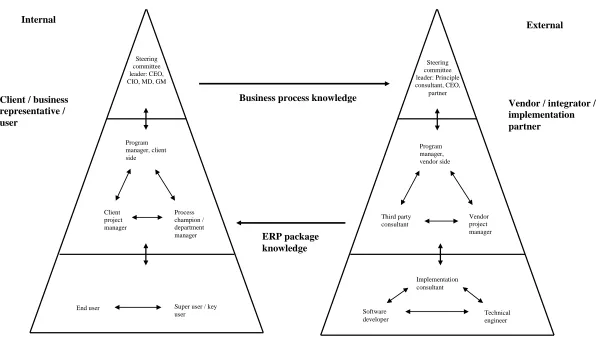
The “knowledge network model” in Figure 6 demonstrates all stakeholders/actors involved in an ERP system’s implementation and the direction of knowledge flow between the stakeholders. It is believed that business performance depends on the smooth flow of knowledge between stakeholders, rather than pure access to knowledge by individuals (Lech, 2014; Newell, 2015). The stakeholders are divided into two main groups; internal (client) and external (vendor). Business process knowledge flows largely from client stakeholders to vendor stakeholders, based on the empirical findings. On the contrary, ERP package knowledge flows from vendor stakeholders to client stakeholders. It can also be observed that the traditional management hierarchy (top, middle and bottom management levels) exists in external and internal project structures. The top level of the client structure consists of steering committee leaders such as CEO, CIO, MD or GM. Depending on the scope of the project, there may be a head and a deputy head in the steering committee leadership. The middle level comprises program manager – client side, client project manager and process champions / departmental managers. The bottom level consists of end users and super users / key users. The top level steering committee leader of the implementation partner organisation could be a principle consultant, CEO or partner. The middle level comprises program manager – vendor side, vendor project manager and third party consultants. Implementation consultants, software developers and technical engineers represent the bottom level. These were evident from the project communication charts of various case implementations investigated in this study. Only on a few occasions, such as in deciding critical system functionalities, can the implementation consultant directly reach the client and vendor top management.
30
Steering committee leader: Principle consultant, CEO,
partner Steering
committee leader: CEO, CIO, MD, GM
External Internal
Client / business representative / user
Vendor / integrator / implementation partner
ERP package knowledge
Business process knowledge
Program manager, client side
Process champion / department manager Client
project manager
Third party consultant
Implementation consultant
Technical engineer Software
developer
Program manager, vendor side
Vendor project manager
[image:30.842.79.692.77.416.2]End user Super user / key user
31
The knowledge network model is useful in three main ways to understand the current research context being investigated: (1) It assists to recognise how the knowledge determinants drive the knowledge lifecycle activities in achieving ERP implementation success. (2) It helps to understand the interactions of knowledge components such as knowledge types, knowledge layers and KM lifecycle. (3) The model facilitates to identify how various stakeholders are involved in knowledge creation, knowledge transfer, knowledge retention and knowledge application in order to enhance knowledge competence. The study shows the importance of effective knowledge management during ERP implementation. The framework of integrative knowledge competence demonstrates the inter-linked effects of knowledge determinants, knowledge-types, knowledge-layers and KM lifecycle phases to increase knowledge competence in order to achieve ultimate ERP success.
5. Discussion and conclusions
The paper has determined the integration of multiple knowledge components with empirical evidence (i.e. knowledge determinants, knowledge-types, knowledge-layers and KM lifecycle) to increase knowledge competence within industries. This paper focused on the empirical evidence of an integrative knowledge competence framework dedicated to ERP systems implementation in real business practices. The key findings of this study have made a number of contributions to the existing body of knowledge while answering the three research questions outlined previously: (1) It provides empirical evidence of the key knowledge determinants that drive knowledge creation, transfer, retention and application in ERP systems implementation in the UK manufacturing and service industries. (2) It develops an innovative “knowledge competence wheel” which assembles knowledge components from multiple perspectives, including knowledge layers, knowledge types and knowledge lifecycle stages. The “knowledge competence wheel” further helps link the identified key knowledge determinants with knowledge components. (3) It develops a “knowledge network model” that facilitates knowledge flows between the multiple stakeholders involved in the ERP system’s implementation, which can help to understand the interactions between the knowledge components during the KM lifecycle.
32
Leidner, 2001; Horwitch and Armacost, 2002; Metaxiotis, 2009; Candra, 2014). In each KM phase, there are important stakeholders to initiate and carry out KM activities during ERP systems implementation, as discussed in the “knowledge network model”. In addition, the “knowledge network model” shows the hierarchy of the stakeholders and how the knowledge flows between them. There have been four knowledge types discussed in the literature; however, the empirical finding of this study reveals that only two knowledge types (ERP package and business process knowledge) have been formally managed through the KM lifecycle. The other two knowledge types (organisational cultural and project management knowledge) have not been formally managed using the KM lifecycle, as per the findings.
Among the 19 knowledge determinants identified through the empirical findings and shown in the “knowledge competence wheel”, the majority of the determinants are new to the KM for ERP success domain. However, there are several determinants that support the literature. Vandaie (2008) identifies the tacit nature of process knowledge and how the nature of individual interactions affect the knowledge creation. This study confirms the results in knowledge creation in the context of ERP implementations. The study carried out by Donate and Guadamillas (2011) illustrates that knowledge centred culture is vital to drive knowledge creation. This study also supports this point. Hung et al. (2012) reveal that top management support is necessary for knowledge transfer activities during the project, but the findings of this study show that top management support is necessary for ERP projects in general, but there is less direct involvement of top managers in knowledge transfer. On the other hand, consultant support positively impacted knowledge transfer activities in both studies. Xu and Ma (2008) highlight the significance of consultant support and user support for effective knowledge transfer activities, which is reinforced by this study. This study also demonstrates how the practice of document management determines the retention of up-to-date and relevant knowledge. This study, along with Wang et al. (2007) both indicate the importance of competent consultants and intelligent business users in order to fetch and re-use relevant knowledge during ERP implementation.
33
knowledge competence for ERP systems implementation. Firstly, it classifies determinants for knowledge management in ERP implementation under each KM lifecycle phase with the support of knowledge-types and knowledge-layers to enhance knowledge competence, based on empirical evidence. Therefore, practitioners can focus on the key determinants in creating, transferring, retaining and applying relevant knowledge during ERP implementation. Secondly, it informs ERP implementers about the most important knowledge types (ERP package and business process knowledge) and how, why and with-what to create, transfer, retain, use and re-use knowledge during an ERP implementation, to achieve project success. Furthermore, they can prioritise and pay less attention to the less important knowledge-types (organisational cultural and project management knowledge). Thirdly, the framework of integrative knowledge competence shows the determinants that are only applicable for ERP and business knowledge respectively, as well as the determinants applicable for both knowledge-types in managing knowledge in each KM phase. Therefore, it eases the management of knowledge in each knowledge-type by narrowing the practitioner’s broader knowledge area to be focused into one knowledge-type and one KM phase. Fourthly, this is the first integrative knowledge competence framework dedicated to ERP implementation in industry.
However, this study does have some limitations. It concentrates only on the ERP implementation stage, not including the pre or post implementation stages. The case implementations only cover SAP and Oracle ERP product implementations in the UK. Further research will extend this work, to prioritise the importance of knowledge-types to achieve ERP success with the support of four success measures and obtain responses from a wider audience of the ERP field. Finally, the integrative knowledge competence framework will be extended for the ERP pre and post implementation stages as well.
References
Ahmadi, S., Papageorgiou, E., Yeh, C.-H. & Martin, R. 2015. Managing readiness-relevant activities for the organizational dimension of ERP implementation. Computers in Industry, 68, 0, 89-104.
Alavi, M. & Leidner, D. 2001. Review: knowledge management and knowledge management systems: conceptual foundations and research issues. MIS Quarterly (MISQ Review), 25, 1, 107–136.
34
Bartezzaghi, E., Corso, M. & Verganti, R. 1997. Continuous Improvement And Inter-Project Learning In New Product Development. International Journal of Technology Management, 14, 116-138.
Baskerville, R., Pawlowski, S. & Mclean, E. Enterprise resource planning and organizational knowledge: patterns of convergence and divergence. International Conference on Information Systems, 2000.
Braun, V. & Clarke, V. 2006. Using thematic analysis in psychology. Qualitative research in psychology, 3, 2, 77-101.
Candra, S. 2014. Knowledge management and enterprise resource planning implementation: a conceptual model. Journal of Computer Science, 10, 3, 499-507.
Chau, P. Y. K. 1995. Factors used in the selection of packaged software in small businesses: Views of owners and managers. Information & Management, 29, 2, 71-78.
Chen, Y.-J. 2010. Development of a method for ontology-based empirical knowledge representation and reasoning. Decision Support Systems, 50, 1-20.
Davenport, T. H. 1998. Putting the enterprise into the enterprise system. Harvard Business Review, July-August, 121-131.
Dawson, C. 2002. Practical Research Methods. Oxford, How To Books.
Dhar, V. & Stein, R. 1997. Intelligent decision support methods: The science of knowledge work. Upper Saddle River, NJ, Prentice Hall.
Donate, M. J. & Guadamillas, F. 2011. Organizational factors to support knowledge management and innovation. Journal of Knowledge Management, 15, 6, 890-914. Ehie, I. C. & Madsen, M. 2005. Identifying critical issues in enterprise resource planning
(ERP) implementation. Computers in Industry, 56, 545–557.
Gable, G. 2005. The enterprise system lifecycle: through a knowledge management lens. Strategic Change, 14, 255-263.
Hong, K.-K. & Kim, Y.-G. 2002. The critical success factors for ERP implementation: an organizational fit perspective. Information & Management, 40, 1, 25-40.
Horwitch, M. & Armacost, R. 2002. Helping Knowledge Management Be All It Can Be. Journal of Business Strategy, 23, 26-31.
Huang, S., Chang, I., Li, S. & Lin, M. 2004. Assessing risk in ERP projects: identify and prioritize the factors. Industrial Management & Data Systems, 104, 8, 681-688. Huber, G. P. 1991. Organizational Learning: The Contributing Processes And The
Literatures Organization Science, 2, 88-115.
Hung, W.-H., Ho, C.-F., Jou, J.-J. & Kung, K.-H. 2012. Relationship bonding for a better knowledge transfer climate: An ERP implementation research. Decision Support Systems, 52, 406-414.
Jayawickrama, U., Liu, S. & Hudson Smith, M. 2013. An integrative knowledge management framework to support ERP implementation for improved management decision making in industry. Heidelberg, Dordrecht, London, New York, Springer.
Jeng, D. & Dunk, N. 2013. Knowledge Management Enablers and Knowledge Creation in ERP System Success. International Journal of Electronic Business Management, 11, 1, 49-59.
Jones, M. C., Cline, M. & Ryan, S. 2006. Exploring knowledge sharing in ERP implementation, an organizational culture framework. Decision Support Systems, 41, 2, 411−434.
35
Kraemmerand, P., Møller, C. & Boer, H. 2003. ERP implementation: An integrated process of radical change and continuous learning. Production Planning & Control, 14, 4, 338-348.
Kumar, K. & Van Hillegersberg, J. 2000. Enterprise resource planning experiences and evolution. Communications of the ACM, 43, 3, 22-26.
Lech, P. 2014. Managing knowledge in IT projects: a framework for enterprise system implementation. Journal of Knowledge Management, 18, 3, 551-573.
Li, H. & Li, L. 2000. Integrating systems concepts into manufacturing information systems. Systems Research and Behavioral Science, 17, 135-147.
Liu, P. 2011. Empirical study on influence of critical success factors on ERP knowledge management on management performance in high-tech industries in Taiwan. Expert Systems with Applications, 38, 8, 10696-10704.
Liu, S., Annansingh, F., Moizer, J., Liu, L. & Sun, W. 2012. A knowledge system for integrated production waste elimination in support of organisational decision making. In: Hernandez, J. E., Zarate, P., Dargam, F., Delibasic, B., Liu, S. And Ribeiro. R., (Eds.) (ed.) Decision Support Systems - Collaborative Models and Approaches in Real Environments, Lecture Notes in Business Information Processing. Heidelberg, Dordrecht, London, New York: Springer, 134-150. Liu, S., Moizer, J., Megicks, P., Kasturiratne, D. & Jayawickrama, U. 2014. A knowledge
chain management framework to support integrated decisions in global supply chains. Production Planning & Control, 25, 8, 639-649.
Maditinos, D., Chatzoudes, D. & Tsairidis, C. 2012. Factors affecting ERP system implementation effectiveness. Journal of Enterprise Information Management, 25, 1, 60-78.
Mcadam, R. & Galloway, A. 2005. Enterprise resource planning and organisational innovation: a management perspective. Industrial Management & Data Systems, 105, 3, 280-290.
Metaxiotis, K. 2009. Exploring the rationales for ERP and knowledge management integration in SMEs. Journal of Enterprise Information Management, 22, 1/2, 51-62.
Miles, M. B. & Huberman, A. M. 1994. An Expanded Sourcebook Qualitative Data Analysis, 2nd ed. California, Sage Publications.
Nah, F., Lau, J. & Kuang, J. 2001. Critical factors for successful implementation of enterprise systems. Business Process Management Journal, 7, 3, 285-296.
Newell, S. 2015. Managing knowledge and managing knowledge work: what we know and what the future holds. Journal of Information Technology, 30, 1, 1-17.
Newell, S., Huang, J. C., Galliers, R. D. & Pan, S. L. 2003. Implementing enterprise resource planning and knowledge management systems in tandem, fostering efficiency and innovation complementarity. Information & Organisation, 13, 25-52.
O'leary, D. E. 2002. Knowledge management across the enterprise resource planning systems life cycle. International Journal of Accounting Information Systems, 3, 99-110.
Parry, G. & Graves, A. 2008. The importance of knowledge management for ERP systems. International Journal of Logistics Research and Applications, 11, 6, 427-441.