Bridging eHealth and the Internet of Things: the
SPHERE Project
Ni Zhu, Tom Diethe, Massimo Camplani, Lili Tao, Alison Burrows, Niall Twomey,
Dritan Kaleshi, Majid Mirmehdi, Peter Flach, Ian Craddock
Abstract—There is a widely-accepted need to revise current forms of healthcare provision. Of particular interest are sensing systems in the home, which have been central to a number of studies in this area. This paper presents an overview of this rapidly growing body of work, as well the implications for machine learning, with a view to uncovering a gap between the state of the art and the broad needs of healthcare services in Ambient Assisted Living (AAL). Most approaches address specific healthcare concerns, which typically results in solutions that are not able to support full-scale sensing and data analysis for a more generic healthcare service. The paper also outlines a multiple-modality sensor platform with heterogeneous network connectivity, which is under development in the Sensor Platform for HEalthcare in Residential Environment (SPHERE) Interdisciplinary Research Collaboration (IRC).
Index Terms—Internet of Things, multiple-modality sensing, Ambient Assisted Living, Machine Learning F
1
I
NTRODUCTIONTraditional models of healthcare are being re-examined due to well-known demographic challenges. Today’s ageing population and the rise in chronic health conditions is precipitating a shift towards empowering people to manage their care and wellbeing at home. In this con-text, advances in AAL are providing resources to improve the lived experience of patients, as well as informing necessary interventions from relatives, carers and healthcare professionals.
The current challenge for the AAL interdis-ciplinary research community is how to build integrated, useful and deployable systems that can close the loop from the data sensing, through processing engines, to the end users. Such systems will rely on the sensor datasets and deliver in (quasi) real-time relevant con-textual information to specific end users, from clinicians or care providers to the individual whose data is being collected and processed. The premise of the work in this area is that building profiles of Activities of Daily Living (ADL) will lead to useful datasets that can scale to very large populations, supporting early
di-agnosis, tracking the progress of chronic dis-eases, informing personalised treatment, and encouraging healthy behaviour change.
These systems are composed of several sub-systems and rely on various technologies, some of which are fit for purpose and some are still under development. Additional challenges arise when these technologies have to cope with multiple end users, as happens in the domestic environment. A household often comprises sev-eral people, who may have differing healthcare needs and individual preferences. For smart home systems to be effective for the detection and management of health conditions, they must provide meaningful clinical data but also be desirable to their domestic users.
to develop an inclusive and meaningful smart home solution are:
• capability to capture and use data from
a variety of sensor technologies;
• capability to support establishment of
temporal, spatial and user identity rela-tionships in the sensor data;
• generic and easily extensible data
rep-resentation (ontology) and interoperabil-ity;
• support for end-user data ownership
management (raw data access and pri-vacy);
• capability to support context-aware
se-curity; and
• passing a critical threshold of
user-acceptability.
This article provides the rationale for ad-dressing these challenges. Firstly, Section 2 re-views the sensing technologies we argue are necessary for a complete system. Section 3 re-views networking technologies and in Section 4 reviews the important aspects of pattern anal-ysis and Machine Learning (ML) in this setting. Sections 5 and 6 are devoted to a discussion of where we are in terms of complete end-to-end systems, in addition to how the SPHERE project seeks to achieve this and create a flexible template for future systems of this type.
2
S
ENSINGT
ECHNOLOGIES INAAL
Sensing technologies have been used in AAL for a range of applications. Among existing solutions, physiological, environmental and vi-sion sensors are frequently used for the pur-pose of health monitoring in the home. These help to characterise users’ everyday activities for dedicated purposes by providing long-term sensing data that, in combination with ambient intelligence algorithms, contribute to behaviour pattern recognition [1]. The following subsec-tions reflect the distinction that is frequently adopted in the literature, owing to the different data outputs and approaches required for each. However, one of the aims of SPHERE is to integrate these various sensing modalities into an Internet of Things (IoT) solution for AAL.
2.1 Physiological Signal Monitoring
Physiological signals provide original health evidence from the human body, using diverse biosensors that measure various physiologi-cal parameters [2]. These biosensors are de-ployed in an implantable (in-body), wearable (on-body), portable (off-body) or environmen-tal modality. Of these, implantable sensors are the most intrusive and are listed here merely for completeness. The aspiration in AAL has been to foster comfort through unobtrusive technol-ogy.
In recent years, the advent of personal wear-able devices for self-monitoring has seen re-search outputs and fashionable electronic gad-gets moving into the consumer space. Figure 1 summarises a number of representative sys-tems, their individual features and architec-tures [3][4][5]. Further research on telecare, tele-health, and telemedicine systems has improved biomedical sensing efficacy. Different concept-to-prototype systems have been proposed and implemented in response to individual health-care issues. A typical biomedical sensing sys-tem is composed of a data acquisition module (DAQ) that collects various biomedical signals; a signal processing module; a communication gateway (normally a computer or smartphone) forwarding data over the Internet; as well as a monitoring centre. Mobile healthcare (m-Health) was introduced for telemedicine and uses smartphones and handheld devices for biomedical signal monitoring [6].
Almost all of these personal physiological signal monitoring systems can automatically synchronise data from the device with various embedded sensors to the network gateway or monitoring centre. Whilst it is promising that these wearable self-monitoring gadgets per-form activity tracking to collect data on ADL, the case-analysis in Figure 1 shows that there are several issues that must be addressed for them to truly support AAL systems:
• lack of long-term, continuous,
easy-to-access raw data that contains rich details of clinically-relevant information;
• lack of interoperability with other
System Raw data freely accessible
Multiple signals
Data
aggregation Application Expandability
Fitbit x ✓ ✓ Fitness Limited
Jawbone Up x ✓ ✓ Fitness Limited
Nike+ Fuelband SE x ✓ ✓ Fitness x
Pebble Steel x x x Fitness x
Withings blood
pressure montor ✓ ✓ x
Measurement of
blood pressure Limited
Fit Shirt ✓ ✓ x Vital signs monitoring x
V-Patch ✓ x x Vital signs monitoring x
Verity AAL [3] ✓ ✓ ✓ Physiological signals
monitoring x
H@H [4] ✓ ✓ x Vital signs monitoring Limited
Activity Recognition
System [5] ✓ x x Activity recognition x
Com
m
er
ci
al
Prod
u
cts
Re
se
arc
h
O
u
tp
u
[image:3.612.100.513.43.228.2]ts
Fig. 1: A list of representative physiological signal monitoring systems.
• limited expandability to adapt to new
sensing data.
The technology is moving towards more comfortable and desirable wearable devices and should also build on the real-life attitudes and experiences of users. Two big challenges are the absence of ambient information related to the physiological data, and energy consump-tion (battery life). The former may introduce sensing cognition difficulty or even bias, and the latter is actually a bottleneck towards wear-able device prosperity.
2.2 Home Environment Monitoring
A Smart Home (SH) is a system of pervasive information and communication technologies by which both the home environment and the resident interaction with the environment are monitored in an unobtrusive manner [2]. A list of sensors is given in [2], which is by no means comprehensive and has the potential to grow as the field of sensor technologies matures. Most AAL research projects will use a diverse sensor portfolio rather than single sensors in various applications, as discussed below.
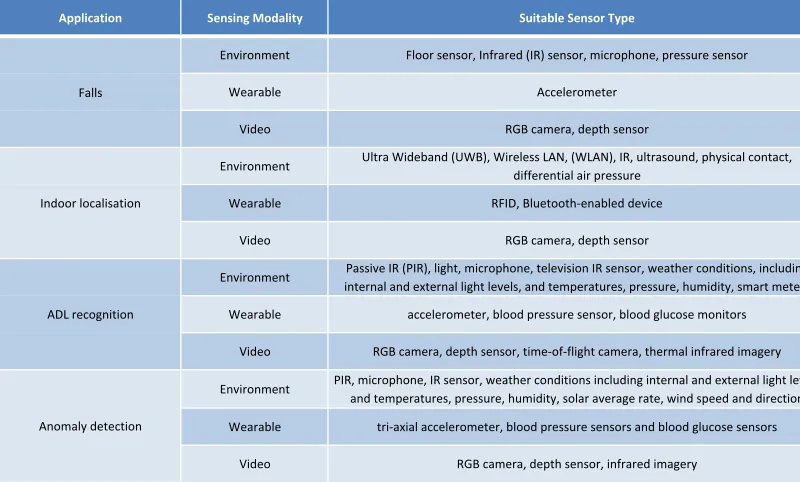
Fusion of ambient-monitoring and activity detection techniques is capable of sensing an environment and recognising various activities or events. Figure 2 provides an overview of some existing sensors and technology types, as well as their application in a healthcare set-ting [7]. It is not an exhaustive summary but
a representative list for demonstration of dif-ferent sensor modality usage. One prominent area of application is fall detection reviewed in [8], using wearable, ambient and camera based approaches. Accurate localisation within the home environment is an important com-ponent in AAL applications [9]. Many ambi-ent sensor systems were applied to address different health issues, such as mental health, emotional state, sleep measures, Diabetes and Alzheimer’s Disease [10]. Those sensing tech-nologies have been used to monitor individual daily activities, aiming to gain health assess-ment and detect deviation from the user’s be-haviour pattern. A good example is the CASAS [11] project that treats environments in SH as intelligent agents, based on technologies of ML and pervasive computing.
systems are disaggregated or less-efficiently manipulated by advanced ML algorithms. A truly generic AAL system of systems that cre-ates knowledge-based context-aware services for AAL is yet to be realised [13].
2.3 Vision-based monitoring
Intelligent visual monitoring has received a great deal of attention in the past decade, for ex-ample due to increased interest in smart health-care systems in the home environments [14]. Although a wide variety of sensing technolo-gies can be used in in-home assistive systems, visual sensors have the potential to address several limitations of current systems: they do not require the user to wear them and they are able to simultaneously detect multiple events.
Analysis of human motion by way of vi-sual information has been achieved through the use of multi-camera architectures in indoor and outdoor environments [15], by using cen-tralised or distributed platforms predicated on processing requirements and scalability issues. Recently, human motion analysis algorithms have dramatically improved through the com-bination of colour cameras and depth sensors. The main advantages of depth sensors are their low cost and their ability to provide real-time dense depth data without intensive processing. These devices allow the extraction of detailed 3D information of a scene, which boost the ability to detect the human shape. However, they suffer from several limitations: interfer-ence from natural light, scattering, and limited range. Although visual data provides rich infor-mation, most of them may involve individuals’ privacy. Therefore, different methods for ensur-ing privacy protection in videos and images are proposed as shown in [14].
Intelligent video analysis can lend itself well to many application areas in health monitoring. Systems for daily life assistance have been de-signed for monitoring people with dementia, measuring sleeping-respiration, and tracking medication habits [16]. Vision systems can also feature in infotainment gadgets that have fu-elled research interest in their use in healthcare applications [17]. However, works based solely
on computer vision techniques for monitoring and clinical evaluation of movement disorders are still in their infancy.
Fall detection is a major challenge in health-care for the elderly, and video-based technolo-gies have many advantages over popular wear-able alarms, since they do not require action from the user and are always active. Recently RGB-Depth (RGB-D) devices have been used successfully for this task, which outperform other sensing technologies [8]. The use of stair-cases can directly reflect musculoskeletal prob-lems and the progress of recovery, and more recently, a general method for online estimation of the quality of movement on stairs was pro-posed in [18].
Main limitations of video-based systems are due to cluttered environments, occluded scenes and unstable lighting conditions. Even if these issues can be reduced by employing multiple cameras or complementary devices, such as depth sensors, they are still open problems to be tackled by integrating the information provided by different environmental sensors. Moreover, in most real world applications, analysing and processing data in real time is paramount, but most existing methods have difficulty achieving this due to their computa-tional demands. The lack of a comprehensive and realistic dataset is also an issue.
3
N
ETWORKINGT
ECHNOLOGIES FORS
MARTH
OMESApplication Sensing.Modality Suitable.Sensor.Type
Environment Floor,sensor,,Infrared,(IR),sensor,,microphone,,pressure,sensor
Wearable Accelerometer
Video RGB,camera,,depth,sensor
Environment Ultra,Wideband,(UWB),,Wireless,LAN,,(WLAN),,IR,,ultrasound,,physical,contact,,
differential,air,pressure
Wearable RFID,,BluetoothEenabled,device
Video RGB,camera,,depth,sensor
Environment Passive,IR,(PIR),,light,,microphone,,television,IR,sensor,,weather,conditions,,including,
internal,and,external,light,levels,,and,temperatures,,pressure,,humidity,,smart,meters
Wearable accelerometer,,blood,pressure,sensor,,blood,glucose,monitors
Video RGB,camera,,depth,sensor,,timeEofEflight,camera,,thermal,infrared,imagery
Environment PIR,,microphone,,IR,sensor,,weather,conditions,including,internal,and,external,light,levels,
and,temperatures,,pressure,,humidity,,solar,average,rate,,wind,speed,and,direction
Wearable triEaxial,accelerometer,,blood,pressure,sensors,and,blood,glucose,sensors
Video RGB,camera,,depth,sensor,,infrared,imagery
Falls
Indoor,localisation
ADL,recognition
[image:5.612.100.500.43.284.2]Anomaly,detection
Fig. 2: Sensor taxonomy of environment, wearable and video sensing modalities used in ambient monitoring and activity detection.
Due to existing in-home infrastructures, wired technologies commonly provide high data transmission rates. Among these, Power Line Communication (PLC) technologies are evolving in the field of smart home applica-tions, especially Advanced Metering Infrastruc-ture (AMI) and Automated Home Energy Man-agement (AHEM). Widely adopted systems use X10, KNX and ITU-T G.Hn, IEEE 1901 [2].
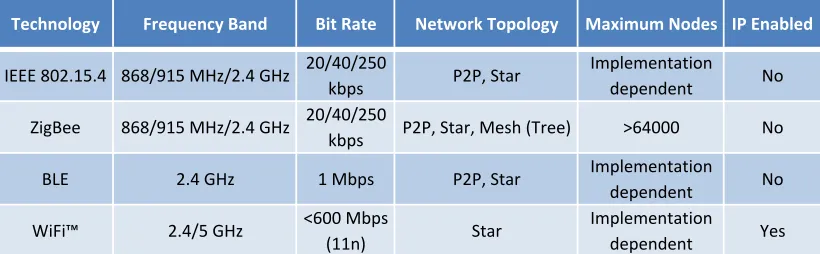
Various wireless networking technologies and communication protocols were sum-marised in [19]. Figure 3 lists some of the typical short-range wireless technologies used. WiFiTM, apart from those non-IP enabled
tech-nologies, has the significant advantage of being Internet Protocol (IP) enabled. However, hard-ware with WiFiTM connectivity is still relatively
power hungry, and it is less suitable for battery-powered sensor motes in applications antici-pating long-term deployment. To break down this barrier, an adaptive sub-layer 6LoWPAN was introduced to enable IPv6 onto low-power processing-limited embedded hardware over low-bandwidth wireless network. An energy-efficient Wireless Sensor Network (WSN) solu-tion will improve AAL system user experience and requires less maintenance effort.
There are several basic factors for adopting these networking technologies, such as guaran-teeing the necessary communications through-put, the power consumption and the cost of hardware. Beyond those elements, to fully un-derpin a multi-modality sensor system in the SH, the major function of IoT infrastructure is to provide ubiquitous connectivity and interaction to all the sensing devices in a heterogeneous network circumstance. Additional advantages over allowing access to existing Internet infras-tructures can be gained by IP-enabled sensing networks, removing the need for translation gateways or proxies in hardware and software, and thus creating more seamless integrated AAL systems. Data collecting points in WSN must have identifiers to be manipulated. If a unique ’name’ to the sensor is defined by an IP (more likely IPv6) address, the data collecting point can be addressable in the Internet through the whole end-to-end system.
Technology Frequency.Band Bit.Rate Network.Topology Maximum.Nodes IP.Enabled
IEEE#802.15.4# 868/915#MHz/2.4#GHz# 20/40/250#
kbps# P2P,#Star
Implementation#
dependent No
ZigBee 868/915#MHz/2.4#GHz# 20/40/250#
kbps# P2P,#Star,#Mesh#(Tree) >64000 No
BLE 2.4#GHz# 1#Mbps P2P,#Star Implementation#
dependent No
[image:6.612.101.511.45.172.2]WiFi™ 2.4/5#GHz# <600#Mbps#(11n) Star Implementation#dependent Yes
Fig. 3: Short-range wireless networking technologies in the home.
technologies were introduced to attempt to solve this problem.
All AAL systems are built around a gateway device. This provides facilities for remote access to the sensor data, and to connect and bridge diverse networks. The home gateway imple-ments multiple functions, such as local mon-itoring/controlling centre, intelligent agents, network management. Saito [21] reviewed the home gateway from a broad, practical per-spective, and proposed a home gateway ar-chitecture suitable for better implementation and management. Middleware solutions em-bedded in the gateway, in the context of sens-ing platform for healthcare and wellbesens-ing in the SH, address the fusion of different clusters of sensors, coordinating and managing these highly heterogeneous systems. Several works address AAL systems specifically, since often middleware solutions are designed for different application domains. For example, openAAL middleware defines a framework on top of the Open Service Gateway initiative (OSGi) specification to facilitate integration and com-munication between services, including Con-text Manager, Procedural Manager and Com-poser [22]. A key factor for the IoT infrastruc-ture successfully enabling AAL systems is to provide loosely coupled functionality, allowing auto-configuration and dynamic interoperabil-ity amongst not only all devices but end users.
4
P
ATTERNA
NALYSIS ANDM
ACHINEL
EARNINGThe performance of different sensor technolo-gies, in terms of reliability, discriminative
abil-ity, monetary and energy costs, is context-dependent. Readings from individual sensors must be preprocessed, integrated and mined to provide a most likely model of activity which maximises information content in the given health monitoring context. Moreover, the decision-making process must be implemented and fine-tuned, and in particular it must con-sider the contextual knowledge of sensors and individuals.
Whilst there have been some advances in applying ML techniques to ADL, an end-to-end system does not currently exist. What follows is a discussion of the state of the art of individual elements of such a ML system.
4.1 Quantification of Uncertainty
Multiple heterogeneous sensors in a real world environment introduce different sources of un-certainty. At a basic level, we might have sen-sors that are simply not working, or that are giving incorrect readings. More generally, a given sensor will at any given time have a particular signal to noise ratio, and the types of noise that are corrupting the signal might also vary.
graphical models, coupled with efficient infer-ence algorithms, provide a principled and flex-ible modelling framework [23].
4.2 Feature Construction, Selection, and Fusion
Given an understanding of data generation pro-cesses, the sensor data can be interpreted for the identification of meaningful features. Hence it is important that this is closely coupled to the development of the individual sensing modali-ties [24], e.g. it may be that sensors have strong spatial or temporal correlations or that specific combinations of sensors are particularly mean-ingful.
One of the main hypotheses underlying the SPHERE project [25] is that once calibrated, many weak signals from particular sensors can be fused into a strong signal allowing meaning-ful health-related interventions [26].
Based on the calibrated and fused signals, the system must decide whether intervention is required and which intervention to recom-mend; interventions will need to be informa-tion gathering as well as health providing. This is known as the exploration-exploitation dilemma, which must be extended to address the challenges of costly interventions and com-plex data-structures [27].
4.3 Adapting to Context and Domain Knowledge
Data mining and decision making need to be contextualised and situated within a wide body of non-trivial health-related background knowledge, which in turn requires highly ex-planatory models [28]. The operating context will vary from training to deployment, between different applications, residents and house-holds, and so incorporation of methods that are robust to these variations are critical.
Continuous streams of data can be mined for temporal patterns that vary between indi-viduals. These temporal patterns can be directly built into the model-based framework, and ad-ditionally can be learnt on both group-wide and individual levels to learn context sensitive and
specific patterns. For a recent review of meth-ods for dealing with multiple heterogeneous streams of data in an on-line setting see [29].
Finally, interfaces will need to communi-cate the data and predictions. Such commu-nications must be informative and assist in decision-making to influence improved health behaviour. This includes communicating un-certainty and conflicts within data, which is increasingly being seen as an important issue [30].
5
T
HEW
AYF
ORWARDThe overview presented in the previous sec-tions, even at a high level, reveals certain gaps and challenges arising due to the multi-disciplinary nature of the systems required to provide AAL data and applications for health-care purposes in home environments. Some of these challenges are not unique to eHealth, but are arising in more application fields where researchers and industry are looking to use data collected in multiple domains and using multiple technological systems, not necessarily designed or even deployed together, in order to bring together a cohesive, stable, and reliable view of the measured activities.
sensing technologies cannot fully represent the context, complexity and variety of daily living. Furthermore, we have shown that, for reasons of cost, time, and user acceptance, the acquired data reported by historical and existing stud-ies is only partially able to exploit anticipated synergies for health and wellbeing applications. SPHERE is addressing this by building a multi-modality sensing system as an infrastructure platform fully integrated, at design stage, with intelligent data processing algorithms driving the data collection.
In this paper, single-domain technologies and networking have been shown to be mature enough to properly enable eHealth architec-tured systems. Whilst individual technologies will continue to be developed, whether wireless or wired, the main challenge remains the design of an analytics-driven data-gathering platforms that provide a rich-set of data efficiently, reli-ably and on-demand. This then can be used to test the hypothesis that ADL data is useful for a range of health and wellbeing purposes, as it is widely envisaged.
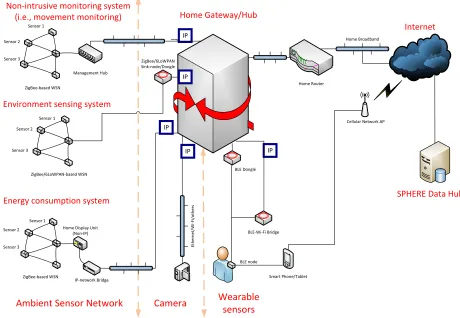
The premise for the SPHERE project is the fact that we do not know what data is neces-sary to drive analytics for ADL identification and standardisation across different homes, and that single-modality sensing platforms cannot answer this question fully. Therefore SPHERE has developed a multi-modality sensing plat-form for collecting data from 100 houses in the Bristol area. The overall architecture, which fol-lows a clustered-sensor approach, is shown in Figure 4 and is currently installed and running in a real house in Bristol (the SPHERE House).
The SPHERE system uses three sensing technologies: environment, video, and wear-able sensing. The environment sensors include humidity, temperature, air quality, noise level, luminosity, occupancy, door contacts, and util-ities (water, gas, electricity) consumption, cen-trally and at appliance/faucet level. The cur-rently deployed system uses 40 nodes provid-ing more than 90 data points, all structured and timestamped to establish context and tempo-ral relationships. The video sensors are RGB-D devices which are placed in various locations, such as the living room, kitchen, corridor/hall
and staircases. The video sensors allow us to obtain residents’ cadence, gait and 3D trajec-tory throughout the smart environment. The wearable sensors are Bluetooth Low Energy (BLE) devices with dual accelerometer data, and support dual operation mode (connection-oriented and extra-low energy connectionless communication modes) to be able to provide full 50Hz accelerator measurements in addi-tion to localisaaddi-tion service. The data from each sensor cluster is collected in a SPHERE Home Gateway, which maintains time synchronisa-tion in the system and, in addisynchronisa-tion, controls data access to ensure user privacy. The data from the SPHERE Home Gateway is collected by a heterogeneous data management platform (SPHERE Data Hub), which manages data ac-cess and will allow a dynamic library of data analytics services to be available for registered end users. The current system is operational and is undergoing scripted validation experi-ments, where multiple sensor domain data are processed to establish ADL against external (manual or automatic) activity tagging. Upon deployment, the data from the environment, wearable and camera sensing sub-systems are tasked to be fused and processed in real-time for activity and health monitoring in longi-tudinal and focused studies. One of the key objectives of the SPHERE project is to deliver datasets with a strong focus on the richness of meta-data annotations, as well as the experi-mental and user contexts in order to provide to the wider research community a platform for improved understanding of their roles in behavioural trends for healthcare.
6
C
ONCLUSIONStogether seamlessly in an AAL platform the two pillars of data-collecting infrastructure and analytics. The discussion in the review sections of this paper shows that whilst the networking and communication technology challenges will continue to be addressed in their respective domains, the biggest gap is to establish a clear link between the data-gathering infrastructure and data analytics by designing the infras-tructure with the data analytics in mind (i.e. defining what data is needed to be collected rather than doing the best one can with the data available). It is clear that single-modality sensing systems provide insufficient data sets to allow verification of the hypothesis of the link between ADL changes and health-related conditions or behaviour for general population. Whilst designing AAL platforms that integrate multi-modality sensing systems is not cheap, it is the only way to address this hypothe-sis conclusively. To this end the SPHERE IRC has designed a multi-modal AAL IoT system driven by data analytics requirements. The sys-tem is under test in a single house, and will be deployed in a general population of 100 homes in Bristol (UK), and the data set collected will be made available to the AAL research community.
A
CKNOWLEDGEMENTThe SPHERE IRC includes 40+ researchers working together and contributing to the SPHERE vision. The authors acknowledge fully the valued contribution, discussions and ex-change of ideas that have influenced the anal-ysis in this paper. A full list of SPHERE col-laborators can be found at http://www.irc-sphere.ac.uk.
This work was performed under the SPHERE IRC funded by the UK Engineering and Physical Sciences Research Council (EPSRC), Grant EP/K031910/1.
R
EFERENCES[1] L. Chen, C. D. Nugent, J. Biswas, and J. Hoey, Activity Recognition in Pervasive Intelligent Environments. Atlantis Publishing Corporation, 1st ed., 2011.
[2] M. R. Alam, M. B. I. Reaz, and M. A. M. Ali, “A review of smart homes: Past, present, and future,”Systems, Man, and Cybernetics, Part C: Applications and Reviews, IEEE Transactions on, vol. 42, no. 6, pp. 1190–1203, 2012. [3] J. Winkley, P. Jiang, and W. Jiang, “Verity: an ambient
assisted living platform,”Consumer Electronics, IEEE Trans-actions on, vol. 58, no. 2, pp. 364–373, 2012.
[4] L. Fanucci, S. Saponara, T. Bacchillone, M. Donati, P. Barba, I. Sanchez-Tato, and C. Carmona, “Sensing de-vices and sensor signal processing for remote monitoring of vital signs in chf patients,” Instrumentation and Mea-surement, IEEE Transactions on, vol. 62, pp. 553–569, March 2013.
[5] P. Gupta and T. Dallas, “Feature selection and activity recognition system using a single triaxial accelerome-ter,” Biomedical Engineering, IEEE Transactions on, vol. 61, pp. 1780–1786, June 2014.
[6] S. Adibi, “Link technologies and Blackberry mobile health (mHealth) solutions: A review,” Information Technology in Biomedicine, IEEE Transactions on, vol. 16, no. 4, pp. 586– 597, 2012.
[7] G. Deak, K. Curran, and J. Condell, “A survey of active and passive indoor localisation systems,”Computer Com-munications, 2012.
[8] M. Mubashir, L. Shao, and L. Seed, “A survey on fall detection: Principles and approaches,” Neurocomputing, vol. 100, pp. 144–152, 2013.
[9] P. Barsocchi, S. Chessa, F. Furfari, and F. Potorti, “Evalu-ating ambient assisted living solutions: The localization competition,” Pervasive Computing, IEEE, vol. 12, no. 4, pp. 72–79, 2013.
[10] G. Acampora, D. Cook, P. Rashidi, and A. Vasilakos, “A survey on ambient intelligence in healthcare,”Proceedings of the IEEE, vol. 101, pp. 2470–2494, Dec 2013.
[11] D. J. Cook, M. Schmitter-Edgecombe,et al., “Assessing the quality of activities in a smart environment,”Methods Inf Med, vol. 48, no. 5, pp. 480–485, 2009.
[12] S. Mennicken, J. Vermeulen, and E. M. Huang, “From today’s augmented houses to tomorrow’s smart homes: New directions for home automation research,” in Pro-ceedings of the 2014 ACM International Joint Conference on Pervasive and Ubiquitous Computing, UbiComp ’14, (New York, NY, USA), pp. 105–115, ACM, 2014.
[13] P. Rashidi and A. Mihailidis, “A survey on ambient-assisted living tools for older adults,”Biomedical and Health Informatics, IEEE Journal of, vol. 17, no. 3, pp. 579–590, 2013. [14] A. A. Chaaraoui, J. R. Padilla-L ´opez, F. J. Ferr´andez-Pastor, M. Nieto-Hidalgo, and F. Fl ´orez-Revuelta, “A vision-based system for intelligent monitoring: Human behaviour anal-ysis and privacy by context,” Sensors, vol. 14, no. 5, pp. 8895–8925, 2014.
[15] S. Soro and W. Heinzelman, “A survey of visual sensor networks,”Advances in Multimedia, vol. 2009, 2009. [16] S.-R. Ke, H. L. U. Thuc, Y.-J. Lee, J.-N. Hwang, J.-H. Yoo,
and K.-H. Choi, “A review on video-based human activity recognition,”Computers, vol. 2, no. 2, pp. 88–131, 2013. [17] Q. Ding, I. Stevenson, N. Wang, W. Li, Y. Sun, Q. Wang,
K. Kording, and K. Wei, “Motion games improve balance control in stroke survivors: a preliminary study based on the principle of constraint-induced movement therapy,” Displays, 2012.
Non-intrusive monitoring system (i.e., movement monitoring)
ZigBee-based WSN
Management Hub
Home Gateway/Hub
Environment sensing system
ZigBee/6LoWPAN-based WSN
IP
ZigBee/6LoWPAN Sink-node/Dongle
Energy consumption system
ZigBee-based WSN
Home Display Unit (Non-IP) Sensor 1
Sensor 1
Sensor 1 Sensor 2
Sensor 2
Sensor 2 Sensor 3
Sensor 3
Sensor 3
IP-network Bridge
IP
Home Router
Wearable sensors
BLE Dongle
BLE node BLE-Wi-Fi Bridge
IP
Camera IP
Et
h
er
n
et
/W
i-Fi
/o
th
er
s
Ambient Sensor Network
Cellular Network AP
Internet
SPHERE Data Hub
Smart Phone/Tablet
Home Broadband
[image:10.612.71.531.58.376.2]IP
Fig. 4: The proposed system scenario of the sensing platform.
[19] H. Alemdar and C. Ersoy, “Wireless sensor networks for healthcare: A survey,”Computer Networks, vol. 54, no. 15, pp. 2688–2710, 2010.
[20] N. Ishikawa, “PUCC activities on overlay networking pro-tocols and metadata for controlling and managing home networks and appliances,”Proceedings of the IEEE, vol. 101, pp. 2355–2366, Nov 2013.
[21] N. Saito, “Ecological home network: An overview,” Pro-ceedings of the IEEE, vol. 101, pp. 2428–2435, Nov 2013. [22] P. Wolf, A. Schmidt, J. Otte, M. Klein, S. Rollwage,
B. K ¨onig-Ries, T. Dettborn, and A. Gabdulkhakova, “ope-nAAL - the open source middleware for ambient-assisted living (AAL),” in AALIANCE Conference, Malaga, Spain, 2010.
[23] C. Bishop, “Model-based machine learning,”Phil Trans R Soc A, vol. 371, 2013.
[24] H. Liu and H. Motoda,Feature extraction, construction and selection: A data mining perspective. Springer, 1998.
[25] T. R. Diethe, N. Twomey, and P. Flach, “Sphere-a sensor platform for healthcare in a residential environment,” Large-scale Online Learning and Decision Making Workshop, 2014.
[26] L. A. Klein, Sensor and data fusion: a tool for information assessment and decision making, vol. 324. Spie Press Belling-ham, WA, 2004.
[27] B. C. May, N. Korda, A. Lee, and D. S. Leslie, “Opti-mistic bayesian sampling in contextual-bandit problems,” J. Mach. Learn. Res., vol. 13, pp. 2069–2106, June 2012.
[28] T. G¨artner, J. W. Lloyd, and P. A. Flach, “Kernels and distances for structured data,”Machine Learning, 2004. [29] T. Diethe and M. Girolami, “Online learning with
(multi-ple) kernels: a review,”Neural computation, vol. 25, no. 3, pp. 567–625, 2013.