TRINITY COLLEGE DUBLIN
C
OL
AISTE NA
´
TR´
ION
OIDE
´
, BAILE
ATHA
´
C
LIATH
Modelling session types using contracts
Giovanni Bernardi and Matthew Hennessy
Computer Science Department Technical Report TCS-CS-2011-07
Modelling session types using contracts
Giovanni Bernardi and Matthew Hennessy
August 2, 2011
Abstract
Session types and contracts are two formalisms used to study client-server protocols. In this paper we study the relationship between them. The main result is the existence of a fully abstract model of session types; this model is based on a natural interpretation of these types into a subset of contracts.1
Contents
1 Introduction 1
2 Session types 3
2.1 Sub-typing . . . 6
3 Contracts 8
3.1 The contract language . . . 8 3.1.1 Client-Server interactions and the compliance relation . . 14 3.2 The server pre-order . . . 19 3.2.1 Co-inductive characterisation . . . 19 3.3 Must testing . . . 24
4 Session Contracts 29
4.1 Session contracts . . . 29 4.2 The server pre-order . . . 30 4.3 The client pre-order . . . 35
5 Modelling session types 38
5.1 Examples and applications . . . 41
6 Conclusions 43
6.1 Summary . . . 43
1
Introduction
Communication between processes in a distributed system often consists of a structured dialogue, following a protocol which specifies the format of the mes-sages interchanged and, at least for binary communication, the direction of the
messages. Session types,ST, have been introduced as an approach to the static analysis of the participants of such dialogues. They allow structured sequences of non-uniform messages to be interchanged between the participants. For ex-ample, using the notation of [GH05], the type ![Int]; ?[Real];end specifies the output of a value of type Intfollowed by the input of a value of typeReal, af-ter which the dialogue is af-terminated. Flexibility in the permitted sequencing of messages by a process is accommodated by two choice operators; thebranching type &hT1, T2ioffers a choice to the partner in the dialogue between following
either the protocol specified by the typeT1or that specified byT2. On the other
hand the choice type ⊕hT1, T2iallows the process itself to follow either of the
protocols specified byT1 orT2.
Sub-typing, [GH05], also increases the flexibility of the type system; intu-itively T1 4st T2 means that any participant designed with the protocol
speci-fied byT1in mind may also be used in a situation where the protocol specified
byT2 will be followed. Intuitively this pre-order between session types is
gen-erated by allowing more possibilities in branching types and restricting them in choice types. The reader is refered to [HVK98, GH05, CP10] for more details on session types, including how they are associated with processes and what behaviour they guarantee.
Web services [ACKM04, BPZ09] are distributed components which can be combined using standard communication protocols and machine-independent message formats to provide services to clients. To encourage reusability, de-scriptions of their behaviour are typically made available in searchable reposi-tories [oasisS11]. In papers such as [CCLP06, LP07, CGP09, Bd10] a language of contracts has been proposed for describing this behaviour which, despite a very different surface syntax, is very similar in style to session types. In par-ticular there is the sequencing of messages α1.α2, an external choice between
behaviours σ1+σ2 reminiscent of the branching type &hT1, T2i, and an
inter-nal choice between allowed behaviours σ1 ⊕σ2, reminiscent of the choice type
⊕hT1, T2i.
The object of this paper is to study the precise relationship between these two formalisms. In particular for first-order session types, which do not allow the use of communication channels in messages, we show that the theory of session types, h ST,4sti, can be captured precisely using a natural pre-order over a natural subclass of contracts.
Contracts for web services serve two roles. A contract σmay describe the behaviour of a server offering some specific service. Dually a contract ρ may describe the behaviour expected of a client who wishes to avail of a particular service. Central to the theory of contracts for web services is the idea of com-pliance between such contracts, formalised as an asymmetric relation ρaσ; it has been defined in a variety of ways in papers such as [LP07, LP08, CGP09]. This leads to two natural pre-orders on contracts, defined set theoretically:
• the server pre-order: σ1 vsrv σ2 if for every (client) contract ρ, ρ a σ1
impliesρaσ2
• the client pre-order: ρ1 vclt ρ2 if for every (server) contract σ, ρ1 a σ
impliesρ2aσ
into contracts. Unfortunately neither of the relations vsrv,vclt are sound with respect to sub-typing; specifically there are session types T1, T2 such that
T14stT2 butM(T1) andM(T2) are unrelated as contracts.
The problem lies in the fact that, viewed as constraints on behaviour, session types are much more constraining than contracts. We therefore isolate a subset of contracts, which we call session contracts SC, which are the range of the translation function M. This enables us to define more restrictive sub–server and sub–client relations, vSC
srv and v
SC
clt respectively, on these contracts. It
turns out that these relations are still unsound with respect to session sub-typing. But in the main result of the paper we show that by combining these pre-orders we obtain full-abstraction, that is a sound and complete model for session types.
The paper is organised as follows. In the next section we give the definition of session types and the sub-typing between them; this material is taken directly from [GH05], although our definition is based on first-order types; however, we allow a primitive sub-typing relation between the basic types.
In the subsequent section we study contracts. Our language for contracts is a subset of the language proposed in [Pad10]; we provide a novel co-inductive formulation of the notion of compliance; nevertheless, the resulting compliance relation coincides with that used in both in [Pad10] and [Bd10]. The sub-typing relation between session types is defined co-inductively and the connection we eventually make between contracts and session types will depend on co-inductive characterisations of the set-based pre-orders on contracts. As an example of this we provide a co-inductive characterisation of the server pre-order on contracts; this definition is based on their behaviour. There is also much similarity between the idea of contract compliance and must-testing [NH84], as has been pointed out in [LP07]. We also prove that in our framework the must-testing pre-order over contracts coincides with the server pre-ordervsrv.
In Section 4 we focus on a subset of contracts called session contracts SC, this time giving co-inductive characterisations to both the restricted server pre-order vSC
srv and the restricted client pre-order v
SC
clt over them. Due to the
very restricted nature of these contracts, these co-inductive characterisations are purely in terms of their syntax.
In Section 5 we tackle the central question of the paper. Having defined the (obvious) translation of session types into session contracts, we explain why the two natural pre-orders vSC
srv and v
SC
clt are unsound relative to the
sub-typing on session types. Finally, we prove that when combined they provide a sound and complete model; the proof is greatly facilitated by their co-inductive characterisations. The paper concludes with a brief look at related work.
2
Session types
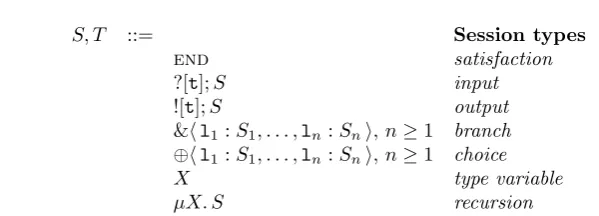
The syntax of terms for session types is given by the languageLST in Figure 1. It presupposes a denumerable set of labels L, ranged over by l, and a set of basic or ground types BT types ranged over byt. We also use a denumerable set of variables Vars, ranged over byX, in order to express recursive types.
The use of variables leads to the usual notion offree andbound occurrences of variables in terms in the standard manner; we say that a term is closed
S, T ::= Session types
end satisfaction
?[t];S input
![t];S output
&hl1:S1, . . . ,ln:Sni, n≥1 branch
⊕hl1:S1, . . . ,ln:Sni, n≥1 choice
X type variable
µX. S recursion
[image:5.595.132.432.127.235.2]We impose the additional proviso that in a term theli’s are pair-wise different.
Figure 1: Session types (first-order).
T T 6=µZ. S
TµY. T/ Y
µY. T
Figure 2: Inference rules for ↓dptonclosedterms.
avoidance substitution of terms for free variables. For the sake of clarity let us recall this definition: a substitutionsis a mapping from the setVars to the set of terms inLST. Let
s−X =
(
s\ {(X,s(X))} ifX ∈dom(s)
s otherwise
Then the result of applying a substitutionsto the termS is defined as follows:
Ss=
end ifS=end
s(X) ifS=X, andX ∈dom(S)
X ifS=X, andX 6∈dom(S)
![t]; (S0s) ifS=![t];S0
?[t]; (S0s) ifS=?[t];S0
&hl1: (S1s), . . . ,ln: (Sns)i ifS= &hl1:S1, . . . ,ln:Sni
⊕hl1: (S1s), . . . ,ln: (Sns)i ifS=⊕hl1:S1, . . . ,ln:Sni
µX.(S0(s−X)) ifS=µX. S0
In the final clause the application of s−X embodies the idea that in µX. S0
occurrences ofX in the sub-termS0are bound and therefore substitutions have no effect on them.
It is easy to check that the effect of a substitution depends only on free variables; that is,Ss1=Ss2 whenevers1(X) =s2(X) for every free variableX
occurring inS. We useT/
X to denote the singleton substitution{(X, T)}.
[image:5.595.152.448.496.607.2]Intuitively,T↓dptmeans that the free variables in T occur after a type con-structor, which differs from µ. Now we say that a term T is guarded if every sub-term of the formµX. SsatisfiesS↓dpt. Finally, we useST to denote the set of closed guarded terms, and we refer to the elements in ST assession types.
Example 2.1. The property↓dptand the property of being guarded are different. Consider the term T = &hl : µX. Xi; it is not a variable and the top-most constructor in it is not a recursion, therefore T↓dpt. A sub-term ofT is µX. X and clearlyµX. X↓dptis false; thereforeT is not guarded.
The advantage of only using guarded terms is that we can unfold types so as to obtain their top-most type constructor. To explain this formally first let us consider the function dpt from terms to N∞ (the set of natural numbers
augmented by∞). This is defined as the least such function which satisfies:
dpt(S) =
(
1 +dpt(S0S/X ) ifS=µX. S0,
0 otherwise
Note thatdpt(µX. X) =∞, but one can show that when applied to terms that satisfy↓dpt, one always obtains a natural number.
Lemma 2.2. IfS↓dpt thendpt(S)∈N.
Proof. The proof is by rule induction on the derivation ofS↓dpt.
If the axiom was used then thanks to the side condition S 6= µX. S0, and so dpt(S) = 0 because of the definition of dpt. If the other rule was used then
S =µX. S0, and the hypothesis of the rule implies SnS0/ X
o
↓dpt. Then, by
definition ofdpt,dpt(S) = 1 +dpt(SnS0/ X
o
), and by the inductive hypothesis
dpt(SnS0/ X
o
)∈N; hencedpt(S)∈N.
Proposition 2.3. The depth of any session type is finite.
Proof. Follows from the definition ofST and Lemma 2.2.
This function dpt will therefore provide a measure of session types over which we can perform induction.
Definition 2.4. [Unfolding [GH05]]
For allT ∈ ST, defineunfold(T) as follows:
unfold(T) =
(
unfold(T0µX. T/X ) ifT =µX. T0
T otherwise
Lemma 2.5. For every T ∈ ST,unfold(T) is a well-defined session type.
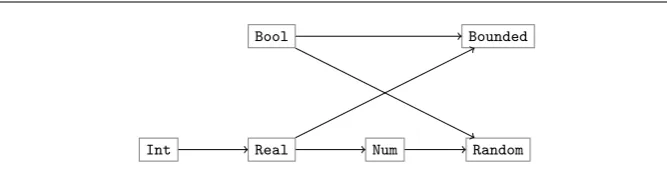
Bounded Bool
[image:7.595.128.462.125.211.2]Int Real Num Random
Figure 3: A sub-type relation on a set of basic typesBT.
Intuitively,unfold(T) unfolds top-level recursive definitions until a type con-structor appears, which is notµ. This will be extremely useful in manipulating session types.
We conclude this sub-section by showing some typical examples of session types, which we recall from the literature.
Example 2.6. [Math server, [GH05]] Consider the session type
S1=µX.&hplus: ?[Int]; ?[Int]; ![Int];X,
eq: ?[Int]; ?[Int]; ![Bool];endi
This specifies the protocol of a server which offers two services at the labelsplus
and eq. The first expects the input of two integers, after which an integer is returned, and then the service is once more available. The second also expects two integers, then returns a boolean, after which the session terminates.
An extension to the service is specified by the type
S2=µX.&hplus: ?[Int]; ?[Int]; ![Int];X,
eq: ?[Int]; ?[Int]; ![Bool];end,
neg: ?[Bool]; ![Bool];endi
This provides in addition queries for negation.
2.1
Sub-typing
There are three sources for the sub-typing relation over types. The first is some predefined pre-order over the basic types, t1 4g t2, which intuitively
says that all data-values of type t1 may be safely used where values of t2
are expected. An example is given in Figure 3, for the set of basic types
BT = {Bounded,Bool,Int,Real,Num,Random}. More generally, if JtK denotes the set of values of the basic typet then we can define4gby lettingt14gt2
whenever Jt1K ⊆ Jt2K. The other sources are two constructs of the language: thebranch construct allows sub-typing by extending the set of labels involved, while in thechoice construct the set of labels may be restricted. For example if
m≤nwe will have
&hl1:S1, . . . ,lm:Smi subtype of &hl1:S1, . . . ,ln:Sni
Moreover, we will have the standard co-variance/contra-variance of input/output types [PS96], extended to both thebranch and choiceconstructs.
However, because of the recursive nature of our collection of types, the formal definition of the sub-typing relation is given co-inductively.
Definition 2.7. [Type simulation]
Let P(X) denote the powerset of a setX and let F4st :P(ST2)−→ P(ST2)
be the function defined so that (T, U)∈ F4st(R) whenever one of the following holds:
1. ifunfold(T) =endthenunfold(U) =end
2. ifunfold(T) =?[t1];S1 thenunfold(U) =?[t2];S2and (S1, S2)∈Rand
t14gt2
3. if unfold(T) =![t1];S1 thenunfold(U) =![t2];S2 and (S1, S2)∈Rand
t24gt1
4. if unfold(T) = &hl1 : S1, . . . lm : Smi then unfold(U) = &hl1 :
S10, . . . ,ln :Sn0 iwherem≤nand (Si, Si0)∈Rfor alli∈[1, . . . , m]
5. if unfold(T) = ⊕hl1 : S1, . . . lm : Smi then unfold(U) = ⊕hl1 :
S10, . . . ,ln :Sn0 iwheren≤mand (Si, Si0)∈Rfor alli∈[1, . . . , n]
A relationRsuch thatR ⊆ F4st(R) is calledtype simulation. The co-inductive sub-typing relation4stis now defined as the greatest fixed point of the equation
X =F4st(X). Standard arguments ensure that the relation4st exists, that it is a typing relation, and indeed the greatest type simulation.
Example 2.8. LetT, Sdenote the typesµX.?[Int];X, µX.?[Real];X respec-tively. Then T 4st S because the relation R={(T, S),(?[Int];T,?[Real];S)}
is a type simulation, sinceInt4gReal.
Referring to Example 2.6, one can also show thatS14stS2by providing an
appropriate type simulation.
The requirement that session types be guarded is crucial for the sub-typing relation to be well-defined. We explain this fact in the next example.
Example 2.9. [Sub-typing and guardedness]
Consider again the termT = &hl:µX. Xiof Example 2.1. Suppose we wanted to check whether
T 4st&hl:Si
for some session type S. The definition of 4st requires us to check whether
unfold(µX. X)4stunfold(S); this check, though, can not be done because
unfold(µX. X)
isnotdefined at all (and unfold(S) may not be defined either).
Proposition 2.10. The relation4st is a pre-order onST.
Proof. See [GH05].
In [GH05] the set of types ST are used to give a typing system for the pi calculus, and appropriate Type Safety and Type Preservation theorems are proved. Here instead our aim is to give a model to the set of typesh ST,4sti
σ ::= Contracts
nil termination
1 success
α.σ action
σ+σ external choice
σ ⊕ σ internal choice
x contract variable
µx. σ recursion
Figure 4: Contract grammar.
3
Contracts
We first define our language for contracts and give some examples. In the following sub-section we define a natural server based pre-order on contracts, for which we give a behavioural co-inductive characterisation. In the final sub-section we investigate a closely related pre-order based on must testing.
3.1
The contract language
This subsection is roughly divided in three parts. In the first one we define the languageLC, and we are concerned withsyntactical properties of its termsσ’s; similarly to what we have done for session types, we introduce the unfolding of closed terms of Lc and a predicate ↓dpt to guarantee that each contract can be unfolded (Lemma 3.1). Afterwards, we give an operational semantics (Figure 5), and we discuss importantsemanticproperties that we want contracts to enjoy; this will lead to the introduction of a predicate↓, and two lemmas (Lemma 3.10 and 3.11) which ensure that (a) contracts do not diverge, and (b) silent moves lead to a finite number of derivatives. In the last part of the subsection we describe how client-server interactions are modelled by contracts (Figure 7).
A language for contracts LC is given in Figure 4. As with session types it uses a denumerable set of recursion variables Vars, here lower case, but also presupposes a setActof actions, ranged over byα, which processes guaranteeing contracts may perform; as we will see the special action X, which we assume is not inAct, will be used to indicate the fulfilment of a contract. Intuitively the contract α.σ performs the actionα and then behaves likeσ; the sum σ0+σ00
is ready to behave either asσ0 or asσ00and the choice depends on the external environment. For this reason the operation + is called external sum. The
internalsumσ0 ⊕σ00represents a contract that can behave asσ0 or asσ00, and the choice is taken by the contract independently from the environment. Such a decision can be due for instance to anifstatement in the process implementing the contracts. The symbolnildenotes an empty contract, which intuitively can never be fulfilled, while1denotes the contract that is always satisfied.
functionunfoldas in the previous section. The functiondpt is the least one that satisfies
dpt(σ) =
(
1 +dpt(σ0{µx. σ/
x}) ifσ=µx. σ0,
0 otherwise
and theunfoldis the least function that satisfies:
unfold(σ) =
(
unfold(σ0{µx. σ/x}) ifσ=µx. σ0,
σ otherwise
These definitions are not arbitrary. As it happens, they let us prove Lemma 5.2, which, to our aim, is paramount (see Section 5).
Let↓dptbe the least fixed point of the functor defined on closed terms ofLC by the rules in Figure 2.
Similarly to what done in the previous section one can prove the following lemma.
Lemma 3.1. Letσ↓dpt. Then
(i) the depth of σis finite: dpt(σ)∈N
(ii) the termunfold(σ) is defined for and, ifσ is closed thenunfold(σ) is closed.
Proof. The proof of (ii) relies on (i) and is similar to the proof of Lemma 2.2. Part (iii) can be proven by induction ondpt.
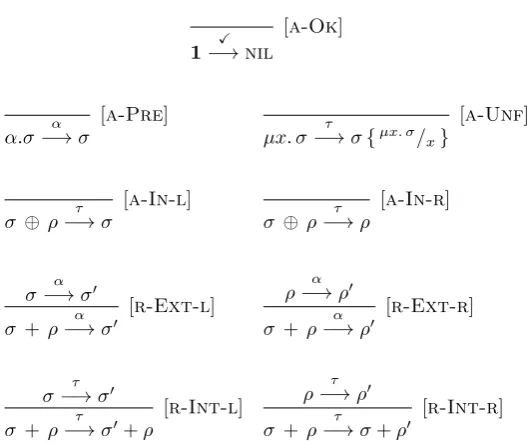
An operational semantics for the closed terms of the languageLC is given in Figure 5. The judgements are of the form
σ−→µ σ0, µ∈ActτX
where we use ActτX as a shorthand for the set Act∪ {τ,X}. The judgement
σ −→α σ, where α ∈ Act has the obvious meaning: σ −→τ σ0, means that the contractσis resolved to the contactσ0 by some internal computation, while
σ−→X σ0represents the reporting of the successful completion of a computation.
Let−→τ ∗ denote the reflexive transitive closure of−→τ .
We are now ready to show two properties ofunfold. We will use them we will require in the rest of the paper.
Lemma 3.2. Letσbe a contract.
(i) Ifσ
τ
6−→thenunfold(σ) =σ
(ii) σ−→τ ∗unfold(σ)
Proof. Property (i) is proved by structural induction onσ;
We prove part (ii); the argument is by induction ondpt(σ). If dpt(σ) = 0 then from the definition ofdptit follows thatσ6=µx. σ0; by definition ofunfold thenunfold(σ) =σ. The reflexivity of −→τ ∗ impliesσ−→τ ∗unfold(σ).
Ifdpt(σ)>1 then, due to the definition ofdpt,σ=µx. σ0. The definition of
1−→X nil
[a-Ok]
α.σ−→α σ
[a-Pre]
µx. σ−→τ σ{µx. σ/ x}
[a-Unf]
σ ⊕ρ−→τ σ
[a-In-l]
σ ⊕ ρ−→τ ρ
[a-In-r]
σ−→α σ0 σ +ρ−→α σ0
[r-Ext-l] ρ
α
−→ρ0
σ + ρ−→α ρ0
[r-Ext-r]
σ−→τ σ0 σ +ρ−→τ σ0+ρ
[r-Int-l] ρ
τ
−→ρ0
σ + ρ−→τ σ+ρ0
[image:11.595.163.429.128.351.2][r-Int-r]
Figure 5: Inference rules for the semantics of closed terms ofLC.
dpt impliesdpt(σ) = 1 +dpt(σ0{σ/
x}), and thereforedpt(σ0{σ/x}) is smaller
thandpt(σ). We are now allowed to use the inductive hypothesis onσ0{σ/ x}:
σ0{σ/ x}
τ
−→∗unfold(σ0{σ/ x})
We use rule [a-Unf] (see Figure 5) to infer σ −→τ σ0{σ/
x}, and then the
transitivity of−→τ ∗ to obtain
σ−→τ ∗unfold(σ0{σ/x})
We already know that unfold(σ) =unfold(σ0{σ/
x}), and, by applying this
equality to the reduction sequence above, we get
σ−→τ ∗unfold(σ)
This concludes the proof.
Let
S(σ) ={σ0 | σ−→µ σ0for someµ∈ActτX}
F(σ) ={σ0 | σ−→τ ∗σ0}
Example 3.3. [Divergence and finite deriviatives]
Consider the terms µx. xandµx.(nil ⊕ x). Both termsdiverge, in the sense that they perform an infinite sequence ofτ’s:
µx. x−→τ µx. x, µx.(nil ⊕x)−→τ nil ⊕µx.(nil ⊕x)−→τ µx.(nil ⊕x)
On the other hand we have
F(µx. x) =S(µx. x) ={µx. x}
and
F(µx.(nil ⊕x)) ={µx.(nil ⊕ x),nil ⊕ µx.(nil ⊕ x)} S(µx.(nil ⊕ x)) ={nil ⊕µx.(nil ⊕x)}
The setF(σ) is not finite for everyσ.
Example 3.4. [Infinite derivatives]
We show two termsσ, σ0such thatF(σ) andF(σ) are infinite. Letσ=µx. α.x+
xand σ0 =µx.(α.nil + (x ⊕ x) ). Then according to the rules in Figure 5 one can infer:
σ−→τ (α.σ + σ)−→τ (α.σ + (α.σ +σ))−→τ . . .
and
σ0 −→τ α.nil+ (σ0⊕σ0)−→τ α.nil+σ0−→τ α.nil+ (α.nil+ (σ0⊕σ0))−→τ . . .
The root of the problem is that the inference rules [r-Int-L] and [r-Int-R] do not resolve the external sum.
On the other hand the finiteness ofS(σ) is easy to prove.
Lemma 3.5. [Finite branches] The setS(σ) is finite for every σ.
Proof. The proof is by structural induction. Ifσ=nil Then plainlyS(σ) =∅. Otherwise we proceed as follows.
• Ifσ=α.σ0 then the only applicable rule (see Figure 5) is [a-Pre], and so
S(σ) ={σ0}
• similarly ifσ=µx. σ0. The only rule [A-Unf] can be applied, so S(σ) =
{σ0{σ/ x}}.
• Ifσ=σ0 +σ00 then itσ0 and σ00are both smaller thanσ. The inductive hypothesis tells us thatS(σ0) and S(σ00) are finite. Rules [
r-Ext-l], [ r-Ext-r], [r-Int-l] and [r-Int-r] in Figure 5 ensure thatS(σ) =S(σ0)∪ S(σ00). This implies that the cardinality ofS(σ) is finite.
1 nil α.σ
ρ σ
(σ ⊕ ρ)
ρ σ
(ρ +σ)
σ{µx. σ/ x}
[image:13.595.124.467.126.165.2]µx. σ
Figure 6: Inference rules for↓ over closed terms ofLC.
Example 3.6. [Divergence and ↓dpt] Consider the term
σ=µx.(x ⊕x)
Using the rules in Figure 2 one can prove that σ↓dpt; consequently dpt(σ) is finite andunfold(σ) is well-defined; in particulardpt(σ) = 1 andunfold(σ) =
σ ⊕ σ. Note now that the term σ engages in an infinite sequence of internal moves
σ−→τ σ ⊕ σ−→τ σ−→τ σ ⊕σ−→τ . . .
In other words the term σ diverges. Similarly, one can reason that terms as
µx.(nil ⊕x) andµx.(α⊕ x) suffer the same issue.
Throughout the paper we want to deal only with terms that donotdiverge and with finite F(σ). Unfortunately, ↓dpt is too weak a predicate to force the terms that satisfy it to converge. To isolate the σ’s that converge we use the predicate↓. Formally, we define it as the least fixed point of the functor given by the inference rules in Figure 6. The predicate↓ is essentially a strengthened version of↓dpt.
Proposition 3.7. For every σ∈LC,σ↓ impliesσ↓dpt.
Proof. Straightforward from the definitions of the predicates.
The predicate↓ is preserved by silent moves.
Lemma 3.8. Letσ↓. Ifσ−→τ σ0 thenσ0↓.
Proof. The proof proceeds by rule induction on the derivation ofσ−→τ σ0. The only interesting case is when the silent move σ −→τ σ0 is inferred by using rule [r-Ext-L] or rule [r-Ext-R] (see Figure 5). Suppose rule [r-Ext-L] was used. Thenσ=σ1 +σ2,σ0=σ10 +σ2, and the derivation is
σ1
τ
−→σ0
1
σ1 + σ2
τ
−→σ0
1 + σ2
We have to prove that σ10 +σ2↓; the definition of ↓ ensures that, to this
aim, it is enough to show that (a) σ10↓ and that (b)σ2↓ (see Figure 6). Point
(b) follows from the hypothesis: sinceσ↓, the equalityσ=σ1+σ2implies that
σ1↓ and thatσ2↓. The last fact is exactly point (b).
Now, by using the fact thatσ1↓, we prove point (a). The derivation shown
above let us use rule induction; the lemma holds for σ1: ifσ1↓ and σ1
τ
−→ ˆσ1
then ˆσ0
1↓. We know thatσ1↓and that σ1
τ
We have also the converse.
Lemma 3.9. Letσ be a closed term of LC. Then σ↓ if and only ifσ
τ
−→ σ0
impliesσ0↓.
Proof. The only if side of the lemma is Lemma 3.8, so we have to prove only
that ifσ−→τ σ0 impliesσ0↓, then σ↓.
Letσ be a closed term of LC such that σ
τ
−→ σ0 impliesσ0↓. We have to show that σ↓.
The proof is by structural induction on the form ofσ; the only interesting case is whenσis an external sum. In that case, σ=σ1 + σ2, so to prove that
σ1↓ it is enough to show thatσ1↓ and thatσ2↓.
We proveσ1↓. The termσ1 is a sub-term ofσ, hence structural induction
guarantees that the lemma holds for σ1: if σ1
τ
−→ σ10 implies σ01↓, then σ1↓.
Assume thatσ1
τ
−→σ10; thanks to the structure ofσwe can derive
σ1
τ
−→σ10
σ1 + σ2
τ
−→σ10 +σ2
[r-Ext-L]
Now the hypothesis of the lemma implies thatσ01 + σ2↓, so from the the
defi-nition of↓ it follows thatσ01↓ and thatσ2↓.
We have shown thatσ1
τ
−→σ01impliesσ10↓, so from the inductive hypothesis it follows that σ1↓. Moreover, we have also shown that σ2↓; we have proven
that σ↓.
The for rule [r-Ext-L] is analogous, and left to the reader.
The predicate↓ let us give an inductive characterisation of the convergent terms.
Lemma 3.10. [Convergence]
Letσbe a closed term of LC. Thenσ↓ if and only if there exists ak∈Nsuch
that σ−→τ ∗nσ0 impliesn≤k.
Proof. Theonly ifside is by rule induction on why σ↓.
We prove the if side, which states that if there exists a k ∈ N such that
σ−→τ ∗
n
σ0 impliesn≤k, thenσ↓.
The argument is an induction onk. Ifk= 0 thenσcan not performτ, and so it is either1, nilor a prefixα.σ0. In all these cases we can easily inferσ↓.
Ifk >0 thenσperforms aτ, so supposeσ−→τ σ0; it follows thatσ0−→τ ∗
m
σ00
implies m ≤ k−1. This means that there exists a k0 such that σ0 −→τ ∗
m
σ00
impliesm≤k0. Sincek−1 < k, we can apply the inductive hypothesis toσ0; from this application it follows thatσ0↓.
As yet, we have proven thatσ −→τ σ0 implies σ0↓; this allows us to apply Lemma 3.9, which ensures thatσ↓.
It is easy to see that a converging termσhas finiteF(σ).
Lemma 3.11. For everyσ∈LC ifσ↓ thenF(σ) is finite.
Now we letCdenote the set of all termsσofLC which are closed and satisfy↓. We refer to these terms ascontracts.
Proposition 3.12. Let σ be a contract, then unfold(σ) is a well-defined contract.
Proof. We have to show thatunfold(σ) is closed, and that it satisfies↓. The first fact is part (ii) of Lemma 3.1. The second fact follows from part (ii) of Lemma 3.2 and Lemma 3.8.
Example 3.13. [e-vote, [LP08, Bd10]]
Ballot = µx.?Login.( !Wrong.x⊕!Ok.( ?VoteA.x+ ?VoteB.x) )
Voter = µx.!Login.( ?Wrong.x+ ?Ok.( !VoteA.1⊕!VoteB.1) )
A process offering contract Ballot implements a service for e-voting. Such a service lets a client log in. If the log in fails the services starts anew, while if the log in succeeds the two actions are offered to the environment, namely VoteA
andVoteB.
The contract Voter is a recursive client for the protocol described by the contract Ballot.
Example 3.14. [e-commerce, [BBMR08]]
Customer = !Request.( !PayDebit.ρ0⊕
!PayCredit.ρ0⊕
!PayCash.1)
ρ0 = !Long.?Bool.1
Bank = µx.?Request.( ?PayCredit.?Long.!Bool.x+
?PayDebit.?Long.!Bool.x+ ?PayCash.x)
The contracts above describe the conversation that should take place be-tween a client (which offers the contract Customer) and a bank (which has contract Bank) involved in an on-line payment. The conversation unfolds as follows: the Customer sends a request to the bank and afterwards it chooses the payment method; the choice is taken by an internal sum and this means that the decision of the Customer is independent from the environment (ie. the Bank contract). If the Customer decides to pay by cash then no other action has to be taken; while if the payment is done by debit or credit card the Customer has to send the card number, this is represented by the output !Long. After the card number has been received the Bank answers with a boolean. Intuitively, this represents the fact that the bank can approve or reject the payment. The Customer protocol finishes after such boolean has been received, while the Bank starts anew.
3.1.1 Client-Server interactions and the compliance relation
Contracts are expressive enough to encodeXMLbased languages such as
how to assign contracts to a subset of ccsprocesses. Intuitively, if a process, such as a server, is assigned a contract σ then it guarantees to support the behaviour described in σ. The interaction between servers and clients can be described at the level of their contracts, by defining a binary operation ρ k σ
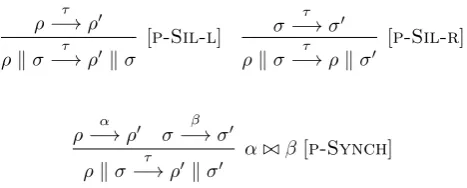
between their contracts and describing the evolution of the contracts as they interact. This interacting semantics is given in Figure 7, where the judgements
are of the formρkσ−→τ ρ0kσ0. It presupposes a binary relation onAct,α ./ β, which intuitively means that the action α can synchronise with action the β. This relation can be instantiated in various ways depending on the particular set of actionsAct; the only general property we require of it is that it befinitary, that is for every actionαthe set{β | α ./ β} be finite.
Example 3.15. Suppose we take Act to be{a?, a! | a∈A} whereA is a set of communicating channels. Then define
α ./i β wheneverα=a?, β=a! orα=a!, β=a? for somea∈A
This represents synchronisation on channels.
We will use a more elaborate set of actions when interpreting session types as contracts. Recall from Section 2 the set of basic typesBTand the set of labels
Lused in session types. Using these we can defineAct to be
{?b,!b | b∈BT} ∪ {l?,l! | l∈L}
with./c determined by
α ./cβ whenever
α=?b, β=!b0 b04gb
α=!b, β=?b0 b4gb0
α=?l, β=!l
α=!l, β=?l
Using the basic sub-typing relation depicted in Figure 3 the following exam-ples should be clear:
(i) ?Num./c!Int: a contract that can read a datum of type Numcan read a
datum of typeIntbecauseInt4gNum.
(ii) ?Int6./c!Num: conversely a contract ready to read a datum of typeIntcan
not read a datum of type Numbecause Num46 gInt.
(iii) ?Random ./c!Bool: as in point (i), Bool4gRandom hence an interaction
between the actions ?Randomand !Boolis safe.
Having described how interactions between clients and servers affect their contracts, let us describe, by means of a relation, when a client (guaranteeing a) contractρcan safely interact with a server (guaranteeing a) contractσ. Indeed, we shall formalise the meaning of “safely”.
The central notion is that ofcompliance between contracts. This is defined
ρ−→τ ρ0 ρkσ−→τ ρ0 kσ
[p-Sil-l] σ
τ
−→σ0
ρkσ−→τ ρkσ0
[p-Sil-r]
ρ−→α ρ0 σ−→β σ0 ρkσ−→τ ρ0 kσ0
[image:17.595.180.414.124.218.2]α ./ β[p-Synch]
Figure 7: Inference rules for contract interaction.
Definition 3.16. [Compliance relation]
Let Fa : P(C2) −→ P(C2) be the function defined so that (ρ, σ) ∈ Fa(R) whenever both the following hold:
(i) ifρkσ
τ
6−→thenρ−→X
(ii) ifρkσ−→τ ρ0kσ0 then (ρ0, σ0)∈R
IfR ⊆ Fa(R) then we say thatRis a co-inductivecompliancerelation. Let a denote the greatest solution of the equationX =Fa(X). We call this solution thecompliancerelation. The relationais the greatest co-inductivecompliance
relation. If ρaσwe say that the contractρ complies withthe contractσ.
Notice that there is an asymmetry in the relationρaσ; the intention is that any client running contractρ when interacting with a server running contract
σ will be satisfied, in the sense that either the interaction between client and server will go on indefinitely, or, if the interaction gets stuck, the client will end
on its own in a state in which it is satisfied,ρ−→X .
Example 3.17. [Compliance and divergent terms]
In order that the relationacaptures the intuition described above, it is crucial that C contains no divergent terms. Had we admitted them, then for every ρ
the relation
{(ρ0, µx. x) | ρ−→τ ∗ρ0}
would have been a perfectly fine co-inductive compliance. Note, though, that the clientρis by no means satisfied by the server.
Example 3.18. Note that according to our definition of compliance, the client need not ever perform X. For example, supposeα ./ β and consider the set
{(µx. α.x, µy. β.y)}
It is a co-inductive compliance relation, and the client contract, µx. α.x, does not perform Xat all.
Example 3.19. The fact thatnilcan not be satisfied is formally expressed by the fact that
for every contractσ. On the other hand 1is always satisfied because for every
σ
1aσ.
Supposeσis a contract which can not interact with the actionα; by this we
mean thatσ−→τ ∗−→β impliesβ 6./ α. Then
1+α.ρaσ
for every ρ, because ρis guarded by an action that can never take place. Referring to Example 3.13, it is routine work to check that the following relation is a co-inductive compliance.
R={(Voter,Ballot),
(?Wrong.Voter + ?Ok.( !VoteA.1⊕!VoteB.1),
!Wrong.Ballot⊕!Ok.(?VoteA.Ballot + ?VoteB.Ballot)),
(?Ok.( !VoteA.1⊕!VoteB.1),!Ok.(?VoteA.Ballot + ?VoteB.Ballot),
(!VoteA.1⊕!VoteB.1,?VoteA.Ballot + ?VoteB.Ballot),
(!VoteA.1,?VoteA.Ballot + ?VoteB.Ballot),
(!VoteB.1,?VoteA.Ballot + ?VoteB.Ballot),
(1,Ballot)}
The compliance relation is determined purely by the client contract perform-ing the success action X, therefore1complies with every contractσ; this means that a client whose contract is1is satisfied by any server. On the other hand a server with contract 1is equivalent to a server with contractnil. We prove this fact.
Proposition 3.20. For every contractρ,ρa1if and only if ρanil.
Proof. Supposeρa1; this means that there exists a co-inductive complianceR
that contains (ρ,1). Since1offers no interaction, the contractρenjoys the two properties which follow,
(a) ifρ
τ
6−→thenρ−→X
(b) ifρ−→τ ρ0 then (ρ0,1)∈R
Knowing (a) , it is straightforward to show that
R0∆
={(ρ0,nil) | ρ
τ
−→∗ρ0, ρa1}
is a co-inductive compliance.
A symmetrical argument can be used to show that also
R0∆
={(ρ0,1) | ρ
τ
−→∗ρ0, ρanil}
The following properties of the compliance relation will be useful later in the paper.
Lemma 3.21. Letρ, σ1,and σ2 be contracts. The following hold:
(i) ifρaσ1, ρaσ2 thenρaσ1 ⊕ σ2
(ii) ifρ1aσ, ρ2aσthenρ1 ⊕ρ2aσ
Proof. As an example we outline the proof of (i). LetRbe the relation defined by
R={(ρ, σ) | ρaσorσ=σ1 ⊕ σ2whereρaσ1andρaσ2}
It is straightforward to show that R is a compliance relation, from which the result follows.
Proposition 3.22. For all contractsρ, σ, we have the following
(a) ifρaσthenρaunfold(σ) (b) ifρaσthenunfold(ρ)aσ
Proof. Both follow in a straightforward manner from part (ii) of Lemma 3.2 and point (ii) of Definition 3.16.
The converse is also true:
Proposition 3.23. For all contractsρ, σ, we have the following
(a) ifρaunfold(σ) thenρaσ
(b) ifunfold(ρ)aσthenρaσ
Proof. Let us look at the proof of (a). Let
R={(ρ, σ) | ρaσorρaunfold(σ)}
The result will follow if we can prove thatRis a co-inductive compliance rela-tion, as given in Definition 3.16.
(i) Supposeρkσ
τ
6−→. Ifρaσthen by definitionρ−→X . Otherwise
ρaunfold(σ)
Note that σ
τ
6−→ and therefore by part (i) of Lemma 3.2 it follows that
unfold(σ) =σ, which means, since nowρaσ, ρ−→X .
3.2
The server pre-order
In this subsection we show how to compare servers in terms of their ability to satisfy clients; once more this is done in terms of their respective contracts.
Definition 3.24. [Server pre-order] LetJσKsrv={ρ | ρaσ}. Then we write
σ vsrv σ0 wheneverJσKsrv⊆Jσ 0
Ksrv.
This provides us with a natural subsumption-like pre-order between server-side contracts. For if σ vsrv σ0 then we are assured every client satisfied by a server running the contractσis by definition also satisfied by a server running the contract σ0.
One consequence of Proposition 3.22 and Proposition 3.23 is that
Junfold(σ)Ksrv=JσKsrv
and therefore when reasoning about the server pre-order we can work up to unfolding.
3.2.1 Co-inductive characterisation
Here we give a co-inductive characterisation of the server pre-order vsrv; this is based on a number of semantic properties of contracts, which we outline in the following lemmas.
Lemma 3.25. Ifσ1 vsrv σ2 andσ2
τ
−→σ20 thenσ1 vsrv σ20.
Proof. Supposeρaσ1, whereσ1vsrvσ2andσ2
τ
−→σ20; we have to showρaσ02. We knowa is a co-inductive compliance relation, and also thatρkσ2
τ
−→ ρkσ20. So by part (ii) of Definition 3.16 the requiredρaσ02follows.
The next property involves theacceptance setsof contracts. For anyr⊆Act
let us write σ ↓ r whenever σ
τ
6−→ and r ={α∈ Act | σ−→ }α . These sets
r,r0, . . . are calledinitials [EF02] orready sets [LP07, LP08]. If σ↓ rwe say
that σconverges to r; indeed, in our presentation onlystuckstates have ready sets.
Then letAcc(σ) ={r | σ−→τ ∗σ0, σ0↓r}; these are called theacceptance setsofσ.
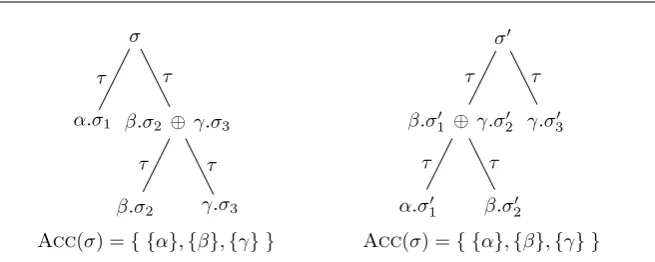
Example 3.26. We give a small example about the definitions above. See also Figure 8.
σ=α.σ1 ⊕(β.σ2 ⊕ γ.σ3) σ0= (α.σ01 ⊕ β.σ2) ⊕γ.σ3)
Acc(σ) ={ {α},{β},{γ} } Acc(σ) ={ {α},{β},{γ} }
Moreover, one sees easily thatnil↓ ∅and1↓ ∅, so
σ
α.σ1
τ
β.σ2 ⊕ γ.σ3
β.σ2
τ
γ.σ3
τ τ
σ0
β.σ01 ⊕ γ.σ02
α.σ10 τ
β.σ20 τ τ
γ.σ03 τ
[image:21.595.137.465.125.256.2]Acc(σ) ={ {α},{β},{γ} } Acc(σ) ={ {α},{β},{γ} }
Figure 8: An example of acceptance sets.
Example 3.27. It is easy to show that whenever unfold(σ) = 1and σ ↓ r
then rvr0 for every
r0. Consider the action X; it does not belong to Act,
therefore by definition of σ ↓ r the action X is not in r. But X is the only
visible action performed byσ, hencer=∅.
Proposition 3.28. Letσ∈ C. Then
(a) ifσ↓rthenris finite
(b) the set Acc(σ) is finite
(c) the setAcc(σ) is non-empty
Proof. Part (a) follows from the fact that external sums contain a finite amount of summands. Part (b) follows form Lemma 3.11. Part (c) follows from the fact that ifσ↓ thenσhas stuck derivatives.
Example 3.29. [Divergent terms and acceptance sets]
Here we show the acceptance set of a divergent term. Letσ=µx. α.x+x. For every r we have σ6↓ r because σ −→τ , and the same is true for the derivative
α.σ +σ, because it also performs a τ:
σ−→τ α.σ +σ−→τ . . .
We thus conclude that Acc(σ) = ∅. Indeed, in the proof of part (iii) of the preceding proposition the crucial hypothesis is σ↓.
Individual acceptance sets are compared by their ability to offer interactions. We writervswhenever for everyαr ∈rand everyβ such that β ./ αr there exists someαs∈ssuch thatβ ./ αsalso. The precise meaning of this pre-order actually depends on the instantiation of the interaction relation./.
Example 3.30. Suppose Act is the set {a?, a! | a ∈ A} and ./i is defined
as in Example 3.15. Then one can check that rvs if and only ifR ⊆S. On the other hand with./c from the same example, defined over the set of actions
{?b,!b | b∈BT} ∪ {l?,l! | l∈L}, it turns out thatrvswhenever
• ?l∈?rimpliesl∈sfor every l∈L
• ?br ∈rimplies ?bs∈sfor some typebssuch thatbs4gbr
• !br∈rimplies !bs∈sfor some typebs such thatbr4gbs
Lemma 3.31. Supposeσ1vsrvσ2andσ2↓r, then there is somer0∈Acc(σ1)
such thatr0vr.
Proof. This proof proceeds by contradiction. To establish the contradiction we construct a contractρsuch that
(i) ρaσ1
(ii) ρ 6aσ2
Suppose there is no r0 ∈
Acc(σ1) such that r0 vr. Thanks to part (c) of
Proposition 3.28 this can not be becauseAcc(σ1) is empty. Again by
Proposi-tion 3.28 we know Acc(σ1) to be finite, so letr1, . . .rn be all the elements in
Acc(σ1). From the hypothesis there areαi ∈ri andβi./ αi such that βi6./ α
wheneverα∈r0. Let the contractρbe defined as β
1.1+. . .+βn.1.
First notice that (ii) above is true: since σ2 ↓ r, ρk σ2
τ
−→∗ρ k σ20 such
thatρkσ20
τ
6−→andρ 6−→X. This means that (ρ, σ2) can not be contained in any
co-inductive compliance relation.
To establish (i) above it is sufficient to prove that
R={(ρ, σ01) | σ1
τ
−→∗σ01}
is a co-inductive compliance relation, which is relatively straightforward.
The final property is even more complicated. For any actionαletσafterα
be the set
{σ0 | σ−→τ ∗−→β −→τ ∗σ0,whereα ./ β}
Proposition 3.32. Let σ be a contract, then for every α ∈ Acts the set (σafterα) is finite.
Proof. Because we assume ./ to be finitary and for every contract S(σ) and
F(σ) are finite (see Lemma 3.5 and Lemma 3.11).
Note that in general this set may be empty. When it is non-empty we use
L(σ
afterα) to denote the obvious contract, the internal sum of all its
ele-ments2.
Lemma 3.33. Supposeσ1 vsrv σ2 andσ2
β
−→σ02. Then wheneverα ./ β,
(i) the set (σ1afterα) is non-empty
(ii) the contractL(σ
1afterα) is smaller thanσ02. Formally,
M
(σ1afterα) vsrv σ
0
2
2 A concise account for the use of the general sum operationL
Proof. To prove part (i) consider the contract ρ=1+α.nil. Since ρkσ2
τ
−→ nilkσ02it follows that (ρ, σ20) can not be in any co-inductive compliance relation,
henceρ 6aσ2. Therefore, fromσ1 vsrv σ2, we have thatρ 6aσ1.
But because of the construction ofρthis can only be the case if (σ1afterα)
is non-empty. More specifically, if it was empty we could construct a simple co-inductive compliance relation containing the pair (ρ, σ1).
Now consider part (ii). SupposeρaL
(σafterα); we have to showρaσ02.
To do so consider the contractρ0=1+α.ρ.Suppose we could establish
ρ0 aσ1 (1)
Becauseσ1 vsrv σ2 this would mean thatρ0 aσ2, from which the required
ρaσ02 follows, by part (ii) of Definition 3.16. It remains to prove (2) above. Let
R={(ρ, σ0) | ρaσ0, σ0 ∈ C } ∪ {(ρ0, σ10) | σ1
τ
−→∗σ01}
Then, becauseρaL
(σafterα), it is easy to establish thatRis a co-inductive compliance relation.
We have now assembled all the required properties for our co-inductive char-acterisation of the server pre-order.
Definition 3.34. [Semantic sub–server relation]
LetF4srv:P(C2)−→ P(C2) be the function defined so that (σ
1, σ2)∈ F4srv(R) if and only if the following conditions hold:
(i) ifσ2
τ
−→σ20 then (σ1, σ20)∈R
(ii) for everyr∈Acc(σ2),σ2↓rimpliesr0vrfor somer0∈Acc(σ1)
(iii) ifσ2
β
−→σ20 andα ./ β then (σ1afterα)=6 ∅ andL(σ1afterα) R σ20
IfR ⊆ F4srv(R) then we say thatRis a co-inductivesemantic sub–server
relation. Let 4srv denote the greatest solution of the equationX =F4srv(X). We call this solution thesemantic sub–serverrelation. The relation4srvis the greatest co-inductive semantic sub–serverrelation.
Proposition 3.35. Ifσ1 vsrv σ2 thenσ14srvσ2.
Proof. It is sufficient to prove that the relation vsrv is a semantic sub-server relation; this is straightforward in view of the last three lemmas.
We also have the converse.
Theorem 3.36. [Co-inductive characterisation]
The server pre-order is the greatest semantic sub–server relation.
Proof. We are required to prove that for all contractsσ1, σ2,
σ1 vsrv σ2 if and only ifσ14srvσ2
Because of the previous proposition it is sufficient to prove thatσ14srvσ2
andρaσ1 impliesρaσ2. This will follow if we can show that the relation
R={(ρ, σ) | ρaσ1for someσ1such thatσ14srvσ}
is a co-inductive compliance relation.
(i) ifρkσ
τ
6−→thenρ−→X
(ii) ifρkσ−→τ ρ0kσ0 then (ρ0, σ0)∈R
By the definition ofRwe know that there is some contractσ1such thatσ14srv
σandρaσ1.
We prove the first point, (i). Ifρkσ
τ
6−→thenρ
τ
6−→,σ
τ
6−→; in addition, the
two contracts can not interact, that isρ−→α and σ
β
−→impliesα6./ β. Sinceρ
and σare stable bothAcc(ρ) andAcc(σ) contain exactly one set each, sayr
andsrespectively. Then rephrasing the above remark we know
α∈r, β∈simpliesα6./ β (2)
Sinceσ14srvσ, by part (ii) of Definition 3.34σ1
τ
−→∗σ01for someσ01such that
σ01↓s0 and
s0vs. One can use (2) above to show that this means
α∈r, β∈s0impliesα6./ β
Also, since ρa σ1 and σ1
τ
−→∗σ10, part (ii) of Definition 3.16 implies ρa σ01.
Butρkσ01
τ
6−→and therefore we have the requiredρ−→X .
To prove point (ii) above, we have to show that if ρk σ−→τ ρ0 k σ0 there exists a ˆσsuch that
ρ0 aσ andˆ σˆ4srvσ0
We proceed by case analysis on the rule used to inferρkσ−→τ ρ0kσ0. There are three possibilities: first suppose the inference rule [p-Sil-L] from Figure 7 is used; that is ρ −→τ ρ0 and σ0 = σ. In this case the required ˆσ is σ1; the
definition of Rgives σ1 4srv σ and point (ii) of the definition of compliance,
Definition 3.16, givesρ0aσ
1.
The case when the rule [p-Sil-R] is used is similar; choosing the required ˆσ
to beσ1 again is justified by point (i) of Definition 3.34.
Finally suppose [p-Synch] is employed. Now we know that
ρ−→δ ρ0, σ
β
−→σ0, δ ./ β.
In this case we show that the required ˆσisL(σ
1afterδ). Part (iii) of
Defini-tion 3.34 implies that L(σ
1afterδ)4srvσ
0 and thus it suffices to show that
ρ0aL(σ
1afterδ).
The setσ1afterδ is finite and therefore by Lemma 3.21 it is sufficient to
prove ρ0 aσ00 for everyσ00∈(σ1afterδ).
For such aσ00we can derive the transition
ρkσ1
τ
−→∗ρ0kσ00,
3.3
Must testing
The compliance relation between contracts, Definition 3.16, has much in com-mon with the idea of testing from [NH84]. Here we explain the relationship. We recall the definition of musttesting, and explain how it differs from the com-pliance relation. Despite this difference we then go on to show that the testing pre-order it induces on contracts actually coincides with the server pre-order.
For every contractρandσa sequence of reductions
ρkσ−→τ ρ1kσ1
τ
−→ρ2kσ2−→. . .
is called a computation of ρ k σ and each derivative ρi k σi is a state of the
computation. Intuitively viewing ρ as a test, we say that the state ρi k σi is
successfulifρi
X
−→. Then, a computation is successful it it contains a successful state.
Example 3.37. For everyσall the computations of
1+ ?l1.nilkσ
are successful because in the first state 1−→X . On the other hand, suppose a contractρdoes not perform Xand neither do its derivatives. Then no compu-tation ofρkσis successful.
A computation is maximalif either
(i) it is infinite, or
(ii) it is finite and the last state is stuck, that is has the form ρk kσk where
ρk kσk τ
6−→
Definition 3.38. [Must testing]
For all contractsρ, σwe writeσmustρif all the maximal computations ofρkσ
are successful.
The notion of a client contract complying with a server contract differs in two ways from that of a server contract passing a client contract viewed as a test.
Example 3.39. One difference between must and a is what happens after a contract has passed a test, that is the test has reached a success full state; the subsequent computation is disregarded by must, whereas the compliance relation has to hold forallthe states in a computation.
As an example considerσ=?Real.nil andρ=1+!Int.nil. Clearlyρ−→X , therefore σmustρ because each maximal computation of ρ k σ begins in a successful state. Howeverρ6a σbecauseρkσ−→τ nilknil.
Example 3.40. The second difference is that the compliance relation does not require the testing contract to ever report success, provided that the communi-cation between the contracts can continue indefinitely. As an example consider the following contracts
Plainly, one sees thatρ 6−→X, and, therefore,ρkσis not a successful state. The only computation of ρ k σ is the infinite loop ρ k σ −→τ ρk σ, and therefore
ρaσholds; on the other handσmustρis false. Example 3.18 contains an even simpler instance of the difference between the relationaand the relationmust.
Themustrelation can be used to define a well known pre-order:
Definition 3.41 (Must pre-order [NH84]). Let σ1, σ2 be contracts. We write
σ1vmustσ2 if and only if for everyρifσ1mustρthen σ2mustρ.
Notwithstanding the differences between testing and compliance discussed above, it turns out that the server pre-order vsrv and themustpre-ordervmust
coincide (Corollary 3.49).
First, in a series of lemmas, we show thatvmust satisfies the three defining properties of the semantic sub–server relation (Definition 3.34).
Lemma 3.42. Letσ1vmustσ2. Ifσ2
τ
−→σ20 thenσ1vmustσ20.
Proof. Take a contract ρsuch that σ1mustρ and a maximal computation C
performed byσ20 kρ. It is easy to see that a maximal computation fromσ2kρ
can be obtained by prefixingC with the moveσ2kρ
τ
−→σ02kρ.
Since σ1 vmust σ2 it follows that this extended computation must be
suc-cessful. However this implies thatCitself is successful sinceρdoes not change during the initial extending move.
Lemma 3.43. Letσ1vmustσ2 andσ2↓r. There exists ar0 ∈Acc(σ1) such
that r0vr.
Proof. The proof is similar to that of Lemma 3.31, and proceeds by contradic-tion. Letr1, . . . ,rn, n≥1 be the elements ofAcc(σ1) and suppose thatri6 vr.
This means that for every ri there is αi ∈ri and a βi such thatβi ./ αi and
βi6./ αwheneverα∈r.
Letρbe the contractβ1.1+. . .+βn.1. The contradiction is established by
showing that
(i) σ1mustρwhile
(ii) σ2mustρis false
Both of which we leave to the reader. Intuitively (ii) follows because σ2 ↓ r,
while (i) is a consequence of the fact that ifσ1
τ
−→∗σ0
τ
6−→thenσ0↓rifor some
1≤i≤n.
Lemma 3.44. Letσ1vmustσ2 andσ2
β
−→σ0
2. Wheneverα ./ β
(i) the set (σ1afterα) is not empty
(ii) the contractL(σ
1afterα) is smaller thanσ02. Formally,
M
(σ1afterα)vmustσ
0
Proof. The proof of (i) is analogous to that of (i) in Lemma 3.33, but the contract to be used in this case isρ= (1 ⊕1) +α.nil.
We prove point (ii) by contradiction. Suppose there is a contract ρ0 such thatL(σ
1afterα)mustρ0 whileσ20mustρ0is false. Now consider the contract
ρ=α.ρ0⊕1. Clearlyσ2mustρis false whileσ1mustρis true. This contradicts
the hypothesis σ1vmustσ2.
Proposition 3.45. Ifσ1vmustσ2thenσ14srvσ2.
Proof. The previous three lemmas show that vmust is a semantic sub–server relation, from which the result follows.
To establish the converse of this result we need to develop some additional notation. The first is a generalisation of the relation σafterα toσafteru
where u is a non-empty sequence of actions from Act?. This is defined by induction on the length ofu, with the inductive case being
σafterwα = [
σ0∈(σafterw)
σ0 after α
Example 3.46. Letσ=!t1.(?t2.σ1+?t3.σ2)+!t1.niland ?t3./!t2. Then
σafter?t1!t2 =
S
σ0∈(σafter?t
1)σ
0
after!t2
= S
σ0∈{
nil,?t2.σ1+?t3.σ2}σ
0
after!t2
= {σ1, σ2}.
Next we generalise the interaction relationα ./ β to non-empty sequences,
u ./ w in the obvious manner; note that this implies that u and w have the same length. Finally we need the notion of contracts performing sequence of actions. For u∈Act? letσ=u⇒σ0 be the least relation which satisfies
(a) σ=ε⇒σfor every contractσ
(b) σ=u⇒σ1, σ1
a
−→σ0, where a∈Act, impliesσ=u.a⇒σ0
(c) σ=u⇒σ1, σ1
τ
−→σ0 impliesσ=u⇒σ0
We have the obvious generalisation of condition (iii) in Definition 3.34:
Lemma 3.47. Supposeσ1 Rσ2 for some semantic sub–server relationRand
σ2
u
=⇒σ20 for some non-emptyu∈Act
?
. Thenv ./ uimplies that
(i) the set (σ1afterv) is not empty
(ii) the contractL(σ
1afterv) is related by Rto σ20. Formally,
M
(σ1afterv) R σ20
Theorem 3.48. [Co-inductive characterisation]
The must pre-order is the greatest semantic sub–server relation.
Proof. We have to prove that for all contractsσ1, σ2
σ14srvσ2 if and only if σ1vmustσ2.
Because of Proposition 3.45 it is sufficient to proveσ14srvσ2impliesσ1vmust
σ2. So, supposeσ14srvσ2 andσ1mustρ; we must proveσ2mustρ.
Consider a maximal computation ofσ2kρ
σ2kρ
τ
−→σ21kρ1
τ
−→. . . (3)
We first examine the case when this is finite, with terminal state σk
2 k ρk.
Intuitively this finite computation can be unzipped to give the contributions from the individual componentsσ2 andρ:
σ2
u
=⇒σk2 ρ=v⇒ρk wherev ./ u
We are required to show that one of the derivatives of ρ in ρ =v⇒ ρk is
successful. To this aim we will exhibit a suitable computation of σ1 k ρ; in
particular we will show that there exists aσ0
1 such that
(a) the compositionσ01kρk is stuck
(b) the computation σ1kρ
τ
−→∗σ01kρk exists
(c) the derivatives of ρ in the computation of point (a) are contained in the
computationσ2kρ
τ
−→∗σk2 kρk
These three points are enough to prove that in ρ=v⇒there exists a successful derivative: thanks to (a), the computation in (b) is a maximal computation of
σ1k ρ; the assumption σ1vmust ρimplies that in that computation there is a
successful derivative ˆρ, and point (c) ensures that ˆρis contained in ρ=v⇒. We prove one by one the points above.
(a) Here we show that, for a suitable σ10, the compositionσ01kρk is stuck.
By assumption the stateσk
2 kρk is terminal; this implies that
(1) bothσk
2 and ρk are stuck. A consequence is that their acceptance sets
are singleton; sayAcc(σ2k) ={r} andAcc(ρk) ={s}
(2) the contractsσk
2 andρk can not interact. Formally
α∈rimpliesβ 6./ αfor everyβ ∈s.
Consider now the contract L(σ
1afterv); Part (i) Lemma 3.47 implies
that the set (σ1afterv) is not empty and part (ii) of the same lemma
implies thatL(σ
1afterv)4srvσk2.
Part (ii) of Definition 3.34 and (2) above imply that there exists r0 ∈ Acc(L(σ1afterv)) such that
From the definition of acceptance set now follows thatL(σ
1afterv)
τ
−→∗σ10
for someσ01 such thatσ01 ↓r0. The latter fact means that σ01
τ
6−→and (4) above means that σ10 and ρk can not interact; Since (1) above proves that
ρk is stuck we have shown thatσ01kρk is stuck.
(b) We are required to exhibit the computationσ1kρ
τ
−→∗σ10 kρk.
Since L(σ
1afterv)
τ
−→∗σ01 there exists a σ100 ∈ (σ1afterv) such that
σ100−→τ ∗σ10. From the definition of (σ1afterv) it follows thatσ1
w
=⇒σ001
for some such that w ./ v, and this implies that σ1
w
=⇒ σ10. Zipping this action sequence together withρ=v⇒ρk we obtain the computation
σ1kρ
τ
−→∗σ01kρk τ
6−→
We remark that the computation above is finite and can not be extended, hence it is maximal.
(c) The derivatives ofρin the computation
σ1kρ
τ
−→∗σ01kρk
are contained in the computation σ2 k ρ
τ
−→∗σk2 k ρk because the former
computation has been obtained by zipping ρ =v⇒ ρk with a computation
made byσ1.
Now suppose that the maximal computation (3) above is infinite. Then the result of unzipping gives infinite tracesu, v such that
σ2
u
=⇒ ρ=v⇒
Let us denote the finite prefixes of these traces of length k by u(k), v(k) re-spectively. By Lemma 3.47 we know thatσ1afterv(k) is non-empty, for every k≥0. This means that the LTS generated by σ1 is infinite.
Now consider the sub-LTS consisting of all nodes σ which can be reached
from σ1 using a weak move σ1
w(k)
=⇒ σ0 where w(k) is some trace satisfying
w(k)./ v(k). This sub-LTS is therefore infinite. It is also finite-branching and so by K˝onig’s lemma it has an infinite path. By following this path from the root we getσ1
w
=⇒such thatw(k)./ v(k), for every k≥0.
This infinite computation can now be zipped withρ=v⇒to obtain an infinite computation from σ1 k ρ. Sinceσ1mustρit follows that there is some σk2 k
ρk in the maximal computation (3) above which is successful, and therefore
σ2mustρ.
Corollary 3.49. The server pre-order equals the must pre-order. Formally
vsrv=vmust
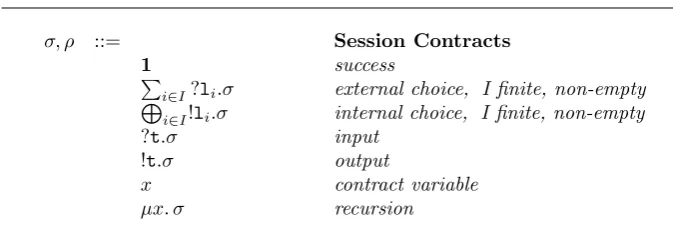
σ, ρ ::= Session Contracts
1 success
P
i∈I?li.σ external choice, I finite, non-empty
L
i∈I!li.σ internal choice, I finite, non-empty
?t.σ input
!t.σ output
x contract variable
µx. σ recursion
[image:30.595.124.461.122.236.2]We impose the additional proviso that in a term theli’s are pair-wise different.
Figure 9: Session contract grammar.
4
Session Contracts
Here we specialise the contract language, to a sub-language which will be the target of our interpretation of the session types from Section 2. This is the topic of the first sub-section. We then go on to re-examine the server pre-order as it applies to this sub-language; in particular we show that it can also be characterised co-inductively, this time using purely syntactical criteria. In the final section we give a similar co-inductive characterisation to a related sub– client pre-order.
4.1
Session contracts
The syntax for the language LSC is given in Figure 9. We work relative to a structural equivalence, generated by the following identities3:
σ ⊕ ρ=ρ ⊕σ σ ⊕ (σ0 ⊕σ00) = (σ ⊕ σ0) ⊕σ00
σ + ρ=ρ +σ σ + (σ0 +σ00) = (σ + σ0) + σ00
This justifies the use of the general summation constructs for internal and ex-ternal choices, which emphasises the intended restrictions in the language. We useSCto denote the set of termsσofLSCsuch thatσ↓. We refer to these terms as session contracts. Note thatSC is a subset of the more general language of contracts C, but
• external choices are restricted to inputs on labels
• internal choices are restricted to outputs on labels
Note also thatnilis not a session contract. Instead we have chosen1to be the base contract, for reasons which will become apparent. Moreover, we already reasoned that a server contract 1 has the same behaviour as nil (Proposi-tion 3.20).
Session contracts, due to the their restrictive syntax, enjoy some properties which we will use in the next sub-sections, and which we prove now.
3Formally the use of these equalities is justified by the relationship betweenaand the weak
Lemma 4.1. Letσbe a session contract. Then
(i) σ−→X if and only ifσ=1
(ii) σ−→τ ∗−→X if and only ifunfold(σ) =1 (iii) σ−→α if and only ifσ6=1
Proof. Part (i) follows from the restrictive syntax of session contract. The proof of part (ii) requires two arguments. The if side,unfold(σ) =1implies
σ−→τ ∗ −→X , is justified by part (ii) of Lemma 3.2. The only ifside, σ−→τ ∗ −→X
implies unfold(σ) = 1, can be proven by induction on the length of the se-quence−→τ ∗; the base case being part (i) of this lemma. Part (iii) can be proven by structural induction.
4.2
The server pre-order
Definition 3.24 applies equally well to session contracts, but it is inappropriate as it compares session contracts from the point of view of satisfying clients who may use the more general contracts from Section 3. Instead let us restrict attention to clients who also only run the more restricted session contracts.
Definition 4.2. [Restricted server pre-order]
For σ1, σ2 ∈ SC let σ1 vSCsrv σ2 wheneverρa σ1 impliesρa σ2 for every ρin
SC.
This relation is more generous than vsrv in that it allows implementation refinement [Pad10] to happen, as the following example shows.
Example 4.3.
?l1.1vSCsrv?l2.1+?l1.1
If a session contract ρ can interact with ?l1.1 then, modulo unfolding, it has
to be defined by an internal sum. Moreover this sum can only contain one summand and thereforeρcomplies also with ?l2.1+?l1.1.
Consider now the more general contractρ0 =!l1.1+ !l2.nil. Then one can
check thatρ0a?l1.1whereasρ0 6a?l2.1+?l1.1. It therefore follows that
?l1.1 6vsrv?l2.1+?l1.1
Example 4.4. [e-vote, ballot refinement]
We give a more concrete instance of the previous example. Recall Example 3.13 and consider the session contract
BallotB =µx.?Login.( !Wrong.1⊕
!Ok.( ?VoteA.1+ ?VoteB.1+ ?VoteC.1+ ?VoteD.1) )
BallotB offers to a voter more options than Ballot, and intuitively it should be possible to use a server that guarantees BallotB in place of a server that guarantees Ballot. This is not the case if the contracts are compared with vsrv, because Ballot 6vsrv BallotB. On the other hand, if we restrict our attention to session contracts, and thus to the pre-ordervSC
srv, we have Ballotv
SC