Proceedings of the Third Workshop on Natural Language Processing and Computational Social Science, pages 7–17 7
Identification, Interpretability, and Bayesian Word Embeddings
Adam M. Lauretig
Department of Political Science Ohio State University
Columbus, OH
Abstract
Social scientists have recently turned to ana-lyzing text using tools from natural language processing like word embeddings to mea-sure concepts like ideology, bias, and affinity. However, word embeddings are difficult to use in the regression framework familiar to social scientists: embeddings are are neither identi-fied, nor directly interpretable. I offer two ad-vances on standard embedding models to rem-edy these problems. First, I develop Bayesian Word Embeddings with Automatic Relevance Determination priors, relaxing the assump-tion that all embedding dimensions have equal weight. Second, I apply work identifying la-tent variable models to anchor the dimensions of the resulting embeddings, identifying them, and making them interpretable and usable in a regression. I then apply this model and anchor-ing approach to two cases, the shift in interna-tionalist rhetoric in the American presidents’ inaugural addresses, and the relationship be-tween bellicosity in American foreign policy decision-makers’ deliberations. I find that in-augural addresses became less international-ist after 1945, which goes against the conven-tional wisdom, and that an increase in bellicos-ity is associated with an increase in hostile ac-tions by the United States, showing that elite deliberations are not cheap talk, and helping confirm the validity of the model.
1 Introduction
Important questions in the social sciences turn on the meanings of words used to express ideas like language change, emotion, and ideological affin-ity (Hamilton et al., 2016; Rheault et al., 2016;
Pomeroy et al.,2018). One increasingly popular way to represent meaning, originating in natural language processing, is through the use of word embeddings. This class of models learns a set of coefficients which encode meaning by predicting a word given the surrounding words (Mikolov et al.,
2013a,b). These coefficients are theembeddings, which can then be used to analyze word meanings.
Unfortunately, existing embedding models are not always appropriate for answering social sci-entists’ questions. Embeddings are not identified, and the dimensions are not directly interpretable, which makes it difficult to perform statistical in-ference on the embeddings produced by standard models, for example, using them as covariates in a regression model.1
To resolve these issues, I cast word embed-dings as a Bayesian latent variable model. Iden-tifying multidimensional latent variable models is a known problem, and I draw on solutions proposed in the ideal point modeling literature (Rivers,2003;Clinton et al.,2004) to render em-beddings interpretable and usable in a regression framework. I demonstrate these results on two cor-pora: a collection of inaugural addresses, and a se-lection of declassified diplomatic documents from
theForeign Relation of the United States. In the
inaugural addresses, I find rhetoric became more domestically-focused after 1945, a shift which existing social science approaches cannot detect. This finding stands in contrast to what existing the-ories of international relations would have us ex-pect. In theFRUSdocuments, I find that more bel-licose rhetoric results in more aggressive Ameri-can foreign policy behavior, helping confirm that elite deliberation matters for shaping foreign pol-icy, and that the measurements I create correlate with existing datasets, helping to establish the va-lidity of the model results.
1
2 Social Science and Embedding Models of Language
Traditional approaches to creating variables from text in the social sciences involve human coders, who assign documents to categories based on pre-defined criteria. However, this approach is ex-pensive, and does not scale. Text as data tech-niques attempt to solve this problem through the use of natural language processing techniques to convert a corpus of text into numeric objects which makes inference possible (Grimmer and Stewart,
2013;Gentzkow et al., 2017). These techniques allow scholars to create variables and operational-ize concepts in corpora that are too large for hu-man coding, and investigate ideas which cannot be measured directly (unlike indicators like Gross Domestic Product or population).
While a variety of models have been proposed to create variables from political text, including scaling models (Lowe et al.,2011), and topic mod-els (Blei et al., 2003; Grimmer, 2010; Roberts et al., 2016), these approaches focus on the doc-ument as the unit of analysis. Word embed-dings, which have a long history in the natural lan-guage processing literature (seeTurney and Pantel
(2010) for an extensive review of pre-neural net-work models), have recently been embraced by social scientists for their potential for inference at the word level. Modern neural word embedding models learn a low-dimensional representation of a word as a dense vector by either factorizing a word occurrence matrix or predicting the co-occurrence of a pair of words using a single-layer neural network. Among the best known of these models is word2vec (Mikolov et al., 2013a,b), which proposed an efficient model for learning embeddings, framing embedding learning as a prediction task, rather than a factorization task.
For social scientists, word embeddings are a powerful tool because they can represent the meanings of individual words. Embeddings can help isolate patterns in corpora that are expen-sive to label, and make apparent latent phenomena not observable through simple document-feature counts such as patterns of semantic change, (Hamilton et al., 2016), cultural assumptions and biases (Caliskan et al., 2017; Kozlowski et al.,
2018;Garg et al.,2018), and ideological affinity in international organizations (Pomeroy et al.,2018). However, these embeddings can be problematic for social science research, where scholars care
about both model identification and interpretable results. Embeddings are multidimensional latent variable models, which are not, by default, iden-tified: a known problem with this class of model, where multiple permutations of latent dimensions can result in the same observed data (Rivers,2003;
Clinton et al.,2004;Aldrich et al., 2014). How-ever, by anchoring points on these dimensions, it is possible to present identified and interpretable dimensions. In the ideal-point literature, these an-chors represent ideological “endpoints,” with the-ory guiding the selection of which legislators are most liberal and conservative. Choosing words as anchors with a large number of dimensions is more difficult than choosing legislators, however, I offer a solution below.
There have been multiple efforts at developing Bayesian word embeddings (Rudolph et al.,2016;
Barkan,2017;Ji et al.,2017;Havrylov and Titov,
2018), however, none of these have exploited the key advantage of Bayesian inference: the abil-ity to quantify the uncertainty in parameter esti-mates, and use prior information to inform param-eter estimates. The one approach that has incor-porated both uncertainty and hypothesis testing is
Han et al.(2018), who offer both measures of un-certainty, and a way to test the effect of metadata on the similarity of embeddings, however, this ap-proach does not account for identification prob-lems in the learned embeddings.
3 Bayesian Word Embeddings
In this section, I develop word embeddings as Bayesian latent variable models estimated with variational inference, following similar work for probabilistic principal components analysis (Bishop,1999) and ideal-point models (Imai et al.,
2016). I first discuss the embedding model setup, add Automatic Relevance Determination priors to the model, and then, present the variational up-dates to estimate the model.
Word embeddings predict the probability of a word-context pair co-occurring, and because the co-occurrence is a binary variable (Yij = 1 if
wi and wj co-occur, 0 otherwise), I use a
pro-bit link function to model the probability of co-occurrence.
p(Yij= 1) =
(111[zij >0]111[yij = 1] + 111[zij <0]111[yij = 0])
T N(zij|xxx>i βββj,1).
XXX andβββ are K ×I (or K ×J, respectively) -dimensional matrices,YYY is anI×Jco-occurrence matrix, the corpus containsIwords andJcontext words. Each embedding vector (xxxi orβββj) has a K-dimensional multivariate normal prior.
Most existing approaches to word embeddings contain no measures of uncertainty, or the covari-ance between dimensions. This can be a problem during estimation, as the model attempts to put equal weight on all dimensions. To resolve this, I use Automatic Relevance Determination (ARD) priors, which place a separate gamma-distributed scalar (e.g. αXk) on the diagonal for each
dimen-sion of the covariance matrix (MacKay and Neal,
1994;Bishop,1999). These priors penalize unnec-essary model dimensions, improving model fit.
This specification results in the following like-lihood:
p(ZZZ,XXX, βββ, αααX, αααβ|Y)∝
(111[zij >0]111[yij = 1] + 111[zij<0]111[yij= 0])
T N(zij|xxx>iβββj,1)×
Y
i
MVN(xxxi|0, ααα−X1)×
Y
i
MVN(βββj|0, ααα−β1)×
Y
k
Gam(αXk|cX0, dX0)×
Y
k
Gam(αβk|cβ0, dβ0).
(2)
For Bayesian models like this, the goal is to esti-mate posterior distributions of the parameters most likely to have produced the observed data. Given the joint density (probability of data and parame-ters), we want to calculate the conditional density of the parameters by evaluating the following in-tegral (notation followsBishop(1999)):
P(YYY) =
Z
p(YYY , θθθ)dθθθ (3)
whereθθθ={ZZZ, XXX, βββ, αααX, αααβ}. This integral is
an-alytically intractable, so we transform the integral using Jensen’s inequality:
lnP(YYY) =ln
Z
p(YYY , θθθ)dθθθ
=ln
Z
Q(θθθ)P(YYY , θθθ) Q(θθθ) dθθθ
≥
Z
Q(θθθ)lnP(YYY , θθθ) Q(θθθ) dθθθ
=L(Q)
(4)
whereL(Q)is evidence lower bound (ELBO). The difference between the true model P(Y) and variational approximation L(Q) can be rep-resented is the Kullbeck-Leibler divergence:
KL(Q||P) =−
Z
Q(θθθ)lnP(Y|θθθ)
Q(θθθ) dθθθ (5)
so we turn to a mean-field variational approx-imation to estimate the model, minimizing the Kullbeck-Leibler divergence (Wainwright and Jor-dan,2008;Blei et al.,2017). This requires assum-ing that the approximation to the posterior can be factorized:
Q(ZZZ, XXX, βββ, αααX, αααβ) =
Q(ZZZ),Q(XXX),Q(βββ),Q(αααX),Q(αααβ)
(6)
and that appropriate approximating distributions can be found. In this case, the requirement is met: zij is approximated with a truncated
nor-mal,xxxi andβββj are approximated with
multivari-ate normals, and αXk and αβk are approximated with gamma distributions. This factorization and approximation can be further factorized into the following parameter updates:
zij∗ =E[xxx>i ]E[βββj]
E[q(zij)] =
z∗ij+ φ(z
∗
ij) Φ(z∗
ij) if
yij = 1
z∗
ij− φ(z∗
ij) 1−Φ(z∗
ij) if
yij = 0
A A A=
diag(E[αααX])−1+
X
j
E[βββjβββ>j]
a aai =
X
j
E[βββj]E[zij]
E[q(xxxi)] =AAA−1aaai
B B
B = diag(E[αααβ])−1+
X
i
E[xxxixxx>i ]
!
bbbj =
X
i
E[xxxi]E[zij]
E[q(βββj]) =BBB−1bbbj
cx=cx0+
I
2
dxk =dx0+
||E[xxxk]||2
2
E[q(αXk)] =
cx
dxk
cβ =cβ0+
J
2
dβk =dβ0+
||E[βββk]||2
2
E[q(αβk)] =
cβ
dβk
where cx0, dx0, cβ0, dβ0 are hyperparameters set
by the user. Convergence is monitored via change in the ELBO, and when change drops below a user-specified threshold, the model is considered converged. This model is implemented in the R packagebwe.2
4 Identifying Model Output
The output from multidimensional latent variable models is not identified, as many possible permu-tations of latent values can produce the same ob-served data (Rivers, 2003). However, by fixing
K(K + 1)linearly independent values (anchors), users can guarantee the embedding matrix is iden-tified (Rivers,2003;Clinton et al., 2004;Bafumi et al., 2005). To determine these anchors in the ideal point modeling literature, theory drives the endpoint selection: Clinton et al.(2004) fix both points for Jesse Helms, Ted Kennedy, and Lincoln Chaffee as right, left, and center anchors, respec-tively, in aK = 2model.
While theory should always motivate modeling choices, determining theoretically motivated an-chors whenK ranges from 50 to 300 can be dif-ficult. I propose a solution: theory can motivate initial anchor selection, and then, for each addi-tional anchor, the most cosine dis-similar word is chosen as the opposite anchor. This allows the an-alyst to specify theoretically motivated opposites as initial anchors, and then, resulting anchors are chosen from remaining words. I provide an imple-mentation of this algorithm in the R packagebwe.
5 Interpreting Model Output
Anchoring the embeddings ensures they are iden-tified, however, they are still not in a format which allows for ready interpretability in the regression-based models social scientists are most familiar with. To transform embeddings so that they can be used in regression, I opt for a modification of the anchoring approach discussed above. For this approach, the user specifies a pair of endpoints for a dimension, where the endpoints of interest are set to 1and−1. This can be applied to as many dimensions as necessary, and then the automatic, cosine-based anchoring is used for the rest of the dimensions. An affine transformation is then used to transform the embedding matrix relative to the chosen anchors.
2https://github.com/adamlauretig/bwe.
A key advantage of this approach is that because two anchors are supplied, words are scaled on this dimension. For example, while simply choosing “war” as an anchor results in the results words scaled according to their similarity with “war”, setting “war” and “peace” as opposite anchors (1 and−1, respectively) allows for a measure of bel-licosity in a corpus.
This method can be applied to as many words/concepts as the user is interested in (as the automated cosine similarity will handle the other dimensions), and, of note for social scientists, each of these word scalings, which areI ×1, can be multiplied by a D × I document-term matrix:
D×I ∗I×1, scaling the documents in a corpus according to dimensions of interest. These docu-ment values can then we used in a regression, and the coefficients can be interpreted in a straightfor-ward way.
6 Inaugurals and Internationalism
In an initial test of this model, I investigate whether the United States saw itself in a new, global role after 1945, as perceived in presi-dents’ inaugural addresses. After 1945, the United States was the global hegemon, and international relations theory argues that this resulted in a shift in American attitudes towards the world (Mearsheimer,2001). It has been shown that the public takes elite cues on various issues (Zaller,
1992; Druckman and Jacobs, 2015), and since foreign-policy is generally viewed as an elite-led phenomenon (Aldrich et al.,2006), I explore whether, after the second World War, inaugural addresses were more internationally focused than those before the war.
I use the corpus of inaugural addresses avail-able in thequantedaR package (Benoit et al.,
2018), which contains 58 speeches. I keep words which occur with frequency> 5, and then low-ercase and tokenize the texts, resulting in 2705 words. I estimate the model with a context win-dow of 9, with 5 negative samples for every pos-itive sample, and and the number of dimensions
simi-lar words, however, anchoring helps make these embeddings more interpretable. To test whether there was a statistically significant difference be-tween American perceptions of global roles before and after 1945, I multiply the document-term ma-trix by the embedding dimension anchored on “in-ternational” and “domestic,” creating an “interna-tionalism” scale for documents. I test this hypoth-esis using a one-sided Kolmogorov-Smirnov test, and reject the null hypothesis, that pre-1945 in-augural addresses are less internationalist than the post-1945 addresses atp < .05. This means pre-1945 addresses are more “internationalist” than the post-1945 addresses. I plot the differing dis-tributions in Figure1.
What explains this finding? One possibility, building on Herring (2008, ch. 1), is that the United States was not isolationist prior to 1945, that isolationism was largely a product of the 1920s and 1930s, however, the United States was more unilateral before 1945. Because the multi-lateral world order was a fact of life after 1945, it is possible presidents were less likely to com-ment on international affairs, international action was the norm, rather than the exception. Further-more, the public played a larger role in shaping foreign policy action, particularly during the Viet-nam War era, than it had previously (Aldrich et al.,
2006), and this could lead to a blurring of the lines between foreign and domestic politics when pres-idents address the public.
I compare the results from Bayesian Word Em-beddings to the results from a standard model used in the social sciences to analyze text, the struc-tural topic model (Roberts et al., 2016)3. I find that “domestic” and “international” topics are not linked, the structural topic model captures no re-lationship between these words. I then investi-gate the change in “domestic” and “international” topics before and after 1945, and find no effect. There is ample belief and qualitative evidence of a change in American views about the world after 1945, which is not captured in the structural topic model. These differing results suggest that the em-beddings are capable of recovering patterns in lan-guage that document-based topic models cannot.
7 Diplomacy and the Onset of War
Natural language processing and text as data meth-ods offer the opportunity to quantify
decision-3Results presented in the Appendix.
Post-1945 Pre-1945
-3000 -2000 -1000 0
International to Domestic Score (Positive is more International) Shift is significant, D = 0.46, p = 0.005
[image:5.595.312.539.61.308.2]Rhetoric is Less Internationalist After 1945
Figure 1: After 1945, rhetoric in inaugural addresses becomes less internationalist, and more domestic.
making and attitude among elites, which is noto-riously difficult to measure, especially in times of conflict. Existing approaches to measuring elite attitudes often depend on survey or laboratory ex-periments (Feaver and Gelpi,2006;LeVeck et al.,
2014), however, I offer an alternative approach that allows us to examine elite decisions as they occur. Drawing on a novel corpus of recently digi-tized diplomatic cables, the Foreign Relations of
the United States (FRUS), I investigate whether
Word of Interest Anchor: International, Domestic
war large declarations pay carefully choice equal this greater
peace practices meeting strife inspiring confederacy advance temple objections
american engagements soil cultivate by heroes goes pride she
international declare path honor expression speaking where vision ignorance national temple subject learned demand advance objections principle guard
Anchor: American
war abroad remedies violate slaves violence declarations proposition sectional peace army plenty victory effort resumption front regulation agreement american regards brief instrumentality execute able friendly hands friendship international assembly european continent capable various canal differing affected national now recognition corporations monetary south more character diversity
Anchor: None
war made had peace force never after still place
peace world nations war strength prosperity progress just security
american through opportunity america life justice right individual equal international maintain lasting fixed beneficial settlement likely relationship intercourse
[image:6.595.80.518.62.238.2]national most necessity common given free first an power
Table 1: The most similar words to “war,” “peace,” “american,” “international,” and “national,” according to each of the anchoring choices, measured via cosine similarity. Choosing appropriate anchors leads to more interpretable embeddings than the unanchored model.
those with the greatest historical import. These are then redacted or declassified, typeset, compared to the original document, and printed and bound (McAllister et al.,2015).
To explore elite bellicosity, I investigate behav-ior during 1964-1966, the leadup to the Vietnam War, and the breakdown of the ”Cold War Consen-sus” (Krebs, 2015). The era is particularly inter-esting because, while the United States increased its commitment to Vietnam, it also engaged in sev-eral other interventions around the world (Herring,
2008, ch. 16). Thus, we would expect to see that an increase in bellicosity in the FRUS corpus would be correlated with an increase in hostile ac-tions by the United States.
I measure hostility using the Cline Center His-torical Event Data, coded from theNew York Times
(Althaus et al., 2017). These data take the form
(DATE, STATE A, ACTION, STATE B), where
(STATE A, STATE B)are directed dyads,DATEis
the day the event was observed, and ACTION is one of five categories of action: neutral, verbal co-operation, verbal conflict, material coco-operation, or material conflict (Norris et al.,2017). I select only those events whereSTATE Ais the United States, and sum events at the biweekly level. I measure hostility using counts of material conflict events, and display the hostile event counts in Figure2.
To calculate bellicosity, I first estimate a Bayesian Word Embedding model, with context window of 9,K = 50, keeping any word that oc-curs at least 40 times. I then anchor the embed-dings on a “war-peace” dimension. I summarize the results of the anchoring using Uniform
Mani-fold Approximation and Projection for Dimension Reduction (UMAP), which calculates a low di-mensional number of components, similar to prin-cipal components analysis. Unlike PCA, UMAP calculates distance using cosine similarity, while balancing both global and local structure in the embeddings (Becht et al.,2019). I present results in Table 2, and the components reveal themes in the corpus, clustering by region and issue, helping highlight the face validity of the embeddings.
To estimate the bellicosity of a given document, I multiply the war-peace dimension by the docu-ment term matrix, averaging docudocu-ment bellicosity scores at the bi-weekly level. I plot the bi-weekly bellicosity scores in Figure2.
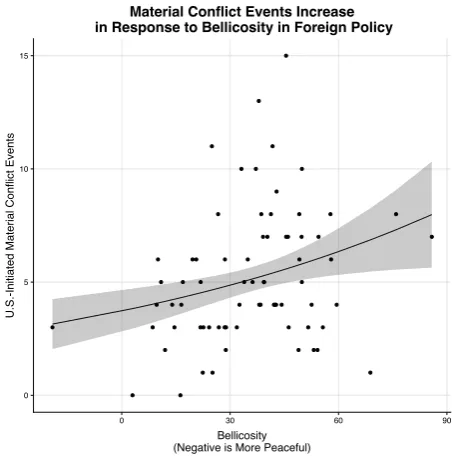
To determine if there is a relationship between hostile events and bellicosity, I regress events on the lagged bellicosity (to account for a delay in policy implementation), using a Poisson general-ized linear model, due to the count-distributed na-ture of the outcome.4 I plot the regression line against the data in Figure 3, and find a positive and statistically significant effect.
This result suggests that bellicosity in elite deliberations, captured in diplomatic documents, results in an increase in conflictual events, which suggests that the documents in theFRUS corpus do not simply contain cheap talk, these deliber-ations ultimately shape policy. These findings also help establish the validity of the “bellicos-ity” scale, that is, it correlates with an entirely
4In the appendix, I remove outliers and high-leverage
iran doubtful communications tam bases relatively robertson initials iranian blocked relations systematically family zambia outflows secretary shah sponsored appreciably north leave udi payments footnotes aram ultimatum masses hanoi deployments tran liabilities present iranians telecommunications sites recce fixed rhodesia fowler conflict afghan recommendation overtures drv precondition sr banks president squadron imminent concurs vinh laotian neighboring tax raymond mnd jet harass chau reasons continent corporations even
Table 2: The top words from a subset of components estimated from UMAP. Components include a variety of regional and substantive themes. These results help highlight the validity of the embeddings: semantically similar words are appearing near each other in cosine space.
0 5 10 15
1964 1965 1966 1967
U.S.-Initiated Hostile Events
Biweekly Material Conflict Event Counts
0 30 60 90
1964 1965 1966 1967
Average Bellicosity Score
Biweekly Bellicosity Score
Date, Biweekly, 1964-1966
Figure 2: Plotting material conflict event counts and bellicosity scores over time aggregated at the bi-weekly level. Both bellicosity and the count of material con-flict events increase with time, as the United States in-creased its involvement in the Vietnam War.
separate dataset, which captures a similar phe-nomena. All replication materials are available at https://github.com/adamlauretig/ bwe_application_naacl_2019.
8 Conclusion
In this paper, I introduced Bayesian Word Embed-dings, a method for estimating word embeddings which uses variational bayesian methods. I incor-porated Automatic Relevance Determination
pri-0 5 10 15
0 30 60 90
Bellicosity (Negative is More Peaceful)
U.S.-Initiated Material Conflict Events
[image:7.595.78.289.228.508.2]Material Conflict Events Increase in Response to Bellicosity in Foreign Policy
Figure 3: An increase in the previous bi-weekly pe-riod’s bellicosity is associated with an increase in U.S.-initiated hostile events. The regression is from a Pois-son generalized linear model, and uncertainty is dis-played with 95% confidence intervals.
ors on the embedding dimensions, relaxing the re-quirement that all dimensions have equal weight. Linking word embeddings to Bayesian latent vari-able models, I then discussed issues with identi-fication, and solutions proposed in the ideal-point literature, as well as offering an alternative which allows for scaling along dimensions of interest, which creates model model that can then be used in a regression.
that there was a statistically significant different in the views of the world expressed in inaugural ad-dresses, and that this shift was the opposite of what hypotheses generated from international relations theory would expect. When testing the effect of bellicosity on the hostility of American foreign policy, I that an increase in bellicosity resulted in an increase in hostility.
Overall, I have contributed a tool which can serve many purposes for social scientists. By building a probabilistic embedding model, I have constructed a tool which moves beyond document-based inferential approaches to text as data, allow-ing inference on individual words. This promises new reaches for social scientists, in particular, the promise of crossover with interpretivist work, building onNelson(2017). Concepts such as secu-ritization theory (Wæver,1995) draw on the idea that language and word choice by elites shape the attitude of the public, and through the methods introduced above provide the opportunity to gen-erate statistical tests for hypotheses derived from theories like securitization theory.
Future methodological work will follow three tracks. The first will build onRudolph et al.(2016) and Han et al. (2018), one goal is incorporating document-level metadata into embedding estima-tion, allowing embeddings to vary according to document-specific attributes, and then, identify-ing the resultidentify-ing embeddidentify-ings. The second will take advantage of stochastic variational inference (Hoffman et al., 2013) to enable Bayesian Word Embeddings to scale to massive corpora. Finally, the third track for future word will involve ty-ing the anchorty-ing approach discussed above with the emerging literature on making casual claims from text (Fong and Grimmer,2016;Mozer et al.,
2018), and taking advantage of the word similari-ties to identify appropriate linguistic counterfactu-als.
Acknowledgments
I would like to thank Bear Braumoeller, William Minozzi, and Gregory Smith, along with the three reviewers for valuable feedback on this project. I would like to thank Michael Neblo and the Institute for Democratic Engagement and Accountability at Ohio State for funding which helped support this project.
References
John H. Aldrich, Christopher Gelpi, Peter Feaver, Jason Reifler, and Kristin Thompson Sharp. 2006. Foreign policy and the electoral connection. Annual Review
of Political Science, 9:477–502.
John H. Aldrich, Jacob M. Montgomery, and David B. Sparks. 2014. Polarization and ideology: Parti-san sources of low dimensionality in scaled roll call analyses. Political Analysis, 22(4):435–456.
Scott Althaus, Joseph Bajjalieh, John F. Carter, Buddy Peyton, and Dan A. Shalmon. Cline center historical
phoenix event data[online]. 2017.
Joseph Bafumi, Andrew Gelman, David K. Park, and Noah Kaplan. 2005. Practical issues in implement-ing and understandimplement-ing bayesian ideal point estima-tion. Political Analysis, 13(2):171–187.
Oren Barkan. 2017. Bayesian neural word embedding. InAAAI, pages 3135–3143.
Etienne Becht, Leland McInnes, John Healy, Charles-Antoine Dutertre, Immanuel W.H. Kwok, Lai Guan Ng, Florent Ginhoux, and Evan W. Newell. 2019. Dimensionality reduction for visualizing single-cell data using umap.Nature biotechnology, 37(1):38.
Kenneth Benoit, Kohei Watanabe, Haiyan Wang, Paul Nulty, Adam Obeng, Stefan M¨uller, and Akitaka Matsuo. 2018. quanteda: An r package for the quan-titative analysis of textual data. Journal of Open
Source Software, 3(30):774.
CM Bishop. 1999. Variational principal components.
In Artificial Neural Networks, 1999. ICANN 99.
Ninth International Conference on (Conf. Publ. No. 470), volume 1, pages 509–514. IET.
David M. Blei, Alp Kucukelbir, and Jon D. McAuliffe. 2017. Variational inference: A review for statisti-cians. Journal of the American Statistical Associa-tion, 112(518):859–877.
David M. Blei, Andrew Y. Ng, and Michael I. Jordan. 2003. Latent dirichlet allocation. Journal of
ma-chine Learning research, 3(Jan):993–1022.
Aylin Caliskan, Joanna J. Bryson, and Arvind Narayanan. 2017. Semantics derived automatically from language corpora contain human-like biases.
Science, 356(6334):183–186.
Joshua Clinton, Simon Jackman, and Douglas Rivers. 2004. The statistical analysis of roll call data.
Amer-ican Political Science Review, 98(2):355–370.
James N. Druckman and Lawrence R. Jacobs. 2015.
Who Governs?: Presidents, Public Opinion, and
Manipulation. University of Chicago Press.
Peter D. Feaver and Christopher Gelpi. 2006. Choos-ing your battles: American civil-military relations
Christian Fong and Justin Grimmer. 2016. Discovery of treatments from text corpora. InACL (1).
Nikhil Garg, Londa Schiebinger, Dan Jurafsky, and James Zou. 2018. Word embeddings quantify 100 years of gender and ethnic stereotypes.
Pro-ceedings of the National Academy of Sciences,
115(16):E3635–E3644.
Matthew Gentzkow, Bryan T. Kelly, and Matt Taddy. 2017. Text as data. Technical report, National Bu-reau of Economic Research.
Justin Grimmer. 2010. A bayesian hierarchical topic model for political texts: Measuring expressed agen-das in senate press releases. Political Analysis, pages 1–35.
Justin Grimmer and Brandon M. Stewart. 2013. Text as data: The promise and pitfalls of automatic content analysis methods for political texts. Political Analy-sis, page mps028.
William L. Hamilton, Jure Leskovec, and Dan Jurafsky. 2016. Diachronic word embeddings reveal statisti-cal laws of semantic change. InProceedings of the 54th Annual Meeting of the Association for
Compu-tational Linguistics (Volume 1: Long Papers),
vol-ume 1, pages 1489–1501.
Rujun Han, Michael Gill, Arthur Spirling, and Kyunghyun Cho. 2018. Conditional word embed-ding and hypothesis testing via bayes-by-backprop.
In Proceedings of the 2018 Conference on
Empiri-cal Methods in Natural Language Processing, pages
4890–4895.
Serhii Havrylov and Ivan Titov. 2018. Embedding words as distributions with a bayesian skip-gram model. In Proceedings of the 27th International
Conference on Computational Linguistics, pages
1775–1789.
George C. Herring. 2008. From colony to superpower:
US foreign relations since 1776. Oxford University
Press.
Matthew D. Hoffman, David M. Blei, Chong Wang, and John Paisley. 2013. Stochastic variational infer-ence. The Journal of Machine Learning Research, 14(1):1303–1347.
Kosuke Imai, James Lo, and Jonathan Olmsted. 2016. Fast estimation of ideal points with massive data.
American Political Science Review, 110(4):631–
656.
Geng Ji, Robert Bamler, Erik B. Sudderth, and Stephan Mandt. 2017. Bayesian paragraph vectors. arXiv
preprint arXiv:1711.03946.
Austin C. Kozlowski, Matt Taddy, and James A. Evans. 2018. The geometry of culture: Analyzing mean-ing through word embeddmean-ings. arXiv preprint
arXiv:1803.09288.
Ronald R. Krebs. 2015. How dominant narratives rise and fall: Military conflict, politics, and the cold war consensus. International Organization, 69(04):809–845.
Brad L LeVeck, D Alex Hughes, James H Fowler, Emilie Hafner-Burton, and David G Victor. 2014. The role of self-interest in elite bargaining.
Pro-ceedings of the National Academy of Sciences,
111(52):18536–18541.
Will Lowe, Kenneth Benoit, Slava Mikhaylov, and Michael Laver. 2011. Scaling policy preferences from coded political texts. Legislative studies
quar-terly, 36(1):123–155.
David J.C. MacKay and Radford M. Neal. 1994. Auto-matic relevance determination for neural networks.
InTechnical Report. Cambridge University.
William B. McAllister, Joshua Botts, Peter Cozzens, and Aaron W. Marrs. 2015. Toward ”Thorough, Accurate, and Reliable”: A History of the Foreign
Relations of the United States Series. Government
Printing Office.
John J. Mearsheimer. 2001. The tragedy of great power
politics. WW Norton & Company.
Tomas Mikolov, Ilya Sutskever, Kai Chen, Greg S Cor-rado, and Jeff Dean. 2013a. Distributed representa-tions of words and phrases and their compositional-ity. InAdvances in neural information processing
systems, pages 3111–3119.
Tomas Mikolov, Wen-tau Yih, and Geoffrey Zweig. 2013b. Linguistic regularities in continuous space word representations. In NAACL-HLT, volume 13, pages 746–751.
Reagan Mozer, Luke Miratrix, Aaron Russell Kauf-man, and L Jason Anastasopoulos. 2018. Match-ing with text data: An experimental evaluation of methods for matching documents and of measuring match quality.arXiv preprint arXiv:1801.00644.
Laura K. Nelson. 2017. Computational grounded the-ory: A methodological framework. Sociological
Methods & Research, page 0049124117729703.
Clayton Norris, Philip Schrodt, and John Beieler. 2017. Petrarch2: Another event coding program. The
Journal of Open Source Software, 2(9).
Caleb Pomeroy, Niheer Dasandi, and Slava Jankin Mikhaylov. 2018. Multiplex communities and the emergence of international conflict. arXiv preprint
arXiv:1806.00615.
Ludovic Rheault, Kaspar Beelen, Christopher Cochrane, and Graeme Hirst. 2016. Measuring emotion in parliamentary debates with automated textual analysis. PloS one, 11(12):e0168843.
Douglas Rivers. 2003. Identification of multidimen-sional spatial voting models. Typescript. Stanford
Margaret E. Roberts, Brandon M. Stewart, and Edoardo M. Airoldi. 2016. A model of text for ex-perimentation in the social sciences. Journal of the
American Statistical Association, (just-accepted):1–
49.
Maja Rudolph, Francisco Ruiz, Stephan Mandt, and David Blei. 2016. Exponential family embeddings.
InAdvances in Neural Information Processing
Sys-tems, pages 478–486.
State Department. About the foreign relations of the
united states series[online]. 2017.
Peter D. Turney and Patrick Pantel. 2010. From fre-quency to meaning: Vector space models of se-mantics. Journal of artificial intelligence research, 37:141–188.
Ole Wæver. 1995. Securitization and desecuritization.
In On Security, pages 46–86. Columbia University
Press.
Martin J. Wainwright and Michael I. Jordan. 2008. Graphical models, exponential families, and varia-tional inference. Foundations and TrendsR in
Ma-chine Learning, 1(1–2):1–305.
John R. Zaller. 1992. The nature and origins of mass
opinion. Cambridge university press.
A Comparing BWE to STM
Unlike the results from the Bayesian Word Em-bedding, the structural topic model detects no dif-ference in topics before and after 1945. The top words, as determined by FREX score, are visible in3.
International Topic Domestic Topic representative pacific
civilization territory
making question
international whilst
tax importance
popular constitution
concern slavery
[image:10.595.327.501.61.289.2]supreme domestic
Table 3: Top eight words from structural topic model for international and domestic topics, by FREX score.
B Inauguration Robustness Check
One concern with the role of internationalism in inaugural addresses is that by splitting at 1945, the “internationalism” of the pre-1945 sample is due to World War Two, and the Roosevelt presidency. To account for this, I re-estimate the Kolmogorov-Smirnov test from above, excluding the Roosevelt
-0.10 -0.05 0.00
Domestic Topic International Topic
Change in Topics After 1945
[image:10.595.309.535.375.607.2]No Shift in Domestic and International Topics After 1945
Figure 4: There is no significant difference between foreign and international topics before and after 1945, uncertainty is displayed with 95% confidence intervals.
After 1945 Before 1932
-3000 -2000 -1000 0
International to Domestic Score (Positive is more International) Shift is significant, D = 0.44, p = 0.009
[image:10.595.97.268.482.607.2]Rhetoric is Less Internationalist After 1945
Figure 5: Even excluding the Roosevelt administration, when only examining inaugural addresses from before 1932 and after 1945, the pre-1932 inaugural addresses are more internationalist than the post-1945 addresses.
5 10
0 30 60 90
Bellicosity (Negative is More Peaceful)
U.S.-Initiated Material Conflict Events
[image:11.595.75.301.63.290.2](Outliers Removed) Material Conflict Events Increase in Response to Bellicosity in Foreign Policy
Figure 6: An increase in bellicosity is associated with an increase in U.S.-initiated hostile events. The regres-sion is from a Poisson generalized linear model, and uncertainty is displayed with 95% confidence intervals.
C GLM without Outliers
To ensure that the results presented in Figure 3