Proceedings of the 3rd Workshop on Evaluating Vector Space Representations for NLP, pages 27–34 27
How Well Do Embedding Models Capture Non-compositionality? A View
from Multiword Expressions
Navnita Nandakumar Timothy Baldwin Bahar Salehi
School of Computing and Information Systems The University of Melbourne
Victoria 3010, Australia
[email protected] {tbaldwin|salehi.b}@unimelb.edu.au
Abstract
In this paper, we apply various embedding methods to multiword expressions to study how well they capture the nuances of non-compositional data. Our results from a range of word-, character-, and document-level em-bbedings suggest thatword2vecperforms the best, followed by fastText and infersent. Moreover, we find that recently-proposed con-textualised embedding models such asBERT
and ELMo are not adept at handling non-compositionality in multiword expressions.
1 Introduction
Modern embedding models, including contextual embeddings, have been shown to work impres-sively well across a range of tasks (Peters et al., 2018; Devlin et al., 2018). However, study of their performance on data with a mix of composi-tionality levels, whose meaning is often not easily predicted from that of its constituent words, has been limited (Salehi et al., 2015; Hakimi Parizi and Cook,2018;Nandakumar et al.,2018).
At present, there exists no definitive metric to measure the modelling capabilities of an em-bedding technique across a spectrum of non-compositionality, especially in the case of newer, contextualised representations, such asELMoand
BERT.
In this study, we apply various embedding methods to the task of determining the com-positionality of English multiword expressions (“MWEs”), specifically noun–noun and adjective– noun pairs, to test their performance on data rep-resenting a range of compositionality (Sag et al., 2002). Compositionality prediction can be mod-eled as a regression task (Baldwin and Kim,2010) that involves mapping an MWE onto a continu-ous scale, representing its compositionality as a whole or with respect to each of its components. For example,application formcan be considered
to be quite compositional, while sitting duck1 is considered to be idiomatic or non-compositional.
Close shave2 could be seen as partially composi-tional, heavily compositional with regards to the first word and less compositional with regards to the second. In this study, we focus on pre-dicting the compositionality of the MWE as a whole. Although we conduct our experiments on English datasets, they can be applied to other lan-guages with ease as we do not perform any kind of language-specific manipulation of the data.
The main contributions of this paper are: (i) we compare embeddings over 3 different
MWE datasets, focusing on noun–noun and adjective–noun pairs;
(ii) we experiment with 7 character-, word-, and document-level embedding models, includ-ing contextualised models;
(iii) we show that, despite their success on a range of other tasks, recent embedding learn-ing methods lag behind simpleword2vec in capturing MWE non-compositionality.
2 Related Work
Although vector space models have been popu-lar since the 1990s, it was only after Collobert and Weston(2008) proposed a unified neural net-work architecture to learning distributed word rep-resentations and demonstrated its performance on downstream tasks, that embedding learning estab-lished a footing in NLP, withword2vec(Mikolov et al.,2013a) being the catalyst to the “embedding revolution”.
Language embeddings are an example of an unsupervised representation learning application done well. They are preferred primarily because they can be learned from unannotated corpora and,
1
Asitting duckmeans “a person or thing with no protec-tion against an attack or other source of danger.”
2A
therefore, eliminate the need for manual annota-tion (which is expensive and time-consuming).
Salehi et al.(2015) were the first to apply word embeddings to the task of predicting the compo-sitionality of MWEs. The assumption is that the compositionality of an MWE is proportional to the relative similarity between each of the compo-nents and the overall MWE, represented by their respective embeddings. This method was recently tuned variously byCordeiro et al.(2019) and re-mains state-of-the-art for the task of MWE com-positionality prediction, but has the downside that it requires automatic token-level pre-identification of each MWE in the training corpus in order to train a model (i.e. all occurrences ofsitting duck
need to be pre-tokenised to a single token, such as sitting duck). This is not ideal, as it means the model will need to be retrained for a new set of MWEs (as the tokenisation will necessarily change). It also requires “complete” knowledge of the MWEs before the training step, which is im-practical in most cases.
Character-level embedding models
(Hakimi Parizi and Cook,2018) are one possible solution to the fixed-vocabulary problem, in being able to handle an unbounded vocabulary, including MWEs. Document embeddings (Le and Mikolov, 2014; Conneau et al., 2017a) are also highly relevant to dynamically generating embed-dings for MWEs, as they generate representations of arbitrary spans of text, which are potentially able to capture the context of use of the MWE.
3 Methodology
Following Salehi et al. (2015) and Nandakumar et al. (2018), we compute the overall composi-tionality of an MWE with three broad metrics: direct composition, paraphrase similarity, and a combined metric. In all experiments, the similar-ity of a pair of vectors is measured using cosine similarity.
3.1 Direct Composition
Intuitively, an MWE appearing in similar contexts to its components is likely to be compositional. We directly compare the vector embedding of the MWE (described in Section 4.2) with that of its component words, in one of two ways: (1) per-forming an element-wise sum to obtain a ‘com-bined’ vector, which is then compared with the vector of the MWE (Directpre); and (2) a post-hoc
combination of the scores obtained by individually comparing the component vectors with that of the MWE via a weighted sum (Directpost). Formally:
Directpre= cos(mwe,w1+w2)
Directpost=αcos(mwe,w1)+
(1−α) cos(mwe,w2),
where:mwe,w1, andw2are the embeddings for
the combined MWE, first component and second component, respectively;3w1+w2is the
element-wise sum of the vectors of each of the component words of the MWE; and α ∈ [0,1] is a scalar which allows us to vary the weight of the respec-tive components in predicting the compositional-ity of the compound. This helps us effectively capture the compositionality of the MWE with re-gards to each of its individual constituents.
We do not perform any tuning of α over held-out data and are, as such, overfitting as we select the best-performingαpost hoc. We do, however, present analysis of hyper-parameter sensitivity in Section5.
3.2 Paraphrase Similarity
Assuming access to paraphrases of an MWE, an-other intuition is that if the MWE appears in sim-ilar contexts to the component words of its para-phrases, it is likely to be compositional (Shwartz and Waterson,2018). Each paraphrase provides an interpretation of the semantics of the MWE, e.g.
ancient historyis “in the past”, “old news” or “for-ever ago” (note how each paraphrase brings out a slightly different interpretation). The RAMISCH
MWE dataset (described in Section4.1) provides one or more paraphrases for each MWE contained in it. We calculate the similarity of the embed-dings of the MWE and its paraphrases using the following three formulae:
Para first= cos(mwe,para1)
Para allpre = cos(mwe,
X
i
parai)
Para allpost=
1 N
N
X
i=1
cos(mwe,parai),
wherepara1andparaidenote the embedding for
the first (most popular) and i-th paraphrases, re-spectively.
3All methods are presented and evaluated in terms of
In the case of Para allpost, we considered com-puting the maximum instead of the average (as we report here) of the similarity scores between each paraphrase and its MWE, following the intuition that an MWE would be similar to at least one re-ported paraphrase, rather than all of them. How-ever, the results for the average similarity were empirically higher across models.
3.3 Combined Metric
Finally, we present the combined results from the two metrics stated above:
Combined=βmax Directpre,Directpost
+
(1−β) max Para first,Para allpre,
Para allpost
,
whereβ ∈ [0,1]is a scalar weighting factor used to balance the effects of the two methods, in order to measure the extent to which the composition-ality is determined by each of the methods. The choice of the max operator here to combine the sub-methods for each of the direct composition and paraphrase methods is that all methods tend to underestimate the compositionality (and empir-ically, it was found to be superior to taking the mean).
4 Experiments
4.1 Datasets
We used three datasets for our experiments, eval-uating each model’s performance using Pearson’s correlation coefficient (r) to compare the similar-ity scores obtained with the annotated composi-tionality scores provided in the dataset.
REDDY The dataset ofReddy et al.(2011) con-tains 90 binary English noun compounds (“NCs”), along with human-annotated scores of their over-all compositionality and component-specific com-positionality, both ranging from 0 to 5. For our experiments, we consider the overall composition-ality scores only.
RAMISCH Similar to REDDY, the English dataset ofRamisch et al.(2016) contains 90 binary noun compounds with annotated scores of compo-sitionality ranging from 0 to 5, both overall and component-specific (of which we use only the for-mer). It also contains a list of paraphrases for each NC, presented in decreasing order of popularity among the annotators.
Dataset µ σ
REDDY 53.2 30.0
RAMISCH 52.6 35.0 DISCO 68.1 21.7
[image:3.595.360.471.60.147.2]Overall 59.7 29.0
Table 1: Mean (µ) and standard deviation (σ) of the compositionality scores for the three datasets used in this research, over a normalised range[0,100].
DISCOADJ The English dataset from the DiSCo shared task (Biemann and Giesbrecht,2011) con-taining a total of 348 binary phrases, comprising adjective–noun, verb–nounsubj, and verb–nounobj pairs, along with their overall compositionality rating ranging from 0 to 100. The phrases were ex-tracted semi-automatically and their relations were assigned by patterns and checked manually. The compositionality scores were collected from Ama-zon Mechanical Turk, where workers were pre-sented 4–5 randomly sampled sentences from the UK English WACKy corpora. We focus on the 144 adjective–noun pairs in this study.
The breakdown of compositionality scores across the three datasets in Table1indicates there is a reasonable distribution of data in terms of compositionality, with REDDYand RAMISCH
be-ing roughly comparable and coverbe-ing a broad (and somewhat balanced) spectrum of compositionali-ties, while DISCO is more skewed towards
com-positional usages, with lower standard deviation.
4.2 Embeddings
4.2.1 Word-level
A word embedding captures the context of a word in a document (in relation to other words) in the form of a vector representation. It tokenises text at the word level.
word2vec We trained word2vec (Mikolov et al., 2013b) on a recent English Wikipedia dump,4 after pre-processing (removing the for-matting and punctuation) and concatenating each occurrence of the multiword expressions in our datasets (e.g. every occurrence of close shave in the corpus becomes closeshave). We make the greedy assumption that every occurence of the component words in sequence is an occurrence of the expression. We perform this token-level iden-tification and manipulation of the corpus in order to obtain a single embedding for the expression, instead of a separate embeddings for the individ-ual component words. In cases where the model still fails to generate an embedding (2 for REDDY, 8 for RAMISCHand 25 for DISCO) for the
expres-sion (due to low token frequency), we assign a de-fault compositionality score of 0.5 (neutral; based on a range of[0,1]). For paraphrases, we compute an element-wise sum of the embeddings for each of the component words to serve as the embedding of the phrase. We do this because token-level iden-tification of each paraphrase in the training corpus is not practical.
4.2.2 Character-level
Character-level embeddings can generate vectors for words based on n-gram character aggrega-tions. This means they can generate embeddings for out-of-vocabulary (OOV) words, as well new words or misspelled words. It tokenises text at the character level.
fastText We used the 300-dimensional fast-Text model pre-trained on Common Crawl and Wikipedia using CBOW (fastTextpre), as well as one trained over the same Wikipedia corpus4 us-ing skip-gram (fastText). Again, sincefastText
(Bojanowski et al., 2017) assumes all words to be whitespace delimited, we preprocess our MWE and paraphrases the same way as above (removing the space between them so thatarmchair critic be-comesarmchaircritic, say).
Contextualised Embeddings Unlike classical embedding techniques, contextualised
embed-4Dated 07-Jan-2019
dings capture the semantics of a word or phrase in a manner which is sensitised to the context of usage.
We used the pretrained implementations of
ELMo (Peters et al., 2018) and BERT (Devlin et al.,2018) found in the Flair framework.5 The framework also has a contextualised string embed-ding model of its own, also named Flair (Akbik et al.,2018).
We supplied sentences extracted from the Brown corpus where available in order to derive a contextualised interpretation. We extracted 25 sentences at random per MWE, except where there were fewer sentences in the corpus.
However, we also included a naive context-independent implementation in our study, consis-tent with the other models, following the intuition that the relative compositionality of even a novel compound can often be predicted from its com-ponent words alone (e.g.giraffe potatohaving the plausible compositional interpretation of a potato shaped like a giraffe vs.couch intelligencehaving no natural interpretation).
4.2.3 Document-level
Document embeddings aggregate from words to documents, generating vector representations for entire documents. Since document and sentence embeddings are capable of generating a single em-bedding for a span of text, we are able to gener-ate representations of the MWEs and paraphrases without preprocessing them (to remove space). We treat each constituent word as a single word document to generate embeddings.
infersent We used two versions of infersent
(Conneau et al., 2017b): infersentGloVe and
in-fersentfastText. Each generates a representation of 300 dimensions, trained over the 1,000,000 most popular English words usingGloVe (Pennington et al.,2014) andfastText, respectively.
doc2vec We used the gensim implementation of doc2vec (Le and Mikolov, 2014; Lau and Baldwin, 2016) pretrained on Wikipedia data us-ing theword2vecskip-gram models pretrained on Wikipedia and AP News.6
5
https://github.com/zalandoresearch/ flair
Emb. method Directpre Directpost Para first Para allpre Para allpost Combined
Flair 0.165 0.295 (α= 0.1) 0.334 0.399 0.492 0.492 (β= 0.0)
Flaircontext 0.181 0.314 (α= 0.1) 0.357 0.411 0.522 0.522 (β= 0.0)
fastTextpre 0.395 0.446 (α= 0.7) 0.242 0.531 0.703 0.703 (β= 0.0)
fastText 0.464 0.532 (α= 0.7) 0.548 0.613 0.673 0.673 (β= 0.0)
BERT 0.071 0.086 (α= 1.0) 0.242 0.531 0.583 0.583 (β= 0.0)
BERTcontext 0.089 0.111 (α= 1.0) 0.267 0.546 0.601 0.601 (β= 0.0)
ELMo 0.420 0.459 (α= 0.6) 0.361 0.488 0.546 0.546 (β= 0.2)
ELMocontext 0.461 0.489 (α= 0.6) 0.373 0.492 0.552 0.627 (β= 0.2)
word2vec 0.581 0.571(α= 0.6) 0.443 0.510 0.504 0.677 (β= 0.9)
infersentGloVe 0.321 0.427 (α= 0.7) 0.636 0.700 0.741 0.783(β= 0.5)
infersentfastText 0.169 0.221 (α= 0.6) 0.488 0.712 0.636 0.774 (β= 0.0)
[image:5.595.310.522.297.485.2]doc2vec −0.157 0.039 (α= 1.0) 0.388 0.334 0.373 0.419 (β= 0.3)
Table 2: Pearson correlation coefficient for compositionality prediction results on the RAMISCHdataset.
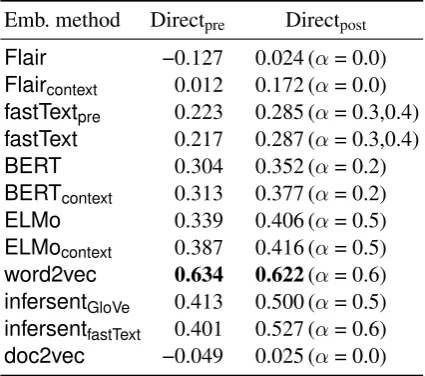
Emb. method Directpre Directpost
Flair −0.127 0.024 (α= 0.0)
Flaircontext 0.012 0.172 (α= 0.0)
fastTextpre 0.223 0.285 (α= 0.3,0.4)
fastText 0.217 0.287 (α= 0.3,0.4)
BERT 0.304 0.352 (α= 0.2)
BERTcontext 0.313 0.377 (α= 0.2)
ELMo 0.339 0.406 (α= 0.5)
ELMocontext 0.387 0.416 (α= 0.5)
word2vec 0.634 0.622(α= 0.6)
infersentGloVe 0.413 0.500 (α= 0.5)
infersentfastText 0.401 0.527 (α= 0.6)
doc2vec −0.049 0.025 (α= 0.0)
Table 3: Pearson correlation coefficient for composi-tionality prediction results on the REDDYdataset.
5 Results and Discussion
The results from our experiments on the RAMISCH, REDDY and DISCO datasets can be found in Tables2, 3 and 4, respectively, with the best performingαs andβs for each embedding method.
We observe that theαs in Table2are high, im-plying the compound nouns in RAMISCHare more compositional in terms of their head (second) nouns. Similarly, the lower α scores in Table 3 suggest REDDY’s compound nouns are more de-pendent on their modifiers, or first nouns. Table4, on the other hand, shows theαs embracing the en-tire range of [0,1]. This suggests the adjective– noun pairs in DISCO are spread in terms of their
Emb. method Directpre Directpost
Flair 0.261 0.291 (α= 0.4)
Flaircontext 0.280 0.315 (α= 0.4)
fastTextpre 0.339 0.353 (α= 0.6,0.7)
fastText 0.374 0.419 (α= 0.4)
BERT 0.154 0.177 (α= 0.3,0.4)
BERTcontext 0.163 0.189 (α= 0.3)
ELMo 0.253 0.287 (α= 0.5)
ELMocontext 0.301 0.319 (α= 0.5)
word2vec 0.427 0.419(α= 0.4)
infersentGloVe 0.321 0.315 (α= 0.4)
infersentfastText 0.001 0.202 (α= 1.0)
doc2vec −0.023 0.003 (α= 0.0)
Table 4: Pearson correlation coefficient for composi-tionality prediction results on the DISCOADJdataset.
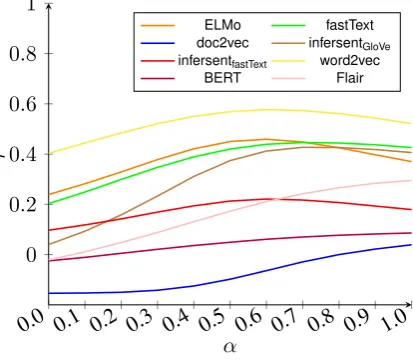
dependency on their constituents, which also de-pends on the embedding method used. Overall, the methods are sensitive to the choice of theα hyper-parameter, withELMoandinfersentbeing partic-ularly sensitive and showing substantial change in output with change inα(Figures1,2and3).
We see that for RAMISCH(Table2),word2vec
achieves the highest scores among the direct com-bination metrics, whileinfersent outperforms the other methods among the paraphrase metrics, and
word2vecfalls behind character embedding mod-els like fastText, ELMo andBERT (even when the latter two were performed without context). The lower β scores also show the other models favouring the paraphrase metrics, while the high
[image:5.595.75.288.298.486.2]di-0.0 0.1 0.2 0.3 0.4 0.5 0.6 0.7 0.8 0.9 1.0
0 0.2 0.4 0.6 0.8 1
α
r
ELMo fastText doc2vec infersentGloVe infersentfastText word2vec
[image:6.595.78.287.65.245.2]BERT Flair
Figure 1: Sensitivity analysis ofα(REDDY)
0.0 0.1 0.2 0.3 0.4 0.5 0.6 0.7 0.8 0.9 1.0
0 0.2 0.4 0.6 0.8 1
α
r
ELMo fastText doc2vec infersentGloVe infersentfastText word2vec
BERT Flair
Figure 2: Sensitivity analysis ofα(RAMISCH)
rect combination.
We observe that, consistent with its perfor-mance on RAMISCH,word2vecperforms the best of all models for the direct combination methods.
Overall, we observe that word2vec is con-sistent in providing the best results based on the methods outlined in Section 3.1, while fast-Text and infersent come a close second and third, respectively. It is noteworthy, however, thatword2vec required explicit modelling of the MWEs during the training procedure, while the other models did not.
It is not surprising that infersent, being a document-level embedding model, works better with paraphrase data than the other models. How-ever, doc2vec has really poor scores overall across the three datasets. It does, however, re-deem itself with the paraphrases, with
substan-0.0 0.1 0.2 0.3 0.4 0.5 0.6 0.7 0.8 0.9 1.0
0 0.2 0.4 0.6 0.8 1
α
r
ELMo fastText doc2vec infersentGloVe infersentfastText word2vec
[image:6.595.311.521.65.247.2]BERT Flair
Figure 3: Sensitivity analysis ofα(DISCO)
tially higher scores than the direct metric but still quite a way behind the top-scoring methods.
We also see that the paraphrase metric seems to achieve much greater results across all mod-els, suggesting this could be a direction for fu-ture study (noting the requirement for paraphrase data for the MWE in order to apply this method, which has inherent scalability limitations). The combined metric seems to favour the paraphrase results as well, based on the relativeβvalues.
One of the reasonsword2vec did not work as well with the paraphrases could be the naive as-sumption that the Directpre is a representation of the paraphrase itself. As we see from the results across the datasets and methods, Directpredoes not entirely capture the compositionality of the MWE, so it is reasonable to assume that a paraphrase would not be accurately represented by Directpre either.
We see that fastText provides us with impres-sive scores throughout, and we notice a slight im-provement when trained on the same corpus as
word2vec. However, there is a huge gap in the performance betweenword2vecandfastText, es-pecially in the case of REDDY (which could be
an issue of a heavier representation of a particu-lar level of compositionality, say).
We also notice that, unlike the noun compounds in REDDYand RAMISCH, there is less variance in the relative scores of each method in the case of DISCOADJ, with overall results dropping appre-ciably, and the best-performing word2vec drop-ping back in rawr value compared to noun–noun pairs.
[image:6.595.78.285.291.471.2]notice that across the three models, there is only a slight increase in correlation when contextualised embeddings are used. This suggests that even with context, these modern embedding techniques are unable to capture non-compositionality as well as their simpler counterparts.
Further analysis reveals that most models strug-gle to accurately predict the compositionality of idiomatic noun compounds, as well as semi-compositional terms wherein one of the con-stituent words are used in a metaphoric sense. In REDDY, we observe this forsilver bulletandsnail mail. Interestingly, while BERT struggles to ef-fectively model compositionality throughout, it is surprisingly the only model able to perfectly pre-dict the compositionality ofsnail mail (which ap-pears as an extreme outlier). This suggests that
BERTmight be more successful using a different metric. In the case of the adjective–noun phrases in DISCO, we see that the models are still unable to accurately predict the compositionality of non-compositional phrases (likebig fish, heavy metal
andred tape). This time, however, they are also unable to capture mobile phone and floppy disk, perhaps because of their relatively archaic use.
6 Conclusion
In this paper, we investigated the modelling capa-bilities of various embedding techniques applied to the specific task of predicting the MWE compo-sitionality, to see how well they model a mixture of compositionalities in the dataset. Our results indicate that modern character- and document-level embedding methods are inferior to the sim-ple word2vec approach. However, the promis-ing results of fastText and infersent across the datasets indicate that, among the more modern methods, they are better equiped to handle non-compositionality as they did not require much manipulation of the corpus or knowledge of the MWEs beforehand. We also found that the para-phrase metric results in greater correlation scores across the models.
In future work, we intend to tune our hyperpa-rameters over held-out data, and experiment with other languages and language-independent tech-niques, including other models.
Acknowledgments
We would like to thank the curators and annotators of the datasets used in this study, and the
anony-mous reviewers for their insightful comments. We would also like to thank Chris Biemann from the University of Hamburg for making the dataset from the DiSCo shared task available to us.
References
Alan Akbik, Duncan Blythe, and Roland Vollgraf. 2018. Contextual string embeddings for sequence labeling. InCOLING 2018, 27th International Con-ference on Computational Linguistics, pages 1638– 1649, Santa Fe, USA.
Timothy Baldwin and Su Nam Kim. 2010. Multiword expressions. InNitin Indurkhya and Fred J. Dam-erau (eds.) Handbook of Natural Language Process-ing, Second Edition, CRC Press, pages 267–292, Boca Raton, USA.
Chris Biemann and Eugenie Giesbrecht. 2011. Dis-tributional semantics and compositionality 2011: Shared task description and results. InProceedings of the Workshop on Distributional Semantics and Compositionality, pages 21–28, Portland, USA.
Piotr Bojanowski, Edouard Grave, Armand Joulin, and Tomas Mikolov. 2017. Enriching word vectors with subword information. Transactions of the Associa-tion for ComputaAssocia-tional Linguistics, 5:135–146.
Ronan Collobert and Jason Weston. 2008. A unified architecture for natural language processing: Deep neural networks with multitask learning. In Pro-ceedings of the 25th International Conference on Machine Learning, pages 160–167.
Alexis Conneau, Douwe Kiela, Holger Schwenk, Lo¨ıc Barrault, and Antoine Bordes. 2017a. Supervised learning of universal sentence representations from natural language inference data. InProceedings of the 2017 Conference on Empirical Methods in Nat-ural Language Processing, pages 670–680, Copen-hagen, Denmark.
Alexis Conneau, Douwe Kiela, Holger Schwenk, Lo¨ıc Barrault, and Antoine Bordes. 2017b. Supervised learning of universal sentence representations from natural language inference data. InProceedings of the 2017 Conference on Empirical Methods in Nat-ural Language Processing, pages 670–680, Copen-hagen, Denmark. Association for Computational Linguistics.
Silvio Cordeiro, Aline Villavicencio, Marco Idiart, and Carlos Ramisch. 2019. Unsupervised composition-ality prediction of nominal compounds. Computa-tional Linguistics, 45(1).
Ali Hakimi Parizi and Paul Cook. 2018. Do character-level neural network language models capture knowledge of multiword expression compositional-ity? InProceedings of the Joint Workshop on Lin-guistic Annotation, Multiword Expressions and Con-structions (LAW-MWE-CxG-2018), pages 185–192, Santa Fe, USA.
Jey Han Lau and Timothy Baldwin. 2016. An empiri-cal evaluation of doc2vec with practiempiri-cal insights into document embedding generation. In Proceedings of the 1st Workshop on Representation Learning for NLP, pages 78–86, Berlin, Germany.
Quoc Le and Tomas Mikolov. 2014. Distributed rep-resentations of sentences and documents. In Pro-ceedings of the 31st International Conference on Machine Learning (ICML 2014), pages 1188–1196, Beijing, China.
Tomas Mikolov, G.s Corrado, Kai Chen, and Jeffrey Dean. 2013a. Efficient estimation of word represen-tations in vector space. InProceddings of Workshop at the International Conference on Learning Repre-sentations, pages 1–12.
Tomas Mikolov, Ilya Sutskever, Kai Chen, Greg S Cor-rado, and Jeff Dean. 2013b. Distributed representa-tions of words and phrases and their compositional-ity. InAdvances in Neural Information Processing Systems 26, pages 3111–3119.
Navnita Nandakumar, Bahar Salehi, and Timothy Bald-win. 2018. A comparative study of embedding mod-els in predicting the compositionality of multiword expressions. In Proceedings of the Australasian Language Technology Association Workshop 2018, pages 71–76, Dunedin, New Zealand.
Jeffrey Pennington, Richard Socher, and Christo-pher D. Manning. 2014. GloVe: Global vectors for word representation. InEmpirical Methods in Nat-ural Language Processing (EMNLP), pages 1532– 1543.
Matthew Peters, Mark Neumann, Mohit Iyyer, Matt Gardner, Christopher Clark, Kenton Lee, and Luke Zettlemoyer. 2018. Deep contextualized word rep-resentations. In Proceedings of the 2018 Confer-ence of the North American Chapter of the Associ-ation for ComputAssoci-ational Linguistics: Human Lan-guage Technologies, Volume 1 (Long Papers), pages 2227–2237, New Orleans, USA.
Carlos Ramisch, Silvio Cordeiro, Leonardo Zilio, Marco Idiart, and Aline Villavicencio. 2016. How naked is the naked truth? a multilingual lexicon of nominal compound compositionality. In Proceed-ings of the 54th Annual Meeting of the Association for Computational Linguistics (Volume 2: Short Pa-pers), pages 156–161, Berlin, Germany.
Siva Reddy, Diana McCarthy, and Suresh Manandhar. 2011. An empirical study on compositionality in
compound nouns. In Proceedings of 5th Interna-tional Joint Conference on Natural Language Pro-cessing, pages 210–218, Chiang Mai, Thailand.
Ivan A. Sag, Timothy Baldwin, Francis Bond, Ann Copestake, and Dan Flickinger. 2002. Multiword expressions: A pain in the neck for NLP. In Pro-ceedings of the 3rd International Conference on In-telligent Text Processing and Computational Lin-guistics (CICLing-2002), pages 1–15, Mexico City, Mexico.
Bahar Salehi, Paul Cook, and Timothy Baldwin. 2015.
A word embedding approach to predicting the com-positionality of multiword expressions. In Proceed-ings of the 2015 Conference of the North Ameri-can Chapter of the Association for Computational Linguistics: Human Language Technologies, pages 977–983, Denver, USA.
![Table 1: Mean (µcompositionality scores for the three datasets used inthis research, over a normalised range) and standard deviation (σ) of the [0, 100].](https://thumb-us.123doks.com/thumbv2/123dok_us/1391696.673675/3.595.360.471.60.147/table-ucompositionality-scores-datasets-research-normalised-standard-deviation.webp)