50
Annotating Shallow Discourse Relations in Twitter Conversations
Tatjana Scheffler1, Berfin Aktas¸1, Debopam Das2, and Manfred Stede1
1Department of Linguistics / SFB1287, University of Potsdam, Germany
2Department of English and American Studies, Humboldt University of Berlin, Germany
Abstract
We introduce our pilot study applying PDTB-style annotation to Twitter conversations. Lexically grounded coherence annotation for Twitter threads will enable detailed investiga-tions of the discourse structure of conversa-tions on social media. Here, we present our corpus of 185 threads and annotation, includ-ing an inter-annotator agreement study. We discuss our observations as to how Twitter courses differ from written news text wrt. dis-course connectives and relations. We confirm our hypothesis that discourse relations in writ-ten social media conversations are expressed differently than in (news) text. We find that in Twitter, connective arguments frequently are not full syntactic clauses, and that a few gen-eral connectives expressing EXPANSIONand CONTINGENCYmake up the majority of the explicit relations in our data.
1 Introduction
The PDTB corpus (Prasad et al.,2008) is a well-known resource of discourse-level annotations, and the general idea of lexically signalled dis-course structure annotation has over the years been applied to a variety of languages. A shallow ap-proach to discourse structure in the PDTB style can also be adapted to different genres. In this pa-per, we consider English conversations on Twitter, and describe the first phase of our annotation, viz. that of explicit connectives whose arguments are within a single tweet. We explain the collection of the data and our annotation procedure, and the results of an inter-annotator-agreement study. We present our analysis of the specific features of this genre of conversation wrt. discourse structure, as well as corpus statistics, which we compare to the distributions in the original PDTB corpus.
We show that explicit discourse relations are frequent in English Twitter conversations, and that
the distribution of connectives and relations dif-fers markedly from the distribution in PDTB text. In particular, the Twitter threads contain many more CONTINGENCYrelations (in particular, con-ditional and causal relations). In addition, the connective’s arguments in the Twitter data are of-ten elliptical phrases standing in for propositional content.
The upcoming second phase of the project will target connectives whose Arg1 is located in a pre-vious tweet, as well as AltLex realizations and implicit relations. We regard this effort as com-plementary to approaches that applied Rhetori-cal Structure Theory (Mann and Thompson,1988) and Segmented Discourse Representation Theory (Asher and Lascarides,2003) to dialogue; the im-portant difference being that other than RST and SDRT, PDTB does not make strong commitments as to an overarching structure of the discourse. Overall, we see this as an advantage for studying relatively uncharted territory: The structural pecu-liarities of social media conversations have not yet been explored in depth, and a PDTB-style anno-tation is one way of laying empirical groundwork for that endeavour.
2 Twitter and Discourse Relations
for spoken conversations, and they work on Italian dialogs. Riccardi et al. (2016) focus on the de-tection of discourse connectives from lexical and acoustic features in help desk dialogs. In contrast, we investigate open topic spontaneous conversa-tions in computer mediated communication, to ab-stract away from the speech mode, but retain the conversational properties.
Twitter1 is a social media platform that pub-lishes short “microposts” by registered users. In addition to textual content, these posts may con-tain embedded images or videos. Twitter users can interact by directly replying to each other’s messages. Such replies are quite frequent and the resulting conversations often contain discourse connectives (Scheffler,2014). There is some evi-dence that the types of relations and connectives found in Twitter conversations differs markedly from edited news text and reflects some features of spoken conversations (Scheffler, 2014; Scheffler and Stede,2016). Here, we introduce an annotated corpus of explicit connectives in English tweets, which allows us to test genre differences between the discourse structure of newspaper texts (PDTB) and conversational writing (our Twitter corpus).
3 Collecting and Annotating the Corpus
We collected English language tweets from the Twitter stream on several (non-adjacent) days in December, 2017 and January 2018 without filter-ing for hashtags or topics in any way. In order to obtain conversations that are linked to each other via thereply-torelation, and which altogether then form a tree structure, we recursively retrieved par-ent tweets of those gathered via the initial search. A singlethreadin our terminology is a path from the root to a leaf node of that tree. For the purposes of the present experiment, we then selected only one of the longest threads (paths) from each tree and discarded everything else in this dataset. See (Aktas¸ et al.,2018) for details on the data collec-tion. The resulting corpus consists of 1756 tweets arranged in 185 threads, and the average length of a tweet is 153 characters.2
So far, we only annotated explicit connectives whose two arguments are contained within the same tweet (whether a source or reply tweet).3
1
www.twitter.com 2
URL strings are excluded, but user names are included in tweet length statistics throughout the paper.
3The only exception to this rule is when one message by a
single author is split over subsequent adjacent tweets. When
We primarily used the list of 100 explicit connec-tives from the PDTB corpus (Prasad et al.,2008) to identify connectives. Additionally, we found a few new connectives in our corpus, such asby the way, plus, so long as, and when-then. In prac-tice, we annotate an explicit connective, identify its two arguments in the same tweet in which the connective occurs, and finally, label the connective sense according to the PDTB-3 relational taxon-omy (Webber et al.,2018)4. In the event we find
an ambiguous connective or interpret more than one relational reading, we assign multiple senses to the connective. The annotation was conducted using the PDTB annotator tool.
Inter-Annotator Agreement. After one author of this paper labeled the dataset in the way just de-scribed, we conducted an Inter-Annotator Agree-ment (IAA) study on 50 threads selected ran-domly. This sub-corpus consists of 683 tweets whose average length is 188 characters, and was re-annotated by a research assistant. We calcu-lated the percent agreement for connective detec-tion (i.e. the percentage of connectives marked by both of the annotators), Arg1 and Arg2 span se-lection, and all levels of sense assignment. Arg1, Arg2 and sense agreements are calculated for the relations annotated by both of the annotators. Ta-ble1shows the percent agreement forexact match andpartial matchof the selected text spans. We consider one character difference in the begin & end indices of text spans as an instance of ex-act matchto eliminate disagreements because of the involvement of punctuation at the end or be-ginning of the texts in marked spans. In partial matchstatistics, in addition to exact matches, the argument spans having any overlapping tokens are also considered matching. We manually inspected all cases ofpartial matchand observed that in all cases, one annotator’s argument span is fully in-cluded in the other annotator’s span.
The agreement is generally good, except for ex-act argument spans for Arg1. The main reason for this is the difficulty in Twitter to determine utter-ance and clause breaks. There was major disagree-ment with respect to social media specific items like hashtags and emoji (should they be included in the argument span or not?; see also Section4).
the continuation is explicitly marked (e.g., with a ’+’ symbol at the end of an incomplete tweet), all connectives are anno-tated (even though the arguments may span across tweets).
4We do not annotate other information such as attribution
Social media text is genuinely more difficult to an-notate than news text in this regard, and we will adapt the annotation guidelines accordingly to de-velop clear instructions for these cases.
Table2shows IAA statistics for sense levels5.
Type % Exact %Partial
Connective Detection 70%
-Arg1 Span 62% 90%
[image:3.595.350.484.59.214.2]Arg2 Span 89% 92%
Table 1: IAA for text spans.
Sense Level %
Level-1 88%
Level-2 82%
Level-3 76%
Table 2: IAA for sense annotations.
4 Analysis: Twitter versus WSJ
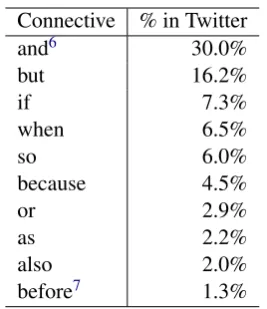
Qualitative Analysis. As said earlier, Twitter posts, although they are written, are part of in-teractive conversations. While annotating these posts, we also encountered a number of phenom-ena that are typically found in spoken registers, and not in written texts. For example, we iden-tified higher numbers of a small set of connec-tives, such asand, but andwhen, that frequently occur in conversations. We rarely annotated (if any) connectives likesince, thereforeor neverthe-less, which are typically found in formal writing (e.g., newspaper, scientific genre). The most fre-quent connectives in our corpus and in newspaper text are shown in Tables3and4, respectively.
Twitter texts, like conversations, most often rep-resent spontaneous use of language, and thus con-tain instances of fragmented or incomplete ut-terances. In our annotation, we often encounter constructions that comprise only nouns or noun phrases, but nevertheless, are often seen to stand for a complete proposition. These phrases can function as the arguments of a connective. (e.g.,
“NO PROB BUT WHERE THE HELL DID U”,
or “If he could work on that, good prospect”). We
5
Level-1 specifies four sense classes, TEMPORAL, CON
-TINGENCY, COMPARISON, and EXPANSION. Level-2 pro-vides 17 sense types, whereas Level-3 encodes only the direc-tionalityof the sense in the PDTB-3 schema (e.g., REASON
vs. RESULTas subtypes of the Level-2 sense type CAUSE).
6
The instances of ”&” are also counted in this category.
7The instances of ”b4” are also counted in this category.
Connective % in Twitter
and6 30.0%
but 16.2%
if 7.3%
when 6.5%
so 6.0%
because 4.5%
or 2.9%
as 2.2%
also 2.0%
[image:3.595.76.285.138.197.2]before7 1.3%
Table 3: Top ten connectives in the Twitter corpus.
Connective % in PDTB
and 26.4%
but 15.4%
also 7.2%
if 4.8%
when 4.4%
as 3.5%
because 3.5%
while 3.3%
after 2.4%
however 2.0%
Table 4: Top ten connectives in the PDTB.
accordingly use more flexible argument selection criteria in order to accommodate such (elliptical) structures, in addition to clauses and other con-structions (nominalizations, VP-conjuncts, etc.) that typically constitute arguments in the PDTB. Furthermore, similar to the genre of instant mes-saging, the Twitter texts contain a wide range of acronyms for sentences/clauses that act like fixed expressions. Examples include: “idc” = I don’t care; “idk” = I don’t know; “idrk” = I don’t really know. In our annotation, we pay special attention to these acronyms as to whether they constitute (part of) the argument of a connective or not. For example, idc in “idcif u do or not” is annotated as an argument (ofif), whileidkis not part of the argument in “i get your point... butidk the k-exol who he was talking to was comforted...”.
Our Twitter data also exhibits different spellings for the same connective, for example, ‘wen’ = when; ‘cos’, ‘cus’, ‘cuz’ = because; ‘btw’ = by the way; ‘&’, ‘&’, ‘an’ =and. We considered these alternative forms as orthographical variants of the same connective.
[image:3.595.353.479.245.398.2]Twit-ter texts and spoken conversations also operates at the level of annotating senses for the connec-tives. For examples, the additive connectiveandis frequently used in conversations (or spoken texts in general) to link upcoming utterances with the present one, even though there is no strong seman-tic relation between them (comparable to the Joint relation in RST). We observe similar uses ofand in our Twitter corpus, too (e.g., “Happy new year andcant wait for you to come back to the UK next year”).
Quantitative Analysis. We performed a quan-titative analysis of our annotations. In general, we observe that explicit discourse relations are a frequent occurrence in our Twitter data. Out of 1756 tweets, over 40% contain at least one tweet-internal explicit discourse relation. Table3shows the relative frequency distribution of the top 10 connectives in our annotations. The calculated percentages are case insensitive (e.g., “and” and “And” are considered as different instances of the same connective). Some basic statistics of our an-notation:
• # of relations: 1237
• # of tweets with a single connective: 406
• # of tweets with multiple connectives: 329
• average Arg1 length (chars): 43
• average Arg2 length (chars): 41
• average length of tweets with a single con-nective (chars):181
• average length of textnotpart of a discourse relation (Arg1 or Arg2) in tweets with a sin-gle connective (chars): 103
As for sense distributions, Table5shows the rel-ative frequency distribution of Level-1 sense tags (i.e. Class level tags) in our corpus. We also calculated the relative frequencies for eachClass level tag in the PDTB 2.0 according to frequen-cies of Explicit connectives presented in Table 4 in (Prasad et al.,2008). The second column in Ta-ble5shows the calculated relative frequencies in the PDTB corpus.8 It can be seen from the distri-bution that there are a lot more CONTINGENCY
8
The class frequencies for PDTB column presented here come from the PDTB 2.0 sense hierarchy and we are using the relations in PDTB 3.0. Since there is no change defined in (Webber et al.,2018) regarding the Class level sense tags, we consider the columns in Table5as comparable.
relations in our Twitter data than in the PDTB, while there are fewer COMPARISON and TEMPO
-RAL relations. Considering that not all explicit relations have been annotated in our Twitter cor-pus yet (only relations contained entirely within one tweet), no final conclusions can be drawn yet, but it appears that narrative (temporal) and com-parative or contrastive relations are more typical of newspaper writing than spontaneous social me-dia conversations. This is also reflected in the lists of frequent connectives (Tables3,4), which show that connectives expressing CONTINGENCY rela-tions like if, when, and so occur relatively more frequently on Twitter.
Class % in Twitter % in PDTB
EXPANSION 33.4% 33.5%
CONTINGENCY 28.0% 18.7%
COMPARISON 24.3% 28.8%
[image:4.595.310.524.265.336.2]TEMPORAL 14.3% 19.0%
Table 5: Distribution of class level sense tags.
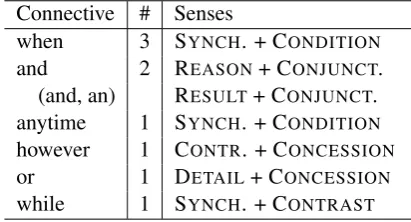
We also allowed the annotator to select more than one sense if both were deemed relevant (see
Rohde et al., 2018, for a discussion of multiple concurrent relations in text); this option was cho-sen in 9 cases, listed in Table6.
Connective # Senses
when 3 SYNCH. + CONDITION
and 2 REASON+ CONJUNCT. (and, an) RESULT+ CONJUNCT. anytime 1 SYNCH. + CONDITION
however 1 CONTR. + CONCESSION
or 1 DETAIL+ CONCESSION
while 1 SYNCH. + CONTRAST
Table 6: Connectives with 2 simultaneous senses.
5 Conclusions and Future Work
[image:4.595.312.518.450.561.2]We reported about our annotation of intra-tweet discourse relations in 185 Twitter threads. We conducted an inter-annotator agreement study, which revealed that in particular the selection of argument spans poses new problems in the Twit-ter domain. We are currently adapting and further specifying our annotation guidelines to cover the phenomena found in our social media data, such as elliptical constituents, hashtags and emoji, abbre-viations, missing punctuation, etc. Based on the amended guidelines, we will validate the existing annotations and edit them for consistency.
The current study only reports on intra-tweet re-lations, where the connective and both arguments are contributed by the same speaker. However, inter-tweet relations are also found in our data. In these cases, a subsequent reply contains a connec-tive and Arg2, but relates to an Arg1 in a previous tweet (typically by a different speaker). We are planning to add annotations for these types of re-lations, as well as non-explicit discourse rere-lations, in future work.
Finally, we showed results from a basic analysis that demonstrates how explicit discourse relations in Twitter conversations differ from the relations in the PDTB newspaper text. Due to genre differ-ences, Twitter conversations contain more CON
-TINGENCYand fewer TEMPORAL and COMPAR -ISONrelations. The distribution of connectives in Twitter also differs from newspaper text. This cor-responds to known differences between connec-tives used in spoken and written language. Finally the syntactic type and size of arguments we find in the Twitter data differs markedly from the PDTB arguments.
In current work, we are extending the annota-tions to include inter-tweet and non-explicit rela-tions. We are planning to use the corpus in devel-oping a shallow discourse parser for English social media text.
Acknowledgements
The authors would like to thank Olha Zolotarenko for assisting with the annotation. This research was funded by the Deutsche Forschungsgemein-schaft (DFG, German Research Foundation) under project nr. 317633480 – SFB 1287, project A03.
References
Berfin Aktas¸, Tatjana Scheffler, and Manfred Stede. 2018. Anaphora resolution for Twitter
conversa-tions: An exploratory study. InProceedings of the First Workshop on Computational Models of Refer-ence, Anaphora and Coreference, pages 1–10.
Nicholas Asher and Alex Lascarides. 2003. Logics of Conversation. Cambridge University Press, Cam-bridge.
Ludivine Crible and Maria Josep Cuenca. 2017. Dis-course markers in speech: characteristics and chal-lenges for corpus annotation. Dialogue and Dis-course, 8(2):149–166.
William Mann and Sandra Thompson. 1988. Rhetori-cal structure theory: Towards a functional theory of text organization. TEXT, 8:243–281.
R. Prasad, N. Dinesh, A. Lee, E. Miltsakaki, L. Robaldo, A. Joshi, and B. Webber. 2008. The Penn Discourse Treebank 2.0. InProc. of the 6th In-ternational Conference on Language Resources and Evaluation (LREC), Marrakech, Morocco.
Ines Rehbein, Merel Scholman, and Vera Demberg. 2016. Annotating discourse relations in spoken lan-guage: A comparison of the PDTB and CCR frame-works. In Proceedings of the Tenth International Conference on Language Resources and Evaluation (LREC).
Giuseppe Riccardi, Evgeny A Stepanov, and Sham-mur Absar Chowdhury. 2016. Discourse connec-tive detection in spoken conversations. In Interna-tional Conference on Acoustics, Speech and Signal Processing (ICASSP), pages 6095–6099. IEEE.
Hannah Rohde, Alexander Johnson, Nathan Schneider, and Bonnie Webber. 2018. Discourse coherence: Concurrent explicit and implicit relations. In Pro-ceedings of the 56th Annual Meeting of the Associa-tion for ComputaAssocia-tional Linguistics, volume 1, pages 2257–2267.
Tatjana Scheffler. 2014. A German Twitter snapshot. In Proc. of the 9th International Conference on Language Resources and Evaluation (LREC), pages 2284–2289, Reykjavik, Iceland.
Tatjana Scheffler and Manfred Stede. 2016. Realiz-ing argumentative coherence relations in German: A contrastive study of newspaper editorials and Twit-ter posts. InProceedings of the COMMA Workshop ”Foundations of the Language of Argumentation”, Potsdam, Germany.
Sara Tonelli, Giuseppe Riccardi, Rashmi Prasad, and Aravind K Joshi. 2010. Annotation of discourse re-lations for conversational spoken dialogs. InProc. of the 7th International Conference on Language Resources and Evaluation (LREC).