42
Eidos, INDRA, & Delphi: From Free Text to Executable Causal Models
Rebecca Sharp, Adarsh Pyarelal, Benjamin M. Gyori†, Keith Alcock, Egoitz Laparra, Marco A. Valenzuela-Esc´arcega, Ajay Nagesh, Vikas Yadav,
John A. Bachman†, Zheng Tang, Heather Lent, Fan Luo, Mithun Paul, Steven Bethard, Kobus Barnard, Clayton T. Morrison, Mihai Surdeanu
University of Arizona, Tucson, Arizona, USA †Harvard Medical School, Boston, Massachusetts, USA
{bsharp,adarsh}@email.arizona.edu
Abstract
Building causal models of complicated phe-nomena such as food insecurity is currently a slow and labor-intensive manual process. In this paper, we introduce an approach that builds executable probabilistic models from raw, free text. The proposed approach is im-plemented through three systems: Eidos1,
IN-DRA2 and Delphi3. Eidos is an open-domain
machine reading system designed to extract causal relations from natural language. It is rule-based, allowing for rapid domain trans-fer, customizability, and interpretability. IN-DRA aggregates multiple sources of causal in-formation and performs assembly to create a coherent knowledge base and assess its relia-bility. This assembled knowledge serves as the starting point for modeling. Delphi is a modeling framework that assembles quantified causal fragments and their contexts into exe-cutable probabilistic models that respect the se-mantics of the original text and can be used to support decision making.
1 Introduction
Food insecurity is an extremely complex phe-nomenon that affects wide swathes of the global population, and is governed by factors ranging from biophysical variables that affect crop yields, to so-cial, economic, and political factors such as migra-tion, trade patterns, and conflict.
For any attempt to combat food insecurity to be effective, it must be informed by a model that comprehensively considers the myriad of factors influencing it. Furthermore, for analysts and deci-sion makers to truly trust such a model, it must be
causalandinterpretable, as in, it must provide a mechanistic explanation of the phenomenon, rather than just being a black-box statistical construction.
1https://github.com/clulab/eidos 2
https://github.com/sorgerlab/indra
3https://github.com/ml4ai/delphi
Currently, however, these models are hand-built for each new situation and require many months to construct, resulting in long delays for much-needed interventions.
Here we propose an end-to-end system that combines open-domain information extraction (IE) with a quantitative model-building framework, transforming free text into executable probabilistic models that capture complex real-world systems. All code and data described here is open-source and publicly available, and we provide a short video demonstration4.
Contributions:
(1)We introduce Eidos, a rule-based open-domain IE system that extracts causal statements from raw text. To maximize domain independence, Eidos is largely unlexicalized (with the exception of causal cues such as promotes), and implements a top-down approach where causal interactions are ex-tracted first, followed by the participating concepts, which are grounded with specific geospatial and temporal contexts for model contextualization. Ei-dos also extracts quantifiable adjectives (e.g. sig-nificant) that can be used to form a bridge between qualitative statements and quantitative modeling.
(2)We describe an extension of the Integrated Net-work and Dynamical Reasoning Assembler (IN-DRA,Gyori et al.,2017), an automated knowledge and model assembly system which implements in-terfaces to Eidos and multiple other machine read-ing systems. Originally developed to assemble models of biochemical mechanisms, we general-ized INDRA to represent general causal influences as INDRA Statements, and load a taxonomy of concepts to align related Statements from multiple readers and documents.
(3) We introduce Delphi, a Bayesian modeling
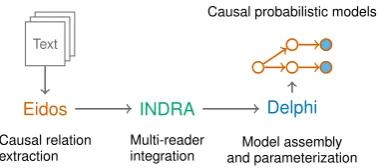
Eidos
Text
Causal relation extraction
INDRA
Multi-reader integration
Delphi
[image:2.595.90.280.65.149.2]Model assembly and parameterization Causal probabilistic models
Figure 1:Overall architecture showing the flow of informa-tion between the systems.
framework that converts the above statements into executable probabilistic models that respect the se-mantics of the source text. These models can help decision-makers rapidly build intuition about com-plicated systems and their dynamics. The proposed framework is interpretable due to its foundation in rule-based IE and Bayesian generative modeling.
Architecture: InFig. 1, we show a high-level de-piction of the information flow pipeline. First, nat-ural language texts serve as inputs to Eidos, which performs causal relation extraction, grounding, and spatiotemporal contextualization. The extracted relations are subsequently aggregated by INDRA into data structures called INDRA Statements for downstream modeling. These serve as an input to Delphi, which assembles a causal probabilistic model from them.
2 Causal Information Extraction
Eidos was designed as an open-domain IE sys-tem (Banko et al.,2007) with a top-down approach that allows us to not be limited to a fixed set of con-cepts, as determining this set across multiple dis-tinct domains (e.g., agronomy and socioeconomics) is close to impossible. First, we find trigger words signaling a relation of interest and then extract and expand the participating concepts (2.1), link these concepts to a taxonomy (2.2), and annotate them with temporal and spatial context (2.3).5,6
In addition to an API that can be used for ma-chine reading at scale, Eidos has a webapp that provides users a way to see what rules were re-sponsible for the extracted content, as well as brat visualizations (Stenetorp et al.,2012) of the output,
5This has some similarities to FrameNet (Baker et al.,
1998), whose Causation frame has targets (triggers) and frame elements (participating concepts) that are associated with a taxonomy (the FrameNet hierarchy). In our case, the concepts come from a domain-specific taxonomy.
6We assume here that causal relations are specified within
sentences rather than across sentences at the document level, and that the concepts involved in the causal relations can be linked to an appropriate taxonomy.
facilitating rapid development of the interpretable rule-grammars.
2.1 Reading Approach
To understand our top-down approach, let us con-sider the individual steps involved in processing the following sentence:The significantly increased conflict seen in South Sudan forced many families to flee in 2017.
(1) We begin by preprocessing the text with depen-dency syntax using Stanford CoreNLP (Manning et al.,2014) and the processors library7.
(2) Then, Eidos finds any occurrences of quanti-fiers(gradable adjectives and adverbs). These are common in the high-level texts relevant to food insecurity, such as reports from UN agencies and nonprofits, but they are difficult to use in quantita-tive models without additional information. In the example above, the wordsignificantlyis found as a quantifier ofincreased. Delphi uses these quan-tifiers to construct probability density functions using the crowdsourced data ofSharp et al.(2018), as detailed in 4.
(3) Next, Eidos uses a set of trigger words to find causal and correlational relations with an Odin grammar (Valenzuela-Esc´arcega et al.,2016). Odin is an information extraction framework which in-cludes a declarative language supporting both sur-face and syntactic patterns and a runtime system. Eidos’s grammar was based in part on the biomedi-cal grammar developed byValenzuela-Esc´arcega et al.(2018) but adapted to the open domain and our representation of concepts. This rule gram-mar is fully interpretable and easily editable, allow-ing users to make modifications without needallow-ing to retrain a complex model. In the example sen-tence from earlier, the extraction of a causal rela-tion would be triggered by the wordforced, with
conflictandfamiliesidentified as the initial cause and effect, respectively.
(4) The initial cause and effect are then expanded using dependency syntax following the approach ofHahn-Powell et al.(2017). Namely, from each of the initial arguments, we traverse outgoing de-pendency links to expand the arguments into their dependency subgraph. Here, the resulting argu-ments aresignificantly increased conflict seen in South Sudanandmany families to flee in 2017.
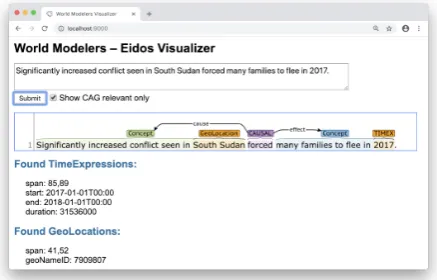
Figure 2: Screenshot of the Eidos output for the running example sentence, visualized in Eidos’s webapp.
(5) Relevant state information is then added to the expanded concepts. Representing the polarity of an influence on the causal relation edge (i.e., in terms ofpromotesorinhibits) can be lossy, so Ei-dos instead uses concept states (i.e., concepts can be increased, decreased, and/or quantified). In the example above, Eidos marks the concept pertaining to conflict as being increased and quantified. If de-sired, the promotion/inhibition representation with edge polarity can be straightforwardly recovered. The final output of the Eidos system for the run-ning example sentence, as displayed in the Eidos webapp, is shown inFig. 2.
2.2 Concept linking
The Eidos reading system, with its top-down ap-proach, was designed to keep extracted concepts as close to the text as possible, intentionally allowing downstream users to make decisions about event semantics depending on their use cases. As a result, linking concepts to a taxonomy becomes critical for preventing sparsity.
Eidos’s concept linking is based on word-embedding similarities. A given concept (with stop words removed), is represented by the average of the word embeddings for each of its words. A vector for each node in the taxonomy is similarly calculated (using the provided “examples” for the node), and the taxonomy node whose vector is closest to the concept vector is considered to be the grounding. In practice, Eidos returns the topk
groundings, allowing for downstream disambigua-tion. The concept linking strategy is modular and allows for grounding to any taxonomy provided in the human-readable YAML format. With this
method, Eidos is able to link to an arbitrary num-ber of taxonomies, at both high and low levels of abstraction.
2.3 Temporal and geospatial normalization
Time normalization The context surrounding the extractions is often critical for downstream rea-soning. Eidos integrates the temporal parser of Laparra et al.(2018) that uses a character recur-rent neural network to identify time expressions in the text which are then linked together with a set of rules into semantic graphs which follow the SCATE schema (Bethard and Parker, 2016) and can be interpreted using temporal logic to obtain the intervals referred to by the time expressions.
After the time expressions are identified and nor-malized, an Odin grammar attaches them to the causal relations extracted by Eidos. If the docu-ment creation time is provided, it is also parsed by our model and used as the default temporal attach-ment for those causal relations without a temporal expression in their close context.
Geospatial normalization Eidos’s geospatial normalization module (Yadav et al.,2019) has two components: a detection component consisting of the word-level LSTM named entity recognition (NER) model ofYadav and Bethard(2018), and a normalization component which implements popu-lation heuristics (i.e., selecting the most populous location (Magge et al.,2018)) and filters using a distance-based heuristic (Magge et al.,2018).
3 Assembly of causal relations
The output of Eidos is processed by INDRA into a collection of INDRA Statements, each of which represents a causal influence relation. INDRA is also able to process the output of multiple other reading systems that extract causal relations from text (these systems are not described in detail here). INDRA implements input processor modules to extract standardized Statements from each reading system. A Statement represents a causal influence between two Concepts (a subject and an object), each of which is linked to one or more taxonomies (see Section2.2). The Statement also captures the polarity and magnitude of change in both subject and object, if available. Finally, one or more Ev-idences are attached to each Statement capturing provenance (reader, document, sentence) and con-text (time, location) information. This common representation establishes a link between diverse knowledge sources and several model formalism endpoints.
tax-onomy to which Concepts are linked, INDRA cates a Statement graph whose edges capture (i) re-dundancy between two Statements (ii) hierarchical refinement between two Statements, and (iii) con-tradiction between two Statements. Statements that are redundant, or in other words, capture the same causal relation, are merged and their evidences are aggregated. A probability model is then used which captures the empirical precision of each reader to calculate the overall support (a “belief” score) for a Statement given the joint probability of correctness implied by the evidence. As a seed to this prob-ability model, INDRA loads empirical precision values collected via human curation for each Eidos rule. INDRA exposes a collection of methods to filter Statements that can be composed to form a problem-specific assembly pipeline, including (i) filtering by Statement belief and Concept linking accuracy (ii) filtering to more general or specific Statements (with respect to a taxonomy), and (iii) filtering contradictions by belief. INDRA also ex-poses a REST API and JSON-based serialization of Statements.
INDRA contains multiple modules that can as-semble Statements into causal graphs (for visual-ization or inference) and executable ODE mod-els. In the architecture presented here, Delphi (our Bayesian modeling framework) takes INDRA Statements directly as input, and serves as a proba-bilistic model assembly system.
4 Causal Probabilistic Models from Text
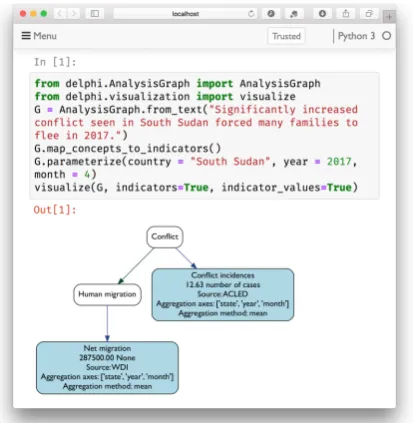
Statements produced by INDRA are assembled by Delphi into a structure called a causal analysis graph, orCAG. InFig. 3, we show theCAG
result-ing from our runnresult-ing example sentence (cell [1]). The node labels (conflict and human migration) in theCAGcorrespond to entries in the high-level
taxonomy that the concepts have been grounded to.
Representation We represent abstract concepts such asconflictandhuman migrationas real-valued
latentvariables in a dynamic Bayes network (DBN) (Dagum et al.,1992), and the indicators correspond-ing to these concepts asobservedvariables. By an indicator, we mean a tangible quantity that serves as a proxy for the abstract concept8. For example,
the variable Net migration (as defined inWorld Bank(2018)) is one of several indicators for the
8Note that these are not the same as the indicator random
[image:4.595.312.519.61.273.2]variables encountered in probability theory.
Figure 3:Construction of a causal analysis graph from the running example sentence.
concept ofhuman migration. To capture the un-certainty inherent in interpreting natural language, we take the transition model of the DBNitself to be a random variable with an associated proba-bility distribution. We interpret sentences about causal relations as saying something about the func-tional relationship between the concepts involved. For example, we interpret the running example sentence as giving us a clue about the shape of
∂(human migration)/∂(conflict).
Assembly To assemble our model, we do the fol-lowing9:
(1) We construct the aforementioned distribution over the transition model of theDBNusing the ex-tracted polarities of the causal relations as well as the gradable adjectives associated with the concepts involved in the relations. The transition model is a matrix whose elements are random variables rep-resenting the coefficients of a system of linear dif-ferential equations (Guan et al.,2015), with distri-butions obtained by constructing a Gaussian kernel density estimator over Cartesian products of the crowdsourced responses collected bySharp et al. (2018) for the adjectives in each relation.
(2) To provide more tangible results, we map the abstract concepts to indicator variables for which we have time series data. This data is gathered from a number of databases, including but not limited to
9The complete mathematical details of the model
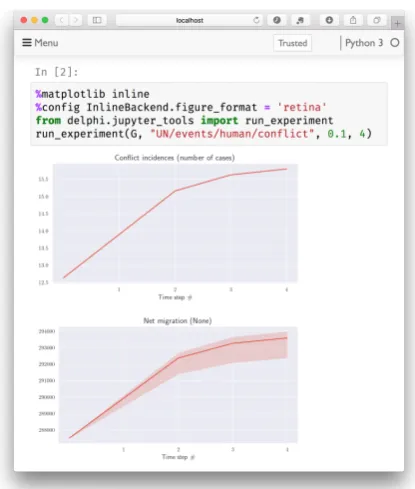
Figure 4:Results of conditional forecasting experiment with CAGbuilt from example sentence.
the FAOSTAT (Food and Agriculture Organization of the United Nations,2018) and the World Devel-opment Indicators (World Bank,2018) databases. The mapping is done using the OntologyMapper tool in Eidos that uses word embedding similarities to map entries in the high-level taxonomy to the lower-level variables in the time series data.
(3) Then, we associate values with indicators using a parameterization algorithm that takes as input some spatiotemporal context, and retrieves values for the indicators from the time series data, falling back to aggregation over a (configurable) set of aggregation axes in order to prevent null results. In Fig. 3, we show the indicators automatically mapped to the conflict and human migration nodes (conflict incidencesandnet migration, respectively) and their values for the spatiotemporal context of South Sudan in April 2017.
Conditional forecasting Once the model is as-sembled, we can run experiments to obtain quan-titative predictions for indicators, which can build intuitions about the complex system in question and support decision making. The outputs take the form of time series data, with associated uncer-tainty estimates. An example is shown inFig. 4, in which we investigate the impact of increasing conflict on human migration using our model, with
∂(conflict)/∂t = 0.1e−t. The predictions of the model reflect (i) the semantics of the source text (increased conflict leads to increased migration)
and (ii) the uncertainty in interpreting the source sentence. The confidence bands in the lower plot re-flect the distribution of the crowdsourced gradable adjective data.
5 Assessment
We are currently in the process of developing a framework to quantitatively evaluate the models as-sembled using this pipeline, primarily via backcast-ing. However, the systems have been qualitatively evaluated by MITRE, an independent performer group in the World Modelers program charged with designing and conducting evaluations of the tech-nologies developed. For the evaluation, a causal analysis graph larger than the toy running exam-ple in this paper (≈ 20 nodes) was created and executed. Noted strengths of the system include the ability to drill down into the provenance of the causal relations, the integration of multiple ma-chine readers, and the plausible directionality of the produced forecast (given the sentences used to construct the models). Some limitations were also noted, i.e., that the initialization and parameteriza-tion of the models were somewhat opaque (which hindered explainability) and some aspects of un-certainty are captured by the readers but not fully propagated to the model. We are actively working on addressing both of these limitations.
6 Conclusion
Complex causal models are required in order to address key issues such as food insecurity that span multiple domains. As an alternative to expensive, hand-built models which can take months to years to construct, we propose an end-to-end framework for creating executable probabilistic causal models from free text. Our entire pipeline is interpretable and intervenable, such that domain experts can use our tools to greatly reduce the time required to develop new causal models for urgent situations.
References
Collin F. Baker, Charles J. Fillmore, and John B. Lowe. 1998. The Berkeley FrameNet project. In Proceed-ings of the 17th international conference on Compu-tational Linguistics-Volume 1, pages 86–90. Associ-ation for ComputAssoci-ational Linguistics.
Michele Banko, Michael J. Cafarella, Stephen Soder-land, Matt Broadhead, and Oren Etzioni. 2007.
Open information extraction from the web. In Pro-ceedings of the 20th International Joint Conference on Artifical Intelligence, IJCAI’07, pages 2670– 2676, San Francisco, CA, USA. Morgan Kaufmann Publishers Inc.
Steven Bethard and Jonathan Parker. 2016. A semanti-cally compositional annotation scheme for time nor-malization. In Proceedings of the Tenth Interna-tional Conference on Language Resources and Eval-uation (LREC 2016), Paris, France. European Lan-guage Resources Association (ELRA). [Acceptance rate 60%].
Paul Dagum, Adam Galper, and Eric Horvitz. 1992.
Dynamic network models for forecasting. In Didier Dubois, Michael P. Wellman, Bruce D’Ambrosio, and Phillipe Smets, editors,Uncertainty in Artificial Intelligence, pages 41 – 48. Morgan Kaufmann.
Food and Agriculture Organization of the United Na-tions. 2018. FAOSTAT Database.
Jinyan Guan, Kyle Simek, Ernesto Brau, Clayton T. Morrison, Emily Butler, and Kobus Barnard. 2015.
Moderated and drifting linear dynamical systems. In
Proceedings of the 32nd International Conference on Machine Learning, volume 37 of Proceedings of Machine Learning Research, pages 2473–2482, Lille, France. PMLR.
Benjamin M. Gyori, John A. Bachman, Kartik Subra-manian, Jeremy L. Muhlich, Lucian Galescu, and Peter K. Sorger. 2017. From word models to ex-ecutable models of signaling networks using au-tomated assembly. Molecular Systems Biology, 13(11).
Gus Hahn-Powell, Marco A. Valenzuela-Esc´arcega, and Mihai Surdeanu. 2017. Swanson linking revis-ited: Accelerating literature-based discovery across domains using a conceptual influence graph. Pro-ceedings of ACL 2017, System Demonstrations, pages 103–108.
Egoitz Laparra, Dongfang Xu, and Steven Bethard. 2018. From characters to time intervals: New paradigms for evaluation and neural parsing of time normalizations. Transactions of the Association for Computational Linguistics, 6:343–356.
Arjun Magge, Davy Weissenbacher, Abeed Sarker, Matthew Scotch, and Graciela Gonzalez-Hernandez. 2018. Deep neural networks and distant supervision for geographic location mention extraction. Bioin-formatics, 34(13):i565–i573.
Christopher D. Manning, Mihai Surdeanu, John Bauer, Jenny Finkel, Steven J. Bethard, and David Mc-Closky. 2014. The Stanford CoreNLP natural lan-guage processing toolkit. InAssociation for Compu-tational Linguistics (ACL) System Demonstrations, pages 55–60.
Rebecca Sharp, Mithun Paul, Ajay Nagesh, Dane Bell, and Mihai Surdeanu. 2018. Grounding grad-able adjectives through crowdsourcing. In Proceed-ings of the Eleventh International Conference on Language Resources and Evaluation (LREC 2018), Paris, France. European Language Resources Asso-ciation (ELRA).
Pontus Stenetorp, Sampo Pyysalo, Goran Topi´c, Tomoko Ohta, Sophia Ananiadou, and Jun’ichi Tsu-jii. 2012. brat: a web-based tool for nlp-assisted text annotation. InProceedings of the Demonstra-tions at the 13th Conference of the European Chap-ter of the Association for Computational Linguistics, pages 102–107. Association for Computational Lin-guistics.
Marco A. Valenzuela-Esc´arcega, ¨Ozg¨un Babur, Gus Hahn-Powell, Dane Bell, Thomas Hicks, Enrique Noriega-Atala, Xia Wang, Mihai Surdeanu, Emek Demir, and Clayton T. Morrison. 2018. Large-scale automated machine reading discovers new cancer driving mechanisms.Database: The Journal of Bio-logical Databases and Curation.
Marco A. Valenzuela-Esc´arcega, Gustave Hahn-Powell, and Mihai Surdeanu. 2016. Odin’s runes: A rule language for information extraction. In Pro-ceedings of the 10th edition of the Language Re-sources and Evaluation Conference (LREC).
World Bank. 2018. World Development Indicators Database.
Vikas Yadav and Steven Bethard. 2018. A survey on re-cent advances in named entity recognition from deep learning models. In Proceedings of the 27th Inter-national Conference on Computational Linguistics, pages 2145–2158.