Proceedings of NAACL-HLT 2016, pages 249–259,
San Diego, California, June 12-17, 2016. c2016 Association for Computational Linguistics
Name Tagging for Low-resource Incident Languages based on
Expectation-driven Learning
Boliang Zhang1, Xiaoman Pan1, Tianlu Wang2, Ashish Vaswani3, Heng Ji1, Kevin Knight3, Daniel Marcu3
1 Computer Science Department, Rensselaer Polytechnic Institute
{zhangb8,panx2,jih}@rpi.edu
2 Computer Science Department, Zhejiang University 3 Information Sciences Institute, University of Southern California
{vaswani,knight,marcu}@isi.edu
Abstract
In this paper we tackle a challenging name tagging problem in an emergent setting - the tagger needs to be complete within a few hours for a new incident language (IL) us-ing very few resources. Inspired by observus-ing how human annotators attack this challenge, we propose a new expectation-driven learning framework. In this framework we rapidly ac-quire, categorize, structure and zoom in on IL-specific expectations (rules, features, patterns, gazetteers, etc.) from various non-traditional sources: consulting and encoding linguistic knowledge from native speakers, mining and projecting patterns from both mono-lingual and cross-lingual corpora, and typing based on cross-lingual entity linking. We also pro-pose a cost-aware combination approach to compose expectations. Experiments on seven low-resource languages demonstrate the effec-tiveness and generality of this framework: we are able to setup a name tagger for a new IL within two hours, and achieve 33.8%-65.1% F-score1.
1 Introduction: “Tibetan Room”
In many emergent situations such as disease out-breaks and natural disasters, there is great demand to rapidly develop a Natural Language Processing (NLP) system, such as name tagger, for a “surprise” Incident Language (IL) with very few resources. Traditional supervised learning methods that rely on large-scale manual annotations would be too costly.
1
The resources developed in this paper, includ-ing the survey, patterns and gazetteers, are available at http://nlp.cs.rpi.edu/data/elisaienaacl16.zip
Let’s start by investigating how a human would discover information in a foreign IL environment. When we are in a foreign country, even if we don’t know the language, we would still be able to guess the word “gate” from the airport broadcast based on its frequency and position in a sentence; guess the word “station” by pattern mining of many subway station labels; and guess the word “left” or “right” from a taxi driver’s GPS speaker by matching move-ment actions. We designed a “Tibetan Room” game, similar to “Chinese Room” (Searle, 1980), by ask-ing a human user who doesn’t know Tibetan to find persons, locations and organizations from some Ti-betan documents. We designed an interface where test sentences are presented to the player one by one. When the player clicks token, the interface will dis-play up to 100 manually labeled Tibetan sentences that include this token. The player can also see trans-lations of some common words and a small gazetteer of common names (800 entries) in the interface.
14 players who don’t know Tibetan joined the game. Their name tagging F-scores ranged from 0% to 94%. We found that good players usually bring in some kind of “expectations” derived from their own native languages, or general linguistic knowl-edge, or background knowledge about the scenario. Then they actively search, confirm, adjust and up-date these expectations during tagging. For exam-ple, they know from English that location names are often ended with suffix words such as “city” and
“country”, so they search for phrases starting or
end-ing with the translations of these suffix words. After they successfully tag some seeds, they will continue to discover more names based on more expectations.
For example, if they already tagged an organization name A, and now observe a sequence matching a common English pattern “[A (Organization)]’s
[Ti-tle] [B (Person)]”, they will tagBas a person name.
And if they know the scenario is about Ebola, they will be looking for a phrase with translation simi-lar to “West Africa” and tag it as a location. Sim-ilarly, based on the knowledge that names appear in a conjunction structure often have the same type, they propagate high-confidence types across multi-ple names. They also keep gathering and synthe-sizing common contextual patterns and rules (such as position, frequency and length information) about names and non-names to expand their expectations. For example, after observing a token frequently ap-pearing between a subsidiary and a parent organiza-tion, they will predict it as a preposition similar to “of” in English, and tag the entire string as a nested organization.
Based on these lessons learned from this game, we propose to automatically acquire and encode expec-tations about what will appear in IL data (names, pat-terns, rules), and encode those expectations to drive IL name tagging. We explored various ways of sys-tematically discovering and unifying latent and ex-pressed expectations from nontraditional resources:
• Language Universals: Language-independent rules and patterns;
• Native Speaker: Interaction with native speak-ers through a machine-readable survey and su-pervised active learning;
• Prior Mining: IL entity prior knowledge min-ing from both mono-lmin-ingual and cross-lmin-ingual corpora and knowledge bases;
Furthermore, in emergent situations these expec-tations might not be available at once, and they may have different costs, so we need to organize and prioritize them to yield optimal performance within given time bounds. Therefore we also experimented with variouscost-awarecomposition methods with the input of acquired expectations, plus a time bound for development (1 hour, 2 hours), and the output as a wall-time schedule that determines the best se-quence of applying modules and maximizes the use of all available resources. Experiments on seven low-resource languages demonstrate that our
frame-work can create an effective name tagger for an IL within a couple of hours using very few resources.
2 Starting Time: Language Universals
First we use some language universal rules, gazetteers and patterns to generate a binary feature vector F = {f1, f2, ...} for each token. Table 1 shows these features along with examples. An identification rule is rI = ⟨TI, f = {fa, fb, ...}⟩ whereTIis a “B/I/O” tag to indicate the beginning, inside or outside of a name, and{fa, fb, ...}is a set of selected features. If the features are all matched, the token will be tagged asTI. Similarly, a classifi-cation rule isrC = ⟨TC, f = {fa, fb, ...}⟩, where
TC is “Person/Organization/Location”. These rules are triggered in order, and some examples are as fol-lows: ⟨B, {AllUppercased}⟩,⟨PER, {PersonGaz}⟩, ⟨ORG, {Capitalized, LongLength}⟩, etc.
3 Expectation Learning
3.1 Approach Overview
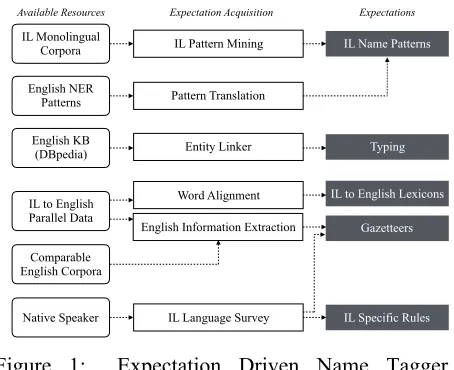
Figure 1 illustrates our overall approach of acquiring various expectations, by simulating the strategies hu-man players adopted during the Tibetan Room game. Next we will present details about discovering ex-pectations from each source.
Native Speaker
Expectation Acquisition Methods
Time 0 Time 1 Time 2
IL Documents
Universal Name Tagger
Native Speaker Unsupervised Method
Supervised Method
Data Sampling Annotating
CRF Model
Expectation Driven Tagger at Time 1
CRF Name Tagger at Time 1
Expectation Driven Tagger at Time 2
CRF Name Tagger at Time 2
Data Sampling Annotating
CRF Model Resources
Expectations
Expectation Acquisition Methods
More Expectations
Available Resources Expectations
IL Monolingual Corpora
IL to English Parallel Data English NER
Patterns
Native Speaker
Expectation Acquisition
IL Pattern Mining
Pattern Translation
IL Language Survey English Information Extraction
Word Alignment English KB
(DBpedia)
IL to English Lexicons
IL Specific Rules IL Name Patterns
Gazetteers
Entity Linker Typing
[image:2.612.316.543.441.626.2]Comparable English Corpora
Figure 1: Expectation Driven Name Tagger Overview
3.2 Survey with Native Speaker
human-in-Features Examples (Feature name is underlined) in English
Gazetteer
-PerGaz: person (472,765);LocGaz: location (211,872);OrgGaz: organization (124,403);Title(889);NoneName(2,380).
Case -Capitalized; -AllUppercased; -MixedCase Punctuation -IternalPeriod: includes an internal period Digit -Digits: consisted of digits
Length -LongLength: a name including more than 4 tokens is likely to be an ORG
TF-IDF -TF-IDF: if a capitalized word appears at the beginning of a sentence, and has a low TF-IDF, then it’s unlikely to be a name Patterns -Pattern1: “Title⟨PER Name⟩”
-Pattern2: “⟨P ERName⟩,00∗,” where00are two digits
-Pattern3: “[⟨Namei⟩...],⟨Namen−1⟩⟨singleterm⟩⟨Namen⟩” where all names have the same type.
Multi-occurrences
-MultipleOccurrence: If a word appears in both uppercased and lowercased forms in a single document, it’s unlikely to be a name.
Table 1: Universal Name Tagger Features
the-loop process to acquire knowledge from native speakers. To meet the needs in the emergent set-ting, we design a comprehensive survey that aims to acquire a wide-range of IL-specific knowledge from native speakers in an efficient way. The sur-vey categorizes questions and organizes them into a tree structure, so that the order of questions is cho-sen based on the answers of previous questions. The survey answers are then automatically translated into rules, patterns or gazetteers in the tagger. Some ex-ample questions are shown in Table 2.
3.3 Mono-lingual Expectation Mining
We use a bootstrapping method to acquire IL pat-terns from unlabeled mono-lingual IL documents. Following the same idea in (Agichtein and Gravano, 2000; Collins and Singer, 1999), we first use names identified by high-confident rules as seeds, and gen-eralize patterns from the contexts of these seeds. Then we evaluate the patterns and apply high-quality ones to find more names as new seeds. This process is repeated iteratively2.
We define a pattern as a triple ⟨left, name, right⟩, where name is a name, left and right3 are context vectors with weighted terms (the weight is computed based on each token’s tf-idf score). For example, from a Hausa sentence
“gwamnatin kasar Sin ta samar wa kasashen
yammacin Afirka ... (the Government of China has
given ... products to the West African countries)”,
we can discover a pattern:
2
We empirically set the number of iterations as 2 in this pa-per.
3leftandrightare the context three tokens before and after
the name
• left:⟨gwamnatin(goevernment), 0.5⟩,⟨kasar (coun-try), 0.6⟩
• name:⟨Sin(China), 0.5⟩ • right:⟨ta(by), 0.2⟩
This pattern matches strings like “gwamnatin kasar
Fiji ta (by the government of Fiji)”.
For any two triplesti =⟨li, namei, ri⟩andtj = ⟨lj, namej, rj⟩, we comput e their similarity by:
Sim(ti, tj) =li·lj+ri·rj
We use this similarity measurement to cluster all triples and select the centroid triples in each cluster as candidate patterns.
Similar to (Agichtein and Gravano, 2000), we evaluate the quality of a candidate pattern P by:
Conf(P) = Ppositive (Ppositive+Pnegative)
,where Ppositive is the number of positive matches for P and Pnegative is the number of negative matches. Due to the lack of syntactic and seman-tic resources to refine these lexical patterns, we set a conservative confidence threshold 0.9.
3.4 Cross-lingual Expectation Projection
Name tagging research has been done for high-resource languages such as English for over twenty years, so we have learned a lot about them. We col-lected 1,362 patterns from English name tagging lit-erature. Some examples are listed below:
• ⟨{},{P ER},{< say >, < . >}⟩
• ⟨{< headquarter >, < in >},{LOC},{}⟩
• ⟨{< secretary >, < of >},{ORG},{}⟩
• ⟨{< in >, < the >},{LOC},{< area >}⟩
True/False Questions
1. The letters of this language have upper and lower cases
2. The names of people, organizations and locations start with a capitalized (uppercased) letter 3. The first word of a sentence starts with a capitalized (uppercased) letter
4. Some periods indicate name abbreviations, e.g., St. = Saint, I.B.M. = International Business Machines. 5. Locations usually include designators, e.g., in a format like“country United states”,“city Washington”
6. Some prepositions are part of names Text input
1. Morphology: please enter preposition suffixes as many as you can (e.g. “’da” in “Ankara’da yaşıyorum (I live in Ankara)” is a preposition suffix which means “in”).
Translation
1. Please translate the following English words and phrases:
- organization suffix: agency, group, council, party, school, hospital, company, office, ... - time expression: January, ..., December; Monday, ..., Sunday; ...
Table 2: Survey Question Examples
Besides the static knowledge like patterns, we can also dynamically acquire expected names from topically-related English documents for a given IL document. We apply the Stanford name tag-ger (Finkel et al., 2005) to the English documents to obtain a list of expected names. Then we translate the English patterns and expected names to IL. When there is no human constructed English-to-IL lexicon available, we derive a word-for-word translation ta-ble from a small parallel data set using the GIZA++ word alignment tool (Och and Ney, 2003). We also convert IL text to Latin characters based on Unicode mapping4, and then apply Soundex code (Mortimer and Salathiel, 1995; Raghavan and Allan, 2004) to find the IL name equivalent that shares the most sim-ilar pronunciation as each English name. For exam-ple, the Bengali name “টিন ে য়ার” and “Tony Blair” have the same Soundex code “T500 B460”.
3.5 Mining Expectations from KB
In addition to unstructured documents, we also try to leverage structured English knowledge bases (KBs) such as DBpedia5. Each entry is associated with a set of types such as Company, Actor and Agent. We utilize the Abstract Meaning Representation cor-pus (Banarescu et al., 2013) which contains both en-tity type and linked KB title annotations, to automat-ically map 9,514entity types in DBPedia to three main entity types of interest: Person (PER), Loca-tion (LOC) and OrganizaLoca-tion (ORG).
Then we adopt a language-independent cross-lingual entity linking system (Wang et al., 2015)
4
http://www.ssec.wisc.edu/ tomw/java/unicode.html 5
http://dbpedia.org
to link each IL name mention to English DBPe-dia. This linker is based on an unsupervised quan-tified collective inference approach. It constructs knowledge networks from the IL source documents based on entity mention co-occurrence, and knowl-edge networks from KB. Each IL name is matched with candidate entities in English KB using name translation pairs derived from inter-lingual KB links in Wikipedia and DBPedia. We also apply the word-for-word translation tables constructed from paral-lel data as described in Section 3.4 to translate some uncommon names. Then it performs semantic com-parison between two knowledge networks based on three criteria: salience, similarity and coherence. Fi-nally we map the DBPedia types associated with the linked entity candidates to obtain the entity type for each IL name.
4 Supervised Active Learning
We anticipated that not all expectations can be en-coded as explicit rules and patterns, or covered by projected names, therefore for comparison we in-troduce a supervised method with pool-based ac-tive learning to learn implicit expectations (features, new names, etc.) directly from human data annota-tion. We exploited basic lexical features including ngrams, adjacent tokens, casing information, punc-tuations and frequency to train a Conditional Ran-dom Fields (CRFs) (Lafferty et al., 2001) based model through active learning (Settles, 2010).
ϕ(x), which is a function used to evaluate each in-stancexin the unlabeled poolU. Algorithm 1 illus-trates the procedure.
Algorithm 1Pool-based Active Learning
1: L←labeled set,U ←unlabeled pool 2: ϕ(·)←query strategy,B←query batch size 3: M ←maximum number of tokens
4: whileLength(L)< Mdo
5: θ=train(L);
6: forb∈ {1,2, ..., B}do
7: x∗b=arg maxx∈Uϕ(x)
8: L=L∪ {x∗b,label(x∗b)}
9: U =U−x∗b
10: end for
11: end while
Jing et al. (2004) proposed an entropy measure for active learning for image retrieval task. We compared it with other measures proposed by (Set-tles and Craven, 2008) and found that sequence entropy (SE)is most effective for our name tagging task. We use ϕSE to represent how informative a sentence is:
ϕSE(x) =−∑T t=1
M
∑
m=1
Pθ(yt=m)logPθ(yt=m)
, where T is the length ofx,m ranges over all pos-sible token labels andPθ(yt=m)is the probability whenytis tagged asm.
5 Cost-aware Combination
A new requirement for IL name tagging is a Linguis-tic Workflow Generator, which can generate an activity schedule to organize and maximize the use of acquired expectations to yield optimal F-scores within given time bounds. Therefore, the input to the IL name tagger is not only the test data, but also a time bound for development (1 hour, 2 hours, 24 hours, 1 week, 1 month, etc.).
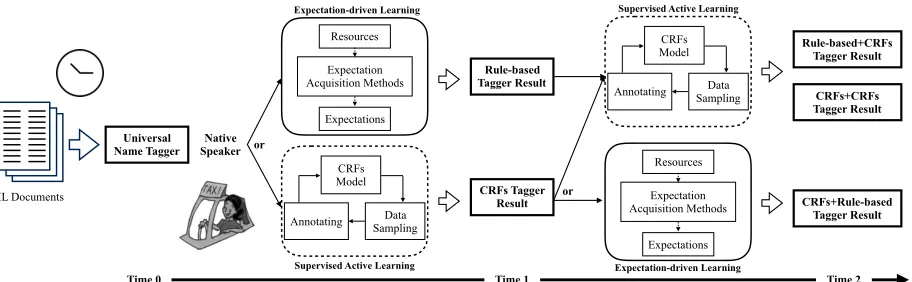
Figure 2 illustrates our cost-aware expectation composition approach. Given some IL documents as input, as the clock ticks, the system delivers name tagging results at time 0 (immediately), time 1 (e.g., in one hour) and time 2 (e.g., in two hours). At time 0, name tagging results are provided by the universal tagger described in Section 2. During the first hour, we can either ask the native speaker to annotate a small amount of data for supervised active learning of a CRFs model, or fill in the survey to build a rule-based tagger. We estimate the confidence value of
Language IL Test Docs
Name Unique Name
IL Dev. Docs
IL-English Docs Bengali 100 4,713 2,820 12,495 169 Hausa 100 1,619 950 13,652 645 Tagalog 100 6,119 3,375 1,616 145 Tamil 100 4120 2,871 4,597 166 Thai 100 4,954 3,314 10,000 191 Turkish 100 2,694 1,323 10,000 484 Yoruba 100 3,745 2,337 427 252
Table 3: Data Statistics
each expectation-driven rule based on its precision score on a small development set of ten documents. Then we apply these rules in the priority order of their confidence values. When the results of two tag-gers are conflicting on either mention boundary or type, if the applied rule has high confidence we will trust its output, otherwise adopt the CRFs model’s output.
6 Experiments
In this section we will present our experimental de-tails, results and observations.
6.1 Data
We evaluate our framework on seven low-resource incident languages: Bengali, Hausa, Tagalog, Tamil, Thai, Turkish and Yoruba, using the ground-truth name tagging annotations from the DARPA LORELEI program6. Table 3 shows data statistics.
6.2 Cost-aware Overall Performance
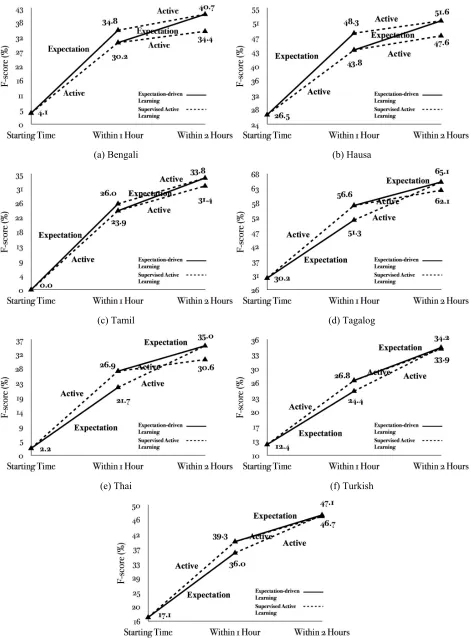
We test with three checking points: starting time, within one hour, and within two hours. Based on the combination approach described in Section 5, we can have three possible combinations of the expectation-driven learning and supervised active learning meth-ods during two hours: (1) expectation-driven learn-ing + supervised active learnlearn-ing; (2) supervised ac-tive learning + expectation-driven learning; and (3) supervised active learning for two hours. Figure 3 compares the overall performance of these combi-nations for each language.
We can see that our approach is able to rapidly set up a name tagger for an IL and achieves promis-ing performance. Durpromis-ing the first hour, there is no clear winner between expectation-driven learning or
6
http://www.darpa.mil/program/low-resource-languages-for-emergent-incidents
Available Resources Expectations
IL Monolingual Corpora
IL to English Parallel Data English NER
Patterns
Native Speaker
Expectation Acquisition
IL Pattern Mining Pattern Translation
IL Language Survey English Information Extraction
Word Alignment English KB
(DBpedia)
IL to English Lexicons
IL Specific Rules IL Name Patterns
IL Gazetteers
Entity Linker Typing
Comparable English Corpora
Latest version
Expectation Acquisition Methods
Time 0 Time 1 Time 2
IL Documents
Universal Name Tagger
Data Sampling Annotating
CRFs Model Expectations
Rule-based Tagger Result
CRFs Tagger Result
Rule-based+CRFs Tagger Result
CRFs+Rule-based Tagger Result
CRFs+CRFs Tagger Result
Resources
Native Speaker
Data Sampling Annotating
CRFs Model
Expectation Acquisition Methods
Expectations Resources
Expectation-driven Learning
Supervised Active Learning Expectation-driven Learning
Supervised Active Learning
or
[image:6.612.80.536.61.202.2]or
Figure 2: Cost-aware Expectation Composition
supervised active learning. But it’s clear that super-vised active learning for two hours is generally not the optimal solution. Using Hausa as a case study, we take a closer look at the supervised active learn-ing curve as shown in Figure 4. We can see that su-pervised active learning based on simple lexical fea-tures tends to converge quickly. As time goes by it will reach its own upper-bound of learning and gen-eralizing linguistic features. In these cases our pro-posed expectation-driven learning method can com-pensate by providing more explicit and deeper IL-specific linguistic knowledge.
6.3 Comparison of Expectation Discovery Methods
Table 4 shows the performance gain of each type of expectation acquisition method. IL gazetteers cov-ered some common names, especially when the uni-versal case-based rules failed at identifying names from non-Latin languages. IL name patterns were mainly effective for classification. For example, the Tamil name “கத்தோலிக்கன் சிரியன் வங்கியில
(Catholic Syrian Bank)” was classified as an orga-nization because it ends with an orgaorga-nization suf-fix word “வங்கியில(bank)”. The patterns projected from English were proven very effective at identi-fying name boundaries. For example, some non-names such as titles are also capitalized in Turkish, so simple case-based patterns produced many spu-rious names. But projected patterns can fix many of them. In the following Turkish sentence, “ An-cak Avrupa Birliği Dış İlişkiler Sorumlusu Catherine Ashton,...(But European Union foreign policy chief
Catherine Ashton,...)”, among all these capitalized
tokens, after we confirmed “Avrupa Birliği
(Euro-pean Union)” as an organization and “Dış İlişkiler
Sorumlusu (foreign policy chief)” as a title, we
ap-plied a pattern projected from English “
[Organiza-tion] [Title] [Person]” and successfully identified
“Catherine Ashton” as a person. Cross-lingual
en-tity linking based typing successfully enhanced clas-sification accuracy, especially for languages where names often appear the same as their English forms and so entity linking achieved high accuracy. For example, “George Bush” keeps the same in Hausa, Tagalog and Yoruba as English.
6.4 Impact of Supervised Active Learning
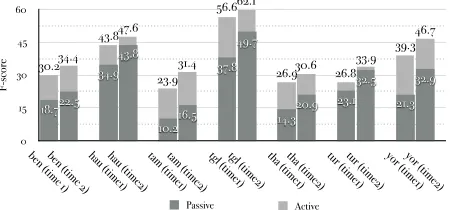
Figure 5 shows the comparison of supervised active learning and passive learning (random sampling in training data selection). We asked a native speaker to annotate Chinese news documents in one hour, and estimated the human annotation speed approxi-mately as 7,000 tokens per hour. Therefore we set the number of tokens as 7,000 for one hour, and 14,000 for two hours. We can clearly see that super-vised active learning significantly outperforms pas-sive learning for all languages, especially for Tamil, Tagalog and Yoruba. Because of the rich morphol-ogy in Turkish, the gain of supervised active learn-ing is relatively small because simple lexical fea-tures cannot capture name-specific characteristics regardless of the size of labeled data. For example, some prepositions (e.g., “nin (in)”) can be part of the names, so it’s difficult to determine name bound-aries, such as “<ORG Ludian bölgesihastanesi>nin
(a) Bengali (b) Hausa
(c) Tamil (d) Tagalog
(e) Thai (f) Turkish
[image:7.612.73.544.64.703.2](g) Yoruba
Figure 3: Comparison of methods combining expectation-driven learning and supervised active learning given various time bounds
Methods Bengali Hausa Tamil Tagalog Thai Turkish Yoruba
Universal Rules 4.1 26.5 0.0 30.2 2.2 12.4 17.1
+IL Gazetteers 29.7 32.1 21.8 34.3 18.9 17.3 26.9
+IL Name Patterns 31.2 33.8 22.9 35.1 18.9 19.1 28.0
[image:8.612.74.298.190.293.2]+IL to English Lexicons 31.3 35.2 24.0 38.0 20.5 19.6 29.4 +IL Survey with Native Speaker 34.1 40.6 25.6 45.9 21.6 39.3 30.2 +KB Linking based Typing 34.8 48.3 26.0 51.3 21.7 43.6 36.0
[image:8.612.75.301.326.431.2]Table 4: Contributions of Various Expectation Discovery Methods (F-score %)
Figure 4: Hausa Supervised Active Learning Curve
46.7 39.3 33.9 26.8 30.6 26.9 62.1 56.6
31.4 23.9 47.6 43.8 34.4 30.2
Active
F-score
0 15 30 45 60
ben (time 1)ben (time 2) hau (time1)hau (time2) tam (time1)tam (time2) tgl (time1)tgl (time2) tha (time1)tha (time2) tur (time1)tur (time2) yor (time1)yor (time2) 32.9
21.3 32.5 23.1 20.9 14.3 49.7
37.8
16.5 10.2 43.8 34.9
22.5 18.7
Passive
Table 1
ben (time 1) ben (time 2) hau (time1) hau (time2) tam (time1) tam (time2) tgl (time1) tgl (time2) tha (time1) tha (time2) tur (time1) tur (time2) yor (time1) yor (time2)
Passive 18.7 22.5 34.9 43.8 10.2 16.5 37.8 49.7 14.3 20.9 23.1 32.5 21.3 32.9 Active 30.2 34.4 43.8 47.6 23.9 31.4 56.6 62.1 26.9 30.6 26.8 33.9 39.3 46.7
Figure 5: Active Learning vs. Passive Learning (%)
6.5 Remaining Error Analysis
Language Identification F-score Typing Accuracy*
Overall F-score PER ORG LOC All
Bengali 51.0 32.7 54.3 48.5 84.1 40.7 Hausa 51.8 36.6 63.3 55.1 93.6 51.6 Tamil 40.4 16.4 46.8 39.2 86.2 33.8 Tagalog 71.6 65.2 73.9 70.1 92.8 65.1 Thai 48.5 21.8 72.8 48.6 72.0 35.0 Turkish 64.3 41.3 73.0 63.1 69.1 43.6 Yoruba 69.3 38.3 60.0 57.2 82.3 47.1
* typing accuracy is computed on correctly identified names
Table 5: Breakdown Scores
Table 5 presents the detailed break-down scores for all languages. We can see that name identifi-cation, especially organization identification is the main bottleneck for all languages. For example, many organization names in Hausa are often very long, nested or all low-cased, such as “
makaran-tar horas da Malaman makaranta ta Bawa Jan Gwarzo (Bawa Jan Gwarzo Memorial Teachers
Col-lege)” and “kungiyar masana’antu da tattalin arziki
ta kasar Sin (China’s Association of Business and
In-dustry)”. Our name tagger will further benefit from
more robust universal word segmentation, rich mor-phology analysis and IL-specific knowledge. For ex-ample, in Tamil “ஃ” is a visarga used as a diacritic to write foreign sounds, so we can infer a phrase in-cluding it (e.g., “ஹெய்ஃபாவின்(Haifa)”) is likely to be a foreign name. Therefore our survey should be enriched by exercising with many languages to cap-ture more categories of linguistic phenomena.
7 Related Work
Name Tagging is a well-studied problem. Many types of frameworks have been used, including rules (Farmakiotou et al., 2000; Nadeau and Sekine, 2007), supervised models using monolingual labeled data (Zhou and Su, 2002; Chieu and Ng, 2002; Rizzo and Troncy, 2012; McCallum and Li, 2003; Li and McCallum, 2003), bilingual labeled data (Li et al., 2012; Kim et al., 2012; Che et al., 2013; Wang et al., 2013) or naturally partially annotated data such as Wikipedia (Nothman et al., 2013), bootstrap-ping (Agichtein and Gravano, 2000; Niu et al., 2003; Becker et al., 2005; Wu et al., 2009; Chiticariu et al., 2010), and unsupervised learning (Mikheev et al., 1999; McCallum and Li, 2003; Etzioni et al., 2005; Nadeau et al., 2006; Nadeau and Sekine, 2007; Ji and Lin, 2009).
Name tagging has been explored for many non-English languages such as in Chinese (Ji and Gr-ishman, 2005; Li et al., 2014), Japanese (Asahara and Matsumoto, 2003; Li et al., 2014), Arabic (Mal-oney and Niv, 1998), Catalan (Carreras et al., 2003), Bulgarian (Osenova and Kolkovska, 2002), Dutch (De Meulder et al., 2002), French (Béchet
et al., 2000), German (Thielen, 1995), Ital-ian (Cucchiarelli et al., 1998), Greek (Karkaletsis et al., 1999), Spanish (Arévalo et al., 2002), Por-tuguese (Hana et al., 2006), Serbo-croatian (Nenadić and Spasić, 2000), Swedish (Dalianis and Åström, 2001) and Turkish (Tür et al., 2003). However, most of previous work relied on substantial amount of re-sources such as language-specific rules, basic tools such as part-of-speech taggers, a large amount of la-beled data, or a huge amount of Web ngram data, which are usually unavailable for low-resource ILs. In contrast, in this paper we put the name tagging task in a new emergent setting where we need to pro-cess a surprise IL within very short time using very few resources.
The TIDES 2003 Surprise Language Hindi Named Entity Recognition task (Li and McCallum, 2003) had a similar setting. A name tagger was re-quired to be finished within a time bound (five days). However, 628 labeled documents were provided in the TIDES task, while in our setting no labeled doc-uments are available at the starting point. There-fore we applied active learning to efficiently anno-tate about 40 documents for each language and pro-posed new methods to learn expectations. The re-sults of the tested ILs are still far from perfect, but we hope our detailed comparison and result analysis can introduce new ideas to balance the quality and cost of name tagging.
8 Conclusions and Future Work
Name tagging for a new IL is a very important but also challenging task. We conducted a thor-ough study on various ways of acquiring, encod-ing and composencod-ing expectations from multiple non-traditional sources. Experiments demonstrate that this framework can be used to build a promising name tagger for a new IL within a few hours. In the future we will exploit broader and deeper entity prior knowledge to improve name identification. We will aim to make the framework more transparent for native speakers so the survey can be done in an au-tomatic interactive question-answering fashion. We will also develop methods to make the tagger capable of active self-assessment to produce the best work-flow within time bounds.
Acknowledgments
This work was supported by the U.S. DARPA LORELEI Program No. HR0011-15-C-0115 and ARL/ARO MURI W911NF-10-1-0533. The views and conclusions contained in this document are those of the authors and should not be interpreted as rep-resenting the official policies, either expressed or implied, of the U.S. Government. The U.S. Gov-ernment is authorized to reproduce and distribute reprints for Government purposes notwithstanding any copyright notation here on.
References
Eugene Agichtein and Luis Gravano. 2000. Snowball: Extracting relations from large plain-text collections. InProceedings of the fifth ACM conference on Digital libraries.
Montse Arévalo, Xavier Carreras, Lluís Màrquez, María Antònia Martí, Lluís Padró, and María José Simón. 2002. A proposal for wide-coverage spanish named entity recognition. Procesamiento del lenguaje natural.
Masayuki Asahara and Yuji Matsumoto. 2003. Japanese named entity extraction with redundant morphological analysis. InProceedings of the 2003 Conference of the North American Chapter of the Association for Com-putational Linguistics on Human Language Technol-ogy.
Laura Banarescu, Claire Bonial, Shu Cai, Madalina Georgescu, Kira Griffitt, Ulf Hermjakob, Kevin Knight, Philipp Koehn, Martha Palmer, and Nathan Schneider. 2013. Abstract meaning representation for sembanking. InACL Workshop on Linguistic Annota-tion and Interoperability with Discourse.
Frédéric Béchet, Alexis Nasr, and Franck Genet. 2000. Tagging unknown proper names using decision trees. InProceedings of the 38th Annual Meeting on Associ-ation for ComputAssoci-ational Linguistics.
Markus Becker, Ben Hachey, Beatrice Alex, and Claire Grover. 2005. Optimising selective sampling for boot-strapping named entity recognition. In Proceedings of ICML-2005 Workshop on Learning with Multiple Views.
Xavier Carreras, Lluís Màrquez, and Lluís Padró. 2003. Named entity recognition for catalan using spanish re-sources. InProceedings of the tenth conference on Eu-ropean chapter of the Association for Computational Linguistics.
Wanxiang Che, Mengqiu Wang, Christopher D Manning, and Ting Liu. 2013. Named entity recognition with bilingual constraints. InProceedings of HLT-NAACL.
Hai Leong Chieu and Hwee Tou Ng. 2002. Named en-tity recognition: a maximum entropy approach using global information. InProceedings of the 19th inter-national conference on Computational linguistics. Laura Chiticariu, Rajasekar Krishnamurthy, Yunyao
Li, Frederick Reiss, and Shivakumar Vaithyanathan. 2010. Domain adaptation of rule-based annotators for named-entity recognition tasks. InProceedings of the 2010 Conference on Empirical Methods in Natural Language Processing.
Michael Collins and Yoram Singer. 1999. Unsupervised models for named entity classification. InProceedings of the joint SIGDAT conference on empirical methods in natural language processing and very large cor-pora.
Alessandro Cucchiarelli, Danilo Luzi, and Paola Velardi. 1998. Automatic semantic tagging of unknown proper names. InProceedings of the 17th international con-ference on Computational linguistics.
Hercules Dalianis and Erik Åström. 2001. Swenam— a swedish named entity recognizer. Technical report, Technical Report. Department of Numerical Analysis and Computing Science.
Fien De Meulder, Walter Daelemans, and Véronique Hoste. 2002. A named entity recognition system for dutch. Language and Computers.
Oren Etzioni, Michael Cafarella, Doug Downey, Ana-Maria Popescu, Tal Shaked, Stephen Soderland, Daniel S Weld, and Alexander Yates. 2005. Unsuper-vised named-entity extraction from the web: An exper-imental study.Artificial intelligence.
Dimitra Farmakiotou, Vangelis Karkaletsis, John Kout-sias, George Sigletos, Constantine D Spyropoulos, and Panagiotis Stamatopoulos. 2000. Rule-based named entity recognition for greek financial texts. In Pro-ceedings of the Workshop on Computational lexicog-raphy and Multimedia Dictionaries (COMLEX 2000). Jenny Rose Finkel, Trond Grenager, and Christopher Manning. 2005. Incorporating non-local information into information extraction systems by gibbs sampling. InProceedings of the 43rd Annual Meeting on Associ-ation for ComputAssoci-ational Linguistics.
Jirka Hana, Anna Feldman, Chris Brew, and Luiz Ama-ral. 2006. Tagging portuguese with a spanish tagger using cognates. In Proceedings of the International Workshop on Cross-Language Knowledge Induction. Heng Ji and Ralph Grishman. 2005. Improving name
tagging by reference resolution and relation detection. InProceedings of ACL2005.
Heng Ji and Dekang Lin. 2009. Gender and animacy knowledge discovery from web-scale n-grams for un-supervised person mention detection. InProceedings of PACLIC2009.
Feng Jing, Mingjing Li, HongJiang Zhang, and Bo Zhang. 2004. Entropy-based active learning with support vec-tor machines for content-based image retrieval. In Pro-ceedings of ICMCS2004.
Vangelis Karkaletsis, Georgios Paliouras, Georgios Peta-sis, Natasa Manousopoulou, and Constantine D Spy-ropoulos. 1999. Named-entity recognition from greek and english texts. Journal of Intelligent and Robotic Systems.
Sungchul Kim, Kristina Toutanova, and Hwanjo Yu. 2012. Multilingual named entity recognition using parallel data and metadata from wikipedia. In Pro-ceedings of the 50th Annual Meeting of the Association for Computational Linguistics.
John D. Lafferty, Andrew McCallum, and Fernando C. N. Pereira. 2001. Conditional random fields: Probabilis-tic models for segmenting and labeling sequence data. InProceedings of the Eighteenth International Confer-ence on Machine Learning.
Wei Li and Andrew McCallum. 2003. Rapid devel-opment of hindi named entity recognition using con-ditional random fields and feature induction. ACM Transactions on Asian and Low-Resource Language Information Processing.
Qi Li, Haibo Li, Heng Ji, Wen Wang, Jing Zheng, and Fei Huang. 2012. Joint bilingual name tagging for parallel corpora. InProceedings of the 21st ACM in-ternational conference on Information and knowledge management.
Haibo Li, Masato Hagiwara, Qi Li, and Heng Ji. 2014. Comparison of the impact of word segmentation on name tagging for chinese and japanese. In Proceed-ings of LREC2014.
John Maloney and Michael Niv. 1998. Tagarab: a fast, accurate arabic name recognizer using high-precision morphological analysis. InProceedings of the Work-shop on Computational Approaches to Semitic Lan-guages.
Andrew McCallum and Wei Li. 2003. Early results for named entity recognition with conditional random fields, feature induction and web-enhanced lexicons. In Proceedings of the seventh conference on Natural language learning at HLT-NAACL 2003.
Andrei Mikheev, Marc Moens, and Claire Grover. 1999. Named entity recognition without gazetteers. In Pro-ceedings of the ninth conference on European chapter of the Association for Computational Linguistics. JY Mortimer and JA Salathiel. 1995. ’soundex’codes
of surnames provide confidentiality and accuracy in a national hiv database. Communicable disease report. CDR review.
David Nadeau, Peter Turney, and Stan Matwin. 2006. Unsupervised named-entity recognition: Generating gazetteers and resolving ambiguity.
Goran Nenadić and Irena Spasić. 2000. Recognition and acquisition of compound names from corpora. In Nat-ural Language Processing—NLP 2000.
Cheng Niu, Wei Li, Jihong Ding, and Rohini K Srihari. 2003. Bootstrapping for named entity tagging using concept-based seeds. InProceedings of the 2003 Con-ference of the North American Chapter of the Associ-ation for ComputAssoci-ational Linguistics on Human Lan-guage Technology.
Joel Nothman, Nicky Ringland, Will Radford, Tara Mur-phy, and James R Curran. 2013. Learning multilingual named entity recognition from wikipedia.Artificial In-telligence.
Franz Josef Och and Hermann Ney. 2003. A system-atic comparison of various statistical alignment mod-els. Computational linguistics.
Petya Osenova and Sia Kolkovska. 2002. Combin-ing the named-entity recognition task and np chunkCombin-ing strategy for robust pre-processing. InProceedings of the Workshop on Treebanks and Linguistic Theories, September.
Hema Raghavan and James Allan. 2004. Using soundex codes for indexing names in asr documents. In Pro-ceedings of the Workshop on Interdisciplinary Ap-proaches to Speech Indexing and Retrieval at HLT-NAACL 2004.
Giuseppe Rizzo and Raphaël Troncy. 2012. Nerd: a framework for unifying named entity recognition and disambiguation extraction tools. In Proceedings of the Demonstrations at the 13th Conference of the Eu-ropean Chapter of the Association for Computational Linguistics.
John Searle. 1980. Minds, brains, and programs.Journal of the Association for Computing Machinery.
Burr Settles and Mark Craven. 2008. An analysis of ac-tive learning strategies for sequence labeling tasks. In Proceedings of the conference on empirical methods in natural language processing.
Burr Settles. 2010. Active learning literature survey. University of Wisconsin, Madison.
Christine Thielen. 1995. An approach to proper name tagging for german. arXiv preprint cmp-lg/9506024. Gökhan Tür, Dilek Hakkani-Tür, and Kemal Oflazer.
2003. A statistical information extraction system for turkish. Natural Language Engineering.
Mengqiu Wang, Wanxiang Che, and Christopher D Man-ning. 2013. Joint word alignment and bilingual named entity recognition using dual decomposition. In Pro-ceedings of the Association for Computational Linguis-tics.
Han Wang, Jin Guang Zheng, Xiaogang Ma, Peter Fox, and Heng Ji. 2015. Language and domain independent entity linking with quantified collective validation. In Proceedings of Conference on Empirical Methods in Natural Language Processing (EMNLP2015). Dan Wu, Wee Sun Lee, Nan Ye, and Hai Leong Chieu.
2009. Domain adaptive bootstrapping for named entity recognition. InProceedings of the 2009 Conference on Empirical Methods in Natural Language Processing. GuoDong Zhou and Jian Su. 2002. Named entity
recog-nition using an hmm-based chunk tagger. In Proceed-ings of the 40th Annual Meeting on Association for Computational Linguistics.