Cross-media Event Extraction and Recommendation
Di Lu1, Clare R. Voss2, Fangbo Tao3, Xiang Ren3, Rachel Guan1, Rostyslav Korolov1, Tongtao Zhang1, Dongang Wang4, Hongzhi Li4, Taylor Cassidy2, Heng Ji1,
Shih-fu Chang4, Jiawei Han3, William Wallace1, James Hendler1, Mei Si1, Lance Kaplan2 1 Rensselaer Polytechnic Institute
{lud2,jih}@rpi.edu
2 Army Research Laboratory, Adelphi, Maryland
{clare.r.voss,taylor.cassidy,lance.m.kaplan}[email protected] 3Computer Science Department, University of Illinois at Urbana-Champaign
4Electrical Engineering Department, Columbia University [email protected]
Abstract
The sheer volume of unstructured multimedia data (e.g., texts, images, videos) posted on the Web during events of general interest is over-whelming and difficult to distill if seeking in-formation relevant to a particular concern. We have developed a comprehensive system that searches, identifies, organizes and summarizes complex events from multiple data modalities. It also recommends events related to the user’s ongoing search based on previously selected attribute values and dimensions of events be-ing viewed. In this paper we briefly present the algorithms of each component and demon-strate the system’s capabilities1.
1 Introduction
Every day, a vast amount of unstructured data in dif-ferent modalities (e.g., texts, images and videos) is posted online for ready viewing. Complex event ex-traction and recommendation is critical for many in-formation distillation tasks, including tracking cur-rent events, providing alerts, and predicting possi-ble changes, as related to topics of ongoing con-cern. State-of-the-art Information Extraction (IE) technologies focus on extracting events from a sin-gle data modality and ignore cross-media fusion. More importantly, users are presented with extracted events in a passive way (e.g., in a temporally ordered event chronicle (Ge et al., 2015)). Such technologies do not leverage user behavior to identify the event 1The system demo is available at: http://nlp.cs.
rpi.edu/multimedia/event/navigation_dark. html
properties of interest to them in selecting new sce-narios for presentation.
In this paper we present a novel event extraction and recommendation system that incorporates ad-vances in extracting events across multiple sources with data in diverse modalities and so yields a more comprehensive understanding of collective events, their importance, and their inter-connections. The novel capabilities of our system include:
• Event Extraction, Summarization and Search: extract concepts, events and their arguments (par-ticipants) and implicit attributes, and semanti-cally meaningful visual patterns from multiple data modalities, and organize them into Event Cubes(Tao et al., 2013) based on Online Analyt-ical Processing (OLAP). We developed a search interface to these cubes with a novel back-end event summarization component, for users to specify multiple dimensions in a query and re-ceive single-sentence summary responses.
• Event Recommendation: recommend related events based on meta-paths derived from event arguments, and automatically adjust the ranking function by updating the weights of dimensions based on user browsing feedback.
2 Overview
2.1 System Architecture
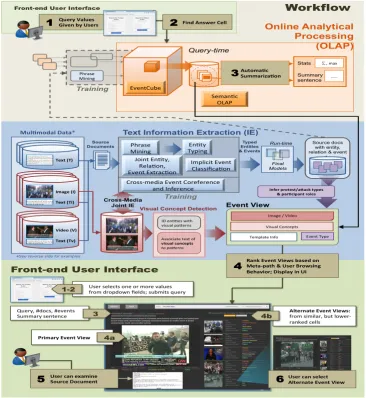
The overall architecture of our system is illustrated in Figure 1. We first extract textual event informa-tion, as well as visual concepts, events and patterns from the raw multimedia documents to construct event cubes. Based on the event cubes, the search interface (Figure 2) returns the document that best
Figure 1: System Workflow.
matches the user’s query as the first primary event for display. A query may consist of multiple dimen-sions. The recommendation interface displays mul-tiple dimensions and rich annotations of the primary event, and recommends similar and dissimilar events to the user.
2.2 Data Sets
To demonstrate the capabilities of our system, we use two event types,ProtestandAttack, as our case studies. We collected the following data sets:
• Protest: 59 protest incidents that occurred be-tween January 2009 and December 2010, from 458 text documents, 28 images and 31 videos.
• Attack: 52 attack incidents that occurred between January 2014 and December 2015, from 812 text
documents, 46 images and 6 videos.
3 Event Cube Construction and Search
[image:2.612.330.530.557.676.2]3.1 Event Extraction
We apply a state-of-the-art English IE system (Li et al., 2014) to jointly extract entities, relations and events from text documents. This system is based on structured perceptron incorporating multiple lev-els of linguistic features. However, some impor-tant event attributes are not expressed by explicit textual clues. To enrich the profile of each protest event, the system identifies two additional implicit attributes that derive from social movement theo-ries (Della Porta and Diani, 2009; Furusawa, 2006; Dalton, 2013):
• Types of Protest, includingdemonstration, riot,
strike,boycott,picketandindividual protest.
• Demands of Protest, indicating the hidden be-havioral intent of protesters, about what they de-sire to change or preserve, includingpacifist, po-litical, economic, retraction, financial, religious,
human rights,race,justice,environmental,sports rivalryandsocial.
We annotated 92 news documents, 59 of which con-tained protests, to learn a set of heuristic rules for au-tomatically extracting these implicit attributes from the IE outputs of these documents.
3.2 Event Cube Construction and Search
Event extraction helps in converting unstructured texts into structured arguments and attributes (di-mensions). However, a user may still need to “drill down,” searching back through many documents and changing query selections before finding an item of interest. We use EventCube (Tao et al., 2013) to effectively organize and efficiently search relevant events, and measure event similarity based on multi-ple dimensions. EventCubeis a general online ana-lytical processing (OLAP) framework for importing any collection of multi-dimensional text documents and constructing text-rich data cube.EventCube dif-fers from traditional search engines in that it returns
Top-Cells, where relevant documents are aggregated by dimension combinations.
We regard each event as a data point associated with multiple dimension values. After a user in-puts a multi-dimensional query in the search inter-face (Figure 2), we build inverted index upon the dimensions in Event Cube to return related events, which provides much more flexible matching
com-pared to keyword search.
4 Multi-media Event Illustration and Summarization
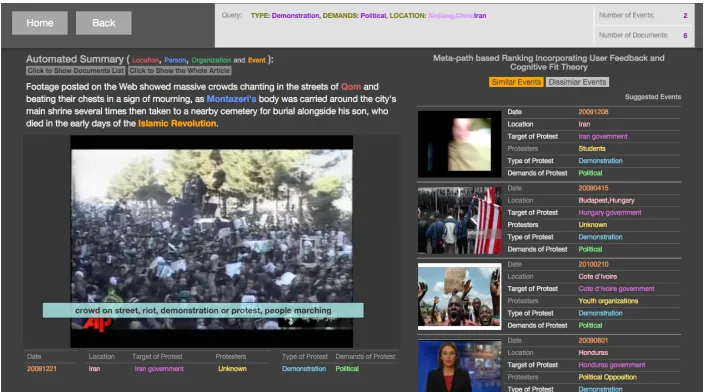
After the search interface retrieves the most rele-vant event (’primary event’), the user will be di-rected to the recommendation interface (Figure 3) and can start exploring various events. The user’s initial query is displayed at the top (gray bar) and is updated to capture new user selections. The number of events that match the user’s initial query and the number of documents associated with the primary event are displayed in the gray bar, at the far right side. In addition to text IE results, we apply the fol-lowing multi-media extraction and summarization techniques to illustrate and enrich event profiles.
4.1 Summarization
From each set of relevant documents, we apply a state-of-the-art phrase mining method (Liu et al., 2016) to mine top-k representative phrases. Then we construct an affinity matrix of sentences and ap-plyspectral clusteringto find several clustering cen-ters (i.e., representative sentences including the most important phrases) as the summary. The user is also provided two options to show the original doc-uments and the document containing the summary.
4.2 Visual Information Extraction
Figure 3: Recommendation Interface.
5 Event Recommendation
We rank and recommend events based on meta paths (Sun et al., 2011), by representing the whole data set as a heterogeneous network, that is composed of multi-typed and interconnected ob-jects (e.g., events, location, protesters, target of protesters). A meta path is a sequence of rela-tions defined between different object types. For protest events, we define six meta paths: “event-date-event”, “event-location-event”, “event-target of protest-event”, protesters-event”, “event-type of event” and “event-demand of protest-event”; and four meta paths for attack events: date-event”, location-event”, “event-attackers-event” and “event-type of attack-event”.
The similarity between two events is the weighted sum of the six meta path similarities. The weights are assigned dynamically by the user’s activity:
• When the user clicks on a certain image/video: as-sign1.0to all meta-path similarities.
• When the user clicks on a certain dimensionX:
1.0 for the similarity based on Event-X-Event, and0.2to other meta-paths.
To illustrate the meta paths, the dimension names of recommended events are highlighted if they share the same dimensions with the primary event. More-over, the system is switchable between recommend-ing the most similar and most dissimilar events with a toggle button that the user can click.
6 Conclusions and Future Work
In this paper we present a cross-media event ex-traction and recommendation system which effec-tively aggregates and summarizes related complex events, and makes recommendations based on user interests. The current system interface incorporates a medium-level human agency (the capacity of an entity to act) by allowing a human user to provide relevance feedback while driving the browsing in-terests by multi-dimensional recommendations. We plan to follow the cognitive fit theory (Vessey, 1991) and conduct a series of human utility evaluations to formally quantify the impact of each new compo-nent and each data modality on enhancing the speed and quality of aggregating and summarizing event-related knowledge, detecting conflicts and errors, and generating alerts.
Acknowledgments
References
Russell J Dalton. 2013. Citizen politics: Public opinion and political parties in advanced industrial democra-cies. Cq Press.
Donatella Della Porta and Mario Diani. 2009. Social movements: An introduction. John Wiley & Sons. Katsuto Furusawa. 2006. Participation and protest in the
european union and the ‘outsider’states. Contempo-rary politics, 12(2):207–223.
Tao Ge, Wenzhe Pei, Heng Ji, Sujian Li, Baobao Chang, and Zhifang Sui. 2015. Bring you to the past: Auto-matic generation of topically relevant event chronicles. InProceedings of the 53rd Annual Meeting of the As-sociation for Computational Linguistics (ACL2015). Polina Kuznetsova, Vicente Ordonez, Alexander C Berg,
Tamara L Berg, and Yejin Choi. 2012. Collective generation of natural image descriptions. In Proceed-ings of the 50th Annual Meeting of the Association for Computational Linguistics: Long Papers-Volume 1. Qi Li, Heng Ji, Yu Hong, and Sujian Li. 2014.
Constructing information networks using one single model. InProceedings of the 2014 Conference of the Empirical Methods on Natural Language Processing (EMNLP2014).
Hongzhi Li, Joseph G. Ellis, and Shih-Fu Chang. 2015. Event specific multimodal pattern mining with image-caption pairs.arXiv preprint arXiv:1601.00022. Jialu Liu, Xiang Ren, Jingbo Shang, Taylor Cassidy,
Clare Voss, and Jiawei Han. 2016. Representing doc-uments via latent keyphrase inference. InProceedings of the 25th international conference on World wide web.
Yizhou Sun, Jiawei Han, Xifeng Yan, Philip S. Yu, and Tianyi Wu. 2011. Pathsim: Meta path-based top-k similarity search in heterogeneous information net-works. In Proceedings of 2011 Int. Conf. on Very Large Data Bases.
Fangbo Tao, Kin Hou Lei, Jiawei Han, ChengXiang Zhai, Xiao Cheng, Marina Danilevsky, Nihit Desai, Bolin Ding, Jing Ge Ge, Heng Ji, et al. 2013. Eventcube: multi-dimensional search and mining of structured and text data. InProceedings of the 19th ACM SIGKDD international conference on Knowledge discovery and data mining.
Iris Vessey. 1991. Cognitive fit: A theory-based anal-ysis of the graphs versus tables literature. Decision Sciences, 22(2):219–240.