Comparing Approaches for Automatic Question Identification
Angel Samsuddin Maredia, Kara Schechtman, Sarah Ita Levitan, Julia Hirschberg
Department of Computer Science, Columbia University, USA
[email protected],[email protected], [email protected],[email protected]
Abstract
Collecting spontaneous speech corpora that are open-ended, yet topically con-strained, is increasingly popular for re-search in spoken dialogue systems and speaker state, inter alia. Typically, these corpora are labeled by human annota-tors, either in the lab or through crowd-sourcing; however, this is cumbersome and time-consuming for large corpora. We present four different approaches to auto-matically tagging a corpus when general topics of the conversations are known. We develop these approaches on the Columbia X-Cultural Deception corpus and find ac-curacy that significantly exceeds the base-line. Finally, we conduct a cross-corpus evaluation by testing the best performing approach on the Columbia/SRI/Colorado corpus.
1 Introduction
Corpora of spontaneous speech are often col-lected through interviews or by otherwise provid-ing subjects with question prompts. Such cor-pora are semi-structured; they are constrained by the prompts used, but the elicited speech is open-ended in vocabulary and structure. It is often de-sirable to segment these corpora into their under-lying topics based on the questions asked. This is typically done manually by annotators in the lab or via crowd-sourcing. However, such annotation is impractical and time-consuming for large corpora. In this paper we describe a set of experi-ments aimed at automatically tagging a large cor-pus with topic labels. We tag the Columbia X-Cultural Deception (CXD) corpus, a large-scale (120-hour) corpus of deceptive and non-deceptive dialogues collected using a semi-structured
inter-view paradigm. Participants took turns interinter-view- interview-ing each other usinterview-ing a fixed set of biographical in-terview questions1, but the questions were asked
in individual variants, in any order, and interview-ers often asked follow-up questions. For example, the question, ”Are your parents divorced?” could be produced as ”Are your mom and dad still to-gether?” These questions are semantically simi-lar, but differ lexically, presenting the challenge of topically tagging a corpus based on semantic similarity. The question, ”Have you ever broken a bone?” could be followed by another, ”How did you break your bone?” This illustrates the chal-lenge of distinguishing between phrases that are lexically similar, but differ semantically. These two examples highlight problems faced when try-ing to automatically annotate a corpus for re-sponses to a given set of questions.
With such a large corpus, it is not practical to manually annotate topic boundaries. So, to com-pare question responses from multiple subjects, we identify conversational turns in the corpus that correspond to the original interview questions. We compare four approaches to question identifica-tion: (1) a baseline approach that identifies ques-tions using strict string matches, (2) the ROUGE metric which is based on n-gram comparisons, (3) cosine similarity between word embedding repre-sentations and (4) cosine similarity between doc-ument embeddings. We include experiments with varying thresholds for approaches (2), (3), and (4) to highlight the trade-off between precision and recall for these approaches. Finally, we test our best approach using word embeddings on another corpus, the Columbia/SRI/Colorado (CSC) corpus (Hirschberg et al.,2005), collected with a similar interview paradigm but different questions, in or-der to evaluate the utility of this method in another
1The interview questions can be found here: http://
tinyurl.com/lzfa8zl
domain.
This work draws upon the body of research on short-text semantic similarity (e.g. (Mihalcea et al.,2006;Kenter and de Rijke,2015;Oliva et al.,
2011)). It is also related to work on topic seg-mentation (e.g. (Cardoso et al.,2013;Dias et al.,
2007) ), however here we focus on matching con-versational turns to a fixed set of possible topics. While this work is done in support of our ongo-ing work on deception detection usongo-ing speech and text-based features, we believe that our approach could be applied to other spontaneous transcribed speech or text corpora which were collected with some constraints on topics.
2 Corpus
The Columbia X-Cultural Deception (CXD) Cor-pus (Levitan et al.,2015) is a collection of within-subject deceptive and non-deceptive speech from native speakers of Standard American English (SAE) and Mandarin Chinese (MC), all speak-ing in English. The corpus contains dialogues between 340 subjects. A variation of a fake re-sume paradigm was used to collect the data. Previ-ously unacquainted pairs of subjects played a ”ly-ing game” with each other. Each subject filled out a 24-item biographical questionnaire and were in-structed to create false answers for a random half of the questions. The lying game was recorded in a sound booth. For the first half of the game, one subject assumed the role of the interviewer, while the other answered the biographical ques-tions, lying for half and telling the truth for the other; questions chosen in each category were bal-anced across the corpus. For the second half of the game, the subjects roles were reversed, and the interviewer became the interviewee. During the game, the interviewer was allowed to ask the 24 questions in any order s/he chose; the inter-viewer was also encouraged to ask follow-up ques-tions to aid them in determining the truth of the interviewees answers. The entire corpus was or-thographically transcribed using the Amazon Me-chanical Turk (AMT)2 crowd-sourcing platform,
and transcripts were forced-aligned with the au-dio recordings. The speech was then automatically segmented intointer-pausal units(IPUs), defined as pause-free segments of speech separated by a minimum pause length of 50 ms. The speech was also segmented into turn units, where a turn is
de-2https://www.mturk.com/mturk/
fined as a maximal sequence of IPUs from a single speaker without any interlocutor speech that is not a backchannel (a simple acknowledgment that is not an attempt to take the turn). For this work, we compiled 40 interviewer sessions (about 20% of the corpus) and hand-annotated the turns for all of these sessions, giving us a total of 5308 turns. Out of these turns, 923 were interviewer questions that corresponded to the list of the original biograph-ical questions, which we labeled with the ques-tion number. Below we describe the different ap-proaches and then discuss results in Section4with a comparison of performance in Table1.
3 Question Identification Approaches
3.1 String-matching Baseline
As a baseline for matching the 24 questions in-terviewers were instructed to ask with interviewer turns, we performed a simple two-pass question matching procedure for exact string matches be-tween written questions and the transcripts. In the first pass, we searched for exact matches of strings with punctuation and spacing removed. With the remaining unmatched questions, we then per-formed another round of matching, with the tran-script lemmatized and with filler words removed, to identify very close though not exact matches.
3.2 ROUGE
ROUGE (Recall-Oriented Understudy for Gist-ing Evaluation)(Lin,2004) is a package designed to evaluate computer-generated summaries against a human-written baseline using a simple n-gram comparison to find precision, recall, and f-score for each machine-human summary comparison. Using ROUGE, we evaluated matches for ques-tions which had not been detected by the baseline. We created a ROUGE task for each unmatched question. For each task, the original question was used as the reference text. We then tested each interviewer turn in the conversation against the reference, using bi-gram matching. We thus matched the turn receiving the highest similarity score to the reference text to that question, testing this method at a variety of similarity thresholds.
3.3 Word Embeddings
24 questions. We use a pre-trained Word2vec model on the Google News dataset3 with over
three million words and phrases to obtain word embeddings. The primary benefit of a Word2vec model is that it clusters semantically similar words and phrases together: for example, ”Golden Gate Bridge” and ”San Francisco” have very low cosine distance between each other in this model. There-fore, semantically similar words were likely to be represented as vectors with high cosine similarity. To obtain a vector representation for each ques-tion as a whole, we found the vector representa-tion for each word using Word2vec. We then took a weighted average of all of the word vectors in the question where words that directly contributed to the topic of the turn such as ”relationship” or ”mom” were weighed more than words that, if re-moved, did not affect the topic of the turn such as ”have” or ”really.” This produced a final vector representation of the entire question. We exclude stop words from this vector average. Following the same approach, we obtained vector represen-tations for each interviewer turn. We then cal-culated the cosine similarities between a turn and each question and found the question that had the highest cosine similarity to the turn vector. We compared the cosine similarity of the turn and the question to the cosine similarity of any previous identified matches. If the newly calculated cosine similarity was higher, then the current turn was deemed the best match so far to the question, oth-erwise we repeated this comparison with the ques-tion that had the second highest cosine similarity to the turn. At the end of each particular inter-viewer session, we had a mapping of each turn to a question if a match was detected, otherwise the turn was marked as not being a question.
3.4 Document Embeddings
We also explored the use of document embeddings for this task. We began by finding a vector repre-sentation for each of the 24 questions. We used a Doc2vec model pre-trained on Wikipedia text4.
Recall that, in our paradigm, questions could be asked in individual variants, in any order, and along with follow-up questions. The primary ben-efit of a Doc2Vec model is that it allows for unsu-pervised learning of larger blocks of text.
There-3The model can be found here: https://code.
google.com/archive/p/word2vec/
4The model can be found here: https://github.
com/jhlau/doc2vec
fore, we hypothesized that Doc2Vec would return word vectors that also depended on contextual us-age as well as semantic similarity. We then cal-culated the vector averages for each turn and pro-duced turn-to-question mappings as explained in the word embeddings approach above.
4 Results
Table1shows the accuracy, precision, recall, and f1-score of each of the four approaches outlined above, evaluated on our hand-labeled subset of interviews. We see that the word embeddings method achieved the highest accuracy, recall, and f1-score of all the methods developed and tested, whereas the ROUGE approach obtained the high-est precision. With the word embeddings ap-proach, most correctly identified turns share one or more meaningful words with the corresponding original question and are often syntactically very similar. This approach, however, is able to make ambiguous matches as well. For example, an inter-viewer turn said, ”wow you broke you broke your hand when you were in elementary school wow i yeah i get so student hate to do homework so have you ever tweet tweeted.” This turn shares mean-ingful words with many other questions, but this approach correctly identified it as matching the question Have you ever tweeted? The word em-beddings approach could also make difficult se-mantic matches. Many interviewers asked, ”Are your mom and dad still together?” instead of ”Are your parents divorced?” Even though there are few lexically common meaningful words between these two phrases, this approach correctly mapped these questions to each other because of their se-mantic similarity. One of the main causes of er-ror for this method is that follow-up questions were sometimes mis-identified as original ques-tions. For example, ”How do you like your ma-jor?” could be mapped to the original question, ”If you attended college, what was your major?” even though the question the interviewer asked was a follow-up question.
Approach Accuracy Precision Recall F1-Score
Baseline (Rule-based) 39.0 72.0 42.0 53.1
ROUGE 74.0 93.0 78.0 84.8
Word Embeddings 91.4 92.1 99.1 95.5
[image:4.595.139.462.61.133.2]Document Embeddings 88.6 90.0 98.2 93.9
Table 1: Accuracy, precision, and recall of each approach, evaluated on hand annotated turns
0.1 0.2 0.3 0.4 0.5 0.6 0.7 0.8 0.9 1 0.3
0.4 0.5 0.6 0.7 0.8 0.9
Threshold
Precision
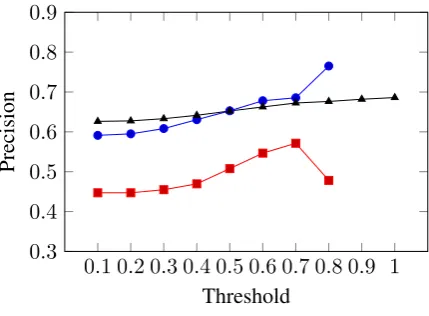
Figure 1: Accuracy of each approach determined by threshold. Filled in dots are word embeddings. Squares represent document embeddings. Trian-gles represent ROUGE.
matched with. We capped the threshold at 0.82. Figure 1 shows that, as we increase the thresh-old, generally, the accuracy of the question match-ing for all approaches is higher. This, intuitively, makes sense because, as we increase the threshold, we are selecting turns that have higher similarity to their matched question. Although this results in lower recall, it can be used in cases where high precision is needed for annotations.
4.1 Cross-corpus Evaluation
To further evaluate our best-performing approach, we applied the word embeddings method to an-other corpus collected using a similar interview paradigm, the Columbia SRI Colorado (CSC) cor-pus. To test word embeddings on this corpus, we compiled 31 interviewer sessions that were al-ready hand annotated, giving us a total of 6395 turns. The (single) interviewer involving in col-lecting this corpus always began with a list of four standard biographical questions, thus reducing the number of turns that contained an interviewer-generated question to 114. Following the word embeddings method described above, we obtained an accuracy of 99.8%, precision of 91.2%, recall of 100%, and F1-score of 95.3 on the CSC corpus. The incorrectly identified questions were
largely because the interviewer did not ask all four biographical questions in every session, while the word embeddings approach assumes that all questions were asked and therefore, matches some turn to the original question even though the interviewer did not ask it. The higher accuracy obtained on the CSC corpus is probably due to the fact that the interviews were all conducted by a single interviewer, so the questions were asked with greater consistency. In addition, all subjects were native speakers of Standard American English, while half the participants in the CXD corpus were native speakers of Mandarin Chinese.
5 Conclusion
[image:4.595.76.291.167.325.2]References
Paula CF Cardoso, Maite Taboada, and Thiago AS Pardo. 2013. Subtopics annotation in a corpus of news texts: steps towards automatic subtopic
seg-mentation. InProceedings of the Brazilian
Sympo-sium in Information and Human Language Technol-ogy.
Ga¨el Dias, Elsa Alves, and Jos´e Gabriel Pereira Lopes. 2007. Topic segmentation algorithms for text sum-marization and passage retrieval: An exhaustive
evaluation. InAAAI. volume 7, pages 1334–1340.
Julia Hirschberg, Stefan Benus, Jason M Brenier, Frank Enos, Sarah Friedman, Sarah Gilman, Cynthia Gi-rand, Martin Graciarena, Andreas Kathol, Laura Michaelis, et al. 2005. Distinguishing deceptive
from non-deceptive speech. In Interspeech. pages
1833–1836.
Tom Kenter and Maarten de Rijke. 2015. Short text
similarity with word embeddings. InProceedings of
the 24th ACM International on Conference on Infor-mation and Knowledge Management. ACM, pages 1411–1420.
Sarah I Levitan, Guzhen An, Mandi Wang, Gideon Mendels, Julia Hirschberg, Michelle Levine, and Andrew Rosenberg. 2015. Cross-cultural produc-tion and detecproduc-tion of decepproduc-tion from speech. In Pro-ceedings of the 2015 ACM on Workshop on Multi-modal Deception Detection. ACM, pages 1–8. Chin-Yew Lin. 2004. Rouge: A package for
auto-matic evaluation of summaries. InText
summariza-tion branches out: Proceedings of the ACL-04 work-shop. Barcelona, Spain, volume 8.
Rada Mihalcea, Courtney Corley, Carlo Strapparava, et al. 2006. Corpus-based and knowledge-based measures of text semantic similarity. InAAAI. vol-ume 6, pages 775–780.