Proceedings of the 12th International Workshop on Semantic Evaluation (SemEval-2018), pages 878–884
UMBC at SemEval-2018 Task 8: Understanding Text about Malware
Ankur Padia1, Arpita Roy1, Taneeya Satyapanich1, Francis Ferraro1, Shimei Pan1,
Youngja Park2, Anupam Joshi1, Tim Finin1 1 University of Maryland, Baltimore County
Baltimore, MD, 21250 USA
{pankur1,arpita2,taneeya1,ferraro,shimei,joshi,finin}@umbc.edu 2 IBM T. J. Watson Research Center
Yorktown Heights, New York, USA young [email protected]
Abstract
We describe the systems developed by the UMBC team for 2018 SemEval Task 8, Se-cureNLP (Semantic Extraction from Cyberse-cUrity REports using Natural Language Pro-cessing). We participated in three of the sub-tasks: (1) classifying sentences as being rele-vant or irrelerele-vant to malware, (2) predicting to-ken labels for sentences, and (4) predicting at-tribute labels from the Malware Atat-tribute Enu-meration and Characterization vocabulary for defining malware characteristics. We achieved F1 scores of 50.34/18.0 (dev/test), 22.23 (test-data), and 31.98 (test-data) for Task1, Task2 and Task2 respectively. We also make our cy-bersecurity embeddings publicly available at https://bit.ly/cybr2vec.
1 Introduction
Task 8 for SemEval 2018 asked participants to work on a set of related sub-tasks involving ana-lyzing information from text about malware drawn from the Advanced Persistent Threats Notes col-lection (Blanda and Westcott,2018) using the se-mantic framework found in the Malware Attribute Enumeration and Characterization language ( Kir-illov et al., 2011; Beck et al., 2014). The task was composed of four related sub-tasks that could be part of a processing pipeline for an informa-tion extracinforma-tion system for cybersecurity related text (Phandi et al.,2018).
Subtask 1 required classifying a sentence as be-ing relevant or irrelevant for inferrbe-ing malware ac-tions and capabilities. Subtask 2 involved predict-ing token labels for entities, actions and modifiers in sentences. Subtask 3, which we did not under-take, expanded on subtask 2 by asking participants to label relevant relations between the entities. Subtask 4 required predicting more detailed at-tribute labels, including ActionName, Capability,
StrategicObjectives and TacticalObjectives, drawn from the MAEC vocabulary.
One of our aims is to better understand the dif-ferences between cybersecurity text and general, non-cybersecurity text; another is to also better understand differences and variation within cyber-security texts. To that end, we focus on learn-ing and extractlearn-ing better representations of the in-put reports. Specifically, for our approaches, we focus on approaches that incorporate additional, domain-specific knowledge into our system, and we use these enhanced representations and fea-tures in well-studied classification, representation, and sequence prediction models.
2 Subtask 1
In this section we describe our approaches to classify a given sentence as relevant or irrele-vant to malware. We used logistic regression (LR), multi-layer perceptron (MLP), and Long-Short Term Memory (Hochreiter and Schmidhu-ber,1997, LSTM) as classifiers, and we used mul-tiple encoding schemes to represent features for the classification task.
2.1 Models
We experimented with and evaluated three dif-ferent techniques for implementing the Subtask 1 relevance classifier. Each approach used simi-lar features; we opted for words or bag-of-embeddings due to their simplicity and competi-tive performance (Wang and Manning,2012).
• Logistic Regression: We used logistic
re-gression, as a baseline classifier with an L2 penalty of 10.
• Multi-Layer Perceptron: We used two ar-chitectures for MLP for two different kinds of input; one was bag-of-words, the other
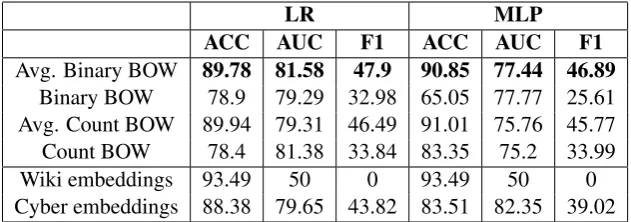
LR MLP ACC AUC F1 ACC AUC F1
Avg. Binary BOW 89.78 81.58 47.9 90.85 77.44 46.89
Binary BOW 78.9 79.29 32.98 65.05 77.77 25.61
Avg. Count BOW 89.94 79.31 46.49 91.01 75.76 45.77
Count BOW 78.4 81.38 33.84 83.35 75.2 33.99
Wiki embeddings 93.49 50 0 93.49 50 0
[image:2.595.141.457.62.173.2]Cyber embeddings 88.38 79.65 43.82 83.51 82.35 39.02
Table 1: Performance on Task 1 (dev-data) for each of the model we implemented. We used the best MLP model for SemEval submission (test-data) and had F1 score of 18. We found LR and MLP to always label majority class resulting in zero F1 score using Wiki embeddings.
was dense embeddings. When the input rep-resentation was bag-of-words, we used one hidden layer of dimension 32 followed by a classification layer. When embeddings were used we used a network of three hid-den layers followed by a classification layer; we found adding up to 3 layers to the net-work helped improving training accuracy. We used L2 regularization (Tibshirani,1996) of 0.1 and dropout (Srivastava et al., 2014) of 0.1 to avoid overfitting. We fixed the value of dropout and experimented with mul-tiple values of L2 and chose one giving the best performance on the development dataset. Performance decreased gradually when L2 penalty was either increased to {0.2, 0.25, 0.5} or decreased to {0.01, 0.001, 0.0001}. We set the size of the hidden layer to 100 when embeddings were used.
• LSTM (for embeddings): We applied an
LSTM network with one hidden layer of size 128. We used dense, pre-trained embeddings (§2.2) for each word in the input sentence.
2.2 Features for the models
We experimented with the following four feature sets in order to determine the best performing rep-resentation for Task 1.
• (Average) Count Bag-Of-Words: We
cre-ated standard bag-of-words features from the training dataset. We experimented with nor-malizing each vector via averaging.
• (Average) Binary Bag-Of-Words: We also considered binary bag-of-words features, by replacing each term frequency count with bi-nary value where positive value is set to one and a negative value to zero. We also
experi-mented with normalizing each feature vector by averaging.
• Cybersecurity embeddings: The
cyber-security embeddings were generated using word2vec Skipgram model with negative samplings of 100 dimension and a window size of five (Mikolov et al., 2013b) on one million cybersecurity related documents.1
• Wikipedia embeddings: We generated 400 dimensional word2vec skip-gram embed-dings from a recent Wikipedia dump. We used a window size of 5.2
2.3 Datasets, embeddings & hyperparameters
For Subtask 1, we used all 65 files available as part of SemEval Task 8. We tuned and tested our model on development data available as part of SemEval. For logistic regression we swept the L2 regular-ization coefficient ({100,10,1,0.1,0.01,0.001}) and chose the value that gave best performance on the development dataset. For neural approaches we used stochastic gradient descent with momen-tum of 0.4 for LSTM and 0.9 for MLP. We tried multiple learning rates and chose one which gave best performance on the development dataset. We chose starting learning rate of 0.2 for LSTM and 0.1 for MLP. We also tried using Adam optimizer (Kingma and Ba, 2014) with the same learning rate as MLP but found the resulting model labeled all test instances with the majority class.
For our implementation we used Keras (Chollet,
1We used an embedding model produced by IBM Re-search trained on a collection of 1 million cybersecurity-related documents with a vocabulary size of 6.4 millions words and 100 dimensions.
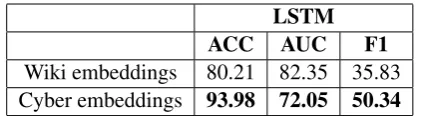
LSTM ACC AUC F1
[image:3.595.76.287.61.119.2]Wiki embeddings 80.21 82.35 35.83 Cyber embeddings 93.98 72.05 50.34
Table 2: LSTM Performance (dev data). We offer these as supplementary evaluations.
2015) with a Tensorflow backend to train neural network based models and Gensim (ˇReh˚uˇrek and
Sojka,2010) to train word embeddings. We used Scikit-learn (Pedregosa et al., 2011) for Logistic Regression. For the LSTM, we let the size of the input sequence be the maximum length of all sen-tences in the batch and padded shorter sensen-tences with zero vectors.
The input was a matrix of dimensionl×dwhere dis the size of embedding vector andlis the length
of the longest sentence.
2.4 Discussion
As evident from Tables1and2, the neural network based classifiers perform better compared to other methods depending on the features.
However, we find a considerable gap between the score from Table1and2. As explained later, we believe that the models’ low scores are related to the scope of the task. Overall, the LSTM per-forms better compared to the MLP due its ability to capture subtle nuances.
We note the positive impact that domain-centered cybersecurity embeddings have. Never-theless, not all cybersecurity texts may accurately reflect other cybersecurity texts, especially ones with the task-specific annotations as considered here. We posit that the performance of all our models, in particular the LSTM, may be improved with embeddings that are learned from documents more representative of those evaluated.3
Comparing the results of Wikipedia embed-dings and embedembed-dings trained on cybersecurity text we found Wikipedia based embeddings to consistently perform poorly. We believe one of the reasons Wikipedia embeddings performed poorly for this task is due to less overlap between the technicality of the task and content.
Moreover the F1 score is zero sometimes as the features are rich enough to classify positive in-stance and predicts only negative (as evident from
3The actual collection of APT notes included about 400 documents, vs. the 1 million documents trained on broader cybersecurity texts.
False Positive: Attackers always use this mini-mal effort approach in order to bypass a victim s defenses.
False Negative: Trojan.Karagany first checks for a live Internet connection by visiting Mi-crosoft or Adobe websites.
General Information: The group has used two main malware tools: Trojan.Karagany and Backdoor.Oldrea.
Table 3: Task 1 classification examples.
AUC). On the other hand, the cybersecurity em-beddings performed better when compared with Wikipedia embeddings, due to the more focused corpus, but we believe there is scope to improve the quality of embeddings. Frequency based fea-tures tend to perform better than binary feafea-tures; averaging the features improves the performance score across all classifiers.
2.5 Error analysis
Among the classifiers, the MLP makes mistakes by getting caught into to domain specific words that occur frequently, like attack and attackers, and skips less frequent but indicative words like
Trojan.Karagany. Additionally we found the MLP incorrectly classifies general sentences as relevant. We demonstrate examples in Table3.
Looking at the example sentences from 3, we see that whether or not a sentence is “relevant” is task-dependent. For example, the general infor-mation sentence above could be useful for iden-tifying relationships among different malware in-stances or families. However, the sentence would be irrelevant in the context of action and capabili-ties of a particular malware mention.
3 Subtask 2
In this section we describe our approach for Task 2, which required participants to predict token la-bels for malware-related documents. The Task 2 system served as an automatic labeling tool using one of four labels:
• Action, referring to an malware-related event;
• Entities, referring to either Subjects or Objects in the malware-related sentence; or
Each label is represented by a tag using the in-side, outin-side, beginning (IOB) format (Ramshaw and Marcus, 1999). The performance was mea-sured using F1 score and the relaxed measurement by omitting the IOB tags.
3.1 Our Approach
We extended the previous workLim et al.(2017), who trained a conditional random field (CRF) on unigram and bigram features of the surface words, part-of-speech tags and Brown clustering signa-tures (Brown et al.,1992). LikeLim et al.(2017), we also trained a CRF. Our features include:
• unigrams and bigrams of words in the
depen-dency parse tree,
• unigrams and bigrams of the word lemmas, • wordshape equivalence class analysis
(Christopher,2016), and
• Brown clustering signatures from a larger APT collection .
The word’s context, which are words in the win-dow of size three, was included. These features were extracted using Stanford CoreNLP (Manning et al.,2014). We did not use the surface word as in development we found it yielded lower perfor-mance. The dependency function will help to rec-ognize the similar sentence by comparing similar sentence’s structure. The wordshape features rep-resent the classes of upper case, lower case, digits, and punctuations, and also groups the sequence of the same class. The wordshape features help to recognize named entities.4
We trained our own Brown clustering features (Liang, 2005) with our own APT corpus of 456 APT files from 2008 to 2017. We experimented with the Brown clustering hyperparameters: the Brown cluster size (1000,10000) and its prefix length (6,8,10,12,16). The best result from the ex-periment is the prefix of size 8 and cluster size 1000. We built our own Brown clustering for two reasons. First, we will not be able to iden-tify Brown clustering feature when we encounter out of vocabulary word; we found the larger cor-pus to partially alleviate this concern. Second, we believed that the bigger size of the corpus, with an appropriate clustering size and prefix length, would yield better clustering features.
4 We use the ‘dan2’ wordshape classes from CoreNLP (Manning et al.,2014).
P R F1
Action 24.50 39.20 30.15
Entity 11.26 17.34 13.65
Modifier 29.37 46.84 36.10 Average 18.22 28.54 22.24
Table 4: Official Task 2 scores on Test set
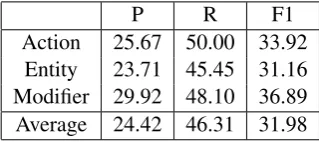
P R F1
Action 25.67 50.00 33.92
Entity 23.71 45.45 31.16
Modifier 29.92 48.10 36.89 Average 24.42 46.31 31.98
Table 5: Official Task 2 relaxed/token-level scores on Test set
3.2 Experimental Results
We used the CRF++ toolkit (Kudo, 2005) to develop our conditional random field (CRF) models. For the official evaluation, we ran our system on Test set provided by SemEval2018. The test set contains 13,080 tokens in total. The official scoring reported our F1 performance of 22 for strict scoring, and 32 for relaxed scoring. Our F1-score for subtask 2 are gen-erally on par with the baselines (23 for the strict, and 31 for the relaxed, measures). Detailed performance analyses are shown in Tables4and5.
3.3 Discussion
Table4demonstrates that our system performance of predicting Entity is lower than Action and Mod-ifier. We believe this is because malware-related entities are different from other text; in particular, they can be quite long. For example, the follow-ing (gold test) entity is a long clause with com-plex syntactic structure: ‘method of leaving the encoded file on disk and only decoding it in mem-ories.’ This entire clause is labeled as an Entity. Despite the dependency features, our system can-not identify these long spans as an entity. Acan-nother example of this limitation is shown in Figure 1. This is a rich area for future improvement.
4 Subtask 4
[image:4.595.334.499.62.133.2] [image:4.595.336.496.167.238.2]Figure 1: An example of wrong prediction of Task 2. Above the line is the gold standard annotation. Under the line is our predictions.
describing action of a malware.
4.1 Our Approach
For this task we focus on learning better quality word embedding features for a classifier, as classi-fier performance depends on the quality of its fea-tures. In addition to encoding semantics present in the text via embeddings, we want to encode do-main specific knowledge in the embeddings. For this purpose, we developed an Annotation Word Embedding (AWE) model that is capable of in-corporating diverse types of domain knowledge, such as metadata, keyword information, ontology knowledge, and manual annotation. The AWE model learns to predict this knowledge from the text, resulting in better quality embedding since domain knowledge can be incorporated in the em-beddings. We then train a classifier with these high quality word embedding features to classify attribute labels.
4.1.1 Annotation Word Embedding
The AWE model’s learning task is to predict an-notations and context words given a target word. A sliding window on the input text generates the training samples. In each sliding window the task is to use target word to predict its own annotation as well as the context words. Formally, we maxi-mize the log probability of context words and an-notations given target word.
Given a sequence of T training words
(W1,W2...Wt−1, Wt,Wt+1...WT) and their an-notations ((A1,1, A1,2...A1,M1),(A2,1...A2,M2) ...
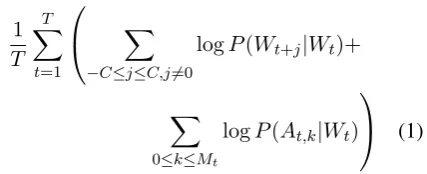
(AT,1,...AT,MT)), our objective is to maximize the average log probability shown in Equation1:
1 T
T X
t=1
X
−C≤j≤C,j6=0
logP(Wt+j|Wt)+
X
0≤k≤Mt
logP(At,k|Wt)
(1)
whereC is the size of the context window,Wtis the target word, Wt+j is a context word, At,k is
thekthannotation of target wordWt. In addition to using the target word to predict context words, likeMikolov et al.(2013a)’s skipgram model, the AWE embedding model predicts annotations of target word using target word itself.
4.2 Experiments
To train the AWE model we used all 456 APT re-ports as text corpus. In addition we used keywords for each attribute label described in MAEC vocab-ulary (Kirillov et al., 2011) and gold annotation given for 65 APT reports available as part of the SemEval task to create text annotation.
To create text annotation we collected keywords from attribute label descriptions and extracted the token groups from the gold annotations. Token groups consist of the subject, action and object linked to each other via relation labels. We used these token words and keywords to create text an-notation; we deleted stop words.
For example, one token group extracted from gold annotation is “these configuration issued commands to attack following domain and IPs.” After deleting stop words this token group we get “configuration,” “issued,” “commands,” “attack,” “domain,” and “IPs.” In the gold annotation, this token group has label Capability12 in attribute cat-egory of Capability. In MAEC vocabulary ( Kir-illov et al., 2011) keywords given for this capa-bility label are “machine access,” “control,” “exe-cute,” “terminate,” and “create.” All these token words and keywords will have an annotation of Capability12 in our AWE model.
4.3 Discussion
This task is one of the most challenging tasks be-cause of data sparsity and large number of at-tribute labels. In fact, out of the 444 atat-tribute labels, 185 labels do not appear in dataset. For the remaining 259 attribute labels 169 labels oc-cur less than five times. In addition, among 3348 instances there are 2298 instances without any Ac-tionName attribute, 642 instances without a Capa-bility attribute, 1244 instances without a Strategic-Objective attribute and 1675 instances without a TacticalObjective attribute.
To improve classifier performance future work can try training a classifier that focuses on the common classes, with non frequent classes labeled as “other.” Applying other techniques like similar-ity score to classify infrequent classes may also be beneficial. Additionally, we noticed that in the gold annotation there are often missing relation labels. This missing relation labels result in in-complete token group as token groups are tokens linked by relation labels.
5 Conclusion
We described the systems developed by the UMBC team for 2018 SemEval Task 8, Se-cureNLP (Semantic Extraction from CybersecU-rity REports using Natural Language Processing). We participated in three of the subtasks: (1) clas-sifying sentences as relevant or irrelevant for fur-ther malware analysis, (2) predicting token la-bels for sentences about malware, and (4) adding detained attribute labels to sentences from the MAEC vocabulary for defining malware charac-teristics. Our cybersecurity embeddings are avail-able athttps://bit.ly/cybr2vec.
We plan to continue development our systems by getting additional annotations for training, ex-ploring the application of different machine learn-ing algorithms, maklearn-ing use of the knowledge in our Unified Cybersecurity Ontology (Syed et al.,
2016) and associated data, and through our ongo-ing collaboration with colleagues at IBM as part of the AI Horizons Network.
Acknowledgments
The research described in this paper was partially supported by gifts from IBM and Northrop Grum-man. We thank Agniva Banerjee, Sudip Mittal, Sandeep Narayanan, Maithilee Prabodh, Vishal
Rathod, and Arya Renjan for helping with anno-tations.
References
Desiree Beck, Ivan Kirillov, and Penny Chase. 2014. The MAEC language. Technical report, MITRE. Kiran Blanda and David Westcott. 2018.APTnotes. Peter F. Brown, Peter V. deSouza, Robert L.
Mer-cer, Vincent J. Della Pietra, and Jenifer C. Lai. 1992. Class-based n-gram models of natural lan-guage.Comput. Linguist., 18(4):467–479.
Franois Chollet. 2015. keras. https://github. com/fchollet/keras.
M Bishop Christopher. 2016. PATTERN RECOG-NITION AND MACHINE LEARNING. Springer-Verlag New York.
Sepp Hochreiter and J¨urgen Schmidhuber. 1997. Long short-term memory. Neural computation, 9(8):1735–1780.
Diederik P Kingma and Jimmy Ba. 2014. Adam: A method for stochastic optimization. arXiv preprint arXiv:1412.6980.
Ivan Kirillov, Desiree Beck, Penny Chase, and Robert Martin. 2011. Malware attribute enumeration and characterization. Technical report, MITRE.
Taku Kudo. 2005. CRF++: Yet another CRF toolkit. https://taku910.github.io/crfpp/.
Percy Liang. 2005. Semi-supervised learning for nat-ural language. Ph.D. thesis, Massachusetts Institute of Technology.
Swee Kiat Lim, Aldrian Obaja Muis, Wei Lu, and Chen Hui Ong. 2017. Malwaretextdb: A database for annotated malware articles. InProceedings of the 55th Annual Meeting of the Association for Com-putational Linguistics (Volume 1: Long Papers), pages 1557–1567. Association for Computational Linguistics.
Christopher D. Manning, Mihai Surdeanu, John Bauer, Jenny Finkel, Steven J. Bethard, and David Mc-Closky. 2014. The Stanford CoreNLP natural lan-guage processing toolkit. InAssociation for Compu-tational Linguistics (ACL) System Demonstrations, pages 55–60.
Tomas Mikolov, Kai Chen, Greg Corrado, and Jef-frey Dean. 2013a. Efficient estimation of word representations in vector space. arXiv preprint arXiv:1301.3781.
F. Pedregosa, G. Varoquaux, A. Gramfort, V. Michel, B. Thirion, O. Grisel, M. Blondel, P. Pretten-hofer, R. Weiss, V. Dubourg, J. Vanderplas, A. Pas-sos, D. Cournapeau, M. Brucher, M. Perrot, and E. Duchesnay. 2011. Scikit-learn: Machine learning in Python. Journal of Machine Learning Research, 12:2825–2830.
Peter Phandi, Amila Silva, and Wei Lu. 2018. Semeval-2018 Task 8: Semantic Extraction from CybersecUrity REports using Natural Language Processing (SecureNLP). In Proceedings of International Workshop on Semantic Evaluation (SemEval-2018), New Orleans, LA, USA.
Lance A Ramshaw and Mitchell P Marcus. 1999. Text chunking using transformation-based learning. In
Natural language processing using very large cor-pora, pages 157–176. Springer.
Radim ˇReh˚uˇrek and Petr Sojka. 2010. Software Frame-work for Topic Modelling with Large Corpora. In
Proceedings of the LREC 2010 Workshop on New Challenges for NLP Frameworks, pages 45–50, Val-letta, Malta. ELRA. http://is.muni.cz/ publication/884893/en.
Nitish Srivastava, Geoffrey Hinton, Alex Krizhevsky, Ilya Sutskever, and Ruslan Salakhutdinov. 2014. Dropout: A simple way to prevent neural networks from overfitting. The Journal of Machine Learning Research, 15(1):1929–1958.
Zareen Syed, Ankur Padia, Tim Finin, M Lisa Math-ews, and Anupam Joshi. 2016. Uco: A unified cy-bersecurity ontology. InAAAI Workshop: Artificial Intelligence for Cyber Security.
Robert Tibshirani. 1996. Regression shrinkage and se-lection via the lasso. Journal of the Royal Statistical Society. Series B (Methodological), pages 267–288.