Natural Language Processing in Policy Evaluation:
Extracting Policy Conditions from IMF Loan Agreements
Joakim Åkerström1 Adel Daoud2,3,4 Richard Johansson1
1Department of Computer Science and Engineering, University of Gothenburg, Sweden 2Centre for Business Research, Cambridge Judge Business School, University of Cambridge, UK
3Harvard Center for Population and Development Studies, Harvard University, USA 4The Alan Turing Institute, London, UK
[email protected], [email protected], [email protected]
Abstract
Social science researchers often use text as the raw data in investigations: for instance, when investigating the effects of IMF poli-cies on the development of countries un-der IMF programs, researchers typically encode structured descriptions of the pro-grams using a time-consuming manual ef-fort. Making this process automatic may open up new opportunities in scaling up such investigations.
As a first step towards automatizing this coding process, we describe an experiment where we apply a sentence classifier that automatically detects mentions of policy conditionsin IMF loan agreements written in English and divides them into different types. The results show that the classifier is generally able to detect the policy con-ditions, although some types are hard to distinguish.
1 Introduction
In the social sciences, evaluating policies often re-lies on text. What is the effect of a high-ranking politician’s tweet on Wall Street? What is the im-pact of a new economic treaty on trade between nations? What part of the treaty or the tweet in-duced the relevant effect? These types of policy evaluation questions often require that researchers identify the relevant text passages in large corpora. Currently, many researchers in these fields de-vote considerable amounts of resources to hand-coding the relevant passages of the entire corpus of interest (King et al., 2017). For example, so-cial scientists have recently devoted much atten-tion to identifying the impact of macroeconomic policies. These policies affect a population’s liv-ing conditions both in the short and the long term.
The International Monetary Fund (IMF) has since the 1980s been involved in setting the macroeco-nomic policy space for many countries. IMF’s programs contain many different policies, where some might be considered more effective than oth-ers. Researchers have therefore sought to com-pile structured databases identifying what policies each IMF program contains. However, this re-quires that researches sift all these IMF policies by going through the documents of about 880 pro-grams, between 1980 and 2014, that have been implemented in about 130 countries, and qualita-tively hand-coding them (Daoud et al., 2019; Ken-tikelenis et al., 2016; Vreeland, 2007).
Accordingly, combining qualitative coding to guide a machine-learning powered natural lan-guage processing (NLP) tool to operate on large textual data will likely produce large benefits for the social science community. In this paper, we carry out an experiment that investigates the fea-sibility of developing such a system. We use the IMF research domain as a case study to evaluate the efficacy of our method.
2 Background and Related Work
2016). A variety of content analysis has been used to produce databases. Two or more researchers are set to the task of implementing a coding schema interpreting the text and coding it up by hand. Us-ing multiple coders help in estimatUs-ing inter-coder reliability metrics for qualitative validation. Be-cause it is labor-intensive, content analysis suits smaller-sized corpora.
However, with the rise of larger corpora, the need for automatic content analysis has emerged. This has led to a number of methodological inno-vations in the overlap between computer science and social science. For example, unsupervised machine learning methods such as topic model-ing are often used for various social science prob-lems (Daoud and Kohl, 2016; DiMaggio et al., 2013; Meeks and Weingart, 2012). These unsu-pervised methods help reduce the dimensionality of the data, but they are unsuitable when there is a clear outcome target – policy text – the re-searchers desire to code. For these task a num-ber of supervised machine learning methods have been proposed (Grimmer and Stewart, 2013; King et al., 2017). Yet, although a combination of NLP and machine learning are on the rise in computer science, they have yet to fully reach their poten-tial within a social science audience. One way of demonstrating the potential of applying NLP tech-niques in the social sciences is to evaluate these methods in a real application: extracting policy conditions from IMF reports.
So far, we are aware of no previous work where automated NLP methods have been ap-plied to compile IMF policies from program doc-uments. Most of the research uses qualitative con-tent analysis (Kentikelenis et al., 2016). Recent approaches have been based on a combination of content analysis and a dictionary method to iden-tify IMF food and agricultural policies (Daoud et al., 2019). Some unsupervised methods, mainly different types of topic models, have been applied to the sister organization of the IMF, namely to World Bank, to identify overarching topic changes over time (Moretti and Pestre, 2015).
3 Data and Implementation
3.1 IMF reports
The corpus used in this investigation consists of loan agreements between countries and the IMF, all written in English. These agreements form the policy foundation for the IMF and the
recip-ient government. These agreements outline the macroeconomic problems that the country is fac-ing as well as what the IMF expects from the recip-ient government. These expectations are defined as a set of policy conditions. The conditions are typically outlined at the end of the loan document.
3.2 Annotation
A team of researchers have coded the policy con-ditions qualitatively using content analysis princi-ples (Kentikelenis et al., 2016). Two researchers coded all of these policy documents resulting in over 54,000 individual conditions in about 880 programs over the 1978–2016 period. When they assigned conflicting codes, these issues were dis-cussed and resolved by consensus. After all the polices were coded, the next step was to cate-gorize all these individual conditions into overar-ching policy categories. The categories we con-sider here arepolicy area, such as finance or en-vironment, andpolicy type, such as benchmarks, performance criteria, etc. This qualitative hand-annotated data provides the input to our supervised training.
3.3 Preprocessing
The IMF documents are stored as PDF documents, some of which required scanning and OCR. The documents go back to the late 1970s, and the qual-ity of the OCR’d text is slightly lower in the earlier documents. Finally, all the documents were con-verted into plain text using thepdftotexttool. The documents were then scanned to extract the text pieces that matched exactly with the hand-annotated instances. When a text piece consisted of two or more sentences, it was split up to create multiple examples of exactly one sentence each. We did not consider text pieces below the sentence level. Furthermore, all tokens were lowercased and all numeric and punctuation symbols were re-moved. Stop words were not rere-moved.
3.4 Building the Classifiers
We formalized the extraction of policy conditions as a classification problem on sentences. In the simplest case, the classifier just spots the men-tions of policy condimen-tions among a document’s sentences. We also extended this basic approach to two different multiclass scenarios, where the pol-icy conditions are subdivided in different ways.
clas-sifiers use a tfidf-weighted feature representation based onn-grams of size one and two, without any feature selection. The classifier is a linear support vector machine withL2 regularization and a regu-larization term of 1.0. A one-versus-rest approach was used for multiclass classification. Preliminary experiments using a classifier based on BERT (De-vlin et al., 2019) were less successful.
4 Experiments
We carried out a number of experiments to see how well the classifier retrieves policy conditions from the IMF loan agreements, and how well dif-ferent types of policy areas and policy types can be distinguished.
4.1 Finding Policy Conditions
In the first experiment, we investigated the model’s capability of finding mentions of the pol-icy conditions in the documents. This task was framed as a binary classification task where an-notated text pieces were treated as a positive set while non-annotated pieces constituted a negative set. The negative examples were subsampled in a random fashion to create a balance of 20% positive examples.
We partitioned the data into training sets and test sets in two different ways. In the first case, we wanted to see how well the classifier gener-alizes between different countries. We assigned the documents corresponding to 80% of the coun-tries into the training set while the remaining doc-uments were placed in the test set. In the second case, we instead considered the question how well the classifier generalizes to newer documents; in this case, we used the oldest 80% of the documents as the training set.
The classifiers were evaluated using precision– recall curves and average precision scores (AP) to see how well they perform for different classifica-tion thresholds. Figure 1 shows the curves and AP scores obtained for the country-based and time-based partition schemes, respectively. It is read-ily apparent that in both cases the model outper-forms a random-guess baseline, which would give an AP score of about 0.20. Furthermore, while the classifier is slightly less accurate when the test set consists of the newer documents, the difference in performance appears to be quite small as indicated by the similar AP scores.
4.2 Classifying the Policy Area
Next, we considered how well the model can clas-sify a text piece as one of several policy areas. The data sampling scheme employed in this exper-iment was similar to the one described in 5.1, with the main difference that the policy area for each example was treated as a target attribute to create a multiclass classification task. Furthermore, the partitioning of the data into training and test sets was performed in a random fashion.
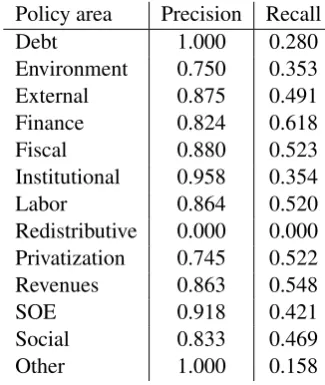
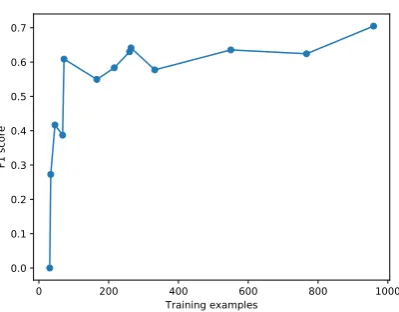
Table 1 shows the precision and recall scores obtained for each individual policy area. The pre-cision scores are consistently higher than the cor-responding recall scores. One probable cause for this tendency is the imbalance between positive and negative examples in the training set. Table 1 also shows that the results obtained for some pol-icy areas are remarkably low, with redistributive policies being the most obvious example. The most likely explanation for this phenomenon is the imbalance in the number of training instances per class. Figure 2 compares the F1scores for the dif-ferent policy areas to the number of training ex-amples. While the curve is not perfectly smooth, it is clearly visible that the F1score increases quite rapidly with the number of training examples, es-pecially in the lower range of the domain.
Policy area Precision Recall
Debt 1.000 0.280
Environment 0.750 0.353
External 0.875 0.491
Finance 0.824 0.618
Fiscal 0.880 0.523
Institutional 0.958 0.354
Labor 0.864 0.520
Redistributive 0.000 0.000 Privatization 0.745 0.522
Revenues 0.863 0.548
SOE 0.918 0.421
Social 0.833 0.469
[image:3.595.332.495.444.637.2]Other 1.000 0.158
Table 1: Policy area classification scores.
4.3 Classifying the Type of Condition
perfor-0.0 0.2 0.4 0.6 0.8 1.0 Recall
0.0 0.2 0.4 0.6 0.8 1.0
Precision
2-class Precision-Recall curve: AP=0.86
(a) Training/test split by country.
0.0 0.2 0.4 0.6 0.8 1.0
Recall 0.0
0.2 0.4 0.6 0.8 1.0
Precision
2-class Precision-Recall curve: AP=0.82
[image:4.595.86.527.68.241.2](b) Training/test split by date.
Figure 1: Precision–recall curves for detecting policy conditions.
0 200 400 600 800 1000 Training examples
0.0 0.1 0.2 0.3 0.4 0.5 0.6 0.7
F1 score
Figure 2: Classification F1 scores for policy areas as a function of the number of training examples.
mance criterion (SPC). The partitioning of the data was done in a similar way as in §4.2, with the only difference that policy type was designated as the target attribute. Table 2 shows the precision and recall scores obtained for each individual policy type. As in the experiment on classifying exam-ples according to policy area, the precision scores are consistently higher than the corresponding re-call scores and we propose the same explanation for this phenomenon as in §4.2.
5 Conclusions
We have evaluated a sentence classification ap-proach as a supporting technology in a social sci-ence research scenario. Our results are promising and show that a straightforward sentence classifier is quite successful in detecting mentions of policy
Policy type Precision Recall
IB 0.955 0.963
PA 0.762 0.535
QPC 0.833 0.269
SB 0.720 0.420
[image:4.595.339.494.291.374.2]SPC 0.913 0.583
Table 2: Policy type classification scores.
conditions in IMF loan agreements, as well as dis-tinguishing different policy areas and policy types, although the rarer classes are more difficult for our system. This work can be seen as a preparatory effort for the main goal of automatizing coding-based methods in social science, and a more am-bitious goal will be to actually apply the classifier in a research scenario and see how the conclusions are affected by the use of an automatic system.
[image:4.595.84.284.307.463.2]Acknowledgments
Richard Johansson was supported by the Swedish Research Council under grant 2013–4944.
References
Adel Daoud and Sebastian Kohl. 2016. How much do sociologists write about economic topics? Us-ing big-data to test some conventional views in eco-nomic sociology, 1890 to 2014. Technical report, Max Planck Institute for the Study of Societies. Dis-cussion Paper.
Adel Daoud, Bernhard Reinsberg, Alexander E. Ken-tikelenis, Thomas H. Stubbs, and Lawrence P. King. 2019. The international monetary fund’s interven-tions in food and agriculture: An analysis of loans and conditions. Food Policy.
Jacob Devlin, Ming-Wei Chang, Kenton Lee, and Kristina Toutanova. 2019. BERT: Pre-training of deep bidirectional transformers for language under-standing. InProceedings of the 2019 Annual Con-ference of the North American Chapter of the Asso-ciation for Computational Linguistics (NAACL).
Paul DiMaggio, Manish Nag, and David Blei. 2013. Exploiting affinities between topic modeling and the sociological perspective on culture: Application to newspaper coverage of u.s. government arts funding.
Poetics, 41(6):570–606.
James A. Evans and Pedro Aceves. 2016. Machine translation: Mining text for social theory. Annual Review of Sociology, 42(1):21–50.
Justin Grimmer and Brandon Stewart. 2013. Text as data: The promise and pitfalls of automatic content analysis methods for political texts. Political Analy-sis, 21(3):267–297.
Alexander E. Kentikelenis, Thomas H. Stubbs, and Lawrence P. King. 2016. Imf conditionality and de-velopment policy space, 1985-2014. Review of In-ternational Political Economy, (Online first).
Gary King, Patrick Lam, and Margaret E. Roberts. 2017. Computer-assisted keyword and document set discovery from unstructured text. American Journal of Political Science.
Elijah Meeks and Scott Weingart. 2012. The digital humanities contribution to topic modeling. Journal of Digital Humanities, 2(1).
Franco Moretti and Dominique Pestre. 2015. Bankspeak. New Left Review, (92):75–99.
Fabian Pedregosa, Gaël Varoquaux, Alexandre Gram-fort, Vincent Michel, Bertrand Thirion, Olivier Grisel, Mathieu Blondel, Peter Prettenhofer, Ron Weiss, Vincent Dubourg, Jake VanderPlas, Alexan-dre Passos, David Cournapeau, Matthieu Brucher,
Matthieu Perrot, and Edouard Duchesnay. 2011. Scikit-learn: Machine learning in Python. Journal of Machine Learning Research, 12:2825–2830.
Anselm L. Strauss and Juliet M. Corbin. 1998. Ba-sics of qualitative research: techniques and proce-dures for developing grounded theory, 2nd edition. SAGE, London and New Delhi.