Phrase Generalization: a Corpus Study in Multi-Document Abstracts and
Original News Alignments
Ariani Di-Felippo Federal University of S˜ao Carlos
Language and Literature Dept. Rod. Washington Luis, km 235 (SP-310)
S˜ao Carlos, SP 13565-905, Brazil [email protected]
Ani Nenkova University of Pennsylvania Computer and Information Science Dept.
3330 Walnut St. Philadelphia, PA 19104, USA [email protected]
Abstract
Content can be expressed at different lev-els of specificity, varying the amount of detail presented to the reader. The need to transform specific content into more general form naturally arises in summa-rization, where people and machines need to convey the gist of a text within im-posed space constraints. Completely re-moving sentences and phrases is one way to reduce the level of detail. The bulk of work on summarization content se-lection and compression deal with these tasks. In this paper, we present a cor-pus study on a more subtle and under-studied phenomenon: noun phrase gener-alization. Based on multi-document news and abstract alignments at the phrase level, we arrive at a five category classification scheme and find that the most common category requires semantic interpretation and inference. The others rely on lexical substitution or deletion of details from the original expression. We provide a system-atic analysis, elucidating the capabilities needed for automating the generation of more general or more specific references. 1 Introduction
Summarization involves a number of complex transformations to condense the gist of a text into a short summary (Nenkova and McKeown, 2011). One of these transformations is changing the amount of detail in the original news texts. Re-moving entire sentences is one of the fairly well-understood ways for changing the amount of de-tail. Which sentences to remove can be decided in a system’s content selection module by a num-ber of competitive approaches (Gillick and Favre,
2009; Lin and Bilmes, 2011; Kulesza and Taskar, 2011). Similarly, one can perform sentence com-pression, removing words or phrases from a tence in the original text to form a summary sen-tence (Knight and Marcu, 2000; Riezler et al., 2003; Turner and Charniak, 2005; McDonald, 2006; Galley and McKeown, 2007; Cohn and Lap-ata, 2008) or perform sentence selection and com-pression jointly (Berg-Kirkpatrick et al., 2011).
In this paper, we focus our attention on a much finer level to study the changes of specificity on the phrase level. The existence of these changes have been documented in prior work (Jing and McKeown, 2000; Marsi and Krahmer, 2010). Jing and McKeown (2000) analyzed 30 single docu-ment articles and their summaries and character-ized the transformations performed on the original text to form a summary. They did not give statis-tics about the relative frequency of each trans-formation operation but list “add descriptions or names for people and organizations” and “substi-tute phrases with more general or specific infor-mation” as two of the summarization operations. In a more recent study, Marsi and Krahmer (2010) analyzed the phrase alignment between original spoken news in a Dutch television news program and the subtitles for the same broadcast. They aligned the transcript and the subtitles and ana-lyzed the transformations performed on the phrase level. The authors distinguished five mutually ex-clusive similarity relations in the corpus: equals
(the aligned phrases are identical),restastes(the
aligned phrases convey the same information but with different wording), specifies(the subtitle phrase is more specific than the transcript phrase),
generalizes(the subtitle phrase is more general than the transcript phrase), andintersects (the aligned phrases share some informational content, but each also expresses some information not ex-pressed in the other). The second most frequent
class is generalizes1. In about 14% of the
aligned phrases, the subtitle contained a more gen-eral phrase than the original. Only a small percent-age ofspecifiespairs is present: in about 3% of
the phrases the subtitles were more specific than the transcripts.
Here we present an analysis of generalization operations that occur in abstracts produced for clusters of topically related news articles in Brazil-ian Portuguese. In the vast majority of cases these require transformations at the phrase level. We ob-served five types of generalization: interpretation, detail removal, class, role, and whole. Named en-tity (NE) generalizations, in particular, belong to four categories: detail removal (removing some of the information contained in the original arti-cle, similar to compression on the phrase level), role (substituting a reference by name with a ref-erence by the role the entity plays in the described events), class (substituting a reference with a su-perordinate concept, i.e. “swimmer – “athlete”) , and whole (a reference to a member of a group or area is substituted by a reference to the whole, i.e. “Jamaica” – “the Caribbean”. In each category, we identified a set of syntactic-semantic operations related to each type of named entities (person, or-ganization, location and sports event). Such oper-ations include substitutions and phrase reductions. Their automation would require the development of capabilities that are not available to current sys-tems.
The remainder of this paper is structured as fol-lows. In Section 2, we introduce our corpus, ex-plaining the manual alignment between the human abstract and the multiple news text inputs, and the pre-processing of such alignments. In Section 3, we describe the analysis of the alignment pairs containing generalization and the categorization of each instance in according to the five-class typol-ogy of transformations. Then, in Section 4, our fo-cus relies on the generalization of phrases contain-ing named entities. Specifically, we describe the syntactic and semantic properties of such phrases considering both the different types of generaliza-tion and entities. In Secgeneraliza-tion 5, we discuss what we learned and close with discussion of perspectives for automatic summarization.
1Equalsis the most common relation between aligned
phrases, accounting for 67% of the alignments
2 The Corpus
We used the CSTNews (Cardoso et al., 2011) cor-pus of multi-document abstracts and the associ-ated news articles. The corpus comprises 50 clus-ters of news texts in Brazilian Portuguese from a range of categories: daily news (14), world (14), domestic politics (10), sports (10) , economy (1), and science (1). There are 140 documents in total in the corpus.
Each cluster contains two or three news articles on the same topic, with 42 sentences per cluster on average. There are six manual multi-document ab-stracts for each cluster. The abstract-writers were instructed to produce abstracts of length equal to 30% of the longest article in the cluster. The re-sulting abstracts were on average seven sentences (132 words) long. CSTNews has annotated ver-sions of the source texts and summaries in differ-ent linguistic levels, e.g., intra- and inter-textual discourse relations, classification of temporal ex-pressions, semantic annotation of nouns and verbs, and subtopic segmentation. The corpus also con-tains alignments between each human abstract and the source texts at the sentence level. Each sen-tence in the abstract is associated with all of the sentences in the original articles that support the information expressed in the abstract.
For our work, we use the existing manual an-notations, pairing sentences from the abstract with their corresponding sentences in the original arti-cle (Camargo et al., 2013). The annotators iden-tified 1,007 alignments, involving 334 summary sentences and 877 document sentences: 99.4% of the summary sentences were aligned to some doc-ument sentence and 42.43% of the docdoc-ument tences were aligned to some some summary sen-tence.
In addition, for each pair of summary-original sentences, annotators included labels describing the sub-sentential relations between the sentences in the pair. Among other tags, the annotators la-beled when a summary sentence contained parts that were more general or more specific than the semantically corresponding part in the document sentence. They however did not mark the exact spans of text involved in the generalization.
states” and “the operation” while the document sentence has a list of Brazilian states and the name of the police investigation (shown in bold).
(1) Summary: Mais de 300 policiais de [v´arios estados] participaram d[a operac¸˜ao](“More than 300 officers from [many states] were part of the operation”).
Document: Ao menos 300 policiais de [Amap´a, Distrito Federal, Mato Grosso, Acre and Rondˆonia] participaram da [Operac¸˜ao Domin´o] (“More than 300 offi-cers from [Amazonas, Distrito Federal, Mato Grosso, Acre and Rondˆonia] were part of the [Operac¸˜ao Domin´o”]).
Overall, 13% of summary-document pairs in-volved a generalization or a specification oper-ation. There are 80 pairs tagged as containing generalization and 47 pairs tagged as containing specification (Camargo et al., 2013). The label describes the change that occurred to transform the document sentence into the summary sentence, i.e. generalization means some information is ex-pressed in more general terms in the summary tence than it was in the original document sen-tence.
2.1 Pre-Processing Steps
With the aim categorizing the type of every gen-eralization case in the summary-documents align-ments, we performed two manual pre-processing steps: (i) expansion and revision of the alignments with generalization, and (ii) delimitation of the generalization cases and indexing of the textual spans involved in each case.
Abstracts contained both generalizations and specifications of entities. Assuming that the un-derlying process involved in modifying the ref-erence is the same in both cases, we augment our corpus of generalizations by “inverting” the 47 specification alignments to obtain 47 examples of generalization, as illustrated in (2). The pair is from a news article about the schedule of the Brazilian men’s volleyball team. It was originally tagged as specification, since the summary sen-tence contains more detail than the original; it de-tails that the team aim is to win “the gold medal”. We swap the direction of the relation between the sentences and consider the resulting sentences as examples of generalization.
In this way, we obtained a set of 127 pairs of aligned sentences with differences in the
speci-ficity of reference. Next, each alignment was man-ually revised by the first author: 12 of them were excluded because the author did not find clear por-tions of the summary sentence that generalize in-formation expressed in the original document. An example of sentence that was excluded is given in (3). The final set consists of a total of 115 aligned pairs.
(2) Summary: O pr´oximo objetivo da selec¸˜ao ´e [a medalha de ouro nos Jogos Pan-Americanos do Rio](“The next goal of the team is [the gold medal in the Pan American Games in Rio]”).
Document: O pr´oximo objetivo ´e [os Jogos Pan-Americanos do Rio](“The next goal is [the Pan American Games in Rio]”).
(3) Summary: A press˜ao argentina continuou no segundo tempo, mas o Brasil fechou a goleada com um gol marcado pela sua dupla de volantes (“Argentina struggled to make any impact in the 2nd half, but Brazil sealed the victory with a goal made by one of its midfields”).
Document: Os argentinos, com um time repleto de craques favoritos ao t´ıtulo, e com campanha irrepreens´ıvel at´e o momento, pareciam n˜ao acreditar no que viam (“Ar-gentina, a team full of stars and favorite to win, could not believe what was happening”).
difference in specificity than aligned sentences be-cause some sentence pairs contained more than one case of phrase generalization case.
(4) Document: [O presidente dos EUA, George Bush]P1, pediu que o Ex´ercito turco busque [uma soluc¸˜ao diplom´atica para a quest˜ao]P2
(“[President of the US, George Bush], asked the Turkish Army to seek [a diplomatic solu-tion to the issue]”)
Summary: [Washington]P1 e a Comiss˜ao Europ´eia tamb´em pedem [uma soluc¸˜ao diplom´atica]P2 (“[Washington] and Euro-pean Commission also ask for a [diplomatic solution]”)
(5) Document: Na Jamaica, [muitos estocaram comida, ´agua, lanternas e velas]C (“In Ja-maica, many stock food, water, flashlights and candles”)
Summary: [Muitos moradores e turistas est˜ao se preparando para a passagem do furac¸˜ao. (“[Many locals and tourists prepare for the hurricane]”)
3 Typology of Transformations
Further, we iteratively analyzed the types of the 136 cases of generalization to come up with cate-gories that cover all examples in the corpus. We converged on a classification scheme with five categories: (i)Interpretation, i.e., generalization based on sophisticated inferences over the source text and additional information such as transform-ing ”200 people were injured” to ”the human toll was high”; (ii) Detail removal, i.e, generaliza-tion by omitting details of a specific textual seg-ment; (iii) Role, i.e., replacement of person en-tities by their title or role; (iv) Class, i.e., sub-stitution of a subordinate concept by a superordi-nate one, and (v)Whole, i.e., concepts represent-ing parts are replaced by concepts that indicate the whole. The typology reveals that humans carry out a variety of inferences based on rich world and do-main knowledge to produce generic information. Table 1 shows the distribution of the categories di-vided by clause and phrase levels.
Interpretation is the most frequent category in the corpus (45.6%) and the only one that oc-curs in both clause and phrase levels. However, 83.8% of the cases (52 out of 62) occur at the clause level and involve propositional generaliza-tions. We show an example in (5). It involves
[image:4.595.304.499.109.178.2]Category Phrase Clause Total Interpretation 10 (7.4) 52 (38.2) 62 (45.6) Detail removal 32 (23.5) 0 32 (23.5) Role 18 (13.2) 0 18 (13.2) Class 13 (9.6) 0 13 (9.6) Whole 11 (8.1) 0 11 (8.1) Total 84 (61.8) 52 (38.2) 136 (100)%
Table 1: Number and percentage of the generalizations
Category Noun Named entity Total Interpretation 10 (11.9) 0 10 (11.9) Detail removal 14 (16.7) 18 (21.4) 32 (38.1) Role 2 (2.4) 16 (19) 18 (21.4) Class 5 (6) 8 (9.5) 13 (15.5) Whole 2 (2.4) 6 (10.7) 11 (13.1) Total 33 (39.3) 51 (60.7) 84 (100)%
Table 2: Number and percentage of general NPs and NEs
an inference that “stocking food, water, flashlights and candles” is a preparedness activity against hur-ricane. Detail removal is the second most frequent, with 32 instances (23.5%), followed by Role, with 18 instances (13.2%). The distribution of cases in Class and Whole is quite similar, 13 (9.6%) and 11 (8.1%), respectively. Next, we turn our description to generalizations that occur at the phrase level2,
specifically to those involving named entities. 4 Named Entity Generalization
We first computed the number of cases that involve named entities or general NPs per category. Ta-ble 2 shows the results.
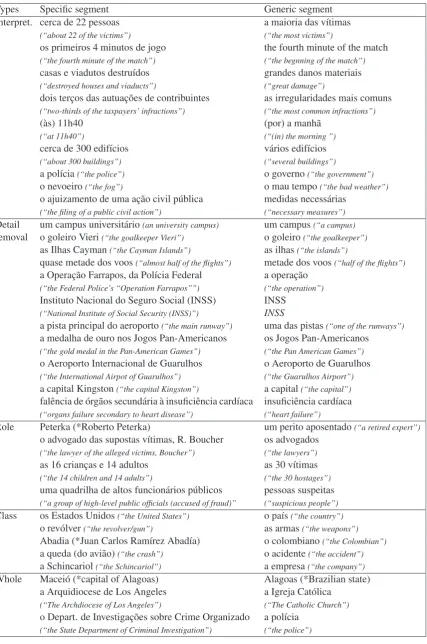
Looking briefly at the 33 common noun pairs, we found that Interpretation tends to be associated with numbers (25%). The substitution of “about 300 buildings” with “many buildings” illustrates this. Interpretation also results from different in-ferences, e.g., when a cause (e.g., ‘the fog”) is re-placed by its effect (e.g., “the bad weather”). The Role case where “the 16 children and 14 adults” was replaced with “the 30 hostages” is the only one involving generation of a numeric expression. Detail removal occurs by deleting noun adjuncts (shown in italics) (e.g., “auniversitycampus”) or complements (e.g., “the inspectionof income tax declarations”).
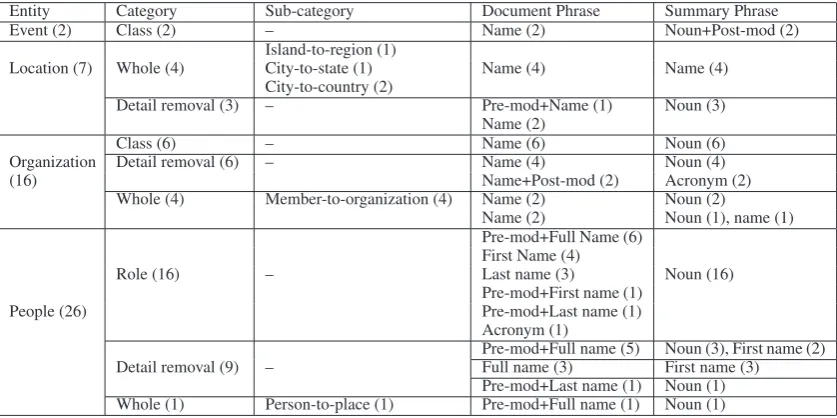
Studying in detail the 51 generalizations involv-ing NEs, we found four types of NEs: 26 per-sons (51%), 16 organizations (31.4%), 7 locations (13.7%), and 2 sports events (2%). We also identi-fied sub-categories of generalization for three en-2Appendix 1 (Table 4) provides examples of phrase
Entity Category Sub-category Document Phrase Summary Phrase Event (2) Class (2) – Name (2) Noun+Post-mod (2)
Island-to-region (1)
Location (7) Whole (4) City-to-state (1) Name (4) Name (4) City-to-country (2)
Detail removal (3) – Pre-mod+Name (1) Noun (3) Name (2)
Class (6) – Name (6) Noun (6)
Organization Detail removal (6) – Name (4) Noun (4)
(16) Name+Post-mod (2) Acronym (2)
Whole (4) Member-to-organization (4) Name (2) Noun (2)
Name (2) Noun (1), name (1) Pre-mod+Full Name (6)
First Name (4)
Role (16) – Last name (3) Noun (16) Pre-mod+First name (1)
People (26) Pre-mod+Last name (1)
Acronym (1)
Pre-mod+Full name (5) Noun (3), First name (2) Detail removal (9) – Full name (3) First name (3)
[image:5.595.82.501.109.318.2]Pre-mod+Last name (1) Noun (1) Whole (1) Person-to-place (1) Pre-mod+Full name (1) Noun (1)
Table 3: Semantic and syntactic properties of named entity phrase generalization
tity types and some syntactic patterns in the transi-tions, related to the type of the phrase head and the occurrence of pre- and post-modifiers. The results are shown in Table 3. The numbers in parenthe-sis show how many times the given category and syntactic form have occurred in the pairs.
The sports event generalizations consist in sub-stituting the multi-word expression (MWE) phrase “the American Cup” with two different general NPs: “the continental competition” and “the oldest soccer tournament”. These are the only instances where the summary phrases include modification. Thus, both general mentions put the referent in a class and provide further details about it as well.
According to Table 3, there are three types of Whole generalizations for locations that solely in-volve names: (i)island-to-region, such as the
replacement of “Haiti” and “Dominican Republic” with “the Caribbean”; (ii)city-to-state, such
as “Macei´o, which was substituted by “Alagoas”, and (iii) city-to-country, such as the
replace-ment of “Boston” with “United States”. There is also one particular type of Detail removal by deleting names from phrases of the form pre-modifier + name (e.g., “the capital Kingston”) to produce mentions whose head was the modifying noun of the specific phrase (“the capital”). Lo-cation names, specifically MWEs (e.g., “Interna-tional Airport of S˜ao Paulo”) that are made up of a place (possibly a MWE itself, such as “S˜ao Paulo”) and additional information (e.g., “inter-national”), are also replaced with common nouns
(“the airport”). The replacement of such proper names with common nouns result from removal of all the details about the referent description.
Organization names are mostly generalized by means of common nouns that express class or whole. The substitution of “Brazil” with “the country” illustrates the Class cate-gory. The Whole generalization occurs through
member-to-organization substitution, i.e., the replacement of “the Military Police Shock Troop” with “the police” illustrates this. The only case of name generalization is the substitution of “the Archdiocese of Los Angeles” with “the Catholic Church”. There are also cases where names fol-lowed by acronyms in parenthesis, such as “Na-tional Institute of Social Security (INSS)”, are re-duced to the acronym only.
The reduction of full name by deleting surname (shown in italics) (e.g., “RenanCalheiros”), yield-ing phrases containyield-ing first name only (e.g., “Re-nan”), is another common type of operation. The case that belong to the Whole category is the only one involving two different types of named en-tity. In particular, “President of the United States, George Bush” was substituted by “Washington”, in aperson-to-placeoperation.
5 Discussion
This study provides an initial characterization for phrase generalizations that arise in summarization. It is evident that our results should be validated on a larger sample of summarization data. Neverthe-less our findings can be seen as a good start for understanding the phenomenon. One of the prac-tical outcomes from our work is the generalization typology which can be applied for the analysis of other data.
Interpretation is the most common category, re-sulting from inferences over propositions and cov-ering a variety of operations. Its automatic treat-ment would be a major endeavor in natural lan-guage processing research because it is at the in-tersection of semantic interpretation and text gen-eration.
Another challenge for summarization systems is how to deal with mentions of numbers, which form a special class of the interpretation transfor-mation. We found that references to date, time, and general quantities accounted for 25% (8 out of 33 instances) of common noun phrase align-ments in our corpus. Only in one case the nu-meric expression was transformed in an alternative numeric expression. All other phrases involving numbers were lexicalized alternatively. Then the task of a system would be to identify which refer-ences to numbers should be generalized and how to generate the generalization of numbers.
In our study, 61% of the generalizations involve operations over specific mentions to named enti-ties. These have been studied computationally in the past, to predict the appropriate form of the name in references to people (Siddharthan et al., 2011) and to exploit the person name repetition in the summary to find the salience of entities (Duni-etz and Gillick, 2014). Neither of these prior stud-ies analyzed reference to named entitstud-ies by com-mon noun, which we provided in the analysis of our data, nor do they look at non-person
refer-ences. In fact, substituting names with generic nouns was the most common operation in our data and it calls for the development of new capabili-ties, both to decide which entities should be men-tioned generically and how to generate the refer-ence itself.
Moreover, specific mentions to sports events, locations and organizations do not include modi-fication in 88% (22 out of 25) of the pairs. Spe-cific mentions to people have an accompanying description in around half the cases (57.6%). The occurrence of a pre-modifying word that identify the person’s title or role provides more details about the referent. Thus, such mentions have a higher level of specificity than other with name only. Moreover, only few generic phrases contain a name, and, when it occurs, the names have par-ticular types, e.g., first name in the case of people, and acronyms for organization.
On the operations concerning named entities, we provide some insights for substitution and re-duction approaches to obtain general phrases.
Substitution is the most common oper-ation (76.5%) (out of 51 cases), and its automatic process would require structured knowledge that includes at least three re-lationships: (i) is-a to express the rough notion of “a kind of”, (ii) part-whole to ex-press island-to-region, city-to-state, city-to-country, member-to-organization,
and person-to-place, and (iii) instance-role,
for entities of the person category. Since such knowledge is very particular to some domains, specially global and local sports, politics, and geography, we believe that it would possible to model it in handcrafted lexicons. It could also be derived automatically for some types of reference (McKinlay and Markert, 2011; Mitchell et al., 2015). In addition, modules to decide when substitution is necessary or appropriate would be needed.
oper-ations are learned by analyzing pair of sentences, one from the source text, and other from human-written abstracts such that they both have the same content. Specifically, 4 reduction rules could be defined: (i) removing pre-modifier from phrase of the form modifier + location name, yielding a common noun mention; (ii) removing name from phrase of the form organization name + parentheti-cal acronym, generating an mention with acronym only; (iii) deleting name from phrase of the form title/role + person name, producing a common noun mention, and (iv) removing surname from person full name, generating a first name mention. We may also contribute for generating refer-ences, since referring expressions in extracts can be problematic because the sentences compiled from different documents might contain too little, too much, or repeated information about the ref-erent. Our results show that 76.5% of the 51 gen-eralizations with named entities (e.g., “the coach Bernardinho”) are made solely with a common noun phrase (without the inclusion of the entity’s name) (e.g., “the coach”), and thus a task to be considered is the generation of common noun ref-erences to named entities. Such generation would allow the production of a more natural summary.
We are aware of full coreference resolution is a very difficult problem and there are no systems that can reliably perform it on free texts. But we believe that the availability of cross-document in-formation can facilitate the resolution of common noun phrases. This assumption is built on the fact that most common nouns in summary phrases were contained in the input texts. For example, the head of the summary NP “the coach”, which gen-eralizes the name “Bernardinho”, is contained in a different sentence of the same input, as part of the mention “the coach Bernardinho”. This means that lexical overlap would indicate that these three NPs refer to the same entity. Common noun gen-eration would increase the genericity level of sum-maries, and avoid the repetition of forms produced by some rewriting methods (Siddharthan et al., 2011).
6 Future work
Our research both provides a preliminary charac-terization of generalization in document-summary alignments and a discussion of some insights for Natural Language Processing. For future work, we plan to increase the sample of specific-generic
pairs by aligning the five new abstracts recently added to each cluster of CSTNews in order to validate our results. We could repeat the man-ual alignment or use automatic methods (Agostini et al., 2014). To identify the categories, we in-tend to carry out a manual annotation with multi-ple judges.
Moreover, we have been performing a manual annotation of coreference chains that consist of all the mentions of an entity in abstracts with different lengths in two languages, Portuguese and English. Our goal is to explore human preferences in mention realization, and possible differences across languages. We also aim at exploring whether the abstract length has influence on the syntactic forms and sequences of mentions, and on the amount of information included in the mentions.
Acknowledgment: We thank the State of S˜ao Paulo Research Foundation (FAPESP) (#2015/01450-5) for the financial support.
References
Verˆonica Agostini, Roque E.L. Condori, and Thiago A. S. Pardo. 2014. Automatic alignment of news texts and their multi-document summaries: Compar-ison among methods. InProceedings of the 11st In-ternational Conference on Computational Process-ing of Portuguese, pages 286–291, S˜ao Carlos, SP, Brazil.
Taylor Berg-Kirkpatrick, Dan Gillick, and Dan Klein. 2011. Jointly learning to extract and compress. In
Proceedings of the 49th ACL/HLT - Volume 1, pages 481–490. Association for Computational Linguis-tics.
Renata T. Camargo, Verˆonica Agostini, Ariani Di-Felippo, and Thiago A. S. Pardo. 2013. Manual typ-ification of source texts and multi-document sum-maries alignments.Procedia Social and Behavioral Sciences, 95:498–506.
Paula C. F. Cardoso, Erick G. Maziero, Maria Lu-cia R. Castro Jorge, Eloize M. R. Seno, Ariani Di-Felippo, Lucia Helena M. Rino, Maria das Graas V. Nunes, and Thiago Pardo. 2011. Cstnews -a discourse--annot-ated corpus for single -and multi-document summarization of news texts in brazilian portuguese. InProceedings of the 3rd RST Brazilian Meeting, pages 88–105, Cuiab´a, MT, Brazil.
Jesse Dunietz and Dan Gillick. 2014. A new entity salience task with millions of training examples. In
Proceedings of the European Association for Com-putational Linguistics, pages 2282–2287.
Michel Galley and Kathleen McKeown. 2007. Lexi-calized markov grammars for sentence compression. InHLT-NAACL, pages 180–187.
Dan Gillick and Benoit Favre. 2009. A scalable global
model for summarization. In Proceedings of the
Workshop on Integer Linear Programming for Natu-ral Language Processing, pages 10–18.
Hongyan Jing and Kathleen R. McKeown. 2000. The decomposition of human-written summary sentence. InProceedings of the 1st NAACL Conference, pages 178–185, Stroudsburg, PA, USA. Association for Computational Linguistics.
Kevin Knight and Daniel Marcu. 2000. Statistics-based summarization - step one: Sentence compres-sion. In Proceedings of the Seventeenth National Conference on Artificial Intelligence and Twelfth Conference on on Innovative Applications of Arti-ficial Intelligence, pages 703–710, Austin, Texas, USA.
Alex Kulesza and Ben Taskar. 2011. Learning
de-terminantal point processes. In Proceedings of
the Twenty-Seventh Conference Annual Conference on Uncertainty in Artificial Intelligence (UAI-11), pages 419–427.
Hui Lin and Jeff Bilmes. 2011. A class of submodular functions for document summarization. In Proceed-ings of the 49th Annual Meeting of the Association for Computational Linguistics: Human Language Technologies - Volume 1, HLT ’11, pages 510–520. Erwin Marsi and Emiel Krahmer. 2010. On the
lim-its of sentence compression by deletion. In Er-win Marsi and M. Theune, editors,Empirical Meth-ods in Natural Language Generation, pages 45–66. Springer-Verlag, Berlin, Heidelberg.
Ryan T McDonald. 2006. Discriminative sentence compression with soft syntactic evidence. InEACL. Andrew McKinlay and Katja Markert. 2011. Mod-elling entity instantiations. InProceedings of the In-ternational Conference on Recent Advances in Nat-ural Language Processing, pages 268–274. Tom M. Mitchell, William Cohen, Estevam Hruschka,
Partha Talukdar, Justin Betteridge, Andrew Carlson, Bhavana Dalvi Mishra, Matthew Gardner, Bryan Kisiel, Jayant Krishnamurthy, Ni Lao, Kathryn Mazaitis, Thahir Mohamed, Ndapa Nakashole, Em-manouil Antonios Platanios, Alan Ritter, Mehdi Samadi, Burr Settles, Richard Wang, Derry Wijaya, Abhinav Gupta, Xinlei Chen, Abulhair Saparov, Malcolm Greaves, and Joel Welling. 2015. Never-ending learning. In Proceedings of the European Association for Computational Linguistics, pages 2302–2310.
Ani Nenkova and Kathleen McKeown. 2011.
Auto-matic summarization. Foundations and Trends in
Information Retrieval, 5(2-3):103–233.
Stefan Riezler, Tracy H King, Richard Crouch, and An-nie Zaenen. 2003. Statistical sentence condensa-tion using ambiguity packing and stochastic disam-biguation methods for lexical-functional grammar. InProceedings of the NAACL/HLT’03, pages 118– 125.
Advaith Siddharthan, Ani Nenkova, and Kathleen McKeown. 2011. Information status distinctions and referring expressions: An empirical study of
references to people in news summaries.
Compu-tational Linguistics, 37(4):811–842.
Jenine Turner and Eugene Charniak. 2005. Super-vised and unsuperSuper-vised learning for sentence com-pression. InProceedings of the 43rd Annual Meet-ing on Association for Computational LMeet-inguistics, pages 290–297.
Types Specific segment Generic segment Interpret. cerca de 22 pessoas a maioria das v´ıtimas
(“about 22 of the victims”) (“the most victims”)
os primeiros 4 minutos de jogo the fourth minute of the match (“the fourth minute of the match”) (“the begnning of the match”) casas e viadutos destru´ıdos grandes danos materiais
(“destroyed houses and viaducts”) (“great damage”)
dois terc¸os das autuac¸˜oes de contribuintes as irregularidades mais comuns (“two-thirds of the taxpayers’ infractions”) (“the most common infractions”)
(`as) 11h40 (por) a manh˜a
(“at 11h40”) (“(in) the morning ”)
cerca de 300 edif´ıcios v´arios edif´ıcios
(“about 300 buildings”) (“several buildings”)
a pol´ıcia(“the police”) o governo(“the government”) o nevoeiro(“the fog”) o mau tempo(“the bad weather”) o ajuizamento de uma ac¸˜ao civil p´ublica medidas necess´arias
(“the filing of a public civil action”) (“necessary measures”) Detail um campus universit´ario(an university campus) um campus(“a campus) removal o goleiro Vieri(“the goalkeeper Vieri”) o goleiro(“the goalkeeper”)
as Ilhas Cayman(“the Cayman Islands”) as ilhas(“the islands”)
quase metade dos voos(“almost half of the flights”) metade dos voos(“half of the flights”) a Operac¸˜ao Farrapos, da Pol´ıcia Federal a operac¸˜ao
(“the Federal Police’s “Operation Farrapos””) (“the operation”) Instituto Nacional do Seguro Social (INSS) INSS
(“National Institute of Social Security (INSS)”) INSS
a pista principal do aeroporto(“the main runway”) uma das pistas(“one of the runways”) a medalha de ouro nos Jogos Pan-Americanos os Jogos Pan-Americanos
(“the gold medal in the Pan-American Games”) (“the Pan American Games”) o Aeroporto Internacional de Guarulhos o Aeroporto de Guarulhos (“the International Airpot of Guarulhos”) (“the Guarulhos Airport”) a capital Kingston(“the capital Kingston”) a capital(“the capital”) falˆencia de ´org˜aos secund´aria `a insuficiˆencia card´ıaca insuficiˆencia card´ıaca (“organs failure secondary to heart disease”) (“heart failure”)
Role Peterka (*Roberto Peterka) um perito aposentado(“a retired expert”) o advogado das supostas v´ıtimas, R. Boucher os advogados
(“the lawyer of the alleged victims, Boucher”) (“the lawyers”) as 16 crianc¸as e 14 adultos as 30 v´ıtimas
(“the 14 children and 14 adults”) (“the 30 hostages”)
uma quadrilha de altos funcion´arios p´ublicos pessoas suspeitas (“a group of high-level public officials (accused of fraud)” (“suspicious people”) Class os Estados Unidos(“the United States”) o pa´ıs(“the country”)
o rev´olver(“the revolver/gun”) as armas(“the weapons”) Abadia (*Juan Carlos Ram´ırez Abad´ıa) o colombiano(“the Colombian”) a queda (do avi˜ao)(“the crash”) o acidente(“the accident”) a Schincariol(“the Schincariol”) a empresa(“the company”) Whole Macei´o (*capital of Alagoas) Alagoas (*Brazilian state)
a Arquidiocese de Los Angeles a Igreja Cat´olica
(“The Archdiocese of Los Angeles”) (“The Catholic Church”)
[image:9.595.90.518.107.752.2]o Depart. de Investigac¸˜oes sobre Crime Organizado a pol´ıcia (“the State Department of Criminal Investigation”) (“the police”)