Proceedings of NAACL-HLT 2018, pages 218–228
Zero-Shot Question Generation from Knowledge Graphs for Unseen
Predicates and Entity Types
Hady Elsahar, Christophe Gravier, Frederique Laforest Universit´e de Lyon
Laboratoire Hubert Curien Saint- ´Etienne, France
{firstname.lastname}@univ-st-etienne.fr
Abstract
We present a neural model for question gener-ation from knowledge base triples in a “Zero-Shot” setup, that is generating questions for triples containing predicates, subject types or object types that were not seen at training time. Our model leverages triples occurrences in the natural language corpus in an encoder-decoder architecture, paired with an original part-of-speech copy action mechanism to gen-erate questions. Benchmark and human evalu-ation show that our model sets a new state-of-the-art for zero-shot QG.
1 Introduction
Questions Generation (QG) from Knowledge Graphs is the task consisting in generating natural language questions given an input knowledge base (KB) triple (Serban et al., 2016). QG from knowledge graphs has shown to improve the performance of existing factoid question answer-ing (QA) systems either by dual trainanswer-ing or by augmenting existing training datasets (Dong et al., 2017;Khapra et al., 2017). Those methods rely on large-scale annotated datasets such as Simple-Questions (Bordes et al., 2015). Building such datasets is a tedious task in practice, especially to obtain an unbiased dataset – i.e. a dataset that covers equally a large amount of triples in the KB. In practice many of the predicates and entity types in KB are not covered by those annotated datasets. For example 75.6% of Freebase predicates are not covered by the SimpleQuestions dataset 1.
Among those we can find important missing predicates such as:fb:food/beer/country, fb:location/country/national anthem, fb:astronomy/star system/stars.
One challenge for QG from knowledge graphs is to adapt to predicates and entity types that 1replicate the observationhttp://bit.ly/2GvVHae
were not seen at training time (Zero-Shot Ques-tion GeneraQues-tion). Since state-of-the-art systems in factoid QA rely on the tremendous efforts made to create SimpleQuestions, these systems can only process questions on the subset of24.4%of free-base predicates defined in SimpleQuestions. Pre-vious works for factoid QG (Serban et al.,2016) claims to solve the issue of small size QA datasets. However encountering an unseen predicate / entity type will generate questions made out of random text generation for those out-of-vocabulary predi-cates a QG system had never seen. We go beyond this state-of-the-art by providing an original and non-trivial solution for creating a much broader set of questions for unseen predicates and entity types. Ultimately, generating questions to predi-cates and entity types unseen at training time will allow QA systems to cover predicates and entity types that would not have been used for QA other-wise.
Intuitively, a human who is given the task to write a question on a fact offered by a KB, would read natural language sentences where the entity or the predicate of the fact occur, and build up questions that are aligned with what he reads from both a lexical and grammatical standpoint. In this paper, we propose a model for Zero-Shot Question Generation that follows this intuitive process. In addition to the input KB triple, we feed our model with a set of textual contexts paired with the input KB triple through distant supervision. Our model derives an encoder-decoder architecture, in which the encoder encodes the input KB triple, along with a set of textual contexts into hidden represen-tations. Those hidden representations are fed to a decoder equipped with an attention mechanism to generate an output question.
In the Zero-Shot setup, the emergence of new predicates and new class types during test time re-quires new lexicalizations to express these
icates and classes in the output question. These lexicalizations might not be encountered by the model during training time and hence do not ex-ist in the model vocabulary, or have been seen only few times not enough to learn a good rep-resentation for them by the model. Recent works on Text Generation tackle the rare words/unknown words problem using copy actions (Luong et al., 2015;G¨ulc¸ehre et al., 2016): words with a spe-cific position are copied from the source text to the output text – although this process is blind to the role and nature of the word in the source text. Inspired by research in open information extrac-tion (Fader et al.,2011) and structure-content neu-ral language models (Kiros et al.,2014), in which part-of-speech tags represent a distinctive feature when representing relations in text, we extend these positional copy actions. Instead of copying a word in a specific position in the source text, our model copies a word with a specific part-of-speech tag from the input text – we refer to those as part-of-speech copy actions. Experiments show that our model using contexts through distant supervi-sion significantly outperforms the strongest base-line among six (+2.04 BLEU-4 score). Adding our copy action mechanism further increases this improvement (+2.39). Additionally, a human evaluation complements the comprehension of our model for edge cases; it supports the claim that the improvement brought by our copy action mecha-nism is even more significant than what the BLEU score suggests.
2 Related Work
QG became an essential component in many ap-plications such as education (Heilman and Smith, 2010), tutoring (Graesser et al., 2004; Evens and Michael,2006) and dialogue systems (Shang et al.,2015). In our paper we focus on the prob-lem of QG from structured KB and how we can generalize it to unseen predicates and entity types. (Seyler et al.,2015) generate quiz questions from KB triples. Verbalization of entities and predi-cates relies on their existing labels in the KB and a dictionary. (Serban et al.,2016) use an encoder-decoder architecture with attention mechanism trained on the SimpleQuestions dataset (Bordes et al., 2015). (Dong et al., 2017) generate para-phrases of given questions to increases the per-formance of QA systems; paraphrases are gener-ated relying on paraphrase datasets, neural
ma-chine translation and rule mining. (Khapra et al., 2017) generate a set of QA pairs given a KB en-tity. They model the problem of QG as a sequence to sequence problem by converting all the KB en-tities to a set of keywords. None of the previous work in QG from KB address the question of gen-eralizing to unseen predicates and entity types. Textual information has been used before in the Zero-Shot learning. (Socher et al.,2013) use infor-mation in pretrained word vectors for Zero-Shot visual object recognition. (Levy et al.,2017) in-corporates a natural language question to the rela-tion query to tackle Zero-Shot relarela-tion extracrela-tion problem.
Previous work in machine translation dealt with rare or unseen word problem problem for trans-lating names and numbers in text. (Luong et al., 2015) propose a model that generates positional placeholders pointing to some words in source sentence and copy it to target sentence (copy ac-tions). (G¨ulc¸ehre et al., 2016; Gu et al., 2016) introduce separate trainable modules for copy ac-tions to adapt to highly variable input sequences, for text summarization. For text generation from tables, (Lebret et al.,2016) extend positional copy actions to copy values from fields in the given ta-ble. For QG, (Serban et al., 2016) use a place-holder for the subject entity in the question to gen-eralize to unseen entities. Their work is limited to unseen entities and does not study how they can generalize to unseen predicates and entity types.
3 Model
Let F = {s, p, o} be the input fact provided to
our model consisting of a subject s, a predicate p and an object o, and C be the set of textual
contexts associated to this fact. Our goal is to learn a model that generates a sequence of T
to-kensY = y1, y2, . . . , yT representing a question about the subjects, where the objectois the
cor-rect answer. Our model approximates the condi-tional probability of the output question given an input factp(Y|F), to be the probability of the out-put question, given an inout-put fact and the additional textual contextC, modelled as follows:
p(Y|F) =
T
Y
t=1
p(yt|y<t, F, C) (1)
wherey<t represents all previously generated
to-kens until time stept. Additional textual contexts
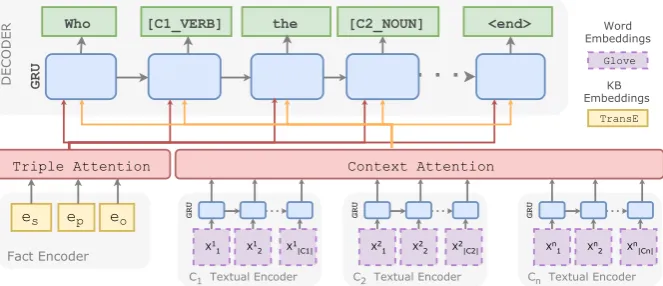
Figure 1: The proposed model for Question Generation. The model consists of a single fact encoder andntextual
context encoders, each consists of a separate GRU. At each time stept, two attention vectors generated from the
two attention modules are fed to the decoder to generate the next word in the output question.
that can be drawn from a corpus – our model is generic to any textual contexts that can be ad-ditionally provided, though we describe in Sec-tion4.1how to create such texts from Wikipedia.
Our model derives the encoder-decoder archi-tecture of (Sutskever et al.,2014;Bahdanau et al., 2014) with two encoding modules: a feed forward architecture encodes the input triple (sec.3.1) and a set of recurrent neural network (RNN) to en-code each textual context (sec. 3.2). Our model has two attention modules (Bahdanau et al.,2014): one acts over the input triple and another acts over the input textual contexts (sec. 3.4). The decoder (sec.3.3) is another RNN that generates the output question. At each time step, the decoder chooses to output either a word from the vocabulary or a special token indicating a copy action (sec. 3.5) from any of the textual contexts.
3.1 Fact Encoder
Given an input factF ={s, p, o}, let each ofes, ep andeo be a 1-hot vectors of sizeK. The fact
encoder encodes each 1-hot vector into a fixed size vectorhs=Efes, hp =Ef ep andho =Ef eo,
whereEf ∈RHk×Kis the KB embedding matrix, Hkis the size of the KB embedding andK is the
size of the KB vocabulary. Theencoded facthf ∈ R3Hk represents the concatenation of those three
vectors and we use it to initialize the decoder.
hf = [hs; hp; ho] (2)
Following (Serban et al.,2016), we learnEf using TransE (Bordes et al., 2015). We fix its weights and do not allow their update during training time.
3.2 Textual Context Encoder
Given a set of n textual contexts C = {c1, c2, . . . , cn :cj = (xj1, x
j
2, . . . , x
j
|cj|)}, where
xji represents the 1-hot vector of the ith token in
thejthtextual contextcj, and|cj|is the length of
thejth context. We use a set of nGated
Recur-rent Neural Networks (GRU) (Cho et al.,2014) to encode each of the textual concepts separately:
hcj
i =GRUj
Ecxji, h cj
i−1
(3)
wherehcj
i ∈ RHc is the hidden state of the GRU
that is equivalent toxji and of sizeHc. Ecis the
input word embedding matrix. Theencoded con-textrepresents the encoding of all the textual con-texts; it is calculated as the concatenation of all the final states of all the encoded contexts:
hc= [hc|c11|;h|cc22|;. . .;hc|cnn|]. (4)
3.3 Decoder
For the decoder we use another GRU with an attention mechanism (Bahdanau et al., 2014), in which the decoder hidden statest ∈ RHd at each
time steptis calculated as:
st=zt◦st−1+ (1−zt)◦˜st , (5)
Where:
˜
st=tanhW Ewyt−1+U[rt◦st−1] +A[aft;a c t]
(6)
zt=σWzEwyt−1+Uzst−1+Az[aft;a c t]
(7)
rt=σWrEwyt−1+Urst−1+Ar[aft;act]
(8)
Ew ∈Rm×V is the word embedding matrix,mis
the word embedding size andHdis the size of the
decoder hidden state.aft,act are the outputs of the
fact attention and the context attention modules respectively, detailed in the following subsection. In order to enforce the model to pair output words with words from the textual inputs, we couple the word embedding matrices of both the decoderEw
and the textual context encoder Ec (eq.(3)). We
initialize them with GloVe embeddings (Penning-ton et al., 2014) and allow the network to tune them.
The first hidden state of the decoders0 = [hf;hc]
is initialized using a concatenation of the encoded fact (eq.(2)) and the encoded context (eq.(4)) . At each time step t, after calculating the hidden
state of the decoder, the conditional probability distribution over each token yt of the generated
question is computed as the sof tmax(Wost)
over all the entries in the output vocabulary,
Wo ∈ RHd×V is the weight matrix of the output
layer of the decoder.
3.4 Attention
Our model has two attention modules:
Triple attentionover the input triple to determine at each time steptan attention-based encoding of the input factaft ∈RHk:
aft =αs,ths+αp,thp+αs,tho , (9)
αs,t, αp,t, αo,t are scalar values calculated by the
attention mechanism to determine at each time step which of the encoded subject, predicate, or object the decoder should attend to.
Textual contexts attention over all the hidden states of all the textual contextsact ∈RHc:
act = |C| X
i=1 |ci|
X
j=1
αci
t,jh ci
j , (10)
αci
t,j is a scalar value determining the weight of the jthword in theithcontextci at time stept.
Given a set of encoded input vectors I = {h1, h2, ...hk} and the decoder previous hidden
state st−1, the attention mechanism calculates
αt = αi,t, . . . , αk,t as a vector of scalar weights,
eachαi,tdetermines the weight of its
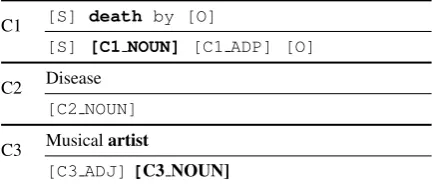
correspond-What caused the[C1 NOUN]of the[C3 NOUN] [S]? C1 [S] death by [O]
[S] [C1 NOUN] [C1 ADP] [O]
[image:4.595.308.525.81.174.2]C2 Disease [C2 NOUN]
C3 Musicalartist
[C3 ADJ][C3 NOUN]
Table 1: An annotated example of part-of-speech copy actions from several input textual contexts (C1, C2, C3), the words or placeholders in bold are copied in the generated question
ing encoded input vectorhi.
ei,t =va> tanh(Wast−1+Uahi) (11)
αi,t = Pkexp(ei,t)
j=1exp(ej,t)
, (12)
where va,Wa,Ua are trainable weight matrices
of the attention modules. It is important to no-tice here that we encode each textual context sep-arately using a different GRU, but we calculate an overall attention over all tokens in all textual con-texts: at each time step the decoder should ideally attend to only one word from all the input contexts.
3.5 Part-Of-Speech Copy Actions
a post-processing step those special tokens are re-placed with their original words from the textual contexts.
4 Textual contexts dataset
As a source of question paired with KB triples we use the SimpleQuestions dataset (Bordes et al., 2015). It consists of 100K questions with their corresponding triples from Freebase, and was cre-ated manually through crowdsourcing. When asked to form a question from an input triple, human annotators usually tend to mainly fo-cus on expressing the predicate of the input triple. For example, given a triple with the pred-icate fb:spacecraft/manufacturer the user may ask ”What is the manufacturer of [S]
?”. Annotators may specify the entity type of the subject or the object of the triple: ”What is the manufacturer of thespacecraft[S]?”or”Which
companymanufactures[S]?”. Motivated by this example we chose to associate each input triple with three textual contexts of three different types. The first is a phrase containing lexicalization of the predicate of the triple. The second and the third are two phrases containing the entity type of the sub-ject and the obsub-ject of the triple. In what follows we show the process of collection and preprocessing of those textual contexts.
4.1 Collection of Textual Contexts
We extend the set of triples given in the Sim-pleQuestions dataset by using the FB5M (Bordes et al., 2015) subset of Freebase. As a source of text documents, we rely on Wikipedia articles.
Predicate textual contexts: In order to collect textual contexts associated with the SimpleQues-tions triples, we follow the distant supervision setup for relation extraction (Mintz et al., 2009). The distant supervision assumption has been ef-fective in creating training data for relation extrac-tion and shown to be 87% correct (Riedel et al., 2010) on Wikipedia text.
First, we align each triple in the FB5M KB to sen-tences in Wikipedia if the subject and the object of this triple co-occur in the same sentence. We use a simple string matching heuristic to find en-tity mentions in text2. Afterwards we reduce the
2We map Freebase entities to Wikidata through the Wiki-data property P646, then we extract their labels and aliases. We use the Wikidata truthy dump: https://dumps. wikimedia.org/wikidatawiki/entities/
Freebase Relation Predicate Textual Context
person/place of birth [O] is birthplace of [S] currency/former countries [S] was currency of [O] dish/cuisine [O] dish [S]
airliner accident/flight origin[S] was flight from [O] film featured song/performer[S] is release by [O] airline accident/operator [S] was accident for [O] genre/artists [S] became a genre of [O] risk factor/diseases [S] increases likelihood of [O] book/illustrations by [S] illustrated by [O]
religious text/religion [S] contains principles of [O] spacecraft/manufacturer [S] spacecraft developed by [O] Table 2: Table showing an example of textual contexts extracted for freebase predicates
sentence to the set of words that appear on the de-pendency path between the subject and the object mentions in the sentence. We replace the posi-tions of the subject and the object menposi-tions with [S]and[O]to the keep track of the information about the direction of the relation. The top occur-ring pattern for each predicate is associated to this predicate as its textual context. Table2shows ex-amples of predicates and their corresponding tex-tual context.
Sub-Type and Obj-Type textual contexts: We use the labels of the entity types as the sub-type and obj-type textual contexts. We collect the list of entity types of each entity in the FB5M through the predicatefb:type/instance. If an entity has multiple entity types we pick the entity type that is mentioned the most in the first sentence of each Wikipedia article. Thus the textual contexts will opt for entity types that is more natural to appear in free text and therefore questions.
4.2 Generation of Special tokens
To generate the special tokens for copy ac-tions (sec.3.5) we run POS tagging on each of the input textual contexts3. We replace every word in
each textual context with a combination of its con-text id (e.g. C1) and its POS tag (e.g. NOUN). If the same POS tag appears multiple times in the textual context, it is given an additional id (e.g. C1 NOUN 2). If a word in the output question overlaps with a word in the input textual context, this word is replaced by its corresponding tag. For sentence and word tokenization we use the Regex tokenizer from the NLTK toolkit (Bird, 2006), and for POS tagging and dependency
Train Valid Test
pr
ed # pred# samples 169.455566.7 24.27938.1 48.415876.2
% samples 70.0±2.77 10.0±1.236 20.0±2.12
sub-types
# types 112.7 16.1 32.2
# samples 60002.6 8571.8 17143.6 % samples 70.0±7.9 10.0±3.6 20.0±6.2
obj-types
# types 521.6 189.9 282.2
# samples 57878.1 8268.3 16536.6 % samples 70.0±4.7 10.0±2.5 20.0±3.8 Table 3: Dataset statistics across 10 folds for each ex-periment
ing we use the Spacy4implementation.
5 Experiments 5.1 Zero-Shot Setups
We develop three setups that follow the same pro-cedure as (Levy et al.,2017) for Zero-Shot relation extraction to evaluate how our model generalizes to: 1) unseen predicates, 2) unseen sub-types and 3) unseen obj-types.
For the unseen predicates setup we group all the samples in SimpleQuestions by the predicate of the input triple, and keep groups that con-tain at least 50 samples. Afterwards we ran-domly split those groups to 70% train, 10% valid and 20% test mutual exclusive sets re-spectively. This guarantees that if the predi-catefb:person/place of birthfor exam-ple shows during test time, the training and vali-dation set will not contain any input triples hav-ing this predicate. We repeat this process to create 10 cross validation folds, in our evaluation we re-port the mean and standard deviation results across those 10 folds. While doing this we make sure that the number of samples in each fold – not only unique predicates – follow the same 70%, 30%, 10% distribution. We repeat the same process for the subject entity types and object entity types (an-swer types) individually. Similarly, for example in the unseen object-type setup, the question”Which
artistwas born in Berlin?” appearing in the test set means that, there is no question in the train-ing set havtrain-ing an entity of type artist. Table 3 shows the mean number of samples, predicates, sub-types and obj-types across the 10 folds for each experiment setup.
4https://spacy.io/
5.2 Baselines
SELECT is a baseline built from (Serban et al., 2016) and adapted for the zero shot setup. During test time given a factF, this baseline picks a fact
Fc from the training set and outputs the question
that corresponds to it. For evaluating unseen pred-icates,Fchas the same answer type (obj-type) as F. And while evaluating unseen sub-types or
obj-types,FcandF have the same predicate.
R-TRANSE is an extension that we propose for SELECT. The input triple is encoded us-ing the concatenation of the TransE embeddus-ings of the subject, predicate and object. At test time, R-TRANSE picks a fact from the train-ing set that is the closest to the input fact us-ing cosine similarity and outputs the question that corresponds to it. We provide two versions of this baseline: R-TRANSEwhich indexes and re-trieves raw questions with only a single place-holder for the subject label, such as in (Serban et al., 2016). And R-TRANSEcopy which
in-dexes and retrieves questions using our copy ac-tions mechanism (sec.3.5).
IR is an information retrieval baseline. Infor-mation retrieval has been used before as base-line for QG from text input (Rush et al., 2015; Du et al., 2017). We rely on the textual con-text of each input triple as the search keyword for retrieval. First, the IR baseline encodes each question in the training set as a vector of TF-IDF weights (Joachims, 1997) and then does di-mensionality reduction through LSA (Halko et al., 2011). At test time the textual context of the input triple is converted into a dense vector using the same process and then the question with the clos-est cosine distance to the input is retrieved. We provide two versions of this baseline: IRon raw text andIRcopyon text with our placeholders for
copy actions.
infor-mation in the pre-trained embeddings. Pretrained KB terms and word embeddings encode relations between entities or between words as translations in the vector space. Thus the model might be able to map new classes or predicates in the input fact to new words in the output question.
5.3 Training & Implementation Details
To train the neural network models we optimize the negative log-likelihood of the training data with respect to all the model parameters. For that we use the RMSProp optimization algorithm with a decreasing learning rate of 0.001, mini-batch size = 200, and clipping gradients with norms larger than0.1. We use the same vocabulary for both the textual context encoders and the decoder outputs. We limit our vocabulary to the top30,000 words including the special tokens. For the word embeddings we chose GloVe (Pennington et al., 2014) pretrained embeddings of size 100. We train TransE embeddings of size Hk = 200, on
the FB5M dataset (Bordes et al.,2015) using the TransE model implementation from (Lin et al., 2015). We set GRU hidden size of the decoder toHd = 500, and textual encoder toHc = 200. The networks hyperparameters are set with respect to the final BLEU-4 score over the validation set. All neural networks are implemented using Ten-sorflow (Abadi et al.,2015). All experiments and models source code are publicly available5for the
sake of reproducibility.
5.4 Automatic Evaluation Metrics
To evaluate the quality of the generated question, we compare the original labeled questions by human annotators to the ones generated by each variation of our model and the baselines. We rely on a set of well established evaluation metrics for text generation: 1, BLEU-2, BLEU-3, BLEU-4 (Papineni et al., 2002), METEOR (Denkowski and Lavie, 2014) and ROUGEL(Lin,2004).
5.5 Human Evaluation
Automatic Metrics for evaluating text generation such as BLEU and METEOR give an measure of how close the generated questions are to the target correct labels. However, they still suffer from many limitations (Novikova et al., 2017).
5https://github.com/hadyelsahar/
Zeroshot-QuestionGeneration
Automatic metrics might not be able to evaluate directly whether a specific predicate was explicitly mentioned in the generated text or not.
As an example, taking a target question and two corresponding generated questionsAandB:
What kind of film is kill bill vol. 2? BLEU
A) What isthe name ofthe film kill bill vol. 2? 71 B) Which genre is kill bill vol. 2 in? 55 We can find that the sentence A having a
better BLEU score than B although it is not able to express the correct target predicate (film genre). For that reason we decide to run two further human evaluations to directly measure the following:
Predicate identification: annotators were asked to indicate whether the generated question contains the given predicate in the fact or not, either directly or implicitly.
Naturalness: following (Ngomo et al.,2013), we measure the comprehensibility and readability of the generated questions. Each annotator was asked to rate each generated question using a scale from1 to5, where: (5) perfectly clear and natural, (3) artificial but understandable, and (1) completely not understandable. We run our studies on 100 randomly sampled input facts alongside with their corresponding generated questions by each of the systems using the help of 4annotators.
6 Results & Discussion
Automatic Evaluation Table4shows results of our model compared to all other baselines across all evaluation metrics. Our that encodes the KB fact and textual contexts achieves a significant en-hancement over all the baselines in all evalua-tion metrics, with+2.04BLEU-4 score than the Encoder-Decoder baseline. Incorporating the part-of-speech copy actions further improves this en-hancement to reach+2.39BLEU-4 points. Among all baselines, the Encoder-Decoder base-line and the R-TRANSE basebase-line performed the best. This shows that TransE embeddings encode intra-predicates information and intra-class-types information to a great extent, and can generalize to some extent to unseen predicates and class types.
Model BLEU-1 BLEU-2 BLEU-3 BLEU-4 ROUGEL METEOR
Unseen
Pr
edicates
[image:8.595.71.293.413.482.2]SELECT 46.81±2.12 38.62±1.78 31.26±1.9 23.66±2.22 52.04±1.43 27.11±0.74 IR 48.43±1.64 39.13±1.34 31.4±1.66 23.59±2.36 52.88±1.24 27.34±0.55 IRCOPY 48.22±1.84 38.82±1.5 31.01±1.72 23.12±2.24 52.72±1.26 27.24±0.57 R-TRANSE 49.09±1.69 40.75±1.42 33.4±1.7 25.97±2.22 54.07±1.31 28.13±0.54 R-TRANSECOPY 49.0±1.76 40.63±1.48 33.28±1.74 25.87±2.23 54.09±1.35 28.12±0.57 Encoder-Decoder 58.92±2.05 47.7±1.62 38.18±1.86 28.71±2.35 59.12±1.16 34.28±0.54 Our-Model 60.8±1.52 49.8±1.37 40.32±1.92 30.76±2.7 60.07±0.9 35.34±0.43 Our-Modelcopy 62.44±1.85 50.62±1.46 40.82±1.77 31.1±2.46 61.23±1.2 36.24±0.65 Table 4: Evaluation results of our model and all other baselines for the unseen predicate evaluation setup
Model BLEU-4 ROUGEL
Sub-T
ypes
R-TRANSE 32.41±1.74 59.27±0.92 Encoder-Decoder 42.14±2.05 68.95±0.86 Our-Model 42.13±1.88 69.35±0.9 Our-Modelcopy 42.2±2.0 69.37±1.0
Obj-T
ypes
R-TRANSE 30.59±1.3 57.37±1.17 Encoder-Decoder 37.79±2.65 65.69±2.25 Our-Model 37.78±2.02 65.51±1.56 Our-Modelcopy 38.02±1.9 66.24±1.38 Table 5: Automatic evaluation of our model against se-lected baselines for unseen sub-types and obj-types
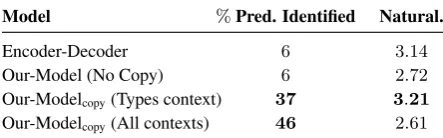
Model %Pred. Identified Natural.
Encoder-Decoder 6 3.14
Our-Model (No Copy) 6 2.72
Our-Modelcopy(Types context) 37 3.21 Our-Modelcopy(All contexts) 46 2.61
Table 6: results of Human evaluation on % of predi-cates identified and naturalness 0-5
all the other systems. Majority of systems have reported a significantly higher BLEU-4 scores in these two tasks than when generalizing to unseen predicates (+12 and +8 BLEU-4 points respec-tively). This indicates that these tasks are tively easier and hence our models achieve rela-tively smaller enhancements over the baselines.
Human Evaluation Table 6 shows how dif-ferent variations of our system can express the unseen predicate in the target question with comparison to the Encoder-Decoder baseline. Our proposed copy actions have scored a sig-nificant enhancement in the identification of unseen predicates with up to +40% more than best performing baseline and our model version without the copy actions.
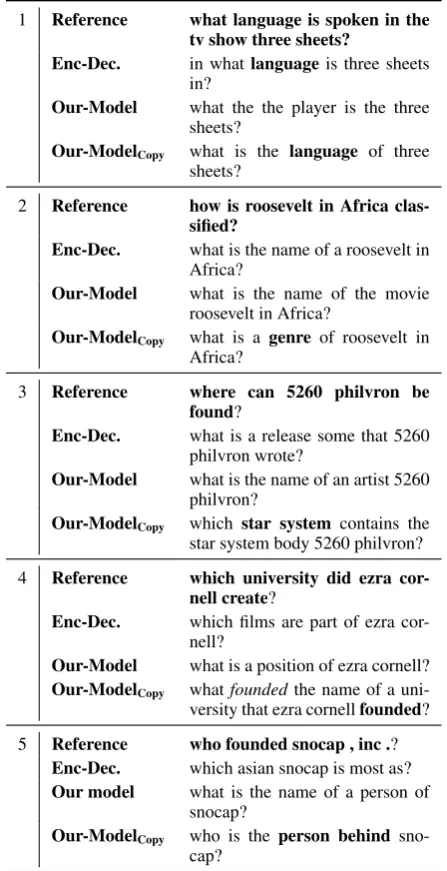
By examining some of the generated ques-tions (Table 7) we see that models without copy actions can generalize to unseen pred-icates that only have a very similar free-base predicate in the training set. For ex-ample fb:tv program/language and fb:film/language, if one of those predi-cates exists in the training set the model can use the same questions for the other during test time. Copy actions from the sub-type and the obj-type textual contexts can generalize to a great extent to unseen predicates because of the overlap between the predicate and the object type in many questions (Example 2 Table7). Adding the pred-icate context to our model has enhanced model performance for expressing unseen predicates by +9%(Table 6). However we can see that it has affected the naturalness of the question. The post processing step does not take into consideration that some verbs and prepositions do not fit in the sentence structure, or that some words are already existing in the question words (Example 4 Table7). This does not happen as much when having copy actions from the sub-type and the obj-type contexts because they are mainly formed of nouns which are more interchangeable than verbs or prepositions. A post-processing step to reform the question instead of direct copying from the input source is considered in our future work.
7 Conclusion
1 Reference what language is spoken in the tv show three sheets?
Enc-Dec. in whatlanguageis three sheets in?
Our-Model what the the player is the three sheets?
Our-ModelCopy what is the language of three sheets?
2 Reference how is roosevelt in Africa clas-sified?
Enc-Dec. what is the name of a roosevelt in Africa?
Our-Model what is the name of the movie roosevelt in Africa?
Our-ModelCopy what is a genre of roosevelt in Africa?
3 Reference where can 5260 philvron be
found?
Enc-Dec. what is a release some that 5260 philvron wrote?
Our-Model what is the name of an artist 5260 philvron?
Our-ModelCopy which star system contains the star system body 5260 philvron? 4 Reference which university did ezra
cor-nell create?
Enc-Dec. which films are part of ezra cor-nell?
Our-Model what is a position of ezra cornell?
Our-ModelCopy whatfoundedthe name of a uni-versity that ezra cornellfounded? 5 Reference who founded snocap , inc .?
Enc-Dec. which asian snocap is most as?
Our model what is the name of a person of snocap?
[image:9.595.69.293.63.499.2]Our-ModelCopy who is the person behind sno-cap?
Table 7: Examples of generated questions from differ-ent systems in comparison
finally a part-of-speech copy action mechanism. Our method exhibits significantly better results for Zero-Shot QG than a set of strong baselines including the state-of-the-art question generation from KB. Additionally, a complimentary human evaluation, helps in showing that the improvement brought by our part-of-speech copy action mech-anism is even more significant than what the au-tomatic evaluation suggests. The source code and the collected textual contexts are provided for the community6
6https://github.com/hadyelsahar/
Zeroshot-QuestionGeneration
Acknowledgements
This research is partially supported by the An-swering Questions using Web Data (WDAqua) project, a Marie Skłodowska-Curie Innovative Training Network under grant agreement No 642795, part of the Horizon2020programme.
References
Mart´ın Abadi, Ashish Agarwal, Paul Barham, Eugene Brevdo, Zhifeng Chen, Craig Citro, Greg S. Cor-rado, Andy Davis, Jeffrey Dean, Matthieu Devin, Sanjay Ghemawat, Ian Goodfellow, Andrew Harp, Geoffrey Irving, Michael Isard, Yangqing Jia, Rafal Jozefowicz, Lukasz Kaiser, Manjunath Kudlur, Josh Levenberg, Dan Man´e, Rajat Monga, Sherry Moore, Derek Murray, Chris Olah, Mike Schuster, Jonathon Shlens, Benoit Steiner, Ilya Sutskever, Kunal Tal-war, Paul Tucker, Vincent Vanhoucke, Vijay Va-sudevan, Fernanda Vi´egas, Oriol Vinyals, Pete War-den, Martin Wattenberg, Martin Wicke, Yuan Yu, and Xiaoqiang Zheng. 2015. TensorFlow: Large-scale machine learning on heterogeneous systems. Software available from tensorflow.org. https: //www.tensorflow.org/.
Dzmitry Bahdanau, Kyunghyun Cho, and Yoshua Bengio. 2014. Neural machine translation by jointly learning to align and translate. CoRR
abs/1409.0473. http://arxiv.org/abs/ 1409.0473.
Steven Bird. 2006. NLTK: the natural language toolkit. In ACL 2006, 21st International Conference on Computational Linguistics and 44th Annual Meet-ing of the Association for Computational LMeet-inguis- Linguis-tics, Proceedings of the Conference, Sydney, Aus-tralia, 17-21 July 2006. http://aclweb.org/ anthology/P06-4018.
Antoine Bordes, Nicolas Usunier, Sumit Chopra, and Jason Weston. 2015. Large-scale simple ques-tion answering with memory networks. CoRR
abs/1506.02075. http://arxiv.org/abs/ 1506.02075.
Kyunghyun Cho, Bart van Merrienboer, C¸aglar G¨ulc¸ehre, Fethi Bougares, Holger Schwenk, and Yoshua Bengio. 2014. Learning phrase representa-tions using RNN encoder-decoder for statistical ma-chine translation. CoRRabs/1406.1078.
Li Dong, Jonathan Mallinson, Siva Reddy, and Mirella Lapata. 2017. Learning to paraphrase for question answering. In Proceedings of the 2017 Conference on Empirical Methods in Natu-ral Language Processing, EMNLP 2017, Copen-hagen, Denmark, September 9-11, 2017. pages 875–886. https://aclanthology.info/ papers/D17-1091/d17-1091.
Xinya Du, Junru Shao, and Claire Cardie. 2017. Learn-ing to ask: Neural question generation for read-ing comprehension. In Proceedings of the 55th Annual Meeting of the Association for Computa-tional Linguistics, ACL 2017, Vancouver, Canada, July 30 - August 4, Volume 1: Long Papers. pages 1342–1352. https://doi.org/10.18653/ v1/P17-1123.
Martha Evens and Joel Michael. 2006. One-on-one tu-toring by humans and machines. Computer Science Department, Illinois Institute of Technology.
Anthony Fader, Stephen Soderland, and Oren Etzioni. 2011.Identifying relations for open information ex-traction. InProceedings of the 2011 Conference on Empirical Methods in Natural Language Process-ing, EMNLP 2011, 27-31 July 2011, John McIn-tyre Conference Centre, Edinburgh, UK, A meeting of SIGDAT, a Special Interest Group of the ACL. pages 1535–1545. http://www.aclweb.org/ anthology/D11-1142.
Arthur C Graesser, Shulan Lu, George Tanner Jack-son, Heather Hite Mitchell, Mathew Ventura, An-drew Olney, and Max M Louwerse. 2004. Autotu-tor: A tutor with dialogue in natural language. Be-havior Research Methods36(2):180–192.
Jiatao Gu, Zhengdong Lu, Hang Li, and Victor O. K. Li. 2016. Incorporating copying mechanism in sequence-to-sequence learning. In Proceedings of the 54th Annual Meeting of the Association for Computational Linguistics, ACL 2016, August 7-12, 2016, Berlin, Germany, Volume 1: Long Pa-pers. http://aclweb.org/anthology/P/ P16/P16-1154.pdf.
C¸aglar G¨ulc¸ehre, Sungjin Ahn, Ramesh Nallapati, Bowen Zhou, and Yoshua Bengio. 2016. Point-ing the unknown words. In Proceedings of the 54th Annual Meeting of the Association for Com-putational Linguistics, ACL 2016, August 7-12, 2016, Berlin, Germany, Volume 1: Long Pa-pers. http://aclweb.org/anthology/P/ P16/P16-1014.pdf.
Nathan Halko, Per-Gunnar Martinsson, and Joel A. Tropp. 2011. Finding structure with random-ness: Probabilistic algorithms for constructing ap-proximate matrix decompositions. SIAM Re-view 53(2):217–288. https://doi.org/10. 1137/090771806.
Michael Heilman and Noah A. Smith. 2010. Good question! statistical ranking for question
genera-tion. InHuman Language Technologies: Confer-ence of the North American Chapter of the As-sociation of Computational Linguistics, Proceed-ings, June 2-4, 2010, Los Angeles, California, USA. pages 609–617. http://www.aclweb.org/ anthology/N10-1086.
Thorsten Joachims. 1997. A probabilistic analysis of the rocchio algorithm with TFIDF for text catego-rization. In Proceedings of the Fourteenth Inter-national Conference on Machine Learning (ICML 1997), Nashville, Tennessee, USA, July 8-12, 1997. pages 143–151.
Mitesh M. Khapra, Dinesh Raghu, Sachindra Joshi, and Sathish Reddy. 2017. Generating natural lan-guage question-answer pairs from a knowledge graph using a RNN based question generation model. In Proceedings of the 15th Conference of the European Chapter of the Association for Com-putational Linguistics, EACL 2017, Valencia, Spain, April 3-7, 2017, Volume 1: Long Papers. pages 376– 385. https://aclanthology.info/pdf/ E/E17/E17-1036.pdf.
Ryan Kiros, Ruslan Salakhutdinov, and Richard S. Zemel. 2014. Unifying visual-semantic embed-dings with multimodal neural language models.
CoRR abs/1411.2539. http://arxiv.org/ abs/1411.2539.
R´emi Lebret, David Grangier, and Michael Auli. 2016. Neural text generation from structured data with application to the biography domain. In Proceedings of the 2016 Conference on Em-pirical Methods in Natural Language Processing, EMNLP 2016, Austin, Texas, USA, November 1-4, 2016. pages 1203–1213. http://aclweb. org/anthology/D/D16/D16-1128.pdf.
Omer Levy, Minjoon Seo, Eunsol Choi, and Luke Zettlemoyer. 2017. Zero-shot relation extraction via reading comprehension. InProceedings of the 21st Conference on Computational Natural Language Learning (CoNLL 2017), Vancouver, Canada, Au-gust 3-4, 2017. pages 333–342. https://doi. org/10.18653/v1/K17-1034.
Chin-Yew Lin. 2004. Rouge: A package for auto-matic evaluation of summaries. InText summariza-tion branches out: Proceedings of the ACL-04 work-shop. Barcelona, Spain, volume 8.
Yankai Lin, Zhiyuan Liu, Maosong Sun, Yang Liu, and Xuan Zhu. 2015. Learning entity and re-lation embeddings for knowledge graph comple-tion. In Proceedings of the Twenty-Ninth AAAI Conference on Artificial Intelligence, January 25-30, 2015, Austin, Texas, USA.. pages 2181– 2187. http://www.aaai.org/ocs/index. php/AAAI/AAAI15/paper/view/9571.
trans-lation. In Proceedings of the 53rd Annual Meet-ing of the Association for Computational LMeet-inguis- Linguis-tics and the 7th International Joint Conference on Natural Language Processing of the Asian Feder-ation of Natural Language Processing, ACL 2015, July 26-31, 2015, Beijing, China, Volume 1: Long
Papers. pages 11–19. http://aclweb.org/
anthology/P/P15/P15-1002.pdf.
Mike Mintz, Steven Bills, Rion Snow, and Daniel Ju-rafsky. 2009.Distant supervision for relation extrac-tion without labeled data. In ACL 2009, Proceed-ings of the 47th Annual Meeting of the Association for Computational Linguistics and the 4th Interna-tional Joint Conference on Natural Language Pro-cessing of the AFNLP, 2-7 August 2009, Singapore. pages 1003–1011. http://www.aclweb.org/ anthology/P09-1113.
Axel-Cyrille Ngonga Ngomo, Lorenz B¨uhmann, Christina Unger, Jens Lehmann, and Daniel Ger-ber. 2013. Sorry, i don’t speak SPARQL: translating SPARQL queries into natural language. In22nd In-ternational World Wide Web Conference, WWW ’13, Rio de Janeiro, Brazil, May 13-17, 2013. pages 977– 988. http://dl.acm.org/citation.cfm? id=2488473.
Jekaterina Novikova, Ondrej Dusek, Amanda Cercas Curry, and Verena Rieser. 2017. Why we need new evaluation metrics for NLG. InProceedings of the 2017 Conference on Empirical Methods in Nat-ural Language Processing, EMNLP 2017, Copen-hagen, Denmark, September 9-11, 2017. pages 2241–2252. https://aclanthology.info/ papers/D17-1238/d17-1238.
Kishore Papineni, Salim Roukos, Todd Ward, and Wei-Jing Zhu. 2002. Bleu: a method for automatic eval-uation of machine translation. InProceedings of the 40th Annual Meeting of the Association for Com-putational Linguistics, July 6-12, 2002, Philadel-phia, PA, USA.. pages 311–318. http://www. aclweb.org/anthology/P02-1040.pdf.
Jeffrey Pennington, Richard Socher, and Christo-pher D. Manning. 2014. Glove: Global vectors for word representation. In Proceedings of the 2014 Conference on Empirical Methods in Natu-ral Language Processing, EMNLP 2014, October 25-29, 2014, Doha, Qatar, A meeting of SIGDAT, a Special Interest Group of the ACL. pages 1532– 1543. http://aclweb.org/anthology/D/ D14/D14-1162.pdf.
Sebastian Riedel, Limin Yao, and Andrew McCal-lum. 2010. Modeling relations and their men-tions without labeled text. In Machine Learn-ing and Knowledge Discovery in Databases, Euro-pean Conference, ECML PKDD 2010, Barcelona, Spain, September 20-24, 2010, Proceedings, Part III. pages 148–163. https://doi.org/10. 1007/978-3-642-15939-8_10.
Alexander M. Rush, Sumit Chopra, and Jason We-ston. 2015. A neural attention model for ab-stractive sentence summarization. InProceedings of the 2015 Conference on Empirical Methods in Natural Language Processing, EMNLP 2015, Lis-bon, Portugal, September 17-21, 2015. pages 379– 389. http://aclweb.org/anthology/D/ D15/D15-1044.pdf.
Iulian Vlad Serban, Alberto Garc´ıa-Dur´an, C¸aglar G¨ulc¸ehre, Sungjin Ahn, Sarath Chandar, Aaron C. Courville, and Yoshua Bengio. 2016. Generating factoid questions with recurrent neural networks: The 30m factoid question-answer corpus. In Pro-ceedings of the 54th Annual Meeting of the Associ-ation for ComputAssoci-ational Linguistics, ACL 2016, Au-gust 7-12, 2016, Berlin, Germany, Volume 1: Long
Papers. http://aclweb.org/anthology/
P/P16/P16-1056.pdf.
Dominic Seyler, Mohamed Yahya, and Klaus Berberich. 2015. Generating quiz questions from knowledge graphs. InProceedings of the 24th Inter-national Conference on World Wide Web Compan-ion, WWW 2015, Florence, Italy, May 18-22, 2015 - Companion Volume. pages 113–114. https: //doi.org/10.1145/2740908.2742722.
Lifeng Shang, Zhengdong Lu, and Hang Li. 2015. Neural responding machine for short-text conver-sation. In Proceedings of the 53rd Annual Meet-ing of the Association for Computational LMeet-inguistics and the 7th International Joint Conference on Nat-ural Language Processing of the Asian Federation of Natural Language Processing, ACL 2015, July 26-31, 2015, Beijing, China, Volume 1: Long Pa-pers. pages 1577–1586. http://aclweb.org/ anthology/P/P15/P15-1152.pdf.
Richard Socher, Milind Ganjoo, Christopher D. Man-ning, and Andrew Y. Ng. 2013. Zero-shot learning through cross-modal transfer. InAdvances in Neu-ral Information Processing Systems 26: 27th Annual Conference on Neural Information Processing Sys-tems 2013. Proceedings of a meeting held Decem-ber 5-8, 2013, Lake Tahoe, Nevada, United States.. pages 935–943.