Finite-State Morphological Analysis for Marathi
Vinit Ravishankar
Faculty of ICT
University of Malta
Msida MSD 2080, Malta
[email protected]
Francis M. Tyers
School of Linguistics
Higher School of Economics
Moscow, Russia
[email protected]
Abstract
This paper describes the development of
free/open-source morphological descriptions
for Marathi, an Indo-Aryan language spoken
in the state of Maharashtra in India. We
de-scribe the conversion and usage of an existing
Latin-based lexicon for our Devanagari-based
analyser, taking into account the distinction
between full vowels and diacritics, that
is not adequately captured by the Latin.
Marathi displays elements of both fusional
and agglutinative morphology, which gives
us different ways to potentially treat the
mor-phology; philosophically, we approach our
analyser by treating the morphology system
as a three-layer affixing system. We use the
lttoolboxlexicon formalism for describing the
finite-state transducer, and attempt to work
within a morphological framework that would
allow for some consistency across Indo-Aryan
languages, enabling machine translation
across language pairs. An evaluation of our
finite-state transducer shows that the coverage
is adequate, over 80% on two corpora, and the
precision is good (over 97%).
1
Introduction
This paper describes the development of
free/open-source morphological descriptions of Marathi, an
Indo-Aryan language spoken in the state of Maharashtra in
India. Morphological descriptions are computational
models of a language’s morphology, and are used to
output morphological analyses from word forms and
vice versa.
In section 2, the paper gives an overview of Marathi
morphology, and talks about some of the grammatical
decisions we made during development of the analyser.
Section 3 is a literature review of previous work done in
the field. Section 4 describes the methodology we
fol-lowed whilst working on the analyser, the formalisms
we have used, and describes our lexicon. We continue
with section 6, describing the evaluation metrics we
have chosen, and how well our analyser performs on
them. Section 7 describes potential future work we
could do.
2
Marathi
Marathi is an Indo-Aryan language spoken primarily
in the west Indian state of Maharashtra, and has
ap-proximately 62 million speakers, as of 2003
(Pandhari-pande, 2003). Despite being an Indo-European
lan-guage, Marathi has borrowed several features - such as
clusivity, and certain retroflex consonants (such as the
retroflex lateral flap), either absent or relatively
uncom-mon in other Indo-Aryan languages.
Whilst Marathi retains some fusional morphological
aspects of its proto-language, Sanskrit, it displays
mor-phological agglutination within many contexts. Our
analysis broadly follows the perspective of Masica
(1993). They consider the split morphological to be a
form of morphological “layering”; with a primary layer,
comprising mainly of inherited fusional elements (the
“oblique” case), a secondary agglutinative layer, and a
tertiary postpositional layer. These layers are, to a
cer-tain extent, universal amongst Indo-Aryan languages:
they differ largely in the conditions under which they
occur, and language-specific variations that may
oc-cur. A brief, specific definition of the layers in Marathi
would, therefore, look like:
1. The “oblique” case; complex morphophonemic
changes in the lemma. eg. मुलगाmulagā “boy”
→मुलाmulā
2. Agglutinative suffixes, similar to traditional cases
that mark noun functions, like the nominative or
the genitive.
3. Postpositions; morphologically and semantically
complex elements. These can attach to an
(op-tional) oblique genitive suffix in layer 2.
Certain particles, such as an emphasis particle-च
-c, or particles like-ही-hīand-सु ा-suddhā“as well
as”, are quite common, and can attach as a suffix to
most words, with the exception of conjunctions. Verbs,
along with the optional negation particle, decline for
50
tense, aspect and mood, and have adjectival and
adver-bial derivations. (1) is an example with two of the three
case layers and two suffix particles.
(1) (to)
(he)
ghar-ā-māge-hī
house-obl-behind.post-too.ptcl
ge-l-ā-c
go-pfv-3msg-foc
“He definitely went behind the house too”
3
Prior work
There have been a number of efforts to develop
mor-phological analysers for Marathi over the years. While
morphological analysis for Marathi is fairly well
stud-ied, one downside of previous work is that the
soft-ware and lexicon is not freely available. Dixit et al.
(2005) present a spellchecker for the language based
on a lexicon of 13,000 root words and
morphologi-cal rules. They did an evaluation of spell-checking
accuracy showing that out of 10,648 words classified
as correctly spelt, only 0.45% were actually false
pos-itives. The morphological analyser of Bapat et al.
(2010) is based on a word–paradigm approach
mod-elled with a finite-state transducer and contains a
lex-icon of 24,035. They evaluate 21,096 unique word
forms from a corpus and find that 97.18% receive all
and only the correct morphological analyses; it is worth
noting, however, is that their dictionary was created to
specifically fit their evaluation corpus. Another
anal-yser based on finite-state technology is described by
Dabre et al. (2012), based on a gold standard of 1,341
words, achieved an accuracy of 72.18%. The size of the
lexicon was not specified. Gawade et al. (2013) also use
a finite-state transducer to model Marathi morphology,
although their paper does not evaluate its effectiveness.
Resources like BabelNet1, generated by statistically
machine translating WordNet ontologies, do not appear
to be very useful - whilst BabelNet does contain some
Marathi nouns, common verbs are all absent.
4
Development
We initially worked on the open word classes, many
of which could be successfully scraped from the
re-sources of the Language Technologies Research
Cen-tre (LTRC), at the International Institute of Information
Technology, Hyderabad.2 As the lexicon was in WX
notation,3a transliteration script was used along, along
with standard UNIX command line utilities, to extract
and convert noun paradigms. Adjective paradigms
were fairly trivial to convert; a significant number of
adjectives do not inflect at all, and most others are very
1
http://babelnet.org/ 2
Available from the LTRC website at http:
//ltrc.iiit.ac.in/showfile.php?filename= onlineServices/morph/index.htm
3
WX is an ASCII-based transliteration scheme for Indian languages; the name derives from the use of ‘w’ and ‘x’ for dental stops.
regular. Words were thenscraped(extracted) from the
lexicon and assigned to their respective paradigms.
Verbal declensions were stored with a
differ-ent method; separate files existed, not for separate
paradigms, but for separate word forms. Each file had
a set of words, declined to match the particular form
described by the file. The lexicon, however, was
simi-lar to the nominal lexicon, in that verbs were assigned a
particular verb paradigm. Rather than merge these
mul-tiple files into a single paradigm, we created our own
verbal paradigms, with Dhongade and Wali (2009) and
Masica (1993) as references. The verb list, however,
primarily consists of entries from the LTRC lexicon.
4.1 Formalisms
For the finite-state transducer we employ thelttoolbox
formalism, an XML-based format used in theApertium
project (Forcada et al., 2011). This formalism is widely
used for encoding language data, with Apertium
hav-ing over 40 language pairs for machine translation.
Al-though we could have used an FST toolkit like HFST
(Lindén et al., 2011) or Foma (Hulden, 2009), with
sep-arate layers for processing morphonology and
morpho-tactics, the lack of significant morphophonological
pro-cesses relevant to Marathi orthography madelttoolbox
a perfectly adequate choice.
4.2 Lexicon
The main source of lexical material for our analyser
is from an existing morphological analyser published
by the Language Technology Research Centre (LTRC)
at IIIT Hyderabad. Unlike other work on Marathi, the
lexicon is available under the free/open-source GPL
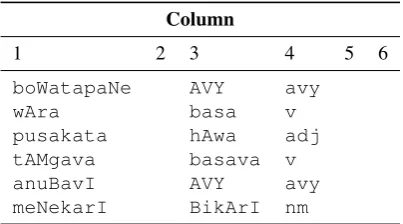
li-cence. The source lexicon (see example in Figure 3) is
composed of a dictionary table containing six columns.
All text in Marathi is written in a Latin-based
translit-eration scheme.
The paradigms in the LTRC lexicon are essentially
lists of different forms of a word; words are assigned
paradigms based on their conformance to the inflection
of the paradigm word. One of the biggest problems
with this is the inefficient noun paradigm system; each
paradigm lists forms that include bound postpositional
morphemes (including adjectival postpositions); this is
quite unnecessary, as postpositions (layer 3) are largely
regular, and attach to the oblique case (layer 1) with an
optional clitic (layer 2). This results in 968 forms per
paradigm, where four would suffice - the singular and
plural nominative and oblique. There were other
mi-nor problems, such as the inclusion of plural forms for
uncountable nouns or abstract nouns.
4.3 Paradigms
The Apertium paradigm system essentially
func-tions using finite-state transducers, defined in XML.
Paradigms are expressed as an input side (within
‘<l></l>’ tags), and a corresponding output side
re-^ठेचा/ठेचा<n><m><sg><nom>$ ^मरची/मरची<n><f><sg><nom>$ ^,/,<cm>$
^चच/चच<n><f><sg><nom>$ ^व/व<cnjcoo>$
^मीठापासून/मीठ<n><nt><sg><obl>+पासून<post><adv>$ ^तयार केला/तयार करणे<vblex><perf><p3><m><sg>$ ^जातो/जाणे<vblex><impf><p3><m><sg>$
^./.<sent>$
Figure 1: Example output from the analyser for the sen-tenceठेचा मरची, चच व मीठापासून तयार केला जातोṭhēcā miracī, ciṃnca va mīṭhāpāsūna tayāra kelā jāto“Pickles are prepared using chilis, tamarind and salt.” Note that the example has been manually disambiguated for brevity. The tagcnjcoo is coordinating conjunction, andcmis comma.
turn the lemma of a word and the corresponding tags.
The Marathi dictionary had a few caveats regarding
transliteration of the lexicon to Unicode; a paradigm
with the invariant part of the word ending before a
vowel would require additional entries in Unicode,
de-pending on whether the final letter of the invariant part
was a vowel sound or not. For instance, consider the
pairA/I andt/I: the Unicode equivalents for this pair
would beआ/ईandत/◌ी, with the vowel displayed as
a diacritic in the second case. Both characters — the
full vowel and the diacritic — are distinct Unicode code
points. Whilst we caninfer, from the WX
translitera-tion equivalent, that the vowel ought to be a diacritic
and not a full vowel, the distinction is explicit in the
Unicode.
For several morphological contexts in which Marathi
displays some form of agglutinativity, we have used the
“join” operator, which essentially redirects the FST to
another paradigm after it consumes the input for the
first. This has resulted in a lot of ‘minor’ paradigms
in the dictionary.
There are significant phonological differences
be-tween spoken and literary Marathi; these often reflect
in informal written Marathi, which tends to modify
spellings to match the spoken variant. Most paradigms
include, therefore, multiple forms mapping onto the
same analysis; there are, however, restrictions placed
on the non-standard forms to prevent them from being
generated during morphological generation. The most
common example of this is neuter agreement - whilst
literary Marathi uses the vowel /e/◌ेeto mark the
third-person neuter, informal Marathi uses a schwa,
repre-sented by a nasalisation diacritic◌ं.
5
Grammar
During the development of this analyser, we made
sev-eral linguistic decisions, some of which we shall
at-tempt to describe and justify.
5.1 Light verbs
Marathi, like many other Indo-Iranian and Turkic
lan-guages, has frequent light verbs. These are, essentially,
^तयार करणे/तयार करणे<vblex><inf>$ ^तयार/तयार<adv>करणे/करणे<vblex><inf>$
Figure 2:Example analyses for the light verb constructतयार
करणेtayār karṇe“to prepare”. The first analysis is what we use; the second is an intended addition.
noun + verb constructs that represent a verbal
predi-cate. These constructs have been fairly widely
stud-ied, particularly within the context of Persian
(Karimi-Doostan, 2005). Whilst N + V combinations are, by
far, the most common type of construct, there are
sev-eral constructs where the first element cannot exist as
an independent term (but are glossed as adverbs). (2)
is an example of a sentence with a light verb
construc-tion, using the relatively uncommon verbमारणेmārṇe
“to hit”.
(2) mī
I
(zamīn-ī-lā)
(floor-obl-dat)
zhāḍū
broom.n
mār-t-o
hit.v-ipfv-1msg
I sweep (the floor)
In our analyser, we attempt to create separate entries
for every semantically valid light verb pair - i.e., an
en-try for each noun + verb combination, with a
whites-pace token separating the two. Whilst this approach
does make things easier from the perspective of
ma-chine translation, it has two disadvantages - it is very
la-borious work, and it is not completely compatible with
other linguistic resources, like the Universal
Dependen-cies treebank project (Nivre, 2015), which requires that
both the noun and the verb have separate analyses. We
intend to eventually add support for both forms of
anal-ysis; Figure 2 shows the difference between the two
analyses.
5.2 Verbal morphology
An issue we faced during development of the analyser
was finding suitable names for all verb forms. Marathi’s
relative verbal complexity, and the lack of consistency
amongst our reference grammars along with the
ab-sence of descriptions of several verb forms, made this
a fairly difficult task. We describe some of the forms:
• Supine: <sup>; name derived from the Latin supine, these forms indicate purpose for the action
denoted by the verb; i.e. “in order to” carry out the
action.
• Transgressives: <trans>; similar to Slavic
transgressives, the forms indicate simultaneous
(imperfective) and consecutive (perfective)
ac-tions.
• Inceptives: <incp>; inceptives typically form
compounds with the verbलागणेlāgṇe“to attach”,
and indicate the starting of the action denoted by
the verb.
• Predictive: <pred>; these forms indicate an
Corpus Tokens Cov.(%) Mean ambig.
Wikipedia 4.0M 80.2 1.7
Bible 751K 80.7 1.9
[image:4.595.334.497.64.109.2]Average – 80.45 1.8
Table 1:Corpora used for naïve coverage tests
The same forms are also used for the desiderative,
to imply a desire to do something - we, however,
chose to use <pred>, similar to Dhongade and
Wali (2009).
It is worth noting that gerunds4, like nouns, can take
affixes functionally similar to the second and third layer
in nominal affixing. The gerund itself is assumed to be
the oblique, and therefore does not undergo any further
modification before it takes case or postpositional
suf-fixes. (3) is an example of a gerund with a postposition.
(3) tu-jhyā
you-gen
basṇ-yā-nantar
sit-ger-after.post mī
I ge-l-o
go-pfv-1msg
I went after you sat(after your sitting)
6
Evaluation
We have evaluated the morphological analyser in two
ways. The first was by calculating the naïve coverage
and mean ambiguity on freely available corpora. Naïve
coverage refers to the percentage of surface forms in
a given corpora that receive at least one
morphologi-cal analysis. Forms counted by this measure may have
other analyses which are not delivered by the
trans-ducer. The mean ambiguity measure was calculated as
the average number of analyses returned per token in
the corpus.
Our analyser was also used by Ravishankar (2017) to
evaluate coverage on generated back-transliterated
cor-pora; their coverage was comparable to our evaluation,
at 72.65% for their best system.
6.1 Corpora
We used two freely-available corpora for the
evalua-tion. The first is the Marathi Wikipedia,5and the second
is the Bible in Marathi.6
6.2 Precision and recall
Precision and recall are measures of the average
ac-curacy of analyses provided by a morphological
trans-ducer. Precision represents the number of the analyses
given for a form that are correct. Recall is the
percent-age of analyses that are deemed correct for a form (by
4
Dhongade and Wali (2009) do not treat these forms as gerunds; we disagree.
5
The dump file used was
mrwiki-20150901-articles.xml.bz2 from http://dumps.
wikimedia.org. 6
Downloaded from https://www.wordproject.
org/bibles/mar/. Corpus statistics and coverage are presented in table 1.
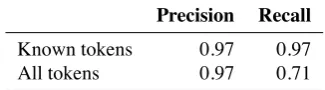
Precision Recall
Known tokens 0.97 0.97
All tokens 0.97 0.71
Table 2:Precision and recall over all tokens and only known tokens. Out of 699 tokens which were checked, the stems of 347 were not in the lexicon.
comparing against a gold standard) that are provided by
the transducer. To calculate precision and recall, it was
necessary to create a hand-verified list of surface forms
and their analyses. We extracted 1,000 unique surface
forms at random from a Wikipedia corpus, and checked
that they were valid words in the languages and
cor-rectly spelled. Where a word was incorcor-rectly spelled or
deemed not to be a form used in the language, it was
discarded.
This list of surface forms was then analysed with the
most recent version of the analyser, and each analysis
was checked. Where an analysis was erroneous, it was
removed; where an analysis was missing, it was added.7
This process gave us a ‘gold standard’ morphologically
analysed word list of 699 forms. The list is publicly
available for each language in Apertium’s SVN
reposi-tory.
We then took the same list of surface forms and ran
them through the morphological analyser once more.
Precision was calculated as the number of analyses
which were found in both the output from the
morpho-logical analyser and the gold standard, divided by the
total number of analyses output by the morphological
analyser.
Recall was calculated as the total number of analyses
found in both the output from the morphological
anal-yser and the gold standard, divided by the number of
analyses found in the morphological analyser plus the
number of analyses found in the gold standard but not
in the morphological analyser.8
The results for precision and recall are presented in
table 2.
6.3 Qualitative
After performing the manual evaluation, we found that
a majority (59.6%) of the missing analyses were nouns
or proper names. For the former class, the missing
anal-yses were often English loanwords; amongst these, we
rejected ones that would not conventionally occur in
7
By this we mean that analyses which the morphological analyser produced which were erroneous were removed from the gold standard in order to be able to determine how fre-quently the analyser produces erroneous analyses.
8
For example, for the surface form wound in En-glish, if the gold standard has {wound<n><sg>,
wind<vblex><pp>, wind<vblex<past>,
wound<vblex><inf>, wound<vblex><pres>} and the output of the morphological analyser is {wound<n><sg>, wound<vblex><inf>,
wound<vblex><pres>} then the recall will be
3 3+2 =
Marathi. Compound nouns were also quite common;
many of these were loanwords from Sanskrit, a
lan-guage with significant compounding, or from
Perso-Arabic. For proper nouns, the missing analyses are
eas-ily explainable by the fact that many foreign names are
not part of the lexicon, and by the fact that we have not
yet split proper names into multiple paradigms: we
as-sume similar inflectional paradigms for all of them.
Amongst the incorrect analyses, a few were due to
our duplication of the-त-tsuffix; we treated it as both
the locative case, and as a postpositional suffix. Both
have exactly the same semantic meaning, and treating
it as a case suffix is largely due to convention and
di-alectal differences. Most other errors were ambiguities
between verbs and nouns. There were also several
er-rors with distinctions between verbal adverbs and
post-positional adverbs; this distinction was removed in
sub-sequent revisions of the analyser.
7
Future work
Most of our future work will involve expanding the size
of the lexicon to improve coverage. Two specific
do-mains, however, would make for interesting future
ex-pansions:
7.1 Apertium
By modifying the morphology standards to fit the
en-tire Indo-Aryan language family, creating rule-based
machine translation systems across Indian languages
would be an interesting future project. The
syn-tactic differences between Indo-Aryan languages are
relatively more minor than the morphological
differ-ences, which make them very suitable to Apertium’s
chunking-based transfer system.
7.2 Universal Dependencies
The Universal Dependencies project (Nivre, 2015) is
a collection of dependency parsed treebanks in several
languages. The ConLL-U format used by UD contains,
along with dependency labelling, fields with
morpho-logical analyses of each word. Using Apertium’s
mor-phological analyser, along with a script to automatically
convert Apertium-style tags to UD-style tags, would
simplify the process of creating a Marathi treebank.
8
Conclusions
We have presented, to our knowledge, the first
free/open-source morphological descriptions for
Marathi. The analyser has reasonable coverage over
two available test corpora, and the precision is high
(over 0.97).
Acknowledgements
We would like to thank the anonymous reviewers for
their insight and helpful comments. We would also like
to thank Memduh Gökırmak for inspiring discussion.
The first author of this paper is funded by a stipend
Column
1 2 3 4 5 6
boWatapaNe AVY avy
wAra basa v
pusakata hAwa adj
tAMgava basava v
anuBavI AVY avy
[image:5.595.307.509.63.175.2]meNekarI BikArI nm
Figure 3:A random sample of entries in WX notation from the LTRC Marathi lexicon. The first column is the stem, the third column is the inflection paradigm name, and the fourth column is the part of speech (avyuninflected,vverb,adj adjective, nmmasculine noun). The second, fifth and sixth columns are not relevant to our work.
from the Erasmus Mundus Language and
Communica-tion Technology programme.
References
Bapat, M., Gune, H., and Bhattacharyya, P. (2010). A
paradigm-based finite state morphological analyzer
for Marathi. InProceedings of the 1st Workshop on
South and Southeast Asian Natural Language
Pro-cessing (WSSANLP), pages 26–34.
Dabre, R., Amberkar, A., and Bhattacharyya, P. (2012).
Morphological analyzer for affix stacking languages:
A case study of Marathi. InCOLING 2012, 24th
In-ternational Conference on Computational
Linguis-tics, Proceedings of the Conference: Posters, 8-15
December 2012, Mumbai, India, pages 225–234.
Dhongade, R. and Wali, K. (2009). Marathi.
Lon-don Oriental and African language library. John
Ben-jamins Publishing Company.
Dixit, V., Dethe, S., and Joshi, R. K. (2005). Design and
implementation of a morphology-based spellchecker
for Marathi, an Indian language.Archives of Control
Sciences, 15:301–308.
Forcada, M. L., Ginestí-Rosell, M., Nordfalk, J.,
O’Regan, J., Ortiz-Rojas, S., Pérez-Ortiz, J. A.,
Sánchez-Martínez, F., Ramírez-Sánchez, G., and
Ty-ers, F. M. (2011). Apertium: a free/open-source
plat-form for rule-based machine translation. Machine
Translation, 25(2):127–144.
Gawade, P., Madhavi, D., Gaikwad, J., Jadhav, S., and
Ambekar, R. (2013). Morphological analyzer for
Marathi using NLP. International Journal of
Engi-neering Research and Applications, 3(2).
Hulden, M. (2009). Foma: a finite-state compiler and
library. In Proceedings of the 12th Conference of
the European Chapter of the Association for
Compu-tational Linguistics: Demonstrations Session, pages
Karimi-Doostan, G. (2005). Light verbs and structural
case. Lingua, 115(12):1737–1756.
Lindén, K., Axelson, E., Hardwick, S., Pirinen, T. A.,
and Silfverberg, M. (2011). Hfst—framework for
compiling and applying morphologies. In
Interna-tional Workshop on Systems and Frameworks for
Computational Morphology, pages 67–85. Springer.
Masica, C. (1993). The Indo-Aryan Languages.
Cam-bridge Language Surveys. Cambridge University
Press.
Nivre, J. (2015). Towards a universal grammar for
nat-ural language processing.Computational Linguistics
and Intelligent Text Processing, 9014:3–16.
Pandharipande, R. (2003). Marathi. In Cardona, G. and
Jain, D., editors,The Indo-Aryan Languages, pages
698–728. Routledge, Abingdon.
Ravishankar, V. (2017). Finite-State
Back-Transliteration for Marathi. The Prague Bulletin of