Multi-task Domain Adaptation for Sequence Tagging
Nanyun Peng and Mark Dredze
Human Language Technology Center of Excellence Center for Language and Speech Processing Johns Hopkins University, Baltimore, MD, 21218 [email protected], [email protected]
Abstract
Many domain adaptation approaches rely on learning cross domain shared represen-tations to transfer the knowledge learned in one domain to other domains. Tradi-tional domain adaptation only considers adapting for one task. In this paper, we explore multi-task representation learning under the domain adaptation scenario. We propose a neural network framework that supports domain adaptation for multiple tasks simultaneously, and learns shared representations that better generalize for domain adaptation. We apply the pro-posed framework to domain adaptation for sequence tagging problems consider-ing two tasks: Chinese word segmenta-tion and named entity recognisegmenta-tion. Exper-iments show that multi-task domain adap-tation works better than disjoint domain adaptation for each task, and achieves the state-of-the-art results for both tasks in the social media domain.
1 Introduction
Many natural language processing tasks have abundant annotations in formal domain (news ar-ticles) but suffer a significant performance drop when applied to a new domain, where only a small number of annotated examples are available. The idea behind domain adaptation is to leverage an-notations from high-resource (source) domains to improve predictions in low-resource (target) do-mains by training a predictor for a single task across different domains.
Domain adaptation work tends to focus on changes in data distributions, e.g. different words are used in each domain. Domain adapta-tion methods include unsupervised (Blitzer et al.,
2006) and supervised (Daum´e III,2007) variants, depending on whether there exists no or some training data in the target domain. This paper con-siders the case of supervised domain adaptation, where we have a limited amount of target domain training data, but much more training data in a source domain.
Work on domain adaptation mostly follows two approaches: parameter tying (i.e. linking simi-lar features during learning) (Dredze and Cram-mer, 2008; Daum´e III, 2007, 2009; Finkel and Manning,2009;Kumar et al.,2010;Dredze et al.,
2010), and learning cross domain representations (Blitzer et al., 2006, 2007; Glorot et al., 2011;
Chen et al., 2012; Yang and Eisenstein, 2015). Often times, domain adaptation is formulated as learning a single model for the same task across domains, although with a focus on maximiz-ing target domain performance. This is simi-lar in spirit to multi-task learning (MTL) ( Caru-ana, 1997) which jointly learns models for sev-eral tasks, for example. learning a single data representation common to each task (Ando and Zhang, 2005; Collobert et al., 2011; Liu et al.,
2016c;Peng and Dredze,2016;Yang et al.,2016;
Liu et al., 2016a). Given the similarity between domain adaptation and MTL, it is natural to ask: can domain adaptation benefit from jointly learn-ing across several tasks?
This paper investigates how MTL can in-duce better representations for domain adaptation. There are several benefits. First, learning multi-ple tasks provides more training data for learning. Second, MTL provides a better inductive learn-ing bias so that the learned representations bet-ter generalize. Third, considering several tasks in domain adaptation opens up the opportunities to adapt from a different domainanda different task, a mismatch setting which has not previously been explored. We present a representation learning
framework based on MTL that incorporates pa-rameter tying strategies common in domain adap-tation. Our framework is based on a bidirec-tional long short-term memory network with a conditional random fields (BiLSTM-CRFs) ( Lam-ple et al.,2016) for sequence tagging. We consider sequence tagging problem since they are common in NLP applications and have been demonstrated to benefit from learning representations (Lample et al.,2016;Yang et al., 2016;Peng and Dredze,
2016;Ma and Hovy,2016).
This paper makes the following contributions: • A neural MTL domain adaptation framework
that considers several tasks simultaneously
when doing domain adaptation.
• A new domain/task mismatch setting: where you have two datasets from two different, but related domains and tasks.
• State-of-the-art results on Chinese word seg-mentation and named entity recognition in social media data.
2 Model
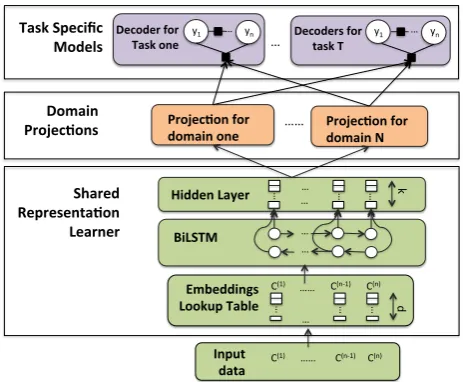
We begin with a brief overview of our model, and then instantiate each layer with specific neural ar-chitectures to conduct multi-task domain adapta-tion for sequence tagging. Figure 1 summarizes the entire model presented in this section.
A representation learner that is shared across all domains and tasks, and learns robust data repre-sentations for features. This feeds a domain pro-jection layer, with one propro-jection for each domain that transforms the learned representations for dif-ferent domains into the same shared space. As a result, the final layer of task specific models, which learns feature weights for different tasks, can be shared across domains since the learned representations (features) for different domains are now in the same space. The framework is flex-ible in both the number of tasks and domains. In-creasing the number of domains linearly increases domain projection parameters, with the number of other model parameters unchanged. Similarly, increasing the number of tasks only linearly in-creases the number of task specific model param-eters. If there is only one domain, then the frame-work reduces to a multi-task learning frameframe-work, and similarly, the framework reduces to a standard domain adaptation framework if there is only one task.
BiLSTM
Hidden Layer k
C(1) …… C(n-1) C(n)
… … …
…
… … …
…
d
Decoder for Task one
… y1 yn
Embeddings Lookup Table
Input data C
(1) …… C(n-1) C(n) Projec@on for
domain one
… Decoders for task T
… …
Projec@on for domain N
……
… y1 yn
…
Shared Representa@on Learner Domain Projec@ons Task Specific
[image:2.595.307.539.61.252.2]Models
Figure 1: An overview of our proposed model framework. The bottom layer is shared by all tasks and domains. The domain projections contain one projection per domain and the task specific models (top layer) contain one model per task.
The shared representation learner, domain pro-jections and task specific models can be instanti-ated based on the application. In this paper, we fo-cus on sequence tagging problems. We now intro-duce our instantiated neural architecture for multi-task domain adaptation for sequence tagging.
2.1 BiLSTM for representation learning
Long short-term memory (LSTM) (Hochreiter and Schmidhuber, 1997) is a type of recurrent neural network (RNN) that models interdependencies in sequential data. It addresses the vanishing or ex-ploding gradients (Bengio et al., 1994; Pascanu et al., 2013) problems of vanilla RNNs by using a series of gates (input, forget and output gates) to control how memory is propagated in the hidden states of the model, and thus effectively captures long-distance dependencies between the inputs.
Many NLP applications use bi-directional LSTMs (BiLSTM) (Dyer et al.,2015) to scan both left-to-right and right-to-left, which capture left and right context. The hidden vectors produced by both LSTMs are concatenated to form the final output vectorht = −→ht⊕←h−t. BiLSTMs have
be-come a common building block for learning rep-resentations in NLP and have achieved impres-sive performance in problems such as sequence tagging (Lample et al., 2016; Yang et al., 2016;
and Huang,2016). We use a BiLSTM as our rep-resentation learner. It produces a hidden vector for each token in the sentence, which we denote as:
ht=BiLSTM(x1:n, t) (1)
where x1:n denotes the whole input sequence of
lengthn, andtdenotes thet-th position. The rep-resentation for the whole sequence is thus denoted ash=h1:n.
2.2 Domain Projections
Domain adaptation requires learning a shared rep-resentation that generalizes across domains. Ide-ally, parameter estimation of the BiLSTM should learn to produce such robust features. However, this may place a heavy burden on the BiLSTM; it does not know the identity of each domain yet must still learns how to map two heterogeneous input types to the same representation. To re-duce this burden, we introre-duce a domain projec-tion layer, which relies on explicit domain spe-cific transformation functions to produce shared representations. We place this transformation be-tween the representation learner and the task spe-cific predictor to alleviates pressure on the repre-sentation learner to learn cross domain representa-tions. Note that the domain projection layer works
jointlywith the representation learner to produce shared representations. We experiment with two simple strategies for domain projections which are based on previous lines of work in domain adapta-tion.
2.2.1 Domain Masks
The first strategy is inspired byDaum´e III(2007) andYang and Hospedales(2015), which split the representations into several regions, with one re-gion shared among domains, and others specific for each domain. As a result, the BiLSTM repre-sentation learner will learn to put the features that are suitable to be shared across domains into the shared region, and domain specific features to the corresponding region for the domain.
We implement this strategy by defining domain masksmd, which is a vector for thedth domain.
The maskmdhas value1for the effective
dimen-sions of domaindand domain shared region, and 0 for all other dimensions. For example, assume we have two domains and a k dimensional hid-den vector for features, the firstk/3-dimensions is shared between the two domains, while thek/3+1 to 2k/3 dimensions are used only for domain 1,
and the remaining dimensions for domain 2. The mask for domain 1 and domain 2 would be:
m1 = [~1,~1,~0], m2 = [~1,~0,~1]. (2)
We can then apply these masks directly to the hid-den vectorshlearned by the BiLSTM to produce a projected hidden statehˆ:
ˆ
h=mdh, (3)
where denotes element-wise multiplication. Since only a subset of the dimensions are used as features in each domain, the BiLSTM will be en-couraged to learn to partition the dimensions of the output hidden vectors into domains.
Note that in Daum´e III (2007), the domain masks operate on hand engineered features, thus only affect feature weights. However, here the do-main masks will change the parameters learned in BiLSTMs as well, changing the learned features. Therefore, training data from one domain will also change the other domains’ representation. When we jointly train with data from all domains, the model has to balance the training objectives for all domains simultaneously.
2.2.2 Linear Projection
The second domain adaptation strategy we explore is a linear transformation to each domain, denoted asTd. Given a k-dimensional vector
representa-tionh,Tdis ak×kmatrix that projects the learned
BiLSTM hidden vector to a common space that can be used by a shared task specific model. We use the transformation:
ˆ
h=Tdh. (4)
We learnTdfor each domain jointly with other
model parameters. While this model has greater freedom in learning representations across do-mains, it relies on the training data to learn a good transformation, and does not explicitly partition the representations into domain regions.
2.3 Task Specific Neural-CRF Models
representations to the desired outputs for the corre-sponding task. Different tasks that define different output spaces need separate task specific models.
For our applications to sequence tagging prob-lems, we choose Conditional Random Fields (CRFs) (Lafferty et al.,2001) as task specific mod-els, since it is widely used in previous work and is shown to benefit from learning representations (Peng and Dredze,2015;Lample et al.,2016;Ma and Hovy, 2016). These “Neural-CRFs” define the conditional probability of a sequence of labels given the input as:
p(yk|xk;W) =
Qn
i=1exp WTF(yik−1, yki, ψ(xk))
Zk ,
whereiindexes the position in the sequence,F is the feature function, andψ(xk)defines a
transfor-mation of the original input, in our caseψ(xk) =
BiLST M(xk). Zk is the partition function
de-fined as:
Zk =X
y∈Y
n
Y
i=1
exp WTF(yk
i−1, yki, ψ(xk)).
2.3.1 Sharing Task Specific Models
We could create a CRF decoder for each task and domain. This is the practice of some (Yang and Hospedales, 2015) who consider domain adapta-tion, or multi-domain learning, a special case of MTL, and learn separate models for the same task from different domains.
Instead, we argue that learning a single model for a task regardless of the number of domains draws strong connections to the traditional domain adaptation literature. It enjoys the benefit of in-creasing the amount of training data for each task by considering different domains, and better han-dles the problem of shifts in data distributions by explicitly considering different domains. There-fore, we use a single CRF pertask, shared across all domains.
3 Parameter Estimation
The proposed neural architecture for multi-task domain adaptation can be trained end-to-end by maximizing data log-likelihood. As there are
D×T 1datasets, the final loss function is a linear
combination of the log-likelihood of each dataset. For simplicity, we give each dataset equal weight when forming the linear combination.
1Ddenotes the number of domains andT the number of
tasks
Training Model training is a straightforward ap-plication of gradient based back-propagation. We use alternating optimization among each dataset with stochastic gradient descent (SGD). To pre-vent training from skewing the model to a specific dataset due to the optimization order, we subsam-ple the number of instances used in each epoch with a fractionλ w.r.t. the smallest dataset size, which is tuned as a hyper-parameter on develop-ment data. A separate learning rate is tuned for each dataset, and we decay the learning rate when results on development data do not improve af-ter 5 consecutive epochs. We train for up to 30 epochs and use early stopping (Caruana et al.,
2001;Graves et al.,2013) as measured on devel-opment data. We select the best model for each dataset based on hyper-parameter tuning. We use dropout on the embeddings and the BiLSTM out-put vectors as inMa and Hovy(2016).
Initialization We use pre-trained Chinese em-beddings provided by Peng and Dredze (2015) with dimension 100. All other model parameters are initialized uniformly at random in the range of [−1,1].
Inference For training the CRFs, we use marginal inference and maximize the marginal probabilities of the labels in the training data. At test time, the label sequence with highest condi-tional probabilityy∗ = arg maxp(y|x; Ω) is ob-tained by MAP inference.
Hyper-parameters Our hyper-parameters in-clude the initial learning rate (per dataset, in the range of [0.005, 0.01, 0.02]), the dropout rate for the input embedding and the hidden vectors (in the range of [0, 0.1, 0.2]), and the subsample coeffi-cient for each setting (in the range of [5, 10, 15]). We tune these hyper-parameter using beam search on development data. For convenience, the em-bedding and the LSTM hidden vector dimensions are set to100and150respectively.
4 Experimental Setup
Dataset #Train #Dev #Test SighanCWS 39,567 4,396 4,278
SighanNER 16,814 1,868 4,636
WeiboCWS 1,600 200 200
[image:5.595.308.524.58.348.2]WeiboNER 1,350 270 270
Table 1: Datasets statistics.
4.1 Datasets
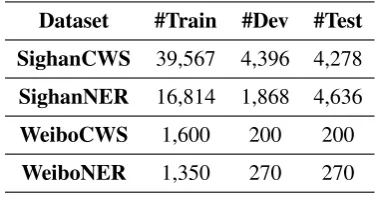
We consider two domains: news and social me-dia for the two tasks: CWS and NER. This re-sults in four datasets: news CWS data comes from the SIGHAN 2005 shared task (SighanCWS) (Emerson,2005), news NER data comes from the SIGHAN 2006 shared task (SighanNER) (Levow,
2006), social CWS data (WeiboSeg) created by
Zhang et al. (2013), and social NER data ( Wei-boNER) created byPeng and Dredze(2015).
BothSighanCWS andSighanNERcontain sev-eral portions2; we use those for simplified
Chi-nese (PKU and MSR respectively). The datasets do not have development data, so we hold out the last10%of training data for development. Sighan-NERcontains three entity types (person, organiza-tion and locaorganiza-tion), whileWeiboNER is annotated with four entity types (person, organization, loca-tion and geo-political entity), including named and nominal mentions. To match the two tag sets, we only use named mentions inWeiboNERand merge geo-political entities and locations. The 2000 an-notated instances in WeiboSeg were meant only for evaluation, so we split the data ourselves us-ing an 8:1:1 split for trainus-ing, development, and test. Hyper-parameters are tuned on the develop-ment data and we report the precision, recall, and F1 score on the test portion. Detailed data statis-tics is shown in Table1.
4.2 Baselines
We consider two baselines common in domain adaptation experiments. The first baseline only considers a single dataset at a time (separate) by trainingseparatemodels just on in-domain train-ing data. The second baseline (mix) uses out-of-domain training data for the same task by mix-ing it with the in-domain data. For both the base-lines, we use the BiLSTM-CRFs neural architec-2The portions are annotated by different institutes, and
cover both traditional and simplified Chinese
0 200 400 600 800 1000 1200
In-domain Training Data Size
72 74 76 78 80 82 84 86 88
Te
st
F1
Separate Domain Adaptation Multi-task Domain Adaptation
(a)
0 200 400 600 800 1000 1200
In-domain Training Data Size
20 30 40 50 60
Te
st
F1
Separate Domain Adaptation Multi-task Domain Adaptation
(b)
Figure 2: The effect of training data size on so-cial media CWS (top) and NER (bottom) tasks. With more in-domain training data we see dimin-ishing returns from domain adaptation. Our pro-posed multi-task domain adaptation framework is also applicable for unsupervised domain adapta-tion (with no in-domain training data).
ture (Lample et al., 2016), which achieved state-of-the-art results on NER and other sequence tag-ging tasks (Peng and Dredze,2016;Ma and Hovy,
2016;Yang et al.,2016).
5 Experimental Results
5.1 Main Results
[image:5.595.86.275.64.166.2]Settings MethodsDatasets Prec RecallCWS F1 Prec RecallNER F1
Baseline SeparateMix 8687..20 8685..17 8686..05 5760..92 4442..01 5148..51
Domain Adapt Domain MaskLinear Projection 8888..70 8787..51 8787..97 6873..32 4548..86 5656..84
[image:6.595.74.527.62.173.2]Multi-task DA Domain MaskLinear Projection 8989..71 8888..36 8988..90 6860..26 5249..53 5957..59
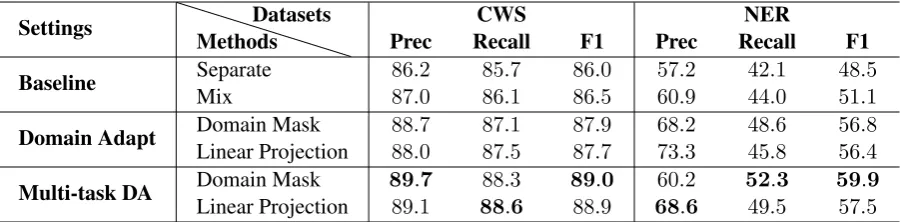
Table 2: Test results for CWS and Chinese NER on the target social media domain. The first two rows are baselines (Section4.2,) followed by two domain adaptation models that only considers one task a time. The last two rows are the proposed multi-task domain adaptation framework building upon the two domain adaptation models, respectively. Domain adaptation models leverage out-of-domain training data andsignificantlyimprove over the Separatebaseline, as well as theMix baseline which trains with the out-of-domain data without considering domain shift. Multi-task domain adaptation furthersignificantly
improves over traditional domain adaptation on both domain adaptation models and achieved the new state-of-the-art results on the two tasks.
addition to domains, we achieve new state-of-the-art results on the two tasks. We compare to the best published results fromZhang et al.(2013) and
Peng and Dredze(2016) with F1 scores of87.5% (CWS) and55.3%(NER), respectively.
Statistical Significance We measures statistical significance using McNemars chi-square test ( Mc-Nemar, 1947) for paired significant test. We treated the predicted spans (not tokens) that agreed with the ground truth as positive, otherwise nega-tive. For the NER task, we only count the spans that corresponds to named entities. We compare the best baseline (mix) and the two domain adapta-tion models, as well as between the domain tation models and their multi-task domain adap-tation counterpart. Both the domain adapadap-tation modelssignificantly improved over themix base-line (p < 0.01), and the multi-task domain adap-tation methods significantly improved over their single task domain adaptation counterpart (p <
0.01). We cannot conduct paired significance tests with the best published results since we do not have access to their outputs.
5.2 In-domain Training Data
We also conducted several experiments to show the flexibility of our multi-task domain adaptation framework and analyze the behavior of the models by varying the training data.
We first consider the effect of in-domain train-ing data size. Figure2 shows the test F1 for the
Separatebaseline which only considers in-domain training data compared with both a single-task
do-main adaptation model and a multi-task dodo-main adaptation model. For simplicity, we only show the curve for the Domain Mask variant. As ex-pected, we observe diminishing returns with addi-tional in-domain training data on both tasks, but domain adaptation and multi-task domain adapta-tion methods suffer less from the diminishing re-turn, especially on the NER task (Figure2a). The curves for domain adaptation and multi-task do-main adaptation also appear to be smoother, as they leverage more data to learn input represen-tations, and thus are more robust.
When we have no in-domain training data, the problem reduces to unsupervised domain adap-tation. Our framework applies here as well, and multi-task domain adaptation achieves perfor-mance close to the Separate baseline with only 200 in-domain training examples.
5.3 Model Variations
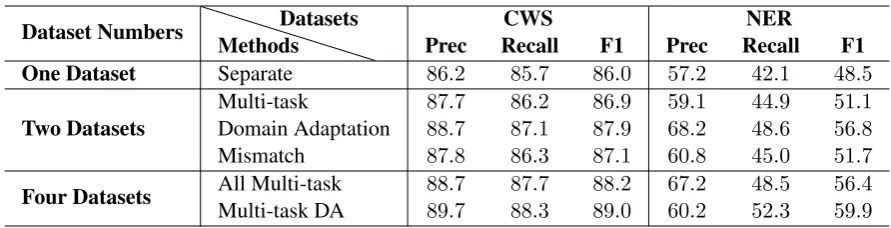
The multi-task domain adaptation framework is flexible regarding the number of domains and tasks, thus the number of datasets. Table3shows the results for several model variations, grouped by the number of training datasets. With one dataset, it is just the standard supervised learning setting, which reduces to ourSeparatebaseline.
Dataset Numbers MethodsDatasets Prec RecallCWS F1 Prec RecallNER F1 One Dataset Separate 86.2 85.7 86.0 57.2 42.1 48.5
Two Datasets Multi-taskDomain Adaptation 8788..77 8786..12 8786..99 5968..21 4844..69 5651..18
Mismatch 87.8 86.3 87.1 60.8 45.0 51.7
[image:7.595.75.521.60.174.2]Four Datasets All Multi-taskMulti-task DA 8889..77 8887..37 8988..20 6760..22 5248..35 5956..49
Table 3: Model variations grouped by number of training datesets.
section of Table 3, including additional training data – no matter from another task, domain or both – always improves the performance. A hidden fac-tor not shown in the table is the additional dataset’s size. For multi-task learning, since we are look at the social media domain, the additional dataset size is small. This is probably the reason why the
Mismatchsetting leveraging data from a different taskanddomain surprisingly outperformed multi-task learning. Domain adaptationenjoys both the benefits of a large amount of additional training data and an aligned task, thus achieving the best results among the two dataset settings.
When conducting multi-task domain adapta-tion, we are leveraging four datasets. One concern is that the performance gains only come from ad-ditional training data, instead of the deliberately designed framework (Joshi et al.,2012). We thus also compare with a strategy which treats the same task for a different domain as a different task. The corresponding neural architecture is a shared BiL-STM with four separate task-specific models: we call it theAll Multi-tasksetting. The results show that explicitly modeling data domains gives ex-tra benefit than blindly throwing in more ex-training data. We found the same benefits when experi-menting with three datasets (instead of 2 or 4).
6 Related Work
The previous work on domain adaptation exclu-sively focused on building a unified model for a
task across domain. However, we argue that a flex-ible framework for domain adaptation on several tasks simultaneously would be beneficial. To the best of our knowledge, the work that is closest to ours is Yang and Hospedales (2015), which pro-vided a unified perspective for multi-task learning and multi-domain learning (a more general case of domain adaptation) under the same perspective of representation learning. However, they only fo-cused on exploring the common ground of
multi-task learning and multi-domain learning, and did not explore the possibility of having multi-task learning to help domain adaptation. We briefly review previous work on domain adaptation and multi-task learning below.
6.1 Domain Adaptation
In domain adaptation, or more general multi-domain learning, the goal is to learn a single model that can produce accurate predictions for multi-ple domains. An important characteristic of learn-ing across domains is that each domain represents data drawn from a different distribution, yet share many commonalities. The larger the difference be-tween these distributions, the larger the general-ization error when learning across domains ( Ben-David et al.,2010;Mansour et al.,2009).
As a result, a long line of work in multi-domain learning concerns learning shared representations, such as through identifying alignments between features (Blitzer et al.,2007,2006), learning with deep networks (Glorot et al., 2011), using trans-fer component analysis (Pan et al.,2011), learning feature embeddings (Yang and Eisenstein, 2015) and kernel methods for learning low dimensional domain structures (Gong et al.,2012), among oth-ers. Another line sought for feature weight tying (Dredze and Crammer, 2008; Daum´e III, 2007,
2009; Finkel and Manning, 2009; Kumar et al.,
2010;Dredze et al.,2010) to transfer the learned feature weights across domains.
We combined the two lines and explored joint learning with multiple tasks.
6.2 Multi-task Learning
The goal of MTL (Caruana, 1997; Ando and Zhang, 2005) is to improve performance on dif-ferent tasks by learning them jointly.
representations for all the tasks, and then a task specific predictor. The representations shared by tasks go from lower level word representations (Collobert and Weston, 2008; Collobert et al.,
2011), to higher level contextual representations learned by Recurrent Neural Networks (RNNs) (Liu et al.,2016b;Yang et al.,2016;Peng et al.,
2017) or other neural architectures (Liu et al.,
2016a;Søgaard and Goldberg,2016;Benton et al.,
2017). MTL has helped in many NLP tasks, such as sequence tagging (Collobert et al.,2011;
Peng and Dredze, 2016; Søgaard and Goldberg,
2016; Yang et al., 2016), text classification (Liu et al.,2016b,a), and discourse analysis (Liu et al.,
2016c).
We expand the spectrum by exploring how multi-task learning can help domain adaptation.
7 Conclusion
We have presented a framework for multi-task domain adaptation, and instantiated a neural ar-chitecture for sequence tagging problems. The framework is composed of a shared representation learner for all datasets, a domain projection layer that learns one projection per domain, and a task-specific model layer that learns one set of feature weights per task. The proposed neural architecture can be trained end-to-end, and achieved the state-of-the-art results for Chinese word segmentation and NER on social media domain.
With this framework in mind, there are several interesting future directions to explore. First, we considered common domain adaptation schemas with our domain mask and linear projection. How-ever, there are many more sophisticated methods that we can consider integrating into our model (Blitzer et al., 2007;Yang and Eisenstein,2015). Second, we only experimented with sequence tag-ging problems. However, the proposed framework is generally applicable to other problems such as text classification, parsing, and machine transla-tion. We plan to explore these applications in the future. Finally, our work draws on two traditions in multi-domain learning: parameter sharing (on the task specific models) and representation learn-ing (the shared representation learner). We plan to explore how other domain adaptation methods can be realized in a deep architecture.
References
Rie Kubota Ando and Tong Zhang. 2005. A framework for learning predictive structures from multiple tasks and unlabeled data. The Journal of Machine Learn-ing Research.
Shai Ben-David, John Blitzer, Koby Crammer, Alex Kulesza, Fernando Pereira, and Jennifer Wortman Vaughan. 2010. A theory of learning from different domains. Machine learning.
Yoshua Bengio, Patrice Simard, and Paolo Frasconi. 1994. Learning long-term dependencies with gradi-ent descgradi-ent is difficult. IEEE Transactions on Neu-ral Networks.
Adrian Benton, Margaret Mitchell, and Dirk Hovy. 2017. Multi-task learning for mental health using social media text. InProceedings of EACL.
John Blitzer, Mark Dredze, Fernando Pereira, et al. 2007. Biographies, bollywood, boom-boxes and blenders: Domain adaptation for sentiment classi-fication. InProceedings of ACL.
John Blitzer, Ryan McDonald, and Fernando Pereira. 2006. Domain adaptation with structural correspon-dence learning. InProceedings of EMNLP.
Rich Caruana. 1997. Multitask learning. Machine learning.
Rich Caruana, vSteve Lawrence, and Lee Giles. 2001. Overfitting in neural nets: Backpropagation, conju-gate gradient, and early stopping. InProceedings of NIPS.
Minmin Chen, Zhixiang Xu, Fei Sha, and Kilian Q Weinberger. 2012. Marginalized denoising autoen-coders for domain adaptation. In Proceedings of ICML.
Ronan Collobert and Jason Weston. 2008. A unified architecture for natural language processing: Deep neural networks with multitask learning. In Pro-ceedings of ICML.
Ronan Collobert, Jason Weston, L´eon Bottou, Michael Karlen, Koray Kavukcuoglu, and Pavel Kuksa. 2011. Natural language processing (almost) from scratch. The Journal of Machine Learning Research .
James Cross and Liang Huang. 2016. Span-based con-stituency parsing with a structure-label system and provably optimal dynamic oracles. InProceedings of EMNLP.
Hal Daum´e III. 2007. Frustratingly easy domain adap-tation. InProceedings of ACL.
Hal Daum´e III. 2009. Bayesian multitask learning with latent hierarchies. InProceedings of UAI.
Mark Dredze, Alex Kulesza, and Koby Crammer. 2010. Multi-domain learning by confidence-weighted pa-rameter combination. Machine Learning.
Chris Dyer, Miguel Ballesteros, Wang Ling, Austin Matthews, and Noah A Smith. 2015. Transition-based dependency parsing with stack long short-term memory. InProceedings of ACL.
Thomas Emerson. 2005. The second international chi-nese word segmentation bakeoff. InProceedings of the fourth SIGHAN workshop on Chinese language Processing.
Jenny Rose Finkel and Christopher D Manning. 2009. Hierarchical bayesian domain adaptation. In Pro-ceedings of NAACL.
Xavier Glorot, Antoine Bordes, and Yoshua Bengio. 2011. Domain adaptation for large-scale sentiment classification: A deep learning approach. In Pro-ceedings of ICML.
Boqing Gong, Yuan Shi, Fei Sha, and Kristen Grau-man. 2012. Geodesic flow kernel for unsupervised domain adaptation. InProceedings of CVPR. Alan Graves, Abdel-rahman Mohamed, and Geoffrey
Hinton. 2013. Speech recognition with deep recur-rent neural networks. InProceedings of ICASSP. Sepp Hochreiter and J¨urgen Schmidhuber. 1997. Long
short-term memory.Neural computation.
Mahesh Joshi, William W Cohen, Mark Dredze, and Carolyn P Ros´e. 2012. Multi-domain learning: when do domains matter? In Proceedings of EMNLP.
Eliyahu Kiperwasser and Yoav Goldberg. 2016. Sim-ple and accurate dependency parsing using bidirec-tional LSTM feature representations. Transactions of the Association for Computational Linguistics. Abhishek Kumar, Avishek Saha, and Hal Daume.
2010. Co-regularization based semi-supervised do-main adaptation. InProceedings of NIPS.
John Lafferty, Andrew McCallum, and Fernando CN Pereira. 2001. Conditional random fields: Prob-abilistic models for segmenting and labeling se-quence data. InProceedings of ICML.
Guillaume Lample, Miguel Ballesteros, Sandeep Sub-ramanian, Kazuya Kawakami, and Chris Dyer. 2016. Neural architectures for named entity recognition. InProceedings of NAACL.
Gina-Anne Levow. 2006. The third international chi-nese language processing bakeoff: Word segmen-tation and named entity recognition. In Proceed-ings of the Fifth SIGHAN Workshop on Chinese Lan-guage Processing.
Pengfei Liu, Xipeng Qiu, and Xuanjing Huang. 2016a. Deep multi-task learning with shared memory. In Proceedings of EMNLP.
Pengfei Liu, Xipeng Qiu, and Xuanjing Huang. 2016b. Recurrent neural network for text classification with multi-task learning. InProceedings of IJCAI.
Yang Liu, Sujian Li, Xiaodong Zhang, and Zhifang Sui. 2016c. Implicit discourse relation classification via multi-task neural networks. InProceedings of AAAI.
Xuezhe Ma and Eduard Hovy. 2016. End-to-end se-quence labeling via bi-directional lstm-cnns-crf. In Proceedings of ACL.
Yishay Mansour, Mehryar Mohri, and Afshin Ros-tamizadeh. 2009. Domain adaptation: Learning bounds and algorithms. InProceedings of COLT.
Quinn McNemar. 1947. Note on the sampling error of the difference between correlated proportions or percentages. Psychometrika12(2):153–157.
Sinno Jialin Pan, Ivor W Tsang, James T Kwok, and Qiang Yang. 2011. Domain adaptation via transfer component analysis. IEEE Transactions on Neural Networks.
Razvan Pascanu, Tomas Mikolov, and Yoshua Bengio. 2013. On the difficulty of training recurrent neural networks. InProceedings of ICML.
Nanyun Peng and Mark Dredze. 2015. Named en-tity recognition for chinese social media with jointly trained embeddings. In Proceedings of EMNLP. Lisboa, Portugal.
Nanyun Peng and Mark Dredze. 2016. Improving named entity recognition for chinese social media with word segmentation representation learning. In Proceedings of ACL.
Nanyun Peng, Hoifung Poon, Chris Quirk, Kristina Toutanova, and Wen-tau Yih. 2017. Cross-sentence n-ary relation extraction with graph lstms. Transac-tions of the Association for Computational Linguis-tics5:101–115.
Anders Søgaard and Yoav Goldberg. 2016. Deep multi-task learning with low level tasks supervised at lower layers. InProceedings of the 54th Annual Meeting of the Association for Computational Lin-guistics. Association for Computational Linguistics, volume 2, pages 231–235.
Yan Xu, Lili Mou, Ge Li, Yunchuan Chen, Hao Peng, and Zhi Jin. 2015. Classifying relations via long short term memory networks along shortest depen-dency paths. InProceedings of EMNLP.
Yi Yang and Jacob Eisenstein. 2015. Unsupervised multi-domain adaptation with feature embeddings. InProceedings of NAACL.
Zhilin Yang, Ruslan Salakhutdinov, and William Co-hen. 2016. Multi-task cross-lingual sequence tag-ging from scratch. arXiv preprint arXiv:1603.06270 .
Longkai Zhang, Li Li, Zhengyan He, Houfeng Wang, and Ni Sun. 2013. Improving chinese word seg-mentation on micro-blog using rich punctuations. In Proceedings of ACL.