Sense Contextualization in a Dependency-Based Compositional
Distributional Model
Pablo Gamallo
Centro Singular de Investigaci´on en Tecnolox´ıas da Informaci´on (CiTIUS) Universidade de Santiago de Compostela, Galiza
Abstract
Little attention has been paid to distribu-tional composidistribu-tional methods which em-ploy syntactically structured vector mod-els. As word vectors belonging to differ-ent syntactic categories have incompatible syntactic distributions, no trivial compo-sitional operation can be applied to com-bine them into a new compositional vec-tor. In this article, we generalize the method described by Erk and Pad´o (2009) by proposing a dependency-base frame-work that contextualize not only lem-mas but also selectional preferences. The main contribution of the article is to ex-pand their model to a fully compositional framework in which syntactic dependen-cies are put at the core of semantic com-position. We claim that semantic compo-sition is mainly driven by syntactic depen-dencies. Each syntactic dependency gen-erates two new compositional vectors rep-resenting the contextualized sense of the two related lemmas. The sequential ap-plication of the compositional operations associated to the dependencies results in as many contextualized vectors as lemmas the composite expression contains. At the end of the semantic process, we do not obtain a single compositional vector rep-resenting the semantic denotation of the whole composite expression, but one con-textualized vector for each lemma of the whole expression. Our method avoids the troublesome high-order tensor representa-tions by defining lemmas and selectional restrictions as first-order tensors (i.e. stan-dard vectors). A corpus-based experiment is performed to both evaluate the quality
of the compositional vectors built with our strategy, and to compare them to other ap-proaches on distributional compositional semantics. The experiments show that our dependency-based compositional method performs as (or even better than) the state-of-the-art.
1 Introduction
Erk and Pad´o (2008) proposed a method in which the combination of two words, a and b, returns two vectors: a vectora’representing the sense of agiven the selectional preferences imposed byb, and a vector b’standing for the sense ofb given the (inverse) selectional preferences imposed bya. The main problem is that this approach does not propose any compositional model for sentences. Its objective is to simulate word sense disambigua-tion, but not to model semantic composition at any level of analysis. In Erk and Pad´o (2009), the au-thors briefly describe an extension of their model by proposing a recursive application of the com-positional function. However, they only formalize the recursive application when the composite ex-pression consits of two dependent words linked to the same head. So, they only explain how the head is contextualized by its dependents, but not the other way around. In addition, they do not model the influence of context on the selectional prefer-ences. In other terms, their recursive model does not make use of contextualized selectional prefer-ences.
In this article, we generalize the method de-scribed in Erk and Pad´o (2009) by proposing a dependency-base framework that contextualize both lemmas and selectional preferences. The main contribution of the article is to expand their model to a fully compositional framework in which syntactic dependencies are put at the core of semantic composition.
In our model, lemmas and selectional prefer-ences are defined as unary-tensors (standard vec-tors), while syntactic dependencies are binary functions combining vectors in an iterative and in-cremental way.
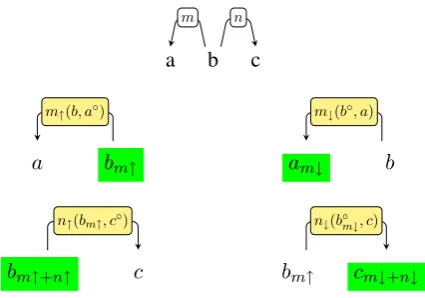
For dealing with any sequence withN (lexical) words andN −1dependencies linking them, the compositional process can be appliedN−1times dependency-by-dependency in two different ways: from left-to-right and from right-to-left. Figure1
illustrates the incremental process of building the sense of words dependency-by-dependency from left-to-right. Given the composite expression “a b c” and its dependency analysis depicted in the first row of the figure, several compositional processes are driven by the two dependencies involved in the analysis (m andn). First, m is decomposed into two functions: the head function m↑, and
the dependent one, m↓. The head function m↑
takes as input the sense of the head word b and the selectional preferences ofa, noted here as a◦,
and returns a new denotation of the head word,
bm↑, which represents the contextualized sense of bgivenaat themrelation. Similarly, the depen-dent function m↓ takes as input the sense of the
dependent wordaand the selectional preferences
b◦, and returns a new denotation of the dependent
word:am↓. The green box is used to highlight the
result of each function. Next, the dependency n
betweenbandcis also decomposed into the head and dependent functions: n↑ and n↓. Function n↑ combines the already contextualized headbm↑
with the selectional preferencesc◦, and returns a
still more specific sense of the head: bm↑+n↑.
Fi-nally, function n↓ takes as input the sense of the
dependent word cand the already contextualized selectional preferencesb◦
m↓, and builds a
contex-tualized sense of the dependent word: cm↓+n↓. At
the end of the process, we have not obtained one single sense for the whole expression “a b c”, but one contextualized sense per word: am↓,bm↑+n↑,
andcm↓+n↓. Notice that the two words involved in
the direct object dependency, b andc, have been contextualized twice since they inherit the restric-tions of the subject dependency. The root word,b, is directly involved in the two dependencies and, then, is assigned an intermediate contextualized sense,bm↑, in the first combination witha.
In the second case, from right-to-left, the se-mantic process is applied in a similar way, but starting from the rightmost dependency, n, and
ending by the leftmost one,m. At the end of the process, three contextualized word senses are also obtained which might be slightly different from those obtained by the left-to-right algorithm. The main difference is thatais now contextualized by bothbandc, whilecis just contextualized byb.
The iterative application of the syntactic depen-dencies found in a sentence is actually the pro-cess of building the contextualized sense of all the content words constituting that sentence. So, the whole sentence is not assigned only one mean-ing - which could be the contextualized sense of therootword-, but one sense per word, being the sense of the root just one of them, as in the work described in Weir et al. (Weir et al., 2016). This allows us to retrieve the contextualized sense of all constituent words within a sentence. The con-textualized sense of any word might be required in further semantic processes, namely for dealing with co-reference resolution involving anaphoric pronouns. Such an elementary operation is pre-vented if the sense of the phrase is just one com-plex sense, as in most compositional approaches.
The rest of the article is organized as follows. In Section2, several distributional compositional approaches are introduced and discussed. Next, in Section3, our dependency-based compositional model is described. In Section4, a corpus-based experiment is performed to build and evaluate the quality of compositional vectors. Finally, relevant conclusions are addressed in Section5.
2 Related Work
To take into account “the mode of combination”, some distributional approaches follow a strategy aligned with the formal semantics perspective in which functional words are represented as high-dimensional tensors (Coecke et al., 2010;Baroni and Zamparelli, 2010; Grefenstette et al., 2011;
Krishnamurthy and Mitchell,2013;Kartsaklis and Sadrzadeh, 2013; Baroni, 2013; Baroni et al.,
a b c
m n
a bm↑
m↑(b, a◦)
am↓ b
m↓(b◦, a)
bm↑+n↑ c
n↑(bm↑, c◦)
bm↑ cm↓+n↓
[image:3.595.192.405.59.208.2]n↓(b◦m↓, c)
Figure 1: Syntactic analysis of the expression“a b c”and left-to-right construction of the contextualized word senses.
of arguments determining their order. Function application is the general composition operation. This is formalized as the tensor product, which is nothing more than a generalization of matrix mul-tiplication in higher dimensions. However, this method results in an information scalability prob-lem, since tensor representations grow exponen-tially (Kartsaklis et al.,2014).
In our approach, by contrast, we operate with only two types of semantic objects: first-order ten-sors (or standard vectors) for lemmas and pref-erences, and second-order functions for syntactic dependencies. This solves the scalability problem of high-order tensors. In addition, it also prevent us giving different categorical representations to verbs in different syntactic contexts. A verb is rep-resented as a single vector which is contextualized as it is combined with its arguments.
Some of the approaches cited above induce the compositional meaning of the functional words from examples adopting regression techniques commonly used in machine learning (Baroni and Zamparelli, 2010; Krishnamurthy and Mitchell,
2013;Baroni,2013;Baroni et al., 2014). In our approach, by contrast, functions associated with dependencies are just basic arithmetic operations on vectors, as in the case of the first arithmetic approaches to composition (Mitchell and Lapata,
2008,2009,2010;Guevara,2010;Zanzotto et al.,
2010). Arithmetic approaches are easy to imple-ment and produce high-quality compositional vec-tors, which makes them a good choice for practical applications (Baroni et al.,2014).
However, given that our vector space is struc-tured and enriched with syntactic information, the vectors built by composition cannot be a
sim-ple mixture of the input vectors as in the bag-of-words approaches (Mitchell and Lapata,2008). Our syntax-based vector representation of two re-lated words encodes incompatible information and there is no direct way of combining the informa-tion encoded in their respective vectors. Vectors of content words (nouns, verbs, adjectives, and ad-verbs) live into different and incompatible spaces because they are constituted by different types of syntactic contexts. So, they cannot be merged. To combine them, on the basis of previous work (Thater et al.,2010;Erk and Pad´o,2008;Melamud et al.,2015), we distinguish between direct deno-tation and selectional preferences within a depen-dency relation. Our approach is an attempt to join the main ideas of these syntax-based and struc-tured vector space models into an entirely compo-sitional model. More precisely, we generalize the recursive model introduced by Erk and Pado (Erk and Pad´o,2009) with the addition of contextual-ized selection preferences.
Finally, recent works make use of deep learn-ing strategies to build compositional vectors, such as recursive neural network models (Socher et al.,
2012; Hashimoto and Tsuruoka, 2015). Still in the deep learning paradigm, special attention de-serves a syntax-based compositional version of C-BOW algorithm (Pham et al.,2015). Our method, however, requires transparent and structured vec-tor spaces to model compositionality.
3 The Method
func-tion and the dependent one. Let us consider the nominal subject syntactic dependency, which de-notes two functions represented by the following binaryλ-expressions:
λxλy◦ nsubj↑(x,y◦) (1) λx◦λy nsubj
↓(x◦,y) (2)
wherensubj↑ andnsubj↓ represent the head and
dependent functions, respectively; x, x◦, y, and y◦ stand for vector variables. On the one hand, xandyrepresent the denotation of the head and dependent lemmas, respectively. They represent standard context distributions. On the other hand,
x◦ represents the selectional preferences imposed
by the head, while y◦ stands for the selectional
preferences imposed by the dependent lemma. Se-lectional preferences are also vectors and the way we build them is described later.
Consider now the vectors of two specific lem-mas, cat and chase, and their respective selec-tional preferences at the subject position. Each function application consists of multiplying the di-rect vector associated with a lemma and the selec-tional preferences imposed by the other lemma:
nsubj↑(chase,cat◦) =chasecat◦=chasensubj↑ (3)
nsubj↓(chase◦,cat) =catchase◦=catnsubj↓ (4)
Each multiplicative operation results in a com-positional vector which represents the contextual-ized sense of one of the two lemmas (either the head or the dependent). Component-wise multi-plication has an intersective effect: the selectional preferences restricts the direct vector by assigning frequency 0 to those contexts that are not shared by both vectors. Here, cat◦ andchase◦ are
se-lectional preferences resulting from the following vector addition:
cat◦ = X
w∈S↓(cat)
w (5)
chase◦ = X
w∈S↑(chase)
w (6)
whereS↓(cat)returns the vector set of those verbs
having cat as subject (except the verb chase).
More precisely, given the nominal subject posi-tion, the new vector cat◦ is obtained by adding
the vectors{w|w∈S↓(cat)}of those verbs (eat,
jump, etc) that are combined with the nouncatin that syntactic context. Component-wise addition of vectors has an union effect. In more intuitive terms,cat◦stands for the inverse selectional
pref-erences imposed by cat on any verb at the sub-ject position. As this new vector consists of ver-bal contexts, it lives in the same vector space than verbs and, therefore, it can be combined with the direct vector ofchase.
On the other hand,S↑(chase)in equation6
rep-resents the vector set of nouns occurring as sub-jects of chase (except the noun cat). Given the subject position, the vectorchase◦is obtained by adding the vectors{w|w ∈ S↑(chase)}of those
nouns (e.g. dog, man,tiger, etc) that might be at the subject position of the verbchase.
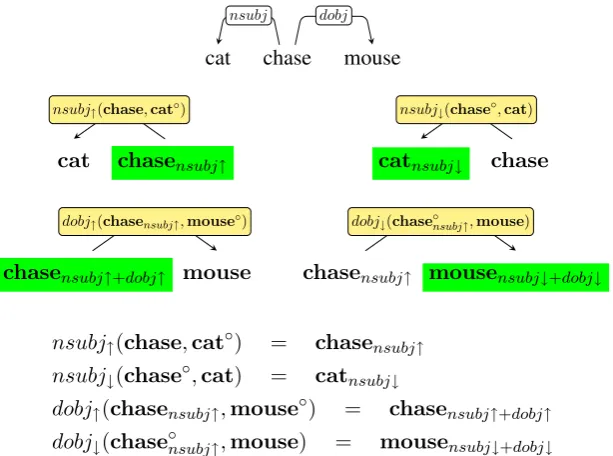
The incremental application of head and de-pendent functions contextualize the representa-tion of each word in the phrase. Incremental-ity also model the influence of context on the selectional preferences. The incremental left-to-right interpretation of“the cat chased a mouse” is illustrated in Figure2(without considering the meaning of determiners nor verbal tense): First, the head and dependent functions associated with the subject dependencynsubjbuild the composi-tional vectorschasensubj↑ andcatnsubj↓. Then,
the head function associated withdobjproduces a more elaborate chasing event,chasensubj↑+dobj↑,
which stands for the final contextualized sense of the root verb. In addition, the dependent function of dobj yields a new nominal vector,
mousensubj↓+dobj↓, whose internal information
only can refer to a specific animal: “the mouse chased by the cat”. Notice that contextualization may disambiguate ambiguous words: in the con-text of a chasing event,mousedoes not refer to a computer’s device. In fact, to interpret “the cat chased a mouse”, it is required to interpret “cat chased” as a fragment that restricts the type of nouns that can appear at the direct object position: mouse, rat, bird, etc. In the same way “police chases”restricts the entities that can be chased by police officers:thieves,robbers, and so on.
cat chase mouse nsubj dobj
cat chasensubj↑
nsubj↑(chase,cat◦)
catnsubj↓ chase
nsubj↓(chase◦,cat)
chasensubj↑+dobj↑ mouse
dobj↑(chasensubj↑,mouse◦)
chasensubj↑ mousensubj↓+dobj↓
dobj↓(chase◦nsubj↑,mouse)
nsubj↑(chase,cat◦) = chasensubj↑ nsubj↓(chase◦,cat) = catnsubj↓
[image:5.595.147.454.60.288.2]dobj↑(chasensubj↑,mouse◦) = chasensubj↑+dobj↑ dobj↓(chase◦nsubj↑,mouse) = mousensubj↓+dobj↓
Figure 2: Syntactic analysis of the expression“the cat chased a mouse”and left-to-right construction of the contextualized word senses.
chase◦nsubj↑, are obtained as follows:
chase◦nsubj↑ = catnsubj↓
X
w∈D↑(chase) w
(7) where D↑(chase) returns the vector set of those
nouns that are in the direct object role of chase (except the noun mouse). The new vector result-ing by this addition is combined by multiplication (intersection) with the contextualized dependent vector, catnsubj↓, to build the contextualized
se-lectional preferences. In more intuitive terms, the selectional preferences built in equation7are con-stituted by selecting the contexts of the nouns ap-pearing as direct object ofchase, which are also part ofcatafter having been contextualized by the verb at the subject position. This is the major con-tribution with regard to the work described in Erk and Pad´o (2009).
The dependency-by-dependency functional application results in three contextualized word senses: catnsubj↓, chasensubj↑+dobj↑ and mousensubj↓+dobj↓. They all together represent
the meaning of the sentence in the left-to-right direction.
In the opposite direction, from right-to-left, the incremental process starts with the direct object dependency:
dobj↑(chase,mouse◦) =chasedobj↑ dobj↓(chase◦,mouse) =mousedobj↓
nsubj↑(chasedobj↑,cat◦) =chasedobj↑+nsubj↑ nsubj↓(chase◦dobj↑,cat) =catdobj↓+nsubj↓
(8)
In Equation 8, the verbchaseis first restricted by mouse at the direct object position, and then by its subject cat. In addition, this noun is re-stricted by the vector chase◦
dobj↓, which
repre-sents the contextualized selectional preferences built by combiningmousedobj↓ with the vectors
of the nouns that are in the subject position of chase(except cat). This new compositional vec-tor represents a very contextualized nominal con-cept:“the cat that chased a mouse”. The wordcat and its specific sense can be related to anaphorical expressions by making use of co-referential rela-tionships at the discourse level: e.g., pronoun it, other definite expressions (“that cat”,“the cat”), and so on.
4 Experiments
incre-mentally composed with nsubj and dobj depen-dencies.
4.1 The Corpus and the Structured Vector Model
Our working corpus consists of both the English Wikipedia (dump file of November 20151) and the
British National Corpus (BNC)2. In total, the
cor-pus contains about 2.5 billion word tokens. We used the rule-based dependency parser DepPattern (Gamallo and Gonz´alez,2011;Gamallo,2015) to perform syntactic analysis on the whole text.
Word vectors were built by computing their co-occurrences in syntactic contexts. Two dif-ferent types of vectors were built from the cor-pus: nominal and verbal vectors. Then, for each word we filtered out non relevant contexts using simple count-based techniques inspired by those described in (Bordag, 2008; Padr´o et al., 2014;
Gamallo,2016), where matrices are stored in hash tables with only non-zero values. More precisely, the association between words and their contexts were weighted with the Dunning’s likelihood ra-tio (Dunning,1993) and then, for each word, only theNcontexts with highest likelihood scores were stored in the hash table (whereN = 500). So, the remaining contexts were removed from the hash (in standard vector/matrix representations, instead of removing contexts we should assign them zero values).
The process of matrix reduction resulted in the selection of330,953nouns (most of them proper names) with236,708different nominal contexts; and 6,618 verbs with 140,695 different verbal contexts. As the contexts of nouns and verbs are not compatible, we created two different vec-tor spaces. Words and their contexts were svec-tored in two hashes, one per vector space, which rep-resent matrices containing only non-zero values. To build compositional vectors from these matri-ces, the strategy defined in the previous section was implemented in PERL giving rise to the soft-wareDepfunc3. Distributional similarity between
pairs of composite expressions was performed us-ingCosine.
1https://dumps.wikimedia.org/enwiki/ 2http://www.natcorp.ox.ac.uk
3Software and models are available at http:// gramatica.usc.es/˜gamallo/prototypes.htm
4.2 NVN Composite Expressions
This experiment consists of evaluating the qual-ity of compositional vectors built by means of the consecutive application of head and dependency functions associated with nominal subject and di-rect object. The experiment is performed on the dataset developed by Grefenstette and Sadrzadeh (2011a). The dataset was built using transi-tive verbs paired with subjects and direct objects: NVN composites.
Given our compositional strategy, we are able to compositional build several vectors that some-how represent the meaning of the whole NVN composite expression. Take the expression “the coach runs the team”. If we follow the left-to-right strategy (notednv-n), at the end of the com-positional process, we obtain two fully contextu-alized senses:
nv-n head The sense of the headrun, as a result of being contextualized first by the prefer-ences imposed by the subject and then by the preferences required by the direct object. We notenv-n headthe final sense of the head in a NVN composite expression following the left-to-right strategy.
nv-n dep The sense of the object team, as a re-sult of being contextualized by the prefer-ences imposed by run previously combined with the subjectcoach. We notenv-n depthe final sense of the direct object in a NVN com-posite expression following the left-to-right strategy.
If we follow the right-to-left strategy (noted n-vn), at the end of the compositional process, we obtain two fully contextualized senses:
n-nv head The sense of the headrunas a result of being contextualized first by the preferences imposed by the object and then by the sub-ject.
n-nv dep The sense of the subject coach, as a result of being contextualized by the prefer-ences imposed by run previously combined with the objectteam.
Systems ρ
non-compositional (V) 0.27
Depfunc (nv head) 0.33
Depfunc (nv dep) 0.19
Depfunc (vn head) 0.36
Depfunc (vn dep) 0.38
Depfunc (nv-n head+dep) 0.35
Depfunc (nv-n head) 0.33
Depfunc (nv-n dep) 0.20
Depfunc (n-vn head+dep) 0.46 Depfunc (n-vn head) 0.36
Depfunc (n-vn dep) 0.42
Depfunc (n-vn+nv-n) 0.44
Grefenstette and Sadrzadeh (2011) 0.28
Hashimoto and Tsuruoka (2014) 0.43
[image:7.595.93.265.58.228.2]Polajnar et al. (2015) 0.35
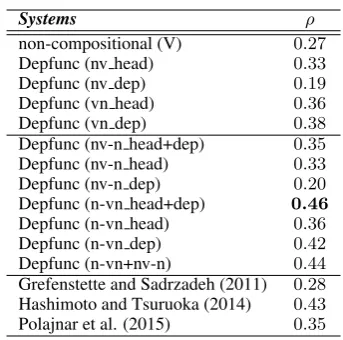
Table 1: Spearman correlation for transitive ex-pressions using the benchmark by Grefenstette and Sadrzadeh (2011)
head and dependent similarity values derived from the n-vn(right-to-left) strategy. Let us note that, for NVN composite expressions, the left-to-right strategy seems to build less reliable compositional vectors than the right-to-left counterpart. Besides, the combination of the two strategies (n-vn+nv-n) does not improve the results of the best one (n-vn).4
The score value obtained by our n-vn head+dep right-to-left strategy outperforms other systems tested for this dataset:Grefenstette and Sadrzadeh
(2011b); Polajnar et al. (2015), which are two works based on the categorical compositional dis-tributional model of meaning of Coecke et al.
(2010), and the neural network strategy described inHashimoto and Tsuruoka(2015).
At the top of Table 1, we show the non-compositional baseline we have created for this dataset: similarity beteween single verbs. The table also shows four intermediate values result-ing from comparresult-ing partial compositional con-structions: the noun-verb (nv head and nv dep) and the verb-noun (vn headandvn dep) combina-tions. Two interesting remarks can be made from these values when they are compared with the full compositional constructions.
First, there is no clear improvement of perfor-mance if we compare the full compositional infor-mation of the two transitive constructions with the partial combinations. On the one hand, the full nv-nconstruction does not improve the scores ob-tained by the partial intransitivenv. On the other
4n-vn+nv-nis computed by averaging the similarities of bothn-vn head+depandnv-n head+dep
hand, n-vn performs slightly better than vn but only in the case of the dependent function which makes use of contextualized selectional prefer-ences: n-vn dep= 0.42 /vn dep= 0.38. The low performance at the second level of composition might call into question the use of contextualized vectors to build still more contextualized senses. The scarcity problem derived from the recursive combination of contextualized vectors is an impor-tant issue which could be faced with more corpus, and which we should analyze with more complex evaluation tests.
The second remark is about the difference be-tween the two algorithms: left-to-righ and right-to-left. The scores achieved by the left-to-right algorithm (nv,nv-n) are clearly below those achieved by right-to-left (vn,n-vn) . This might be due to the weak semantic motivation of the selec-tional preferences involved in the subject depen-dency of transitive constructions in comparison to the direct object one. In fact, right-to-left and left-to-right function application produces quite differ-ent vectors because each algorithm corresponds to a particular hierarchy of constituents. Change of constituency implies different semantic entail-ments such as we can easily observe if we consider the different levels of constituency of noun mod-ifiers (e.g. “fastest American runner”6= “Amer-ican fastest runner”). Finally, the poor results of nvin this dataset might be explained because the subject role is less meaningful in transitive clauses than in intransitive ones. The subject of intransi-tive clauses is assigned a complex semantic role that tends to merge the notions of agent and pa-tient. By contrast, the subject of transitive con-structions tends to be just the agent of an action with an external patient.
5 Conclusions
In this paper, we described a distributional compo-sitional model based on a transparent and syntacti-cally structured vector space. The combination of two related lemmas gives rise to two vectors which represent the senses of the two contextualized lem-mas. This process can be repeated until no syntac-tic dependency is found in the analyzed composite expression. The compositional interpretation of a composite expression builds the sense of each con-stituent lemma in an incremental way.
compositional and non-compositional expressions (collocations, compounds, or idioms). It seems to be obvious that vectors of full compositional units should be built by means of compositional oper-ations and predictions based on their constituent vectors. It is also evident that vectors of entirely frozen expressions should be totally derived from corpus co-occurrences of the whole expressions without considering internal constituency. How-ever, there are many expressions, in particular col-locations (such as“save time”,“go mad”,“heavy rain”, . . . ) which can be considered as both com-positional and non-comcom-positional. In those cases, it is not clear which is the best method to build their distributional representation: predicted tors by compositionality or corpus-observed vec-tors of the whole expression?
Another problem that has not been considered is how to represent the semantics of some gram-matical words, namely determiners and auxiliary verbs (i.e., noun and verb specifiers). For this pur-pose, we think that it would be required a different functional approach, probably closer to the work described by Baroni (2014), who defines functions as linear transformations on vector spaces.
Finally, as we have outlined above, generated vectors tend to be too scarce when they are derived from the recursive combination of already contex-tualized vectors. Further experiments with more complex phrases and larger training corpora are required in order to deeply analyse this issue. For this purpose, we will explore the strategy defined in Kober et al. (2016) to improve sparse distribu-tional representations.
In current work, we are defining richer semantic word models by combining WordNet features with semantic spaces based on distributional contexts (Gamallo and Pereira-Fari˜na,2017). This hybrid method might also help overcome scarcity.
Acknowledgments
This work has received financial support from a 2016 BBVA Foundation Grant for Researchers and Cultural Creators, TelePares (MINECO, ref:FFI2014-51978-C2-1-R), the Conseller´ıa de Cultura, Educaci´on e Ordenaci´on Universitaria (accreditation 2016-2019, ED431G/08) and the European Regional Development Fund (ERDF).
References
Marco Baroni. 2013. Composition in distributional se-mantics. Language and Linguistics Compass7:511– 522.
Marco Baroni, Raffaella Bernardi, and Roberto Zam-parelli. 2014. Frege in space: A program for compo-sitional distributional semantics.LiLT9:241–346. Marco Baroni and Roberto Zamparelli. 2010. Nouns
are vectors, adjectives are matrices: Representing adjective-noun constructions in semantic space. In Proceedings of the 2010 Conference on Empirical
Methods in Natural Language Processing.
Strouds-burg, PA, USA, EMNLP’10, pages 1183–1193. Stefan Bordag. 2008. A Comparison of Co-occurrence
and Similarity Measures as Simulations of Context. In9th CICLing. pages 52–63.
B. Coecke, M. Sadrzadeh, and S. Clark. 2010. Math-ematical foundations for a compositional distribu-tional model of meaning. Linguistic Analysis 36(1-4):345–384.
Ted Dunning. 1993. Accurate methods for the statistics of surprise and coincidence. Computational Lin-guistics19(1):61–74.
Katrin Erk and Sebastian Pad´o. 2008. A structured vec-tor space model for word meaning in context. In
Proceedings of EMNLP. Honolulu, HI.
Katrin Erk and Sebastian Pad´o. 2009. Paraphrase as-sessment in structured vector space: Exploring pa-rameters and datasets. InProceedings of the EACL Workshop on Geometrical Methods for Natural
Lan-guage Semantics. Athens, Greece.
Pablo Gamallo. 2015. Dependency parsing with com-pression rules. InInternational Workshop on Pars-ing Technology (IWPT 2015). Bilbao, Spain. Pablo Gamallo. 2016. Comparing explicit and
predic-tive distributional semantic models endowed with syntactic contexts. Language Resources and Eval-uationFirst online: 13 May 2016.
Pablo Gamallo and Isaac Gonz´alez. 2011. A grammat-ical formalism based on patterns of part-of-speech tags. International Journal of Corpus Linguistics 16(1):45–71.
Pablo Gamallo and Mart´ın Pereira-Fari˜na. 2017. Com-positional semantics using feature-based models from wordnet. In 1st Workshop on Sense, Con-cept and Entity Representations and their Applica-tions, co-located at 15th Conference of the European Chapter of the Association for Computational Lin-guistics. Association of Computational Linguistics (ACL), pages 1–10.
Edward Grefenstette and Mehrnoosh Sadrzadeh. 2011b. Experimenting with transitive verbs in a dis-cocat. InWorkshop on Geometrical Models of
Nat-ural Language Semantics (EMNLP-2011).
Edward Grefenstette, Mehrnoosh Sadrzadeh, Stephen Clark, Bob Coecke, and Stephen Pulman. 2011. Concrete sentence spaces for compositional distri-butional models of meaning. InProceedings of the Ninth International Conference on Computational
Semantics. IWCS ’11, pages 125–134.
Emiliano Guevara. 2010. A regression model of adjective-noun compositionality in distributional se-mantics. In Proceedings of the 2010 Workshop on GEometrical Models of Natural Language Seman-tics. GEMS ’10.
Kazuma Hashimoto and Yoshimasa Tsuruoka. 2015. Learning embeddings for transitive verb disambiguation by implicit tensor
factoriza-tion. In Proceedings of the 3rd Workshop on
Continuous Vector Space Models and their
Compositionality. Association for
Computa-tional Linguistics, Beijing, China, pages 1–11. http://www.aclweb.org/anthology/W15-4001.
Dimitri Kartsaklis. 2014. Compositional operators in distributional semantics. Springer Science Reviews 2(1-2):161–177.
Dimitri Kartsaklis, Nal Kalchbrenner, and Mehrnoosh Sadrzadeh. 2014. Resolving lexical ambiguity in tensor regression models of meaning. In Proceed-ings of the 52nd Annual Meeting of the Associa-tion for ComputaAssocia-tional Linguistics (Vol. 2: Short Papers). Association for Computational Linguistics, Baltimore, USA, pages 212–217.
Dimitri Kartsaklis and Mehrnoosh Sadrzadeh. 2013. Prior disambiguation of word tensors for construct-ing sentence vectors. InConference on Empirical Methods in Natural Language Processing (EMNLP 2013).
Thomas Kober, Julie Weeds, Jeremy Reffin, and David J. Weir. 2016. Improving sparse word rep-resentations with distributional inference for se-mantic composition. In Proceedings of EMNLP
2016, Austin, Texas, USA. pages 1691–1702.
http://aclweb.org/anthology/D/D16/D16-1175.pdf.
Jayant Krishnamurthy and Tom Mitchell. 2013. Pro-ceedings of the Workshop on Continuous Vector
Space Models and their Compositionality,
Associ-ation for ComputAssoci-ational Linguistics, chapter Vector Space Semantic Parsing: A Framework for Compo-sitional Vector Space Models, pages 1–10.
Oren Melamud, Ido Dagan, and Jacob Gold-berger. 2015. Modeling word meaning in con-text with substitute vectors. In NAACL HLT
2015, Denver, Colorado, USA. pages 472–482.
http://aclweb.org/anthology/N/N15/N15-1050.pdf.
Jeff Mitchell and Mirella Lapata. 2008. Vector-based models of semantic composition. InProceedings of
ACL-08: HLT. pages 236–244.
Jeff Mitchell and Mirella Lapata. 2009. Language models based on semantic composition. In
Proceed-ings of EMNLP. pages 430–439.
Jeff Mitchell and Mirella Lapata. 2010. Composition in distributional models of semantics. Cognitive Sci-ence34(8):1388–1439.
Muntsa Padr´o, Marco Idiart, Aline Villavicencio, and Carlos Ramisch. 2014. Nothing like good old fre-quency: Studying context filters for distributional thesauri. In Proceedings of EMNLP 2014, Doha,
Qatar. pages 419–424.
Nghia The Pham, Germ´an Kruszewski, Angeliki Lazaridou, and Marco Baroni. 2015. Jointly op-timizing word representations for lexical and sen-tential tasks with the C-PHRASE model. In Pro-ceedings of the 53rd Annual Meeting of the Associ-ation for ComputAssoci-ational Linguistics and the 7th In-ternational Joint Conference on Natural Language Processing of the Asian Federation of Natural Lan-guage Processing, ACL 2015, July 26-31, 2015, Bei-jing, China, Volume 1: Long Papers. pages 971–981. http://aclweb.org/anthology/P/P15/P15-1094.pdf. Tamara Polajnar, Laura Rimell, and Stephen Clark.
2015. An exploration of discourse-based sentence spaces for compositional distributional semantics.
In Proceedings of the First Workshop on Linking
Computational Models of Lexical, Sentential and
Discourse-level Semantics. Association for
Compu-tational Linguistics, Lisbon, Portugal, pages 1–11. http://aclweb.org/anthology/W15-2701.
Richard Socher, Brody Huval, Christopher D. Manning, and Andrew Y. Ng. 2012. Seman-tic compositionality through recursive matrix-vector spaces. In Proceedings of the
EMNLP-CoNLL’12. Association for Computational
Lin-guistics, Stroudsburg, PA, USA, pages 1201–1211. http://dl.acm.org/citation.cfm?id=2390948.2391084. Stefan Thater, Hagen F¨urstenau, and Manfred Pinkal.
2010. Contextualizing semantic representations us-ing syntactically enriched vector models. In Pro-ceedings of the 48th Annual Meeting of the Asso-ciation for Computational Linguistics. Stroudsburg, PA, USA, pages 948–957.
David J. Weir, Julie Weeds, Jeremy Reffin, and Thomas Kober. 2016. Aligning packed dependency trees: A theory of composition for distributional semantics.
Computational Linguistics42(4):727–761.
Fabio Massimo Zanzotto, Ioannis Korkontzelos, Francesca Fallucchi, and Suresh Manandhar. 2010. Estimating linear models for compositional distribu-tional semantics. InProceedings of the 23rd
Inter-national Conference on Computational Linguistics.