Structured Learning for Context-aware
Spoken Language Understanding of Robotic Commands
Andrea Vanzo† and Danilo Croce‡ and Roberto Basili‡ and Daniele Nardi† †Sapienza University of Rome
Dept. of Computer, Control and Management Engineering “Antonio Ruberti”
‡University of Roma, Tor Vergata
Dept. of Enterprise Engineering
{vanzo,nardi}@dis.uniroma1.it,{croce,basili}@info.uniroma2.it
Abstract
Service robots are expected to operate in specific environments, where the presence of humans plays a key role. A major fea-ture of such robotics platforms is thus the ability to react to spoken commands. This requires the understanding of the user ut-terance with an accuracy able to trigger the robot reaction. Such correct interpretation of linguistic exchanges depends on physi-cal, cognitive and language-dependent as-pects related to the environment. In this work, we present the empirical evaluation of an adaptive Spoken Language Under-standing chain for robotic commands, that explicitly depends on the operational en-vironment during both the learning and recognition stages. The effectiveness of such a context-sensitive command inter-pretation is tested against an extension of an already existing corpus of commands, that introduced explicit perceptual knowl-edge: this enabled deeper measures prov-ing that more accurate disambiguation ca-pabilities can be actually obtained.
1 Introduction
In recent years, one of the most challenging issues that Service Robotics is facing is the automation of high level and collaborative interactions between humans and robots. In such a robotic context, hu-man language is the most natural way of commu-nication as for its expressiveness and flexibility. However, an effective communication in natural language between humans and robots is challeng-ing mostly for the different cognitive abilities it in-volves. For a robot to react to a simple command like “take the mug in the kitchen”, a number of implicit assumptions should be met. First, at least
two entities, amugand a kitchen, must exist in the environment and the speaker must be aware of such entities. Accordingly, the robot must have access to an inner representation of its world, e.g., an explicit map of the environment. Second, map-pings from lexical references to real world entities must be developed or made available. In this re-spect, theGroundingprocess (Harnad,1990) links symbols (e.g., words) to the corresponding percep-tual information. Hence, robot interactions need to begrounded, as meaning depends on the state of the physical world and the interpretation cru-cially interplays with perception, as pointed out by psycho-linguistic theories (Tanenhaus et al.,
1995). The integration of perceptual information derived from the robot’s sensors with an onto-logically motivated description of the world has been adopted as an augmented representation of the environment, in the so-called semantic maps (N¨uchter and Hertzberg,2008). In these maps, the existence of real world objects can be associated tolexicalinformation, in the form of entity names given by a knowledge engineer or spoken by a user for a pointed object, as in Human-Augmented Mapping (Diosi et al., 2005; Gemignani et al.,
2016). While Command Interpretation for Inter-active Robotics has been mostly carried out over the only evidence specific to the linguistic level (see, for example, (Chen and Mooney,2011; Ma-tuszek et al.,2012)), we argue that a proper Spo-ken Language Understanding (SLU) for Human-Robot Interaction should be context-aware, in the sense that both the user and the robot live in and make references to a shared environment. For ex-ample, in the above command, “taking” is the in-tended action whenever a mug is actually in the kitchen, so that “the mug in the kitchen” refers to a single argument. On the contrary, the command may refer to a “bringing” action, when no mug is in the kitchen and the mug andin the kitchen
correspond to different semantic roles. We are in-terested in an approach for the interpretation of robotic spoken commands that is consistent with (i) the world (with all the entities composing it), (ii) the Robotic Platform (with its inner represen-tations and capabilities), and (iii) the linguistic in-formation derived from the user’s utterance.
In this paper, we foster machine learning methodologies for Spoken Language Understand-ing that force the above research perspective: this is obtained by extending the linguistic evidence that can be extracted from the uttered commands with perceptual evidence directly derived by the semantic map of a robot. In particular, the in-terpretation process is modeled as a sequence la-beling problem where the final labeler is trained by applying Structured Learning methods over re-alistic commands expressed in domestic environ-ments, as in (Bastianelli et al., 2017). The re-sulting interpretations adhere to Frame Seman-tics (Fillmore, 1985): this well-established the-ory provides a strong linguistic foundations to the overall process while enforcing its applicability, as it is made independent of the vast plethora of existing robotic platforms. Such methodologies have been implemented in a free and ready-to-use framework, here presented, whose name isLU4R - an adaptive spoken Language Understanding framework for(4)Robots. LU4R is entirely coded in Java and, thanks to its Client/Server architec-tural design, it is completely decoupled from the robot, enabling for an easy and fast deployment on every platform1.
As the aforementioned approaches rely on re-alistic data, in this work we also present an extended version of HuRIC - a Human Robot
InteractionCorpus, originally introduced in ( Bas-tianelli et al., 2014) This resource is a collection of realistic spoken commands that users might express towards generic service robots. In this resource, each sentence is labeled with morpho-syntactic information (e.g., dependency relations, POS tags, . . . ), along with its correct interpretation in terms of semantic frames (Baker et al.,1998). In our extension, each annotated sentence is paired with a semantic representation of the world, that justifies the command itself. To the best of our knowledge this is the first corpus providing such a rich representation of a robotic spoken command2.
1LU4R can be downloaded at
http://sag.art.uniroma2.it/lu4r.html
2The extended version of HuRIC will be released at
This extension of HuRIC supports a broader evaluation of LU4R chain against the information introduced by perceptual knowledge. We observed a significant increase in performance w.r.t. inher-ent ambiguities of the language, whose outcomes are encouraging for the deployment of such sys-tem in realistic applications.
The rest of the paper is structured as follows. Section 2provides a short survey of existing ap-proaches to SLU for Human-Robot Interaction. Section3describes the semantic analysis process that represents the core of LU4R. In Section4, an architectural description of the entire framework is provided, as well as an overall introduction about its integration with a generic robot. Section5 de-scribes the extension of HuRIC, while in Section6
we provide empirical evidence demonstrating the applicability of the proposed system in the inter-pretation of robotic commands, by reporting our experimental results. In Section7we draw some conclusions.
2 Related Work
In Robotics, some solutions for the interpreta-tion of spoken commands have been modeled us-ing grammar-based approaches. In general, they provide mechanisms to enrich the syntactic struc-ture with semantic information, to build a se-mantic representation during the transcription pro-cess (Bos,2002;Bos and Oka,2007).
Other approaches are based on formal lan-guages, as in (Kruijff et al., 2007; Thoma-son et al., 2015), where Combinatory Catego-rial Grammar (CCG) are applied for spoken dia-logues in Human-Robot Interaction, and in ( Per-era and Veloso,2015) where template-based algo-rithms allow extracting semantic interpretations of robotic commands by applying specific templates over the corresponding syntactic trees.
Data-driven methods have been also applied to command interpretation for robotic applications. Examples are (MacMahon et al.,2006) and (Chen and Mooney, 2011), where the parsing of route instructions is addressed as a Statistical Machine Translation task between the human language and a synthesized robot language. The same approach is applied in (Matuszek et al.,2010) to learn trans-lation models between natural language and for-mal descriptions of paths. A probabilistic CCG is used in (Matuszek et al., 2012) to map
ral navigational instructions into robot executable commands. The same problem is faced in ( Kol-lar et al.,2010;Duvallet et al.,2013), where Spa-tial Description Clauses are parsed from sentences through sequence labeling approaches. In (Tellex et al.,2011), the authors address natural language instructions about motion and grasping, that are mapped into Generalized Grounding Graphs (G3).
In (Fasola and Mataric, 2013a,b), Spoken Lan-guage Understanding (SLU) for pick-and-place in-structions is performed through a Bayesian classi-fier trained over a specific corpus. In (Misra et al.,
2016), the authors define a probabilistic approach to ground natural language instructions within a changing environment.
In this paper we present a data-driven approach that integrates an explicit semantic representation with linguistic generalization induced through ma-chine learning. On the one hand, the interpre-tation is carried out according to the Frame Se-mantics paradigm (Fillmore, 1985), thus result-ing in a principled meanresult-ing representation for-malism. Moreover, a context-dependent inter-pretation process is realized: knowledge derived from perceptual evidence is made available and di-rectly used to discriminate against conflicting in-terpretations. Perceptual information is here rep-resented through an ontologically motivated de-scription of the surrounding environment, i.e., a semantic map(N¨uchter and Hertzberg,2008). The semantic map is an explicit representation of the knowledge about surroundings, acquired to enable reasoning over environments, objects and proper-ties. In the map, the existence and position of real world objects is associated to lexical information, in the form of entity class names. On the other hand, machine learning depends on such percep-tual information, thus inducing the contexpercep-tual pre-conditions of the involved disambiguation choices from real examples, i.e. sentence-map pairs. The process can thus provide different interpretations of one sentence against different maps and realizes a highly reusable and mostly domain-independent model of grounded interpretation.
3 The Language Understanding Cascade
A command interpretation system for a robotic platform must produce interpretations of user ut-terances. In this paper, we consider Frame Seman-tics (Fillmore,1985), the formalization promoted in the FrameNet (Baker et al.,1998) project, where
actions expressed in user utterances can be mod-eled assemantic frames. Each frame represents a micro-theory about a real world situation, e.g., the actions ofbringing,motionormanipulation. Such micro-theories encode all the relevant information needed for their correct interpretation. This in-formation is represented in FrameNet via the so-calledframe elements, whose role is to specify the participating entities in a frame, e.g., the THEME
frame element represents the object that is taken in abringingaction.
As an example, let us consider the sentence: “take the pillow to the couch”. This sentence can be intended as a command whose effect is to in-struct a robot that, in order to achieve the task, has to: (i) move towards a pillow,(ii) pick it up, (iii)move to the couch and, finally,(iv)release the object on the couch. The language understanding cascade should produce its FrameNet-annotated version:
[take]Bringing[the pillow]THEME[to the couch]GOAL (1)
Semantic frames can thus provide a cognitively sound bridge between the actions expressed in the language and the implementation of such actions in the robot world, namely plans and operations.
The whole SLU process has been designed as a cascade of reusable components, as shown in Figure 1. As we deal with vocal commands, their (possibly multiple) hypothesized transcrip-tions derived from an Automatic Speech Recog-nition (ASR) engine constitute the input of this process. It is composed by four modules, whose final output is the interpretation of an utterance, to be used to implement the corresponding robotic actions. First, Morpho-syntactic analysis is performed over the available utterance transcrip-tions by applying morphological analysis, Part-of-Speech tagging and syntactic analysis. In partic-ular, dependency trees are extracted from the sen-tence as well as POS tags, as shown in Figure2. Then, if more than one transcription hypothesis is available, theRe-rankingmodule can be activated to compute a new ranking of the hypotheses, in or-der to get the best transcription out of the initial ranking. This module is realized through a learn-to-rank approach, where a Support Vector Ma-chine exploiting a combination of linguistic ker-nels is applied, according to (Basili et al.,2013). Third, the best transcription is the input of the
Morpho-Syntactic Analysis
Re-ranking DetectionAction IdentificationArgument ClassificationArgument
Hypotheses
Perceived entities
[image:4.595.98.499.65.104.2]Interpretation
Figure 1: The SLU cascade
take the pillow to the couch
VB DT NN IN DT NN
ROOT
DOBJ DET
PREP
DET POBJ
Figure 2: Example of a dependency graph associ-ated to “take the pillow to the couch”
corresponding evoking words, the so-called lexi-cal units. Let us consider the recurring sentence: the AD should produce the following interpreta-tion [take]Bringing the pillow to the couch. The
fi-nal step is theArgument Labeling, where a set of frame elements is retrieved for each frame. This process is realized in two sub-steps. First, the Ar-gument Identification (AI) finds the spans of all the possible frame elements, producing the follow-ing form [take]Bringing [the pillow] [to the couch].
Then, the Argument Classification (AC) assigns the suitable label (i.e., the frame element) to each span thus returning the final tagging shown in the Example (1).
The AD, AI and AC steps are modeled as a sequence labeling task, as in (Bastianelli et al.,
2016). The Markovian formulation of a structured SVM proposed in (Altun et al., 2003) is applied to implement the labeler, known asSVMhmm. In
general, this learning algorithm combines a local discriminative model, which estimates the individ-ual observation probabilities of a sequence, with a global generative approach to retrieve the most likely sequence, i.e., tags that better explain the whole sequence. In other words, given an input sequence x= (x1. . . xl) ∈ X of feature vectors
x1. . . xl, SVMhmm learns a model isomorphic to
a k-order Hidden Markov Model, to associate x
with a set of labelsy= (y1. . . yl)∈ Y.
A sentence sis here intended as a sequence of wordswi, each modeled through a feature vector
xi and associated to a dedicated label yi,
specif-ically designed for each interpretation process3:
in any case, features combine linguistic evidence
3More details about the labeling notation can be found in
(Bastianelli et al.,2016)
from a targeted sentences, but also properties de-rived from the semantic map (when available) in order to synthesize information about existence and position of entities around the robot, as dis-cussed in more details in (Bastianelli et al.,2016). During training, the SVM algorithm associates words to step-specific labels: linear kernel func-tions are applied to different types of features, ranging from linguistic to perception-based fea-tures, and linear combinations of kernels are used to integrate independent properties. At classifi-cation time, given a sentence s= (w1. . . w|s|), theSVMhmmefficiently predicts the tag sequence
y = (y1. . . y|s|)using a Viterbi-like decoding al-gorithm. More details about the construction of feature vectorsxiare reported in (Bastianelli et al., 2016).
are smoothing factors against possible ASR tran-scription errors, e.g.,pitcher andpicture: this al-lows to actually cope with the noisy phenomena characterizing spoken language.
Once links between fillers and entities have been activated, they act as abductive hypothesis: they inspire features related to individual words that express perceptual information (e.g. pres-ence/absence of referred objects in the environ-ment or spatial relations between them) as well as lexical knowledge (e.g. semantic and phonetic similarity between entity names and uttered refer-ences). The labeler trained over such richer de-scriptions is made thus sensitive to perceptual in-formation both in the learning and the tagging process. As a side effect, the above mechanism provides the robot with the set of linguistically-motivated groundings, that can be potentially used for any further grounding process.
This information can be crucial in the correct interpretation of ambiguous commands, which de-pends on the specific environmental setting the robot is operating into. A clear example is the command “bring the pillow on the couch in the living room”. Such a sentence may have two different interpretations, according to the config-uration of the environment. In fact, when the couch is located into the living room, the goal of the Bringing action is the couch and interpre-tation will be: [bring]Bringing[the pillow]THEME[on
the couch in the living room]GOAL. Conversely,
if the couch is outside the living room, it means that probably the pillow is already on the couch. Hence, the interpretation of the sentence will be different, due to different argument spans, and the couch becomes the goal of the Bringing action: [bring]Bringing[the pillow on the couch]THEME[in
the living room]GOAL.
Additional details about the pure linguistic ap-proach can be found in (Bastianelli et al.,2017).
4 The LU4R Framework
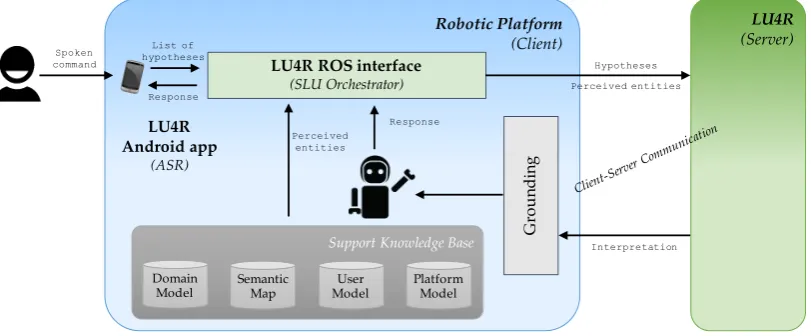
The architecture of the system considers two main actors, as shown in Figure 3: the Robotic Plat-formandLU4R, where the processing cascade of the latter component have been introduced in the previous Section.
The Client-Server communication schema be-tween LU4R and the Robot allows for the indepen-dence from the Robotic Platform, in order to max-imize the re-usability and integration in
heteroge-neous robotic settings. LU4R exhibits semantic capabilities (e.g., disambiguation, predicate detec-tion or grounding into robotic acdetec-tions and environ-ments) that are designed to be general enough to be representative of a large set of application sce-narios.
It is obvious that an interpretation process must be achieved even when no information about the domain/environment is available, i.e., a scenario involving a blind but speaking robot, or when the actions a robot can perform are not made ex-plicit. At the same time, the proposed SLU cas-cade makes available methods to specialize its se-mantic interpretation process to individual situa-tions where more information is available about goals, the environment and the robot capabilities. These methods are expected to support the opti-mization of the core SLU process against a spe-cific interactive robotics setting, in a cost-effective manner. In fact, whenever more information about the environment perceived by the robot (e.g., a se-mantic map) or about its capabilities is provided, the interpretation of a command can be improved by exploiting a more focused scope.
In order to better understand the different oper-ating modalities of LU4R, some assumptions to-ward the Robotic Platform must be made explicit: this will allow to precisely establish functionalities and resources that the robot needs to provide to un-lock the more complex processes. These informa-tion will be used to express the experience that the robot is able to share with the user (i.e., the percep-tual knowledge about the environment where the linguistic communication occurs and some lexical information and properties about objects in the en-vironment) and some level of awareness about its own capabilities (e.g., the primitive actions that the robot is able to perform, given its hardware components).
4.1 The Robotic Platform
re-LU4R (Server) Robotic Platform
(Client)
Response
LU4R ROS interface
(SLU Orchestrator)
Response
Hypotheses Perceived entities List of
hypotheses
Gr
o
u
n
d
in
g
Support Knowledge Base
Domain Model
Semantic Map
User Model
Platform Model
Spoken command
Interpretation
LU4R Android app
(ASR)
[image:6.595.98.504.64.232.2]Perceived entities
Figure 3: The architecture of the LU4R framework
Number of examples 656 Number of frames 18 Number of predicates 767 Number of roles 34 Predicates per sentence 1.17 Sentences per frame 36.44 Roles per sentence 2.04 Entities per sentence 7.29
Table 1: Some statistics of the corpus
alized exploits the LU4R Android app whereas the SLU orchestrator is implemented as a ROS node, through theLU4R ROS interface. Addition-ally, the optionalSupport Knowledge Base compo-nent is expected to interface the different involved knowledge sources and support their maintenance: this provides the contextual information discussed above.
5 A Perceptual Corpus of Robotic Commands
The computational paradigms adopted here are based on machine learning techniques and depend strictly on the availability of training data. In or-der to train and test our framework, a proper re-source that collects both linguistic and perceptual information is required. To this end, we extended the Human-Robot Interaction Corpus4 (HuRIC),
formerly presented in (Bastianelli et al., 2014), by pairing each English sentence with the corre-sponding perceptual evidence that justifies the tar-geted semantics.
HuRIC is based on Frame Semantics and
cap-4Available athttp://sag.art.uniroma2.it/huric. The
download page also contains a detailed description of the re-lease format.
Motion 143 Bringing 153
Cotheme 39 Locating 90
Inspecting 29 Taking 80
Change direction 11 Arriving 12
Giving 10 Placing 52
Closure 19 Change operat state 49
Being located 38 Attaching 11
Releasing 9 Perception active 6 Being in category 11 Manipulation 5
Table 2: Distribution of frames over the corpus
tures cognitive information about situations and events expressed in sentences. The corpus does not include system or robot-dependent sentences or formalisms. Instead, it contains information strictly related to Natural Language Semantics, decoupled from specific tasks. The corpus ex-ploits different situations representing possible commands given to a robot in a house environ-ment. Each sentence is paired with a set of au-dio files representing robot commands and its cor-responding correct transcription. Each sentence is then annotated with: lemmas, POS tags, de-pendency trees and Frame Semantics. Semantic frames and frame elements are used to represent the meaning of commands, as they reflect the ac-tions a robot can accomplish in a home environ-ment. In this respect, theAMRrepresentation of the Example1is
(t1 /take-Bringing
:Theme(b1/pillow) :Goal(t2/couch) )
In this way, HuRIC can potentially be used to train all the modules of the processing chain pre-sented in Section4.
corresponding semantic map, composed of all en-tities populating the environment and presumably “perceived” by the robot. Each entity is repre-sented by the following set of information.
The Atom is a unique identifier of the entity, whereas theTypeof each entity, reflects the class to which each specific entity belongs5.
ThePreferred Lexical Referenceis used to re-fer to a class of objects; it is crucial in order to en-able the grounding between the commands uttered by the user and the entities within the environment. For example, an entity of the classtablecan be referred by the worddesk.
Finally, the position of each entity is essential to determine shallow spatial relations between enti-ties, e.g., whether two objects arenearorfarfrom each other. To this end, each entity is associated with itsCoordinatein the world, in terms of pla-nar coordinates (x, y), elevation (z) and angle as the orientation. We adopted a simple numerical scaling that discretized the map.
Table 1 shows the number of annotated sen-tences, number of frames, along with the average number of entities per sentence. Each entity in-volved in the command, e.g., mugandkitchen in the Example 1, is provided with one lexical ref-erence, not necessarily the same word used in the command (e.g. using a synonym such ascushion orsofa). Detailed statistics about the number of sentences for each frame are reported in Table2.
6 Experimental Evaluation
In order to provide evidence about the benefits of perceptual knowledge, we report an evaluation of the interpretation process of robotic commands over the enhanced version of HuRIC, i.e., contem-plating the semantic maps for each sentence.
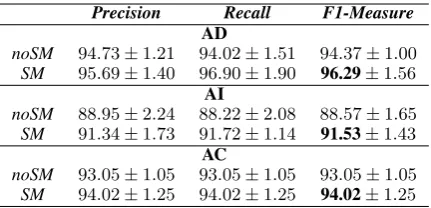
Table 3 shows the results obtained. The re-sults, expressed in terms ofPrecision,Recalland F1 measure, focus on the semantic interpretation process, in particular Action Detection (AD), Ar-gument Identification (AI) and ArAr-gument Classi-fication (AC) steps, addressing two possible con-figurations: a basic setting where only linguistic information is exploited (i.e.,noSM, as the seman-tic maps are ignored), and the configuration where semantic maps are included into the learning loop (i.e.,SM). F1 scores measure the quality of a spe-cific module. While in the AD step the F1 refers
5Notice that an entity can be an object, e.g.,couch,pillow,
or a location, e.g.,bedroom
Precision Recall F1-Measure
AD
noSM 94.73±1.21 94.02±1.51 94.37±1.00 SM 95.69±1.40 96.90±1.90 96.29±1.56
AI
noSM 88.95±2.24 88.22±2.08 88.57±1.65 SM 91.34±1.73 91.72±1.14 91.53±1.43
AC
[image:7.595.309.525.61.165.2]noSM 93.05±1.05 93.05±1.05 93.05±1.05 SM 94.02±1.25 94.02±1.25 94.02±1.25 Table 3: Experimental evaluation of the semantic interpretation process
to the ability to extract the correct frame(s) (i.e., robot action(s) expressed by the user) evoked by a sentence, in the AI step it evaluates to the cor-rectness of the predicted argument spans. Finally, in the AC step the F1 measures the accuracy of the classification of individual arguments. The ex-periments have been performed in a 5-fold cross validation setting. In this respect, Table 3 pro-vides also thestandard deviations among the dif-ferent folds. We tested each sub-module in isola-tion, feeding each step with gold information pro-vided by the previous step in the chain. Moreover, the evaluation has been carried out considering the correct transcriptions, i.e., not contemplating the error introduced by the Automatic Speech Recog-nition system.
discrimi-nate among them. Hence, the resulting interpre-tation will be wrong, as it does not reflect the se-mantics that is motivated by the environment. In terms of F1 measure, this issue affects mainly the Argument Identification step (AI), rather than the Action Detection (AD) one, as for each (possibly) wrong frame, there could be more than two (possi-bly) wrong arguments. For example, the sentence “take the mug in the kitchen” will be probably recognized to be a Takingaction, even though it is labeled as Bringing, i.e., mug and kitchen are supposed to be far in the environment. While the AD step will receive just one penalty for the wrong recognized action, the AI step is penalized twice, as two arguments were expected by the gold stan-dard annotation, i.e., the the mugas THEME and
thein the kitchenas GOAL, instead of one, i.e.,the
mug in the kitchenas a single THEMEargument.
When looking at the SM setting, it seems that the injection of perceptual knowledge into the se-mantic analysis process is able to mitigate the ef-fect of the aforementioned phenomena and each SLU step gains in predictive performance. In the case of AD, the information about the enti-ties shows a relative improvement of +2.03% in terms of F1 (94.37%vs96.29%). This means that the semantic map allows to predict the intended action more accurately, whenever the underlying semantic ambiguity depends on the configuration of the environment. The tight correlation between the predicted action and the frame elements sug-gests a similar behavior in Argument Identifica-tion. In fact, as well as for the AD, in the AI step perceptual knowledge reveal its support in predict-ing the correct spans of semantic arguments, with a relative improvement of +3.34% w.r.t. the F1 score. Though a lower gain is observed (+1.04%), the introduction of Distributional Semantics im-proves the ability of recognizing the correct frame element for a given argument span, i.e., AC step. This is probably due to the lexical generalization provided by the word embeddings, whenever al-ternative naming are used to refer to an entity of the semantic map.
Finally, small values of standard deviation sug-gest that the system seems to be rather stable across the different iterations of the experiment and that the results do not depend on specific splits of the entire dataset.
7 Conclusions
In this paper, we presented a comprehensive framework for the design of robust natural language interfaces for Human-Robot Interac-tion (HRI). The corresponding implementaInterac-tion is specifically designed for the automatic interpre-tation of spoken commands in domestic environ-ments. The proposed solution relies on Frame Semantics and supports a structured learning ap-proach to language processing able to map indi-vidual sentence transcriptions to meaningful com-mands. A hybrid discriminative and generative learning method is proposed to map the interpre-tation process into a cascade of sentence anno-tation tasks. The interpreanno-tation of commands is made dependent on the robot’s environment; in fact the adopted training annotations not only ex-press linguistic evidence from source utterances, but also account for specific perceptual informa-tion derived from a reference map. In this way the semantic map aspects useful to interpretation are expressed via feature modeling with the struc-tured learning mechanism applied. Such percep-tual knowledge is derived from a semantically-enriched implementation of a robot map, i.e., its semantic map. It expresses information about the existence and position of entities surrounding the robot: as this is also available to the user, this information is crucial to disambiguate predicates and role assignments.
To this end, we trained the machine learning processes by using an extended version ofHuRIC, the Human Robot Interaction Corpus. This cor-pus, originally composed by sentences in English, now benefits from the introduction of such seman-tic maps, expressed as lists of entities and support-ing the research in natural language interfaces for Robots in such language. The empirical results obtained over the perceptual version of the dataset show a significant improvement w.r.t. the pure lin-guistic process. This confirms the effectiveness of the proposed processing chain.
References
Yasemin Altun, I. Tsochantaridis, and T. Hofmann. 2003. Hidden Markov support vector machines. In
Proc. of ICML.
Collin F. Baker, Charles J. Fillmore, and John B. Lowe. 1998. The berkeley framenet project. In Proceed-ings of ACL and COLING. pages 86–90.
Roberto Basili, Emanuele Bastianelli, Giuseppe Castellucci, Daniele Nardi, and Vittorio Perera. 2013. Kernel-based discriminative re-ranking for spoken command understanding in hri. In AI* IA 2013: Advances in Artificial Intelligence, Springer International, pages 169–180.
Emanuele Bastianelli, Giuseppe Castellucci, Danilo Croce, Roberto Basili, and Daniele Nardi. 2014. Huric: a human robot interaction corpus. InProc. of LREC 2014. Reykjavik, Iceland.
Emanuele Bastianelli, Giuseppe Castellucci, Danilo Croce, Roberto Basili, and Daniele Nardi. 2017.
Structured learning for spoken language understand-ing in human-robot interaction. The International Journal of Robotics Research 0(0):To appear in.
https://doi.org/10.1177/0278364917691112. Emanuele Bastianelli, Danilo Croce, Andrea Vanzo,
Roberto Basili, and Daniele Nardi. 2016. A dis-criminative approach to grounded spoken language understanding in interactive robotics. InProc. of the 25th IJCAI, New York.
Johan Bos. 2002. Compilation of unification gram-mars with compositional semantics to speech recog-nition packages. In Proceedings of the 19th Inter-national Conference on Computational Linguistics - Volume 1. Association for Computational Linguis-tics, Stroudsburg, PA, USA, COLING ’02, pages 1– 7. https://doi.org/10.3115/1072228.1072323.
Johan Bos and Tetsushi Oka. 2007. A spoken language interface with a mobile robot. Artificial Life and Robotics11(1):42–47.
David L. Chen and Raymond J. Mooney. 2011. Learn-ing to interpret natural language navigation instruc-tions from observainstruc-tions. InProc. of the 25th AAAI Conference. pages 859–865.
Albert Diosi, Geoffrey R. Taylor, and Lindsay Klee-man. 2005. Interactive SLAM using laser and ad-vanced sonar. In Proc. of the 2005 International Conference on Robotics and Automation. pages 1103–1108.
Felix Duvallet, Thomas Kollar, and Anthony Stentz. 2013. Imitation learning for natural language direction following through unknown environ-ments. In 2013 IEEE International Confer-ence on Robotics and Automation, Karlsruhe, Germany, May 6-10, 2013. pages 1047–1053.
https://doi.org/10.1109/ICRA.2013.6630702.
Juan Fasola and Maja J Mataric. 2013a. Using se-mantic fields to model dynamic spatial relations in a robot architecture for natural language instruction of service robots. InInternational Conference on Intel-ligent Robots and Systems (IROS), 2013 IEEE/RSJ. pages 143–150.
Juan Fasola and Maja J. Mataric. 2013b. Using spa-tial semantic and pragmatic fields to interpret natu-ral language pick-and-place instructions for a mobile service robot. InSocial Robotics: 5th International Conference, ICSR 2013, Bristol, UK, October 27-29, 2013, Proceedings, Springer International Pub-lishing, pages 501–510.
Charles J. Fillmore. 1985. Frames and the semantics of understanding.Quaderni di Semantica6(2):222– 254.
Guglielmo Gemignani, Roberto Capobianco, Emanuele Bastianelli, Domenico Daniele Bloisi, Luca Iocchi, and Daniele Nardi. 2016. Living with robots. Robot. Auton. Syst. 78(C):1–16.
https://doi.org/10.1016/j.robot.2015.11.001. S. Harnad. 1990. The symbol grounding problem.
Physica D: Nonlinear Phenomena42(1-3):335–346. Thomas Kollar, Stefanie Tellex, Deb Roy, and Nicholas Roy. 2010. Toward understanding natural language directions. In Proceedings of the 5th ACM/IEEE. Piscataway, NJ, USA, HRI ’10, pages 259–266. Geert-Jan M. Kruijff, H. Zender, P. Jensfelt, and
Hen-rik I. Christensen. 2007. Situated dialogue and spa-tial organization: What, where. . . and why? Inter-national Journal of Advanced Robotic Systems4(2). Matt MacMahon, Brian Stankiewicz, and Benjamin Kuipers. 2006. Walk the talk: connecting language, knowledge, and action in route instructions. In pro-ceedings of the 21st national conference on Artifi-cial intelligence - Volume 2. AAAI Press, AAAI’06, pages 1475–1482.
Cynthia Matuszek, Dieter Fox, and Karl Koscher. 2010. Following directions using statistical machine translation. In Proceedings of the 5th ACM/IEEE International Conference on Human-robot Interac-tion. IEEE Press, Piscataway, NJ, USA, HRI ’10, pages 251–258.
Cynthia Matuszek, Evan Herbst, Luke S. Zettlemoyer, and Dieter Fox. 2012. Learning to parse natural lan-guage commands to a robot control system. In Jay-dev P. Desai, Gregory Dudek, Oussama Khatib, and Vijay Kumar, editors,ISER. Springer, volume 88 of
Springer Tracts in Advanced Robotics, pages 403– 415.
Dipendra K. Misra, Jaeyong Sung, Kevin Lee, and Ashutosh Saxena. 2016. Tell me dave: Context-sensitive grounding of natural language to manipulation instructions. The International Journal of Robotics Research 35(1-3):281–300.
Andreas N¨uchter and Joachim Hertzberg. 2008. To-wards semantic maps for mobile robots. Robot. Au-ton. Syst.56(11):915–926.
Vittorio Perera and Manuela M. Veloso. 2015. Han-dling complex commands as service robot task re-quests. In Proceedings of the Twenty-Fourth Inter-national Joint Conference on Artificial Intelligence, IJCAI 2015, Buenos Aires, Argentina, July 25-31, 2015. pages 1177–1183.
M. Tanenhaus, M. Spivey-Knowlton, K. Eberhard, and J. Sedivy. 1995. Integration of visual and linguis-tic information during spoken language comprehen-sion.Science268:1632–1634.
Stefanie Tellex, Thomas Kollar, Steven Dickerson, Matthew R Walter, Ashis Gopal Banerjee, Seth Teller, and Nicholas Roy. 2011. Approaching the symbol grounding problem with probabilistic graph-ical models. AI Magazine34(4):64–76.
Jesse Thomason, Shiqi Zhang, Raymond Mooney, and Peter Stone. 2015. Learning to interpret natural language commands through human-robot dialog. In Proceedings of the 24th International Conference on Artificial Intelli-gence. AAAI Press, IJCAI’15, pages 1923–1929.
http://dl.acm.org/citation.cfm?id=2832415.2832516. Peter D. Turney and Patrick Pantel. 2010. From
frequency to meaning: Vector space models of semantics. J. Artif. Int. Res. 37(1):141–188.