Ensemble Methods for Native Language Identification
Sophia Chan∗, Maryam Honari Jahromi∗, Benjamin Benetti∗, Aazim Lakhani, Alona Fyshe
Department of Computer Science University of Victoria
Victoria, BC, Canada
{schan1,mhonari,bbenetti,aazimlakhani,afyshe}@uvic.ca
Abstract
Our team—Uvic-NLP—explored and evaluated a variety of lexical features for Native Language Identification (NLI) within the framework of ensemble methods. Using a subset of the highest-performing features, we train Support Vector Machines (SVM) and Fully Con-nected Neural Networks (FCNN) as base classifiers, and test different methods for combining their outputs. Restricting our scope to the closed essay track in the NLI Shared Task 2017, we find that our best SVM ensemble achieves an F1 score of 0.8730 on the test set.
1 Introduction
Native Language Identification (NLI) is the task of identifying a person’s native language (L1) based on a sample of their writing or speech in a second language (L2). The underlying intu-ition is that those with the same L1 tend to use similar language patterns during L2 production. This is known as cross-linguistic influence ( Or-tega,2014).
NLI can accelerate second language acquisition by giving students L1-specific feedback on their written or spoken samples (Malmasi et al.,2014). In forensic linguistics, NLI can be applied to iden-tify the L1 of anonymous texts (Perkins,2015).
The NLI Shared Task 2013—the first of its kind—was based on written essays (Tetreault et al., 2013), while the 2016 Computational Par-alinguistics Challenge was based on spoken re-sponses (Schuller et al., 2016). The NLI Shared Task 2017 organizers provided a dataset of both essays and transcriptions of verbal responses
∗These authors contributed equally to this work.
(Malmasi et al., 2017). As our team—Uvic-NLP—participated in the closed essay track, we performed classification on essays only.
We begin our analysis by comparing various lexical features and focus on two high-performing classifiers: Support Vector Machines (SVM) and Fully Connected Neural Networks (FCNN). Then, we explore different ensemble methods for com-bining outputs of individual classifiers. We present and discuss three of our best systems for this task: a single SVM classifier, an SVM ensemble, and an FCNN ensemble.
2 Related Work
NLI is generally conceptualized as a multi-class supervised multi-classification problem, where the classes represent the set of possible L1s. One of the first NLI systems trained SVMs on a variety of stylistic features (Koppel et al.,2005).
The NLI Shared Task 2013 introduced a corpus designed specifically for NLI (Blanchard et al., 2013). Use of a standardized dataset and eval-uation metric allowed for the effective compar-ison of different models, and the results con-firmed the usefulness of SVMs for NLI (Tetreault et al.,2013). Popular features included word, part of speech (POS), and character n-grams; higher-ordern-grams were shown to be especially useful. Four of the top five teams used at least 4-grams, with the top team using up to 9-grams. String ker-nels using 5- to 8-grams at the character-level also worked well, and were one of the best performing models for this task (Ionescu et al.,2014).
A trend in recent work is the use of ensem-ble methods, which combine the predictions of a set of classifiers, giving more accurate results than a single classifier trained on a combination of different features (Tetreault et al.,2012;Malmasi et al.,2013).Malmasi and Dras(2017) used
classifier ensembles, where results from base clas-sifiers are fed to an ensemble of meta-clasclas-sifiers. Such models are the current state of the art for NLI.
3 Data
The dataset for the essay track of the NLI Shared Task 2017 was collected by Educational Testing Services, and consists of written responses to a standardized assessment of English proficiency for academic purposes.
13,200 response essays from test takers were separated into three sets: 11,000 for training (TRAIN), 1,100 for development (DEV), and 1,100 for testing (TEST). Each set of documents is equally distributed among eleven L1s: Ara-bic (ARA), Chinese (CHI), French (FRE), Ger-man (GER), Hindi (HIN), Italian (ITA), Japanese (JPN), Korean (KOR), Spanish (SPA), Telugu (TEL), and Turkish (TUR).
4 Features
Previous work demonstrates that a variety of lex-ical and syntactic features are useful for NLI (Tetreault et al.,2012). In addition to incorporat-ing lexical features known to be effective for this task, we also extract phonemes. Here, we describe each of the features in turn.
Word n-grams Where topic bias is pervasive, wordn-grams are not useful features for classifica-tion (Brooke and Hirst,2011), but have been used successfully in topic-balanced corpora (Tetreault et al.,2012). Our dataset is balanced across top-ics, making wordn-grams useful.
Lemma n-grams Lemmas are the dictionary representation of words, i.e. words that are stripped of morphological marking. The lemma-tized versions of all words in our corpus were at-tained using Natural Language Toolkit’s WordNet interface (Bird et al.,2009;Feinerer and Hornik, 2016;Wallace,2007;Fellbaum,1998).
Charactern-grams Tsur and Rappoport(2007) achieved good results on the NLI task using only character bigrams as features. Methods working at the character level were also the previous state of the art (Ionescu et al., 2014). Charactern-grams can be generated from text within or across word boundaries.
Part of speech n-grams Koppel et al. (2005) found rare part of speech (POS) bigrams to be a useful feature; many teams in the 2013 Shared Task also made use of this feature (Tetreault et al., 2013). We use the Stanford Tagger to extract POS features (Toutanova et al.,2003).
Function words Function words are a closed class of words that serve a grammatical function in sentences, whose use for NLI was explored early on (Koppel et al., 2005). These include ar-ticles, determiners, conjunctions, and auxiliaries. These were extracted based on a list provided in the ModErn Text Analysis Toolkit (Massung et al., 2016).
Spelling errors Spelling errors were extracted by finding the difference between misspelled words before and after they were corrected using the autocorrect package (Jonas,2013). We coded a subset of the spelling errors defined by Koppel et al.(2005): repeated letter, double letter appears only once, letter replacement, letter inversion, in-serted letter, and missing letter.
Phoneme n-grams Phonemes are representa-tions of sounds in a language. In English, one sound can be represented using many different let-ters (e.g. cat and kick). For mapping orthogra-phy onto phonemes, we used the Carnegie Mel-lon Pronouncing Dictionary (Weide,2005). To our knowledge, phonemes have not yet been explored as a feature.
5 Classifiers
We evaluated classifier performance across fea-tures types and found that the SVM and FCNN classifiers consistently outperformed other classi-fiers, such as Perceptron and Multinomial Naive Bayes. As such, we focus on these two classifiers in subsequent experiments.
Table 1: Comparison of individual feature types using SVM and FCNN classifiers, using F1 scores onDEV. The highest F1 score for each feature set is indicated in bold.
Feature type SVM FCNN Word unigram 0.6936 0.7645
Word bigram 0.7228 0.8027 Word trigram 0.6705 0.6790
Lemma 0.6703 0.7481
Character bigram 0.4787 0.5818
Character trigram 0.6360 0.7381
Character 4-gram 0.7213 0.7836
Character 5-gram 0.7363 0.8081 POS bigram 0.4286 0.4081
POS trigram 0.4723 0.4472
Function words 0.3036 0.5646 Spelling errors 0.2201 0.2509 Phoneme bigram 0.5356 0.5509
Phoneme trigram 0.6697 0.6654
Phoneme 4-gram 0.7089 0.6727
Phoneme 5-gram 0.7241 0.6654
Combined 0.8183 0.7784
5.1 Support Vector Machine (SVM)
SVMs (Joachims, 1998) are frequently used for text classification and have been applied success-fully to NLI (Tetreault et al., 2013). We use a scikit-learn SVM implementation: LinearSVC (Pedregosa et al.,2011).
5.2 Neural Networks
Since we found little previous work applying neu-ral networks to NLI, this paper strives to fill this gap by constructing a FCNN using TensorFlow (Allaire et al.,2016) and the Keras (Chollet et al., 2015) framework.
The network is comprised of one hidden layer of 128 nodes that uses a tanh activation function and an input dropout of 0.2. The optimal dropout value was established empirically. Following the hidden layer, there is an 11 node output layer that uses the softmax activation function. The entire network uses a cross entropy loss function and the Adam optimization algorithm.
Due to memory constraints, we limit analysis to only the 100,000 most important features, selected by performing an ANOVA F-test on the entire
fea-ture set (Harwell et al.,1992).
In addition to the FCNN, we test another type of neural network for this task. Following the archi-tecture described byWang et al. (2016), we train a pipeline consisting of a convolutional neural net-work (CNN) which transforms the input data at the character-level and a Long Term Short Memory (LSTM) neural network which performs classifi-cation on the output of the CNN. We also trained an LSTM on word vectors (Mikolov et al.,2013). In both cases, however, we found results to be lacking in accuracy.
5.3 Ensemble construction
For any given SVM or FCNN, the output for 11-way classification can be represented as a vector of 11 numbers. For the SVM, output is in the form of confidence scores for each class, which is equivalent to the signed distance of that sample to each class’s hyperplane (Weston and Watkins, 1998). Similarly, each FCNN prediction is in the form of confidence values for each class, derived from the softmax output layer.
Using the best feature combination and rep-resentation from the previous experiments, we trained two sets of base classifiers—FCNNs and SVMs—on different features and combined each set of outputs using three different voting schemes (Polikar,2006):
• Mean: Final label is the class corresponding to the greatest average confidence score.
• Median: Final label is the class correspond-ing to the greatest median confidence score.
• Plurality vote: Final label is the class with the greatest number of votes. In a tie, we choose the class that comes first alphabeti-cally.
In line with previous work, we achieve the high-est accuracy using the mean rule (Malmasi et al., 2013), as shown in Table3.
5.4 Meta-classifier
that were then used as input to an LDA meta-classifier, which was found to outperform other algorithms for meta-classification inMalmasi and Dras(2017).
5.5 Meta-classifier ensembles
Building on the idea of ensembles and meta-classification, we experiment with ensembles of meta-classifiers (Malmasi and Dras,2017). SVM and FCNN outputs—meta-features—are gener-ated in the same way as in section 5.4. How-ever, instead of training a single meta-classifier on these features, we use bagging (bootstrap aggre-gating) to train multiple LDAs on random subsets of the base classifier outputs. A grid search was performed to find the optimal number of meta-classifiers and optimal percentage of samples to train each LDA on. The predictions from multiple LDAs were then combined using voting schemes described in section5.3.
6 Results and Discussion
In this section we present our results on single fea-tures, feature combinations, single classifiers, and classifier ensembles.
6.1 Individual features
The results of SVM and FCNN classifiers trained on different features are shown in Table 1. For these experiments, features were represented by their frequency count. We observe a general trend within different feature types: F1 scores increase asn-gram order increases (see Table1). This is not unexpected, given the success of NLI models that make use of higher-order n-grams (Jarvis et al., 2013;Tetreault et al.,2013). One exception to this trend is that there seems to be a upper-bound for wordn-grams at the bigram level, where accuracy drops for word trigrams. This may be attributed in part to the increased sparsity of features when we move from bigrams to trigrams at the word-level.
Interestingly, spelling errors were less informa-tive than what we had expected. Although we did not evaluate the accuracy of the autocorrect package we used for spelling correction, we sus-pect that it did not perform well since it operates naively, without looking at context (Jonas,2013). Additionally, the types of errors we defined might have not been fine-grained enough to capture dif-ferences unique to groups of L1 writers.
6.2 Single classifier results
As in Malmasi et al. (2013), we measure the ef-fectiveness of different feature representations. Of the feature types described above, we include in our final system only a subset of the highest per-forming features. Thus, analysis is limited to this subset of features.
With frequency counts as a baseline, we com-pare the performance of classifiers trained on three different combinations of high-performing fea-tures. These groups are:
• Word: Lemmas, words (1-, 2-, and 3-grams).
• Char: Characters (4- and 5-grams).
• Phoneme: Phonemes (4- and 5-grams).
Each group of features is tested with and with-out term frequency-inverse document frequency (TF-IDF) weighting. Further, we examine the ef-fects of binarization, L1 normalization, and L2 normalization on the same feature set. Note that L1 and L2 normalization refer to the vector norms across each input row. These results are summa-rized in Table2.
Comparing classifiers trained on individual fea-tures (Table1) to those trained on combinations of features (Table2), it is evident that better results are achieved by training a single classifier on mul-tiple features than on any single feature type. Fur-ther, Table2shows that the best performing clas-sifiers use L2-normalized features with TF-IDF.
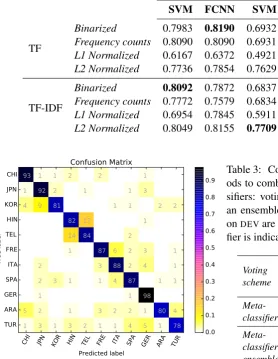
Our official submission to the NLI Shared Task 2017 used a single SVM classifier, which requires less time and fewer computational resources to train compared to a FCNN. An SVM on words (1-, 2-, and 3-grams) and characters (4- and 5-grams) achieves an F1 score of 0.8633 onTEST(see Table 4). The features were binarized, L2-normalized and TF-IDF weighted. The confusion matrix is shown in Figure1.
6.3 Ensembles
The results detailed in this section were not sub-mitted as part of the NLI Shared Task 2017, and were obtained after the test phase ended.
Table 2: Comparison of feature representations for SVM and FCNN classifiers, using F1 scores onDEV. The best feature representation for each classifier is indicated in bold.
Word Char Phoneme
SVM FCNN SVM FCNN SVM FCNN
TF
Binarized 0.7983 0.8190 0.6932 0.8172 0.7550 0.6950
Frequency counts 0.8090 0.8090 0.6931 0.8003 0.7056 0.6971
L1 Normalized 0.6167 0.6372 0.4921 0.4427 0.4270 0.4604
L2 Normalized 0.7736 0.7854 0.7629 0.7610 0.7677 0.6971
TF-IDF
Binarized 0.8092 0.7872 0.6837 0.7693 0.7489 0.6623
Frequency counts 0.7772 0.7579 0.6834 0.7560 0.7085 0.6578
L1 Normalized 0.6954 0.7845 0.5911 0.3794 0.5325 0.2919
L2 Normalized 0.8049 0.8155 0.7709 0.8048 0.7812 0.7059
CHI JPN KOR HIN TEL FRE ITA SPA GER ARA TUR
Predicted label CHI
JPN KOR HIN TEL FRE ITA SPA GER ARA TUR
True label
93 1 1 2 2 1
1 92 2 1 1 3
4 9 81 1 1 2 2
82 17 1
14 84 2
1 87 6 2 3 1
2 3 88 2 4 1
2 3 1 1 4 87 1 1
1 1 98
5 2 1 3 2 2 1 80 4 1 3 1 3 2 1 1 4 5 1 78
Confusion Matrix
[image:5.595.80.359.113.473.2]0.0 0.1 0.2 0.3 0.4 0.5 0.6 0.7 0.8 0.9
Figure 1: SVM confusion matrix on TEST. The SVM was trained on words (1-, 2-, and 3-grams) and characters within word boundaries (4- and 5-grams).
the outputs, and then by constructing an ensem-ble of meta-classifiers, we observe a slight perfor-mance gain for both SVMs and FCNNs at each step, consistent with the results in Malmasi and Dras(2017). Table3summarizes our results from using different ensemble methods to combine in-dividual classifiers trained on words (2- and 3-grams), characters (4- and 5-grams) and phonemes (4- and 5-grams).
Further experiments with SVMs and FCNNs were conducted by selecting different features to combine on a trial and error basis. The decision to use charactern-grams within as opposed to across word boundaries was made arbitrarily. All fea-tures are binarized, L2-normalized, and TF-IDF
Table 3: Comparison of different ensemble meth-ods to combine outputs of SVM and FCNN clas-sifiers: voting schemes, LDA meta-classifier, and an ensemble of LDA meta-classifiers. F1 scores onDEVare shown. The best result for each classi-fier is indicated in bold.
SVM FCNN
Voting scheme
Plurality vote 0.8285 0.8109
Mean 0.8417 0.8345
Median 0.8313 0.8363
Meta-classifier LDA 0.8448 0.8534
Meta-classifier ensembles
Plurality-LDA 0.8449 0.8507 Mean-LDA 0.8475 0.8544
Median-LDA 0.8475 0.8544
weighted. The results of our best ensemble classi-fiers onDEVandTESTare displayed in Table4.
While an ensemble of meta-classifiers outper-forms both a simple voting scheme and a single meta-classifier, we do not observe the same per-formance gain with respect to FCNNs (see Table 3).
Our best SVM ensemble consists of an ensem-ble of meta-classifiers. SVMs are trained on words (2- and 3-grams), characters within word bound-aries (4- and grams), and phonemes (4- and 5-grams), giving a total of six classifiers. The out-puts of these individual classifiers are fed to an ensemble of LDAs, as described in 5.5. Finally, the LDA predictions are combined using the mean rule. The F1 score on TEST for this model is 0.8730.
[image:5.595.320.513.361.481.2]Table 4: F1 scores on TESTand onDEVfor final systems. Ensemble results were obtained after the test phase. The best result for each dataset is indi-cated in bold. ∗ = Official submission to the NLI Shared Task 2017.
System DEV TEST
Random baseline 0.9090 —
Official baseline 0.7104 —
SVM∗ 0.8168 0.8633 SVM ensemble 0.8475 0.8730 FCNN ensemble 0.8576 0.8560
are trained on the following combination of fea-tures: (1) word bigrams and lemma trigrams, (2) word bigrams, (3) character 5-grams, (4) charac-ter 5-grams within word boundaries. The outputs from these individual networks are combined us-ing the mean rule, yieldus-ing an F1 score of 0.8560 onTEST.
Additionally, we created an ensemble of differ-ent SVM and FCNN classifiers but found no im-provement over pure ensembles of either type.
7 Future work
We excluded from our system individual features that did not perform well in our experiments. It would be helpful to evaluate the influence of these less accurate features and determine whether they would be useful to include in ensemble classifiers. Further, we tested a limited number of combina-tions of features. One facet of the problem in-volves developing a systematic approach to search for a good feature set.
Although we trained several FCNNs on differ-ent feature types, its utility as a meta-classifier has not been examined.
A CNN-LSTM model shown to perform well for sentiment analysis (Wang et al., 2016) did not achieve good results for NLI. While senti-ment classification typically involves five or fewer classes, there were 11 classes for the NLI Shared Task 2017. It may may be that additional classes increase the possibility of error. Further investi-gation is required to explain why a CNN-LSTM architecture performs worse relative to a FCNN model.
Our results show the utility of various features for this task and confirm that ensemble methods perform better than single classifiers trained on multiple features. They also offer several new
di-rections to further improve NLI systems.
References
Joseph Allaire, Dirk Eddelbuettel, Nick Golding, and Yuan Tang. 2016. tensorflow: R interface to tensor-flow. https://github.com/rstudio/tensorflow. Steven Bird, Ewan Klein, and Edward Loper.
2009. Natural Language Processing with Python. O’Reilly Media.
Daniel Blanchard, Joel Tetreault, Derrick Higgins, Aoife Cahill, and Martin Chodorow. 2013. Toefl11: A corpus of non-native english. Technical report, Educational Testing Service.
Julian Brooke and Graeme Hirst. 2011. Native lan-guage detection with ‘cheap’ learner corpora. In
Conference of Learner Corpus Research. Presses universitaires de Louvain.
François Chollet et al. 2015. Keras.
https://github.com/fchollet/keras.
Ingo Feinerer and Kurt Hornik. 2016. wordnet: WordNet Interface. R package version 0.1-11.
https://CRAN.R-project.org/package=wordnet. Christiane Fellbaum. 1998. WordNet: An Electronic
Lexical Database. Bradford Books.
Michael Harwell, Elaine Rubinstein, William Hayes, and Corley Olds. 1992. Summarizing monte carlo results in methodological research: The one-and two-factor fixed effects ANOVA cases. Journal of Educational Statistics17(4):315–339.
Radu Ionescu, Marius Popescu, and Aoife Cahill. 2014. Can characters reveal your native language? a language-independent approach to native language identification. In Proceedings of the 2014 Confer-ence on Empirical Methods in Natural Language Processing. Association for Computational Linguis-tics.
Scott Jarvis, Yves Bestgen, and Steve Pepper. 2013. Maximizing classification accuracy in native lan-guage identification. In Proceedings of the Eighth Workshop on Innovative Use of NLP for Building Educational Applications. pages 111–118.
Thorsten Joachims. 1998. Text categorization with support vector machines: Learning with many rel-evant features. InProceedings of the 10th European Conference on Machine Learning. Springer, pages 137–142.
McCallum Jonas. 2013. autocorrect spelling.
https://github.com/phatpiglet/autocorrect.
Shervin Malmasi and Mark Dras. 2017. Native lan-guage identification using stacked generalization
abs/1703.06541. http://arxiv.org/abs/1703.06541. Shervin Malmasi, Mark Dras, et al. 2014. Language
transfer hypotheses with linear SVM weights. In
Proceedings of the 2014 Conference on Empirical Methods in Natural Language Processing. Associ-ation for ComputAssoci-ational Linguistics, pages 1385– 1390.
Shervin Malmasi, Keelan Evanini, Aoife Cahill, Joel Tetreault, Robert Pugh, Christopher Hamill, Diane Napolitano, and Yao Qian. 2017. A Report on the 2017 Native Language Identification Shared Task. In Proceedings of the 12th Workshop on Building Educational Applications Using NLP. Association for Computational Linguistics.
Shervin Malmasi, Sze-Meng Jojo Wong, and Mark Dras. 2013. NLI shared task 2013: MQ submis-sion. InProceedings of the Eighth Workshop on In-novative Use of NLP for Building Educational Ap-plications. Association for Computational Linguis-tics, pages 124–133.
Sean Massung, Chase Geigle, and ChengXiang Zhai. 2016. MeTA: A Unified Toolkit for Text Retrieval and Analysis. In Proceedings of ACL-2016 Sys-tem Demonstrations. Association for Computational Linguistics, pages 91–96.
Tomas Mikolov, Kai Chen, Greg Corrado, and Jeffrey Dean. 2013. Efficient estima-tion of word representaestima-tions in vector space http://arxiv.org/abs/1301.3781.
Lourdes Ortega. 2014. Understanding second lan-guage acquisition. Routledge.
Fabian Pedregosa, Gaël Varoquaux, Alexandre Gram-fort, Vincent Michel, Bertrand Thirion, Olivier Grisel, Mathieu Blondel, Peter Prettenhofer, Ron Weiss, Vincent Dubourg, et al. 2011. Scikit-learn: Machine learning in Python. Journal of Machine Learning Research12:2825–2830.
Ria Perkins. 2015. Native language identification (NLID) for forensic authorship analysis of weblogs.
New Threats and Countermeasures in Digital Crime and Cyber Terrorismpages 213–234.
Robi Polikar. 2006. Ensemble based systems in deci-sion making. IEEE Circuits and systems magazine
6(3):21–45.
Björn Schuller, Stefan Steidl, Anton Batliner, Julia Hirschberg, Judee Burgoon, Alice Baird, Aaron Elkins, Yue Zhang, Eduardo Coutinho, and Keelan Evanini. 2016. The INTERSPEECH 2016 computa-tional paralinguistics challenge: Deception, sincer-ity & native language. pages 2001–2005.
Joel Tetreault, Daniel Blanchard, and Aoife Cahill. 2013. A Report on the First Native Language Iden-tification Shared Task. InProceedings of the Eighth
Workshop on Building Educational Applications Us-ing NLP. Association for Computational Linguis-tics.
Joel Tetreault, Daniel Blanchard, Aoife Cahill, and Martin Chodorow. 2012. Native tongues, lost and found: Resources and empirical evaluations in na-tive language identification. In Proceedings of the 24th International Conference on Computational Linguistics. Association for Computational Linguis-tics, pages 2585–2602.
Kristina Toutanova, Dan Klein, Christopher Manning, and Yoram Singer. 2003. Feature-rich part-of-speech tagging with a cyclic dependency network. InProceedings of the 2003 Conference of the North American Chapter of the Association for Computa-tional Linguistics on Human Language Technology. Association for Computational Linguistics, pages 173–180.
Oren Tsur and Ari Rappoport. 2007. Using classifier features for studying the effect of native language on the choice of written second language words. In
Proceedings of the Workshop on Cognitive Aspects of Computational Language Acquisition. Associa-tion for ComputaAssocia-tional Linguistics, pages 9–16. Mike Wallace. 2007. Jawbone Java WordNet API.
http://mfwallace.googlepages.com/jawbone. Xingyou Wang, Weijie Jiang, and Zhiyong Luo. 2016.
Combination of convolutional and recurrent neural network for sentiment analysis of short texts. In
Proceedings of the 26th International Conference on Computational Linguistics. pages 2428–2437. Robert Weide. 2005. The Carnegie Mellon
pronounc-ing dictionary. http://www.speech.cs.cmu.edu/cgi-bin/cmudict.