Automatic Threshold Detection for Data Selection in Machine Translation
Mirela-Stefania Duma and Wolfgang Menzel
University of Hamburg Natural Language Systems Division
{mduma, menzel}@informatik.uni-hamburg.de
Abstract
We present in this paper the participation of the University of Hamburg in the Biomedical Translation Task of the Sec-ond Conference on Machine Translation (WMT 2017). Our contribution lies in adopting a new direction for perform-ing data selection for Machine Transla-tion via Paragraph Vector and a Feed For-ward Neural Network Classifier. Contin-uous distributed vector representations of the sentences are used as features for the binary classifier. Most approaches in data selection rely on scoring and ranking gen-eral domain sentences with respect to their similarity to the in-domain and setting a range of thresholds for selecting a percent-age of them for training various MT sys-tems. The novelty of our method consists in developing an automatic threshold de-tection paradigm for data selection which provides an efficient and simple way for selecting the most similar sentences to the in-domain. Encouraging results are ob-tained using this approach for seven lan-guage pairs and four data sets.
1 Introduction
Data selection for Machine Translation (MT) rep-resents a standard domain adaptation technique with the aim of tackling the problem of select-ing from various general domain data the sen-tences that are most similar to sensen-tences from the in-domain. Irrespective of having available vast amounts or small amounts of in-domain data, one of the advantages of data selection consists in pro-viding more in-domain data selected from large amounts of general domain data. Two difficult tasks arise when performing data selection: what
method to use for scoring the sentences from the general domain according to their similarity to the in-domain and how many of the scored sentences to keep for later use in training MT systems.
Standard state-of-the-art methods resolve the first difficulty by means of information retrieval, perplexity or edit distance methods. However, the second difficulty remains a challenge. There are no standard start-threshold and increment-threshold defined in the community.Axelrod et al. (2011), for example, uses the top N={35k, 70k,
150k}sentence pairs from the scored general do-main data, whileBic¸ici and Yuret(2011) increas-ingly select N∈ {100, 200, 500, 1000, 2000, 3000,
5000, 10000}instances for each test sentence for training and Kirchhoff and Bilmes (2014) select subsets of 10%, 20%, 30% and 40% of the data.
We present a time and resource efficient method of performing data selection using Paragraph Vec-tor (Le and Mikolov, 2014) for representing the sentences and a Feed Forward Neural Network Classifier for determining which general domain sentences should be considered similar to the in-domain. The paragraph vectors and the binary classifiers are trained using standard parame-ters and have a great advantage of dropping the need to experiment with different sentence selec-tion thresholds. Therefore, we call our method automatic threshold detection for data selection (ATD).
The method has been applied in the Biomedical translation task of the Second Conference on Ma-chine Translation (WMT) 2017 (Yepes et al., 2017). The in-domain corpora were made avail-able by the competition and the general domain corpora we have chosen to select data from are the Wikipedia corpora (Wolk and Marasek,2014) and the Commoncrawl corpora1. Experiments
1http://commoncrawl.org/
were performed on the language pairs English-French, English-Spanish, English-Portuguese and English-German (both directions for all language pairs except for English-German as the competi-tion did not require German-English translacompeti-tions). Good results have been obtained for all language pairs.
The paper is structured as follows: related work is presented in Section 2, then the data, tools and data selection method are described in Section 3. Section 4 contains the experimental results and the last section presents conclusions and suggestions for future work.
2 Related work
Given a large pool of general domain data and a small amount of in-domain data, selecting the sen-tences from the general domain that are most simi-lar to the in-domain is referred in literature as data selection. The work-flow of performing data se-lection includes developing a metric or function that scores general domain sentences according to their relevance to the in-domain and experiment-ing with various ratios of top ranked sentences in order to obtain the best result in terms of one or more MT evaluation metrics.
The approaches most commonly adopted in the literature are based on information retrieval (Hildebrand et al.(2005);Tamchyna et al.(2012)), on perplexity (Moore and Lewis(2010); Axelrod et al.(2011)), or on edit distance similarity (Wang et al.,2013).
Recently, a new direction has gained interest by making use of Word or Paragraph Vectors (embed-dings). Chen and Huang(2016) use word embed-dings along with in-domain selected sentences as positive samples and randomly selected sentences from the general domain as negative samples in training convolutional networks that yield good re-sults. Also,Duma and Menzel(2016) developed a new scoring method using Paragraph Vectors with positive results.
In this paper, we apply Paragraph Vectors for training FFNN classifiers that categorize the gen-eral domain sentences as being in-domain or out-of-domain. One of the most challenging tasks in data selection consists in finding the optimal threshold (how many of the scored sentences to select). It is a time-consuming process in which several experiments need to be performed, usually aiming to obtain the best BLEU score. Moreover,
there is no general consensus in the community regarding the increment ratio. We contribute to the state-of-the-art with a method that overcomes this challenge by means of a binary classifier: the problem of data selection is simplified by reducing the task of scoring and experimenting with differ-ent thresholds to a binary decision (keep/ discard a general domain sentence).
3 Experiments
This section describes the corpora and tools used, as well as the automatic threshold detection method we propose.
3.1 Data and tools
All SMT models were developed using the Moses phrase-based MT toolkit (Koehn et al., 2007) and the Experiment Management System (Koehn, 2010). The preprocessing of the data consisted in tokenization, cleaning (6-80), lowercasing and normalizing punctuation. The tuning and the test sets were provided by WMT 2016 (Bojar et al., 2016) and WMT 2017.
The SRILM toolkit (Stolcke,2002) and Kneser-Ney discounting (Kneser and Ney, 1995) were used to estimate 5-gram language models (LM). All the trained SMT systems use a strong LM built by interpolating a LM for the in-domain and a LM for the general domain with weights that are tuned to minimize the perplexity on the tuning set (Schwenk and Koehn,2008).
For word alignment we used GIZA++ (Och and Ney, 2003) with the default grow-diag-final-and alignment symmetrization method. Tuning of the SMT systems was performed with MERT (Och, 2003).
Commoncrawl and Wikipedia were used as general domains for all language pairs except for EN↔PT where no Commoncrawl data was pro-vided by WMT. As for the in-domain corpora, EMEA (Tiedemann, 2012) was used for all lan-guage pairs and Muchmore, ECDC, Pattr and Pubmed (all from UFAL Medical Corpus2) for
those language pairs where data was available. We also made use of the training data provided by the previous Biomedical task from 2016. The corpora corresponding to the general domain was concate-nated into a single data source and the same proce-dure was applied for the in-domain corpora. The
size of the corpora is presented in the follow-ing table (since the bilfollow-ingual corpora remain the same for both cases of translatingLanguage1 to
Language2and vice-versa, we mention only one direction in the table):
Track / Corpora EN-DE EN-FR EN-ES EN-PT
Commoncrawl 2.4M 3.2M 1.8M
-Wikipedia 2.4M 818K 1.8M 1.6M
EMEA 1.1M 1.09M 1.09M 1.08M
Muchmore 29K - -
-ECDC 2547 2665 2357
-Pattr 1.8M - -
-Scielo-gma 2016 - 18K 175K 613K
Pubmed - - 285K 74K
Table 1: Corpora used for ATD
3.2 Automatic Threshold Detection for Data Selection
The data selection method we used for the WMT Biomedical task is described in this section with a special focus on Paragraph Vector and the FFNN classifier employed in developing the automatic threshold detection.
Paragraph Vector
Sentences were represented using Paragraph Vec-tors (Le and Mikolov,2014) which give a contuous distributed vector representation of the in-put. Paragraph Vector is an extension of word embeddings (Mikolov et al., 2013) to phrases or sentences. Given a sentence, Paragraph Vector learns its representation by mapping context words and a paragraph identifier to the word to be pre-dicted. The paragraph token acts like a memory of the topic of the sentence (Le and Mikolov,2014). While the word vectors are shared between all paragraphs, the paragraph vector is shared among all the contexts generated from the same sentence. We used the gensimtoolkit3 (ˇReh˚uˇrek and
So-jka, 2010) that implements Doc2Vec (Paragraph Vectors). We present results using a Doc2Vec model trained with PV-DBOW4 applying the
de-fault parameters of size 200 for the vectors and window of 10 (the maximum distance between the predicted word and context words used for predic-tion within a document).
3https://radimrehurek.com/gensim/models/doc2vec.html 4Distributed Bag of Words
Feed-forward Neural Network Classifier
The Feed-Forward Neural Network uses a super-vised learning algorithm that receives as input the Paragraph Vectors for the labeled sentences. The feed-forward neural network classifier was trained using the python library sknn5. We
re-port here results obtained using a fully connected Tanhlayer of 200 units with dropoutp=0.5and a Softmaxoutput layer. The optimal dropout value was selected in accordance with the findings from Srivastava et al.(2014).
We experimented with both the source and the target language, in order to determine the best use of classified data given our settings.
For each of the language pairs we trained classi-fiers on≈200K sentences with an equal number of
positive and negative samples. The positive sam-ples were randomly selected from the in-domain data and the negative samples were randomly se-lected from the general domain data.
4 Experimental results
We report in this section the BLEU (Papineni et al., 2002) scores obtained by our submissions, as well as the classifiers accuracy. For each lan-guage pair and for each test set provided by the Biomedical task, we submitted three runs as fol-lows:
• the selected sentences with the classifier trained on the source language data (run 1)
• the selected sentences with the classifier trained on the target language data (run 2)
• the union (without duplicates) of the selected sentences proposed by the two classifiers (run 3)
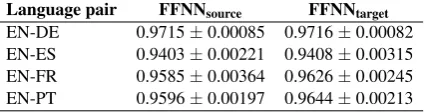
Intrinsic evaluation of the proposed data selec-tion technique was performed by computing the classifier accuracy. Following the recommenda-tions from (Kohavi, 1995), we employ the strati-fied cross-validation method with ten folds. The accuracy values were computed using scikit-learn (Pedregosa et al., 2011). The following table presents the FFNN classifier mean accuracy and standard deviation for each of the language pairs. The low values of standard deviation for all clas-sifiers indicate the consistency of our proposed method.
Language pair FFNNsource FFNNtarget EN-DE 0.9715±0.00085 0.9716±0.00082 EN-ES 0.9403±0.00221 0.9408±0.00315 EN-FR 0.9585±0.00364 0.9626±0.00245 EN-PT 0.9596±0.00197 0.9644±0.00213
Table 2: Classifier accuracy (%): mean and stan-dard deviation
This year four datasets were used in the eval-uation: Scielo, EDP, Cochrane and NHS belong-ing to scientific publications or health information texts. The format of the datasets differed as Sci-elo and the EDP datasets follow the BioC format and Cochrane and NHS follow the format of the UFAL Corpus (sgm). Table 3 depicts the size of the datasets.
Language pair Scielo EDP Cochrane NHS
EN-DE - - 467 1044
EN-ES 1120 - 467 1044
ES-EN 1135 - -
-EN-FR - 784 467 1044
FR-EN - 662 -
-EN-PT 1897 - -
-PT-EN 1825 - -
-Table 3: Size of the test sets
The results of our submissions are presented with respect to different datasets. Table 5 depicts all the BLEU scores of our submissions. For the Scielo dataset, our team was the only one that sub-mitted runs. The organisers provided baselines for all language pairs and our best run improves with almost 9 BLEU points over the baseline for EN-PT and EN-ES, and almost 7 BLEU point over the baseline for PT-EN and ES-EN. There were small differences between the results of the three runs which suggests that either method could be used for gaining positive results.
For the EDP dataset (FR-EN and EN-FR) there were eight submissions and our best run for EN-FR had a gain of around 10 BLEU points over the baseline, as for FR-EN a gain of around 6 BLEU points. Considering our runs, there is 1 BLEU point difference between run 2 and run 3 for FR-EN and 0.5 difference between run 3 and run 2 for EN-FR. This indicates that the union method pro-vides the best results.
On the Cochrane and NHS datasets our team was the only one that submitted for EN-ES obtain-ing high BLEU scores (48.99, 48.45 and 48.70 for Cochrane and 40.97, 41.20 and 41.22 for NHS). The differences between the runs are again very
small. For EN-FR there were two teams participat-ing. In our runs the union method gave better re-sults for both datasets. For EN-DE there were six teams participating and the differences between our runs are again small.
In the general ranking among all participat-ing teams, our team ranked first for EN-FR for the Cochrane and NHS datasets, second on FR-EN and third on FR-EN-FR for the EDP datasets, last place on EN-DE for the Cochrane and NHS datasets, and was the only team submitting for Sci-elo (PT-EN, EN-PT, ES-EN, EN-ES) as well as for Cochrane and NHS (EN-ES).
Lavie (2010) points out that BLEU scores above 30 reflect understandable translations, while scores over 50 are considered good and fluent translations. Within 36 submitted runs by our team, 24 runs have BLEU scores between≈32 and
≈49 (for six language pairs). Therefore, we
con-clude that the method presented obtains generally good translation results on a variety of language pairs.
Another important result consists in the fact that small amounts of general domain data were se-lected using ATD ranging from 3.1% up to 9.35%. This represents a promising direction for applying this method on much larger general domain cor-pora where selecting small amounts of data mat-ters even more. The union of the selected sen-tences with the classifiers trained on the source and target languages ranges from 5.6% up to 12.1%.
The following table presents the amount of gen-eral data selected using ATD for the three runs along with the percentage of general domain data that it represents:
Language pair # selected src. sent. # selected trg. sent. Union
EN-DE 148K (3.1%) 188K (4.0%) 263K (5.6%) EN-ES 327K (9.35%) 257K (7.36%) 425K (12.1%) EN-FR 223K (5.6%) 225K (5.7%) 345K (8.7%) EN-PT 78K (4.7%) 89K (5.3%) 123K (7.4%)
Table 4: Number of selected sentences and per-centage of General domain
The average duration for training the Doc2Vec models was≈2.5 hours and the average duration
for ten fold cross-validation was ≈12 minutes6,
which represents an advantage in terms of time consumption since afterwards only one MT sys-tem needs to be trained.
6on a 2 Ten Core Intel Xeon processor/ 128 GB of RAM
Language pair EN-DE EN-ES ES-EN EN-FR FR-EN EN-PT PT-EN
Test set Cochrane NHS Scielo Cochrane NHS Scielo EDP Cochrane NHS EDP Scielo Scielo run 1 22.03 18.71 36.08 48.99 40.97 37.14 22.43 32.46 31.79 22.64 39.14 43.84 run 2 22.37 19.80 35.93 48.45 41.20 37.47 22.25 32.59 31.89 22.37 39.38 43.93
[image:5.595.73.526.62.116.2]run 3 22.63 19.66 36.23 48.70 41.22 37.49 22.79 33.16 33.36 23.41 39.21 43.88
Table 5: WMT results in terms of BLEU
5 Conclusions and Future Work
We presented the University of Hamburg participation to the WMT Biomedical task. The main contribution of our work consists in developing an automatic threshold detection method for data selection which yields good results for seven language pairs and four data sets. It requires little time for obtaining the general domain sentences that are considered most similar to the in-domain.
For six of the seven language pairs, the BLEU scores that our method obtained are in the range between 32 and 49. Generally, the best results among our three runs is obtained using the union approach, but with small differences among the other runs suggesting that there is no clear pref-erence for one of the approaches.
Since we evaluated our approach only with respect to the WMT task, we intend to further apply it to other in-domains and language pairs, as well as, to compare it directly with standard state-of-the-art methods.
References
Amittai Axelrod, Xiaodong He, and Jianfeng Gao. 2011. Domain adaptation via pseudo in-domain data selection. InProceedings of the Conference on Em-pirical Methods in Natural Language Processing. Association for Computational Linguistics, Strouds-burg, PA, USA, EMNLP ’11, pages 355–362. http://dl.acm.org/citation.cfm?id=2145432.2145474.
Ergun Bic¸ici and Deniz Yuret. 2011. Instance selection for machine translation using fea-ture decay algorithms. In Proceedings of the Sixth Workshop on Statistical Machine Transla-tion. Association for Computational Linguistics, Stroudsburg, PA, USA, WMT ’11, pages 272–283. http://dl.acm.org/citation.cfm?id=2132960.2132996.
Ondˇrej Bojar, Rajen Chatterjee, Christian Feder-mann, Yvette Graham, Barry Haddow, Matthias Huck, Antonio Jimeno Yepes, Philipp Koehn, Varvara Logacheva, Christof Monz, Matteo Negri, Aurelie Neveol, Mariana Neves, Martin Popel, Matt Post, Raphael Rubino, Carolina Scarton, Lucia Specia, Marco Turchi, Karin Verspoor, and Marcos Zampieri. 2016. Findings of the
2016 conference on machine translation. In
Proceedings of the First Conference on Ma-chine Translation. Association for Computational Linguistics, Berlin, Germany, pages 131–198. http://www.aclweb.org/anthology/W/W16/W16-2301.
Boxing Chen and Fei Huang. 2016. Semi-supervised convolutional networks for translation adaptation with tiny amount of in-domain data. InProceedings of the 20th SIGNLL Conference on Computational Natural Language Learning, CoNLL 2016, Berlin, Germany, August 11-12, 2016. pages 314–323. http://aclweb.org/anthology/K/K16/K16-1031.pdf. Mirela-Stefania Duma and Wolfgang Menzel. 2016.
Data selection for IT texts using paragraph vec-tor. InProceedings of the First Conference on Ma-chine Translation, WMT 2016, colocated with ACL 2016, August 11-12, Berlin, Germany. pages 428– 434. http://aclweb.org/anthology/W/W16/W16-2331.pdf.
Almut Silja Hildebrand, Matthias Eck, Stephan Vogel, and Alex Waibel. 2005. Adaptation of the transla-tion model for statistical machine translatransla-tion based on information retrieval. InProceedings of EAMT. pages 133–142.
Katrin Kirchhoff and Jeff A. Bilmes. 2014. Sub-modularity for data selection in machine trans-lation. In Proceedings of the 2014 Confer-ence on Empirical Methods in Natural Language Processing, EMNLP 2014, October 25-29, 2014, Doha, Qatar, A meeting of SIGDAT, a Spe-cial Interest Group of the ACL. pages 131–141. http://aclweb.org/anthology/D/D14/D14-1014.pdf. Reinhard Kneser and Hermann Ney. 1995. Improved
backing-off for n-gram language modeling. In Pro-ceedings ICASSP. pages 181–184.
Philipp Koehn. 2010. An experimental man-agement system. Prague Bull. Math.
Linguistics 94:87–96.
http://dblp.uni-trier.de/db/journals/pbml/pbml94.html.
Philipp Koehn, Hieu Hoang, Alexandra Birch, Chris Callison-Burch, Marcello Federico, Nicola Bertoldi, Brooke Cowan, Wade Shen, Christine Moran, Richard Zens, Chris Dyer, Ondˇrej Bojar, Alexandra Constantin, and Evan Herbst. 2007. Moses: Open source toolkit for statistical machine translation. In
Ron Kohavi. 1995. A study of cross-validation and bootstrap for accuracy estimation and model selection. InProceedings of the 14th International Joint Conference on Artificial Intelligence - Vol-ume 2. Morgan Kaufmann Publishers Inc., San Francisco, CA, USA, IJCAI’95, pages 1137–1143. http://dl.acm.org/citation.cfm?id=1643031.1643047.
Alon Lavie. 2010. Evaluating the output of machine translation systems. In AMTA. Denver, Colorado, USA.
Quoc V. Le and Tomas Mikolov. 2014. Distributed rep-resentations of sentences and documents. In Pro-ceedings of the 31th International Conference on Machine Learning, ICML 2014, Beijing, China, 21-26 June 2014. pages 1188–1196.
Tomas Mikolov, Ilya Sutskever, Kai Chen, Gregory S. Corrado, and Jeffrey Dean. 2013. Distributed rep-resentations of words and phrases and their com-positionality. In Advances in Neural Information Processing Systems 26: 27th Annual Conference on Neural Information Processing Systems 2013. Pro-ceedings of a meeting held December 5-8, 2013, Lake Tahoe, Nevada, United States.. pages 3111– 3119.
Robert C. Moore and William Lewis. 2010. Intelligent selection of language model training data. In Pro-ceedings of the ACL 2010 Conference Short Papers. Association for Computational Linguistics, Strouds-burg, PA, USA, ACLShort ’10, pages 220–224. http://dl.acm.org/citation.cfm?id=1858842.1858883.
Franz Josef Och. 2003. Minimum error rate train-ing in statistical machine translation. In Pro-ceedings of the 41st Annual Meeting on As-sociation for Computational Linguistics - Vol-ume 1. Association for Computational Linguistics, Stroudsburg, PA, USA, ACL ’03, pages 160–167. https://doi.org/10.3115/1075096.1075117.
Franz Josef Och and Hermann Ney. 2003. A systematic comparison of various statistical alignment models.
Computational Linguistics29(1):19–51.
Kishore Papineni, Salim Roukos, Todd Ward, and Wei-Jing Zhu. 2002. Bleu: A method for au-tomatic evaluation of machine translation. In
Proceedings of the 40th Annual Meeting on As-sociation for Computational Linguistics. Asso-ciation for Computational Linguistics, Strouds-burg, PA, USA, ACL ’02, pages 311–318. https://doi.org/10.3115/1073083.1073135.
F. Pedregosa, G. Varoquaux, A. Gramfort, V. Michel, B. Thirion, O. Grisel, M. Blondel, P. Pretten-hofer, R. Weiss, V. Dubourg, J. Vanderplas, A. Pas-sos, D. Cournapeau, M. Brucher, M. Perrot, and E. Duchesnay. 2011. Scikit-learn: Machine learning in Python. Journal of Machine Learning Research
12:2825–2830.
Radim ˇReh˚uˇrek and Petr Sojka. 2010. Soft-ware Framework for Topic Modelling with Large Corpora. In Proceedings of the LREC 2010 Workshop on New Challenges for NLP Frame-works. ELRA, Valletta, Malta, pages 45–50. http://is.muni.cz/publication/884893/en.
Holger Schwenk and Philipp Koehn. 2008. Large and diverse language models for statistical machine translation. InIn Proceedings of The Third Interna-tional Joint Conference on Natural Language Pro-cessing (IJCNP.
Nitish Srivastava, Geoffrey Hinton, Alex Krizhevsky, Ilya Sutskever, and Ruslan Salakhutdinov. 2014. Dropout: A simple way to prevent neural networks from overfit-ting. J. Mach. Learn. Res. 15(1):1929–1958. http://dl.acm.org/citation.cfm?id=2627435.2670313. Andreas Stolcke. 2002. Srilm-an extensible language
modeling toolkit. InInterspeech. volume 2002. Aleˇs Tamchyna, Petra Galuˇsˇc´akov´a, Amir
Kam-ran, Miloˇs Stanojevi´c, and Ondˇrej Bojar. 2012. Selecting data for english-to-czech machine translation. In Proceedings of the Seventh Workshop on Statistical Machine Translation. Association for Computational Linguistics, Strouds-burg, PA, USA, WMT ’12, pages 374–381. http://dl.acm.org/citation.cfm?id=2393015.2393068. J¨org Tiedemann. 2012. Parallel data, tools and
in-terfaces in opus. In Nicoletta Calzolari (Con-ference Chair), Khalid Choukri, Thierry Declerck, Mehmet Ugur Dogan, Bente Maegaard, Joseph Mar-iani, Asuncion Moreno, Jan Odijk, and Stelios Piperidis, editors,Proceedings of the Eight Interna-tional Conference on Language Resources and Eval-uation (LREC’12). European Language Resources Association (ELRA), Istanbul, Turkey.
Longyue Wang, Derek F. Wong, Lidia S. Chao, Jun-wen Xing, Yi Lu, and Isabel Trancoso. 2013. Edit distance: A new data selection criterion for do-main adaptation in SMT. In Recent Advances in Natural Language Processing, RANLP 2013, 9-11 September, 2013, Hissar, Bulgaria. pages 727–732. http://aclweb.org/anthology/R/R13/R13-1094.pdf. Krzysztof Wolk and Krzysztof Marasek. 2014.
Build-ing subject-aligned comparable corpora and minBuild-ing it for truly parallel sentence pairs. InProcedia Tech-nology, 18. Elsevier, pages 126 – 132.