Proceedings of the Multiling 2019 Workshop, co-located with the RANLP 2019 conference, pages 35–43 Varna, Bulgaria, September 6, 2019.
35
A Study on Video Game Review Summarization
George Panagiotopoulos
Dpt. of Informatics & Telecommunications University of Athens
Athens, Greece
George Giannakopoulos
NCSR Demokritos Athens, Greece
Antonios Liapis
Institute of Digital Games University of Malta
Msida, Malta
Abstract
Game reviews have constituted a unique means of interaction between players and companies for many years. The dynamics appearing through online publishing have significantly grown the number of com-ments per game, giving rise to very inter-esting communities. The growth has, in turn, led to a difficulty in dealing with the volume and varying quality of the com-ments as a source of information. This work studies whether and how game re-views can be summarized, based on the notions pre-existing in aspect-based sum-marization and sentiment analysis. The work provides suggested pipeline of anal-ysis, also offering preliminary findings on whether aspects detected in a set of com-ments can be consistently evaluated by hu-man users.
1 Introduction
The rapid growth of video game industry with new products and technology has significantly in-creased the popularity of video games. As video games have now become one of the most profitable source of entertainment worldwide, the compe-tition between development companies has in-creased notably.
Catering for gamers’ needs is a demanding task that developers struggle to deal with. Thus, it is crucial for game companies to understand the overall consensus about their products. Addition-ally, what other people think of a game can also
be an important piece of information for potential buyers. Video game reviews offer user-generated data that can be processed in order to identify both people’s concerns and user-perceived quality of the game. A number of publishers (Steam1, GoG2, etc.) offer a wide range of games, spanning vari-ous genres. By visiting such a publisher’s store, people are able to look through a game’s descrip-tion and its features, delve into the reviews of the game provided by other users and experts, but also contribute their own review. As some of the games can have millions of reviews, the large scale of in-formation poses the need and challenge of auto-matic summarization.
The aims of the present paper are:
• to examine if and how aspect-based summa-rization and sentiment analysis can be ap-plied on the domain of game reviews
• to propose a first approach on game review summarization,
• to offer an evaluation process on the per-formance of the game review summarization task.
The rest of the paper is structured as follows. In Section 2 we overview the research endeav-ours related to this work, uniquely positioning it in the current research spectrum and discussing the unique setting of game review summarization. In Section 3, we formulate the problem of game review summarization. In Section 4 we propose
1
https://store.steampowered.com/
an approach to tackle the problem at hand, while in Section 5 we validate the performance of our method in a user study. We conclude the paper with a summary of the findings and future work, in Section6.
2 Related Work
The importance of analyzing user reviews has drawn a great deal of interest among researchers. There has been a plethora of studies presenting different approaches on sentiment analysis as well as summarization of user reviews from various do-mains, such as product reviews and movie reviews. In the following paragraphs we overview such ap-proaches, trying to sketch the research landscape and position this work with respect to other works. Turney (Turney, 2002) suggests a PMI-based approach for classifying reviews from four dif-ferent domains (e.g. automobiles, movies, e.t.c)
as recommended or not recommended. His
ap-proach consists of three main steps: phrase extrac-tion from a given review by applying POS tagging, orientation estimation for each phrase based on the PMI score between the phrase and the words ex-cellentandpoor, review labelling based on the av-erage orientation of its phrases. In (Hu and Liu,
2004) Hu and Liu present an approach for gen-erating a feature-based opinion summary from a large number of reviews. They propose promising techniques for each stage of their method, which aims at classifying sentences rather than each re-view as a whole. They present, among others, an iterative algorithm for identifying the underlying sentiment of a word using a small set of seed ad-jectives combined with WordNet’s synset relations (Miller,1998).
Similarly, Zhuang et al. (Zhuang et al., 2006) propose their approach for producing feature-based summaries on the domain of movie reviews. They make use of regular expressions and Word-Net for feature mining and opinion word identi-fication respectively. POS-tag patterns are used in order to identify feature-opinion pairs. Their experiments produced lower precision and recall scores than the results obtained in the domain of product reviews (Hu and Liu, 2004), mainly be-cause of the peculiarity of movie reviews. Instead of just producing an opinion summary, (Jmal and Faiz,2013) assess the opinion strength on a prod-uct and its features, while exploiting Twitter posts to highlight the most relevant features more
effec-tively. In a more recent work (Rist et al., 2018) identify aspect-based statements from product re-views through patterns extracted from dependency parse trees.
A number of studies have proposed supervised learning approaches by training sentiment classi-fiers. Pang and Lee (Pang et al.,2002) attempt to classify movie reviews using Naive Bayes, SVM and Max Entropy and multiple feature combina-tions. Their results indicate that ML techniques on sentiment classification can achieve high accu-racy when feature presence instead of feature fre-quency is used. In (Wilson et al., 2005) the au-thors attempt to recognize phrase-level contextual polarity by using a two-step process. They firstly classify expressions as polar or neutral and subse-quently classify the polar ones as positive, nega-tive or neutral.
A novel flexible summarization framework, called Opinosis, is proposed by Ganesan et al. in (Ganesan et al., 2010). It is a graph-based approach that represents review text as a graph with unique properties and identifies various paths in it, each one acting as a candidate summary. The SMACk system (Dragoni et al., 2018) is an argumentation-based opinion mining framework which detects and extracts aspects coupled with polarities from documents by creating an argu-mentation graph.
Topic modeling has been widely used as a ba-sis to perform extraction and grouping of aspects. Titov and McDonald (Titov and McDonald,2008) introduce a Multi-grain LDA model which models global topics and local topics that capture ratable aspects and properties of reviewed items respec-tively. Their method is particularly suited to aspect extraction from reviews as it does not only identify important terms but also clusters them into coher-ent groups. In (Lu et al.,2009) aspects in eBay’s sellers feedback comments are discovered using PLSA-based techniques. The authors try to group aspect terms that tend to co-occur in comments. Jo and Oh (Jo and Oh,2011) proposed two gener-ative models to discover aspects and sentiment in reviews. Sentence-level LDA (SLDA) constrains that all words in a single sentence be drawn from one aspect. Aspect and Sentiment Unification Model (ASUM) unifies aspects and sentiment and discovers pairs of aspect, sentiment, which we call senti-aspects.
to-gether with the increased availability of data have led to the ubiquitous use of neural networks as an effective tool for producing summaries and identi-fying sentiment in text.
In (dos Santos and Gatti,2014) the authors de-velop a deep convolutional neural network that ex-ploits from character- to sentence-level informa-tion to perform sentiment analysis of short texts. Conversely, in (Severyn and Moschitti,2015) the authors construct a network with just a single con-volutional layer and also presented a new model for initializing the weights of the network. A novel deep learning approach to aspect extraction is shown in (Poria et al., 2016) where a 7-layer CNN is combined with linguistic patterns. Using the dataset made available by Pontiki et al. ( Pon-tiki et al.,2016), the authors in (Ruder et al.,2016) propose a hierarchical LSTM-based approach for that task of aspect-based sentiment analysis whilst a Cascaded-CNN architecture is presented in (Wu et al.,2016).
Despite the widespread appeal of video games, there has been little discussion on the domain of game reviews. Yauris and Khodra (Yauris and Khodra, 2017) propose an aspect-based summa-rization system for Steam reviews. They employ a modified double propagation (DP) algorithm for extracting aspect-sentiment word pairs. Follow-ing this, they use a seed list and word similarity to categorize aspect terms into groups, thus produc-ing an aspect-based summary. In (Baowaly et al.,
2019) the authors developed a robust model using Gradient Boosting Machine algorithm to predict the Steam review helpfulness.
Most works so far have relied on supervised learning methods by utilizing annotated datasets (Pontiki et al.,2016). As there is currently no ex-isting dataset for aspect-based game review sum-marization, our work is designed with the aim to minimize the role of supervision. Furthermore, in our undertaking we take into account the follow-ing idiosyncrasies of the game settfollow-ing:
• The folksonomy (dynamic) nature of the terms used in comments. Each genre and possibly game appear to be mapped to spe-cific expectations by its users and, conse-quently, aspects that the users comment on. There appears that a fixed ontology or as-pect set would not be sufficient to describe the aspects of all the game genres that get published over time. This is further
accentu-ated by the fact that hybrid games, combining genres, become a common sight.
• The possible vagueness of aspects, based also on the above comment. We thus examine whether aspects identified through an unsu-pervised process can be consistently labeled by humans.
• The fact that it is important to hold not a sin-gle response of sentiment, but understand the full spectrum of sentiments of players. This means that a single ”positive”, ”negative” or ”neutral” answer to how people have com-mented for an aspect is only a secondary find-ing. The distribution of comments over these three labels is more interesting and useful, and may be the primary aim of a game review summarization process.
Given the above analysis, we establish a prob-lem definition in the following paragraph, trying to formally frame the game review summarization problem.
3 Problem Definition
As noted, video game reviews are likely to dis-cuss several aspects of the game, such as graphics, gameplay, community e.t.c. Expert/professional reviewers tend to follow specific patterns of sum-marizing reviews, utilizing the above established aspects. They also provide an overall recommen-dation and possibly grade, while oftentimes they highlight ”pros” and ”cons” of the reviewed game. These pros and cons essentially designate the spe-cific, non-formalized, aspects of a game (and pos-sibly of other games of its genre). On the other hand, we should note that the expert reviewers only summarize their own review, which forms a single-document setting. In our case, we exam-ine an approach more suited for a multi-document summarization setting, where several texts (re-views) are to be summarized in a single summary. To take into account the above “gold stan-dard” human approach, while tackling the multi-document differentiation, we formulate the prob-lem as follows:
Given a set of game reviews R = {r1, r2, ...}
for a gameg, the game review summarization task tries to perform the following steps:
aspect labeling map each aspectAto a label set LA= {l1, l2, ...}, where each ofli is a
(pos-sibly weighted) term.
sentiment extraction extract a senti-ment distribution SA of the form SA = {spositive, sneutral, snegative}, which describes the user sentiment over each aspect A.
highlight extraction extract the subset P ∈ A of ”pros”, where spositive > snegative and the subset C ∈ A of ”cons”, where spositive < snegative.
review summary generate a single summary S
containing all the above information.
Within this work we focus on theaspect identi-fication,aspect labeling steps. We also touch the
sentiment extractionandhighlight extraction, pro-viding baseline implementations. In the following paragraphs, we elaborate on the suggested meth-ods that implement these steps.
4 Proposed Method
In this section we describe in detail the steps of our proposed method. Given a game, we first fetch a set of reviews, which are subsequently split into sentences. After having processed each sentence, we represent them using a bag-of-words (BOW) model. Sentences are then clustered followed by sentiment analysis on each cluster. The individual processing steps are described below :
4.1 Review Representation
Text representation plays a major role in the ef-fectiveness and accuracy of clustering algorithms (Aggarwal and Zhai,2012). In our approach we represent each review as a set of processed sen-tences, which are then converted into tf-idf vec-tors. More precisely, after having segmented each review into sentences, tokenization, stopword re-moval and lemmatization are applied on each one. For this purpose we employ spaCy v2.03, an open-source software library for advanced NLP. Follow-ing this, we convert the sentences into tf-idf vec-tors. Below we provide a review excerpt followed by the extracted sentences:
Global offensive is not the key evolution point that we were hoping for and the response from the
3https://spacy.io/
Cluster 1 story, character, mode, main, mission Cluster 2 money, spend, earn, waste, real Cluster 3 time, fun, long, loading, screen Cluster 4 reason, ban, permanently, innocent, account Cluster 5 support, great, bad, community, good
Table 1: Most frequent words in each cluster
community often reflects this view. It is still how-ever a glorious experience that sets a benchmark for all multiplayer shooters.
• global offensive key evolution point hope re-sponse community reflect view
• glorious experience set benchmark multi-player shooter
We also examined whether a word embedding would provide better results. However, the BOW representation method appeared to give more co-herent results in the clustering step. It is very likely that the short length of sentences combined with the large vocabulary size has led to this find-ing. Thus, capturing the context of each sentence via a sentence2vec method can be challenging, probably requiring more specific training data.
4.2 Aspect Extraction
In this step we try to extract the aspects of a game that are mainly discussed by the reviewers. Video game aspects can be either explicitly or implic-itly mentioned in a review text. For example, the sentence “Easily my favorite game with real-istic graphics” clearly expresses an opinion about the aspect “graphics”. On the contrary, the sen-tence “The grenade explosions are so fake” does not mention the word “graphics” but it obviously refers to the graphics of the game, or possibly the physics engine.
We apply k-means clustering on the previously collected sentences with the aim of producing a cluster-wise summary. The intuition behind this approach is that the produced clusters will exhibit the most salient aspects appearing in the reviews. In Section5we elaborate on our decision regard-ing the number of clusters.
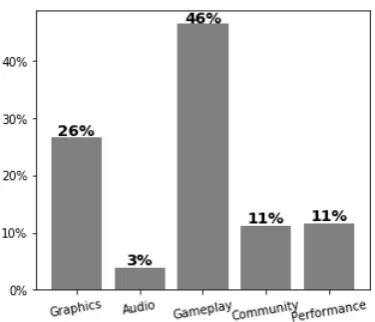
Figure 1: Aspect proportions exhibited in cluster on “The Elder Scrolls V: Skyrim” game
4.3 Aspect Labeling
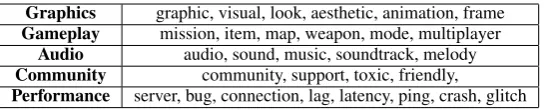
Another way to label the aspects is to map them to a predefined set of aspect labels, based on gold-standard (i.e. professional) reviews. In Table 2
we show an indicative, human-provided mapping between terms and predefined aspect labels.
Based on the mapping illustrated in Table 2, each sentence can be classified into one of the as-pects, by identifying the prevalent aspect of the sentence’s words (i.e. terms). For instance, if the majority of the terms in a sentence belong to the communityaspect, then the sentence is given this label. It should be noted that the term lists needs to be slightly modified based on the game’s genre. The reason is that the terms that illustrate the “gameplay” aspect of a first-person shooter game differ notably from those of a puzzle or an adventure game. This fact highlights the intrica-cies of the game review task, where secondary (la-tent) variables alter the aspect descriptions.
Eventually, we end up with the predefined as-pect proportions that each cluster exhibits. In Fig-ure3we provide a few indicative sentences from a specific aspect cluster. Then, in Figure1we show how the sentences of the cluster led to a distribu-tion over the predefined aspects.
4.4 Sentiment Analysis
The sentiment analysis step focuses on identifying the underlying sentiment that pervades each clus-ter. Since our clusters consist of sentences we per-form sentence-level sentiment analysis.
As there is no sentiment analysis dataset
spe-cific to our domain, we decided to use VADER (Hutto and Gilbert, 2014), a lexicon and rule-based sentiment analysis tool that is specifically attuned to sentiments expressed in social media. Interestingly, VADER can tell us how positive, negative and neutral a given sentence is, instead of just classifying the sentence in a single category. VADER combines a dictionary of lexical features to sentiment scores with a set of five heuristics (e.g. punctuation, degree modifiers, e.t.c). Conse-quently, by calculating the three sentiment scores for each sentence in a cluster and averaging, we can get the distribution of the reviewers’ sentiment for this cluster.
4.5 Final Output
The final output of the process is an aspect-based summary of a set of reviews of a specific game, coupled with positive, negative and neutral senti-ment proportions for each aspect. While the initial set of numerous unstructured reviews are consid-erably difficult to deal with, this type of summary enables the reader to retrieve the most relevant information about the game according to his/her need.
5 Experiments
5.1 Experimental Setup
For our experiments we used the Steam review dataset gathered by Zuo (2018). It consists of more than 7 million reviews obtained via Steam’s API. Each review text comes with a plethora of features concerning both the game being reviewed and the reviewer. For our experiments, we only utilized the game’s ID, the review itself and the number of “helpful” votes the review has received by other community members.
In our experiments, to speedup the clustering process we use only a sample of the reviews of each game consisting of the 10,000 most voted re-views. Due to the syntactical peculiarities found in user-generated reviews, we also had to per-form some extra pre-processing together with the sentence segmentation. This involved repeating phrases and multiple whitespace removal as well as filtering out terms consisting of non-ASCII characters.
Graphics graphic, visual, look, aesthetic, animation, frame Gameplay mission, item, map, weapon, mode, multiplayer
Audio audio, sound, music, soundtrack, melody Community community, support, toxic, friendly,
[image:6.595.164.437.61.116.2]Performance server, bug, connection, lag, latency, ping, crash, glitch
Table 2: Selected terms for each aspect
You get attached to so many characters and the world is amazing.
Probably the best open-world rpg out there.
The vast open world is absolutely stunning.
If you’re looking for a way to waste massive amounts of time just trolling around a world play this.
Table 3: Indicative sentences from cluster on “The Elder Scrolls V: Skyrim” game
approach computationally expensive.
Identifying the appropriate number of clustersk can sometimes be one of trickier tasks in the study of clustering. In order to deal with this issue, we attempted to use the elbow method and we also performed Silhouette analysis (Rousseeuw,1987). Nonetheless, no appreciably optimal k was found by the two methods. However, this is not particu-larly surprising, in light of the fact that the reviews address a wide range of themes. Thus, the more clusters we create, the higher the coherence will be. Considering, though, that we aim to produce a digestible aspect-based summary using these clus-ters, it would be irrational to produce too many of them. For this reason, we decided to work with 5 clusters.
5.2 Results
In order to reach a sound conclusion we have performed an empirical evaluation with four dif-ferent human evaluators. Before describing our evaluation process, we remind the reader that we seek to provide an evaluation process for game review summarization. Given this requirement, we assess the coherence of the generated clus-ters and examine whether they can be mapped to specific game aspects in a consistent way by hu-mans. This study allows us to understand whether steps of the problem, as formulated in Section3,
can be evaluated consistently. For the final out-put of the whole summarization pipeline we ex-pect that standard summary evaluation methods, such as MeMoG (Giannakopoulos and Karkalet-sis,2013) and ROUGE (Lin,2004) will be useful. We asked the help of 4 evaluators, who were flu-ent in the English language. The evaluators were given a set of 20 sentences fetched from each of the five clusters of three different games (for a to-tal of 15 clusters). We also opted for different gen-res in order to examine the inter-genre differences with respect to the terms used for describing game aspects. They were then asked read each set of sentences and complete the following tasks:
• Select up tonrepresentative sentences from the aspect cluster to represent/summarize the cluster. The idea behind this task is to show whether the cluster was coherent enough to be described by a representative subset of its sentences. The lower the number of repre-sentative sentences one would need to use to represent the cluster, the higher the coherence of the cluster.
• Describe the theme of each set using 3 to 5 (possibly multi-word) terms. This task aims to see whether humans can consistently label a given aspect cluster. If so, then the agreed wording(s) can be considered gold-standard, similarly to a Pyramid evaluation (Nenkova and Passonneau,2004).
• Select one or more predefined terms (game-play, graphics, audio, community, perfor-mance, overall, other) that best describe the aspect, according to the opinion of the human evaluator. We also allowed the user to select “other” as an option, to examine whether a significant number of aspects go beyond the predefined ones. This would indeed indicate the dynamic nature of aspects in the game re-view summarization setting.
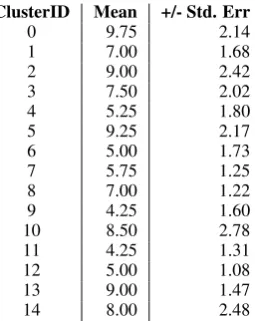
ClusterID Mean +/- Std. Err
0 9.75 2.14
1 7.00 1.68
2 9.00 2.42
3 7.50 2.02
4 5.25 1.80
5 9.25 2.17
6 5.00 1.73
7 5.75 1.25
8 7.00 1.22
9 4.25 1.60
10 8.50 2.78
11 4.25 1.31
12 5.00 1.08
13 9.00 1.47
[image:7.595.120.248.61.222.2]14 8.00 2.48
Table 4: Average representative sentences per as-pect
We expect that the lower the number, the better the coherence of the cluster. In Table4we see, for each cluster, the average number of sentences se-lected as representative by the users, plus the stan-dard error. We see that, given 20 sentences, the users selected on average from 4 to 9 representa-tive sentences.
In the “describe the theme” task, we examine whether humans can assign consistent labels in an open terminology setting (i.e. without limiting the possible labels). To measure the agreement here we post-processed their terms, semi-automatically creating equivalence classes of terms (which could also have been determined based on an embedding or a linguistic resource). Indicative equivalence classes were:
• ban; ban possible; bans
• best game; best rally game; buy; buy game; buying recommendations; described as best game; ...
• bad community; community; community bad; community sucks; low rank player be-haviour bad; toxic community
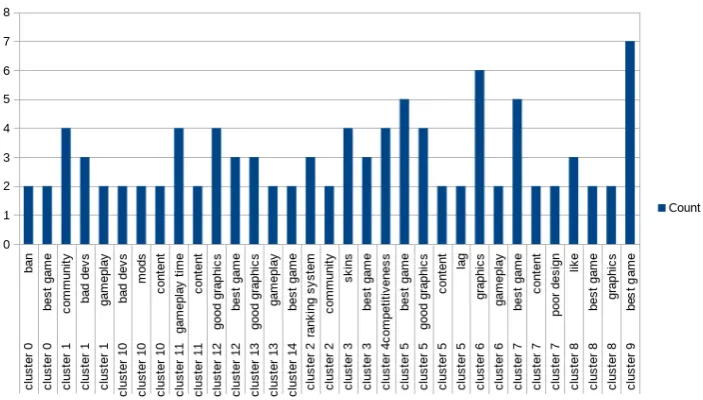
We then examined, for each cluster, the number of equivalent terms that were used across all evalu-ators to label the specific aspect cluster. If at least 2 of the 4 evaluators utilize equivalent terms, we consider that the labeling is possible and success-ful. In all the 15 clusters at least one equivalence class was used consistently. In Figure2we show the consistently used equivalence classes per clus-ter. 4
4There are cases where a single evaluator used more than
6 Conclusion
In this paper we discuss the domain of game re-view summarization. We highlighted main chal-lenges of the domain, showing that a number of unique traits require different approaches from other summarization settings. We formally ex-pressed a view of the task, suggesting a base-line implementation. We then described a possi-ble evaluation process, aiming to quantify the suc-cess of the aspect identification and labeling, tak-ing into account coherence and consistent labeltak-ing from human evaluators.
This preliminary study of the game review set-ting opens a number of research questions that we can pursue in the future. First, how does the game genre affect the aspects of a game? Is there a causal relation that connects them? Can we per-form automatic evaluation with or without human gold standard summaries? What is different from other summarization settings, concerning the eval-uation?
In this work, we offer a first research step to-wards the emerging and useful domain of game re-view summarization. We understand that this first step simply highlights interesting points of focus, while providing some intuition on what is mean-ingful and doable from an evaluation perspective. We feel confident that this will help document and formulate a consistent setting and benchmarking process, helping related endeavors grow in the fu-ture.
References
Charu C. Aggarwal and ChengXiang Zhai. 2012. A survey of text clustering algorithms. InMining Text Data.
Mrinal Kanti Baowaly, Yi-Pei Tu, and Kuan-Ta Chen. 2019. Predicting the helpfulness of game reviews: A case study on the Steam store. Journal of Intelligent & Fuzzy Systems36(5):4731–4742.
Cicero dos Santos and Maira Gatti. 2014. Deep Con-volutional Neural Networks for Sentiment Analysis of Short Texts. In Proceedings of COLING 2014, the 25th International Conference on Computational Linguistics: Technical Papers. Dublin City Univer-sity and Association for Computational Linguistics, Dublin, Ireland, pages 69–78.
Figure 2: Count of usage for consistent equivalence classes per cluster
Mauro Dragoni, Celia da Costa Pereira, Andrea G. B. Tettamanzi, and Serena Villata. 2018. Combin-ing argumentation and aspect-based opinion minCombin-ing: The SMACk system. AI Communications31(1):75– 95.
Kavita Ganesan, Chengxiang Zhai, and Jiawei Han. 2010. Opinosis: a graphbased approach to abstrac-tive summarization of highly redudant opinions. In In COLING.
George Giannakopoulos and Vangelis Karkaletsis. 2013. Summary evaluation: Together we stand npower-ed. InInternational Conference on Intelli-gent Text Processing and Computational Linguistics. Springer, pages 436–450.
Minqing Hu and Bing Liu. 2004. Mining opinion fea-tures in customer reviews. InAAAI. volume 4, pages 755–760.
Clayton J Hutto and Eric Gilbert. 2014. Vader: A par-simonious rule-based model for sentiment analysis of social media text. InEighth international AAAI conference on weblogs and social media.
Jihene Jmal and Rim Faiz. 2013. Customer review summarization approach using Twitter and Senti-WordNet. In Proceedings of the 3rd International Conference on Web Intelligence, Mining and Seman-tics - WIMS ’13. ACM Press, Madrid, Spain, page 1.
Yohan Jo and Alice H. Oh. 2011. Aspect and Senti-ment Unification Model for Online Review Analy-sis. InProceedings of the Fourth ACM International Conference on Web Search and Data Mining. ACM, New York, NY, USA, WSDM ’11, pages 815–824. Event-place: Hong Kong, China.
Chin-Yew Lin. 2004. Rouge: A package for auto-matic evaluation of summaries. InText summariza-tion branches out. pages 74–81.
Yue Lu, ChengXiang Zhai, and Neel Sundaresan. 2009. Rated Aspect Summarization of Short Comments. InProceedings of the 18th International Conference on World Wide Web. ACM, New York, NY, USA, WWW ’09, pages 131–140. Event-place: Madrid, Spain.
George Miller. 1998. WordNet: An electronic lexical database. MIT press.
Ani Nenkova and Rebecca Passonneau. 2004. Evalu-ating content selection in summarization: The pyra-mid method. InProceedings of the human language technology conference of the north american chap-ter of the association for computational linguistics: Hlt-naacl 2004. pages 145–152.
Bo Pang, Lillian Lee, and Shivakumar Vaithyanathan. 2002. Thumbs up? Sentiment Classification using Machine Learning Techniques. In Proceedings of the 2002 Conference on Empirical Methods in Nat-ural Language Processing (EMNLP 2002).
Maria Pontiki, Dimitris Galanis, Haris Papageorgiou, Ion Androutsopoulos, Suresh Manandhar, Moham-mad AL-SMoham-madi, Mahmoud Al-Ayyoub, Yanyan Zhao, Bing Qin, Orphe De Clercq, Vronique Hoste, Marianna Apidianaki, Xavier Tannier, Na-talia Loukachevitch, Evgeniy Kotelnikov, Nuria Bel, Salud Mara Jimnez-Zafra, and Glen Eryiit. 2016. SemEval-2016 Task 5: Aspect Based Sentiment Analysis. In Proceedings of the 10th Interna-tional Workshop on Semantic Evaluation (SemEval-2016). Association for Computational Linguistics, San Diego, California, pages 19–30.
Soujanya Poria, Erik Cambria, and Alexander Gel-bukh. 2016. Aspect extraction for opinion min-ing with a deep convolutional neural network. Knowledge-Based Systems108:42–49.
Statement Extraction. In7th International Confer-ence on Natural Language Processing. pages 01–12.
Peter Rousseeuw. 1987. Silhouettes: A Graphical Aid to the Interpretation and Validation of Cluster Anal-ysis. J. Comput. Appl. Math.20(1):53–65.
Sebastian Ruder, Parsa Ghaffari, and John G. Breslin. 2016. A Hierarchical Model of Reviews for Aspect-based Sentiment Analysis. arXiv:1609.02745 [cs] ArXiv: 1609.02745.
Aliaksei Severyn and Alessandro Moschitti. 2015. Twitter Sentiment Analysis with Deep Convolu-tional Neural Networks. InProceedings of the 38th International ACM SIGIR Conference on Research and Development in Information Retrieval. ACM, New York, NY, USA, SIGIR ’15, pages 959–962. Event-place: Santiago, Chile.
Ivan Titov and Ryan McDonald. 2008. Modeling Online Reviews with Multi-grain Topic Models. arXiv:0801.1063 [cs]ArXiv: 0801.1063.
Peter D. Turney. 2002. Thumbs Up or Thumbs Down? Semantic Orientation Applied to Unsuper-vised Classification of Reviews. arXiv:cs/0212032 ArXiv: cs/0212032.
Theresa Wilson, Janyce Wiebe, and Paul Hoffmann. 2005. Recognizing Contextual Polarity in Phrase-Level Sentiment Analysis. In Proceedings of Hu-man Language Technology Conference and Confer-ence on Empirical Methods in Natural Language Processing.
Haibing Wu, Yiwei Gu, Shangdi Sun, and Xiaodong Gu. 2016. Aspect-based Opinion Summarization with Convolutional Neural Networks. In 2016 In-ternational Joint Conference on Neural Networks (IJCNN). IEEE, Vancouver, BC, Canada, pages 3157–3163.
K. Yauris and M. L. Khodra. 2017. Aspect-based summarization for game review using double prop-agation. In2017 International Conference on Ad-vanced Informatics, Concepts, Theory, and Applica-tions (ICAICTA). pages 1–6.
Li Zhuang, Feng Jing, and Xiao-Yan Zhu. 2006. Movie Review Mining and Summarization. InProceedings of the 15th ACM International Conference on In-formation and Knowledge Management. ACM, New York, NY, USA, CIKM ’06, pages 43–50.