106
Neural Question Generation using Interrogative Phrases
Yuichi Sasazawa Sho Takase Naoaki Okazaki
Tokyo Institute of Technology
{yuichi.sasazawa, sho.takase} at nlp.c.titech.ac.jp okazaki at c.titech.ac.jp
Abstract
Question Generation (QG) is the task of gen-erating questions from a given passage. One of the key requirements of QG is to generate a question such that it results in a target an-swer. Previous works used a target answer to obtain a desired question. However, we also want to specify how to ask questions and im-prove the quality of generated questions. In this study, we explore the use of interroga-tive phrases as additional sources to control QG. By providing interrogative phrases, we expect that QG can generate a more reliable sequence of words subsequent to an interroga-tive phrase. We present a baseline sequence-to-sequence model with the attention, copy, and coverage mechanisms, and show that the simple baseline achieves state-of-the-art per-formance. The experiments demonstrate that interrogative phrases contribute to improving the performance of QG. In addition, we report the superiority of using interrogative phrases in human evaluation. Finally, we show that a question answering system can provide target answers more correctly when the questions are generated with interrogative phrases.1
1 Introduction
Question Generation (QG) is the task of generat-ing questions from a given passage. It has several applications: (1) In the area of the education, QG can help to generate questions for reading compre-hension materials (Heilman and Smith,2010). (2) QG can aid development of conversational chat-bots, which ask questions (Mostafazadeh et al.,
2016). (3) QG is useful for development of ques-tion answering datasets (Duan et al., 2017;Tang et al.,2018).
1Our code is available at https://github.com/ WERimagin/NQG_Interrogative_Phrases.
One of the key requirements of QG is to gen-erate a question such that it asks a target answer. For example, the sentence “Bob went to the airport yesterday.” can have various candidate questions such as “When did Bob go to the airport?,” “Where did Bob go yesterday?,” and “Who went to the air-port yesterday?” It is necessary for QG to specify a desired question from among multiple possibili-ties. Du et al. (2017) and Chali et al. (2018) used the sequence-to-sequence model (Bahdanau et al.,
2015), which takes only a passage as the input. Thus, only one question is generated from mul-tiple possibilities at random. Most recent studies tried to generate a desired question using a target answer as the input. Zhou et al. (2017) and Song et al. (2018) incorporated the target answer using the answer position feature. Kim et al. (2018) sep-arated target answer words from the original pas-sages to address the problem of many generated questions including the target answer words.
However, we also want to specify how questions should be asked and improve the quality of the generated questions. The existing method some-times generates inappropriate questions whose in-terrogative phrases do not match the target an-swers. For example, we specify a target answer, “in 1920,” but an interrogative phrase of the gen-erated question is “how much.” Sun et al. (2018) proposed the answer-focused model to address this problem. Heilman and Smith. (2010) extracted target answers from passages and automatically converted them into interrogative phrases by a se-quence of general rules.
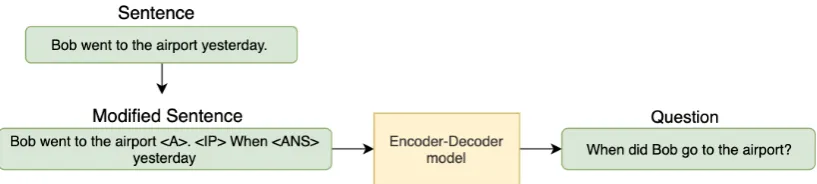
Figure 1: Overview of the proposed method. We concatenate an answer and interrogative phrase at the end of the passage using the special tokens<IP>and<ANS>. Also, we replace the answer phrase with the special token
<A>. We use this modified passage as the input and generate a question.
phrases manually is not so difficult; thus, using the correct interrogative phrases as inputs is an expected experimental setting. We investigate to what extent using proper interrogative phrases as inputs contributes to the quality of the questions. To the best of our knowledge, this is the first study that studies the use of interrogative phrases as in-puts to improve the quality of questions in QG.
We test our method on the SQuAD dataset (
Ra-jpurkar et al.,2016). We demonstrate that the use
of interrogative phrases contributes to improving the performance of QG by automatic metrics and human evaluation. We also conduct a question an-swering experiment. We show that it is easier for a question answering system to provide the correct target answers when questions are generated using interrogative phrases.
2 Method
In this work, we generate a question from a pas-sage, a target answer, and an interrogative phrase. An outline of our method is shown in Figure1.
We use the Encoder-Decoder model with an attention mechanism (Bahdanau et al., 2015) for generating questions. In order to obtain a ques-tion that depends on a passage, a target an-swer and an interrogative phrase, we concatenate the target answer and the interrogative phrase at the end of the passage using the special tokens <IP>and<ANS>. This treatment can inform the model about the target answer and the interroga-tive phrase that should be considered in the gen-erated questions. In addition, we replace the span of the target answer in the passage with the spe-cial token<A>. This treatment helps the model to focus on the words present near the answer in the passage when generating a question.
Because a question is expected to use the words appearing in the passage, we incorporate the copy
mechanism (See et al.,2017) into the model. By copying the words in the passage while generat-ing the question, this mechanism reduces the risk of generating words not included in the passage. We also explore the use of the coverage mecha-nism (Tu et al.,2016) to avoid generating an inap-propriate question. This mechanism can also pvent the model from generating the same word re-peatedly.
Although this model is simpler than other QG models, it achieves the surprisingly good perfor-mance on the SQuAD v1.1 dataset, as described in Sections3.4and3.5.
3 Experiments
3.1 Dataset
We use the SQuAD v1.1 dataset (Rajpurkar et al.,
These pairs are unsuitable for the QG dataset be-cause the passage is not related to the question. We thus obtain 74,863, 4,658, and 4,658 pairs for training, development, and test, respectively.
3.2 Experiment setting
We use the OpenNMT system (Klein et al.,2017). We retain 45,000 of the most frequent words on the source side and 28,000 of the most frequent words on the target side. All the other words are replaced by the <UNK> token. We use 300 di-mensions pretrained glove.840B.300d ( Penning-ton et al.,2014) embeddings for initialization, and we fix them during training. We use 2-layer long short-term memory in both the encoder and the de-coder. The size of the hidden state is 600. The dropout rate is 0.3. We use stochastic gradient de-scent for optimization. The initial learning rate is 1.0. We halve the learning rate every 2,500 steps from 20,000 steps onwards. We finish the training at 50,000 steps. We adopt the model that achieves the highest accuracy in the development set.
During inference, we conduct the beam search with a beam width of 2. Decoding stops when the model generates the<EOS> token. All hyperpa-rameters are tuned using the development set, and the results are reported using the test set.
We use two models for comparisons.
ASs2s This model is the state-of-the-art of the
neural QG model for the SQuAD dataset (Kim
et al., 2018). Based on the Encoder-Decoder
ar-chitecture, this model incorporates a target answer using answer-separated seq2seq and the keyword-net module. This model need to use a target an-swer. We compare the accuracy of using ative phrases as inputs. When we use an interrog-ative phrase as the input, we concatenate it at the end of the passage using the special token<IP>.
Seq2SeqThis is our baseline model. We use the
RNN-based Encoder-Decoder model with the at-tention, copy, and coverage mechanisms. We com-pare the accuracy of using interrogative phrases or target answers as inputs. When we use an in-terrogative phrase as the input, we concatenate it at the end of the passage using the special token <IP>. When we use a target answer as the input, we concatenate it at the end of the passage using the special token<ANS> and replace the span of the target answer in the passage with special token <A>.
To check the contributions of the components in
our model, we conduct ablation tests. We remove each component from the Seq2Seq + Answer + In-terrogative method.
-Copy: Without the copy mechanism.
-Coverage: Without the coverage mechanism.
-Answer: Without concatenating the target
an-swer at the end of the passage. We use the target answer by replacing it in the passage.
-Answer separation: Without replacing the target
answer in the passage. We use the target answer by concatenating it at the end of the passage.
3.3 Evaluation
Following other QG studies, we use three evalu-ation metrics: BLEU, METEOR, and ROUGEL
similar to other QG studies (Du et al.,2017;Kim
et al., 2018). In the SQuAD dataset, a passage
sometimes has multiple gold questions. Other studies used all these questions as references. In this research, we use one gold question that is a pair of the source passage and the target answer, as a reference. The score apparently decreases us-ing this evaluation method. This method is more accurate to evaluate generated questions using tar-get answers as inputs.
In addition, the evaluation method has one lim-itation. As we use interrogative phrases that form part of the questions, the score increases consider-ably because the model knows parts of the ques-tions (interrogative phrases) to be generated. For this reason, we also evaluate the generated ques-tions excluding the interrogative phrases. This treatment helps us verify whether the whole gen-erated questions will lead to the target answers.
3.4 Result of the experiment
Normal Evaluation Excluding Interrogative Phrases Model Answer Interrogative BLEU METEOR ROUGEL BLEU METEOR ROUGEL
ASs2s X 14.6 19.1 43.0 13.7 17.7 40.8
X X 21.6 23.0 51.2 14.4 17.8 41.8
Seq2Seq
12.1 16.4 39.0 11.8 15.5 37.9 X 22.8 23.1 51.6 14.4 17.4 41.6
X 18.7 21.8 47.5 17.9 20.4 45.2
X X 26.4 26.2 55.9 18.6 20.9 46.9
Ablation Tests
[image:4.595.101.496.60.206.2]- Copy X X 22.0 23.3 52.1 14.2 17.9 42.8 - Coverage X X 26.4 26.1 56.0 18.5 20.8 46.9 - Answer X X 26.1 25.9 55.5 18.3 20.5 46.3 - Answer Sep X X 23.5 23.5 52.2 15.2 17.9 42.4
Table 1: Result of the QG. We use three evaluation metrics: BLEU, METEOR, and ROUGEL. We also evaluate
questions excluding interrogative phrases. In addition, we do four ablation tests.
Seq2Seq+Answer Seq2Seq+Answer
+Interrogative Interrogative Phrase
Same as Gold 51% 100%
Appropriate 43% 0%
Inappropriate 6% 0%
Answer
Correct 61% 74%
Incorrect 39% 26%
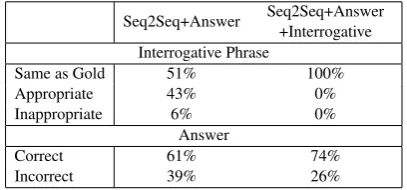
Table 2: Human evaluations of QG. We check the ques-tions according to two criteria: (1) Do the interrogative phrases match the target answers? (2) Can the ques-tions provide the target answers?
to increasing the accuracy compared to concate-nating the target answers at the end of the passage.
Human evaluation We conduct human
evalua-tion to check whether the generated quesevalua-tions are appropriate. We randomly extract 100 generated questions from the test set. We check the questions according to two criteria: (1) Do the interrogative phrases match the target answers? We classify the generated questions as follows: the same interrog-ative phrase as one of the gold questions, different from one of the gold questions but an appropri-ate interrogative phrase that matches the target an-swer, and inappropriate interrogative phrase that do not match the target answer. (2) Can the ques-tions provide the target answers?
Table 2 shows the result. Seq2Seq + Answer + Interrogative always generates questions that in-clude the same interrogative phrase as one of the gold questions. Seq2Seq2 + Answer often uses simpler interrogative phrases than Seq2Seq + An-swer + Interrogative, and thus, the questions be-come abstractive. For example, while the gold in-terrogative phrase is “what year”, Seq2Seq + An-swer generates “when”. With regard to the
an-Passage:A regulation of the Rhine was called for, with an upper canal near Diepoldsau and a lower canal at Fuach, in order to counteract the constant flooding and strong sedimentation in the western Rhine Delta.
Target Answer:constant flooding
Gold Question:Why was the Rhine regulated?
ASs2s: What is a lower canal by a lower canal at the western Rhine Delta?
Seq2Seq+Answer: What was the regulation of the Rhine called for ?
Seq2Seq+Answer+Interrogative:Why was a regula-tion of the Rhine called ?
Passage:[note 6] In 1978 a disco version of the theme was released in the UK, Denmark and Australia by the group Mankind, which reached number 24 in the UK charts.
Target Answer:number 24
Gold Question: How high on the charts did the Mankind version of the theme go?
ASs2s: What was the group of the theme ballad re-leased by the group?
Seq2Seq+Answer: How many number of the UK charts did the group Mankind reach in the UK charts?
Seq2Seq+Answer+Interrogative: How high on the charts did the group Mankind reach?
Table 3: Examples of the generated questions. This shows questions generated by three models: ASs2S, Seq2Seq + Answer, and Seq2Seq + Answer + Inter-rogative.
swers, Seq2Seq + Answer + Interrogative outper-forms Seq2Seq + Answer. This implies that us-ing interrogative phrases as inputs makes the ques-tions more informative and answerable.
Case study Table3shows two examples
[image:4.595.79.283.259.354.2]cor-Passage:In July 1977, General Zia-ul-Haq overthrew Prime Minister Zulfiqar Ali Bhutto ’s regime in Pak-istan .
Interrogative Phrase:What
Generated Question:What was the name of the Prime Minister who overthrew Pakistan in 1977?
Interrogative Phrase:Who
Generated Question:Who overthrew Prime Minister in 1977?
Interrogative Phrase:When
Generated Question: When was Zulfiqar Ali Bhutto elected?
Interrogative Phrase:Where
Generated Question:Where was Zulfiqar Ali Bhutto from?
Interrogative Phrase:How
Generated Question:How did Zulfiqar Ali Bhutto re-spond to the Prime Minister?
Interrogative Phrase:Why
Generated Question: Why was Zulfiqar Ali Bhutto elected?
Interrogative Phrase:In what year
Generated Question: In what year was Zulfiqar Ali Bhutto elected?
Interrogative Phrase:How many
[image:5.595.321.512.62.154.2]Generated Question:How many Prime Minister did Zulfiqar Ali Bhutto have in pakistan?
Table 4: Example of the question generated by the Seq2Seq + Interrogative model. This model does not use an answer phrase. Thus, it can generate various questions only from passages and interrogative phrases.
rect interrogative phrase and the generated ques-tion can thus provide the target answer.
In the second example, a similar phenomenon appears. ASs2s use “what” and Seq2Seq + An-swer use “how many number of the UK charts” as interrogative phrases for the target answer “num-ber 24”. They are inappropriate for context, and the passage become unnatural.
Table 4 shows an example generated by Seq2Seq + Interrogative model. This example comprises a passage and eight questions gener-ated from eight frequently interrogative phrases. This model does not use answer phrases. Thus, it can generate various questions only from passages and interrogative phrases. They can also generate questions where the answer phrase is not in the passage although all questions in the train data in-clude answer phrases in the passage.
3.5 Question answering using generated
questions
We also examine the quality of the generated ques-tions in the question answering experiments. We verify whether the generated questions can pro-vide the target answers. We apply BERT (Devlin
et al.,2019) for the question answering model on
Method Answer Interrogative EM F1
ASs2s X 68.9 78.7
X X 71.7 80.1
Seq2Seq
34.1 43.4 X 58.7 69.0
X 72.6 82.2
X X 75.3 84.2
Human 81.2 88.9
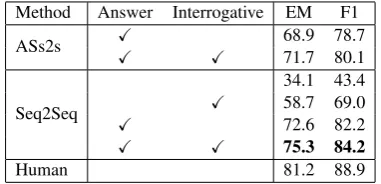
Table 5: Result of question answering using generated questions. We use two evaluation metrics: Exact Match and F1 score.
the SQuAD dataset. We train and test the question answering model using the generated questions. We also train and test original passages created by a human in the SQuAD dataset as the upper bound. We use two evaluation metrics: Exact Match and F1 score.
Table 5 shows the result. This demonstrates that using interrogative phrases helps the ques-tion answering system to reach the target answers. The score of Seq2Seq + Answer + Interrogative is a little lower than the one associated with the human-generated questions (by 4.7 F1 points). This shows that for the question answering model, the system-generated questions are close to those created by a human.
4 Conclusion and Future Work
In this study, we explore the use of interrogative phrases as additional sources to control QG. The results of the experiment show that using inter-rogative phrases contributes to improving the per-formance of QG. The question answering experi-ment demonstrates that using interrogative phrases helps the question answering system to provide target answers.
Future studies on QG will focus on the follow-ing aspects. (1) We directly input the interroga-tive phrases in this study. However, we also con-sider automatic selection of appropriate interroga-tive phrases such that the answerers can reach the target answer easily. (2) The model sometimes generates questions that contradict the source pas-sages. To reduce that risk, we will use textual en-tailment to verify whether the generated questions are consistent with the source passages.
Acknowledgments
[image:5.595.89.277.64.333.2]References
Dzmitry Bahdanau, Kyunghyun Cho, and Yoshua Ben-gio. 2015. Neural machine translation by jointly learning to align and translate. In Proceedings of the International Conference on Learning Represen-tations.
Yllias Chali and Tina Baghaee. 2018. Automatic opin-ion questopin-ion generatopin-ion. In Proceedings of the 11th International Conference on Natural Language Generation, pages 152–158.
Jacob Devlin, Ming-Wei Chang, Kenton Lee, and Kristina Toutanova. 2019. BERT: Pre-training of deep bidirectional transformers for language under-standing. InProceedings of the 2019 Conference of the North American Chapter of the Association for Computational Linguistics, pages 4171–4186.
Xinya Du, Junru Shao, and Claire Cardie. 2017. Learn-ing to Ask: Neural Question Generation for ReadLearn-ing Comprehension. InProceedings of the 55th Annual Meeting of the Association for Computational Lin-guistics, pages 1342–1352.
Nan Duan, Duyu Tang, Peng Chen, and Ming Zhou. 2017. Question generation for question answering. In Proceedings of the 2017 Conference on Empiri-cal Methods in Natural Language Processing, pages 866–874.
Michael Heilman and Noah A. Smith. 2010. Good Question! Statistical Ranking for Question Gener-ation. InHuman Language Technologies: The 2010 Annual Conference of the North American Chap-ter of the Association for Computational Linguistics, pages 609–617.
Yanghoon Kim, Hwanhee Lee, Joongbo Shin, and Ky-omin Jung. 2018. Improving Neural Question Gen-eration using Answer Separation. InProceedings of the Thirty-Third AAAI Conference on Artificial In-telligence.
Guillaume Klein, Yoon Kim, Yuntian Deng, Jean Senellart, and Alexander Rush. 2017. OpenNMT: Open-source toolkit for neural machine translation. InProceedings of the 55th annual meeting of the As-sociation for Computational Linguistics, pages 67– 72.
Christopher Manning, Mihai Surdeanu, John Bauer, Jenny Finkel, Steven Bethard, and David McClosky. 2014. The Stanford CoreNLP natural language pro-cessing toolkit. InProceedings of the the 52nd An-nual Meeting of the Association for Computational Linguistics, pages 55–60.
Nasrin Mostafazadeh, Ishan Misra, Jacob Devlin, Mar-garet Mitchell, Xiaodong He, and Lucy Vander-wende. 2016. Generating natural questions about an image. InProceedings of the 54th Annual Meet-ing of the Association for Computational LMeet-inguis- Linguis-tics, pages 1802–1813.
Jeffrey Pennington, Richard Socher, and Christopher Manning. 2014. Glove: Global vectors for word representation. In Proceedings of the 2014 Con-ference on Empirical Methods in Natural Language Processing, pages 1532–1543.
Pranav Rajpurkar, Jian Zhang, Konstantin Lopyrev, and Percy Liang. 2016. SQuAD: 100,000+ Questions for Machine Comprehension of Text. In Proceed-ings of the 2016 Conference on Empirical Methods in Natural Language Processing, pages 2383–2392.
Abigail See, Peter J. Liu, and Christopher D. Manning. 2017. Get to the point: Summarization with pointer-generator networks. InProceedings of the 55th An-nual Meeting of the Association for Computational Linguistics, pages 1073–1083.
Linfeng Song, Zhiguo Wang, Wael Hamza, Yue Zhang, and Daniel Gildea. 2018. Leveraging Context In-formation for Natural Question Generation. In Pro-ceedings of the 2018 Conference of the North Amer-ican Chapter of the Association for Computational Linguistics, pages 569–574.
Xingwu Sun, Jing Liu, Yajuan Lyu, Wei He, Yan-jun Ma, and Shi Wang. 2018. Answer-focused and position-aware neural question generation. In Pro-ceedings of the 2018 Conference on Empirical Meth-ods in Natural Language Processing, pages 3930– 3939.
Duyu Tang, Nan Duan, Zhao Yan, Zhirui Zhang, Yibo Sun, Shujie Liu, Yuanhua Lv, and Ming Zhou. 2018. Learning to collaborate for question answering and asking. InProceedings of the 2018 Conference of the North American Chapter of the Association for Computational Linguistics, pages 1564–1574.
Zhaopeng Tu, Zhengdong Lu, Yang Liu, Xiaohua Liu, and Hang Li. 2016. Modeling coverage for neural machine translation. InProceedings of the 54th An-nual Meeting of the Association for Computational Linguistics, pages 76–85.