355
Best practices for the human evaluation of automatically generated text
Chris van der Lee
Tilburg University [email protected]
Albert Gatt
University of Malta [email protected]
Emiel van Miltenburg
Tilburg University [email protected]
Sander Wubben
Tilburg University [email protected]
Emiel Krahmer
Tilburg University [email protected]
Abstract
Currently, there is little agreement as to how Natural Language Generation (NLG) systems should be evaluated, with a particularly high degree of variation in the way that human eval-uation is carried out. This paper provides an overview of how human evaluation is currently conducted, and presents a set of best practices, grounded in the literature. With this paper, we hope to contribute to the quality and consis-tency of human evaluations in NLG.
1 Introduction
Even though automatic text generation has a long tradition, going back at least toPeter(1677) (see also Swift, 1774; Rodgers, 2017), human eval-uation is still an understudied aspect. Such an evaluation is crucial for the development of Nat-ural Language Generation (NLG) systems. With a well-executed evaluation it is possible to assess the quality of a system and its properties, and to demonstrate the progress that has been made on a task, but it can also help us to get a better under-standing of the current state of the field (Mellish and Dale, 1998; Gkatzia and Mahamood, 2015; van der Lee et al.,2018). The importance of evalu-ation for NLG is itself uncontentious; what is per-haps more contentious is the way in which eval-uation should be conducted. This paper provides an overview of current practices in human evalua-tion, showing that there is no consensus as to how NLG systems should be evaluated. As a result, it is hard to compare the results published by differ-ent groups, and it is difficult for newcomers to the field to identify which approach to take for eval-uation. This paper addresses these issues by pro-viding a set of best practices for human evaluation in NLG. A further motivation for this paper’s fo-cus on human evaluation is the recent disfo-cussion on the (un)suitability of automatic measures for
the evaluation of NLG systems (see Ananthakr-ishnan et al.,2007;Novikova et al.,2017;Sulem et al., 2018; Reiter, 2018, and the discussion in Section2).
Previous studies have also provided overviews of evaluation methods. Gkatzia and Mahamood (2015) focused on NLG papers from 2005-2014; Amidei et al. (2018a) provided a 2013-2018 overview of evaluation in question generation; and Gatt and Krahmer(2018) provided a more general survey of the state-of-the-art in NLG. However, the aim of these papers was to give a structured overview of existing methods, rather than discuss shortcomings and best practices. Moreover, they did not focus on human evaluation.
FollowingGkatzia and Mahamood(2015), Sec-tion 3provides an overview of current evaluation practices, based on papers from INLG and ACL in 2018. Apart from the broad range of meth-ods used, we also observe that evaluation practices have changed since 2015: for example, there is a significant decrease in the number of papers fea-turing extrinsic evaluation. This may be caused by the current focus on smaller, decontextualized tasks, which do not take users into account.
Building on findings from NLG, but also statis-tics and the behavioral sciences, Section 4 pro-vides a set of recommendations and best practices for human evaluation in NLG. We hope that our recommendations can serve as a guide for new-comers in the field, and can otherwise help NLG research by standardizing the way human evalua-tion is carried out.
2 Automatic versus human evaluation
met-rics, while our own survey (described more fully inSection 3) shows that 80% of the empirical pa-pers presented at the ACL track on NLG or at the INLG conference in 2018 reported on automatic metrics. However, the use of these metrics for the assessment of a system’s quality is controversial, and has been criticized for a variety of reasons. The two main points of criticism are:
Automatic metrics are uninterpretable. Text generation can go wrong in different ways while still receiving the same scores on automated met-rics. Furthermore, low scores can be caused by correct, but unexpected verbalizations (Anan-thakrishnan et al., 2007). Identifying what can be improved therefore requires an error analysis. Automatic metric scores can also be hard to in-terpret because it is unclear how stable the re-ported scores are. With BLEU, for instance, li-braries often have their own BLEU score imple-mentation, which may differ from one another, thus affecting the scores (this is recently addressed byPost,2018). Reporting the scores accompanied by confidence intervals, calculated using bootstrap resampling (Koehn, 2004), may increase the sta-bility and therefore interpretasta-bility of the results. However, such statistical tests are not straightfor-ward to perform.
Automatic metrics do not correlate with hu-man evaluations. This has been repeatedly ob-served (e.g. Belz and Reiter, 2006; Reiter and Belz, 2009; Novikova et al., 2017).1 In light of this criticism, it has been argued that automated metrics are not suitable to assess linguistic prop-erties (Scott and Moore,2007), andReiter(2018) discouraged the use of automatic metrics as a (pri-mary) evaluation metric. The alternative is to per-form a human evaluation.
There are arguably still good reasons to use au-tomatic metrics: they are a cheap, quick and re-peatable way to approximate text quality (Reiter and Belz, 2009), and they can be useful for er-ror analysis and system development (Novikova et al., 2017). We would not recommend using
1
In theory this correlation might increase when more ref-erence texts are used, since this allows for more variety in the generated texts. However, in contrast to what this theory would predict, both Doddington (2002) andTurian et al.(2003) report that correlations between metrics and hu-man judgments in machine translation do not improve sub-stantially as the number of reference texts increases. Simi-larly,Choshen and Abend(2018) found that reliability issues of reference-based evaluation due to low-coverage reference sets cannot be overcome by attainably increasing references.
human evaluation for every step of the develop-ment process, since this would be costly and time-consuming. Furthermore, there may be automatic metrics that reliably capture some qualitative as-pects of NLG output, such as fluency or stylistic compatibility with reference texts. But for a gen-eral assessment of ovgen-erall system quality, human evaluation remains the gold standard.
3 Overview of current work
This section provides an overview of current hu-man evaluation practices, based on the papers pub-lished at INLG (N=51) and ACL (N=38) in 2018. We did not observe noticeable differences in eval-uation practices between INLG and ACL, which is why they are merged for the discussion of the bibliometric study.2
3.1 Intrinsic and extrinsic evaluation
Human evaluation of natural language generation systems can be done using intrinsic and extrinsic methods (Sparck Jones and Galliers, 1996; Belz and Reiter, 2006). Intrinsic approaches aim to evaluate properties of the system’s output, for in-stance, by asking participants about the fluency of the system’s output in a questionnaire. Extrinsic approaches aim to evaluate the impact of the sys-tem, by investigating to what degree the system achieves the overarching task for which it was de-veloped. While extrinsic evaluation has been ar-gued to be more useful (Reiter and Belz,2009), it is also rare. Only three papers (3%) in the sam-ple of INLG and ACL papers presented an extrin-sic evaluation. This is a notable decrease from Gkatzia and Mahamood (2015), who found that nearly 25% of studies contained an extrinsic eval-uation. Of course, extrinsic evaluation is the most time- and cost-intensive out of all possible evalu-ations (Gatt and Krahmer,2018), which might ex-plain the rarity, but does not exex-plain the decline in (relative) frequency. That might be because of the set-up of the tasks we see nowadays. Extrinsic evaluations require that the system is embedded in its target use context (or a suitable simulation thereof), which in turn requires that the system ad-dresses a specific purpose. In practice, this often means the system follows the ‘traditional’ NLG
2
Criterion Total Criterion Total
[image:3.595.74.289.63.173.2]Fluency 13 Manipulation check 3 Naturalness 8 Informativeness 3 Quality 5 Correctness 3 Meaning preservation 5 Syntactic correctness 2 Relevance 5 Qualitative analysis 2 Grammaticality 5 Appropriateness 2 Overall quality 4 Non-redundancy 2 Readability 4 Semantic adequacy 2 Clarity 3 Other criteria 25
Table 1:Criteria used for human evaluation from all papers. Separate counts for ACL and INLG 2018 are in the appendix.
pipeline (Reiter and Dale, 2000), encompassing many of these pipeline sub-tasks to go from input data to complete output texts (Mellish et al.,2006; Gatt and Krahmer, 2018). Such systems were a mainstay of NLG literature until recently (e.g., Harris,2008;Gatt and Portet,2010;Reiter et al., 2003), but the field has shifted towards focusing on only one or a few of the sub-tasks from the NLG pipeline (e.g. text planning, surface realization, re-ferring expression generation), with a concomitant focus on text output quality, for which an intrin-sic evaluation may be sufficient. However, we are starting to see a swing back towards a full pipeline approach with separate neural modules handling sub-tasks (Castro Ferreira et al.,2019), which may also cause a resurgence of extrinsic evaluation.
3.2 Properties of text quality
Many studies take some notion of ‘text quality’ as their primary evaluation measure, but this goal is not easy to assess, since text quality criteria dif-fer across tasks (see Section 4.1 for further dis-cussion). This variety, suggesting a lack of agree-ment, is clear fromTable 1. Except for fluency, and for naturalness and quality which were used for a shared task, most criteria are infrequent; the numerous ‘other criteria’ are those which are used only once. At the same time, there is probably sig-nificant overlap. For instance, naturalness is some-times linked to fluency, and informativeness to ad-equacy (Novikova et al.,2018). In short, there is no standard evaluation model for NLG. Further-more, there is significant variety in naming con-ventions.
3.3 Sample size and demographics
When looking at sample size, it is possible to distinguish between expert-focused and reader-focused evaluation. 14 papers (28%) used an
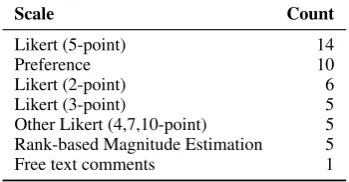
Scale Count
Likert (5-point) 14
Preference 10
Likert (2-point) 6 Likert (3-point) 5 Other Likert (4,7,10-point) 5 Rank-based Magnitude Estimation 5 Free text comments 1
Table 2:Types of scales used for human evaluation
expert-focused approach, meaning that between 1 and 4 expert annotators evaluated system output. 13 papers (26%) employed a larger-scale reader-focused method in which 10 to 60 readers judged the generated output. We found a median of 4 annotators. However, these numbers might not reflect reality: only 55% of papers specified the number of participants and an even smaller num-ber (18%) reported the demographics of their sam-ple. Only 12.5% of the papers with a human eval-uation reported inter-annotator agreement, using Krippendorff’s α, Fleiss’ κ, Weighted κ or Co-hen’s κ. Agreement in most cases ranged from 0.3 to 0.5, but given the variety of metrics and the thresholds used to determine acceptable agree-ment, this range should be treated with caution.
3.4 Design
Apart from participant sample size, an important issue that impacts statistical power is the number of items (e.g. generated sentences) used in an eval-uation. Among papers that reported these num-bers, we observed a median of 100 items used for human evaluation in INLG and ACL papers. The number of items however ranged between 2 and 5,400, illustrating a sizable discrepancy. In 83% of papers that reported these figures, all annotators saw all examples. Only 12.5% of papers reported other aspects of evaluation study design, such as the order in which items were presented, randomi-sation and counterbalancing methods used (e.g. a latin square design), or whether criteria were mea-sured at the same time or separately.
3.5 Number of questions and types of scales
[image:3.595.329.504.64.155.2]a close second (see Table 2). Other types of rat-ing methods are much less common. Rank-based Magnitude Estimation, a continuous metric, was only found among shared task papers, and only one paper reported using free-text comments.
We also investigated the number of ratings used to measure a single criterion (e.g. a paper may use two ratings to measure two different aspects of flu-ency). Only 34% of papers with a human evalua-tion reported the number of ratings to measure a criterion. These numbers ranged from 1 to 4 rat-ings for a criterion, with 1 rating being the most common.
3.6 Statistics and data analysis
A minority (33%) of papers report one or more statistical analyses for their human evaluation to investigate if findings are statistically significant. The types of statistical analyses vary greatly: there is not one single test that is the most common. Ex-amples of tests found are Student’s T test, Mann-Whitney U test, and McNemar’s test. Theoreti-cally, such statistical tests should be performed to test a specific hypothesis (Navarro,2019). How-ever, not all papers using a statistical test report their hypotheses. And conversely, some papers reporting hypotheses do not perform a statistical test. 19% of all papers explicitly state their hy-potheses or research questions.
4 Best practices
This section provides best practices for carrying out and reporting human evaluation in NLG. We (mostly) restrict ourselves to intrinsic evaluation.
4.1 Text quality and criteria
Renkema (2012, p. 37) defines text quality in terms of whether the writer (or: NLG system) suc-ceeds in conveying their intentions to the reader. He outlines three requirements for this to be achieved: (i) the writer needs to achieve their goal while meeting the reader’s expectations; (ii) lin-guistic choices need to match the goal; and (iii) the text needs to be free of errors.
If successfully conveying communicative inten-tion is taken to be the main overarching criterion for quality, then two possibilities arise. One could treat quality as a primitive, as it were, evaluating it directly with users. Alternatively—and more in line with current NLG evaluation practices—one could take text quality to be contingent on
individ-ual dimensions or criteria (for various studies of such criteria, seeDell’Orletta et al.,2011; Falken-jack et al.,2013;Nenkova et al.,2010;Pitler and Nenkova,2008,inter alia).
The choice between these two options turns out to be a point of contention. Highly correlated scores on different quality criteria suggest that human annotators find them hard to distinguish (Novikova et al.,2017). For this reason, some re-searchers directly measure the overall quality of a text. However,Hastie and Belz(2014) note that an overall communicative goal is often too abstract a construct to measure directly. They argue against this practice and in favour of identifying separate criteria, weighted according to their importance in contributing to the overall goal.
The position taken by Hastie and Belz (2014) implies that, to the extent that valid and agreed-upon definitions exist for specific quality crite-ria, these should be systematically related to over-all communicative success. Yet, this relationship need not be monotonic or linear. For example, two texts might convey the underlying intention (in-cluding the intention to inform) equally success-fully, while varying in fluency, perhaps as long as some minimal level of fluency is satisfied by both. In that case, the relationship would not be mono-tonic (higher fluency may not guarantee success beyond a point). A further question is how the various criteria interact. For instance, it is conceiv-able that under certain conditions (e.g. summaris-ing high-volume, heterogeneous data in a short span of text), readability and adequacy are mutu-ally conflicting goals beyond a certain point (e.g. because adequately conveying all information will result in more convoluted text which is harder to understand).
Ultimately, the criteria to be considered will de-pend on the task. For example, in style transfer, manipulation checks are important to determine whether the style has been transferred correctly, while also ensuring meaning preservation. These criteria are not necessarily important for a sys-tem that generates weather reports from numeri-cal data, where accuracy, fluency, coherence and genre compatibility might be more prominent con-cerns. By contrast, coherence and fluency would not be important criteria for the PARRY chatbot (Colby et al.,1971) which attempts to simulate the speech of a person with paranoid schizophrenia.
evaluation are usually treated as subjective (as in the case of judgments of fluency, adequacy and the like). It is also conceivable that these cri-teria can be assessed using more objective mea-sures, similar to existing readability measures (e.g., Ambati et al., 2016; Kincaid et al., 1975; Pitler and Nenkova, 2008; Vajjala and Meurers, 2014), where objective text metrics (e.g. age word length, average parse tree height, aver-age number of nouns) are used in a formula, or as features in a regression model, to obtain a score for a text criterion. Similarly, it may be possible to use separate subjective criteria as features in a regression model to calculate overall text quality scores. This would also provide information about the importance of the subjective criteria for over-all text quality judgments. However, such research on the relationship between subjective criteria and objective measures is currently lacking for NLG.
One obstacle to addressing the difficulties iden-tified in this section is the lack of a standard-ised nomenclature for different text quality cri-teria. This presents a practical problem, in that it is hard to compare evaluation results to previ-ously reported work; but it also presents a theo-retical problem, in that different criteria may over-lap or be inter-definable. AsGatt and Belz(2010) andHastie and Belz(2014) suggest, common and shared evaluation guidelines should be developed for each task, and efforts should be made to stan-dardise criteria and naming conventions. In the absence of such guidelines, care should be taken to explicitly define the criteria measured and high-light possible overlaps between them.
4.2 Sample size, demographics and agreement
Expert- versus reader-focused Section 3.3 made a distinction between expert-focused and reader-focused evaluation. With an expert-focused design, a small number of expert annotators is recruited to judge aspects of the NLG system. A reader-focused design entails a typically larger sample of (non-expert) participants. Lentz and De Jong(1997) found that these two methods can be complementary: expert problem detection may highlight textual problems that are missed by gen-eral readers. However, this strength is mostly applicable when a more qualitative analysis is used, whereas most expert-focused evaluations in our sample of papers used closed-ended questions
with Likert scales.
Evidence suggests that expert readers approach evaluation differently from general readers, inject-ing their own opinions and biases (Amidei et al., 2018b). This might be troublesome if a system is meant for the general population, as expert opin-ions and biases might not be representative for those of non-experts. This is corroborated by Lentz and De Jong(1997), who found that expert judgments only predict the outcomes of reader-focused evaluation to a limited extent. Experts are also susceptible to considerable variance, so that automatic metrics are sometimes more reli-able (Belz and Reiter,2006). Thus, the conclusion ofBelz and Reiter(2006) in favour of large-scale reader-focused studies, rather than expert-focused ones, seems well-taken.
An additional factor to consider is the types of ‘general’ or ‘expert’ populations that are accessi-ble to NLG researchers. It is not untypical for eval-uations to be carried out with students, or fellow researchers (recruited, for instance, via SIGGEN or other mailing lists). This may introduce sam-pling biases of the kind that have been critiqued in psychology in recent years, where experimental results based on samples of WEIRD (Western, Ed-ucated, Industrialised, Rich and Developed) popu-lations may well have given rise to biased models (see, for example,Henrich et al.,2010).
Evaluator agreement The varying opinions of judges are also reflected in low Inter-Annotator Agreement (IAA), where adequate thresholds also tend to be open to interpretation (Artstein and Poe-sio,2008).Amidei et al.(2018b) argue that, given the variable nature of natural language, it is unde-sirable to use restrictive thresholds, since an osten-sibly low IAA score could be due to a host of fac-tors, including personal bias. The authors there-fore suggest reporting IAA statistics with confi-dence intervals. However, narrower confidence intervals (suggesting a more precise IAA score) would normally be expected with large samples (e.g., 1000 or more comparisonsMcHugh,2012), which are well beyond most sizes reported in our overview (§3.4).
to a broader reader population. An additional con-sideration is that some statistics (such as κ; see McHugh, 2012) make overly restrictive assump-tions, though they have the advantage of account-ing for chance agreement. Thus, apart from porting such statistics, it is advisable to also re-port percentage agreement, which is easily inter-pretable (McHugh,2012).
Sample size For expert-focused evaluations, good advice is provided by Van Enschot et al. (2017): difficult coding tasks (which most NLG evaluations are) require three or more annotators (though preferably more; see Potter and Levine-Donnerstein, 1999), more straightforward tasks can do with two to three. In the case of large-scale studies,Brysbaert(2019) recently stated that most studies with less than 50 participants are un-derpowered and that for most designs and analy-ses 100 or more participants are needed. With the introduction of crowdsourcing such numbers are obtainable, at least for widely-spoken languages (though seevan Miltenburg et al. 2017for a coun-terexample). Furthermore, the number of partici-pants necessary can be decreased by having multi-ple observations per condition per participant (i.e., having participants perform more judgments).
Whatever the sample size, a minimum good practice guideline is to always report participant numbers, with relevant demographic data (i.e., gender, nationality, age, fluency in the target lan-guage, academic background, etc), in order to en-hance replicability and enable readers to gauge the meaningfulness of the results.
4.3 Number of questions and types of scales
As shown in Section 3.5, Likert scales are the prevalent rating method for NLG evaluation, 5-point scales being the most popular, followed by 2-point, and 3-point scales. While the most appro-priate number of response points may depend on the task itself, 7-point scales (with clear verbal an-choring) seem best for most tasks. Most of the ex-perimental literature’s findings found that 7-point scales maximise reliability, validity and discrim-inative power (for instance, Miller, 1956; Green and Rao,1970;Jones,1968;Cicchetti et al.,1985; Lissitz and Green, 1975; Preston and Colman, 2000). These studies discourage smaller scales, and adding more response points than 7 also does not increase reliability according to these studies.
While Likert scales are the most popular scale
within the NLG domain (and probably in many other domains), the use of this scale has been re-ceiving more and more criticism. Recent studies have found that participant ratings are more reli-able, consistent, and are less prone to order ef-fects when they involve ranking rather than Lik-ert scales (Martinez et al., 2014;Yannakakis and Mart´ınez, 2015; Yannakakis and Hallam, 2011). Similarly, for the development of an automatic metric for NLG,Chaganty et al.(2018) found that annotator variance decreased significantly when using post-edits as a metric instead of a Likert scale survey. Finally,Novikova et al.(2018) com-pared Likert scales for NLG system evaluation to two continuous scales: a vanilla magnitude mation measure and a rank-based magnitude esti-mation measure. The researchers found that both magnitude estimation scales delivered more reli-able and consistent text evaluation scores.
All these studies seem to suggest that ranking-based methods (combined with continuous scales) are the preferred method. However, there are two critical remarks to be made on this. Firstly, a draw-back of ranking-based methods is that the num-ber of judgments increases substantially as more systems are compared. To mitigate this,Novikova et al.(2018) illustrated that the TrueSkillTM algo-rithm (Herbrich et al.,2007) can be implemented. This algorithm uses binary comparisons to reliably rank systems, which greatly reduces the amount of data needed for multiple-system comparisons.
cau-tion in the use of single-item scales, unless the construct in question is very simple, clear and one-dimensional. Under most conditions, multi-item scales have much higher predictive validity. Us-ing multiple items may well make the reliabil-ity of Likert scales on a par with that of rank-ing tasks; this, however, has not been empirically tested. Also, do note that the use of multiple-item scales versus single-item scales affects the type of statistical testing needed (for an overview and ex-planation, seeAmidei et al.,2019).
In sum, we advise to use either multiple-item 7-point Likert scales, or a (continuous) ranking task. The latter should be used in combination with TrueSkillTMwhen multiple systems are com-pared. AsAroyo and Welty(2014) note, disagree-ment in the responses can be due to three factors: the item, the worker, and the task. Therefore, it is necessary to pilot the rating task before deploy-ing it more widely, and to analyze disagreement on the annotator level, to see whether individual annotators are causing discrepancies in the ratings for different items.
Alternative evaluation instruments should not be ruled out either. Ever since a pilot in 2016 (Bo-jar et al., 2016a), recent editions of the Confer-ence on Machine Translation (WMT), have used Direct Assessment, whereby participants com-pare an output to a reference text on a contin-uous (0-100) scale (Graham et al., 2017; Bojar et al., 2016b), similar to Magnitude Estimation (Bard et al., 1996). Zarrieß et al. (2015) used a mouse contingent reading paradigm in an evalua-tion study of generated text, finding that features recorded using this paradigm (e.g. reading time) provided valuable information to gauge text qual-ity levels. It should also be noted that most met-rics used in NLG are reader-focused. However, in many real-world scenarios, especially ‘creative’ NLG applications, NLG systems and human writ-ers work alongside each other in some way (see Maher,2012;Manjavacas et al.,2017). With such a collaboration in mind, it makes sense to also investigate writer-focused methods. Having par-ticipants edit generated texts. Then processing these edits using post-editing distance measures like Translation Edit Rate (Snover et al., 2006), might be a viable method to investigate the time and cost associated with using a system. While more commonly seen in Machine Translation, au-thors have explored the use of such metrics in
NLG (Bernhard et al.,2012;Han et al.,2017; Sri-pada et al.,2005).
Finally, some remarks on qualitative evaluation methods are in order. Reiter and Belz(2009) note that free-text comments can be beneficial to diag-nose potential problems of an NLG system. Fur-thermore,Sambaraju et al.(2011) argue the added value of content analysis and discourse analysis for evaluation. Such qualitative analyses can find potential blind spots of quantitative analyses. At the same time, the subjectivity that is often inher-ent in studies based on discourse analysis, such as Sambaraju et al.(2011) would need to be offset by data from larger-scale, quantitative studies.
4.4 Design
Few papers report exact details of the design of their human evaluation experiments, although most indicate that multiple systems were com-pared and annotators were shown all examples. This suggests that within-subjects designs are a common practice.
subject to debate, with some researchers point-ing out that after such elimination procedures, the remaining cases may be a biased subsample of the total sample, thus biasing the results (Anduiza and Galais,2016;Bennett,2001;Berinsky et al., 2016). Experiments show that excluding partici-pants that failed attention checks introduces a de-mographic bias, and attention checks actually in-duce low-effort responses or socially desirable re-sponses (Clifford and Jerit,2015;Vannette,2016). Order effects can also be reduced by present-ing the conditions in a systematically varied or-der. Counterbalancing is one such measure. With counterbalancing, all examples are presented in every possible order. While such a design is the best way to reduce order-effects, it quickly be-comes expensive. When annotators judge 4 ex-amples,4! = 24different orders should be investi-gated (this, however, can be partially mitiinvesti-gated by grouping items randomly into sets, and counter-balancing the order of sets rather than individual items). In most cases, randomising the order of ex-amples should be sufficient. Another possibility is to use a between-subjects design, in which the sub-jects only judge the (randomly ordered) outputs of one system. When order effects are expected and a large number of conditions are investigated, such a design is preferable (Shaughnessy et al.,2006).
Novikova et al.(2018) found that the presenta-tion of quespresenta-tions matters. When evaluating text criteria, answers to questions about different cri-teria tend to correlate when they are presented si-multaneously for a given item. When participants are shown an item multiple times and questioned about each text criterion separately, this correla-tion is reduced.
4.5 Statistics and data analysis
Within behavioral sciences, it is standard to evalu-ate hypotheses based on whether findings are sta-tistically significant or not (typically, in published papers, they are), although a majority of NLG pa-pers do not report statistical tests (seeSection 3.6). However, there is a growing awareness that statis-tical tests are often conducted incorrectly, both in NLP (Dror et al.,2018) and in behavioral sciences more generally (e.g.,Wagenmakers et al., 2011). Moreover, one may wonder whether standard null-hypothesis significance testing (NHST) is applica-ble or helpful in human NLG evaluation.
In a common scenario, NLG researchers may
want to compare various versions of their own novel system (e.g. with or without output varia-tion, or relying on different word embedding mod-els, to give just two more or less random exam-ples) to compare them to each other, to some other (‘state-of-the-art’) systems, and/or with respect to one or more baselines. Notice that this quickly gives rise to a rather complex statistical design with multiple factors and multiple levels. Ironi-cally, with every system or baseline that is added to the evaluation, the comparison becomes more interesting but the statistical model becomes more complex, and power issues become more press-ing (Cohen,1988;Button et al.,2013). However, statistical power—the probability that the statisti-cal test will reject the null hypothesis (H0) when the alternative hypothesis (H1, e.g., that your new NLG system is the best) is true—are seldom (if ever) discussed in the NLG literature.
A related issue is that clear hypotheses are of-ten not stated (see Section 3.6). Of course, re-searchers generally assume that their system will be rated higher than the comparison systems. But they will not necessarily assume that they will per-form better on all dependent variables. Moreover, they may have no specific hypotheses about which variant of their own system will perform best.
In fact, in the scenario sketched above there may be multiple (implicit) hypotheses: new sys-tem better than state-of-the-art, new syssys-tem bet-ter than baseline, etcebet-tera. When testing multiple hypotheses, the probability of making at least one false claim (incorrectly rejecting a H0) increases (such errors are known as false positives or Type I errors). Various remedies for this particular prob-lem exist, one being an application of the simple Bonferroni correction, which amounts to lowering the significance threshold α—commonly .05, but see for exampleBenjamin et al.(2018) andLakens et al.(2018)—toα/m, wheremis the number of hypotheses tested. This procedure is not systemat-ically applied in NLG, although the awareness of the issues with multiple comparisons is increasing.
Topic Best practice
General Always conduct a human evaluation (if possible).
Criteria Use separate criteria rather than an overall quality assessment. Properly define the criteria that are used in the evaluation.
Sampling Preferably use a (large-scale) reader-focused design rather than a (small-scale) expert-focused design. Always recruit sufficiently many participants. Report (and motivate) the sample size and the demographics. Annotation For a qualitative analysis, recruit multiple annotators (at least 2, more is better)
Report the Inter-Annotator Agreement score with confidence intervals, plus a percentage agreement. Measurement For a quantitative study, use multiple item 7-point (preferably) Likert scales, or (continuous) ranking. Design Reduce order- and learning effects by counterbalancing/random ordering, and properly report this. Statistics If the evaluation study is exploratory, only report exploratory data analysis.
If the study is confirmatory, consider preregistering and conduct appropriate statistical analyses.
Table 3:List of best practices for human evaluation of automatically generated text.
if only because different systems may rely on the same training data. In view of these issues, some have argued that NHST should be abandoned (Ko-plenig,2017;McShane et al.,2019).
In our opinion, the distinction between ex-ploratory and confirmative (hypothesis) testing should be taken more seriously within NLG. Much human evaluation of NLG could better be ap-proached from an exploratory perspective, and in-stead of full-fledged hypothesis testing it would be more appropriate to analyse findings with ex-ploratory data analysis techniques (Tukey, 1980; Cumming,2013). When researchers do have clear hypotheses, statistical significance testing can be a powerful tool (assuming it is applied correctly). In these cases, we recommend preregistering the hy-potheses and analysis plans before conducting the actual evaluation.3
Preregistration is still uncommon in NLG and other fields of AI (with a few notable exceptions, like for instance Vogt et al., 2019), but it ad-dresses an important issue with human evalua-tions. Conducting and analysing a human exper-iment is like entering a garden of forking paths (Gelman and Loken, 2013): along the way re-searchers have many choices to make, and even though each choice may be small and seemingly innocuous, collectively they can have a substantial effect on the outcome of the statistical analyses, to the extent that it becomes possible to present virtu-ally every finding as statisticvirtu-ally significant (Sim-mons et al.,2011;Wicherts et al.,2016). In human NLG evaluation, choices may include for instance, termination criteria (when does the data collection stop?), exclusion criteria (when is a participant re-moved from the analysis?), reporting of variables
3For example atosf.iooraspredicted.org
(which dependent variables are reported?), etc. By being explicit beforehand (i.e., by preregistering), any flexibility in the analysis (be it intentional or not) is removed. Preregistration is increasingly common in medical and psychological science, and even though it is not perfect (Claesen et al., 2019) at least it has made research more transpar-ent and controllable, which has a positive impact on the possibilities to replicate earlier findings.
Finally, alternative statistical models deserve more attention within NLG. For example, within psycholinguistics it is common to look both at participant and item effects (Clark, 1973). This would make a lot of sense in human NLG eval-uations as well, because it might well be that a new NLG system works well for one kind of gen-erated item (short active sentences, say) and less well for another kind (complex sentences with rel-ative clauses). Mixed effects models capture such potential item aspects very well (e.g., Barr et al., 2013), and deserve more attention in NLG. Fi-nally, Bayesian models are worth exploring, be-cause they are less sensitive to the aforementioned problems with NHST (e.g., Gelman et al., 2006; Wagenmakers,2007).
5 Conclusion
Acknowledgements
We received support from RAAK-PRO SIA (2014-01-51PRO) and The Netherlands Organiza-tion for Scientific Research (NWO 360-89-050), which is gratefully acknowledged. We would also like to thank the anonymous reviewers for their valuable and insightful comments.
References
Bharat Ram Ambati, Siva Reddy, and Mark Steedman. 2016. Assessing relative sentence complexity us-ing an incremental CCG parser. InProceedings of the 2016 Conference of the North American Chap-ter of the Association for Computational Linguistics, pages 1051–1057, San Diego, California, USA. As-sociation for Computational Linguistics.
Jacopo Amidei, Paul Piwek, and Alistair Willis. 2018a.
Evaluation methodologies in Automatic Question Generation 2013-2018.INLG 2018, page 307.
Jacopo Amidei, Paul Piwek, and Alistair Willis. 2018b.
Rethinking the agreement in human evaluation tasks. InProceedings of the 27th International Con-ference on Computational Linguistics, pages 3318– 3329.
Jacopo Amidei, Paul Piwek, and Alistair Willis. 2019. The use of rating and Likert scales in Natural Lan-guage Generation human evaluation tasks: A review and some recommendations. InProceedings of the 12th International Conference on Natural Language Generation, Tokyo, Japan. Association for Compu-tational Linguistics.
R Ananthakrishnan, Pushpak Bhattacharyya, M Sasikumar, and Ritesh M Shah. 2007. Some issues in automatic evaluation of English-Hindi MT: More blues for BLEU.ICON.
Eva Anduiza and Carol Galais. 2016. Answering with-out reading: IMCs and strong satisficing in online surveys. International Journal of Public Opinion Research, 29(3):497–519.
Lora Aroyo and Chris Welty. 2014. The three sides of crowdtruth. Journal of Human Computation, 1:31– 34.
Ron Artstein and Massimo Poesio. 2008. Inter-coder agreement for computational linguistics. Computa-tional Linguistics, 34(4):555–596.
Ellen Gurman Bard, Dan Robertson, and Antonella So-race. 1996. Magnitude estimation of linguistic ac-ceptability. Language, pages 32–68.
Dale J Barr, Roger Levy, Christoph Scheepers, and Harry J Tily. 2013. Random effects structure for confirmatory hypothesis testing: Keep it maximal.
Journal of Memory and Language, 68(3):255–278.
Anja Belz and Ehud Reiter. 2006. Comparing auto-matic and human evaluation of NLG systems. In
11th Conference of the European Chapter of the As-sociation for Computational Linguistics, pages 313– 320. Association for Computational Linguistics.
Daniel J Benjamin, James O Berger, Magnus Johan-nesson, Brian A Nosek, E-J Wagenmakers, Richard Berk, Kenneth A Bollen, Bj¨orn Brembs, Lawrence Brown, Colin Camerer, et al. 2018. Redefine statis-tical significance.Nature Human Behaviour, 2(1):6.
Derrick A Bennett. 2001. How can I deal with miss-ing data in my study? Australian and New Zealand Journal of Public Health, 25(5):464–469.
Adam J Berinsky, Michele F Margolis, and Michael W Sances. 2016. Can we turn shirkers into workers? Journal of Experimental Social Psychology, 66:20– 28.
Delphine Bernhard, Louis De Viron, V´eronique Moriceau, and Xavier Tannier. 2012. Question gen-eration for french: Collating parsers and paraphras-ing questions.Dialogue & Discourse, 3(2):43–74.
Ondˇrej Bojar, Rajen Chatterjee, Christian Federmann, Yvette Graham, Barry Haddow, Matthias Huck, An-tonio Jimeno Yepes, Philipp Koehn, Varvara Lo-gacheva, Christof Monz, Matteo Negri, Aur´elie N´ev´eol, Mariana Neves, Martin Popel, Matt Post, Raphael Rubino, Carolina Scarton, Lucia Spe-cia, Marco Turchi, Karin Verspoor, and Marcos Zampieri. 2016a. Findings of the 2016 confer-ence on machine translation. InProceedings of the First Conference on Machine Translation: Volume 2, Shared Task Papers, pages 131–198, Berlin, Ger-many. Association for Computational Linguistics.
Ondrej Bojar, Christian Federmann, Barry Haddow, Philipp Koehn, Matt Post, and Lucia Specia. 2016b. Ten years of WMT evaluation campaigns: Lessons learnt. InProceedings of the LREC 2016 Workshop Translation Evaluation From Fragmented Tools and Data Sets to an Integrated Ecosystem, pages 27–34.
Marc Brysbaert. 2019. How many participants do we have to include in properly powered experiments? A tutorial of power analysis with reference tables.
Journal of Cognition, 2(1):1–38.
Katherine S Button, John PA Ioannidis, Claire Mokrysz, Brian A Nosek, Jonathan Flint, Emma SJ Robinson, and Marcus R Munaf`o. 2013.Power fail-ure: Why small sample size undermines the reliabil-ity of neuroscience. Nature Reviews Neuroscience, 14(5):365.
Arun Chaganty, Stephen Mussmann, and Percy Liang. 2018. The price of debiasing automatic metrics in natural language evaluation. In Proceedings of the 56th Annual Meeting of the Association for Compu-tational Linguistics (Volume 1: Long Papers), pages 643–653.
Leshem Choshen and Omeri Abend. 2018. Inherent biases in reference-based evaluation for grammati-cal error correction and text simplification. In Pro-ceedings of 56th Annual Meeting of the Association for Computational Linguistics, pages 632–642, Mel-bourne, Australia. Association for Computational Linguistics.
Domenic V Cicchetti, Donald Shoinralter, and Peter J Tyrer. 1985. The effect of number of rating scale categories on levels of interrater reliability: A Monte Carlo investigation. Applied Psychological Mea-surement, 9(1):31–36.
Aline Claesen, Sara Lucia Brazuna Tavares Gomes, Francis Tuerlinckx, et al. 2019. Preregistration: Comparing dream to reality.PsyArXiv.
Herbert H Clark. 1973. The language-as-fixed-effect fallacy: A critique of language statistics in psycho-logical research.Journal of verbal learning and ver-bal behavior, 12(4):335–359.
Scott Clifford and Jennifer Jerit. 2015. Do attempts to improve respondent attention increase social desir-ability bias? Public Opinion Quarterly, 79(3):790– 802.
Jacob Cohen. 1988. Statistical power analysis for the behavioral sciences. Routledge.
Kenneth Mark Colby, Sylvia Weber, and Franklin Den-nis Hilf. 1971. Artificial paranoia. Artificial Intelli-gence, 2(1):1–25.
Geoff Cumming. 2013. Understanding the new statis-tics: Effect sizes, confidence intervals, and meta-analysis. Routledge.
Felice Dell’Orletta, Simonetta Montemagni, and Giu-lia Venturi. 2011. READ-IT: Assessing readability of Italian texts with a view to text simplification. In Proceedings of the Second Workshop on Speech and Language Processing for Assistive Technolo-gies, pages 73–83. Association for Computational Linguistics.
Adamantios Diamantopoulos, Marko Sarstedt, Christoph Fuchs, Petra Wilczynski, and Sebastian Kaiser. 2012. Guidelines for choosing between multi-item and single-item scales for construct measurement: A predictive validity perspective.
Journal of the Academy of Marketing Science, 40(3):434–449.
George Doddington. 2002. Automatic evaluation of machine translation quality using n-gram co-occurrence statistics. In Proceedings of the Sec-ond International Conference on Human
Lan-guage Technology Research, pages 138–145. Mor-gan Kaufmann Publishers Inc.
Rotem Dror, Gili Baumer, Segev Shlomov, and Roi Re-ichart. 2018. The hitchhikers guide to testing statis-tical significance in natural language processing. In
Proceedings of the 56th Annual Meeting of the As-sociation for Computational Linguistics (Volume 1: Long Papers), pages 1383–1392.
Johan Falkenjack, Katarina Heimann M¨uhlenbock, and Arne J¨onsson. 2013. Features indicating readability in Swedish text. InProceedings of the 19th Nordic Conference of Computational Linguistics (NODAL-IDA 2013), pages 27–40.
Albert Gatt and Anja Belz. 2010. Introducing shared tasks to NLG: The TUNA shared task evaluation challenges. InEmpirical Methods in Natural Lan-guage Generation, pages 264–293. Springer.
Albert Gatt and Emiel Krahmer. 2018. Survey of the state of the art in natural language generation: Core tasks, applications and evaluation.Journal of Artifi-cial Intelligence Research, 61:65–170.
Albert Gatt and Franc¸ois Portet. 2010. Textual prop-erties and task based evaluation: Investigating the role of surface properties, structure and content. In
Proceedings of the 6th International Natural Lan-guage Generation Conference, pages 57–65. Asso-ciation for Computational Linguistics.
Andrew Gelman and Eric Loken. 2013. The garden of forking paths: Why multiple comparisons can be a problem, even when there is no fishing expedition or p-hacking and the research hypothesis was posited ahead of time. Unpublished Manuscript.
Andrew Gelman et al. 2006. Prior distributions for variance parameters in hierarchical models (com-ment on article by Browne and Draper). Bayesian analysis, 1(3):515–534.
Dimitra Gkatzia and Saad Mahamood. 2015. A snap-shot of NLG evaluation practices 2005-2014. In
Proceedings of the 15th European Workshop on Nat-ural Language Generation (ENLG), pages 57–60. Association for Computational Linguistics.
Yvette Graham, Timothy Baldwin, Alistair Moffast, and Justin Zobel. 2017. Can machine translation systems be evaluated by the crowd alone. Natural Language Engineering, 23(1):330.
Paul E Green and Vithala R Rao. 1970. Rating scales and information recovery: How many scales and re-sponse categories to use? Journal of Marketing, 34(3):33–39.
Mary Dee Harris. 2008. Building a large-scale com-mercial NLG system for an EMR. InProceedings of the Fifth International Natural Language Gener-ation Conference (INLG ’08), pages 157–160, Mor-ristown, NJ, USA. Association for Computational Linguistics.
Helen Hastie and Anja Belz. 2014. A comparative evaluation methodology for NLG in interactive sys-tems. In Proceedings of the Ninth International Conference on Language Resources and Evaluation (LREC-2014).
Joseph Henrich, Steven J Heine, and Ara Norenzayan. 2010. The weirdest people in the world? The Be-havioral and Brain Sciences, 23:61–83; discussion 83–135.
Ralf Herbrich, Tom Minka, and Thore Graepel. 2007.
TrueSkillTM: A Bayesian skill rating system. In Ad-vances in Neural Information Processing Systems, pages 569–576.
Richard R Jones. 1968. Differences in response consis-tency and subjects preferences for three personality inventory response formats. In Proceedings of the 76th Annual Convention of the American Psycholog-ical Association, volume 3, pages 247–248. Ameri-can Psychological Association Washington, DC.
J Peter Kincaid, Robert P Fishburne Jr, Richard L Rogers, and Brad S Chissom. 1975. Derivation of new readability formulas (Automated Readabil-ity Index, FOG count and Flesch reading ease for-mula) for navy enlisted personnel.Research Branch Report, 8(75).
Philipp Koehn. 2004. Statistical significance tests for machine translation evaluation. In Proceed-ings of the 2004 Conference on Empirical Meth-ods in Natural Language Processing, pages 388– 395, Barcelona, Spain. Association for Computa-tional Linguistics, Association for ComputaComputa-tional Linguistics.
Alexander Koplenig. 2017. Against statistical signifi-cance testing in corpus linguistics. Corpus Linguis-tics and Linguistic Theory.
Daniel Lakens, Federico G Adolfi, Casper J Al-bers, Farid Anvari, Matthew AJ Apps, Shlomo E Argamon, Thom Baguley, Raymond B Becker, Stephen D Benning, Daniel E Bradford, et al. 2018.
Justify your alpha. Nature Human Behaviour, 2(3):168.
Chris van der Lee, Bart Verduijn, Emiel Krahmer, and Sander Wubben. 2018. Evaluating the text quality, human likeness and tailoring component of PASS: A Dutch data-to-text system for soccer. In Proceed-ings of the 27th International Conference on Com-putational Linguistics, pages 962–972.
Leo Lentz and Menno De Jong. 1997. The evaluation of text quality: Expert-focused and reader-focused methods compared. IEEE transactions on profes-sional communication, 40(3):224–234.
Robert W Lissitz and Samuel B Green. 1975.Effect of the number of scale points on reliability: A Monte Carlo approach. Journal of Applied Psychology, 60(1):10.
Mary Lou Maher. 2012. Computational and collective creativity: Who’s being creative? InProceedings of the 3rd International Conference on Computer Cre-ativity, pages 67–71, Dublin, Ireland. Association for Computational Linguistics.
Enrique Manjavacas, Folgert Karsdorp, Ben Burten-shaw, and Mike Kestemont. 2017. Synthetic liter-ature: Writing science fiction in a co-creative pro-cess. In Proceedings of the Workshop on Compu-tational Creativity in Natural Language Generation (CC-NLG 2017), pages 29–37, Santiago de Com-postela, Spain. Association for Computational Lin-guistics.
Hector P Martinez, Georgios N Yannakakis, and John Hallam. 2014. Don’t classify ratings of affect; rank them! IEEE transactions on affective computing, 5(3):314–326.
Mary L McHugh. 2012. Interrater reliability: The kappa statistic.Biochemia Medica, 22(3):276–282.
John McIver and Edward G Carmines. 1981. Unidi-mensional scaling. 24. Sage.
Blakeley B McShane, David Gal, Andrew Gelman, Christian Robert, and Jennifer L Tackett. 2019.
Abandon statistical significance. The American Statistician, 73(sup1):235–245.
Chris Mellish and Robert Dale. 1998. Evaluation in the context of natural language generation. Computer Speech & Language, 12(4):349–373.
Chris Mellish, Donia Scott, Lynne Cahill, Daniel Paiva, Roger Evans, and Mike Reape. 2006. A refer-ence architecture for natural language generation systems.Natural Language Engineering, 12(01):1– 34.
George A Miller. 1956. The magical number seven, plus or minus two: Some limits on our capacity for processing information. Psychological Review, 63(2):81.
Emiel van Miltenburg, Desmond Elliott, and Piek Vossen. 2017. Cross-linguistic differences and sim-ilarities in image descriptions. InProceedings of the 10th International Conference on Natural Language Generation, pages 21–30, Santiago de Compostela, Spain. Association for Computational Linguistics.
Daniel Navarro. 2019. Learning statistics with R: A tu-torial for psychology students and other beginners: Version 0.6.1. University of Adelaide.
Jekaterina Novikova, Ondˇrej Duˇsek, Amanda Cercas Curry, and Verena Rieser. 2017. Why we need new evaluation metrics for NLG. InProceedings of the 2017 Conference on Empirical Methods in Natural Language Processing, pages 2241–2252.
Jekaterina Novikova, Ondˇrej Duˇsek, and Verena Rieser. 2018. RankME: Reliable human ratings for Natural Language Generation. InProceedings of the 2018 Conference of the North American Chapter of the Association for Computational Linguistics: Human Language Technologies, Volume 2 (Short Papers), pages 72–78.
John Peter. 1677. Artificial Versifying, or the School-boys Recreation. John Sims, London, UK.
Emily Pitler and Ani Nenkova. 2008. Revisiting read-ability: A unified framework for predicting text quality. InProceedings of the conference on empiri-cal methods in natural language processing, pages 186–195. Association for Computational Linguis-tics.
Matt Post. 2018. A call for clarity in reporting BLEU scores. InProceedings of the Third Conference on Machine Translation: Research Papers, pages 186– 191, Belgium, Brussels. Association for Computa-tional Linguistics.
W James Potter and Deborah Levine-Donnerstein. 1999. Rethinking validity and reliability in content analysis. Journal of Applied Communication Re-search, 27:258–284.
Carolyn C Preston and Andrew M Colman. 2000. Op-timal number of response categories in rating scales: reliability, validity, discriminating power, and re-spondent preferences.Acta Psychologica, 104(1):1– 15.
Ehud Reiter. 2018. A structured review of the validity of BLEU.Computational Linguistics, pages 1–12.
Ehud Reiter and Anja Belz. 2009. An investigation into the validity of some metrics for automatically evalu-ating natural language generation systems. Compu-tational Linguistics, 35(4):529–558.
Ehud Reiter and Robert Dale. 2000. Building Natural Language Generation Systems. Cambridge Univer-sity Press, Cambridge, UK.
Ehud Reiter, Roma Robertson, and Liesl M Osman. 2003. Lessons from a failure: Generating tailored smoking cessation letters. Artificial Intelligence, 144(1-2):41–58.
Jan Renkema. 2012. Schrijfwijzer, 5 edition. SDU Uit-gevers, Den Haag, The Netherlands.
Johannah Rodgers. 2017. The genealogy of an image, or, what does literature (not) have to do with the his-tory of computing?: Tracing the sources and recep-tion of Gullivers ‘Knowledge Engine. Humanities, 6(4):85.
Rahul Sambaraju, Ehud Reiter, Robert Logie, Andy McKinlay, Chris McVittie, Albert Gatt, and Cindy Sykes. 2011. What is in a text and what does it do: Qualitative evaluations of an NLG system –the BT-Nurse– using content analysis and discourse analy-sis. InProceedings of the 13th European Workshop on Natural Language Generation, pages 22–31. As-sociation for Computational Linguistics.
Donia Scott and Johanna Moore. 2007. An NLG eval-uation competition? Eight reasons to be cautious. In
Proceedings of the Workshop on Shared Tasks and Comparative Evaluation in Natural Language Gen-eration, pages 22–23.
JJ Shaughnessy, EB Zechmeister, and JS Zechmeister. 2006. Research methods in psychology. McGraw-Hill.
Joseph P Simmons, Leif D Nelson, and Uri Simonsohn. 2011. False-positive psychology: Undisclosed flex-ibility in data collection and analysis allows present-ing anythpresent-ing as significant. Psychological science, 22(11):1359–1366.
Matthew Snover, Bonnie Dorr, Richard Schwartz, Lin-nea Micciulla, and John Makhoul. 2006. A study of translation edit rate with targeted human annotation. In Proceedings of Association for Machine Trans-lation in the Americas, pages 223–231, Cambridge, MA, USA. Association for Machine Translation in the Americas.
Karen Sparck Jones and Julia R. Galliers. 1996. Eval-uating Natural Language Processing Systems: An Analysis and Review. Springer, Berlin and Heidel-berg.
Somayajulu Sripada, Ehud Reiter, and Lezan Hawizy. 2005. Evaluation of an NLG system using post-edit data: Lessons learnt. InProceedings of the 10th Eu-ropean Workshop on Natural Language Generation, pages 133–139, Aberdeen, Scotland. Association for Computational Linguistics.
Elior Sulem, Omri Abend, and Ari Rappoport. 2018.
BLEU is not suitable for the evaluation of text sim-plification. arXiv preprint arXiv:1810.05995. Ac-cepted for publication as a short paper at EMNLP 2018.
Jonathan Swift. 1774. Travels Into Several Remote Na-tions of the World: In Four Parts. By Lemuel Gul-liver. First a Surgeon, and Then a Captain of Several Ships..., volume 1. Benjamin Motte, London, UK.
John W Tukey. 1980. We need both exploratory and confirmatory. The American Statistician, 34(1):23– 25.
Sowmya Vajjala and Detmar Meurers. 2014. Assessing the relative reading level of sentence pairs for text simplification. InProceedings of the 14th Confer-ence of the European Chapter of the Association for Computational Linguistics, pages 288–297, Gothen-burg, Sweden. Association for Computational Lin-guistics.
Renske Van Enschot, Wilbert Spooren, Antal van den Bosch, Christian Burgers, Liesbeth Degand, Jacque-line Evers-Vermeul, Florian Kunneman, Christine Liebrecht, Yvette Linders, and Alfons Maes. 2017. Taming our wild data: On intercoder reliability in discourse research. Unpublished Manuscript, pages 1–18.
David L Vannette. 2016. Testing the effects of differ-ent types of attdiffer-ention intervdiffer-entions on data quality in web surveys. Experimental evidence from a 14 country study. In 71st Annual Conference of the American Association for Public Opinion Research.
Paul Vogt, Rianne van den Berghe, Mirjam de Haas, Laura Hoffman, Junko Kanero, Ezgi Mamus, Jean-Marc Montanier, Cansu Oranc, Ora Oudgenoeg-Paz, Daniel Hernandez Garcia, , Fotios Papadopou-los, Thorsten Schodde, Josje Verhagen, Christopher Wallbridge, Bram Willemsen, Jan de Wit, Tony Bel-paeme, Tilbe G¨oksun, Stefan Kopp, Emiel Krah-mer, Aylin K¨untay, Paul Leseman, and Amit Ku-mar Pandey. 2019. Second language tutoring using social robots: A large-scale study. In 2019 14th ACM/IEEE International Conference on Human-Robot Interaction (HRI). IEEE.
Eric-Jan Wagenmakers. 2007. A practical solution to the pervasive problems of p values. Psychonomic bulletin & review, 14(5):779–804.
Eric-Jan Wagenmakers, Ruud Wetzels, Denny Bors-boom, and Han van der Maas. 2011. Why psychol-ogists must change the way they analyze their data: the case of psi: Comment on Bem (2011). Journal of personality and social psychology, 100(3):426.
Jelte M Wicherts, Coosje LS Veldkamp, Hilde EM Au-gusteijn, Marjan Bakker, Robbie Van Aert, and Mar-cel ALM Van Assen. 2016. Degrees of freedom in planning, running, analyzing, and reporting psy-chological studies: A checklist to avoid p-hacking.
Frontiers in psychology, 7:1832.
Georgios N Yannakakis and John Hallam. 2011. Rank-ing vs. preference: A comparative study of self-reporting. InInternational Conference on Affective Computing and Intelligent Interaction, pages 437– 446. Springer.
Georgios N Yannakakis and H´ector P Mart´ınez. 2015.
Ratings are overrated! Frontiers in ICT, 2:13.
Sina Zarrieß, Sebastian Loth, and David Schlangen. 2015. Reading times predict the quality of gener-ated text above and beyond human ratings. In Pro-ceedings of the 15th European Workshop on Natural