Proceedings of NAACL-HLT 2015, pages 51–55,
SETS: Scalable and Efficient Tree Search in Dependency Graphs
Juhani Luotolahti1, Jenna Kanerva1,2, Sampo Pyysalo1and Filip Ginter1 1Department of Information Technology
2University of Turku Graduate School (UTUGS)
University of Turku, Finland [email protected]
Abstract
We present a syntactic analysis query toolkit geared specifically towards massive depen-dency parsebanks and morphologically rich languages. The query language allows arbi-trary tree queries, including negated branches, and is suitable for querying analyses with rich morphological annotation. Treebanks of over a million words can be comfortably queried on a low-end netbook, and a parsebank with over 100M words on a single consumer-grade server. We also introduce a web-based inter-face for interactive querying. All contribu-tions are available under open licenses.
1 Introduction
Syntactic search is one of the basic tools necessary to work with syntactically annotated corpora, both manually annotated treebanks of modest size and massive automatically analyzed parsebanks, which may go into hundreds of millions of sentences and billions of words. Traditionally, tools such as
TGrep2 (Rohde, 2004) andTRegex (Levy and An-drew, 2006) have been used for tree search. How-ever, these tools are focused on constituency trees annotated with simple part-of-speech tags, and have not been designed to deal with dependency graphs and rich morphologies. Existing search systems are traditionally designed for searching from treebanks rarely going beyond million tokens. However, tree-bank sized corpora may not be sufficient enough for searching rare linguistic phenomena, and therefore ability to cover billion-word parsebanks is essen-tial. Addressing these limitations in existing tools, we present SETS, a toolkit for search in dependency treebanks and parsebanks that specifically empha-sizes expressive search of dependency graphs in-cluding detailed morphological analyses, simplicity of querying, speed, and scalability.
Operator Meaning < governed by > governs
<@L governed by on the left <@R governed by on the right >@L has dependent on the left >@R has dependent on the right ! negation
& | and / or
+ match if both sets not empty
-> universal quantification
Table 1: Query language operators.
2 Demonstration outline
We demonstrate the query system on the set of all available Universal Dependencies1 treebanks, cur-rently covering 10 languages with the largest tree-bank (Czech) consisting of nearly 90K trees with 1.5M words. We demonstrate both the command line functionality as well as an openly accessible web-based interface for the graph search and visual-ization on multiple languages. We also demonstrate how new treebanks in the CoNLL formats are added to the system.
3 Query language
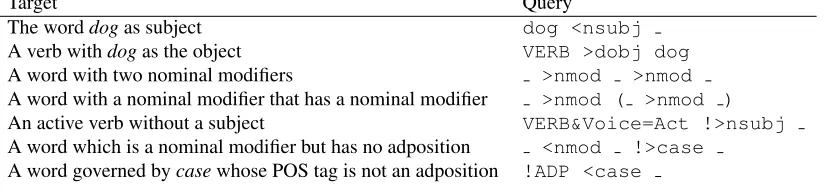
The query language is loosely inspired by TRegex, modified extensively for dependency structures. Each query specifies the words together with any restrictions on their tags or lemmas, and then con-nects them with operators that specify the depen-dency structure. Table1shows the operators defined in the query language, and Table2illustrates a range of queries from the basic to the moderately complex.
1universaldependencies.github.io/docs.
Note that while the SETS system is completely generic, we here use UD tagsets and dependency relations in examples throughout.
Target Query
The worddogas subject dog <nsubj A verb withdogas the object VERB >dobj dog A word with two nominal modifiers >nmod >nmod A word with a nominal modifier that has a nominal modifier >nmod ( >nmod ) An active verb without a subject VERB&Voice=Act !>nsubj A word which is a nominal modifier but has no adposition <nmod !>case
[image:2.612.103.515.76.173.2]A word governed bycasewhose POS tag is not an adposition !ADP <case
Table 2: Example queries.
The query language is explained in detail in the fol-lowing.
3.1 Words
Word positions in queries can be either unspeci-fied, matching any token, or restricted for one or more properties. Unspecified words are marked with the underscore character. Lexical token restric-tions include wordform and lemma. Wordforms can appear either as-is (word) or in quotation marks ("word"). Quotation marks are required to dis-ambiguate queries where the wordform matches a feature name, such as a query for the literal word
NOUN instead of tokens with the NOUN POS tag. Words can be searched by lemma using theL= pre-fix: for example, the queryL=bematches all tokens with the lemma(to) be.
Words can also be restricted based on any tags, including POS and detailed morphologi-cal features. These tags can be included in the query as-is: for example, the query for search-ing all pronouns is simply PRON. All word restrictions can also be negated, combined ar-bitrarily using the and and or logic operators, and grouped using parentheses. For example, (L=climb|L=scale)&VERB&!Tense=Past searches for tokens with either climb or scale as lemma whose POS is verb and that are not in the past tense.
3.2 Dependency relations
Dependency relations between words are queried with the dependency operators (<and>), option-ally combined with the dependency relation name. For example, the query to find tokens governed by an nsubj relation is <nsubj , and tokens governing an nsubj relation can be searched with >nsubj . The left-most word in the search
expression is always the target, and is identified in the results. While the two precedingnsubj queries match the same graphs, they thus differ in the tar-get token. To constrain the linear direction of the dependency relation, the operators @Rand @Lcan be used, where e.g. >nsubj@R means that the token must have ansubjdependent to the right.
Negations and logical operators can be applied to the dependency relations in the same manner as to words. There are two different ways to negate relations; the whole relation can be negated, as in !>nsubj , which means that the tokens may not have annsubjdependent (not having any depen-dent is allowed), or only the type can be negated, as in >!nsubj , where the token must have a dependent but it cannot be nsubj. Tokens which have either a nominal or clausal subject dependent can be queried for with the logical or operator:
>nsubj|>csubj .
Subtrees can be identified in the search expres-sion by delimiting them with parentheses. For ex-ample, in >nmod ( >nmod ), the target to-ken must have a nominal modifier which also has a nominal modifier (i.e a chain of two modifiers), whereas in >nmod >nmod the token must have two (different) nominal modifiers. Note that queries such as >nmod >nmod are inter-preted so that all sibling nodes in the query must be unique in the match to guarantee that the restriction is not satisfied twice by the same token in the target tree.
3.3 Sentence
The more general properties of the sentence instead of just the properties of certain token, can be queried using the operators +, match a sentence if both sets are not empty and ->, universal quantification – operators. For example, if we wanted to find a sentence where all subject de-pendents are in the third person, we could query ( <nsubj ) -> (Person=3 <nsubj ). And to find sentences where we have a token with two nmod dependents and a word dog somewhere in the sentence we could query ( >nmod >nmod ) + "dog".
4 Design and implementation
The scalability and speed of the system stem from several key design features, the most important of which is the that every query is used to generate an algorithmic implementation that is then compiled into native binary code, a process which takes typi-cally less than a second. Search involves the follow-ing steps:
1) The user query is translated into a sequence of set operations (intersection, complement, etc.) over tokens. For example, a query for tokens that are in the partitive case and dependents of a subject rela-tion is translated into an intersecrela-tion of the set of partitive case tokens and the set of subject depen-dents. Similarly, negation can in most cases be plemented as the set complement. The code im-plementing these operations is generated separately for each query, making it possible to only include the exact operations needed to execute each specific query.
2) The code implementing this sequence of op-erations is translated into C by the Cython compiler. The set operations are implemented as bit operations on integers (bitwise and, or, etc.) and can thus be ex-ecuted extremely fast.
3) An SQL statement is generated and used to fetch from a database the token sets that are needed to evaluate the query. The query retrieves the to-ken sets only for those trees containing at least one token meeting each of the restrictions (dependency relations, morphological tags, etc.).
4) The sequence of set operations implementing the query is used to check whether their
configura-tion matches the query. For each match, the whole tree is retrieved from the database, reformatted and output in the CoNLL-U format.
The data is stored in an embedded database as pre-computed token sets, with separate sets for all dif-ferent lemmas, wordforms, and morphological fea-tures. These sets are stored as native integers with each bit corresponding to a single token position in a sentence. Since the vast majority of sentences are shorter than 64 words, these sets typically fit into a single integer. However, the system imposes no upper limit on the sentence length, using several in-tegers when necessary.
The system uses SQLite as its database back-end and the software is written as a combination of Python, Cython and C++. Cython enables easy inte-gration of Python code with fast C-extensions, vital to assure the efficiency of the system. As it uses the embedded SQLite database, the system is fully self-contained and requires no server applications.
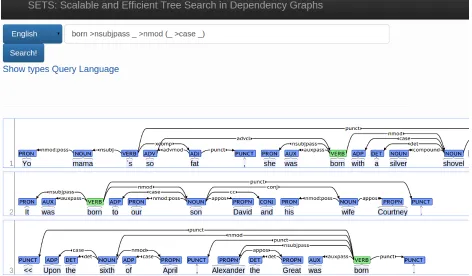
In addition to the primary search system, we cre-ated a simple browser-based frontend to the query system that provides a dynamic visualization of the retrieved trees and the matched sections (Figure1). This interface was implemented using the Python Flask2 framework and the BRAT annotation tool (Stenetorp et al., 2012).
5 Benchmarks
Our graph-search tool is tested and timed on three different machines and two datasets. Evaluation platforms include a server-grade machine with good resources, a standard laptop computer and a small netbook with limited performance. To compare the efficiency of our system to the state-of-the-art treebank searching solutions, we employ ICARUS (G¨artner et al., 2013) search and visualization tool which also focuses on querying dependency trees. ICARUS system loads the data into the computer’s main memory, while our system uses a database, which is optimized by caching. The comparison of our graph-search tool and the ICARUS baseline is run on server machine with a dataset of roughly 90K trees.
Three test queries are chosen so that both systems support the functionality needed in
Figure 1: Web interface showing trees in Finnish.
der to run the tests. The first query is a straightforward search for all subject dependents ( <nsubj ) and the second query adds a lex-ical restraint to it and requires the lemma to be I (L=I <nsubj ). The third query is much more complex and is inspired by an actual linguis-tic use case to find examples of an exceptionally rare transitive verb usage in Finnish. The query includes chaining of dependencies and a negation ( >nsubj (Case=Gen > ) >dobj ...
!<xcomp ).
Query 1 Query 2 Query 3 ICARUS 2m30s 2m30s 2m30s SETS 1.61s 1.2s 2.18s
Table 3: The speed of our system compared to the base-line on the three different test queries when a treebank of about 90K sentences is used.
As can be seen from Table3, when our system and the baseline system are tested on the server machine using the three example queries our system clearly outperforms the baseline. The speed of the baseline seems to be relatively unaffected by the complexity of the query, suggesting a bottle-neck somewhere
else than tree-verification. It should be noted that these measurements are only to illustrate the relative speed and performance differences, and are subject to change depending on system cache. Due to their architecture, neither system has a major advantage in the use of memory and the results are broadly com-parable.
Our system is also tested on a standard laptop, and a netbook using the same three queries and the same input corpus. The first test query was finished by a netbook in 37 seconds, the third query, most com-plex of them, was finished in 13.5 seconds. The lap-top finished the first query in 16 seconds, the second in 7 seconds and the third in 16 seconds.
Since our system uses pre-indexed databases the disk space needed for holding the data slightly in-creases. Indexing the 90K sentence treebank used in our tests requires about 550M of free disk space, whereas indexing the 10 million sentence parsebank uses 35G of space.
6 Conclusion
We have presented a syntax query system especially geared towards very large treebanks and parsebanks. In the future, we will implement support for graph queries, e.g. coindexing of the tokens, since many treebanks have multiple layers of dependency struc-tures. Related to this goal, we aim to include sup-port for properties of the tokens and dependencies, for example the annotation layer of the dependency, word sense labels, etc.
The full source code of the system is available un-der an open license at https://github.com/
fginter/dep_search. Additionally, we
main-tain a server for public online search in all avail-able Universal Dependencies treebanks (Nivre et al., 2015) at http://bionlp-www.utu.fi/
dep_search.
Acknowledgments
This work was supported by the Kone Foundation and the Emil Aaltonen Foundation. Computational resources were provided by CSC – IT Center for Sci-ence.
References
[G¨artner et al.2013] Markus G¨artner, Gregor Thiele, Wolfgang Seeker, Anders Bj¨orkelund, and Jonas Kuhn. 2013. Icarus – an extensible graphical search tool for dependency treebanks. In Proceedings of
Demonstrations at ACL’13, pages 55–60.
[Levy and Andrew2006] Roger Levy and Galen Andrew. 2006. Tregex and Tsurgeon: tools for querying and manipulating tree data structures. In Proceedings of
LREC’06).
[Nivre et al.2015] Joakim Nivre, Cristina Bosco, Jinho Choi, Marie-Catherine de Marneffe, Timothy Dozat, Rich´ard Farkas, Jennifer Foster, Filip Ginter, Yoav Goldberg, Jan Hajiˇc, Jenna Kanerva, Veronika Laip-pala, Alessandro Lenci, Teresa Lynn, Christopher Manning, Ryan McDonald, Anna Missil¨a, Simon-etta Montemagni, Slav Petrov, Sampo Pyysalo,
Na-talia Silveira, Maria Simi, Aaron Smith, Reut Tsarfaty, Veronika Vincze, and Daniel Zeman. 2015. Universal dependencies 1.0.
[Rohde2004] Douglas L. T. Rohde, 2004. TGrep2 User Manual. Available at http://tedlab.mit.edu/˜dr/Tgrep2. [Stenetorp et al.2012] Pontus Stenetorp, Sampo Pyysalo, Goran Topi´c, Tomoko Ohta, Sophia Ananiadou, and Jun’ichi Tsujii. 2012. Brat: a web-based tool for nlp-assisted text annotation. In Proceedings of