A Mobility-Aware File System - file availability in a
mobile-aware, context aware environment
by
Owen O’Flaherty, B.A. Mod.
Dissertation
Presented to the
University of Dublin, Trinity College
in partial fulfilment
of the requirements
for the Degree of
Master of Science in Computer Science
University of Dublin, Trinity College
Declaration
I, the undersigned, declare that this work has not previously been submitted as an exercise for
a degree at this, or any other University, and that unless otherwise stated, is my own work.
Owen O’Flaherty
Permission to Lend and/or Copy
I, the undersigned, agree that Trinity College Library may lend or copy this thesis upon
request.
Owen O’Flaherty
Dedicated to the Trinity cat, who appears to have left to find a new campus since a thesis
was last dedicated to him.
Acknowledgments
Many thanks are due to my supervisor, Dr. Siobh´an Clarke, who provided goals, advice and
good humour during this summer. Invaluable advice from Andronikos Nedos and Kulpreet
Singh is hereby acknowledged with sincere thanks. I am also grateful to Pete Barron for his
time, advice and equipment; to Dr. Stefan Weber for his generous provision of laptops, and
to Mark Gleeson for handy tips.
I would like to thank very sincerely my family who have put up with endless amounts
during the lifetime of this dissertation, and Aileen, who hasn’t seen me for weeks. And to
the rest of the NDS class of ’05—it’s been a good ’un.
OWEN
O’FLAHERTY
University of Dublin, Trinity College
A Mobility-Aware File System - file availability in a
mobile-aware, context aware environment
Owen O’Flaherty
University of Dublin, Trinity College, 2005
Supervisor: Siobh´an Clarke
The rapid growth in number of portable electronic devices with wireless networking
ca-pabilities in recent times has thrown up many new computing problems and opportunities.
Such devices typically lack the processing power common to more familiar desktop and
lap-top computers. They are also constrained by their limited power supply. Given the scenario
of an urban environment in which a large number of people using such devices constantly
move about with a need to share information, it is clear that existing network topologies are
inherently unsuited to supporting the sort of applications that they might need.
This dissertation project addresses the changing role of that most integral part of
com-puter systems in this new environment - the file system. A distributed file system called
Stirling is presented that takes advantage of both the ad hoc nature of the network
environ-ment and the structure provided by the WAND (Wireless Ad-hoc Network for Dublin.)
This filesystem offers a set of features suited for ad-hoc networking. These features, such
as virtual file placement and latency minimisation, may be set and adjusted by users at a
fine-grained level. It is envisaged that such a system may be put in place on a backbone network
such as the WAND in order that users and their devices can be guaranteed ’reachability’ to
other devices from one end of the network to the other. Usability scenarios are presented and
Contents
Acknowledgments v
Abstract vi
List of Tables xi
List of Figures xii
Chapter 1 Introduction 1
1.1 About this chapter . . . 1
1.2 About this document . . . 1
1.3 Research objectives . . . 2
Chapter 2 Background 3 2.1 About this chapter . . . 3
2.2 The importance of being wireless . . . 3
2.3 Mobile ad hoc networking . . . 4
2.4 About AODV . . . 6
2.6 Filesystems, old and new . . . 9
2.6.1 About filesystems . . . 9
2.6.2 What is it? . . . 10
2.7 Converging distributed filesystems and wireless technology . . . 13
Chapter 3 The competition - state of the art 14 3.1 About this chapter . . . 14
3.2 Some features of distributed file systems . . . 14
3.2.1 Storage in ad-hoc wireless networks . . . 15
3.3 The Network File System (NFS) . . . 16
3.4 The Andrew File System (AFS) . . . 17
3.5 Coda and others . . . 18
3.6 Extending beyond the filesystem - application adaptation . . . 19
3.7 The AdHocFS filesystem . . . 20
3.8 Current thinking on mobile computing research . . . 22
Chapter 4 Design 24 4.1 About this chapter . . . 24
4.2 High-level design and goals . . . 25
4.2.1 Filesystems in a mobile environment . . . 25
4.2.2 Filesystems using WAND . . . 25
4.3 The approach . . . 27
4.3.2 Basic design decisions . . . 28
4.3.3 About the Python language . . . 29
4.3.4 The filesystem view . . . 30
4.3.5 The filesystem state . . . 31
4.3.6 File attributes . . . 32
4.4 Use cases . . . 33
4.4.1 The general environment . . . 33
4.4.2 Multimedia . . . 34
4.4.3 Location-dependent applications . . . 34
4.5 Stirling components & API . . . 35
4.5.1 Deployed components . . . 36
4.5.2 Usage and the API . . . 37
Chapter 5 Implementation and evaluation 40 5.1 About this chapter . . . 40
5.2 Technical background . . . 40
5.2.1 Wireless ad-hoc connectivity . . . 41
5.2.2 The middleware approach vs. application-transparency . . . 42
5.3 Implementation overview . . . 44
5.3.1 System state . . . 44
5.3.2 The server node daemon . . . 45
5.3.3 The client node library . . . 45
5.4 Operation of the server node daemon . . . 46
5.4.1 The client connection manager . . . 47
5.4.2 The command manager . . . 48
5.4.3 The read thread manager . . . 51
5.5 Operation of the client node library . . . 52
5.5.1 The connection thread . . . 53
5.5.2 The API . . . 55
5.6 Operation of the XML state management subsystem . . . 59
5.6.1 XML access . . . 61
5.7 Implementation issues & discussion . . . 63
5.8 Evaluation . . . 64
Chapter 6 Conclusions and future work 67
Appendices 69
List of Tables
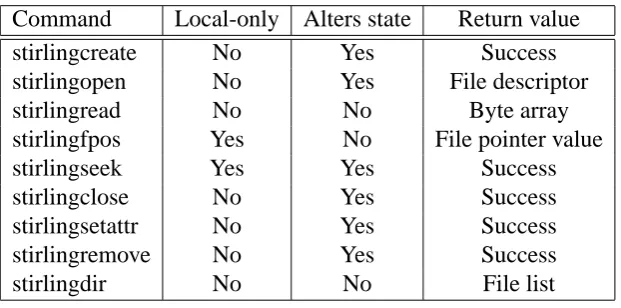
4.1 Stirling client API. . . 37
5.1 Stirling’s use of socket ports. . . 47
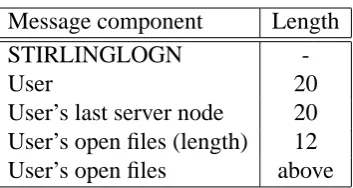
5.2 Client login message . . . 47
5.3 Create message . . . 49
5.4 File message . . . 49
5.5 Remove message . . . 49
5.6 Open message . . . 50
5.7 Set attribute message . . . 50
5.8 Directory listing message . . . 51
5.9 Read thread initializing message. . . 51
5.10 Read message (client to server) . . . 52
List of Figures
2.1 Wireless devices connected in ad hoc mode (Derived from [KB].) . . . 5
2.2 Route discovery in AODV. (Derived from [KB].) . . . 7
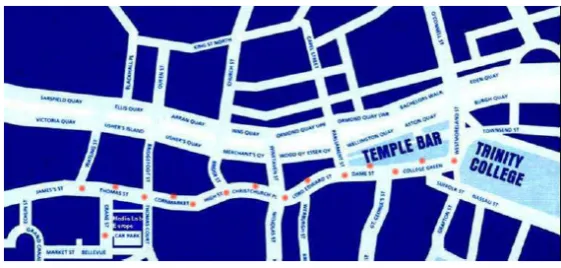
2.3 The placing of WAND nodes around Dublin. . . 8
3.1 File access in AdHocFS. (From [BI03]) . . . 21
4.1 The basic mode of operation in the proposed filesystem. . . 26
4.2 Stirling filesystem layout. . . 30
4.3 Stirling filesystem layout. . . 36
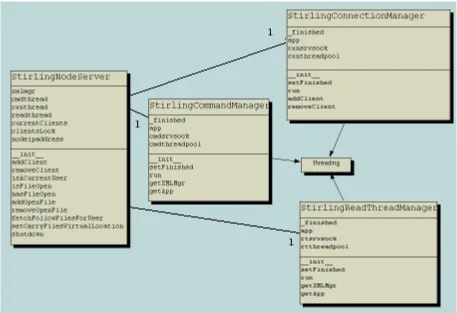
5.1 Stirling server node class view. . . 46
5.2 Stirling exception classes. . . 53
5.3 Stirling client class view. . . 54
5.4 Stirling client life cycle. . . 55
5.5 The stirlingcreate protocol. . . 56
5.6 The stirlingremove protocol. . . 57
5.7 The stirlingopen protocol. . . 57
5.9 The stirlingclose protocol. . . 58
5.10 The stirlingsetattr protocol. . . 59
5.11 The stirlingdir protocol. . . 60
Chapter 1
Introduction
1.1
About this chapter
T
his chapter explains how this dissertation is structured, and outlines the objectives of the project.1.2
About this document
• Chapter 2 provides essential background information on wireless networking,
filesys-tems and the attendant terminology that is crucial to understanding the motivation
be-hind this project.
• Chapter 3 describes various distributed filesystems in use today that share some of
the goals of this dissertation.
• Chapter 4 details the design of the Stirling filesystem, from motivation to use cases.
• Chapter 5 presents details on the implementation issues encountered while creating
the filesystem, and explains how it was evaluated.
1.3
Research objectives
The work in this project was carried out with the following goals:
• To learn more about modern, cutting-edge technologies that are shaping the way we use technology today.
• To acquire new technical skills, notably the use of the Linux operating system and proficiency in Python programming.
• To undertake a research review of a particular area, and to evaluate implementation goals based on that review.
• To present the results of the above in an informative and readable academic work.
Note: I make reference throughout this document to the ‘filesystem’. After a
signifi-cant period of time investigating the various ways in which files may be structured, the two
separate words ‘file’ and ‘system’ tend to become conflated in the researcher’s head and it
becomes natural to think of the concept as a unit. This is the convention that is adopted
Chapter 2
Background
2.1
About this chapter
M
otivating factors behind this project are the subject of this chapter—the reasons fordeveloping a file system that allows users to take advantage of a mobile, ad hoc net-working environment. To do this, brief synopses of the areas involved are presented, such as a quick introduction to the world of file systems and the difficulties and opportunitiesafforded to it by wireless networking. These will show how there is plenty of scope for a
project of this kind, and will outline some of the proposed benefits of such a system.
2.2
The importance of being wireless
Using a laptop computer while wandering through the streets of Dublin’s city centre is not
generally considered advisable, at least if keeping the laptop intact is important to its owner.
But given the proliferation of mobile phones and PDAs coupled with the advancing
process-ing power and storage capacity of relatively small devices, this scenario does not sound quite
so implausible.
Wireless technology has developed at such a pace in recent times that a sizeable gulf
actu-ally possible in this enviromment. This area is currently the focus of significant market
research in what the future holds for wi-fi technology and other wireless technologies.
Con-sultancy think-tank Ovum has forecast growth from 6 million users of some form of wireless
e-commerce at the report’s time of writing, for example, to 500 million users in 2005. Euro-pean Information Technology Observatory (EITO) figures suggest 10 million present users
to 175 million in 2005.1
The following sections explain some of the technologies mention here and how research
is conducted exploring ways to use these technologies.
2.3
Mobile ad hoc networking
The year 2004 saw the sudden widescale adoption of wireless networking. As broadband
services took over from dial-up connections in the mainstream of the internet access market,
sales of wireless access points grew in a similar fashion, as households with multiple
internet-ready devices sought to take advantage of an always-on connection with minimum fuss. In this way, wireless networking has become the norm rather than the exception, as ‘hotspots’
proliferate in urban areas.
This form of network access relies on a wireless access point which provides connectivity
to the other nodes on the network, and acts as a gateway to other networks. This is commonly
referred to as a ‘star’ topology, with the accesss point at the centre and the participating nodes
at the star’s apexes. When nodes communicate, they do so indirectly via the access point,
which acts as a router for messages sent between the nodes. Such a configuration implies some sort of previously defined topology—typically, the access point itself is connected via a
physical wire link of some sort to another network (in most broadband cases, the access point
incorporates router functionality and connects to the ISP using DSL over the phone line.)
However, it is quite possible for nodes possessing radio transceiver cards to talk directly to
each other without the need for a centralized access point. This is what is known as ‘ad hoc’
mode. The early 802.11 protocol incorporated the ability for nodes using it to connect in this
manner.
Figure 2.1: Wireless devices connected in ad hoc mode (Derived from [KB].)
A mobile, ad-hoc network, therefore, consists of a set of wireless-capable nodes with
routing functionality and the location of which is not fixed (see Figure 2.1.) Hence, the
network configuration is that of an arbitrary topology. The network must not be reliant on
any supporting infrastructure. Nodes must be capable of routing messages, in a
‘store-and-forward’ sense, as a given node may be only able to communicate directly to a subset of the
network at any given time, and so messages must ’hop’ their way between nodes until they
reach a node which is within range of the destination.
It is worth noting that the use of the term ‘ad hoc’ nowadays implies routing capability,
whereas the 802.11 standard from the IEEE simply specifies ‘ad hoc’ as a network lacking
network infrastructure to organise participating nodes without any prerequisite routing
func-tionality. This would imply that participating nodes must be relatively close together, so as
to ensure each node is within transmitting and receiving distance of all others.
There are certain features that set ad-hoc wireless networks apart from traditional, even
access point-based, networks. [CM99] gives a list of these characteristics, explained as fol-lows:
• Dynamic Topologies. The most useful characteristic of wireless technology is the
mobility it affords to its user. The network must be able to cope with shifts in node
topology as a result of this, with its attendant effects of route alteration and differing
• Energy-constrained operation. Battery power is, remarkably, a major constraint in
the development of efficient wireless computing devices, as it has lagged behind in
terms of keeping up with developments in processing capability and the increased
power demands that come with it. Several strategies for energy conservation in wire-less networks have been mooted, including allowing devices to ‘sleep’ in a low-power
state when not in use, but this has consequences for routing protocols which then
can-not guarantee multihop routes for all network participants.
• Bandwidth-constrained, variable capacity links. Unlike wired networks, links
be-tween nodes in such an environment rely an unpredictable radio frequency medium,
the characteristics of which are highly dynamic due to node mobility and external
in-terference. For this reason, throughput capacity is highly unpredictable.
• Limited security. The wireless medium means that there is nothing to stop interested
parties with radio equipment listening on all network traffic. Traditional network
at-tacks become a degree easier due to this fact. Extra care must be taken when designing
ad hoc protocols such that this consideration is taken into account.
A further characteristic of ad hoc networks is the lack of configuration required to
ad-minister membership and routing of the network. Nodes should be able to self-configure
membership information in a given network on joining, much in the same way fixed
net-works allocate addresses via DHCP, for example.
2.4
About AODV
AODV, the Ad hoc On-demand Distance Vector routing protocol, is a solution to the
por-blem of limited radio range in wireless networks. While a transmission route can always
be guaranteed in normal circumstances in a wired network (and a route that is not expected
to change very often) this is not the case in the wireless domain. Using dynamic discovery,
each participating node maintains a route table of other nodes it can communicate to.
This route table is guaranteed loop-free and is capable of changing as routes become
arise should transmission errors occur. It is built up using a combination of node awareness
of its immediate neighbours (nodes only one hop away) and ‘route request’ messages sent
on from other nodes. Neigbours are discovered by periodically sending ‘HELLO’ messages
on broadcast. Route Request messages (RREQ) are sent out when a packet has to be sent to a node for which no address exists in the routing table. These messages are passed on to
other nodes as necessary, with a ‘time to live’ value to ensure the message will not circulate
aimlessly forever around the network.
All AODV messages use sequence numbering to indicate how ‘fresh’ (and hence, valid)
the information they carry is. This enables nodes to choose between conflicting route
infor-mation. Route error messages (RERR) are sent out when a node discovers a bad route, and
enables other nodes to pick up on this new information.
[image:20.595.182.460.380.542.2]An example sequence of route discovery is shown in Figure 2.2.
Figure 2.2: Route discovery in AODV. (Derived from [KB].)
Various implementations of AODV exist; those considered for use in this dissertation are
those from the University of Uppsala (a user space daemon) and Kernel-AODV, from the
National Institute of Science and Technology (NIST). The latter is the preferred version, as it operates as its name suggests as a kernel module, and hence benefits from performance
gains. Packets queued for routing do not need to be ‘context-switched’ into a user space
2.5
About WAND
A relatively high-profile use of ad hoc wireless networking is the Wireless Ad hoc network
for Dublin, or WAND for short. It is an initiative coordinated by the Distributed Systems
Group in the Department of Computer Science at Trinity College Dublin in association with
Media Lab Europe (MLE), the latter of which, sadly, is now defunct at the time of writing.
It is an experiment in the application of metropolitan-scale wireless networking through the
installation of a series of permanent wireless nodes distributed through Dublin’s city centre.
These nodes consist of wireless-enabled PCs running a Linux installation with AODV.
They are scattered along a route stretching from the Pearse Street end of Westland Row, up
Lincoln Place, along Nassau and Dame Streets and finishing up around Lord Edward Street,
located in various buildings along the way (see Figure 2.3.) This distribution provides a
minimum of connectivity from one end of the two kilometre stretch to the other, and may
be augmented by the presence of other dynamically participating users, such as people in
the area armed with suitably-equipped PDAs. The units themselves are embedded PCs of dimensions roughly 6cm x 6cm x 12cm, containing the PC boards, power supply and WiFi
[image:21.595.179.460.455.589.2]equipment.
Figure 2.3: The placing of WAND nodes around Dublin.
This ‘test bed’ allows potentially interesting distributed wireless applications to be tested
in the real world - most often demonstrating that what is most robust, stable and usable in lab
conditions or in simulation quickly faces a whole new set of unanticipated problems when
2.6
Filesystems, old and new
From leading-edge technology to the more mundane and unexciting - this project considers
the role of the file system in an environment such as that described above. It is useful at this
point to consider the origins and many facets of this bedrock of computing that we all take
for granted.
File systems have been at the heart of modern practical computing since its inception.
The hierarchical ‘tree’ model that we are so used to has proved surprisingly durable. The
first useful UNIX file systems were based on this notion of organising files using folders, or
directories, which could be recursively nested and in which non-directory files themselves
could be located at any level. This model has been used in a similar fashion by rival PC
oper-ating system vendors and others and, as such, has allowed for a certain level of compatibility
between such systems. This approach has lasted so long because it has proved so suitable
to monolithic, centralized computer systems that, of necessity, traditionally dominated the
area. Subsequent advances in network technology has not yet forced a radical redesign of this paradigm that has enjoyed widescale deployment. This section describes the desirable
characteristics of file systems, and how their design and interworking has responded to the
network age.
2.6.1
About filesystems
It has been observed that the UNIX operating system works on the basis that ‘everything
is a file’. That is, that the most important component part of a computer is its filesystem,
and every other aspect of the environment—display, network, peripherals—interacts with
the operating system via a file or set of files. The obvious case of this is in the /dev
directory in *NIX systems, where many ‘special’ files reside whose names provide a key
to understanding their purposes, such as ‘hda0’, referring to a hard disk.
It is natural, therefore, to examine the purpose of the filesystem itself, to understand its
purpose and motivations behind the designs of various filesystem implementations, and see
how advances in technology and the way computing devices are used today affect the
on our computers, with their comforting and familiar hierarchies of directories containing
sets of files, and nowadays almost as used to accessing such hierarchies on remote
com-puters through the use of facilitating technologies like NFS on Windows Workgroups and
Samba. Few, however, outside academia have much experience using filesystems developed for use in far less monolithic, predictable environments, where location of resources and
availability of those resources at a given time can often be volatile factors. Such systems
include the Andrew filesystem, designed to minimise communications costs in a fairly stable
distributed environment, and Coda, which takes into account additional factors such as
dis-connected operation, replication and mobility. As modern usage patterns change, however,
thanks largely to the widespread deployment of wireless technologies such as Wi-Fi and
Bluetooth, such filesystems will feature more prominently and play a wider role in providing
users with the resources they require. This is the motivation for this dissertation—given a
certain non-traditional computing environment, how best might its file-related requirements be addressed?
To do this, we must go back to examining the fundamental static filesystem that we all
take for granted and determine its purpose and implementation, and reevaluate this in light
of modern usage patterns. It is hoped that this will lead to a better understanding of the
requirements posed by large-scale computing environments and provide a better basis for
possible design solutions.
2.6.2
What is it?
Large numbers of files require organisation. It is necessary for users to access resources in a
uniform and convenient manner, while hiding from them the intricacies of storage allocation
and other housekeeping details. It is the filesystem’s job to do this organisation through effi-cient storage, directory maintenance, security management, file naming and sharing access.
It must also provide an abstraction layer on top of the files to allow a common scheme of
access. To facilitate all this, files themselves are considered to be more than just the raw data
that they contain. A typical file consists of its contained data and an amount of metadata
the latter consisting of naming information and attributes governing its type, access
permis-sions, owner, and so forth. Directories themselves are special kinds of files in themselves
A file is a sequence of data that is governed by attributes. This is not much use by itself,
as an operating system would find it very inefficient to access files, particularly as the system
scales. Therefore, the job of the file system - a layer of abstraction that hides the physical
layout of the data storage from the operating system - must provide the following services with regard to these files:
• Storage and organisation. The most obvious requirement of the system, this entails
the efficient distribution of files, each not necessarily contiguously, across the storage
medium while organised into folders for easy access. The end user need not know
that the file they are currently working on is not actually stored as a discrete block—in
fact, it may be broken into several chunks stored at various locations in the medium.
The system must trade off responsive file access to files for the user against efficient use of space on the storage medium. This view of isolating the user from the storage
reality can begin to break down in cases such as in an environment where the files on
the medium have become heavily fragmented—say, due to having been subjected to
a lengthy period of continuous use and user reorganisation—or where a significantly
large number of files and directories exist relative to the size of the actual files
them-selves, in which case the system can declare its free capacity to be surprisingly small
as a result of so much space ‘vanishing’ for administrative purposes.
• Retrieval. Speed is most important from the user’s point of view - as consistency and
information corruption prevention are generally taken for granted by users! It is only in
relatively recent times when accessing files across network links became feasible that
speed became an issue again. Previous to this, it was safe to assume that file access
time would be restricted to being a matter of milliseconds, given the physical proximity
of storage to processor. Retrieval is also closely linked to hierarchy organisation, and
given the geometric possibilities offered by just a few layers of nested directories, this
is generally a satisfactory solution. When taking into account the requirements of modern, distributed file systems, however, it becomes clear that these assumptions do
not necessarily hold any longer, and that considerable effort must be put into this area.
• Naming. The combination of a hierarchy of directories followed by a user-chosen
name is the standard way to refer to a file. It is easy to see how restrictive this method
hyper-links enable users to effortlessly jump around information sources in a much less
con-strained fashion. It is also unfortunately true that users are not good at the business of
naming. As noted in [Nie96], files tend to suffer from the “‘premature classification
problem’: the name normally has to be generated long before the content is created, and thus users may not fully understand what they’re naming”. In a distributed
environ-ment, this can be crucial where an arbitrary number of users need not be in agreement
on a file naming convention. The naming of a file cannot be relied upon to convey a
sense of its content. This creates untold problems for subsequent retrieval.
• Security. It is a file system’s job in a multiuser environment to restrict access to files
based on user privileges. Indeed, even in a single-user environment, is can be
neces-sary to protect that user from inadvertently damaging important system files. This is
achieved through the use of file attributes, governing at various levels of granularity the questions of who may read, write, delete and otherwise use files. In a distributed
envi-ronment, extra issues must be considered such as eavesdropping on the network links
during file manipulation, an aspect of everyday use that becomes ever more important
with the current fast rise in the adoption of wireless network technology.
Such a system must be highly scalable and provide a relatively simple and efficient API
for manipulating it. Such requirements have been well documented and, while not wishing
to discount their importance, we choose to concentrate instead here more on those
character-istics that distinguish the distributed aspect of a distributed filesystem. Such charactercharacter-istics
include:
• Transparency. This includes both location transparency and access transparency. The
view of the filesystem presented to the user must not be dependent on either the user’s physical location or the physical location of the actual files themselves.
• Performance. The necessity of network communication for ordinary file operations
adds significant latency issues to operations that could hitherto be relied on to return
almost-instantaneous results. This poses potential problems for time-sensitive
appli-cations.
• Fault tolerance. As with the previous point, network communication adds an
congestion delays or actual unbridgeable connections. Additional strategies must be
employed to combat this factor, such as caching and replication.
• Additional security requirements. The distributed nature of the system adds other
points of attack for intruders, an further consideration in an wireless environment.
• Concurrency control. Concurrency control, or locking, must be incorportated into
the filesystem to contend with the added issue of processes on other machines vying
for resources as well as local processes.
2.7
Converging distributed filesystems and wireless
tech-nology
This chapter has introduced the basic issues that concern the areas of wireless networking
and filesystems research. It is probably clear from this discussion that these are two subjects
that are not naturally reconciled. The environment that best suits the traditional filesystem is
the polar opposite of that put forward by the challenges of the wireless network.
However, it is perhaps ironic that it is the stability and familiarity of the filesystem that is
most needed in the chaotic, unpredictable world of the ad hoc network. Organising
informa-tion in a community sense is essential if a coherent use is to be made out of such a dynamic
medium. A filesystem offers a well-known and trusted foundation for organising a host of
applications that depend on it. Many scenarios that examine potential applications of the
WAND network would require, or at least benefit from, the presence of such a filesystem.
Chapter 3
The competition - state of the art
3.1
About this chapter
T
his chapter analyses several file systems based on some of the characteristics outlined in the previous chapter. We focus mainly on NFS, Andrew, Coda and AdHocFS.3.2
Some features of distributed file systems
Accessing information while on the move is a complicated process. To some extent, the
filesystems outlined in this chapter all attempt to answer the question: what is different about mobile computing?
Most computer users nowadays are familiar with the idea of a distributed filesystem in the
form of the fileserver model, which is in effect a use of the traditional client-server model.
Instead of accessing files on a local hard disk, the user accesses a file across a network
from a known machine, often using a transparency mechanism that allows a syntax closely
mirroring that used for local access. In this way, programs running on client machines are
able to easily choose files to work with both locally and remotely. This does require prior knowledge, however, of file location. As user requirements change, we are seeing many
together, most notably in WiFi environments, the given membership of which at a given
moment tends to be highly volatile.
Several solutions have been developed to cater for the intermediate stages on the way
to the latter extreme. As the use of computer networking has evolved, so has the number
of solutions for information storage. In general, distributed file systems have been designed
to suit the characteristics of the local-area networks that they run over. “Their design is
adapted to the performance and reliability characteristics of local networks and hence they
are most effective in providing shared persistent storage throughout an intranet.” [CDK94]
This way of looking at distributed storage has been been extended a long way in recent years
however, with both the scale of the Internet and the rise of wireless computing contributing
to this. The internet is indeed the ultimate distributed filesystem, an enormous repository with almost a non-existent naming or filing system. On a smaller scale, efforts such as
AFS (Andrew File System) and its successor Coda take considerations such as caching and
replication into account using strategies previously considered unnecessary in more standard
network filesystems. The tradeoff occurs in that these systems are more complex and require
more maintenance, and hence can be not as robust.
3.2.1
Storage in ad-hoc wireless networks
We see today an explosion in WiFi capability in almost all handheld hi-tech devices, such as
the latest, the Sony PSP. In such environments, what use are traditional filesystems, even the
distributed sort? Given the tendency of peers to form, leave, regroup and partition networks
it is clear that the old model of filesystem as shared repository needs a rethink.
The advantages of being able to access data while on the move are quite clear. Fast
access to shared information gives competitive advantage to workers on the go. In emergency
situations, quick access to medical records can be crucial. Telecommuting becomes far more
flexible when considered in a ubiquitous computing environment.
Realising these scenarios is not a hardware problem--the technology certainly exists to
address these issues (if we ignore inconvenient details such as battery power consumption
compared to static ‘fixed’ devices, the danger associated with showing off expensive
tech-nology in public (theft, mugging, breakage), potentially volatile network availability and so
forth. It is also worth considering the sheer growth in mobile device numbers—scalability is
an unavoidable issue even in these early days of mobile applications.
Returning to basics, the following section gives a brief look at the most successful
LAN-based distributed file system today, Suns NFS and gives a good overview of the basic
dis-tributed requirements for such a filesystem.
3.3
The Network File System (NFS)
Principally aimed at UNIX, NFS supports heterogeneous platforms by specifying a contract
to be supported on participating machines. By designating certain areas of the local
filesys-tem as being shared, a user of that machine can advertise what files should be available to
other clients, and can browse the shared areas of all other machines. This of course requires
individual machine intervention and implies that the system is only supported when the sup-porting machine is switched on. It also assumes some prior knowledge of network topology,
or at least some search service bolted on top.
NFS provides a virtual file system, adding an extra virtual inode to denote a remote file.
It mirrors the UNIX file system model where it can, except for the notable exception in that
its operations are idempotent, i.e., it does not keep files open as UNIX does. Extra
opera-tions are provided to provide seamless operation path name translation, automounting and
client/server caching for performance gains. NFS has been adapted for use with Kerberos for extra security against malicious attacks and unauthorised access. Overall, NFS has been
a success, providing support for heterogenous platforms, good scalability and significant of
user-perceived transparency in its operation. Its naming syntax is compatible with local
path-names, allowing existing applications to use it without loading extra libraries and undergoing
3.4
The Andrew File System (AFS)
The AFS takes the abstract distributed file system model requirements a step further with
its support for disconnected operation. This is achieved by using a caching strategy that
leaves files on client machines until an update of some sort is made known to the server.
While this minimises network communication, it throws up obvious consistency issues that
require a robust protocol to administer. By using whole-file caching where possible, most
client requests will be serviced by local copies. When a close operation or some equivalent is invoked, the AFS is responsible for updating the master copy back at the server. This
approach is based on observation of file access behaviour on UNIX systems whereby locality
of reference is strong in other words, most files on a system are not considered collaborative,
and users tend to modify their own files and theirs alone in general—obviating the need for
update resolution for long periods of time and so freeing network resources.
This is achieved in practice by having the AFS client (Venus) use a portion of the local
filesystem as the shared AFS area, accessed via symbolic links from the rest of the filesystem, so providing transparency. Kernel modifications allow hooks into file system calls in order to
redirect requests to the shared area if necessary. The main concern to the system is therefore
cache consistency—if another user updates another cached copy of the same file, all other
caches must be updated. This is achieved using a callback promise mechanism.
Numerous improvements and updates have been made to both NFS and AFS systems and
their variants as computing requirements change. It should be becoming clear, however, that
a postentially globally connected wireless world requires a fresh approach to the notion of an information repository. Indeed, [CDK94] notes that future requirements include support for
mobile users with disconnected operation, and automatic reintegration and quality-of-service
guarantees to meet the need for the persistent storage and delivery of streams of multimedia
and other time-dependent data. The next section will examine current efforts that exist in this
3.5
Coda and others
Coda is a successor to AFS in that it aims to support more disconnected operation. It claims
that it strives for constant data availability. [SKK+90] It is resilient to failures through its two
mechanisms of server replication and disconnected operation. In this way, caching sites
may temporarily become server sites. A user may therefore work independently of failures
in the network system. A related goal, as noted by [SKK+90], is “to gracefully integrate
the role of AFS with portable computers”—a concept of much interest to this document. Work in this area is currently continuing, mainly at Carnegie-Mellon University under Prof.
Satyanarayanan [Mis], where projects such as Odyssey and Aura further these goals.
Much related documentation abounds in the literature that addresses the issues involved
managing mobile file systems. [HH95] makes the point that proper management of
discon-nected operation is the key to efficient file management. Minimising traffic is not the goal,
but “adapt[ing] to adverse network conditions”. The authors discuss a modified form of AFS
for their purpose.
Similarly, [HLM03] puts forward a proposed mobile, peer-to-peer information retrieval
system. It is contended that ad-hoc routing is not robust, and that a sparse distributed
filesys-tem will work best in an environment without it, where nodes will only contact each other
directly. Fault tolerance is addressed through file replication. This sort of system, the
au-thors explain, is aimed at a scenario such as, say, an emergency response, where timeliness
is of the essence in one, reasonably confined, space. While a relevant and useful study, the
findings and conditions for those findings do not match the envisaged test conditions for this dissertation which will involve the Wireless Ad-hoc Network for Dublin (WAND).
Chessa and Maestrini [CPM] concentrate on a more mathematical approach to file storage
in an unreliable, ad-hoc network environment, which, by fragmenting files, boosts
confiden-tiality. The system’s main effort is to break away from the outlook of competing systems
such as Coda and Petal, say, with their emphasis on adapting the client/server model for
to-days changed environment. While a technically innovative system, it does not specifically
3.6
Extending beyond the filesystem - application
adapta-tion
Coda is an application-transparent system—which is to say, it requires no changes to existing
applications in order to run successfully. Applications need not be aware of the difference
between a conventional filesystem and an application-transparent system. While this is
cer-tainly convenient, it has its disadvantages. Chief among these is the inability of an application to specifically tailor behaviour to the extra opportunities afforded by the mobile nature of the
filesystem.
To explore this idea, researchers at Carnegie-Mellon are currently working on Odyssey—
a set of extensions to UNIX for mobile computing. Odyssey is portrayed as an environment
rather than a filesystem, a pervasive computing environment that would incorporate Coda
as part of a greater whole. At the moment Odyssey represents the application-aware side
of the area of mobile filesystems. It presents itself, most bluntly, as an API for resource negotiation. Underneath, the Odyssey system itself manages access to scarce resources. Its
premise is that the application itself is best suited to deciding a course of action in the face
of changing network resources, and offers the user/application of possible choices.
This usefulness can be seen in the example of video player which, if during playback the
connection were to deteriorate, could switch to black-and-white or could drop the frame rate
rather than simply stutter. An application opts to request resources at a given quality level.
Odyssey informs the client of best available, and the client can then choose a resource level if it wants. The actual Filespace broken into ‘tomes’ (analogous to volumes), each of which
holds objects of a specific type. Applications access files via the viceroy, which controls
wardens, each of which is responsible for accesses to one particular object type. In this way,
each warden can know about acceptable fidelity levels. Odyssey also uses a new concept
known as ‘dynamic sets’, where groups of related files are grouped for prefetching. The
application discloses hints to the OS/Odyssey about possible related groups of files, so the
filesystem can perform fetch optimizations. This all sounds very esoteric, and it probably
is. The abstruse nature of Odyssey documentation available would suggest that the system is
still in the development stages.
mod-ify existing solutions. In the face of weak connectivity, modifications to Coda have been
implemented that address the following:
• More compressed, robust protocols for cache validation, including background
ser-vicing of cache validation. Coda originally relied on callbacks for update propagation,
which is not a tenable strategy in an environment of weak connectivity.
• Volume versioning as well as file versioning--if no files have changed in a volume,
then naturally the volume itself will not be changed, thereby implying that a coherency
validation can often be reduced to a single date comparison which saves checking all
files in a volume.
• Trickle reintegration--as opposed to a ‘log optimizations’ approach, which can be
wasteful. Consider, for example, and update operation on a file followed by a delete
operation on that file—the first operation is rendered obsolete by the second.
• IOTs—UNIX filesystems have no read-write conflict resolution. Satyanarayanan has
proposed extensions of Coda with a solution based on isolation-only transactions (IOTs.)
These may be used in a special IOT-aware shell to run programs, or can modify apps
with an API.
All these Coda modifications are currently in deployment in real-world installations and
have been reported successful. Drawbacks to these approaches mainly occur due to
envi-ronmental factors—conflict resolution, for example, is good for text but not for comparing
multimedia files. Caching also not useful if there is no temporal locality to exploit (i.e., the
system is reliant on caching being useful.) This can hit performance if cache misses remain
high, for example, given mobile clients doing a lot of searching on remote file servers.
3.7
The AdHocFS filesystem
The AdHocFS system [BI03] is a significantly interesting proposition in its use of a
collab-orative file sharing system that adapts to users changing network conditions. The system
group management capabilities offered by OpenSLP (Service Location Protocol.) It is of
great interest given the similarities demonstrated in its network test conditions to those that,
it is envisaged, will be those of the work of this dissertation.
AdHocFS claims to “realize transparent, adaptive file access according to the users
spe-cific situations” ([BI03]). In doing so, it provides collaborative file sharing to groups of users
who are united by having the same security level. It is characterised by its policy of caching
files on the filesystems of local nodes, in its use of naming and location services, in its use of
secure links between nodes, and a coherency management service that organises replicated
files and facilitates file sharing and updating.
Rather than concentrate on support for disconnected operation though predictive means
(i.e. by prefetching), AdHocFS prefers instead to use a log-based system of update
propaga-tion, and an optimistic replication scheme. This enables ad hoc groups to come together to
work on certain files, and then share those changes with other groups when connectivity is
[image:34.595.177.463.398.689.2]established.
Figure 3.1 illustrates file access in the system. When a file is found not to be cached
locally, it is necessary to connect to the home server and fetch it from there. Subsequent
up-dates are applied to the local copy, and cache coherency management ensures that a coherent
view of shared data is enforced across the system.
It will be seen in the next chapter, where the design for a putative file system for WAND
is outlined, how certain of the more suitable aspects of this and previous systems have been
incorporated into the architecture of the proposed system.
3.8
Current thinking on mobile computing research
If we return to the question that was posed earlier—what is different about mobile computing?—
we may now suggest some answers. As before, it is the constraints imposed by mobile
com-puting that dictate its characteristics. These constraints include caching metrics, semantic
callbacks and validators, resource revocation, analysis of adaptation, and policies of global
estimation based on local observations.
Mobile devices in wireless networks, as has been onserved, are relatively resource-poor.
They are also physically vulnerable, suffer unreliable connections and are further constrained
by a relatively weak power supply. For this reason, much research in the field points to the
ability to adapt dynamically to circumstances the most important factor of mobile nodes.
Is this adaptation, therefore, best done by the individual application or by the underlying system? As with all things, this needs compromise. It depends on the goals of the
appli-cation. Application-level transparency has been extensively tested through deployment of
Coda and its subsequent modifications, as described above. Odyssey, on the other hand,
explores application-aware adaptation—trusting in the agility of clients to respond best to
changes in the network according to their needs.
This is redolent of the traditional balance between autonomy and interdependence in distributed systems. The addition of the mobility factor into the mix only exacerbates this.
One of the bigger questions concerning the future of mobile computing, therefore, is of
In the spirit of current thinking at Carnegie-Mellon, given their emphasis on
Odyssey-based research, it will be shown that the Stirling filesystem tends more towards the area of
Chapter 4
Design
4.1
About this chapter
I
n order to test the usefulness or otherwise of a distributed file system based on an urbanad-hoc network such as WAND, it is necessary to implement a test system that strikes a balance between the features regarded as desirable and the reality of the supporting infras-tructure. The WAND architecture, summarized in a previous chapter, provides a backbone ofsorts to the the target ad-hoc environment. This is immediately useful, as by its nature a
dis-tributed filesystem involves potentially very large chunks of data being transferred across its
network. In an ad-hoc network, any member node must agree to act as a router should traffic
come its way, and so there arises the potential for low-power, low-bandwidth devices being
unwittingly coerced into acting as bridges for other nodes’ large data transfers. By ensuring,
through the WAND design, that a route will always exist between two non-WAND nodes
that does not involve any other non-WAND nodes, this problem can be largely discounted.
This chapter outlines the features sought for such a filesystem, followed by discussions
of implementation options (programming languages and platforms) and of the planned
4.2
High-level design and goals
The goal of the implementation section of this dissertation is the creation and testing of a
prototype filesystem that allows users to set extra attributes on their files, attributes that are
geared towards taking advantage of a mobile ad-hoc network environment. For reasons of
time and simplicity, this initial version limits itself to implementing the following two main
areas:
• Minimum latency for time-critical access
• Virtual location of files
These attributes and their implications will be described in depth in later sections.
4.2.1
Filesystems in a mobile environment
Given that there is no management infrastructure required in a strictly ad-hoc mobile
net-work, the idea of an organised filesystem does not fit well into this environment. Filesystems
by their nature are repositories, designed for availability, stability, and to be well-known.
These requirements are quite the opposite of conditions that are tolerated in the ad-hoc en-vironment. A discovery protocol is essential in order to find out where files are stored at a
given time, as is a replication protocol, if files are required to be persistent and available after
their creator has left the network. Many, therefore, of the assumptions made when
consid-ering filesystem design must be reevaluated when porting these requirements to the wireless
world.
4.2.2
Filesystems using WAND
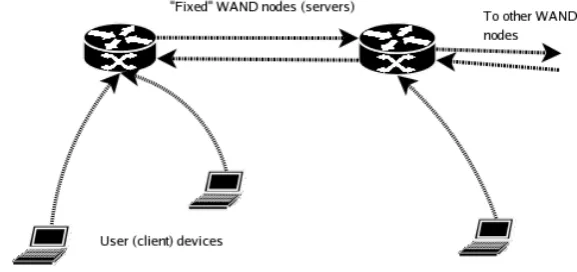
The design of WAND eases these difficulties to some degree. By strategically arranging
Linux boxes with ad-hoc wireless capability in a ‘spine’ layout throughout the city centre,
each node is guaranteed one-hop communication with two of its neighbours, one ‘upstream’
efficient route to any other, and any transient device connecting to WAND’s network can take
advantage of this.
WAND nodes can essentially be regarded as fixed nodes in the ad-hoc network - cheating
to some degree, but the preferable viewpoint is that this feature adds stability to the network.
From the filesystem designer’s point of view, however, this is most welcome. The presence
of invariable, always-on and immobile nodes implies an excellent place to store the actual
files that comprise the filesystem.
This frees user (client device) nodes from the responsibility of actually hosting the files
themselves, and also goes a significant way to ensuring that user nodes will not have to bear the burden of large file transfer routing. Existing routes between WAND nodes should direct
data along the ‘backbone’ if possible, rather than via client nodes. This model is illustrated
[image:39.595.173.462.373.509.2]in Figure 4.1:
Figure 4.1: The basic mode of operation in the proposed filesystem.
Since this distinction is to prove so important in the subsequent design of the filesystem,
it becomes convenient to refer henceforth to backbone WAND nodes as ‘server nodes’, and
the user devices that move unpredictably between them carried by people in their vicinity as
4.3
The approach
4.3.1
List of features
The envisaged environment for the proposed filesystem system is of course a dynamic one,
containing many mobile devices operating in an ad-hoc manner. The backbone system,
WAND, whereby a set of ‘server’ nodes (connected in ad-hoc mode) form a fixed chain
through the operating area, guarantees a path from one end of the system to the other. This
backbone system can support a transient population of mobile, handheld nodes. These latter
nodes can carry the rule sets for their users’ preferences, but it is assumed, correctly or
incorrectly, that these nodes will not host actual files directly.
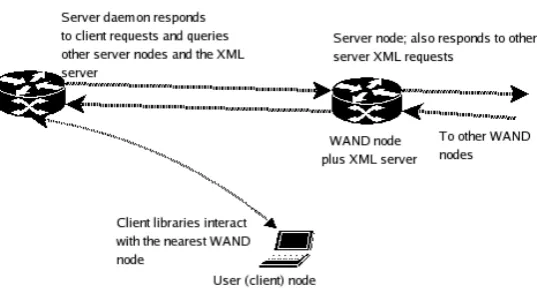
Instead, the files will be stored on backbone nodes (in a manner that is not necessarily
related to the virtual filesystem layout.) The ‘server’ daemon application will reside on
these nodes and will govern file inter-node transfers via sockets and AODV. A secondary
client application (for users’ portable devices) performs the role of ‘file system API’. The
system redirects ‘file open’ requests, ‘read’ requests, etc., to a server node, which obliges by
accessing files on the virtual filesystem.
With these factors in mind, we can approach a list of features desirable for the filesystem:
• Global view. It should follow the UNIX-like model of a one-tree filesystem,
start-ing from a ‘/’ directory, rather than incorporatstart-ing the network structure itself into the
naming convention (`a la NFS.) This provides location transparency, and simple
ease-of-operation, to the client.
• Persistence. If a user ‘creates’ a file on the filesystem, it must be subsequently
avail-able, file permissions allowing, to other users, after the creator has left the network.
• Filesystem operations. The filesystem should support traditional filesystem operations,
such as open, read and close calls. Desirable features would also include move, copy
and directory creation operations.
• Permissions. It must be possible for users to maintain a degree of access control over
subset of the system’s users.
• Mobile attributes. To make the filesystem truly useful and original, the files must
support extra metadata attributes that take advantage of the mobile environment that users operate in. Such attributes include directing the file to physically ‘follow’ the
user around the network, in order to guarantee fast (low-latency) access. This would
be particularly useful for large media files. A different attribute would be one that
allows a file to have a ‘virtual location’ instead, whereby users could ‘carry’ a set of
objects around with them as they move through the network, ensuring that those files
would only be visible to other users in the immediate vicinity.
As files do not physically reside on client nodes, the notion of ‘available only at a certain location’ means that files being ’carried around’ in this way would be associated with one
server node at a time. Client nodes that deem themselves closest to this server node of all
server nodes would be granted access to these files - other clients would simply not ‘see’
them until they move into range.
The codename given to the subsequent development of this system was ‘Stirling’. The
name derives from a certain dog, native of Holland Park, Brisbane, whose distinguishing
characteristic is that of following any available person around with various objects in his mouth - a perfect summary of how a distributed filesystem should present itself.
4.3.2
Basic design decisions
It was originally envisaged that the system would intercept file system calls (fopen,read, etc.) using a dynamically loaded library written in C, but subsequent investigation led to a
shift towards a middleware approach. Early proof-of-concept demos and prototypes written
in C led to the realization that, were a significant number of goals to be achieved in the
timeframe available, a shift to a higher-level language would be needed. For this reason,
the Python language was selected. The basis for this was its portability, ease-of-use and
4.3.3
About the Python language
Python is a high-level, object-oriented interpreted language. Strictly speaking therefore, it is
a scripting language, a term which has pejorative connotations among the mainstream appli-cation developer community, which tends to regard a low-level feature set and performance
considerations as being essential for enterprise-level requirements. Python, however, boasts
advantages that counteract such criticism. Arising from originator Guido van Rossum’s work
in the late 80s on language design, Python has undergone subsequent development since its
posting to Usenet in 1991. Its features include “modules, classes, exceptions, very high level
dynamic data types, and dynamic typing” [VR] and, most crucially, a comprehensive set of
useful libraries that are part and parcel of the language and are very simple to use.
These libraries include all kinds of networking protocols, system resource access
fa-cilities, string parsing (including regular expressions), multimedia processing, as well as
introspection options for investigating the state of the Python interpreter itself. The
Internet-related protocols libraries in particular are an excellent example of the ease-of-use provided
by the platform; a customised HTTP server can, for example, be a matter of only a few lines
of code.
This is only the briefest of introductions to the capabilities of the Python language, but
for the sake of the requirements of this dissertation it proved that both the easy learning
curve associated with the platform, combined with the sheer power of its built-in resources,
was enough to prompt a move in implementation choice from C++. A certain amount of
preliminary proof-of-concept work had already been completed in C++ when this decision
was taken, but it was not enough or of a sufficient degree of complexity as to require a
substantial degree of reimplementation in Python. Most of it concerned the interception of
file system calls, a feature that was subsequently removed from the final system.
There is great scope for interoperating between Python and C, and hence there is the
pos-sibility of extending the scope of this dissertation to including the original aim of filesystem
4.3.4
The filesystem view
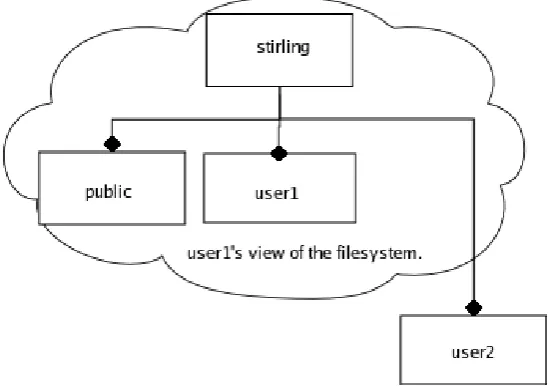
The filesystem hierarchy presented to the user is that of a very pared-down UNIX system. It
consists of one level of directories:
/stirling/public
/stirling/username1
/stirling/username2
...
The environment variable$U SER is utilised by the client to identify the current user,
and a directory with this name is used to store private file (not viewable by other clients.)
Thus, to a given usergeoff, the Stirling filesystem’s hierarchy consists of two directories,
/stirling/publicand/stirling/geoff, the former containing an arbitrary
num-ber of files placed there by Geoff and others and which are accessible by all, and the latter
[image:43.595.188.464.435.628.2]containing files placed there solely by Geoff and which are only accessible by him.
Figure 4.2: Stirling filesystem layout.
Given the time constraints of the project, it became apparent quite early in the design
phase that implementing a fully-featured filesystem would be beyond the scope of the goals
only, i.e., files could be deleted, but no write access would be allowed to those files while
they resided on the Stirling filesystem.
4.3.5
The filesystem state
Stirling maintains state of the global filesystem view through an XML document. XML—
the eXtensible Markup Language—is a framework for structuring universally-available data.
It has become ubiquitous on the Internet, not least because of its widespread adoption in
XHTML as the World-Wide Web’s language of choice. Its use, however, extends far beyond web content presentation. It is intended to serve as the medium of structured information
of the future, which includes traditional information repositories such as databases,
spread-sheets and so forth.
Hence, an XML user may specify an information structure that suits a set of particular
requirements, and no more. This may subsequently be used to verify that an XML document
is ‘valid’, i.e. that it matches the required structure. Without this, the information parser
cannot ensure that coherent meaning will be reliably extracted from the data. In this way, applications may depend on a universally-accessible data source. Critics have pointed out
the high level of ‘syntactic fluff’ that necessarily pads out XML documents, especially if tag
names tend to be lengthy, but this is typically offset in practice by cheap disk storage and
effective compression algorithms, the latter of which can be found built into modern network
transmission protocols such as HTTP 1.1.
Stirling specifies a set of tags that are used to maintain information about and organise
the files that reside in its virtual filesystem. These tags include the file name, owner and location in the virtual file tree. Most usefully, extra attributes may be added to these file
descriptions that reflect a user’s desire that files behave in a certain way. This behaviour is
intended to take advantage of unique features of the filesystem environment. In the case of
Stirling, this is an ad-hoc network with a distinguishing backbone of nodes. The following
4.3.6
File attributes
So far, the design has concentrated on availability and location transparency. Such
char-acteristics, while essential for a distributed filesystem in the target environment, have been implemented successfully in many current filesystem solutions. Stirling aims to distinguish
itself by allowing file attributes that allow the user to take advantage of the mobile nature
of the network environment. As part of the filesystem API, users can ‘set’ or ‘unset’ these
attributes on individual files or groups of files.
The prototype of Stirling concentrates on two possible mobile file attributes—virtual file
location and transparent physical file location. This leads to the concept of a file being potentially in one of the states of ‘global public’ and ‘local public’.
Global public / local public
In the ‘public’ directory, files are considered to be communal. Ownership as such is not an
important attribute. A file created here is accessible by all. The distinction that is important,
however, is whether or not the file is considered to have a ‘virtual location’ - that is, it may
only be visible when the viewing client is physically present near a certain node. If it does not
possess a ‘virtual location’ attribute, then it is visible to any user from any location, despite
the fact that the actual file itself may well exist on only one node. In Stirling terminology, this attribute of ‘virtual location’ of files in the/public directory is referred to as being
‘local public’, whereas universally visible files are ‘global public’.
Users’ directories contain files that are visible only to their respective users. These files
may optionally be set to have a ‘virtual location’ attribute as described above, in which case
such files may be referred to as being ‘local private’. All other user directory files are ‘global
private’ - meaning that the owning user, and only the owning user, can view and access them
Transparent physical file location
Another attribute that may be optionally set by a user on any file in either their user directory
or the public directory is that of following the user. As the user roams between server nodes, the filesystem transparently copies the file to the server node closest to the user’s physical
location. This ensures a one-hop latency for file access, which may be of particular use for
streaming multimedia files. The user’s view of the Stirling file tree is, of course, unchanged.
Using this attribute on a file also has replication implications. The one file can therefore
reside on several physical nodes at any given time.
4.4
Use cases
This foregoing description of the file hierarchy and its contained files’ optional attributes is
solely a technical one. To illustrate how this system may actually be useful, it is necessary to
work through several use cases for this technology. Considering such scenarios is essential feedback for further refinement of system design.
4.4.1
The general environment
Users become Stirling clients when they enter the range of a WAND node. In practice, this implies a large portion of Dublin’s immediate south city centre. The user interacts with the
WAND via a wireless device equipped with 802.11 capability in ad hoc mode, and which is
running Stirling-aware applications. The device automatically connects itself to the Stirling
system. This process is described in detail in a subsequent section.
As the client roams throughout the network, the device continually scans for signal
strength and manages the current connection to the nearest server node. Server nodes manage
a list of currently-connected clients, and detect when a client has reconnected to a different node.
Examples of proposed usage scenarios put forward at an early stage of the project were
• Tourist guides providing streaming video to guests with handhelds roaming around a large area (a national gallery, for example)
• Video servers on public transport providing in-carriage entertainment, as the bus/train moves along a predefined route
• Provision of on-demand streaming music radio to roaming subscribers
A subset of these applications is discussed below.
4.4.2
Multimedia
As the technological capabilities of common mobile computing devices increases, demand for multimedia applications rises accordingly. Stirling clients may take advantage of the
filesystem’s ability to promote low latency by enabling the ‘follow’ attribute on
latency-sensitive files (such as large ‘streamed’ audio or video files.) As the user moves between
different WAND nodes, the system transparently moves the file to the nearest server node.
In this way, the system guarantees a minimum transfer time for designated files, as they are
located only one hop away from the user. This is important in preventing stuttering, or jitter,
in playback.
This feature becomes useful when the communal ‘public’ directory is considered, as
portable hard disk space is nowadays not such an issue that it becomes necessary to retrieve
multimedia files in real time from a network, as the proliferation of personal music players
such as Apple’s iPod and its many rivals demonstrates. By using the ‘public’ directory, users
may share clips, messages, etc. as needed with other Stirling-enabled users of the network.
This opens the way to many possible applications using the Stirling filesystem; applications,
however, that might have to consider copyright issues before public deployment.
4.4.3
Location-dependent applications
The idea that an application behaves in a certain way in response to the geographical
![Figure 2.1: Wireless devices connected in ad hoc mode (Derived from [KB].)](https://thumb-us.123doks.com/thumbv2/123dok_us/1408453.676202/18.595.184.456.129.291/figure-wireless-devices-connected-hoc-mode-derived-kb.webp)
![Figure 2.2: Route discovery in AODV. (Derived from [KB].)](https://thumb-us.123doks.com/thumbv2/123dok_us/1408453.676202/20.595.182.460.380.542/figure-route-discovery-aodv-derived-kb.webp)
![Figure 3.1: File access in AdHocFS. (From [BI03])](https://thumb-us.123doks.com/thumbv2/123dok_us/1408453.676202/34.595.177.463.398.689/figure-file-access-in-adhocfs-from-bi.webp)