A Novel Feature-based Bayesian Model for Query Focused Multi-document
Summarization
Jiwei Li
School of Computer Science Carnegie Mellon University
Sujian Li
Laboratory of Computational Linguistics Peking University
Abstract
Supervised learning methods and LDA based topic model have been successfully applied in the field of multi-document summarization. In this paper, we propose a novel supervised approach that can in-corporate rich sentence features into Bayesian topic models in a principled way, thus taking advantages of both topic model and feature based supervised learn-ing methods. Experimental results on DUC2007, TAC2008 and TAC2009 demonstrate the effective-ness of our approach.
1 Introduction
Query-focused multi-document summarization (Nenkova et al., 2006; Wan et al., 2007; Ouyang et al., 2010) can facilitate users to grasp the main idea of documents. In query-focused summarization, a specific topic description, such as a query, which expresses the most important topic information is proposed before the document collection, and a summary would be generated according to the given topic.
Supervised models have been widely used in sum-marization (Li, et al., 2009, Shen et al., 2007, Ouyang et al., 2010). Supervised models usually re-gard summarization as a classification or regression problem and use various sentence features to build a classifier based on labeled negative or positive sam-ples. However, existing supervised approaches sel-dom exploit the intrinsic structure among sentences. This disadvantage usually gives rise to serious prob-lems such as unbalance and low recall in summaries. Recently, LDA-based (Blei et al., 2003) Bayesian topic models have widely been applied in multi-document summarization in that Bayesian ap-proaches can offer clear and rigorous probabilis-tic interpretations for summaries(Daume and Marcu,
2006; Haghighi and Vanderwende, 2009; Jin et al., 2010; Mason and Charniak, 2011; Delort and Alfon-seca, 2012). Exiting Bayesian approaches label sen-tences or words with topics and sensen-tences which are closely related with query or can highly generalize documents are selected into summaries. However, LDA topic model suffers from the intrinsic disad-vantages that it only uses word frequency for topic modeling and can not use useful text features such as position, word order etc (Zhu and Xing, 2010). For example, the first sentence in a document may be more important for summary since it is more likely to give a global generalization about the document. It is hard for LDA model to consider such informa-tion, making useful information lost.
It naturally comes to our minds that we can im-prove summarization performance by making full use of both useful text features and the latent seman-tic structures from by LDA topic model. One related work is from Celikyilmaz and Hakkani-Tur (2010). They built a hierarchical topic model called Hybh-sum based on LDA for topic discovery and asHybh-sumed this model can produce appropriate scores for sen-tence evaluation. Then the scores are used for tun-ing the weights of various features that helpful for summary generation. Their work made a good step of combining topic model with feature based super-vised learning. However, what their approach con-fuses us is that whether a topic model only based on word frequency is good enough to generate an appropriate sentence score for regression. Actually, how to incorporate features into LDA topic model has been a open problem. Supervised topic models such as sLDA(Blei and MacAuliffe 2007) give us some inspiration. In sLDA, each document is asso-ciated with a labeled feature and sLDA can integrate such feature into LDA for topic modeling in a
cipled way.
With reference to the work of supervised LDA models, in this paper, we propose a novel sentence feature based Bayesian model S-sLDA for multi-document summarization. Our approach can natu-rally combine feature based supervised methods and topic models. The most important and challeng-ing problem in our model is the tunchalleng-ing of feature weights. To solve this problem, we transform the problem of finding optimum feature weights into an optimization algorithm and learn these weights in a supervised way. A set of experiments are con-ducted based on the benchmark data of DUC2007, TAC2008 and TAC2009, and experimental results show the effectiveness of our model.
The rest of the paper is organized as follows. Sec-tion 2 describes some background and related works. Section 3 describes our details of S-sLDA model. Section 4 demonstrates details of our approaches, including learning, inference and summary gener-ation. Section 5 provides experiments results and Section 6 concludes the paper.
2 Related Work
A variety of approaches have been proposed for query-focused multi-document summarizations such as unsupervised (semi-supervised) approaches, supervised approaches, and Bayesian approaches.
Unsupervised (semi-supervised) approaches such as Lexrank (Erkan and Radex, 2004), manifold (Wan et al., 2007) treat summarization as a graph-based ranking problem. The relatedness between the query and each sentence is achieved by impos-ing querys influence on each sentence along with the propagation of graph. Most supervised ap-proaches regard summarization task as a sentence level two class classification problem. Supervised machine learning methods such as Support Vector Machine(SVM) (Li, et al., 2009), Maximum En-tropy (Osborne, 2002) , Conditional Random Field (Shen et al., 2007) and regression models (Ouyang et al., 2010) have been adopted to leverage the rich sentence features for summarization.
Recently, Bayesian topic models have shown their power in summarization for its clear probabilistic interpretation. Daume and Marcu (2006) proposed Bayesum model for sentence extraction based on
query expansion concept in information retrieval. Haghighi and Vanderwende (2009) proposed topic-sum and hiertopic-sum which use a LDA-like topic model and assign each sentence a distribution over back-ground topic, doc-specific topic and content topics. Celikyilmaz and Hakkani-Tur (2010) made a good step in combining topic model with supervised fea-ture based regression for sentence scoring in sum-marization. In their model, the score of training sentences are firstly got through a novel hierarchi-cal topic model. Then a featured based support vec-tor regression (SVR) is used for sentence score pre-diction. The problem of Celikyilmaz and Hakkani-Turs model is that topic model and feature based re-gression are two separate processes and the score of training sentences may be biased because their topic model only consider word frequency and fail to con-sider other important features. Supervised feature based topic models have been proposed in recent years to incorporate different kinds of features into LDA model. Blei (2007) proposed sLDA for doc-ument response pairs and Daniel et al. (2009) pro-posed Labeled LDA by defining a one to one corre-spondence between latent topic and user tags. Zhu and Xing (2010) proposed conditional topic random field (CTRF) which addresses feature and indepen-dent limitation in LDA.
3 Model description 3.1 LDA and sLDA
The hierarchical Bayesian LDA (Blei et al., 2003) models the probability of a corpus on hidden topics as shown in Figure 1(a). Let K be the number of topics ,M be the number of documents in the cor-pus andV be vocabulary size. The topic distribution of each documentθmis drawn from a prior Dirichlet
distributionDir(α), and each document wordwmn
is sampled from a topic-word distributionφz
spec-ified by a drawn from the topic-document distribu-tionθm.βis aK×Mdimensional matrix and each
βk is a distribution over theV terms. The
generat-ing procedure of LDA is illustrated in Figure 2. θm
is a mixture proportion over topics of documentm andzmn is a K dimensional variable that presents
intro-Figure 1: Graphical models for (a) LDA model and (b) sLDA model.
1. Draw a document proportion vectorθm|α∼Dir(α)
2. For each word inm
(a)draw topic assignmentzmn|θ∼M ulti(θzmn)
(b)draw wordwmn|zmn, β∼M ulti(βzmn)
Figure 2: Generation process for LDA
duces a response variable to each document for topic discovering, as shown in Figure 1(b). In the gener-ative procedure of sLDA, the document pairwise la-bel is draw fromy|−→zm, η, δ2∼p(y|−→zm, η, δ2), where
−→
zm = N1 PNn=1zm,n.
3.2 Problem Formulation
Here we firstly give a standard formulation of the task. LetK be the number of topics,V be the vo-cabulary size andM be the number of documents. Each documentDm is represented with a collection
of sentence Dm = {Ss}ss==1Nm where Nm denotes
the number of sentences in mth document. Each
sentence is represented with a collection of words {wmsn}nn==1Nms where Nms denotes the number of
words in current sentence. −−→Yms denotes the feature
vector of current sentence and we assume that these features are independent.
3.3 S-sLDA
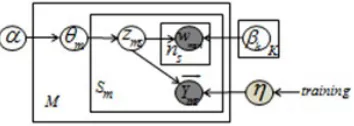
zms is the hidden variable indicating the topic of
current sentence. In S-sLDA, we make an assump-tion that words in the same sentence are generated from the same topic which was proposed by Gruber (2007). zmsn denotes the topic assignment of
[image:3.612.100.277.614.677.2]cur-rent word. According to our assumption, zmsn =
Figure 3: Graph model for S-sLDA model
1. Draw a document proportion vectorθm|α∼Dir(α)
2. For each sentence inm
(a)draw topic assignmentzms|θ∼M ulti(θzmn)
(b)draw feature vector−−→Yms|zms, η∼p(−−→Yms|zms, η)
(c)for each wordwmsnin current sentence
drawwmsn|zms, β∼M ulti(βzms)
Figure 4: generation process for S-sLDA
zms for anyn∈[1, Nms]. The generative approach
of S-sLDA is shown in Figure 3 and Figure 4. We can see that the generative process involves not only the words within current sentence, but also a series of sentence features. The mixture weights over fea-tures in S-sLDA are defined with a generalized lin-ear model (GLM).
p(−−→Yms|zms, η) = exp(z T
msη)−−→Yms
P
zmsexp(zTmsη)−−→Yms
(1)
Here we assume that each sentence has T features and −−→Yms is a T × 1 dimensional vector. η is a
K ×T weight matrix of each feature upon topics, which largely controls the feature generation proce-dure. Unlike s-LDA whereηis a latent variable esti-mated from the maximum likelihood estimation al-gorithm, in S-sLDA the value ofηis trained through a supervised algorithm which will be illustrated in detail in Section 3.
3.4 Posterior Inference and Estimation
Given a document and labels for each sentence, the posterior distribution of the latent variables is:
p(θ, z1:N|w1:N, Y, α, β1:K, η) =
Q
mp(θm|α)
Q
s[p(zms|θm)p(
−−→
Yms|zms, η)Qnp(wmsn|zmsn, βzmsn]
R
dθp(θm|α)Pz
Q
s[p(zms|θm)p(−−→Yms|zms, η)Qnp(wmsn|βzmsn)]
(2) Eqn. (2) cannot be efficiently computed. By applying the Jensens inequality, we obtain a lower bound of the log likelihood of document p(θ, z1:N|w1:N,−−→Yms, α, β1:K, η)≥L, where
L=X
ms
E[logP(zms|θ)] +
X
ms
E[logP(−−→Yms|zms, η)]+
X
m
E[logP(θ|α)] +X
msn
E[logP(wmsn|zms, β)] +H(q)
where H(q) = −E[logq] and it is the entropy of variational distribution q is defined as
q(θ, z|γ, φ) =Y
mk
q(θm|γ)
Y
sn
q(zmsn|φms) (4)
here γ a K-dimensional Dirichlet parameter vector and multinomial parameters. The first, third and forth terms of Eqn. (3) are identical to the corre-sponding terms for unsupervised LDA (Blei et al., 2003). The second term is the expectation of log probability of features given the latent topic assign-ments.
E[logP(−−→Yms|zms, η)] =
E(zms)Tη−−→Yms−log
X
zms
exp(zTmsη−−→Yms)
(5) where E(zms)T is a 1 × K dimensional vector
[φmsk]kk==1K. The Bayes estimation for S-sLDA model can be got via a variational EM algorithm. In EM procedure, the lower bound is firstly minimized with respect toγ andφ, and then minimized withα andβby fixingγandφ.
E-step:
The updating of Dirichlet parameter γ is identical to that of unsupervised LDA, and does not involve feature vector−−→Yms.
γnewm ←α+X
s∈m
φs (6)
φnewsk ∝exp{E[logθm|γ] + NXms
n=1
E[log(wmsn|β1:K)]+
T
X
t=1
ηktYst}=exp[Ψ(γmk)−Ψ( K
X
k=1
γmk) + T
X
t=1
ηktYst]
(7) whereΨ(·)denotes the logΓfunction. msdenotes
the document that current sentence comes from and Yst denotes thetthfeature of sentences.
M-step:
The M-step for updatingβ is the same as the pro-cedure in unsupervised LDA, where the probability of a word generated from a topic is proportional to the number of times this word assigned to the topic.
βkwnew=
M
X
m=1
Nm
X
s=1
NmsX
n=1
1(wmsn=w)φkms (8)
4 Our Approach 4.1 Learning
In this subsection, we describe how we learn the fea-ture weightηin a supervised way. The learning pro-cess ofη is a supervised algorithm combined with variational inference of S-sLDA. Given a topic de-scriptionQ1and a collection of training sentencesS from related documents, human assessors assign a scorev(v =−2,−1,0,1,1)to each sentence inS. The score is an integer between−2(the least desired
summary sentences) and+2(the most desired
sum-mary sentences), and score 0 denotes neutral
atti-tude. Ov ={ov1, ov2, ..., vvk}(v =−2,−1,0,1,2)
is the set containing sentences with scorev. LetφQk
denote the probability that query is generated from topick. Since query does not belong to any docu-ment, we use the following strategy to leverageφQk
φQk=
Y
w∈Q
βkw·
1 M
M
X
m=1
exp[Ψ(γmk)−Ψ( K
X
k=1 γmk)]
(9) In Equ.(9),Qw∈Qβkw denotes the probability that
all terms in query are generated from topic k and 1
M
PM
m=1exp[Ψ(γmk)−Ψ(PKk=1γmk)]can be
seen as the average probability that all documents in the corpus are talking about topic k. Eqn. (9) is based on the assumption that query topic is relevant to the main topic discussed by the document corpus. This is a reasonable assumption and most previous LDA summarization models are based on similar as-sumptions.
Next, we defineφOv,kfor sentence setOv, which
can be interpreted as the probability that all sen-tences in collectionOvare generated from topick.
φOv,k=
1 |Ov|
X
s∈Ov
φsk, k∈[1, K], v∈[−2,2] (10)
|Ov|denotes the number of sentences in setOv.
In-spired by the idea that desired summary sentences would be more semantically related with the query, we transform problem of finding optimumη to the following optimization problem:
minηL(η) = v=2 X
v=−2
v·KL(Ov||Q); T
X
t=1
ηkt= 1 (11)
where KL(Ov||Q) is the Kullback-Leibler
diver-gence between the topic and sentence set Ov as
shown in Eqn.(12).
KL(Ov||Q) = K
X
k=1
φOvklog
φOvk
φQk (12)
In Eqn. (11), we can see thatO2, which contain de-sirable sentences, would be given the largest penalty for its KL divergence from Query. The case is just opposite for undesired set.
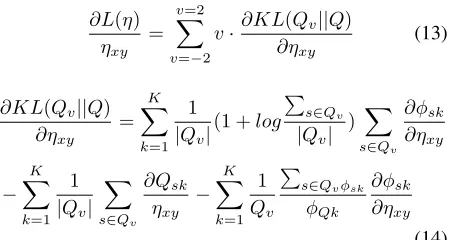
Our idea is to incorporate the minimization pro-cess of Eqn.(11) into variational inference propro-cess of S-sLDA model. Here we perform gradient based optimization method to minimize Eqn.(11). Firstly, we derive the gradient ofL(η)with respect toη.
∂L(η)
ηxy
=
v=2 X
v=−2
v·∂KL(Qv||Q)
∂ηxy (13)
∂KL(Qv||Q)
∂ηxy = K X k=1 1 |Qv|
(1 +log
P
s∈Qv
|Qv|
) X
s∈Qv
∂φsk ∂ηxy − K X k=1 1 |Qv|
X
s∈Qv
∂Qsk
ηxy − K X k=1 1 Qv P
s∈Qvφsk
φQk
∂φsk
∂ηxy
(14) For simplification, we regard β and γ as constant during updating process ofη, so ∂φQk∂ηxy = 0.2We can
further get first derivative for each labeled sentence.
∂φsk
ηxy ∝
Ysyexp[Ψ(γmsi)−Ψ(
K
X
k=1
γmsk) +
T
X
t=1
ηktYsy]
×Y
w∈s
βkw if k=x
0 if k6=x
(15)
4.2 Feature Space
Lots of features have been proven to be useful for summarization (Louis et al., 2010). Here we dis-cuss several types of features which are adopted in S-sLDA model. The feature values are either binary or normalized to the interval [0,1]. The following features are used in S-sLDA:
Cosine Similarity with query: Cosine similarity is based on the tf-idf value of terms.
2This is reasonable because the influence ofγandβhave been embodied inφduring each iteration.
Local Inner-document Degree Order: Local Inner document Degree Order is a binary feature which indicates whether Inner-document Degree (IDD) of sentencesis the largest among its neighbors. IDD means the edge number between s and other sen-tences in the same document.
Document Specific Word: 1 if a sentence contains document specific word, 0 otherwise.
Average Unigram Probability(Nenkova and Van-derwende, 2005; Celikyilmaz and Hakkani-Tur 2010): As for sentences, p(s) = Pw∈s|1s|pD(w),
wherepD(w)is the observed unigram probability in
document collection.
In addition, we also use the commonly used fea-tures including sentence position, paragraph po-sition, sentence lengthand sentence bigram fre-quency.
E-step
initializeφ0sk := 1/Kfor all i and s. initializeγmi:=αmi+N)m/K for all i.
initializeηkt= 0for allkandt.
while not convergence form= 1 :M
updateγt+1
m according to Eqn.(6)
fors= 1 :Nm
fork= 1 :K
updateφtsk+1according to Eqn.(7) normalize the sum ofφtsk+1to 1. MinimizeL(η)according to Eqn.(11)-(15).
M-step:
[image:5.612.75.300.278.398.2]updateβaccording to Eqn.(8)
Figure 5: Learning process ofηin S-sLDA
4.3 Sentence Selection Strategy
Next we explain our sentence selection strategy. Ac-cording to our intuition that the desired summary should have a small KL divergence with query, we propose a function to score a set of sentencesSum. We use a decreasing logistic functionζ(x) = 1/(1+ ex)to refine the score to the range of (0,1).
Score(Sum) =ζ(KL(sum||Q)) (16)
LetSum?denote the optimum update summary. We can getSum? by maximizing the scoring function.
Sum? = arg max
Sum∈S&&words(Sum)≤L
Score(Sum)
1. Learning: Given labeled set Ov, learn the feature
weight vectorηusing algorithm in Figure 5. 2. Given new data set andη, use algorithm in section
3.3 for inference. (The only difference between this step and step (1) is that in this step we do not need minimizeL(η).
3. Select sentences for summarization from algo-rithm in Figure 6.
Figure 6: Summarization Generation by S-sLDA.
A greedy algorithm is applied by adding sentence one by one to obtain Sum?. We use G to denote the sentence set containing selected sentences. The algorithm first initializesGtoΦandXtoSU. Dur-ing each iteration, we select one sentence fromX which maximizeScore(sm∪G). To avoid topic
re-dundancy in the summary, we also revise the MMR strategy (Goldstein et al., 1999; Ouyang et al., 2007) in the process of sentence selection. For eachsm,
we compute the semantic similarity betweensmand
each sentencestin set Y in Eqn.(18).
cos−sem(sm, st) =
P
kφsmkφstk
qP
kφ2smk
qP
kφ2stk
(18)
We need to assure that the value of semantic similar-ity between two sentences is less thanT hsem. The
whole procedure for summarization using S-sLDA model is illustrated in Figure 6. T hsemis set to 0.5
in the experiments.
5 Experiments
5.1 Experiments Set-up
The query-focused multi-document summarization task defined in DUC3(Document Understanding Conference) and TAC4(Text Analysis Conference) evaluations requires generating a concise and well organized summary for a collection of related news documents according to a given query which de-scribes the users information need. The query usually consists of a title and one or more narra-tive/question sentences. The system-generated sum-maries for DUC and TAC are respectively limited to
3http://duc.nist.gov/. 4http://www.nist.gov/tac/.
250 words and 100 words. Our experiment data is composed of DUC 2007, TAC52008 and TAC 2009 data which have 45, 48 and 44 collections respec-tively. In our experiments, DUC 2007 data is used as training data and TAC (2008-2009) data is used as the test data.
Stop-words in both documents and queries are removed using a stop-word list of 598 words, and the remaining words are stemmed by Porter Stem-mer6. As for the automatic evaluation of summa-rization, ROUGE (Recall-Oriented Understudy for Gisting Evaluation) measures, including ROUGE-1, ROUGE-2, and ROUGE-SU47 and their corre-sponding95%confidence intervals, are used to
eval-uate the performance of the summaries. In order to obtain a more comprehensive measure of summary quality, we also conduct manual evaluation on TAC data with reference to (Haghighi and Vanderwende, 2009; Celikyilmaz and Hakkani-Tur, 2011; Delort and Alfonseca, 2011).
5.2 Comparison with other Bayesian models
In this subsection, we compare our model with the following Bayesian baselines:
KL-sum: It is developed by Haghighi and Vanderwende (Lin et al., 2006) by using a KL-divergence based sentence selection strategy.
KL(Ps||Qd) =
X
w
P(w)logP(w)
Q(w) (19)
where Ps is the unigram distribution of candidate
summary andQddenotes the unigram distribution of
document collection. Sentences with higher ranking score is selected into the summary.
HierSum: A LDA based approach proposed by Haghighi and Vanderwende (2009), where unigram distribution is calculated from LDA topic model in Equ.(14).
Hybhsum: A supervised approach developed by Celikyilmaz and Hakkani-Tur (2010).
For fair comparison, baselines use the same pro-precessing methods with our model and all
sum-5Here, we only use the docset-A data in TAC, since TAC data is composed of A and B data, and the docset-B data is mainly for the update summarization task.
6http://tartarus.org/ martin/PorterStemmer/.
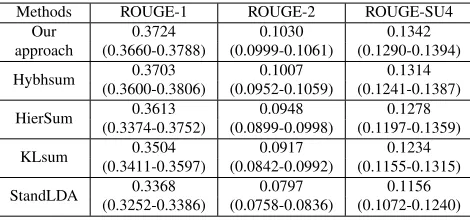
maries are truncated to the same length of 100 words. From Table 1 and Table 2, we can
Methods ROUGE-1 ROUGE-2 ROUGE-SU4
Our 0.3724 0.1030 0.1342
[image:7.612.66.301.91.201.2]approach (0.3660-0.3788) (0.0999-0.1061) (0.1290-0.1394) Hybhsum (0.3600-0.3806)0.3703 (0.0952-0.1059)0.1007 (0.1241-0.1387)0.1314 HierSum (0.3374-0.3752)0.3613 (0.0899-0.0998)0.0948 (0.1197-0.1359)0.1278 KLsum (0.3411-0.3597)0.3504 (0.0842-0.0992)0.0917 (0.1155-0.1315)0.1234 StandLDA (0.3252-0.3386)0.3368 (0.0758-0.0836)0.0797 (0.1072-0.1240)0.1156 Table 1: Comparison of Bayesian models on TAC2008
Methods ROUGE-1 ROUGE-2 ROUGE-SU4
Our 0.3903 0.1223 0.1488
approach (0.3819-0.3987) (0.1167-0.1279) (0.1446-0.1530) Hybhsum (0.3686-0.3952)0.3824 (0.1132-0.1214)0.1173 (0.1358-0.1514)0.1436 HierSum (0.3624-0.3788)0.3706 (0.0950-0.1144)0.1088 (0.1312-0.1464)0.1386 KLsum (0.3510-0.3728)0.3619 (0.0917-0.1047)0.0972 (0.1213-0.1385)0.1299 StandLDA (0.3447-0.3657)0.3552 (0.0813-0.0881)0.0847 (0.1141-0.1286)0.1214 Table 2: Comparison of Bayesian models on TAC2009
see that among all the Bayesian baselines, Hybh-sum achieves the best result. This further illus-trates the advantages of combining topic model with supervised method. In Table 1, we can see that our S-sLDA model performs better than Hybhsum and the improvements are3.4%and3.7%with
re-spect to ROUGE-2 and ROUGE-SU4 on TAC2008 data. The comparison can be extended to TAC2009 data as shown in Table 2: the performance of S-sLDA is above Hybhsum by 4.3% in ROUGE-2
and 5.1% in ROUGE-SU4. It is worth explaining
that these achievements are significant, because in the TAC2008 evaluation, the performance of the top ranking systems are very close, i.e. the best system is only4.2%above the 4th best system on
ROUGE-2 and1.2%on ROUGE-SU4.
5.3 Comparison with other baselines.
In this subsection, we compare our model with some widely used models in summarization.
Manifold: It is the one-layer graph based semi-supervised summarization approach developed by Wan et al.(2008). The graph is constructed only con-sidering sentence relations using tf-idf and neglects
topic information.
LexRank: Graph based summarization approach (Erkan and Radev, 2004), which is a revised version of famous web ranking algorithm PageRank. It is an unsupervised ranking algorithms compared with Manifold.
SVM: A supervised method - Support Vector Ma-chine (SVM) (Vapnik 1995) which uses the same features as our approach.
MEAD: A centroid based summary algorithm by Radev et al. (2004). Cluster centroids in MEAD consists of words which are central not only to one article in a cluster, but to all the articles. Similarity is measure using tf-idf.
At the same time, we also present the top three participating systems with regard to ROUGE-2 on TAC2008 and TAC2009 for comparison, denoted as (denoted as SysRank 1st, 2nd and 3rd)(Gillick et al., 2008; Zhang et al., 2008; Gillick et al., 2009; Varma et al., 2009). The ROUGE scores of the top TAC system are directly provided by the TAC evaluation. From Table 3 and Table 4, we can see that our approach outperforms the baselines in terms of ROUGE metrics consistently. When compared with the standard supervised method SVM, the relative improvements over the ROUGE-1, ROUGE-2 and ROUGE-SU4 scores are4.3%,13.1%,8.3%
respec-tively on TAC2008 and 7.2%, 14.9%, 14.3% on TAC2009. Our model is not as good as top par-ticipating systems on TAC2008 and TAC2009. But considering the fact that our model neither uses sen-tence compression algorithm nor leverage domain knowledge bases like Wikipedia or training data, such small difference in ROUGE scores is reason-able.
5.4 Manual Evaluations
Methods ROUGE-1 ROUGE-2 ROUGE-SU4
Our 0.3724 0.1030 0.1342
approach (0.3660-0.3788) (0.0999-0.1061) (0.1290-0.1394) SysRank 1st 0.3742 0.1039 0.1364
(0.3639-0.3845) (0.0974-0.1104) (0.1285-0.1443) SysRank 2nd 0.3717 0.0990 0.1326
(0.3610-0.3824 (0.0944-0.1038) (0.1269-0.1385) SysRank 3rd 0.3710 0.0977 0.1329
[image:8.612.64.316.52.221.2](0.3550-0.3849) (0.0920-0.1034) (0.1267-0.1391) PageRank (0.3499-0.3695)0.3597 (0.0809-0.0950)0.0879 (0.1173-0.1269)0.1221 Manifold (0.3506-0.3736)0.3621 (0.0868-0.0994)0.0931 (0.1206-0.1280)0.1243 SVM (0.3489-0.3687)0.3588 (0.0882-0.0960)0.0921 (0.1204-0.1302)0.1258 MEAD (0.3489-0.3627)0.3558 (0.0882-0.0952)0.0917 (0.1174-0.1278)0.1226
Table 3: Comparison with baselines on TAC2008
Methods ROUGE-1 ROUGE-2 ROUGE-SU4
Our 0.3903 0.1223 0.1488
approach (0.3819-0.3987) (0.1167-0.1279) (0.1446-0.1530) SysRank 1st (0.3778-0.4057)0.3917 (0.1122-0.1314)0.1218 (0.1414-0.1596)0.1505 SysRank 2nd (0.3808-0.4020)0.3914 (0.1147-0.1277)0.1212 (0.1455-0.1571)0.1513 SysRank 3rd (0.3762-0.3932)0.3851 (0.1025-0.1144)0.1084 (0.1398-0.1496)0.1447 PageRank (0.3532-0.3700)0.3616 (0.0802-0.0896)0.0849 (0.1221-0.1277)0.1249 Manifold (0.3586-0.3841)0.3713 (0.0950-0.1178)0.1014 (0.1299-0.1385)0.1342 SVM (0.3536-0.3762)0.3649 (0.0957-0.1099)0.1028 (0.1258-0.1380)0.1319 MEAD (0.3536-0.3666)0.3601 (0.0953-0.1049)0.1001 (0.1228-0.1346)0.1287
Table 4: Comparison with baselines on TAC2009
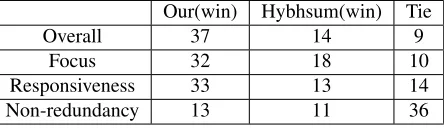
and Hybhsum, as well as the four questions above. Then they need to answer which summary is better (tie). We randomly select 20 document collections from TAC 2008 data and randomly assign two sum-maries for each collection to three different evalua-tors to judge which model is better in each aspect.
As we can see from Table 5, the two models al-most tie with respect to Non-redundancy, mainly because both models have used appropriate MMR strategies. But as for Overall quality, Focus and
Our(win) Hybhsum(win) Tie
Overall 37 14 9
Focus 32 18 10
Responsiveness 33 13 14 Non-redundancy 13 11 36
Table 5: Comparison with baselines on TAC2009
Responsiveness, S-sLDA model outputs Hybhsum based on t-test on 95% confidence level.
Ta-ble 6 shows the example summaries generated re-spectively by two models for document collection D0803A-A in TAC2008, whose query is “Describe the coal mine accidents in China and actions taken“. From table 6, we can see that each sentence in these two summaries is somewhat related to topics of coal mines in China. We also observe that the summary in Table 6(a) is better than that in Table 6(b), tend-ing to select shorter sentences and provide more in-formation. This is because, in S-sLDA model, topic modeling is determined simultaneously by various features including terms and other ones such as sen-tence length, sensen-tence position and so on, which can contribute to summary quality. As we can see, in Table 6(b), sentences (3) and (5) provide some unimportant information such as “somebody said“, though they contain some words which are related to topics about coal mines.
(1)China to close at least 4,000 coal mines this year: official (2)By Oct. 10 this year there had been 43 coal mine accidents that killed 10 or more people, (3)Offi-cials had stakes in coal mines. (4)All the coal mines will be closed down this year. (5) In the first eight months, the death toll of coal mine accidents rose 8.5 percent last year. (6) The government has issued a series of regulations and measures to improve the coun.try’s coal mine safety situation. (7)The mining safety technology and equipments have been sold to countries. (8)More than 6,000 miners died in accidents in China
[image:8.612.63.308.253.421.2](1) In the first eight months, the death toll of coal mine accidents across China rose 8.5 percent from the same period last year. (2)China will close down a number of ill-operated coal mines at the end of this month, said a work safety official here Monday. (3) Li Yizhong, director of the National Bureau of Production Safety Supervision and Administration, has said the collusion between mine owners and officials is to be condemned. (4)from January to September this year, 4,228 people were killed in 2,337 coal mine accidents. (5) Chen said officials who refused to register their stakes in coal mines within the required time
[image:8.612.76.298.621.685.2]6 Conclusion
In this paper, we propose a novel supervised ap-proach based on revised supervised topic model for query-focused multi document summarization. Our approach naturally combines Bayesian topic model with supervised method and enjoy the advantages of both models. Experiments on benchmark demon-strate good performance of our model.
Acknowledgments
This research work has been supported by NSFC grants (No.90920011 and No.61273278), National Key Technology R&D Program
(No:2011BAH1B0403), and National High Tech-nology R&D Program (No.2012AA011101). We also thank the three anonymous reviewers for their helpful comments. Corresponding author: Sujian Li.
References
David Blei and Jon McAuliffe. Supervised topic models. 2007. InNeural Information Processing Systems
David Blei, Andrew Ng and Micheal Jordan. Latent dirichlet allocation. InThe Journal of Machine Learn-ing Research, page: 993-1022.
Charles Broyden. 1965. A class of methods for solv-ing nonlinear simultaneous equations. InMath. Comp.
volume 19, page 577-593.
Jaime Carbonell and Jade Goldstein. 1998. The use of MMR, diversity-based reranking for reordering doc-uments and producing summaries. InProceedings of the 21st annual international ACM SIGIR conference on Research and development in information retrieval. Asli Celikyilmaz and Dilek Hakkani-Tur. 2010. A Hy-brid hierarchical model for multi-document summa-rization. InProceedings of the 48th Annual Meeting of the Association for Computational Linguistics. page: 815-825
Jade Goldstein, Mark Kantrowitz, Vibhu Mittal and Jaime Carbonell. 1999. Summarizing Text Docu-ments: Sentence Selection and Evaluation Metrics. In
Proceedings of the 22nd annual international ACM SI-GIR conference on Research and development in infor-mation retrieval, page: 121-128.
Amit Grubber, Micheal Rosen-zvi and Yair Weiss. 2007. Hidden Topic Markov Model.In Artificial Intelligence and Statistics.
Hal Daume and Daniel Marcu H. 2006. Bayesian Query-Focused Summarization. In Proceedings of the 21st
International Conference on Computational Linguis-tics and the 44th annual meeting of the Association for Computational Linguistics, page 305-312.
Gune Erkan and Dragomir Radev. 2004. Lexrank: graph-based lexical centrality as salience in text summariza-tion. InJ. Artif. Intell. Res. (JAIR), page 457-479. Dan Gillick, Benoit Favre, Dilek Hakkani-Tur,The ICSI
Summarization System at TAC, TAC 2008.
Dan Gillick, Benoit Favre, and Dilek Hakkani-Tur, Berndt Bohnet, Yang Liu, Shasha Xie.The ICSI/UTD Summarization System at TAC 2009. TAC 2009 Aria Haghighi and Lucy Vanderwende. 2009. Exploring
content models for multi-document summarization. In
Proceedings of Human Language Technologies: The 2009 Annual Conference of the North American Chap-ter of the Association for Computational Linguistics, pages 362370.
Feng Jin, Minlie Huang, and Xiaoyan Zhu. 2010. The summarization systems at tac 2010. InProceedings of the third Text Analysis Conference, TAC-2010. Liangda Li, Ke Zhou, Gui-Rong Xue, Hongyuan Zha and
Yong Yu. 2009. Enhancing diversity, coverage and bal-ance for summarization through structure learning. In
Proceedings of the 18th international conference on World wide web, page 71-80.
Chin-Yew Lin, Guihong Gao, Jianfeng Gao and Jian-Yun Nie. 2006. An information-theoretic approach to au-tomatic evaluation of summaries. In Proceedings of the main conference on Human Language Technology Conference of the North American Chapter of the As-sociation of Computational Linguistics, page:462-470. Annie Louis, Aravind Joshi, Ani Nenkova. 2010. Dis-course indicators for content selection in summariza-tion. In Proceedings of the 11th Annual Meeting of the Special Interest Group on Discourse and Dialogue, page:147-156.
Tengfei Ma, Xiaojun Wan. 2010. Multi-document sum-marization using minimum distortion, inProceedings of International Conference of Data Mining. page 354363.
Rebecca Mason and Eugene Charniak. 2011. Extractive multi-document summaries should explicitly not con-tain document-specific content. Inproceedings of ACL HLT, page:49-54.
Ani Nenkova and Lucy Vanderwende. The impact of fre-quency on summarization. In Tech. Report MSR-TR-2005-101, Microsoft Research, Redwood, Washing-ton, 2005.
Re-search and Development in Information Retrieval, page 573-580.
Miles Osborne. 2002. Using maximum entropy for sen-tence extraction. InProceedings of the ACL-02 Work-shop on Automatic Summarization, Volume 4 page:1-8.
Jahna Otterbacher, Gunes Erkan and Dragomir Radev. 2005. Using random walks for question-focused sen-tence retrieval. In Proceedings of the Conference on Human Language Technology and Empirical Methods in Natural Language Processing, page 915-922 You Ouyang, Wenjie Li, Sujian Li and Qin Lua. 2011.
Applying regression models to query-focused multi-document summarization. In Information Processing and Management, page 227-237.
You Ouyang, Sujian. Li, and Wenjie. Li. 2007, Develop-ing learnDevelop-ing strategies for topic-based summarization. In Proceedings of the sixteenth ACM conference on Conference on information and knowledge manage-ment, page: 7986.
Daniel Ramage, David Hall, Ramesh Nallapati and Christopher Manning. 2009. Labeled LDA: A super-vised topic model for credit attribution in multi-labeled corpora. In Proceedings of the 2009 Conference on Empirical Methods in Natural Language Processing, Vol 1, page 248-256.
Dou She, Jian-Tao Sun, Hua Li, Qiang Yang and Zheng Chen. 2007. Document summarization using conditional random elds. In Proceedings of Inter-national Joint Conference on Artificial Intelligence, page: 28622867.
V. Varma, V. Bharat, S. Kovelamudi, P. Bysani, S. GSK, K. Kumar N, K. Reddy, N. Maganti , IIIT Hyderabad atTAC 2009. TAC2009
Xiaojun Wan and Jianwu Yang. 2008. Multi-document Summarization using cluster-based link analysis. In
Proceedings of the 31st annual international ACM SI-GIR conference on Research and development in in-formation retrieval, page: 299-306.
Xiaojun Wan, Jianwu Yang and Jianguo Xiao. 2007. Manifold-ranking based topic-focused multi-document summarization. In Proceedings of In-ternational Joint Conference on Artificial Intelligence, page 2903-2908.
Furu Wei, Wenjie Li, Qin Lu and Yanxiang He. 2008. Ex-ploiting Query-Sensitive Similarity for Graph-Based Query-Oriented Summarization. InProceedings of the 31st annual International ACM SIGIR Conference on Research and Development in Information Retrieval, page 283-290.
Jin Zhang, Xueqi Cheng, Hongbo Xu, Xiaolei Wang, Yil-ing Zeng. ICTCAS’s ICTGrasper at TAC 2008: Sum-marizing Dynamic Information with Signature Terms Based Content Filtering, TAC 2008.
Dengzhong Zhou, Jason Weston, Arthur Gretton, Olivier Bousquet and Bernhard Schlkopf. 2003. Ranking on Data Manifolds. InProceedings of the Conference on Advances in Neural Information Processing Systems, page 169-176.
Jun Zhu and Eric Xing. 2010. Conditional Topic Random Fields. InProceedings of the 27th International Con-ference on Machine Learning.