North Sámi morphological segmentation with
low-resource semi-supervised sequence labeling
Stig-Arne Grönroos
[email protected]
Aalto University, Finland
Sami Virpioja
[email protected]
Aalto University, Finland
Utopia Analytics, Finland
Mikko Kurimo
[email protected]
Aalto University, Finland
December 14, 2018
Abstract
Semi-supervised sequence labeling is an effective way to train a low-resource morphological segmentation system. We show that a feature set augmentation approach, which combines the strengths of generative and discriminative mod-els, is suitable both for graphical models like conditional random field (CRF) and sequence-to-sequence neural models. We perform a comparative evaluation be-tween three existing and one novel semi-supervised segmentation methods. All four systems are language-independent and have open-source implementations. We improve on previous best results for North Sámi morphological segmentation. We see a relative improvement in morph boundaryF1-score of 8.6% compared
to using the generative Morfessor FlatCat model directly and 2.4% compared to a seq2seq baseline. Our neural sequence tagging system reaches almost the same performance as the CRF topline.
Tiivistelmä
Puoliohjattu sekvenssiluokitus on tehokas tapa opettaa morfologinen pilkon-tajärjestelmä kielelle, jolle on saatavilla niukasti lingvistisiä resursseja. Osoitam-me, että generatiivisen mallin tuottamien piirteiden käyttäminen soveltuu paitsi graafisille malleille kuten ehdollinen satunnaiskenttä (CRF), myös sekvenssistä-sekvenssiin (seq2seq) -neuroverkkomalleille. Vertailemme kolmea olemassaole-vaa ja yhtä uutta puoliohjattua menetelmää. Kaikki menetelmät ovat kieliriippu-mattomia, ja niille on avoimen lähdekoodin toteutus. Parannamme aikaisempia tuloksia pohjoissaamen morfologisen pilkonnan tehtävässä. Suhteelliset paran-nukset morfirajojen osumienF1-mittaan ovat 8.6% verrattuna generatiiviseen
Morfessor FlatCat -malliin ja 2.4% verrattuna seq2seq-verrokkimalliin. Ehdotta-mamme uusi neuroverkkomalli saavuttaa lähes saman tason kuin paras CRF-malli.
1 Introduction
Subword models have enjoyed recent success in many natural language processing (NLP) tasks, such as machine translation (Sennrich et al., 2015) and automatic speech recognition (Smit et al., 2017). Uralic languages have rich morphological structure, making morphological segmentation particularly useful for these languages. While rule-based morphological segmentation systems can achieve high quality, the large amount of human effort needed makes the approach problematic for low-resource languages. As a fast, cheap and effective alternative, data-driven segmentation can be learned based on a very small amount of human annotator effort. Using active learning, as little as some hundreds of annotated word types can be enough (Grönroos et al., 2016).
Adopting neural methods has lead to a large performance gain for many NLP tasks. However, neural networks are typically data-hungry, reducing their applicability to low-resource languages. Most research has focused on high-resource languages and large data sets, while the search for new approaches to make neural methods applica-ble to small data has only recently gained attention. For example, the workshop Deep Learning Approaches for Low-Resource NLP (DeepLo¹) was arranged first time in the year of writing. Neural methods have met with success in high-resource morpholog-ical segmentation (e.g. Wang et al., 2016). We are interested to see if data-hungry neural network models are applicable to segmentation in low-resource settings, in this case for the Uralic language North Sámi.
Neural sequence-to-sequence (seq2seq) models are a very versatile tool for NLP, and are used in state of the art methods for a wide variety of tasks, such as text sum-marization (Nallapati et al., 2016) and speech synthesis (Wang et al., 2017). Seq2seq methods are easy to apply, as you can often take e.g. existing neural machine trans-lation software and train it with appropriately preprocessed data. Kann et al. (2018) apply the seq2seq model for low-resource morphological segmentation.
However, arbitrary length sequence-to-sequence transduction is not the optimal formulation for the task of morphological surface segmentation. We return to formu-lating it as a a sequence tagging problem instead, and show that this can be imple-mented with minor modifications to an open source translation system.
Moreover, we show that the semi-supervised training approach of Ruokolainen et al. (2014) using feature set augmentation can also be applied to neural networks to effectively leverage large unannotated data.
2 Morphological processing tasks
There are several related morphological tasks that can be described as mapping from one sequence to another. Morphological segmentation is the task of splitting words into morphemes, meaning-bearing sub-word units. In morphologicalsurface segmen-tation, the wordwis segmented into a sequence of surface morphs, substrings whose
concatenation is the wordw.
e.g. achievability7→achiev◦abil◦ity
Canonical morphological segmentation(Kann et al., 2016) instead yields a sequence of standardized segments. The aim is to undo morphological processes that result in
allomorphs, i.e. different surface morphs corresponding to the same meaning.
w7→y; w∈Σ∗, y∈(Σ∪ {◦})∗
e.g. achievability7→achieve◦able◦ity
whereΣis the alphabet of the language, and◦is the boundary marker.
Morphological analysisyields the lemma and tags representing the morphological properties of a word.
w7→yt; w, y∈Σ∗, t∈τ∗
e.g. took7→takePAST
whereτis the set of morphological tags.
Two related morphological tasks are reinflection and lemmatization. In morpho-logical reinflection(see e.g. Cotterell et al., 2016), one or more inflected forms are given to identify the lexeme, together with the tags identifying the desired inflection. The task is to produce the correctly inflected surface form of the lexeme.
wt7→y; w, y∈Σ∗, t∈τ∗
e.g. takenPAST7→took
Inlemmatization, the input is an inflected form and the output is the lemma.
w7→y; w, y∈Σ∗
e.g. better7→good
Morphological surface segmentation can be formulated in the same way as canon-ical segmentation, by just allowing the mapping to canoncanon-ical segments to be the iden-tity. However, this formulation fails to capture the fact that the segments must con-catenate back to the surface form. The model is allowed to predict any symbol from its output vocabulary, although only two symbols are valid at any given timestep: the boundary symbol or the actual next character. If the labeled set for supervised training is small, the model may struggle with learning to copy the correct characters. Kann et al. (2018) address this problem by a multi-task training approach where the auxiliary task consists of reconstructing strings in a sequence auto-encoder setting. The strings to be reconstructed can be actual words or even random noise.
Surface segmentation can alternatively be formulated as structured classification
w7→y; w∈Σk, y∈Ωk, k∈N
e.g. uses7→BM ES
whereΩis the segmentation tag set. Note that there is no need to generate characters
from the original alphabet, instead a small tag setΩis used. The fact that the sequence
of boundary decisions is of the same lengthkas the input has also been made explicit.
Different tag setsΩcan be used for segmentation. The minimal sets only include
two labels: BM/ME (used e.g. by Green and DeNero, 2012). Either the beginning (B) or end (E) of segments is distinguished from non-boundary time-steps in the middle (M). A more fine-grained approach BMES² (used e.g. by Ruokolainen et al., 2014) uses
LSTM LSTM s2 LSTM LSTM s3 LSTM LSTM s4 LSTM LSTM s5
l e a n
1 0 0 1
STM STM STM SUF + LSTM h1 LSTM h2 LSTM h3 LSTM h4 LSTM h5 LSTM h6
<B> l e a + n
l e a + n <E>
(a) seq2seq LSTM LSTM s2 LSTM LSTM s3 LSTM LSTM s4 LSTM LSTM s5
l e a n <E>
1 0 0 1
STM STM STM SUF
LSTM h1 LSTM h2 LSTM h3 LSTM h4 LSTM h5
<B> B M E S
B M E S <E>
(b) neural sequence tagger
l e a n
. . . .
B M E S
Vectors: source embedding source encoding target embedding Nodes: + LSTM node CRF node attention
feed-back during inference
[image:4.595.126.475.119.427.2](c) conditional random field
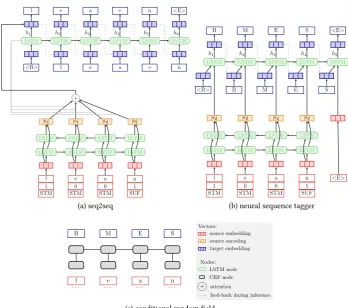
Figure 1: Model architectures. To prevent the figure from becoming too large, the seq2seq model is drawn with only one LSTM layer in both encoder and decoder. The attention is only shown for the fist time step.
four labels. In addition to marking both beginning and end of segments, a special label is used for single-character (S) segments.
Morphological analysis or canonical segmentation resolve ambiguity, and are more informative than surface segmentation. Learning to resolve such ambiguity is a more challenging task to learn than surface segmentation. Surface segmentation may be preferred over the other tasks e.g. when used in an application that needs to generate text in a morphologically complex language, such as when it is the target language in machine translation. If surface segments are generated, the final surface form is easily recovered through concatenation.
To summarize, arbitrary-length sequence transduction is a formulation well suited for many morphological tasks. Morphological surface segmentation is an exception, being more appropriately formulated as sequence tagging.
3 Models for semi-supervised segmentation
Factor Emb
[image:5.595.124.468.128.184.2]character 350 b i e b m o r á h k a d e a m i s boundary 10 0 0 0 0 0 0 1 0 0 0 0 0 1 0 0 0 1 category 10 M M M M M M M M M M M M f f f f f
Table 1: Example input factors with embedding dimension. The example word biebmoráhkadeamis is segmented as biebmo/STM ráhkad/STM eami/SUF s/SUF. Stem (STM) is abbreviated M, and suffix (SUF) is f.
case Morfessor FlatCat, is trained in a semi-supervised fashion using the first part of the labeled training set. The words in the second part of the labeled training set are segmented using the generative model. Now these words are associated with two seg-mentations: predicted and gold standard. A discriminative model is then trained on the second part of the labeled training set. The predictions of the generative model are fed into the discriminative model as augmented features. The gold standard seg-mentation is used as the target sequence.
At decoding time a two-step procedure is used: first the features for the desired words are produced using the generative model. The final segmentation can then be decoded from the discriminative model.
The idea is that the features from the generative model allow the statistical pat-terns found in the large unannotated data to be exploited. At the same time, the capac-ity of the discriminative model is freed for learning to determine when the generative model’s predictions are reliable, in essence to only correct its mistakes.
3.1 Morfessor FlatCat
We produce the features for our semi-supervised training using Morfessor FlatCat (Grönroos et al., 2014). Morfessor FlatCat is a generative probabilistic method for learning morphological segmentations. It uses a prior over morph lexicons inspired by the Minimum Description Length principle (Rissanen, 1989). Morfessor FlatCat applies a simple Hidden Markov model for morphotactics, providing morph category tags (stem, prefix, suffix) in addition to the segmentation. The segmentations are more consistent compared to Morfessor Baseline, particularly when splitting compound words.
Morfessor FlatCat produces morph category labels in addition to the segmentation decisions. These labels can also be used as features. An example of the resulting 3-factor input is shown in Table 1.
3.2 Sequence-to-sequence
Our sequence-to-sequence (seq2seq) baseline model follows Kann et al. (2018) with some minor modifications. It is based on the encoder-decoder with attention (Bah-danau et al., 2014). The encoder is a 2-layer bidirectional Long Short-Term Mem-ory (LSTM) layer (Hochreiter and Schmidhuber, 1997), while the decoder is a 2-layer LSTM. The model is trained on the character level.
3.3 Conditional random fields
Conditional random fields (CRF) are discriminative structured classification models for sequential tagging and segmentation (Lafferty et al., 2001). They are expressed as undirected probabilistic graphical models. Figure 1c shows the model structure. CRFs can be seen as generalizing the log-linear classifier to structured outputs. They bear a structural resemblance to hidden Markov models, while relaxing the assumption of the observations being conditionally independent given the labels.
We use the implementation of linear-chain CRFs by Ruokolainen et al. (2014)³.
3.4 Neural sequence tagger
The encoder is a standard layer bidirectional LSTM. The decoder is a single-layer LSTM, which takes as input at timetthe concatenation of the encoder output at
timetand an embedding of the predicted label att−1. There is no attention
mecha-nism. However, the time-dependent connection to the encoder could be described as a hard-coded diagonal monotonic attention that always moves one step forward. The architecture can be seen in Figure 1b.
The most simple fixed-length decoding strategy is to forego structured prediction and instead make a prediction at each time-step based only on the encoder outputst.
The prediction at each time-step is then conditionally independent given the hidden states. We choose to instead feed the previous decision back in, causing a left-to-right dependence on previous decisions.
The proposed model has only 5% of the number of parameters of the seq2seq model (469 805 versus 8 820 037). The proposed model requires no attention mechanism, and the target vocabulary is much smaller. We also found that the optimal network size in terms of number of layers and vector dimensions was smaller.
We use factored input for the additional features. The FlatCat segmentation deci-sion and morph category label are independently embedded. These factor embeddings are concatenated to the character embedding.
Because our human annotations include the category labels, we use a simple target-side multi-task setup to predict them in addition the the segmentation bound-aries. The output vocabulary is extended to cover all combinations of segmentation decision and category label. Because our data set contains two morph categories, STM and SUF, this only increases the size of the output vocabulary from 5 (BMES + end symbol) to 10.
We use a modified beam search to ensure that the output sequence is of the correct length. This is achieved by manipulating the probability of the end symbol, setting it to zero if the sequence is still too short and to one when the correct length is reached. The system is implemented by extending OpenNMT (Klein et al., 2017). Our im-plementation is open source⁴.
4 North Sámi
North Sámi (davvisámegiella) is a Finno-Ugric language, spoken in the northern parts of Norway, Sweden, Finland and Russia. With around 20 000 speakers, it is biggest of the nine Sámi languages.
³Available fromhttp://users.ics.tkk.fi/tpruokol/software/crfs_morph.zip
Purpose Subset Component Word types Labels Training Unlabeled FlatCat 691190 No Training Feature train FlatCat 200 Yes Main train System 844 Yes
Development Both 199 Yes
Testing 796 Yes
Table 2: Subdivision of data sets, with size in word types. The component column indicates which components use the data during training.
North Sámi is a morphologically complex language, featuring both rich inflection, derivation and productive compounding. It has complicated although regular mor-phophonological variation. Compounds are written together without an intermediary space. For example nállošalbmái (“into the eye of the needle”), could be segmented as nállo◦šalbmá◦i.
The morphology of Sámi languages has been modeled using finite state methods (Trosterud and Uibo, 2005; Lindén et al., 2009). The Giellatekno research lab⁵ provides rule-based morphological analyzers both for individual word forms and running text, in addition to miscellaneous other resources such as wordlists and translation tools. A morphological analyzer is not a direct replacement for morphological segmentation, as there is no trivial way to map from analysis to segmentation. In addition to this, rule-based analyzers are always limited in their coverage of the vocabulary.
For an overview into the Giellatekno/Divvun and Apertium projects, including their work on Sámi languages, see Moshagen et al. (2014).
5 Data
We use version 2 of the data set collected by (Grönroos et al., 2015; Grönroos et al., 2016) as the labeled data, and as unlabeled data a word list extracted fromDen samiske tekstbankencorpus⁶.
The labeled data contains words annotated for morphological segmentation with morph category labels. The annotations were produced by a single Sámi scholar, who is not a native speaker of Sámi. In total 2311 annotated words were available. The de-velopment and test sets contain randomly selected words. The training set set of 1044 annotations is the union of 500 randomly selected words and and 597 using different active learning approaches. There was some overlap in the sets. Due to the active learning, it should be assumed that the data set is more informative than a randomly selected data set of the same size.
Table 2 shows how the data was subdivided. The unlabeled data, the development set and the test set are the same as in Grönroos et al. (2016). To produce the two la-beled training sets, we first combined the lala-beled training data collected with different methods. From this set, 200 word types were randomly selected for semi-supervised training of Morfessor FlatCat, and the remaining 844 were used for training the
dis-⁵http://giellatekno.uit.no/
criminative system. These two labeled data sets must be disjoint to avoid the system overestimating the reliability of the FlatCat output.
6 Training details
Tuning of FlatCat was performed following Grönroos et al. (2016). The corpus likeli-hood weightαwas set to 1.4. The value for the annotation likelihood weightβwas
set using a heuristic formula optimized for Finnish:
logβ = 1.9 + 0.8log|D| −0.6log|A|, (1)
where|D|and|A|are the numbers of word types in the unannotated and annotated
training data sets, respectively. Using this formula resulted in settingβ to 13000.
Perplexity threshold for suffixes was set to 40. For prefixes we used a high threshold (999999) to prevent the model from using them, as there are no prefixes in North Sámi. The neural networks were trained using SGD with learning rate 1.0. Gradient norm was clipped to 5.0. Batch size was set to 64 words. Embeddings were dropped out with probability 0.3. Models were trained for at most 5000 steps, and evaluated for early stopping every 250 steps.
For the neural sequence tagger, the embedding size was 350 for characters and 10 for other input factors, and 10 for target embeddings. The encoder single bi-LSTM layer size was set to 150.
All neural network results are the average of 5 independent runs with different seeds.
7 Evaluation
The segmentations generated by the model are evaluated by comparison with anno-tated morph boundaries usingboundary precision,boundary recall, andboundaryF1
-score(see e.g., Virpioja et al., 2011). The boundaryF1-score equals the harmonic mean
of precision (the percentage of correctly assigned boundaries with respect to all as-signed boundaries) and recall (the percentage of correctly asas-signed boundaries with respect to the reference boundaries).
Precision= #(correct)
#(proposed); Recall=
#(correct)
#(reference) (2)
Precision and recall are calculated using macro-averages over the words in the test set. In the case that a word has more than one annotated segmentation, we take the one that gives the highest score.
system Pre Rec F1 w-acc
[image:9.595.188.406.127.254.2]FlatCat (200 words) 78.20 77.60 77.90 57.20 Seq2seq (s) 86.94 78.62 82.54 64.60 NST (s) 83.26 83.92 83.58 69.12 CRF (s) 87.70 83.30 85.40 69.30 FlatCat (full) 74.30 84.10 78.90 61.80 Seq2seq (ss) 87.66 80.16 83.72 68.36 NST (ss) 84.28 85.58 84.94 71.02 CRF (ss) 86.30 85.20 85.70 71.10
Table 3: Results on the test set. Boundary precision (Pre), recall (Rec), andF1-scores,
together with word-type level accuracy (w-acc). NST is short for neural sequence tagger. FlatCat (200 words) shows the performance of the FlatCat system used to produce the input features. FlatCat (full) line shows FlatCat trained using the full training set. Fully supervised models, i.e. without using FlatCat features, are marked (s). Semi-supervised models are marked (ss).
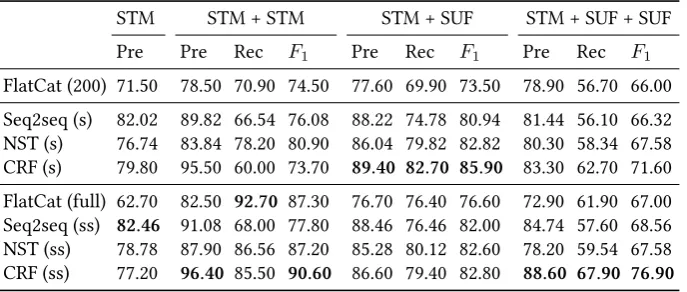
STM STM + STM STM + SUF STM + SUF + SUF Pre Pre Rec F1 Pre Rec F1 Pre Rec F1
FlatCat (200) 71.50 78.50 70.90 74.50 77.60 69.90 73.50 78.90 56.70 66.00 Seq2seq (s) 82.02 89.82 66.54 76.08 88.22 74.78 80.94 81.44 56.10 66.32 NST (s) 76.74 83.84 78.20 80.90 86.04 79.82 82.82 80.30 58.34 67.58 CRF (s) 79.80 95.50 60.00 73.70 89.40 82.70 85.90 83.30 62.70 71.60 FlatCat (full) 62.70 82.50 92.70 87.30 76.70 76.40 76.60 72.90 61.90 67.00 Seq2seq (ss) 82.46 91.08 68.00 77.80 88.46 76.46 82.00 84.74 57.60 68.56 NST (ss) 78.78 87.90 86.56 87.20 85.28 80.12 82.60 78.20 59.54 67.58 CRF (ss) 77.20 96.40 85.50 90.60 86.60 79.40 82.80 88.60 67.90 76.90
Table 4: Boundary precision (Pre), recall (Rec), andF1-scores for different subsets
of the evaluation data. NST stands for Neural sequence tagger. (s) stands for fully supervised, (ss) for semi-supervised.
8 Results
Table 3 shows results on the full test set. The semi-supervised CRF shows the best per-formance both according toF1-score and word-type level accuracy. Semi-supervised
seq2seq has high precision but low recall, indicating under-segmentation. The neural sequence tagger shows the opposite behavior, with the highest recall.
All semi-supervised methods improve on the quality of the semi-supervised Flat-Cat trained on 200 annotated words which is used as input features. All three dis-criminative methods also outperform FlatCat trained on the whole training set, onF1
[image:9.595.127.471.358.504.2]The seq2seq model frequently fails to output a valid segmentation, either gener-ating incorrect characters, stopping too early, or getting stuck repegener-ating a pattern of characters. For 10.7% of the test set, the seq2seq output does not concatenate back to the input word.
Table 4 shows results for subsets of the evaluation data. The subsets include all words were the gold standard category labels follow a particular pattern: No inter-nal structure (STM), uninflected compound (STM+STM), single-suffix inflected word (STM+SUF) and two-suffix inflected word (STM+SUF+SUF).
The seq2seq model has the best performance for the STM-pattern. This is only partly explained by the bias towards not segmenting at all caused by the replacement procedure for the invalid outputs.
The seq2seq model has high precision for all category patterns. Fully supervised CRF has superior precision and recall for the STM+SUF pattern, while semi-supervised CRF is superior for the STM+SUF+SUF pattern. CRF is good at modeling the bound-aries of suffixes. Adding the FlatCat features improves the modeling of the boundary between multiple suffixes, while slightly deteriorating the modeling of the boundary between stem and suffix. The left-to-right decoding is a possible explanation for the weaker performance of the neural sequence tagger on the STM+SUF+SUF pattern. Fully supervised CRF is poor at splitting compound words, evidenced by the low re-call for the STM+STM pattern. This deficiency is effectively alleviated by the addition of the FlatCat features.
The neural sequence tagger is good at modeling the ends of stems, indicated by high recall on the STM+STM and STM+SUF patterns.
9 Conclusions and future work
Semi-supervised sequence labeling is an effective way to train a low-resource morpho-logical segmentation system. We recommend training a CRF sequence tagger using a Morfessor FlatCat-based feature set augmentation approach. This setup achieves a morph boundaryF1-score of 85.70, improving on previous best results for North Sámi
morphological segmentation. Our neural sequence tagging system reaches almost the same word-type level accuracy as the CRF system, while having better morph bound-ary recall.
The bidirectional LSTM-CRF model (Huang et al., 2015) uses the power of a re-current neural network to combine contextual features, and stacks a CRF on top for sequence level inference. The performance of this architecture on the North Sámi morphological segmentation task should be explored in future work.
Acknowledgments
This research has been supported by the European Union’s Horizon 2020 Research and Innovation Programme under Grant Agreement No 780069. Computer resources within the Aalto University School of Science “Science-IT” project were used.
References
Ryan Cotterell, Christo Kirov, John Sylak-Glassman, David Yarowsky, Jason Eisner, and Mans Hulden. 2016. The sigmorphon 2016 shared task—morphological reinflec-tion. InProceedings of the 14th SIGMORPHON Workshop on Computational Research in Phonetics, Phonology, and Morphology. pages 10–22.
Spence Green and John DeNero. 2012. A class-based agreement model for generating accurately inflected translations. InProceedings of the 50th Annual Meeting of the Association for Computational Linguistics: Long Papers-Volume 1. Association for Computational Linguistics, pages 146–155.
Stig-Arne Grönroos, Katri Hiovain, Peter Smit, Ilona Erika Rauhala, Päivi Kristiina Jokinen, Mikko Kurimo, and Sami Virpioja. 2016. Low-resource active learning of morphological segmentation.Northern European Journal of Language Technology.
Stig-Arne Grönroos, Kristiina Jokinen, Katri Hiovain, Mikko Kurimo, and Sami Virpi-oja. 2015. Low-resource active learning of North Sámi morphological segmentation. InProceedings of 1st International Workshop in Computational Linguistics for Uralic Languages. pages 20–33.
Stig-Arne Grönroos, Sami Virpioja, Peter Smit, and Mikko Kurimo. 2014. Morfessor FlatCat: An HMM-based method for unsupervised and semi-supervised learning of morphology. InProceedings of COLING 2014, the 25th International Conference on Computational Linguistics. Association for Computational Linguistics, Dublin, Ireland, pages 1177–1185.
Sepp Hochreiter and Jürgen Schmidhuber. 1997. Long short-term memory. Neural Computation9(8):1735–1780.
Zhiheng Huang, Wei Xu, and Kai Yu. 2015. Bidirectional LSTM-CRF models for se-quence tagging. CoRR arXiv:1508.01991.
Katharina Kann, Ryan Cotterell, and Hinrich Schütze. 2016. Neural morphological analysis: Encoding-decoding canonical segments. InProceedings of the 2016 Confer-ence on Empirical Methods in Natural Language Processing. Association for Compu-tational Linguistics, pages 961–967.
Katharina Kann, Manuel Mager, Ivan Meza, and Hinrich Schütze. 2018. Fortification of neural morphological segmentation models for polysynthetic minimal-resource languages. InProceedings of NAACL 2018. Association for Computational Linguis-tics, New Orleans, Louisiana, USA.
Guillaume Klein, Yoon Kim, Yuntian Deng, Jean Senellart, and Alexander M. Rush. 2017. OpenNMT: open-source toolkit for neural machine translation. InProc. ACL.
John Lafferty, Andrew McCallum, and Fernando CN Pereira. 2001. Conditional ran-dom fields: Probabilistic models for segmenting and labeling sequence data. In
Proceedings of ICML. pages 282–289.
Sjur Moshagen, Jack Rueter, Tommi Pirinen, Trond Trosterud, and Francis M. Ty-ers. 2014. Open-source infrastructures for collaborative work on under-resourced languages. InCollaboration and Computing for Under-Resourced Languages in the Linked Open Data Era. LREC 2014.. pages 71–77.
Ramesh Nallapati, Bowen Zhou, Caglar Gulcehre, and Bing Xiang. 2016. Abstractive text summarization using sequence-to-sequence rnns and beyond. Inin Proceedings of The 20th SIGNLL Conference on Computational Natural Language Learning. pages 280–290.
Jorma Rissanen. 1989. Stochastic Complexity in Statistical Inquiry, volume 15. World Scientific Series in Computer Science, Singapore.
Teemu Ruokolainen, Oskar Kohonen, Sami Virpioja, and Mikko Kurimo. 2014. Pain-less semi-supervised morphological segmentation using conditional random fields. InEuropean Chapter of the Association for Computational Linguistics (EACL). Asso-ciation for Computational Linguistics, Gothenburg, Sweden, pages 84–89.
Rico Sennrich, Barry Haddow, and Alexandra Birch. 2015. Neural machine translation of rare words with subword units. InACL16.
Peter Smit, Sami Virpioja, Mikko Kurimo, et al. 2017. Improved subword modeling for WFST-based speech recognition. InIn INTERSPEECH 2017–18th Annual Conference of the International Speech Communication Association..
Trond Trosterud and Heli Uibo. 2005. Consonant gradation in Estonian and Sámi: two-level solution. InInquiries into Words, Constraints and Contexts–Festschrift for Kimmo Koskenniemi on his 60th Birthday, Citeseer, page 136.
Sami Virpioja, Ville T Turunen, Sebastian Spiegler, Oskar Kohonen, and Mikko Ku-rimo. 2011. Empirical comparison of evaluation methods for unsupervised learning of morphology. Traitement Automatique des Langues52(2):45–90.
Linlin Wang, Zhu Cao, Yu Xia, and Gerard de Melo. 2016. Morphological segmentation with window LSTM neural networks. InAAAI. pages 2842–2848.