How to Use Gazetteers for Entity Recognition with Neural Models
Simone Magnolini1, Valerio Piccioni1,2, Vevake Balaraman1,2, Marco Guerini1, Bernardo Magnini1 1Fondazione Bruno Kessler, Via Sommarive 18, Povo, Trento — Italy
2 University of Trento, Italy.
{magnolini, balaraman, guerini, magnini}@fbk.eu
Abstract
Although the use of end-to-end neural archi-tectures has been proven to be effective on several sequence labeling tasks, the use of gazetteers in these architectures is still rather unexplored. We investigate several options, aiming at exploiting gazetteers to extract rel-evant features, and then at integrating these features in a neural model for entity recogni-tion. We provide experimental evidences on two datasets (named entities and nominal enti-ties) and two languages (English and Italian), showing that extracting features from a rich model of the gazetteer and then concatenating such features with the input embeddings of a neural model is the best strategy in all our ex-perimental settings, significantly outperform-ing more conventional approaches.
1 Introduction
In the recent years a number of neural architec-tures have been successfully applied to several se-quence labelling tasks, including, among others, part-of-speech tagging (Choi,2016), named entity recognition (Ma and Hovy, 2016), and semantic role labeling (He et al.,2017). It has been shown that these architectures can achieve state-of-art performance with an end-to-end configuration, i.e. without recurring either to linguistic features or to external knowledge sources (e.g. gazetteers). However, experiments have been often conducted over datasets with large amount of training data and in a rather limited spectrum of experimental conditions. Overall, we think that there has not been much discussion about the use of gazetteers together with neural models, and that a deeper in-vestigation is necessary.
In this paper we focus on the role of gazetteers for entity recognition. The following are our two main research questions: (i) As neural networks architectures are highly modular, which is the best
way to integrate information from gazetteers? (ii) What is the impact of the size of both training data and gazetteers over the performance of a neural model for entity recognition?
As mentioned, we focus on entity recognition and refer to the Automatic Content Extraction pro-gram - ACE (Doddington et al., 2004). In this context, entity recognition has been approached as a sequence labeling task. Given an utterance U = {t1, t2, ..., tn} and a set of entity categories C = {c1, c2, ..., cm}, the task is to label the to-kens in U that refer to entities belonging to the categories in C. As an example, using the IOB format (Inside-Outside-Beginning, (Ramshaw and Marcus,1995)), the sentence “I would like to order a salami pizza and two mozzarella cheese sand-wiches” could be labeled as shown in Table 1. ACE distinguishes two main entity classes:named entitiesandnominal entities, and we consider both of them for our experiments.
The first entity class, named entities, roughly corresponds to proper names, and named enti-ties recognition (NER) tools for frequent cate-gories (i.e. persons as “Barack Obama”, loca-tions as “New York”, and organizaloca-tions as “IBM”) have been developed for many languages. Sev-eral datasets are available for training purposes (e.g. the Conll-2003 datasets (Tjong Kim Sang and De Meulder,2003)). It has been a common practice of NER systems to make use of gazetteers (i.e. lists of entity names), considering the pres-ence of a token in certain gazetteer as an additional feature for the classifier (see, for instance, the use of the Stanford NERuseGazettes parameter for the CRF classifier (Finkel et al.,2005)).
I would like to order a salami pizza and two mozzarella cheese sandwiches O O O O O O B-FOOD I-FOOD O O B-FOOD I-FOOD I-FOOD
Table 1: IOB annotation of food entities inside user request.
names,spanish baked salmon,roasted salmonand
hot smoked salmon), which makes it possible to combine tokens of one entity name with tokens of another entity name to generate new names (e.g. for food names, salmon tacos is a potential food name given the existence of salmon and tacos). In the framework of the ACE program there have been several attempts to develop supervised sys-tems for nominal entities (Biggio et al., 2010); these systems, however, had to face the problem of the scarcity of annotated data, and, for this rea-son, were developed for few entity types.
In this paper we make use of an end-to-end state-of-art entity recognition system (described in Section 2), and investigate the combination with gazetteers under several integration methods, which are described in Section3and4. Datasets for our experiments are described in Section 5, while results are presented and discussed in Sec-tion6.
2 Core Entity Recognition System
In order to investigate the use of gazetteers in com-bination with neural models we first need an entity recognition system. For our experiments we have adopted the neural system proposed in (Ma and Hovy, 2016), which achieved state-of-art perfor-mance for named entity recognition for English on the ConLL-2003 dataset (see section5). Specifi-cally, we use the most recent implementation of the system in Pytorch distributed by the authors1,
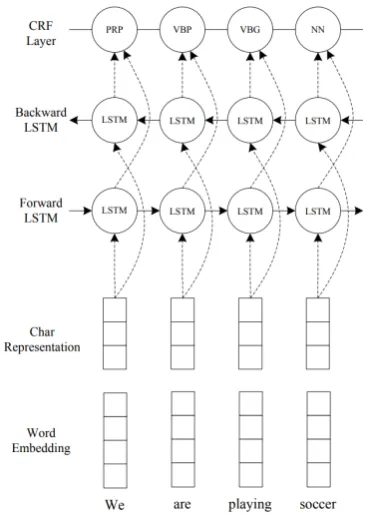
and calledNeuroNLP2. The system is composed of three layers (Figure1): (i) a CNN that allows to extract information from the input text without any pre-processing; (ii) a bidirectional LSTM layer that presents each sequence forwards and back-wards to two separate LSTM; (iii) a CRF layer that decodes the best label sequence.
For each token in the input sequence, first a character-level representation is computed by a CNN with character embeddings as inputs. Then the character-level representation vector is con-catenated with the word embedding vector to feed the BLSTM network. The CNN for Character-level Representation is an effective approach to
1https://github.com/XuezheMax/NeuroNLP2
Figure 1: The main NeuroNLP2 structure. Dashed ar-rows indicate dropout layers applied on both the input and output vectors of BLSTM.
extract morphological information (like the pre-fix or sufpre-fix of a word) from characters of words and encode it into neural representations. In Neu-roNLP2 the CNN is similar to the one proposed in (Chiu and Nichols,2015), except that it uses only character embeddings as inputs, without character type.
of the BLSTM.
Finally, the third layer implemented by Neu-roNLP2 is a Conditional Random Fields (CRF) based decoder, which considers dependencies be-tween entity labels in their context and then jointly decodes the best chain of labels for a given input sentence. For example, in NER with standard IOB annotation, an I-token can not follow an O, a con-straint which is captured by the CFR layer. Con-ditional Random Fields (Lafferty et al.,2001) of-fer several advantages over hidden Markov models and stochastic grammars for such tasks, including the ability to relax strong independence assump-tions made in those models. For a sequence CRF model (only interactions between two successive labels are considered), training and decoding can be solved efficiently by adopting the Viterbi algo-rithm.
We use exactly the same network parameters described in (Ma and Hovy, 2016) and provided as default by the available implementation. As in-put embeddings we use Stanford’s publicly avail-able GloVe 100-dimensional embeddings trained on 6 billion words from Wikipedia and web texts for English (in the same way as (Ma and Hovy,
2016)); for Italian we use Stanford’s GloVe 50-dimensional embeddings trained on a Wikipedia’s dump2 with the default setup. For the out of vo-cabulary words we use a unique randomly gener-ated vector for every word.
3 Gazetteers as Features
In this section we present three methods that allow us to exploit information contained in gazetteers and to represent such information as features to be used by the neural entity recognition system. While the first two methods, single token pres-ence and multi-token prespres-ence, have been often used, the third method, i.e. gazetteer neural model, is based on the assumption that a more complex model can better exploit the properties of nominal entities.
3.1 Single Token Presence
A simple and straight-forward approach to use a gazetteer is to consider the presence of a single token in the gazetteer as a feature. To do that, we extract the vocabulary of the gazetteer and provide a boolean value to every token in the sentence,
220/04/2018
which indicates the presence or absence of the to-ken in the vocabulary. If the number of gazetteers in the domain is n, corresponding to the number of entity classes, a single token takes a vector of n-dimensions: if the vocabularies of the different gazetteers do not overlap this is a one-hot vector, otherwise we can have multiple positive dimen-sions.
3.2 Multi-token Presence
The second approach uses the same feature space as the single token presence method, but instead of checking for the presence of a single token in the gazetteer, it looks for the longest entity name in the gazetteer contained in the sentence. Let us consider the example in Table 1, I would like to order a salami pizza and two mozzarella cheese sandwiches, and assume a gazetteer for the classFOODcomposed of two entries: mozzarella pizza and salami sandwiches. With the multi-token approach none of the multi-tokens would have the gazetteer feature equal to true, while with the sin-gle token approach bothsalami,pizza,mozzarella
and sandwiches would have the presence set to true. The multi-token technique enables a more consistent usage of gazetteers, especially in case of noisy entity names, although a possible draw-back could be a lack of generalization.
3.3 Gazetteer Neural Model: NNg
The third method to extract features from a gazetteer follows the intuition that the presence-absence approaches presented in Sections3.1and
3.2 might not be adequate for nominal entities, which show higher linguistic complexity than named entities. The idea is to build a neural clas-sifier trained solely on gazetteers, that classifies a subsequence of tokens on the input sentence as be-longing to a certain entity class with a certain con-fidence. Then we use the output of such classifier as a feature to be integrated within the NeuroNLP2 system.
The neural architecture of the entity classifier, the features it uses, and the methodology to gen-erate synthetic negative examples are briefly pre-sented in the following.
black and white t-shirt TRUE (0.75)
Input layer Input layer BLSTM 1 BLSTM 2 BLSTM 3
[image:4.595.82.282.61.210.2]Dropout Softmax
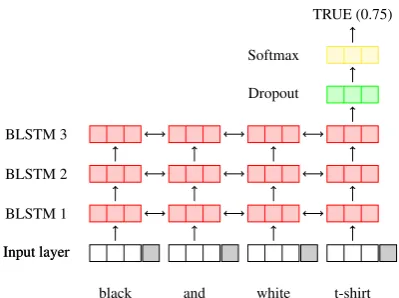
Figure 2: Structure of the neural gazetteer entity recog-nition (NNg). The input layer concatenates the features in a single vector.
tokens either as an entity of a certain gazetteer or a non-entity, with a degree of confidence, i.e. the system classifies the sequences in number-of-gazetteers plus one (non-entity) different classes. The NNg classifier is based on the system pro-posed in (Lample et al., 2016). The core is still a bidirectional LSTM, but it has a 3-layer BLSTM with 128 units per layer and with a single dropout layer (with a dropout probability of 0.5) between the third BLSTM and the output layer (a softmax layer). The topology of the network is depicted in Figure2.
NNg Classifier Features. The NNg classifier combines several features: word embeddings, char-based embedding, and nine handcrafted fea-tures. Word embeddings are similar to those used for NeuroNLP2. For English we used Stan-fords publicly available 50-dimensions embed-dings, while for Italian we use 50-dimensional embeddings trained on a Wikipedia’s dump with the default setup. The char-based embeddings, with a dimension of 30, are based on (Lample et al.,2016), and are trained on the entries in the gazetteers. The expected role of the char-based embeddings is to deal with out of vocabulary terms and possible word misspellings.
The handcrafted features are meant to explicitly represent the structure of a certain entity name, as it can be induced from the gazetteer in which the entity appears. NNg considers nine features for each token in an entity name: (i) the actual po-sition of the token within an entity name; (ii) the length of the entity name under inspection; (iii) the frequency of the token in the gazetteer; (iv) the av-erage length of the entity names containing a
cer-tain token; (v) the average position of the token in the entity names it appears in; (vi) the bigram probability with reference to the previous token in the entity name; (vii) whether the token can be an entity or not; (viii) the ratio of the times the token is the first token in an entity name; (ix) the ratio of the times the token is the last token in an entity name.
Generating Synthetic Training Data. The NNg classifier for a certain entity class is trained with both positive examples, i.e. entity names present in a gazetteer of the entity class, and neg-ative examples, which are obtained by synthetic generation from the positive examples. In the fol-lowing we explain how negative examples are gen-erated.
For each entity nameiin a gazetteerG(i.e. the positive example), negative counterparts are sub-sequences ofi, ori with additional tokens at the beginning or end of it (or both), e.g. t1 + i + t2. Wheret1 is the ending token of a random entity inGandt2is the starting token of a random en-tity inG. Between these tokens andithere can be separators, as a white space, a comma or theand
conjunction, so to mimic how multiple entities are usually expressed in sentences. Alternatively, t1
and t2can be tokens randomly extracted from a generic corpus, so to mimic cases when the entity is expressed in isolation.
For example, if the initial positive example is
Community of Madrid, the possible negative sub-sequences that are generated are: | Community
| of | Community of | of Madrid |. The sub-sequence |Madrid |is not considered because it is already included in the gazetteer as positive ex-ample. Adding tokens, using the patternt1 + i + t2, we obtain other potential negative examples:
|contemporary Community of Madrid | Commu-nity of Madrid and Murcia|contemporary Com-munity of Madrid and Murcia|, and so on. Ac-cording to this procedure, we generate more neg-ative examples than positive. In order to avoid a too unbalanced datatset, we randomly selected two negative examples for each positive example: a sub-sequence and an example surrounded by other words, resulting in a1 : 2proportion.
4 Integrating Gazetteer Features
the neural entity recognition system. Each of the integration methods adds one boolean feature for each gazetteer.
4.1 Integration 1: Gazetteer Features as Embedding Dimensions
Once we have extracted gazetteer features for each token of the input sentence, the first approach that we consider is to feed such features directly into the neural network. In this method the gazetteer information, represented by a n-dimensions vec-tor, is simply concatenated with the embedding of each token of the input sentence. By default, the NeuroNLP2 system (see Section 2) uses both char-acter and word embeddings, which are concate-nated and passed on to the BLSTM layer to learn from them. In this approach the gazetteer feature is concatenated with the character and word em-bedding, and then it is passed to the BLSTM. The embedding representation for a given tokenxis as follows:
Embeddingx = [xword;xchar;xgaz]
While the integration as embedding dimensions for the single token and the multi-token features is straightforward, in order to combine NNg with NeuroNLP2 we need to substitute part of the NNg’s network after training. In fact, we need a NNg’s output for every token, while NNg classi-fies a sequence of tokens. To do that we remove the softmax layer of NNg and we feed the output vectors of the third BLSTM to a fully connected layer of 32 nodes followed by a rectified linear unit (ReLU). With this modification we add to Neu-roNLP2 32 features that represent a model of the gazetteers.
4.2 Integration 2: Gazetteer Features as Input for the CRF Classifier
As NER is a classification task, the system uses features extracted by the BLSTM layer to classify the tokens as one of the possible entity types. CRF is the probabilistic model adopted by NeuroNLP2 to classify a token with an entity type based on the features extracted. Providing the information of the gazetteer to this layer should help the model to better classify tokens. So this integration tech-nique uses the gazetteer features as an additional dimension by concatenating them with the fea-tures extracted by the BLSTM.
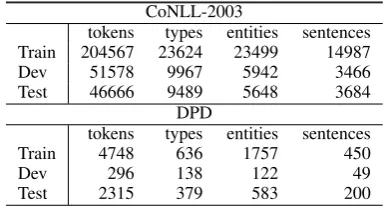
CoNLL-2003
tokens types entities sentences Train 204567 23624 23499 14987 Dev 51578 9967 5942 3466 Test 46666 9489 5648 3684
DPD
tokens types entities sentences Train 4748 636 1757 450 Dev 296 138 122 49 Test 2315 379 583 200
Table 2: Statistics about data sets used for our experi-ments.
dev∩train test∩train test∩gazetteers CoNLL-2003 50% 35% 35%
[image:5.595.319.514.62.166.2]DPD 48% 26% 33%
Table 3: Unique entities overlap between various sets. The percentage refers to the count of unique entities in the first dataset.
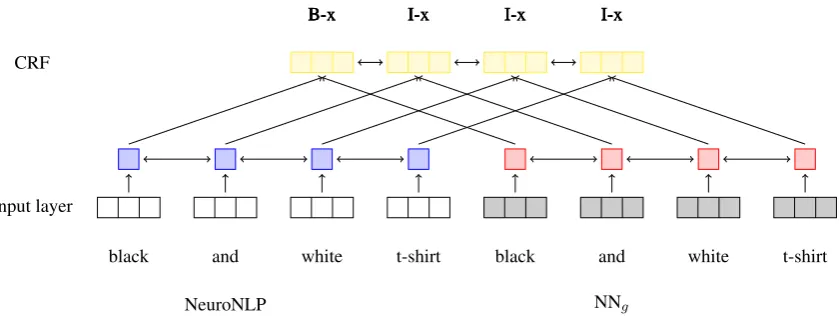
An example of this integration methodology ap-plied to the features provided by the NNg classi-fier is presented in Figure3. It is important to no-tice that, like in the previous integration approach, NNgis pre-trained and it is not jointly trained with NeuroNLP2.
5 Data Sets
In this section we describe the two datasets and the various gazetteers used for our experiments. The first dataset is CoNLL-2003 (Tjong Kim Sang and De Meulder, 2003), for named entity recog-nition, while the second one is a novel dataset (DPD) (Magnini et al.,2018), specifically focused on nominal entities. In Table2we report the main characteristics of the two datasets and the parti-tions used for the experiments, while in Table3we report the intersection among entities in the vari-ous sets (e.g. how many entities in the test set can be also found in the training set or the gazetteers). These percentages are a rough indicator of: (i) how a perfect match baseline using gazetteers can perform, and (ii) how much the NeuroNLP2 sys-tem can take advantage of already seen entities during training phase.
We describe the two datasets with more detail in the following two paragraphs.
black and white t-shirt black and white t-shirt
NeuroNLP NNg
CRF
Input layer
[image:6.595.93.513.62.220.2]B-x I-x I-x I-x B-x I-x I-x I-x B-x I-x I-x I-x B-x I-x I-x I-x
Figure 3: NeuroNLP + NNg- the output layer of the two systems is combined into the CRF layer. For NNg, a fully connected layer with 32 nodes and a ReLU has been substituted for the original SoftMax layer (in red).
data was taken from the Reuters news corpus. For instance, the sentence “EU rejects German call to boycott British lamb” is tagged as follows in CoNLL-2003:
<EU>ORG rejects <German>M ISC call to
boycott<British>M ISC lamb.
DPD – Diabetic Patients Diary – is a data set in Italian made of diary entries of diabetic pa-tients. Each day the patient has to write down what s/he ate in order to keep track of his/her di-etary behavior. In this data set, which is much smaller than CoNNL-2003, all entities of type FOOD have been manually annotated by two an-notators (inter-annotator agreement is 96.75 dice coefficient). Sentences in the dataset have a tele-graphic style, e.g. the main verb is often missing, resulting in a list of foods like the following:
“<risotto ai multicereali e zucchine>F OOD <insalata>F OOD e <pomodori>F OOD” (“<risotto with multigrain and zucchini> <salad>and<tomatoes>”).
Entity Gazetteers. In Table 4 we describe the gazetteers that we have used in our experiments for the two datasets, reporting, for each entity type, sizes in terms of number of entity names, the av-erage length of the names (in number of tokens), plus the length variability of such names (standard deviation). We also report additional metrics that try to grasp the complexity of entities names in the gazetteer: (i) the normalized type-token ratio (TTR), as a rough measure of how much lexical diversity is in the nominal entities in a gazetteer, see (Richards,1987); (ii) the ratio of type1 tokens, i.e. tokens that can appear in the first position of an entity name but also in other positions, and type2
tokens, i.e. tokens appearing at the end and else-where; (iii) the ratio of entities that contain another entity as sub-part of their name. With these mea-sures we are able to partially quantify how diffi-cult it is to recognize the length of an entity (SD), how difficult it is to individuate the boundaries of an entity (ratio of type1 and type2 tokens), how much compositionality there is starting from basic entities (i.e. how many new entities can be po-tentially constructed by adding new tokens - sub-entity ratio). Note that type1 and type2 ratios can cover some cases in common with sub-entity ratio, but they model different phenomena: givenwhite t-shirt, the entity nameblack and white skirt rep-resents a case of type1 token forwhitebut without sub-entity matching, whilewhite t-shirt with long sleeves represents a sub-entity matching without makingwhitea type1 token.
6 Experiments
The experimental results for the various ap-proaches that use gazetteers as features in the con-text of a neural entity recognition system, are dis-cussed in this Section. For all experiments, the hyper-parameters of the neural model for both NNgand NeuroNLP2 are the same as in (Guerini et al., 2018) and (Ma and Hovy, 2016) respec-tively.
6.1 Overall Results
Neu-Data Set Gaz. #entities #tokens length±SD TTR type1(%) type2(%) sub-entity(%)
CoNNL
[image:7.595.71.529.198.277.2]PER 3613 6454 1.79±0.54 0.96 19.00 04.63 23.60 LOC 1331 1720 1.29±0.69 0.97 04.66 04.33 10.14 ORG 2401 4659 1.94±1.16 0.91 09.35 15.06 19.44 MISC 869 1422 1.64±0.94 0.89 08.61 08.73 19.85 DPD FOOD 23472 83264 3.55±1.87 0.75 17.22 22.97 11.27
Table 4: Gazetteers used in the experiments. Description is provided in terms of number of entity names, total number of tokens, average length and standard deviation (SD) of entities, type-token ratio (norm obtained by repeated sampling of 200 tokens), type1 and type2 unique tokens ratio and sub-entity ratio.
CoNLL DPD
Accuracy Precision Recall F1 Accuracy Precision Recall F1
NeuroNLP2 98.06 91.42 90.95 91.19 88.47 77.17 74.79 75.96
NeuroNLP2 + single token 98.06 91.53 90.51 91.02 88.29 75.63 77.19 76.40 NeuroNLP2 + multi token 98.08 91.41 90.76 91.08 88.98 78.90 76.33 77.59 NeuroNLP2 + NNg 98.05 91.41 91.02 91.22 89.89 79.68 77.36 78.50
Table 5: Experimental results using gazetteers as features together with embeddings.
roNLP2 and NNgreaches state-of-art performance on ConNLL-2003 when it is added as embedding feature, while both the single token and the multi-token approaches do not improve the overall re-sults. It can also be clearly seen that providing the gazetteer feature to CRF is a deteriorating choice, as the model probably tends to over-fit to the gazetteer information resulting in a drop of perfor-mance. On the other hand, using gazetteer features as part of embedding dimensions helps the model to adapt better when the training data are very few, like in the DPD dataset. Furthermore, the results on the DPD dataset of NeuroNLP2 + NNg, com-pared to the others, show that NNgcorrectly gen-eralizes nominal entities from the gazetteer, im-proving both Recall and Precision with respect to the multi-token approach.
6.2 Impact of Training Size
Neural network architectures are data-hungry models, requiring large amounts of training data in order to generalize. In those scenarios where the amount of available training is not an issue the effect of the gazetteer on the model performance is negligible, as the model learns to generalize on the large number of annotated sentences. How-ever, for domains where there is scarcity of train-ing data, the gazetteer feature is much appreci-ated for a better performance. To understand this effect, we simulated a low data scenario for the CONLL-2003 dataset by training the model on a small amount of data. The test and dev datasets are kept the same, while varying only the training
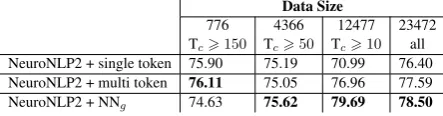
data size. Tables 7 and 8 show the performance of the models with varying training data sizes on CONLL and DPD datasets, respectively. We can infer that for Named Entity Recognition using to-ken presence is not the right approach especially when the gazetteer is well formed and with little noise. The multi-token feature approach is more consistent, and it improves the performance of the NeuroNLP2 model by at least 3 points over all data sizes used. However, these approaches tend to be inconsistent when learning nominal entities. Results show that NNg proves to be more robust for nominal entities and provides a more consis-tent performance indicating its impact in recog-nizing compositional entities. We can see that, for nominal entities, the single token approach is not recommended, as both the learning curve and the gazetteer size effect show (see Table9).
Results are variable particularly for food names, which are nominal entities that can considerably change in length, contain stop-words, numbers or nouns that usually can appear in other contexts (i.e.Miami beachcocktail,chinesechicken,white
wine,padthai,energyballs...).
6.3 Impact of Gazetteer Size
CoNLL DPD
Accuracy Precision Recall F1 Accuracy Precision Recall F1
NeuroNLP2 98.06 91.42 90.95 91.19 88.47 77.17 74.79 75.96
[image:8.595.71.531.60.140.2]NeuroNLP2 + single token 94.82 86.90 71.03 78.17 85.75 69.79 68.95 69.37 NeuroNLP2 + multi token 92.20 85.44 59.24 69.97 87.52 74.23 74.61 74.42 NeuroNLP2 + NNg 97.96 90.95 90.53 90.74 89.37 78.56 74.79 76.63
Table 6: Experimental results using gazetteers as features for CRF.
Data Size
100 200 300 450 NeuroNLP2 47.31 56.78 56.96 69.55 NeuroNLP2 + single token 47.70 59.25 61.32 71.66 NeuroNLP2 + multi token 51.24 62.77 63.19 74.63
[image:8.595.82.283.304.365.2]NeuroNLP2 + NNg 42.30 57.99 58.65 69.20
Table 7: Learning Curve on the CONLL 2003 dataset. Columns report the number of sentences in the training dataset.
Data Size
100 200 300 450 NeuroNLP2 55.99 74.93 73.88 75.96 NeuroNLP2 + single token 48.93 72.29 78.53 76.40 NeuroNLP2 + multi token 63.82 72.80 77.30 77.59 NeuroNLP2 + NNg 52.85 72.24 77.02 78.50
Table 8: Learning Curve on the DPD dataset. Columns report the number of sentences in the training dataset.
contain tokens that appear less than10times helps NNg to better generalize food names, without fo-cusing on rare and uncommon entities. With this approach the size of the gazetteer is nearly halved, and it is noticeable that5019out of8420unique tokens in the gazetteer appear only once. Remov-ing common tokens, i.e. those that appear be-tween10and49times, no model seems to give de-cent results, with performance lower than the Neu-roNLP2 model alone. A last reduction experiment, i.e. removing entities that contain very common tokens, occurring more than150 times, bringing the gazetteer to a size of only 779entries, leave NNg with too few compositions to learn how to
Data Size
776 Tc>150
4366 Tc>50
12477 Tc>10
23472 all NeuroNLP2 + single token 75.90 75.19 70.99 76.40 NeuroNLP2 + multi token 76.11 75.05 76.96 77.59 NeuroNLP2 + NNg 74.63 75.62 79.69 78.50
Table 9: Results of reducing gazetteer size on a less commonprinciple; in the columns, the first number is the gazetteer size, while the second element represents the minimum number of occurrences for the tokens in the FOOD gazetteer.
generalize, but permits the multi-token approach to give core information to NeuroNLP2, increas-ing its baseline performance.
7 Related Work
Although, at least to the best of our knowledge, there is no much work specifically addressing the use of gazetteers in nthe context of neural archi-tectures, still there is a number of related contribu-tions which we discuss in this section.
The use of gazetteers with neural networks has been proposed by (Park et al.,2017), who present a neural network model augmented with sylla-ble embedding vectors, parts-of-speech probabil-ity vectors, and gazetteer vectors as input features. Although the proposed model showed good per-formance, there is no attempt to isolate the impact of gazetteers, which is the goal of our work.
A related approach is presented in (Zhao et al.,
2017), which ranked first in English NERC eval-uation at KBP 2017. Basically this is an exten-sion of (Lample et al., 2016) that includes entity embedding from gazetteers, where embeddings are derived from a noisy gazetteer created using Wikipedia’s articles. The gazetteer is derived from the word-entity statistics from (Park et al.,2017).
A good example of work that builds on the idea of creating a statistical model of named en-tity starting from gazetteers, is presented in ( Al-Olimat et al.,2017). The paper focuses on extract-ing location names from informal and unstruc-tured texts by identifying referent boundaries. The core of the approach is a statistical language model consisting of a probability distribution over se-quences of words (collocations) that represent lo-cation names in gazetteers. The algorithm uses the relative likelihood of an observed word sequence to decide the boundaries of a location name in tweets. This is similar in spirit to the NNg used in our approach, although we make use of a neural model rather than a statistical model.
[image:8.595.74.296.637.695.2]of using gazetteers when training a neural network with few data. In fact, particularly for massive data scenarios like NER on Twitter, collecting a large amount of high quality gazetteers can allevi-ate the problem of training data scarcity. The pa-per shows that large gazetteers may cause a side-effect called ‘feature under-training’, i.e. gazetteer features overwhelm the training data and may de-grade performance. To solve this problem, the au-thors propose a dropout conditional random fields, which decreases the influence of gazetteer features with a high weight.
8 Conclusions and Future Work
In this paper we were interested to investigate sev-eral options about the use of gazetteers in neu-ral architectures for entity recognition. We con-ducted several experiments on both named enti-ties (CONLL 2003 - English) and nominal entienti-ties (food names in DPD - Italian) and showed that: (i) gazetteer features that are extracted by a sepa-rately trained the NNg classifier are more signifi-cant than conventional features based on presence-absence of tokens; (ii) integrating such features as extension of the input embedding outperforms in-tegration at the CRF level; (iii) these findings are particularly significant when either the size of the training data or of the gazetteers are reduced.
As a general comment on the use of gazetteers for neural NER, our experiments highlight that gazetteers are much more useful for nominal enti-ties (e.g. food names) than for named entienti-ties (e.g. person names). In this respect, the paper shows that the NNgapproach significantly helps to iden-tifying compositional variants of nominal entities. In the paper we have based our experiments on the neural model described in (Ma and Hovy,
2016). However, very recently, new models (e.g. BERT (Devlin et al., 2018) and ELMO (Peters et al., 2018)) have been proposed, which have further improved performance on Named Entity Recognition. Based on such expectations, we run a preliminary experiment using the multilingual BERT model on the DPD dataset: results, prob-ably due to the poor performance of the model on Italian food, are still significantly lower than Neu-roNLP2, and additional work seems to be neces-sary to properly take advantage of the full capacity of the BERT model.
Finally, as for future work, we intend to apply the current models to a larger number of
scenar-ios, including utterance understanding for conver-sational agents.
References
Hussein S Al-Olimat, Krishnaprasad Thirunarayan, Valerie Shalin, and Amit Sheth. 2017. Location name extraction from targeted text streams using gazetteer-based statistical language models. arXiv preprint arXiv:1708.03105.
Silvana Marianela Bernaola Biggio, Manuela Sper-anza, and Roberto Zanoli. 2010. Entity mention detection using a combination of redundancy-driven classifiers. In Proceedings of the Seventh Interna-tional Conference on Language Resources and Eval-uation (LREC’10), Valletta, Malta. European Lan-guage Resources Association (ELRA).
Jason PC Chiu and Eric Nichols. 2015. Named entity recognition with bidirectional LSTM-CNNs. arXiv preprint arXiv:1511.08308.
Jinho D Choi. 2016. Dynamic feature induction: The last gist to the state-of-the-art. InProceedings of the 2016 Conference of the North American Chapter of the Association for Computational Linguistics: Hu-man Language Technologies, pages 271–281.
Jacob Devlin, Ming-Wei Chang, Kenton Lee, and Kristina Toutanova. 2018. Bert: Pre-training of deep bidirectional transformers for language understand-ing.
George Doddington, Alexis Mitchell, Mark Przybocki, Lance Ramshaw, Stephanie Strassel, and Ralph Weischedel. 2004. The automatic content extraction (ace) program - tasks, data, and evaluation. In Pro-ceedings of the Fourth International Conference on Language Resources and Evaluation (LREC-2004), Lisbon, Portugal. European Language Resources Association (ELRA). ACL Anthology Identifier: L04-1011.
Chris Dyer, Miguel Ballesteros, Wang Ling, Austin Matthews, and Noah A Smith. 2015. Transition-based dependency parsing with stack long short-term memory.arXiv preprint arXiv:1505.08075.
Jenny Rose Finkel, Trond Grenager, and Christo-pher D. Manning. 2005. Incorporating non-local information into information extraction systems by
gibbs sampling. InProceedings of the 43nd Annual
Meeting of the Association for Computational Lin-guistics (ACL 2005), pages 363–370.
Luheng He, Kenton Lee, Mike Lewis, and Luke Zettle-moyer. 2017. Deep semantic role labeling: What works and whats next. InProceedings of the 55th Annual Meeting of the Association for Computa-tional Linguistics (Volume 1: Long Papers), vol-ume 1, pages 473–483.
Sepp Hochreiter and J¨urgen Schmidhuber. 1997. Long short-term memory. Neural computation, 9(8):1735–1780.
John Lafferty, Andrew McCallum, and Fernando CN Pereira. 2001. Conditional random fields: Prob-abilistic models for segmenting and labeling se-quence data.
Guillaume Lample, Miguel Ballesteros, Sandeep Sub-ramanian, Kazuya Kawakami, and Chris Dyer. 2016.
Neural architectures for named entity recognition. CoRR, abs/1603.01360.
Xuezhe Ma and Eduard Hovy. 2016. End-to-end Se-quence Labeling via Bi-directional LSTM-CNNs-CRF. InProceedings of the 54th Annual Meeting of the Association for Computational Linguistics (Vol-ume 1: Long Papers), volume 1, pages 1064–1074.
Bernardo Magnini, Vevake Balaraman, Mauro Drag-oni, Marco Guerini, Simone Magnolini, and Vale-rio Piccioni. 2018. Ch1: A conversational system to calculate carbohydrates in a meal. In International Conference of the Italian Association for Artificial Intelligence, pages 110–122. Springer.
Geonwoo Park, Hyeon-Gu Lee, and Harksoo Kim. 2017. Named entity recognition model based on neural networks using parts of speech probability and gazetteer features. Advanced Science Letters, 23(10):9530–9533.
Matthew Peters, Mark Neumann, Mohit Iyyer, Matt Gardner, Christopher Clark, Kenton Lee, and Luke Zettlemoyer. 2018. Deep contextualized word rep-resentations.Proceedings of the 2018 Conference of the North American Chapter of the Association for Computational Linguistics: Human Language Tech-nologies, Volume 1 (Long Papers).
Lance A. Ramshaw and Mitchell P. Marcus. 1995.
Text chunking using transformation-based learning. CoRR, cmp-lg/9505040.
Brian Richards. 1987. Type/token ratios: What do they really tell us? Journal of child language, 14(2):201– 209.
Erik F Tjong Kim Sang and Fien De Meulder. 2003. Introduction to the conll-2003 shared task: Language-independent named entity recognition. In Proceedings of the seventh conference on Natural language learning at HLT-NAACL 2003-Volume 4, pages 142–147. Association for Computational Lin-guistics.
Eunsuk Yang, Young-Bum Kim, Ruhi Sarikaya, and Yu-Seop Kim. 2016. Drop-out conditional random fields for twitter with huge mined gazetteer. In Pro-ceedings of the 2016 Conference of the North Amer-ican Chapter of the Association for Computational Linguistics: Human Language Technologies, pages 282–288.