An Exact Dual Decomposition Algorithm
for Shallow Semantic Parsing with Constraints
Dipanjan Das∗ Andr´e F. T. Martins∗† Noah A. Smith∗
∗Language Technologies Institute, Carnegie Mellon University, Pittsburgh, PA 15213, USA
†Instituto de Telecomunicac¸˜oes, Instituto Superior T´ecnico, Lisboa, Portugal
{dipanjan,afm,nasmith}@cs.cmu.edu
Abstract
We present a novel technique for jointly predict-ing semantic arguments for lexical predicates. The task is to find the best matching between seman-tic roles and sentential spans, subject to struc-tural constraints that come from expert linguistic knowledge (e.g., in the FrameNet lexicon). We formulate this task as an integer linear program (ILP); instead of using an off-the-shelf tool to solve the ILP, we employ a dual decomposition algorithm, which we adapt for exact decoding via a branch-and-bound technique. Compared to a baseline that makes local predictions, we achieve better argument identification scores and avoid all structural violations. Runtime is nine times faster than a proprietary ILP solver.
1 Introduction
Semantic knowledge is often represented declara-tively in resources created by linguistic experts. In this work, we strive to exploit such knowledge in a principled, unified, and intuitive way. An ex-ample resource where a wide variety of knowledge has been encoded over a long period of time is the FrameNet lexicon (Fillmore et al., 2003),1 which suggests an analysis based on frame semantics (Fill-more, 1982). This resource defines hundreds of semantic frames. Each frame represents a gestalt event or scenario, and is associated with several se-manticroles, which serve as participants in the event that the frame signifies (see Figure 1 for an exam-ple). Along with storing the above data, FrameNet also provides a hierarchy of relationships between frames, and semantic relationships between pairs of roles. In prior NLP research using FrameNet, these interactions have been largely ignored, though they
1
http://framenet.icsi.berkeley.edu
have the potential to improve the quality and consis-tency of semantic analysis.
In this paper, we present an algorithm that finds the full collection of arguments of a predicate given its semantic frame. Although we work within the conventions of FrameNet, our approach is general-izable to other semantic role labeling (SRL) frame-works. We model thisargument identificationtask as constrained optimization, where the constraints come from expert knowledge encoded in a lexi-con. Following prior work on PropBank-style SRL (Kingsbury and Palmer, 2002) that dealt with simi-lar constrained problems (Punyakanok et al., 2004; Punyakanok et al., 2008,inter alia), we incorporate this declarative knowledge in an integer linear pro-gram (ILP).
Because general-purpose ILP solvers are propri-etary and do not fully exploit the structure of the problem, we turn to a class of optimization tech-niques called dual decomposition (Komodakis et al., 2007; Rush et al., 2010; Martins et al., 2011a). We derive a modular, extensible, parallelizable ap-proach in which semantic constraints map not just to declarative components of the algorithm, but also to procedural ones, in the form of “workers.” While dual decomposition algorithms only solve a relax-ation of the original problem, we make a novel con-tribution by wrapping the algorithm in a branch-and-bound search procedure, resulting inexactsolutions. We experimentally find that our algorithm achieves accuracy comparable to a state-of-the-art system, while respecting all imposed linguistic con-straints. In comparison to inexact beam search that violates many of these constraints, our exact decoder has less than twice the runtime; furthermore, it de-codes nine times faster than CPLEX, a state-of-the-art, proprietary, general-purpose exact ILP solver.
Austria , once expected to waltz smoothly into the European Union , is elbowing its partners ,
treading on toes and pogo-dancing in a most un-Viennese manner .
SELF_MOTION COLLABORATION
CONDUCT Goal
Manner Partner_1 Partner_2
Manner Agent
Self_mover
Figure 1: An example sentence from the annotations released as part of FrameNet 1.5 with three predicates marked in bold. Each predicate has its evoked semantic frame marked above it, in a distinct color. For each frame, its semantic roles are shown in the same color, and the spans fulfilling the roles are underlined. For example,mannerevokes the
CONDUCTframe, and has theAgentandMannerroles fulfilled by Austria and most un-Viennese respectively.
2 Collective Argument Identification
Here, we take a declarative approach to modeling argument identification using an ILP and relate our formulation to prior work in shallow semantic pars-ing. We show how knowledge specified in a lin-guistic resource can be used to derive the constraints used in our ILP. Finally, we draw connections of our specification to graphical models, a popular formal-ism in AI, and describe how the constraints can be treated as factors in a factor graph.
2.1 Declarative Specification
Let us denote a predicate by t and the semantic frame it evokes within a sentence x by f. In this work, we assume that the semantic framef is given, which is traditionally the case in controlled exper-iments used to evaluate SRL systems (M`arquez et al., 2008). Given the semantic frame of a predicate, the semantic roles that might be filled are assumed to be given by the lexicon (as in PropBank and FrameNet). Let the set of roles associated with the framef beRf. In sentencex, the set of candidate spans of words that might fill each role is enumer-ated, usually following an overgenerating heuristic;2 let this set of spans beSt. We include the null span∅
inSt; connecting it to a roler∈ Rf denotes that the role is not overt. Our approach assumes a scoring function that gives a strength of association between roles and candidate spans. For each roler∈ Rf and spans∈ St, this score is parameterized as:
c(r, s) =ψ·h(t, f,x, r, s), (1)
whereψ are model weights andhis a feature func-tion that looks at the predicatet, the evoked frame f, sentencex, and its syntactic analysis, along with
2
Here, as in most SRL literature, role fillers are assumed to be expressed ascontiguousspans, though such an assumption is easy to relax in our framework.
r ands. The SRL literature provides many feature functions of this form and many ways to use ma-chine learning to acquireψ. Our presented method does not make any assumptions about the score ex-cept that it has the form in Eq. 1.
We define a vector z of binary variables zr,s ∈ {0,1} for every role and span pair. We have that:
z∈ {0,1}d, whered=|R
f| × |St|.zr,s= 1means
that roleris filled by spans. Given the binaryz vec-tor, it is straightforward to recover the collection of arguments by checking which componentszr,shave
an assignment of 1; we use this strategy to find argu-ments, as described in§4.2 (strategies 4 and 6). The joint argument identification task can be represented as a constrained optimization problem:
maximize P r∈Rf
P
s∈Stc(r, s)×zr,s
with respect to z∈ {0,1}d
such that Az≤b. (2)
The last line imposes constraints on the mapping be-tween roles and spans; these are motivated on lin-guistic grounds and are described next.3
Uniqueness: Each role r is filled by at most one span inSt. This constraint can be expressed by:
∀r ∈ Rf,Ps∈Stzr,s= 1. (3)
There areO(|Rf|)such constraints. Note that since
Stcontains the null span∅, non-overt roles are also
captured using the above constraints. Such a con-straint is used extensively in prior literature (Pun-yakanok et al., 2008,§3.4.1).
Overlap: SRL systems commonly constrain roles to be filled by non-overlapping spans. For example, Toutanova et al. (2005) used dynamic programming over a phrase structure tree to prevent overlaps be-tween arguments, and Punyakanok et al. (2008) used
3
constraints in an ILP to respect this requirement. In-spired by the latter, we require that each input sen-tence position ofxbe covered by at most one argu-ment. For each roler∈ Rf, we define:
Gr(i) ={s|s∈ St, scovers positioniinx}. (4)
We can define our overlap constraints in terms ofGr
as follows, for every sentence positioni:
∀i∈ {1, . . . ,|x|}, P r∈Rf
P
s∈Gr(i)zr,s≤1, (5)
This gives usO(|x|)constraints.
Pairwise “Exclusions”: For many predicate classes, there are pairs of roles forbidden to appear together in the analysis of a single predicate token. Consider the following two sentences:
A blackberry
Entity 1
resemblesa loganberry
Entity 2
. (6)
Most berries
Entities
resembleeach other. (7)
Consider the uninflected predicate resemble in both sentences, evoking the same meaning. In exam-ple 6, two roles, which we callEntity 1andEntity 2
describe two entities that are similar to each other. In the second sentence, a phrase fulfills a third role, called Entities, that collectively denotes some ob-jects that are similar. It is clear that the rolesEntity 1
andEntitiescannot be overt for the same predicate at once, because the latter already captures the func-tion of the former; a similar argument holds for the
Entity 2andEntitiesroles. We call this phenomenon the “excludes” relationship. Let us define a set of pairs fromRf that have this relationship:
Exclf ={(ri, rj)|riandrj excludeeach other}
Using the above set, we define the constraint:
∀(ri, rj)∈Exclf, zri,∅+zrj,∅ ≥1 (8)
In English: if both roles are overt in a parse, this constraint will be violated, and we will not respect the “excludes” relationship between the pair. If nei-ther or only one of the roles is overt, the constraint is satisfied. The total number of such constraints is O(|Exclf|), which is the number of pairwise
“ex-cludes” relationships of a given frame.
Pairwise “Requirements”: The sentence in exam-ple 6 illustrates another kind of constraint. The pred-icateresemblecannot have only one ofEntity 1and
Entity 2as roles in text. For example,
* A blackberry
Entity 1
resembles. (9)
Enforcing the overtness of two roles sharing this “requires” relationship is straightforward. We define the following set for a framef:
Reqf ={(ri, rj)|riandrj requireeach other}
This leads to constraints of the form
∀(ri, rj)∈Reqf, zri,∅−zrj,∅ = 0 (10)
If one role is overt (or absent), so must the other be. A related constraint has been used previously in the SRL literature, enforcing joint overtness re-lationships between core arguments and referential arguments (Punyakanok et al., 2008,§3.4.1), which are formally similar to the example above.4
Integer Linear Program and Relaxation: Plug-ging the constraints in Eqs. 3, 5, 8 and 10 into the last line of Eq. 2, we have the argument identifica-tion problem expressed as an ILP, since the indica-tor variableszare binary. In this paper, apart from the ILP formulation, we will consider the follow-ing relaxation of Eq. 2, which replaces the binary constraintz ∈ {0,1}dby a unit interval constraint z∈[0,1]d, yielding alinearprogram:
maximize P r∈Rf
P
s∈Stc(r, s)×zr,s
with respect to z∈[0,1]d
such that Az≤b. (11)
There are several LP and ILP solvers available, and a great deal of effort has been spent by the optimization community to devise efficient generic solvers. An example is CPLEX, a state-of-the-art solver for mixed integer programming that we em-ploy as a baseline to solve the ILP in Eq. 2 as well as its LP relaxation in Eq. 11. Like many of the best implementations, CPLEX is proprietary.
4
2.2 Linguistic Constraints from FrameNet
Although enforcing the four different sets of con-straints above is intuitive from a general linguistic perspective, we ground their use in definitive lin-guistic information present in the FrameNet lexicon (Fillmore et al., 2003). FrameNet, along with lists of semantic frames, associated semantic roles, and predicates that could evoke the frames, gives us a small number of annotated sentences with frame-semantic analysis. From the annotated data, we gathered that only 3.6% of the time is a role instanti-ated multiple times by different spans in a sentence. This justifies the uniqueness constraint enforced by Eq. 3. Use of such a constraint is also consistent with prior work in frame-semantic parsing (Johans-son and Nugues, 2007; Das et al., 2010a). Similarly, we found that in the annotations, no arguments over-lapped with each other for a given predicate. Hence, the overlap constraints in Eq. 5 are also justified.
Our third and fourth sets of constraints, presented in Eqs. 8 and 10, come from FrameNet, too; more-over, they are explicitly mentioned in the lexicon. Examples 6–7 are instances where the predicate re-semble evokes theSIMILARITY frame, which is de-fined in FrameNet as: “Two or more distinct en-tities, which may be concrete or abstract objects or types, are characterized as being similar to each other. Depending on figure/ground relations, the entities may be expressed in two distinct frame el-ements and constituents, Entity 1 and Entity 2, or jointly as a single frame element and constituent,
Entities.”
For this frame, the lexicon lists several roles other than the three roles we have already observed, such asDimension(the dimension along which the enti-ties are similar), Differentiating fact (a fact that re-veals how the concerned entities are similar or dif-ferent), and so forth. Along with the roles, FrameNet also declares the “excludes” and “requires” relation-ships noted in our discussion in Section 2.1. The case of theSIMILARITYframe is not unique; in Fig. 1, the frameCOLLABORATION, evoked by the predicate partners, also has two rolesPartner 1andPartner 2
that share the “requires” relationship. In fact, out of 877 frames in FrameNet 1.5, the lexicon’s latest edition, 204 frames have at least a pair of roles that share the “excludes” relationship, and 54 list at least
a pair of roles that share the “requires” relationship.
2.3 Constraints as Factors in a Graphical Model
The LP in Eq. 11 can be represented as a maxi-mum a posteriori (MAP) inference problem in an undirected graphical model. In the factor graph, each component of z corresponds to a binary vari-able, and each instantiation of a constraint in Eqs. 3, 5, 8 and 10 corresponds to a factor. Smith and Eisner (2008) and Martins et al. (2010) used such a representation to impose constraints in a de-pendency parsing problem; the latter discussed the equivalence of linear programs and factor graphs for representing discrete optimization problems. Each of our constraints take standard factor forms we can describe using the terminology of Smith and Eisner (2008) and Martins et al. (2010). The uniqueness constraint in Eq. 3 corresponds to an XOR factor, while the overlap constraint in Eq. 5 corresponds to an ATMOSTONE factor. The constraints in Eq. 8 enforcing the “excludes” relationship can be repre-sented with an OR factor. Finally, each “requires” constraints in Eq. 10 is equivalent to an XORWITH -OUTPUTfactor.
In the following section, we describe how we ar-rive at solutions for the LP in Eq. 11 using dual de-composition, and how we adapt it to efficiently re-cover theexact solution of the ILP (Eq. 2), without the need of an off-the-shelf ILP solver.
3 “Augmented” Dual Decomposition
Dual decomposition methods address complex op-timization problems in the dual, by dividing them into simple worker problems, which are repeat-edly solved until a consensus is reached. The most simple technique relies on the subgradient algorithm (Komodakis et al., 2007; Rush et al., 2010); as an alternative, an augmented Lagrangian technique was proposed by Martins et al. (2011a, 2011b), which is more suitable when there are many small components—commonly the case in declara-tive constrained problems, such as the one at hand. Here, we present a brief overview of the latter, which is called Dual Decomposition with the Alternating Direction Method of Multipliers(AD3).
the vector of indices of variables linked to that fac-tor. (Recall that each factor represents the instantia-tion of a constraint.) We introduce a new set of vari-ables,u ∈Rd, called the “witness” vector. We split
the vectorzintoM overlapping piecesz1, . . . ,zM,
where eachzm ∈[0,1]|i(m)|, and addMconstraints zm =ui(m)to impose that all the pieces must agree
with the witness (and therefore with each other). Each of the M constraints described in §2 can be encoded with its own matrix Am and vector bm
(which jointly defineAandbin Eq. 11). For conve-nience, we denote byc∈Rdthe score vector, whose
components arec(r, s), for eachr∈ Rf ands∈ St
(Eq. 1), and define the following scores for themth subproblem:
cm(r, s) =δ(r, s)−1c(r, s), ∀(r, s)∈i(m), (12)
where δ(r, s) is the number of constraints that in-volve rolerand spans. Note that according to this definition,c·z = PM
m=1cm·zm. We can rewrite
the LP in Eq. 11 in the following equivalent form:
maximize
M X
m=1
cm·zm
with respect to u∈Rd, z
m∈[0,1]i(m), ∀m
such that Amzm≤bm, ∀m
zm=ui(m), ∀m. (13)
We next augment the objective with a quadratic penalty termρ2PM
m=1kzm−ui(m)k2(for someρ >
0). This does not affect the solution of the problem, since the equality constraints in the last line force this penalty to vanish. However, as we will see, this penalty will influence the workers and will lead to faster consensus. Next, we introduce Lagrange mul-tipliersλmfor those equality constraints, so that the
augmented Lagrangian function becomes:
Lρ(z,u,λ) = M X
m=1
(cm+λm)·zm−λm·ui(m)
−ρ
2kzm−ui(m)k
2. (14)
The AD3 algorithm seeks a saddle point of Lρ by
performing alternating maximization with respect to
zandu, followed by a gradient update ofλ. The re-sult is shown as Algorithm 1. Like dual decomposi-tion approaches, it repeatedly performs abroadcast operation (thezm-updates, which can be done in
pa-Algorithm 1AD3for Argument Identification
1: input:
•role-span matching scoresc:=hc(r, s)ir,s,
•structural constraintshAm,bmiMm=1, •penaltyρ >0
2: initializeuuniformly (i.e.,u(r, s) = 0.5, ∀r, s) 3: initialize eachλm=0, ∀m∈ {1, . . . , M} 4: initializet←1
5: repeat
6: for eachm= 1, . . . , M do
7: make azm-update by finding the best scoring
analysis for themth constraint, with penalties for deviating from the consensusu:
ztm+1← arg max
Amzm≤bm
(cm+λm)·zm−
ρ
2kzm−ui(m)k
2
8: end for
9: make au-update by updating the consensus solu-tion, averagingz1, . . . ,zm:
ut+1(r, s)← 1
δ(r, s)
X
m:(r,s)∈i(m)
zmt+1(r, s)
10: make aλ-update:
λtm+1←λ t
m−ρ(z(mt+1)−u (t+1) i(m)), ∀m
11: t←t+ 1
12: untilconvergence.
13: output:relaxed primal solutionu∗and dual solution λ∗. Ifu∗is integer, it will encode an assignment of spans to roles. Otherwise, it will provide an upper bound of the true optimum.
-rallel, one constraint per “worker”) and agather op-eration (the u- and λ-updates). Each u-operation can be seen as an averaged voting which takes into consideration each worker’s results.
Like in the subgradient method, theλ-updates can be regarded as price adjustments, which will affect the next round ofzm-updates. The only difference
with respect to the subgradient method (Rush et al., 2010) is that each subproblem involved in a zm
-update also has a quadratic penalty that penalizes de-viations from the previous average voting; it is this term that accelerates consensus and therefore con-vergence. Martins et al. (2011b) also provide stop-ping criteria for the iterative updates using primal and dual residuals that measure convergence; we re-fer the reader to that paper for details.
in the procedural form. Each worker corresponds exactly to one constraint in the ILP, which corre-sponds to one linguistic constraint. There is no need to work outwhen, during the procedure, each con-straint might have an effect, as in beam search.
Solving the subproblems. In a different appli-cation, Martins et al. (2011b, §4) showed how to solve each zm-subproblem associated with the
XOR, XORWITHOUTPUTand ORfactors in runtime O(|i(m)|log|i(m)|). The only subproblem that re-mains is that of the ATMOSTONE factor, to which we now turn. The problem can be transformed into that of projecting a point(a1, . . . , ak)onto the set
Sm =nzm ∈[0,1]|i(m)|
P|i(m)|
j=1 zm,j≤1 o
.
This projection can be computed as follows: 1. Clip each aj into the interval [0,1] (i.e., set
a0j = min{max{aj,0},1}). If the result satisfies Pk
j=1a
0
j ≤1, then return(a01, . . . , a0k).
2. Otherwise project(a1, . . . , ak)onto the
probabil-ity simplex:
n
zm ∈[0,1]|i(m)|
P|i(m)|
j=1 zm,j = 1
o .
This is precisely the XOR subproblem and can be solved in timeO(|i(m)|log|i(m)|).
Caching. As mentioned by Martins et al. (2011b), as the algorithm comes close to convergence, many subproblems become unchanged and their solutions can be cached. By caching the subproblems, we managed to reduce runtime by about 60%.
Exact decoding. Finally, it is worth recalling that AD3, like other dual decomposition algorithms, solves arelaxationof the actual problem. Although we have observed that the relaxation is often tight— cf. §4—this is not always the case. Specifically, a fractional solution may be obtained, which is not in-terpretable as an argument, and therefore it is de-sirable to have a strategy to recover the exact solu-tion. Two observations are noteworthy. First, the optimal value of the relaxed problem (Eq. 11) pro-vides an upper bound to the original problem (Eq. 2). This is because Eq. 2 has the additional integer con-straint on the variables. In particular, any feasible dual point provides an upper bound to the original
problem’s optimal value. Second, during execution of the AD3algorithm, we always keep track of a se-quence of feasible dual points. Therefore, each it-eration constructs tighter and tighter upper bounds. With this machinery, we have all that is necessary for implementing a branch-and-bound search that finds the exact solution of the ILP. The procedure works recursively as follows:
1. InitializeL=−∞(our best value so far). 2. Run Algorithm 1. If the solutionu∗is integer,
re-turnu∗and setLto the objective value. If along the execution we obtain an upper bound less than L, then Algorithm 1 can be safely stopped and return “infeasible”—this is thebound part. Oth-erwise (ifu∗is fractional) go to step 3.
3. Find the “most fractional” component ofu∗(call it u∗j) and branch: constrain uj = 0 and go to
step 2, eventually obtaining an integer solutionu∗0
or infeasibility; and then constrainuj = 1and do
the same, obtainingu∗1. Return theu∗ ∈ {u∗0,u∗1}
that yields the largest objective value.
Although this procedure may have worst-case expo-nential runtime, we found it empirically to rapidly obtain the exact solution in all test cases.
4 Experiments and Results
4.1 Dataset, Preprocessing, and Learning
In our experiments, we use FrameNet 1.5, which contains a lexicon of 877 frames and 1,068 role labels, and 78 documents with multiple predicate-argument annotations (a superset of the SemEval shared task dataset; Baker et al., 2007). We used the same split as Das and Smith (2011), with 55 doc-uments for training (containing 19,582 frame anno-tations) and 23 for testing (with 4,458 annoanno-tations). We randomly selected 4,462 predicates in the train-ing set as development data. The raw sentences in all the training and test documents were preprocessed using MXPOST (Ratnaparkhi, 1996) and the MST dependency parser (McDonald et al., 2005).
The state-of-the-art system for this task is SE-MAFOR, an open source tool (Das et al., 2010a)5 that provides a baseline benchmark for our new al-gorithm. We use the components of SEMAFOR as-is to define the featuresh and train the weights ψ used in the scoring function c. We also use its
5
heuristic mechanism to find potential spansStfor a given predicatet. SEMAFOR learns weights using `2-penalized log-likelihood; we augmented its dev
set-tuning procedure to tune both the regularization strength and the AD3 penalty strength ρ. We ini-tialize ρ = 0.1 and follow Martins et al. (2011b) in dynamically adjusting it. Note that we do not use SEMAFOR’s automatic frame identification compo-nent in our presented experiments, as we assume that we have gold frames on each predicate. This lets us compare the different argument identification meth-ods in a controlled fashion.
4.2 Decoding Strategies
We compare the following algorithms:
1. Local: this is a na¨ıve argument identification strategy that selects the best span for each roler, according to the score functionc(r, s). It ignores all constraints except “uniqueness.”
2. SEMAFOR: this strategy employs greedy beam search to eliminate overlaps between predicted ar-guments (Das et al., 2010b, Algorithm 1). Note that it does not try to respect the “excludes” and “requires” constraints between pairs of roles. The default size of the beam in SEMAFOR was a safe 10,000; this resulted in extremely slow decoding times. We also tried beam sizes of 100 and 2 (the latter being the smallest size that achieves the sameF1score on the dev set as beam width 100.)
3. CPLEX, LP: this uses CPLEX to solve the re-laxed LP in Eq. 11. To handle fractional z, for each roler, we choose the best spans∗, such that s∗ = arg maxs∈Srzr,s, solving ties arbitrarily. 4. CPLEX,exact: this tackles the actual ILP (Eq. 2)
with CPLEX.
5. AD3,LP: this is the counterpart of the LP version of CPLEX, where the relaxed problem is solved using AD3. We choose the spans for each role in the same way as in strategy 3.
6. AD3, exact: this couples AD3 with branch-and-bound search to get the exact integer solution.
4.3 Results
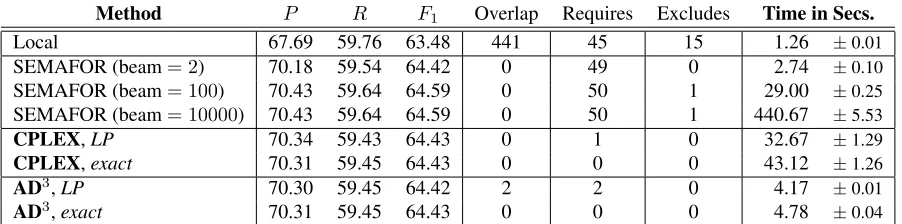
Table 1 shows performance of the different decoding strategies on the test set. We report precision, recall, and F1 scores.6 Since these scores do not
penal-6
We use the evaluation script from SemEval 2007 shared task, modified to evaluate only the argument identification output.
ize structural violations, we also report the number of overlap, “excludes,” and “requires” constraints that were violated in the test set. Finally, we tab-ulate each setting’s decoding time in seconds on the whole test set averaged over 5 runs.7 The Local model is very fast but suffers degradation in pre-cision and violates one constraint roughly per nine predicates. SEMAFOR used a default beam size of 10,000, which is extremely slow; a faster version of beam size 100 results in the same precision and re-call values, but is 15 times faster. Beam size 2 results in slightly worse precision and recall values, but is even faster. All of these, however, result in many constraint violations. Strategies involving CPLEX and AD3 perform similarly to each other and SE-MAFOR on precision and recall, but eliminate most or all of the constraint violations. SEMAFOR with beam size 2 is 11-16 times faster than the CPLEX strategies, but is only twice as fast than AD3, and re-sults in significantly more structural violations. The exact algorithms are slower than the LP versions, but compared to CPLEX, AD3is significantly faster and has a narrower gap between its exact and LP ver-sions. We found that relaxation was tight 99.8% of the time on the test examples.
The example in Fig. 1 is taken from our test set, and shows an instance where two roles, Partner 1
andPartner 2share the “requires” relationship; for this example, the beam search decoder misses the
Partner 2role, which is a violation, while our AD3 decoder identifies both arguments correctly. Note that beam search makes plenty of linguistic viola-tions, but has precision and recall values that are marginally better than AD3. We found that beam search, when violating many “requires” constraints, often finds one role in the pair, which increases its recall. AD3is sometimes more conservative in such cases, predicting neither role. A second issue, as noted in footnote 4, is that the annotations some-times violate these constraints. Overall, we found it interesting that imposing the constraints did not have much effect on standard measures of accuracy.
7
We used a 64-bit machine with 2 2.6GHz dual-core CPUs (i.e., 4 processors in all) with a total of 8GB of RAM. The work-ers in AD3were not parallelized, while CPLEX automatically
Violations
Method P R F1 Overlap Requires Excludes Time in Secs.
Local 67.69 59.76 63.48 441 45 15 1.26 ±0.01
SEMAFOR (beam= 2) 70.18 59.54 64.42 0 49 0 2.74 ±0.10
SEMAFOR (beam= 100) 70.43 59.64 64.59 0 50 1 29.00 ±0.25 SEMAFOR (beam= 10000) 70.43 59.64 64.59 0 50 1 440.67 ±5.53
CPLEX,LP 70.34 59.43 64.43 0 1 0 32.67 ±1.29
CPLEX,exact 70.31 59.45 64.43 0 0 0 43.12 ±1.26
AD3,LP 70.30 59.45 64.42 2 2 0 4.17 ±
0.01
[image:8.612.82.533.74.186.2]AD3,exact 70.31 59.45 64.43 0 0 0 4.78 ±0.04
Table 1: Comparison of decoding strategies in§4.2. We evaluate in terms of precision, recall andF1score on a test set containing 4,458 predicates. We also compute the number of structural violations each model makes: number of overlapping arguments and violations of the “requires” and “excludes” constraints of§2. Finally decoding time (without feature computation steps) on thewholetest set is shown in the last column averaged over 5 runs.
5 Related Work
Semantic role labeling: Most SRL systems use conventions from PropBank (Kingsbury and Palmer, 2002) and NomBank (Meyers et al., 2004), which store information about verbal and nominal pred-icates and corresponding symbolic and meaning-specific semantic roles. A separate line of work, including this paper, investigates SRL systems that use FrameNet conventions; while less popular, these systems, pioneered by Gildea and Jurafsky (2002), consider predicates of a wider variety of syntactic categories, use semantic frame abstractions, and em-ploy explicit role labels. A common trait in prior work has been the use of a two-stage model that identifies arguments first, then labels them. They are treated jointly here, unlike what has typically been done in PropBank-style SRL (M`arquez et al., 2008). Dual decomposition: Rush et al. (2010) proposed subgradient-based dual decomposition as a way of combining models which are tractable individually, but not jointly, by solving a relaxation of the origi-nal problem. This was followed by work adopting this method for syntax and translation (Koo et al., 2010; Auli and Lopez, 2011; DeNero and Macherey, 2011; Rush and Collins, 2011; Chang and Collins, 2011). Recently, Martins et al. (2011b) showed that the success of subgradient-based dual decomposi-tion strongly relies on breaking down the original problem into a “good” decomposition,i.e., one with few overlapping components. This leaves out many declarative constrained problems, for which such a good decomposition is not readily available. For those, Martins et al. (2011b) proposed the AD3
al-gorithm, which retains the modularity of previous methods, but can handle thousands of small over-lapping components.
Exact decoding: This paper contributes an exact branch-and-bound technique wrapped around AD3. A related line of research is that of Rush and Collins (2011), who proposed a tightening procedure for dual decomposition, which can be seen as a cutting plane method (another popular approach in combi-natorial optimization).
6 Conclusion
We presented a novel algorithm for incorporating declarative linguistic knowledge as constraints in shallow semantic parsing. It outperforms a na¨ıve baseline that is oblivious to the constraints. Further-more, it is significantly faster than a decoder em-ploying a state-of-the-art proprietary solver, and less than twice as slow as beam search, which is inexact and does not respect all linguistic constraints. Our method is easily amenable to the inclusion of more constraints, which would require minimal program-ming effort. Our implementation of AD3 within SEMAFOR will be publicly released athttp:// www.ark.cs.cmu.edu/SEMAFOR.
Acknowledgments
References
M. Auli and A. Lopez. 2011. A comparison of loopy be-lief propagation and dual decomposition for integrated ccg supertagging and parsing. InProc. of ACL. C. Baker, M. Ellsworth, and K. Erk. 2007.
SemEval-2007 Task 19: Frame semantic structure extraction. In Proc. of SemEval.
Y.-W. Chang and Michael Collins. 2011. Exact decoding of Phrase-Based translation models through lagrangian relaxation. InProc. of EMNLP. Association for Com-putational Linguistics.
D. Chen, N. Schneider, D. Das, and N. A. Smith. 2010. SEMAFOR: Frame argument resolution with log-linear models. InProc. of SemEval.
D. Das and N. A. Smith. 2011. Semi-supervised frame-semantic parsing for unknown predicates. InProc. of ACL.
D. Das, N. Schneider, D. Chen, and N. A. Smith. 2010a. Probabilistic frame-semantic parsing. In Proc. of NAACL-HLT.
D. Das, N. Schneider, D. Chen, and N. A. Smith. 2010b. SEMAFOR 1.0: a probabilistic frame-semantic parser. Technical report, CMU-LTI-10-001.
J. DeNero and K. Macherey. 2011. Model-based aligner combination using dual decomposition. In Proc. of ACL.
C. J. Fillmore, C. R. Johnson, and M. R.L. Petruck. 2003. Background to FrameNet. International Journal of Lexicography, 16(3).
C. J. Fillmore. 1982. Frame Semantics. InLinguistics in the Morning Calm. Hanshin.
M. Gerber and J. Y. Chai. 2010. Beyond nombank: A study of implicit arguments for nominal predicates. In ACL.
D. Gildea and D. Jurafsky. 2002. Automatic labeling of semantic roles.Computational Linguistics, 28(3). R. Johansson and P. Nugues. 2007. LTH: semantic
struc-ture extraction using nonprojective dependency trees. InProc. of SemEval.
P. Kingsbury and M. Palmer. 2002. From TreeBank to PropBank. InProc. of LREC.
N. Komodakis, N. Paragios, and G. Tziritas. 2007. MRF optimization via dual decomposition: Message-passing revisited. InICCV.
T. Koo, A. M. Rush, M. Collins, T. Jaakkola, and D. Son-tag. 2010. Dual decomposition for parsing with non-projective head automata. InProc. of EMNLP. L. M`arquez, X. Carreras, K. C. Litkowski, and S.
Steven-son. 2008. Semantic role labeling: an introduction to the special issue. Computational Linguistics, 34(2). A. F. T. Martins, N. A. Smith, E. P. Xing, M. A. T.
Figueiredo, and P. M. Q. Aguiar. 2010. Turbo parsers:
Dependency parsing by approximate variational infer-ence. InEMNLP.
A. F. T. Martins, M. A. T. Figueiredo, P. M. Q. Aguiar, N. A. Smith, and E. P. Xing. 2011a. An augmented Lagrangian approach to constrained MAP inference. InProc. of ICML.
A F. T. Martins, N. A. Smith, P. M. Q. Aguiar, and M. A. T. Figueiredo. 2011b. Dual decomposition with many overlapping components. InProc. of EMNLP. R. McDonald, K. Crammer, and F. Pereira. 2005. Online
large-margin training of dependency parsers. InProc. of ACL.
A. Meyers, R. Reeves, C. Macleod, R. Szekely, V. Zielin-ska, B. Young, and R. Grishman. 2004. The NomBank project: An interim report. In Proc. of NAACL/HLT Workshop on Frontiers in Corpus Anno-tation.
V. Punyakanok, D. Roth, W.-T. Yih, and D. Zimak. 2004. Semantic role labeling via integer linear programming inference. InProc. of COLING.
V. Punyakanok, D. Roth, and W Yih. 2008. The impor-tance of syntactic parsing and inference in semantic role labeling. Computational Linguistics, 34:257–287. A. Ratnaparkhi. 1996. A maximum entropy model for
part-of-speech tagging. InProc. of EMNLP.
A. M. Rush and M. Collins. 2011. Exact decoding of syntactic translation models through lagrangian relax-ation. InProc. of ACL.
A. M. Rush, D. Sontag, M. Collins, and T. Jaakkola. 2010. On dual decomposition and linear programming relaxations for natural language processing. In Pro-ceedings of EMNLP.
D. Smith and J. Eisner. 2008. Dependency parsing by belief propagation. InEMNLP.