Weiwei: A Simple Unsupervised Latent Semantics based Approach for
Sentence Similarity
Weiwei Guo
Department of Computer Science, Columbia University, [email protected]
Mona Diab
Center for Computational Learning Systems, Columbia University,
Abstract
The Semantic Textual Similarity (STS) shared task (Agirre et al., 2012) computes the degree of semantic equivalence between two sen-tences.1 We show that a simple unsupervised latent semantics based approach, Weighted Textual Matrix Factorization that only exploits bag-of-words features, can outperform most systems for this task. The key to the approach is to carefully handle missing words that are not in the sentence, and thus rendering it su-perior to Latent Semantic Analysis (LSA) and Latent Dirichlet Allocation (LDA). Our sys-tem ranks 20 out of 89 syssys-tems according to the official evaluation metric for the task, Pear-son correlation, and it ranks 10/89 and 19/89 in the other two evaluation metrics employed by the organizers.
1 Introduction
Identifying the degree of semantic similarity [SS] between two sentences is helpful for many NLP top-ics. In Machine Translation (Kauchak and Barzi-lay, 2006) and Text Summarization (Zhou et al., 2006), results are automatically evaluated based on sentence comparison. In Text Coherence Detection (Lapata and Barzilay, 2005), sentences are linked to-gether by similar or related words. For Word Sense Disambiguation, researchers (Banerjee and Peder-sen, 2003; Guo and Diab, 2012a) construct a sense similarity measure from the sentence similarity of the sense definitions.
Almost all SS approaches decompose the task into word pairwise similarity problems. For example,
Is-1Mona Diab, co-author of this paper, is one of the task orga-nizers
lam and Inkpen (2008) create a matrix for each sen-tence pair, where columns are the words in the first sentence and rows are the words in the second sen-tence, and each cell stores the distributional similar-ity of the two words. Then they create an alignment between words in two sentences, and sentence simi-larity is calculated based on the sum of the simisimi-larity of aligned word pairs. There are two disadvantages with word similarity based approaches: 1. lexical ambiguity as the word pairwise similarity ignores the semantic interaction between the word and sen-tence/context. 2. word co-occurrence information is not as sufficiently exploited as they are in latent variable models such as Latent Semantic Analysis (LSA) (Landauer et al., 1998) and Latent Dirichilet Allocation (LDA) (Blei et al., 2003). On the other hand, latent variable models can solve the two issues naturally by modeling the semantics of words and sentences simultaneously in the low-dimensional la-tent space.
However, attempts at addressing SS using LSA perform significantly below word similarity based models (Mihalcea et al., 2006; O’Shea et al., 2008). We believe the reason is that the observed words in a sentence are too few for latent variable mod-els to learn robust semantics. For example, given the two sentences of WordNet sense definitions for
bank#n#1andstock#n#1:
bank#n#1:a financial institution that accepts de-posits and channels the money into lending activities stock#n#1: the capital raised by a corporation through the issue of shares entitling holders to an ownership interest (equity)
LDA can only find the dominant topic (the
f inancialtopic) based on the observed words with-out further discernibility. In this case, many
tences will share the same latent semantics profile, as long as they are in the same topic/domain.
In our work (Guo and Diab, 2012b), we propose to model the missing words (words that are not in the sentence) to address the sparseness issue for the SS task. Our intuition is since observed words in a sentence are too few to tell us what the sentence is about, missing words can be used to tell us what the sentence isnotabout. We assume that the semantic space of both the observed and missing words make up the complete semantic profile of a sentence. We implement our idea using a weighted matrix factor-ization approach (Srebro and Jaakkola, 2003), which allows us to treat observed words and missing words differently.
It should be noted that our approach is very gen-eral (similar to LSA/LDA) in that it can be applied to any genre of short texts, in a manner different from existing work that models short texts by using addi-tional data, e.g., Ramage et al. (2010) model tweets using their metadata (author, hashtag, etc). Also we do not extract additional features such as multiwords expression or syntax from sentences – all we use is bag-of-words feature.
2 Related Work
Almost all current SS methods work in the high-dimensional word space, and rely heavily on word/sense similarity measures. The word/sense similarity measure is either knowledge based (Li et al., 2006; Feng et al., 2008; Ho et al., 2010; Tsatsa-ronis et al., 2010), corpus-based (Islam and Inkpen, 2008) or hybrid (Mihalcea et al., 2006). Almost all of them are evaluated on a data set introduced in (Li et al., 2006). The LI06 data set consists of 65 pairs of noun definitions selected from the Collin Cobuild Dictionary. A subset of 30 pairs is further selected by LI06 to render the similarity scores evenly dis-tributed. Our approach has outperformed most of the previous methods on LI06 achieving the second best Pearson’s correlation and the best Spearman corre-lation (Guo and Diab, 2012b).
3 Learning Latent Semantics of Sentences 3.1 Intuition
[image:2.612.340.512.54.105.2]Given only a few observed words in a sentence, there are many hypotheses of latent vectors that are highly related to the observed words. Therefore, missing
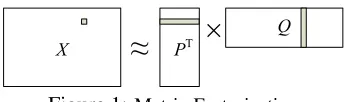
Figure 1:Matrix Factorization
words can be used to prune the hypotheses that are also highly related to the missing words.
Consider the hypotheses of latent vectors in Ta-ble 1 for the sentence of the WordNet definition ofbank#n#1. Assume there are 3 dimensions in our latent model: financial, sport, institution. We use Rvo to denote the sum of relatedness between latent vector v and all observed words; similarly,
Rvm is the sum of relatedness between the vector
v and all missing words. Hypothesis v1 is given
by topic models, where only the f inancial sen-tence is found, and it has the maximum relatedness to observed words inbank#n#1sentenceRv1o =20.
v2 is the ideal latent vector, since it also detects
thatbank#n#1is related toinstitution. It has a slightly smaller Rv2o =18, but more importantly, re-latedness to missing wordsRmv2=300 is substantially smaller thanRv1m=600.
However, we cannot simply choose a hypothesis with the maximumRo−Rmvalue, sincev3, which
is clearly not related tobank#n#1but with a min-imum Rm=100, will be our final answer. The
so-lution is straightforward: give a smaller weight to missing words, e.g., so that the algorithm tries to select a hypothesis with maximum value of Ro − 0.01×Rm. To implement this idea, we model the
missing words in the weighted matrix factorization framework [WMF] (Srebro and Jaakkola, 2003).
3.2 Modeling Missing Words by Weighted Matrix Factorization
Given a corpus we represent the corpus as an
M ×N matrix X. The row entries of the matrix are the unique N words in the corpus, and theM
columns are the sentence ids of all the sentences. The yieldedN ×M co-occurrence matrixX com-prises the TF-IDF values in each Xij cell, namely
that TF-IDF value of wordwiin sentencesj.
In WMF, the original matrixX is factorized into two matrices such thatX ≈P>Q, wherePis aK×
M matrix, andQis aK×N matrix (Figure 1). In this scenario, the latent semantics of each wordwior
financial sport institution Ro Rm Ro−Rm Ro−0.01Rm
v1 1 0 0 20 600 -580 14
v2 0.6 0 0.1 18 300 -282 15
[image:3.612.128.489.57.115.2]v3 0.2 0.3 0.2 5 100 -95 4
Table 1: Three possible hypotheses of latent vectors for definition ofbank#n#1
P·,i orQ·,j. Note that the inner product ofP·,i and Q·,jis used to approximate the semantic relatedness
of wordwiand sentencesj:Xij ≈P·,i·Q·,j, as the
shaded parts in Figure 1.
In WMF each cell is associated with a weight, so missing words cells (Xij=0) can have a much less
contribution than observed words. Assume wm is
the weight for missing words cells. The latent vec-tors of words P and sentences Q are estimated by minimizing the objective function:
X
i
X
j
Wij(P·,i·Q·,j−Xij)2+λ||P||22+λ||Q||22
whereWi,j=
1, ifXij6= 0 wm, ifXij= 0
(1)
Equation 1 explicitly requires the latent vector of sentence Q·,j to be not related to missing words
(P·,i ·Q·,j should be close to 0 for missing words Xij = 0). Also weight wm for missing words is
very small to make sure latent vectors such asv3in
Table 1 will not be chosen. In experiments we set
wm = 0.01. We refer to our approach as Weighted
Textual Matrix Factorization (WTMF).
After we run WTMF on the sentence corpus, the similarity of the two sentencessjandskcan be
com-puted by the inner product ofQ·,jandQ·,k.
3.3 Inference
The latent vectors in P andQare first randomly initialized, then can be computed iteratively by the following equations (derivation is omitted due to limited space, but can be found in (Srebro and Jaakkola, 2003)):
P·,i=
QW˜(i)Q>+λI
−1
QW˜(i)Xi,>·
Q·,j=
PW˜(j)P>+λI
−1
PW˜(i)X·,j
(2)
where W˜(i) = diag(W
·,i) is an M ×M diagonal
matrix containingith row of weight matrixW. Sim-ilarly, W˜(j) = diag(W·,j) is an N ×N diagonal
matrix containingjth column ofW.
Since most of the cells have the same value of 0, the inference can be further optimized to save com-putation, which has been described in (Steck, 2010).
4 Data Preprocessing
The data sets for WTMF comprises two dictionar-ies WordNet (Fellbaum, 1998), Wiktionary,2 and the Brown corpus. We did not link the senses be-tween WordNet and Wiktionary, therefore the defini-tion sentences are simply treated as individual docu-ments. We crawl Wiktionary and remove the entries that are not tagged as noun, verb, adjective, or ad-verb, resulting in 220,000 entries. For both WordNet and Wiktionary, target words are added to the defini-tion (e.g. the wordbankis added into the definition sentence ofbank#n#1). Also usage examples are appended to definition sentences (hence sentences become short texts). For the Brown corpus, each sentence is treated as a document in order to create more co-occurrence. The importance of words in a sentence is estimated by the TF-IDF schema.
All data is tokenized, pos-tagged3, and lemma-tized4. To reduce word sparsity issue, we take an additional preprocessing step: for each lemma-tized word, we find all its possible lemmas, and choose the most frequent lemma according to Word-Net::QueryData. For example, the wordthinkingsis first lemmatized asthinking, then we discover think-inghas possible lemmasthinkingandthink, finally we choosethinkas targeted lemma. The STS data is also preprocessed using the same pipeline.
5 Experiments
5.1 Setting
STS data: The sentence pair data in the STS task is collected from five sources: 1. MSR Para-phrase corpus (Dolan et al., 2004), 2. MSR video data (Chen and Dolan, 2011), 3. SMT europarl data,
2
http://en.wiktionary.org/wiki/Wiktionary:Main Page 3
http://nlp.stanford.edu/software/tagger.shtml 4
models MSRpar MSRvid SMT-eur ON-WN SMT-news
LDA 0.274 0.7682 0.452 0.619 0.366
[image:4.612.112.499.58.102.2]WTMF 0.411(67/89) 0.835(11/89) 0.513(10/89) 0.727(1/89) 0.438(28/89) Table 2: Performance of LDA and WTMF on each individual test set of Task 6 STS data
ALL ALLnrm Mean
0.695(20/89) 0.830(10/89) 0.608(19/89) Table 3: Performance of WTMF on all test sets
4. OntoNotes-WordNet data (Hovy et al., 2006), 5. SMT news data.
Evaluation Metrics: Since the systems are re-quired to assigned a similarity score to each sentence pair, Pearson’s correlation is used to measure the performance of systems on each of the 5 data sets. However, measuring the overall performance on the concatenation of 5 data sets is rarely discussed in previous work. Accordingly the organizers of STS task provide three evaluation metrics: 1. ALL: Pear-son correlation with the gold standard for the com-bined 5 data sets. 2. ALLnrm: Pearson correlation after the system outputs for each data set are fitted to the gold standard using least squares. 3. Mean: Weighted mean across the 5 data sets, where the weight depends on the number of pairs in the dataset.
WTMF Model: Our model is built on Word-Net+Wiktionary+Brown+training data of STS. Each sentence of STS test data is transformed into a latent vector using Equation 2. Then sentence pair similar-ity is computed by the cosine similarsimilar-ity of the two latent vectors. We employ the parameters used in (Guo and Diab, 2012b) (λ= 20, wm = 0.01).
5.2 Results
Table 3 summarizes the overall performance of WTMF on the concatenation of 5 data sets followed by the corresponding rank among all participating systems.5 There are 88 submitted results in total and 1 baseline which is simply the cosine similarity of surface word vectors.
Table 2 compares the individual performance of LDA (trained on the same corpus) and WTMF on each data set. WTMF outperforms LDA by a large margin. This is because LDA only uses10observed words to infer a100dimension vector, while WTMF takes advantage of much more missing words to
5http://www.cs.york.ac.uk/semeval-2012/
task6/index.php?id=results-update
learn more robust latent semantic vectors.
WTMF model achieves great overall perfor-mance, with ranks 20, 10, 19 out of 89 reported re-sults in three evaluation metrics respectively. It is worth noting that WTMF is unsupervised in that it does not use the training data similarity values, also the only feature WTMF uses is bag-of-words fea-tures without other information such as syntax, sen-timent, etc. indicating that these additional features could lead to even more improvement.
Observing the individual performance on each of the 5 data set, we find WTMF ranks relatively high in the four data sets: MSRvid (11/89), SMT-eur (11/89), ON-WN (1/89), SMT-news (28/89). How-ever, WTMF is outperformed by most of the systems on MSRpar data set (67/89). We analyze the data set and find that different from the other four data sets, MSRpar is related to a lot of other NLP topics such as textual entailment or sentiment coherence. There-fore, our feature set (bag of words) is too shallow for this data set indicating that using syntax and more semantically oriented features could be helpful.
6 Conclusions
We introduce a new latent variable model WTMF that is competitive with high dimensional ap-proaches to the STS task. In WTMF model, we ex-plicitly model missing words to alleviate the sparsity problem in modeling short texts. For future work, we would like to combine our methods with existing word similarity based approaches and add more nu-anced features incorporating syntax and semantics in the latent model.
Acknowledgments
References
Eneko Agirre, Daniel Cer, Mona Diab, and Aitor Gonzalez-Agirre. 2012. Semeval-2012 task 6: A pilot on semantic textual similarity. InProceedings of the 6th International Workshop on Semantic Evaluation (SemEval 2012), in conjunction with the First Joint Conference on Lexical and Computational Semantics (*SEM 2012).
Satanjeev Banerjee and Ted Pedersen. 2003. Extended gloss overlaps as a measure of semantic relatedness. InProceedings of the 18th International Joint Confer-ence on Artificial IntelligConfer-ence, pages 805–810. David M. Blei, Andrew Y. Ng, and Michael I. Jordan.
2003. Latent dirichlet allocation. Journal of Machine Learning Research, 3.
David L. Chen and William B. Dolan. 2011. Collecting highly parallel data for paraphrase evaluation. In Pro-ceedings of the 49th Annual Meeting of the Association for Computational Linguistics.
William Dolan, Chris Quirk, and Chris Brockett. 2004. Unsupervised construction of large paraphrase cor-pora: Exploiting massively parallel news sources. In
Proceedings of the 20th International Conference on Computational Linguistics.
Christiane Fellbaum. 1998. WordNet: An Electronic Lexical Database. MIT Press.
Jin Feng, Yi-Ming Zhou, and Trevor Martin. 2008. Sen-tence similarity based on relevance. InProceedings of IPMU.
Weiwei Guo and Mona Diab. 2012a. Learning the latent semantics of a concept from its definition. In Proceed-ings of the 50th Annual Meeting of the Association for Computational Linguistics.
Weiwei Guo and Mona Diab. 2012b. Modeling sen-tences in the latent space. InProceedings of the 50th Annual Meeting of the Association for Computational Linguistics.
Chukfong Ho, Masrah Azrifah Azmi Murad, Rabiah Ab-dul Kadir, and Shyamala C. Doraisamy. 2010. Word sense disambiguation-based sentence similarity. In
Proceedings of the 23rd International Conference on Computational Linguistics.
Eduard Hovy, Mitchell Marcus, Martha Palmer, Lance Ramshaw, and Ralph Weischedel. 2006. Ontonotes: The 90% solution. InProceedings of the Human Lan-guage Technology Conference of the North American Chapter of the ACL.
Aminul Islam and Diana Inkpen. 2008. Semantic text similarity using corpus-based word similarity and string similarity. ACM Transactions on Knowledge Discovery from Data, 2.
David Kauchak and Regina Barzilay. 2006. Paraphras-ing for automatic evaluation. In Proceedings of the
Human Language Technology Conference of the North American Chapter of the ACL.
Thomas K Landauer, Peter W. Foltz, and Darrell Laham. 1998. An introduction to latent semantic analysis.
Discourse Processes, 25.
Mirella Lapata and Regina Barzilay. 2005. Automatic evaluation of text coherence: Models and representa-tions. InProceedings of the 19th International Joint Conference on Artificial Intelligence.
Yuhua Li, Davi d McLean, Zuhair A. Bandar, James D. O Shea, and Keeley Crockett. 2006. Sentence similar-ity based on semantic nets and corpus statistics. IEEE Transaction on Knowledge and Data Engineering, 18. Rada Mihalcea, Courtney Corley, and Carlo Strapparava. 2006. Corpus-based and knowledge-based measures of text semantic similarity. InProceedings of the 21st National Conference on Articial Intelligence.
James O’Shea, Zuhair Bandar, Keeley Crockett, and David McLean. 2008. A comparative study of two short text semantic similarity measures. In Proceed-ings of the Agent and Multi-Agent Systems: Technolo-gies and Applications, Second KES International Sym-posium (KES-AMSTA).
Daniel Ramage, Susan Dumais, and Dan Liebling. 2010. Characterizing microblogs with topic models. In Pro-ceedings of the Fourth International AAAI Conference on Weblogs and Social Media.
Nathan Srebro and Tommi Jaakkola. 2003. Weighted low-rank approximations. InProceedings of the Twen-tieth International Conference on Machine Learning. Harald Steck. 2010. Training and testing of
recom-mender systems on data missing not at random. In
Proceedings of the 16th ACM SIGKDD International Conference on Knowledge Discovery and Data Min-ing.
George Tsatsaronis, Iraklis Varlamis, and Michalis Vazir-giannis. 2010. Text relatedness based on a word the-saurus.Journal of Articial Intelligence Research, 37. Liang Zhou, Chin-Yew Lin, Dragos Stefan Munteanu,