Selecting Machine-Translated Data for Quick Bootstrapping of a Natural
Language Understanding System
Judith Gaspers Amazon Aachen, Germany [email protected]
Penny Karanasou Amazon Cambridge, UK [email protected]
Rajen Chatterjee University of Trento
Trento, Italy
Abstract
This paper investigates the use of Machine Translation (MT) to bootstrap a Natural Lan-guage Understanding (NLU) system for a new language for the use case of a large-scale voice-controlled device. The goal is to de-crease the cost and time needed to get an an-notated corpus for the new language, while still having a large enough coverage of user requests. Different methods of filtering MT data in order to keep utterances that improve NLU performance and language-specific post-processing methods are investigated. These methods are tested in a large-scale NLU task with translating around 10 millions training ut-terances from English to German. The results show a large improvement for using MT data over a grammar-based and over an in-house data collection baseline, while reducing the manual effort greatly. Both filtering and post-processing approaches improve results further.
1 Introduction
In recent years, there has been growing inter-est in voice-controlled devices, such as Amazon Alexa or Google home. This success makes the quick bootstrapping of corresponding systems, in-cluding NLU models, for new languages a priori-tised goal. However, building a new NLU model for each language from scratch and gathering the necessary annotated corpora implies a significant amount of human time and effort both by anno-tators and scientists. In addition, this procedure is not scalable to supporting an increasing number of languages. On the other hand, a large amount of data is usually available for the language(s) that are already supported. Leveraging this source of data seems an obvious solution. In this paper,
The author Rajen Chatterjee conducted the work for this paper during an internship at Amazon, Cambridge, UK
we investigate the use of Machine Translation to translate existing data sources to a new target lan-guage and use them to bootstrap an NLU system for this target language.
A common procedure for data gathering for a new language starts by some grammar-generated data. Significant time and effort is consumed at this stage by language specialists to build gram-mars that offer a good coverage needed for a first working system. Once this first system reaches a certain performance threshold, it can be shared with beta users. This step allows more data that cover real user’s queries to be generated. All exist-ing data sources are then used to train the system that will be released to the final customers, once a new higher performance threshold is reached. Finally, when the system is released to the cus-tomers, customer data become available. Beta and customer data better cover the user utterances than grammar-generated data and are, thus, valuable for the development of a good and generalisable NLU system. However, it takes a significant amount of time and human annotation effort in order to have enough annotated beta, and later customer data, needed to build a good NLU system. Furthermore, having a system robust to new domains and fea-tures is very challenging and requires data with a wide coverage.
Machine Translation can be a useful tool for the quick expansion to new languages by automati-cally translating customer data from existing re-sources to new languages. This could decrease significantly the time needed to develop an NLU system that replies well to customer queries and is robust to new features. In this paper, we work with a large-scale system where around 10 millions an-notated customer data are available for US English with a wide coverage of domains and features. We use this corpus to augment the training data of a new language. In particular, we will present our
experiments on applying our technique to boot-strap a German NLU system based on existing US English training data.
In addition, we explore ways to choose the “good” translations from the translated ones, i.e. the ones that improve the NLU performance. The investigated methods fall in the following cate-gories. First, we investigate filtering based on MT quality. This method makes use of scores generated by the MT model to assign the qual-ity of translations. The second method explores improving the NLU performance by making sure the filtered translations keep the semantic infor-mation required by the NLU system. In this case, the matching of the NLU labels after a backward translation task is used as the filtering criterion. Lastly, some language-specific post-processing is applied on the translation output. This includes resampling data with catalogues of the new lan-guage. Another post-processing step applied is to keep the original (EN) version of certain slots that the users tend to leave untranslated.
This paper is organised as follows. In Section2, we give an overview of related literature. In Sec-tion 3, we present the methods for MT filtering for bootstrapping a new language while improv-ing NLU performance. Next, we detail the experi-mental setup in section4, including details on the used NLU and MT systems as well as the mono-lingual and bimono-lingual corpora used. Afterwards, we present results in Section5before concluding the paper in Section6.
2 Background work
Many efforts to avoid or minimize this manual work have been made in the last few years us-ing transfer learnus-ing, active learnus-ing and semi-supervised training. One of the successful ap-proaches has been making use of an MT system to obtain annotated corpora. The results of such works depend on the availability of an MT sys-tem (general-purpose or in-domain), on the qual-ity of the acquired translations and on the preci-sion of NLU label-word alignment when passing from one language to another.Garc´ıa et al.(2012) combine multiple online general-purpose trans-lation systems to achieve transferability between French and Spanish for a dialog system. Jabaian et al.(2011) study phrase-based translation as an alternative to Conditional Random Fields (CRF) to keep NLU label-word alignment info in the
decoding process. Lef`evre et al. (2010) propose the Semantic Tuple Classifiers (STC) model with-out any need for alignment information. Servan et al.(2010) translate the conceptual segments (i.e. NLU labeled) separately to maintain the chunking between source and target language but at the cost of degrading the translation quality.
There is a wide literature on assessing the MT quality. Evaluating the quality of MT output has been a topic in the Workshop of Machine Trans-lation (WMT) since its beginnings (WMT06) and a separate task since 2008 (“Shared Evaluation Task” (WMT08)). Since 2012 a more specific “Quality Estimation Task” (WMT12) appears with a focus on deciding whether a translation is good and how to filter out translations that are not good enough. In addition, in 2017 (WMT17) other re-lated topics appear including post-editing and ban-dit learning as specific tasks of correcting errors and improving MT quality by learning from feed-back. A straight-forward method is using human translated data as the true reference and correct MT errors using this ground truth. Automatic Post-Editing (APE) can also improve MT qual-ity by modifying MT output to the correct version (Chatterjee et al.,2017). Bandit learning (Sokolov et al., 2017) replaces human reference and post-edits by a weak user’s feedback. This feedback is introduced in the training process in a reinforce-ment learning framework updating the gradient to maximize the rewards corresponding to user’s feedback.
However, all previous method focus on improv-ing MT quality (i.e. BLEU score) and not the NLU task of interest. Jabaian et al.(2011) add noise to translation data and use translation post-editing to increase the robustness of NLU to translation er-rors. Other methods include measuring the proba-bility of a translated utterance by applying a target language LM, i.e. measuring if a translated utter-ance is typical, or computing the likelihood that an alignment between the source and the trans-lated utterance is correct, asKlinger and Cimiano
er-roneous translation results, the authors use back-translation results to check whether the back-translation result maintains the semantic meaning of the origi-nal sentence. The main difference though is that in the latter paper the method is applied using a very small dataset (less than 3k translated utterances) while we work with around 10 millions.
3 Method
In this paper, we explore bootstrapping of NLU models for a new language by translating train-ing data from an NLU system for a different language. The training data is representative of user requests to voice-controlled assistants; anno-tations are projected from source to target utter-ances during MT decoding. Since the quality of NLU models trained on MT data depends heavily on the quality of the MT data, we explore differ-ent methods for filtering and post-processing. In the following, we describe all approaches in more detail.
3.1 Filtering
The goal of the filtering approaches is to choose ”good” translations, i.e. we aim to keep primary translations in the training data which are likely to be useful for building NLU models. We ex-plore two approaches for filtering, one based on MT system scores and one based on semantic in-formation.
3.1.1 Filtering based on semantic information
Misu et al. (2012) remove erroneous machine translations in the NLU training data by using back-translations to measure whether the seman-tic information of a source utterance is retained in the translated utterance. In particular, they apply the following steps:
1. Label the source utterance with an NLU model
2. Translate the source utterance
3. Label the translated utterance by aligning with the result of step 1
4. Translate the translated utterance back into the source language
5. Label the back-translated utterance with an NLU model
6. Keep the target utterance, if the the recog-nised intents of steps 1 and 5 are the same
The authors present results with Japanese as the source and English as the target language, sug-gesting improved spoken language understanding results by filtering translations for the training data with their approach. Thus, this approach aims to keep translations for which some semantic infor-mation of utterances is retained, potentially avoid-ing errors in the NLU models trained on these data. We apply this approach in an adapted form, i.e. instead of the additional alignment step (3), we project labels using the MT system, i.e. we make use of the alignment model trained for the MT system. In addition, we extend the approach by 1) determining if the recognised slots are re-tained in addition to the intent, and 2) making use of the NLU model’s confidence, i.e. we remove utterances retaining the intent, if the confidence of the NLU model is very low (<0.1on a scale from 0−1).
3.1.2 Filtering based on MT scores
This approach explores the scores returned by the MT system for choosing translations from a train-ing dataset. Since annotattrain-ing the translations for quality judgement by humans is expensive, we considered to use the translation score as a qual-ity metric that can give us relative qualqual-ity judge-ment among a list of translations. In particu-lar, we computed a threshold for each domain based on translation scores. The score we used is the weighted overall translation score as given by Moses MT toolkit and combining the scores of the translation model, the language model, the re-ordering score and some word penalty. To create a domain-wise threshold, given a translated utter-ance and its score, we first normalised the score by utterance length. Afterwards, we computed mean and standard deviation per domain. We then se-lected translations that have a score greater than or equal to the threshold. In this work, we eval-uated different thresholds like mean of the trans-lation scores, mean+stdev (standard deviation), mean+(0.5*stdev), and mean+(0.25*stdev).
3.2 Language-specific post-processing
Aiming to improve the quality of slot values in the translated data, we explore two strategies for language-specific post-processing.
3.2.1 Slot resampling
lan-guage might not model those of user requests in the target language. For example, when request-ing a weather forecast, American customers would much more frequently ask for an American city than a German one. Thus, an utterance ”how is the weather in New York” is likely to be much more frequent in the resulting training data than an utterance ”how is the weather in Berlin”, and consequently it would appear more frequently in the data after translation to German. This, how-ever, doesn’t seem to model language use by Ger-man customers well and can hence potentially de-grade performance of statistical models trained on these data. Aiming to decrease the mismatch in slots values between source language and target language use, we used catalogs to resample slot values for slots where this seemed to be appro-priate. In particular, we replaced slot values in the translated data using target language catalog entries corresponding to the slot. For instance, a catalog with German cities can be used to replace ”New York” by ”Berlin” in the previously men-tioned example. For catalogs comprising informa-tion, which can be used for weighting catalog en-tities, we made use of it in that we sample entities according to weights, i.e. the higher the weight, the more often the corresponding entity is sam-pled. For example, the number of orders can be used to weight albums and population size can be used to weight cities.
3.2.2 Keeping some original slot values
Machine translation systems might incorrectly translate slot values which should not be trans-lated. For example, in an utterance ”play we are the champions by queen”, the song title ”we are the champions” and the band name ”queen” should not be translated. While we can apply slot resampling to ingest existing slot values into such utterances, we also explore a different approach. In particular, in this approach we post-process the translated utterances to retain the slot values from the source language utterances for certain slots, such as artists or song titles.
4 Experimental setup
We ran experiments using US English as the source and German as the target language. Since we are interested in bootstrapping an NLU model for a new language which would first be deployed to beta customers, we evaluate our approach on German beta data. In the following, we first briefly
describe the MT and NLU systems and subse-quently the datasets.
4.1 MT and NLU systems
We used a phrase-based MT system which was built using Moses (Koehn et al., 2007) for a sim-ilar task, i.e. Question Answering (QA). The MT system is a multi-domain model trained on a mixture of internal and external parallel data sources, which are not from the QA domain; overall the out-of-domain data sources comprised 28,733,606 segments. The system was fine-tuned using a small manually created parallel corpus for QA, comprising 4,000 segments, and 424,921 in-domain target language segments were used for the target language model. Training data were pre-processed, in particular they were converted into spoken form before building the MT system to bet-ter match spoken user utbet-terances of an NLU sys-tem. We used an MT system for a similar task rather than an MT system adapted for our data, because we would expect that suitable in-domain data for adaptation might not yet be available for early bootstrapping, i.e. when target language data have not yet been collected.
For building NLU models, we use Conditional Random Fields (Lafferty et al., 2001; Okazaki,
2007) for Named Entity Recognition and a Max-imum Entropy classifier (Berger et al.,1996) for Intent Classification; we keep the sets of features, hyper-parameters and configuration constant for our experiments.
4.2 Datasets
We translated 10M of training data utterances from a US English NLU system. Overall, the data cover several domains with a large number of dif-ferent intents and slots/named entities. We trans-lated the data using the previously described MT system. NLU labels were kept and aligned dur-ing the MT decoddur-ing to project them from the En-glish source utterances to the corresponding Ger-man translations. The final training dataset com-prised 9,963,624 utterances.
For testing, we created a dataset collected from German Beta users; German test data were man-ually transcribed and annotated with intents and slots/named entities. The resulting test dataset comprised 119,772 utterances.
slots. While in-house data collections are costly and time-consuming, they constitute a reasonable approach for bootstrapping a model from scratch when customer data are not yet available.
The data amounts are summarised in Table1.
Dataset No. utt.
US EN→DE translated data (train) 9,963,624
DE Beta data (test) 119,772 In-house data collection (train) 10,000
Table 1: Number of utterances per dataset.
In addition, we created a grammar-based base-line. In particular, we randomly sampled ut-terances from grammars and created a training dataset from them. For this, we used around 200 grammars written by language experts covering (most) intents and slots supported by the NLU sys-tem. However, one of the domains was not cov-ered by grammars, because it supports very di-verse features and requests, which are difficult to capture by a grammar.
We report results by means of a semantic er-ror rate (SemER) which is computed based on the number of insertions, deletions and substitutions for slots and the intent in a recognised utterance compared to a reference utterance, i.e.
SemER= # (slots + intents in reference)# (slot + intent errors)
5 Results
First, we compare our approach to the baseline approaches based on grammars and an in-house data collection. For this, we trained NLU mod-els on MT data, on the in-house data collection, on grammar-generated data as well as on MT data together with each baseline dataset. Subsequently, we evaluated the models on the German beta data test set. Results for model trained on the MT dataset and on the baseline datasets are presented in Table2.
Training data SemER (%)
Grammar-generated data (baseline) 55.44 In-house collection (baseline) 23.30
MT data 21.38
MT data+grammar-generated data 20.00
MT data+in-house collection 17.20
Table 2: Comparison for NLU models trained on MT data to our baseline models, i.e. models trained on grammar-generated data and models trained on an in-house data collection of 10k utterances.
As can be seen, the MT approach outperforms the grammar-based one by a large percentage (i.e. around 33% absolute in SemER), while requiring much less manual effort. In addition, training on both MT and grammar-generated data improves performance over training solely on either one of the datasets; the improvement of the joined ap-proach is particularly large over training solely on grammar-generated data (i.e. around 35 % abso-lute in SemER). As noted before, the grammars did not cover one of the domains, yielding errors for its test utterances. To get an estimate of this im-pact, we removed all utterances from this domain from the test set and recomputed SemER for the grammar-based baseline. While SemER dropped to 34.23, there is still a large difference in perfor-mance compared to training on MT data and one domain is not supported at all, even though it is needed by the system. Compared to the grammar-based baseline, training on the in-house data col-lection yields a lower SemER of 23.3. Still, train-ing on MT data outperforms this baseline as well, and combining MT data with the in-house data collection improves further over training solely on either one of the datasets (i.e. 17.2 for both vs 21.38 for MT and 23.3 for the in-house collection). Thus, MT data appear to be useful for both boot-strapping an NLU model from scratch and enhanc-ing models trained on grammar-generated data or on an in-house data collection of 10k.
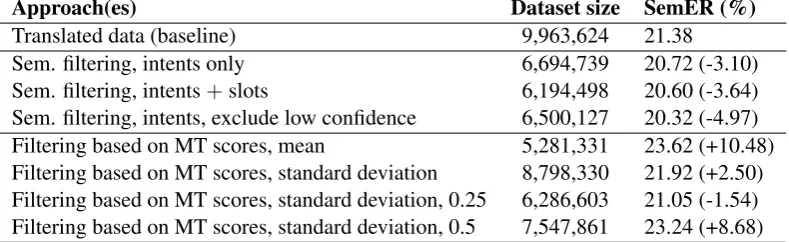
In the following, we evaluate whether our filter-ing and post-processfilter-ing approaches can improve the quality of the MT training data further. Ta-ble 3 presents the results for our filtering ap-proaches. While filtering based on semantic in-formation yields an improvement in SemER over using MT data as they are, filtering based on MT scores only yields a slight improvement in one of the conditions. For filtering based on semantic formation, our results confirm in a large-scale in-dustry setting that training on utterances for which the intent is retained after back-translation is use-ful. In addition, our results show that perfor-mance can be improved further by either addi-tionally removing utterances for which the slots are not retained or by removing utterances for which the confidence is very low. Here, removing low confidence utterances yields slightly better re-sults. While we tested with0.1as a threshold,
Approach(es) Dataset size SemER (%)
Translated data (baseline) 9,963,624 21.38 Sem. filtering, intents only 6,694,739 20.72 (-3.10) Sem. filtering, intents+slots 6,194,498 20.60 (-3.64)
[image:6.595.102.497.65.186.2]Sem. filtering, intents, exclude low confidence 6,500,127 20.32 (-4.97) Filtering based on MT scores, mean 5,281,331 23.62 (+10.48) Filtering based on MT scores, standard deviation 8,798,330 21.92 (+2.50) Filtering based on MT scores, standard deviation, 0.25 6,286,603 21.05 (-1.54) Filtering based on MT scores, standard deviation, 0.5 7,547,861 23.24 (+8.68)
Table 3: Results of the filtering approaches. Relative changes with respect to the baseline are given in parentheses.
Filtering based on MT scores decreases per-formance in all considered conditions, except mean+(0.25*stdev), which yields a very slight im-provement. However, results were not consistent across domains, i.e., while overall SemER as well as SemER for several domains increased in most cases, it decreased for several domains with rel-ative decreases of up to 48.35%. Here, manual inspection of the data indicates that this approach is not well-suited for domains comprising very di-verse data, since one threshold based on a mean score cannot capture diverse data well. In ad-dition, manual inspection revealed that a rather large percentage of the increase in SemER was due to removing ambiguous utterances, as these typi-cally have a rather low MT score, but are some-times very frequently used and hence need to be captured by the NLU system. For example, the German utterance ”weiter” is frequently used, but can mean both ”forward” and ”resume” in En-glish, implying also different user intents. Remov-ing only this one utterance from the trainRemov-ing data yielded around 2.5k errors, since this utterance is frequent in the test data. However, frequent errors could potentially be fixed manually with little ef-fort by a rule-based approach. Since the approach based on MT scores yields improvements for cer-tain domains, further investigations on the nature of datasets/domains it works well with could be in-teresting. Since it also yields improved results for some domains compared to the approach based on semantic information, further experiments investi-gating the combination of both approaches could potentially improve results further.
Table 4 shows the results of our language-specific post-processing approaches.
The results show that slot resampling has al-most no impact on the error rates. The reason might be that the statistical model uses catalogs
Approach(es) SemER (%)
Translated data (baseline) 21.38
Slot resampling 21.53 (+0.69) Original slots 23.82 (+11.40) Original slots+resampling 20.18 (-5.60)
Table 4: Results of the language-specific post-processing approaches. Relative changes in relation to the baseline are given in parentheses.
also as gazetteers, and hence already includes in-formation on German entities during training. Fu-ture work might investigate the effect of slot re-sampling for models which do not use gazetteers. Keeping some original slot values degrades per-formance from 21.38% to 23.82%. One reason for the decrease in performance might be that keep-ing a few original slot values decreases the fre-quency of appearance of some German words that still appear in the test set and are requested by users in German. However, it is not consistent that some words or some slots are always in German or English, yielding some mismatches between translated training data and test data. Aiming to counterbalance the increase of English words’ fre-quency, but also consider the original slot values, we combined both approaches. As can be seen in the table, the combined approach yields an im-provement, i.e. SemER is 20.18% compared to 21.38% for training on MT data as they are. With 20.18%, this approach is also performing better than our best-performing filtering approach which yields 20.32% in SemER. One interesting ques-tion for future work will be to explore if combin-ing filtercombin-ing and language-specific post-processcombin-ing approaches will improve results further.
similar to the NLU model trained on both the initial MT data and the grammar-generated data (20.18% vs 20.0%). However, our proposed post-processing approach can be applied automatically and quickly, while grammar writing is very costly and time-consuming.
6 Conclusion
Aiming to reduce time and costs needed to boot-strap an NLU model for a new language, in this paper we made use of MT data to build NLU mod-els. In addition, we compared different techniques to filter and post-process the MT data, aiming to improve NLU performance further. These meth-ods were evaluated in large-scale experiments for a voice-controlled assistant to bootstrap a Ger-man system using English data. The results when using MT data showed a large improvement in performance compared to a grammar-based base-line and outperformed a basebase-line using an in-house data collection. The applied filtering and post-processing techniques improved results fur-ther over using MT data as they are.
In future work, we plan to apply our approach to further languages and explore bootstrapping new domains for an existing NLU system.
Acknowledgments
We thank Steve Sloto, Greg Hanneman, Donna Gates and Patrick Porte for building the MT sys-tem and Fabian Triefenbach and Daniel Marcu for valuable comments on this paper.
References
Adam L Berger, Vincent J Della Pietra, and Stephen A Della Pietra. 1996. A maximum entropy approach to natural language processin. Computational
Lin-guistics22(1):39–71.
Rajen Chatterjee, Amin Farajian, Matteo Negri, Marco Turchi, Ankit Srivastava, Santanu Kumar Pal, and Bruno Kessler. 2017. Multi-source neural automatic post-editing: Fbkas participation in the wmt 2017 ape shared task. InProceedings of the Second Con-ference on Machine Translation,Copenhagen, Den-mark.
Fernando Garc´ıa, Llu´ıs F. Hurtado, Encarna Segarra, Emilio Sanchis, and Giuseppe Riccardi. 2012. Com-bining multiple translation systems for spoken lan-guage understanding portability. In2012 IEEE Spo-ken Language Technology Workshop (SLT), Miami,
FL, USA, December 2-5, 2012. pages 194–198.
B. Jabaian, L. Besacier, and F. Lef`evre. 2011. Com-bination of stochastic understanding and machine translation systems for language portability of dia-logue systems. In 2011 IEEE International Con-ference on Acoustics, Speech and Signal Processing
(ICASSP). pages 5612–5615.
Roman Klinger and Philipp Cimiano. 2015. Instance selection improves cross-lingual model training for fine-grained sentiment analysis. InProceedings of the Nineteenth Conference on Computational
Natu-ral Language Learning. Association for
Computa-tional Linguistics, Beijing, China, pages 153–163.
Philipp Koehn, Hieu Hoang, Alexandra Birch, Chris Callison-Burch, Marcello Federico, Nicola Bertoldi, Brooke Cowan, Wade Shen, Christine Moran, Richard Zens, Chris Dyer, Ondˇrej Bojar, Alexandra Constantin, and Evan Herbst. 2007. Moses: Open source toolkit for statistical machine translation. In Proceedings of the 45th Annual Meeting of the ACL
on Interactive Poster and Demonstration Sessions.
ACL ’07, pages 177–180.
John D. Lafferty, Andrew McCallum, and Fernando C. N. Pereira. 2001. Conditional random fields: Probabilistic models for segmenting and labeling se-quence data. InProceedings of the Eighteenth
Inter-national Conference on Machine Learning. ICML
’01, pages 282–289.
Fabrice Lef`evre, Franc¸ois Mairesse, and Steve J. Young. 2010. Cross-lingual spoken language un-derstanding from unaligned data using discrimina-tive classification models and machine translation.
In INTERSPEECH 2010, 11th Annual Conference
of the International Speech Communication Associ-ation, Makuhari, Chiba, Japan, September 26-30, 2010. pages 78–81.
T. Misu, E. Mizukami, H. Kashioka, S. Nakamura, and H. Li. 2012. A bootstrapping approach for slu porta-bility to a new language by inducting unannotated user queries. In 2012 IEEE International Confer-ence on Acoustics, Speech and Signal Processing
(ICASSP). pages 4961–4964.
Naoaki Okazaki. 2007.Crfsuite: a fast implementation of conditional random fields (crfs).http://www.
chokkan.org/software/crfsuite/.
Christophe Servan, Nathalie Camelin, Christian Ray-mond, Fr´ed´eric B´echet, and Renato de Mori. 2010. On the use of machine translation for spoken lan-guage understanding portability. In Proceedings of the IEEE International Conference on Acoustics, Speech, and Signal Processing, ICASSP 2010, 14-19 March 2010, Sheraton Dallas Hotel, Dallas, Texas, USA. pages 5330–5333.
WMT06. 2006. NAACL 2006 workshop on statisti-cal machine translation. http://www.statmt. org/wmt06/.
WMT08. 2008. ACL 2008 third workshop on statistical machine translation - Shared task: Automatic evaluation of machine transla-tion. http://www.statmt.org/wmt08/
shared-evaluation-task.html.
WMT12. 2012. NAACL 2012 seventh workshop on statistical machine translation - Shared task: Qual-ity estimation. http://www.statmt.org/
wmt12/quality-estimation-task.html.
WMT17. 2017. EMNLP 2017 second conference on machine translation (WMT17). http://www.