Proceedings of NAACL-HLT 2018: Demonstrations, pages 61–65
CNNs for NLP in the Browser: Client-Side Deployment
and Visualization Opportunities
Yiyun Liang, Zhucheng Tu, Laetitia Huang, and Jimmy Lin
David R. Cheriton School of Computer Science University of Waterloo
{yiyun.liang, michael.tu, laetitia.huang, jimmylin}@uwaterloo.ca
Abstract
We demonstrate a JavaScript implementation of a convolutional neural network that per-forms feedforward inference completely in the browser. Such a deployment means that mod-els can run completely on the client, on a wide range of devices, without making backend server requests. This design is useful for ap-plications with stringent latency requirements or low connectivity. Our evaluations show the feasibility of JavaScript as a deployment tar-get. Furthermore, an in-browser implemen-tation enables seamless integration with the JavaScript ecosystem for information visual-ization, providing opportunities to visually in-spect neural networks and better understand their inner workings.
1 Introduction
Once trained, feedforward inference using neu-ral networks (NNs) is straightforward: just a se-ries of matrix multiplications, application of non-linearities, and other simple operations. With the rise of model interchange formats such as ONNX, we now have clean abstractions that sepa-rate model training from model inference. In this context, we explore JavaScript as a deployment target of neural networks for NLP applications. To be clear, we are not concerned with training, and simply assume the existence of a pre-trained model that we wish to deploy for inference.
Why JavaScript? We provide two compelling reasons. First, JavaScript is the most widely de-ployed platform in the world since it resides in ev-ery web browser. An implementation in JavaScript means that a NN can be embedded in any web page for client-side execution on any device that has a browser—from laptops to tablets to mobile phones to even potentially “smart home” gadgets. Performing inference on the client also obviates
the need for server requests and the associated la-tencies. With such a deployment, NLP applica-tions that have high demands on responsiveness (e.g., typeahead prediction, grammar correction) or suffer from low connectivity (e.g., remote lo-cations or developing countries) can take advan-tage of NN models. Such a deployment also pro-tects user privacy, since user data does not leave the client. Second, the browser has emerged as the dominant platform for information visualiza-tion, and JavaScript-based implementations sup-port seamless integration with modern techniques and existing toolkits (e.g., D3.js). This provides opportunities to visually inspect neural networks.
We demonstrate a prototype implementation of a convolutional neural network for sentence classi-fication, applied to sentiment analysis—the model ofKim(2014)—in JavaScript, running completely inside a web browser. Not surprisingly, we find that inference performance is significantly slower compared to code running natively, but the browser is nevertheless able to take advantage of GPUs and hardware acceleration on a variety of platforms. Our implementation enables simple visualizations that allow us to gain insights into what semantic n-gram features the model is ex-tracting. This is useful for pedagogy (teaching stu-dents about neural networks) as well as research, since understanding a model is critical to improv-ing it. Overall, our visualizations contribute to an emerging thread of research oninterpretable ma-chine learning (Lipton,2016).
2 Background and Related Work
Browser-based neural networks are by no means new. Perhaps the best illustration of their poten-tial is the work of Smilkov et al. (2016a), who illustrate backpropagation on simple multi-layer perceptrons with informative visualizations. This
work, however, can be characterized as focusing on toy problems and useful primarily for peda-gogy. More recently, Google Brain introduced TensorFlow.js (formerly deeplearn.js), an open-source library that brings NN building blocks to JavaScript. We take advantage of this library in our implementation.
Our work overcomes a technical challenge that to date remains unaddressed—working with word embeddings. Most NNs for NLP applications be-gin by converting an input sentence into an em-bedding matrix that serves as the actual input to the network. Embeddings can be quite large, of-ten gigabytes, which makes it impractical to store directly in a web page. Following Lin (2015), we overcome this challenge by using an HTML standard known as IndexedDB, which allows word vectors to be stored locally for efficient access (more details below).
3 Technical Implementation
The convolutional neural network ofKim (2014) is a sentence classification model that consists of convolutions over a single sentence input em-bedding matrix with a number of feature maps and pooling followed by a fully-connected layer with dropout and softmax output. Since it has a straightforward architecture, we refer the reader to Kim’s original paper for details. The starting point for this work is a PyTorch reimplementation of the model, which achieves accuracy comparable to the original reported results.1
Since our demonstration focuses on inference performance, we simply used a pre-trained model for sentiment analysis based on the Stanford Senti-ment Treebank. We manually exported all weights from PyTorch and hand-coded the model archi-tecture in TensorFlow.js, which at startup im-ports these weights. Since Kim CNN has a rela-tively simple architecture, this implementation is straightforward, as TensorFlow.js provides primi-tives that are quite similar to those in PyTorch. Be-cause our implementation is pure JavaScript, the entire model can be directly included in the source of any web page, and, for example, connect to text entry boxes for input and DOM-manipulating code for output. However, there is one additional technical hurdle to overcome:
Nearly all neural networks for NLP applications make use of pre-trained word vectors to build an
1https://github.com/castorini/Castor
input representation (the embedding matrix) as the first step in inference. For a non-toy vocabulary, these word vectors consume many gigabytes. It is impractical to embed these data directly within a web page or as an external resource due to mem-ory limitations, since all JavaScript code and as-sociated resources are loaded into memory. Even if this were possible, all data would need to be reloaded every time the user refreshes the browser tab, leading to long wait times and an awkward user experience.
To address this challenge, we take advantage of IndexedDB, which is a low-level API for client-side storage of arbitrary amounts of data. Since IndexedDB is an HTML5 standard, it does not re-quire additional plug-ins (assuming a standards-compliant browser). Although IndexedDB has a rich API, for our application we use it as a simple key–value store, where the key is a word and the value is its corresponding word vec-tor. In Google’s Chrome browser (which we use for our experiments), IndexedDB is supported by LevelDB, an on-disk key–value store built on the same basic design as the Bigtable tablet stack (Chang et al., 2006). In other words, in-side every Chrome browser there is a modern data management platform that is directly accessible via JavaScript.
With IndexedDB, prior to using the model for inference, the user must first download and store the word embeddings locally. For convenience, the model weights are treated the same way. Note that this only needs to be performed once, and all data are persisted on the client until storage is ex-plicitly reclaimed. This means that after a one-time setup, model inference happens locally in the browser, without any need for external connectiv-ity. This enables tight interaction loops that do not depend on unpredictable server latencies.
4 Performance Evaluation
Latency (ms) / batch
1 32 64 128
PyTorch
Desktop GPU(Ubuntu 16.04) 2.9 3.0 3.1 3.1 Desktop CPU(Ubuntu 16.04) 4.3 43 86 130 Chrome Browser
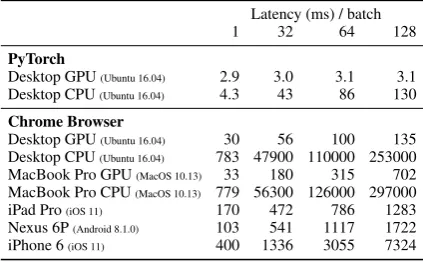
[image:3.595.76.288.63.194.2]Desktop GPU(Ubuntu 16.04) 30 56 100 135 Desktop CPU(Ubuntu 16.04) 783 47900 110000 253000 MacBook Pro GPU(MacOS 10.13) 33 180 315 702 MacBook Pro CPU(MacOS 10.13) 779 56300 126000 297000 iPad Pro(iOS 11) 170 472 786 1283 Nexus 6P(Android 8.1.0) 103 541 1117 1722 iPhone 6(iOS 11) 400 1336 3055 7324
Table 1: Latency of our CNN running in Chrome on different devices for a batch ofNsentences.
GPU (running Ubuntu 16.04). Our model was im-plemented using PyTorch v0.3.0 running CUDA 8.0. All experiments were performed on the Stan-ford Sentiment Treebank validation set. Due to the asynchronous nature of JavaScript execution in the browser, the TensorFlow.js API applies inference to batches of input sentences at a time. Thus, we measured latency per batch for batches of 1, 32, 64, and 128 sentences.
Evaluation results are shown in Table 1. The first block of the table shows the performance of PyTorch running on the desktop, with and without GPU acceleration. As expected, the GPU is able to exploit parallelism for batch inferencing, but on individual sentences, the CPU is only slightly slower. In the bottom block of the table, we report results of running our JavaScript implementation in Google Chrome (v64). We compared the desk-top and the lapdesk-top, with and without GPU accel-eration. For the most common case (inference on a single sentence), the browser is about an order of magnitude slower with the GPU. Without the GPU, performance drops by another∼25×.
The above figures include only inference time. Loading the word vectors takes 7.4, 214, 459, and 1184 ms, for batch sizes of 1, 32, 64, and 128, respectively, on the MacBook Pro. As ex-plained previously, using IndexedDB requires a one-time download of the word vectors and the model weights. This step takes approximately 16s on our MacBook Pro for 16,271 word vectors (for simplicity, we only download the vocabulary needed for our experiments). Loading the model itself takes approximately one second.
Because our implementation is in JavaScript, our model runs in any device that has a web browser. To demonstrate this, we evaluated per-formance on a number of other devices we had
convenient access to: an iPad Pro with an Apple A10X Fusion chip, a Nexus 6P with a Qualcomm Snapdragon 810 octa-core CPU, and an iPhone 6 with an Apple A8 chip. These results are also shown in Table 1. As expected, performance on these devices is lower than our laptop, but inter-estingly, batch inference on these devices is faster than batch inference in the browser without GPU acceleration. This indicates that hardware accel-eration is a standard feature on many devices to-day. These experiments illustrate the feasibility of deploying neural networks on a wide range of de-vices, exploiting the ubiquity of JavaScript.
5 Visualization of Feature Maps
Another major advantage of in-browser JavaScript implementations of neural networks is seamless integration with modern browser-based informa-tion visualizainforma-tion techniques and toolkits (e.g., D3.js), which we describe in this section. Visu-alizations are useful for two purposes: First, they serve as intuitive aids to teach students how neu-ral networks function. Although there are plenty of pedagogical resources for deep learning, noth-ing beats the convenience of an interactive neu-ral network directly embedded in a web page that students can manipulate. Second, contributing to growing interest in “interpretable” machine learn-ing (Lipton,2016), visualizations can help us un-derstand how various network components con-tribute to producing the final predictions.
Although there are many examples of neural network visualizations (Smilkov et al.,2016a;Bau
et al.,2017;Olah et al.,2018), they mostly focus
on vision applications, where inputs and feature maps are much easier to interpret visually. The fundamental challenge with NLP applications is that word embeddings (and by extension, feature maps) exist in an abstract semantic space that has no inherent visual meaning. How to best visualize embeddings remains an open question (Smilkov
et al.,2016b;Rong and Adar,2016).
Nevertheless, feature maps in CNNs can be thought of as n-gram feature detectors. For our
4/12/2018 word2vec Demo
file:///Users/isa/Documents/University_of_Waterloo/URA/3A-Jimmy%20Lin/kim-cnn-vis/kimcnn-demo.html 1/1 anchored
by friel
and williams
's exceptional performances
, the film
's power
lies in its complexity
.
word2vec
Filter Demo
The following demo searches word2vecs. Be sure to build the index (indexing-demo.html) first!
Finished processing sentence in: 491.5000000000873ms.
anchored by friel and williams 's e Run width=3 width=4 width=5
×
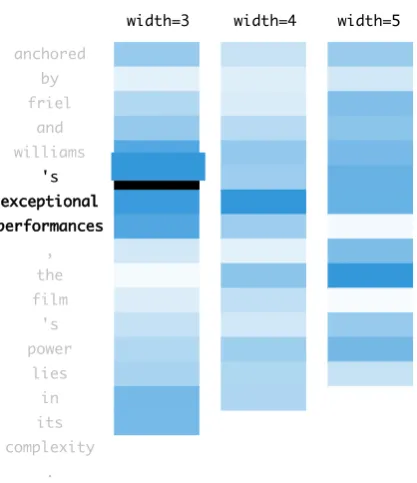
Figure 1: Visualization of feature map activations.
The visualization in Figure1is designed to an-swer the first question. Running down the left edge is the sentence that we are examining; ex-amples in this section are taken from the devel-opment set of the Stanford Sentiment Treebank. Each column represents feature maps of a particu-lar width; each cell is aligned with the first token from the corresponding n-gram of the sentence
over which the feature map applies. The heatmap (i.e., blue saturation) corresponds to maximum ac-tivation across all feature maps on that particu-lar n-gram in the sentence. In our interactive
vi-sualization, when we mouse over a cell, it be-comes enlarged and slightly offset to indicate fo-cus, and the correspondingn-gram in the sentence
is highlighted in bold. For this sentence, we see that filters of width three are most highly acti-vated by then-gram sequence [’s exceptional
per-formance]. There are multiple ways to use color to summarize the activation of the feature maps, but we have found MAX to be the most insight-ful. From this visualization, we can see that fea-ture maps of widths four and five activate on dif-ferent parts of the sentence.
From the visualization in Figure 1, we see that
somefeature map activates highly on the n-gram
[’s exceptional performance]. But which one? To answer this question, we can pivot over to the vi-sualization shown in Figure 2, where we see that the answer is Filter 12: we show then-grams that
trigger the highest activation from sentences in the
Filter 12 (width = 3, bias = 0.01)
4/4 ... this chamber drama is superbly acted by the deeply appealing ...
3/4 a superbly actedand funny gritty fable of ...
3/4 a rigorously structured and exquisitely filmed drama about a father ...
4/4 uses sharp humor and insight into human ...
4/4 ... friel and williams's exceptional performances , the film 's ...
4/4 ... of elling , and gets fine performancesfrom his two leads ...
4/4 an exquisitely crafted and acted tale .
4/4 ... mueller , the film gets great laughs, but never at the ...
3/4 ... glides through on some solid performances and witty dialogue .
[image:4.595.78.287.61.303.2]3/4 ... and buoyed by three terrific performances, far from ...
Figure 2: Visualization of then-grams that a particular feature map most highly activates on.
development set. The n-grams are aligned in a
keyword-in-context format for easy browsing. To the left of each sentence we showx/y, wherexis
the ground truth label andyis the predicted label.
Here, we clearly see that all then-grams are re-lated to positive aspects of performances, and this gives us some insight into the semantics captured by this feature map. From this visualization, we can click on any sentence and pivot back to the sentence-focused visualization in Figure1.
6 Future Work and Conclusions
We describe a JavaScript implementation of a con-volutional neural network that runs completely in the browser. Unsurprisingly, in-browser inference is significantly slower. However, for many ap-plications, such a performance tradeoff may be worthwhile given the advantages of a JavaScript implementation—the ability to embed a neural network in any web page, the ability to run on a wide variety of devices and without internet con-nectivity, and opportunities for visualizations that help us interpret the model.
Ongoing work focuses on better integration of model training and browser deployment. Cur-rently, porting a PyTorch model into JavaScript requires tediously rewriting the model into Ten-sorFlow.js by hand. Although the library sup-ports reading TensorFlow models, importers for PyTorch do not exist yet, as far as we are aware. Provided that the right adaptors are built, the ONNX model interchange format could provide an interlingua to support seamless integration, en-abling a future where running neural networks in JavaScript becomes routine.
References
David Bau, Bolei Zhou, Aditya Khosla, Aude Oliva, and Antonio Torralba. 2017. Network dissection: Quantifying interpretability of deep visual represen-tations. InProceedings of the 2017 IEEE Confer-ence on Computer Vision and Pattern Recognition (CVPR 2017), pages 6541–6549, Honolulu, Hawaii. Fay Chang, Jeffrey Dean, Sanjay Ghemawat, Wil-son C. Hsieh, Deborah A. Wallach, Michael Bur-rows, Tushar Chandra, Andrew Fikes, and Robert Gruber. 2006. Bigtable: A distributed storage sys-tem for structured data. In Proceedings of the 7th USENIX Symposium on Operating System Design and Implementation (OSDI 2006), pages 205–218, Seattle, Washington.
Yoon Kim. 2014. Convolutional neural networks for sentence classification. In Proceedings of the 2014 Conference on Empirical Methods in Natural Language Processing (EMNLP 2014), pages 1746– 1751, Doha, Qatar.
Jimmy Lin. 2015. Building a self-contained search en-gine in the browser. InProceedings of the ACM In-ternational Conference on the Theory of Information Retrieval (ICTIR 2015), pages 309–312, Northamp-ton, Massachusetts.
Zachary C. Lipton. 2016. The mythos of model inter-pretability. arXiv:1606.03490.
Chris Olah, Arvind Satyanarayan, Ian Johnson, Shan Carter, Ludwig Schubert, Katherine Ye, and Alexan-der Mordvintsev. 2018. The building blocks of inter-pretability. Distill.
Xin Rong and Eytan Adar. 2016. Visual tools for de-bugging neural language models. InProceedings of the ICML 2016 Workshop on Visualization for Deep Learning, New York, New York.
Daniel Smilkov, Shan Carter, D. Sculley, Fernanda B. Vi´egas, and Martin Wattenberg. 2016a. Direct-manipulation visualization of deep networks. In
Proceedings of the ICML 2016 Workshop on Visu-alization for Deep Learning, New York, New York.
Daniel Smilkov, Nikhil Thorat, Charles Nicholson, Emily Reif, Fernanda B. Vi´egas, and Martin Wat-tenberg. 2016b. Embedding projector: Interac-tive visualization and interpretation of embeddings.