Genome specialization and decay of the
strangles pathogen,
Streptococcus equi
, is driven
by persistent infection
Simon R. Harris,
1Carl Robinson,
2Karen F. Steward,
2Katy S. Webb,
2Romain Paillot,
2Julian Parkhill,
1Matthew T.G. Holden,
1,3and Andrew S. Waller
21
The Wellcome Trust Sanger Institute, Wellcome Trust Genome Campus, Hinxton, Cambridge CB10 1SA, United Kingdom;
2
The Animal Health Trust, Lanwades Park, Kentford, Newmarket CB8 7UU, United Kingdom;
3School of Medicine, University
of St Andrews, North Haugh, St. Andrews KY16 9TF, United Kingdom
Strangles, the most frequently diagnosed infectious disease of horses worldwide, is caused by
Streptococcus equi
. Despite its
prevalence, the global diversity and mechanisms underlying the evolution of
S. equi
as a host-restricted pathogen remain
poorly understood. Here, we define the global population structure of this important pathogen and reveal a population
replacement in the late 19th or early 20th Century. Our data reveal a dynamic genome that continues to mutate and decay,
but also to amplify and acquire genes despite the organism having lost its natural competence and become host-restricted.
The lifestyle of
S. equi
within the horse is defined by short-term acute disease, strangles, followed by long-term infection.
Population analysis reveals evidence of convergent evolution in isolates from post-acute disease samples as a result of niche
adaptation to persistent infection within a host. Mutations that lead to metabolic streamlining and the loss of virulence
de-terminants are more frequently found in persistent isolates, suggesting that the pathogenic potential of
S. equi
reduces as a
consequence of long-term residency within the horse post-acute disease. An example of this is the deletion of the equibactin
siderophore locus that is associated with iron acquisition, which occurs exclusively in persistent isolates, and renders
S. equi
significantly less able to cause acute disease in the natural host. We identify several loci that may similarly be required for the
full virulence of
S. equi
, directing future research toward the development of new vaccines against this host-restricted
pathogen.
[Supplemental material is available for this article.]
Bacterial pathogens live a double life, balancing the requirements of acute disease with persistence and colonization in order to opti-mize their ability to transmit to naïve animals. These high and low virulence states evolve over time to fit with each host species. However, the impact of evolution toward a persistent state on streamlining the genome of a virulent organism has not been de-scribed. Strangles is one of the oldest recognized infectious diseases of horses and continues to cause significant welfare and economic costs throughout the world. The causative agent,Streptococcus equi
subspeciesequi(S. equi), was first identified in 1888 (Schutz 1888). However, the clinical signs of strangles, typified by pyrexia, fol-lowed by abscessation of lymph nodes in the head and neck, were first reported by Jordanus Ruffus in 1251 (Ruffus 1251), and detailed descriptions of the clinical course of disease are provided in old veterinary texts (Solleysel 1664; White 1825; Anon 1831; Blaine 1841; White and Spooner 1842; Miles 1868; Williams 1884). The historical clinical signs of strangles exactly mimic those observed in contemporary populations of horses, and it is likely that the disease has been caused by the same species of bacteria throughout this 700-yr period. Rupture of lymph node abscesses releases highly infectious pus that can spread the infection from one horse to another, but this direct transmission from acute dis-ease cases in itself cannot explain the global success ofS. equi.
Rather, it is believed that incomplete drainage of abscess material from the retropharyngeal lymph nodes permits the organism to persistently infect the adjacent guttural pouches of convalescent horses, usually by residing within dried balls of pus known as chondroids (Newton et al. 1997).S. equican persist in this low nu-trient state in the absence of clinical signs for several years and po-tentially the remaining lifetime of the horse, providing the organism with prolonged opportunity to be shed into the environ-ment and transmit to naïve animals (Newton et al. 2000). The dis-ease cycle of acute disdis-ease followed by persistent infection has underpinned the success ofS. equi, balancing the requirements of both acute and persistent states.
The worldwide population ofS. equiis almost clonal by multi-locus sequence typing (MLST) (Webb et al. 2008), consisting of only two sequence types (ST), ST179 and ST151, and has been proposed to have evolved recently from an ancestral strain of
Streptococcus equi subspecies zooepidemicus (S. zooepidemicus) (Webb et al. 2008). BothS. equi andS. zooepidemicusbelong to the same group of pyogenic streptococci as the important human pathogenStreptococcus pyogenes(Group AStreptococcus) and share many common virulence mechanisms, with evidence of cross-spe-cies horizontal DNA exchange (Holden et al. 2009; Lefebure et al. 2012). Comparison of the complete genomes ofS. equistrain 4047 (Se4047) and S. zooepidemicus strain H70 (SzH70) showed that the pathogenic specialization of S. equi has been shaped by a
Corresponding author: [email protected]
Article published online before print. Article, supplemental material, and publi-cation date are at http://www.genome.org/cgi/doi/10.1101/gr.189803.115. Freely available online through theGenome ResearchOpen Access option.
combination of gene loss due to nonsense mutations and dele-tions, and gene gain through the acquisition of mobile genetic el-ements (MGEs) (Holden et al. 2009). However, the effects of the disease cycle transitions between acute disease and persistent in-fection on the genome ofS. equiremain unknown.
In this study, we utilize whole-genome sequencing of a large collection ofS. equistrains from around the globe. The collection contains isolates from horses that were part of outbreaks on large farms in the United Kingdom, including isolates from acute and persistent states and also multiple isolates from the same animal. Using these data, we investigate the evolutionary history of the species, reveal the complexity of disease outbreaks and uncover evidence of common pathways of within-host adaptation asso-ciated with persistent infection, which together shed new light on the evolution of this important animal pathogen toward host restriction.
Results
Population structure of a global collection of
S. equi
The genomes of a collection of 224S. equiisolates were sequenced (Supplemental Table 1). Forty geographically and temporally diverse isolates from outbreaks in Australia, Belgium, Canada, Ireland, New Zealand, Saudi Arabia, Sweden, and the United States were included to provide a global snapshot of the diversity ofS. equi. Allied with this, 180 acute infection and persistent iso-lates from 41 counties across the United kingdom were included to determine the diversity ofS. equiwithin individual outbreaks. Finally, isolates from commercially available live attenuated vac-cines, Equilis StrepE (Jacobs et al. 2000) and Pinnacle IN (high and low capsule) (Walker and Timoney 2002), and theSe1866 isolate, which is the basis of the new multicomponent Strangvac vaccine (Guss et al. 2009), were included to determine the relation-ships of these vaccines to the currently circulating population ofS. equiand to identify mutations responsible for attenuation of the Pinnacle IN strain.
The indexed sequencing reads from each isolate were mapped against theSe4047 reference genome (Holden et al. 2009) to iden-tify single-nucleotide polymorphisms (SNPs), insertions, and dele-tions (indels). Across the genome, 3109 polymorphic sites were identified. Of these sites, 58.8% (n= 1844) were in accessory re-gions of the Se4047 reference genome, which corresponds to only 16.4% of the length of the genome. Much of this variation in accessory regions is likely to have arisen by recombination and horizontal gene transfer of alternative MGEs. To remove con-founding signals in these regions, all phylogenetic analyses were carried out using the 1265 polymorphic sites (Supplemental Table 2) in the 1.9 Mb of the core genome.
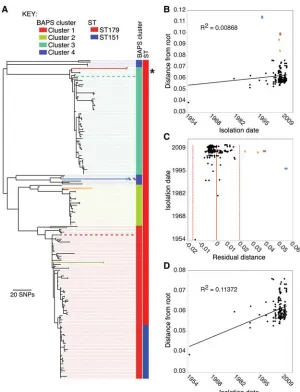
A maximum likelihood (ML) phylogenetic reconstruction of the core variable sites of the sequenced isolates is shown in Figure 1A. Isolates are colored according to clusters defined using a tree-independent Bayesian method for subdividing populations based on sequence similarity (Corander et al. 2008). Clusters 1–3 correspond to the three major clades in the ML tree, with cluster 4 representing the remaining isolates. The increasingly prevalent ST151 formed a clade within cluster 1, distant from the Equilis StrepE and Pinnacle IN vaccine samples, which fell into clusters 3 and 4, respectively (Fig. 1A). Two features of the tree were partic-ularly striking. First, the observed sequence diversity was surpris-ingly low for a global collection of isolates of a pathogen with a historical record that suggests it dates back to at least the 13th
Century. Second, the tree includes a number of anomalously long branches toward its tips, which appeared inconsistent with the isolation dates of the samples.
Variation in the rate of substitution
in the
S. equi
core genome
Plotting root-to-tip distance against isolation date for each isolate for which dating information was available revealed a poor corre-lation between accumucorre-lation of substitutions and time (Fig. 1B) (R2= 0.00868), although a tip-date permutation test (Firth et al.
2010) confirmed significant temporal signature in the data (P= 0.001 from 1000 permutations). Similar observations in other streptococci have been the result of the effect of homologous re-combination, which can import large amounts of variation into the genome en masse, leading to elongation of branches and the loss of clock-like mutational signals. Although it has been thought thatS. equihas lost natural competence (Holden et al. 2009), we in-vestigated the possibility that recombination was the cause of the observed long branches. By reconstructing sequences for ancestral nodes in the tree, evidence for past recombination events can be identified in two ways: Recombination events from donors outside the diversity of the tree will cause imports of large numbers of clus-tered substitutions on individual branches of the tree, whereas re-combination events between donors and recipients within the diversity of the tree will lead to accumulation of homoplasies. In contrast to other streptococci (Croucher et al. 2011; Marttinen et al. 2011; Cornejo et al. 2013), we observed low levels of both SNP clustering (Supplemental Fig. 1) and homoplasy (only 47 or 3.6% of core variable sites), ruling out recombination as the cause of the long branches. The highest density of SNPs (3.2% of SNPs,P
< 0.0001) and homoplasies (28% of homoplasic SNPs,P< 0.0001) in the core genome coincided with the 5′1.2-kb region (0.06% of the core genome length) of the SeM protein gene (seM) that en-codes a virulence factor that binds to fibrinogen and immunoglob-ulin. The promoter region of the same gene also contained three homoplasies. Similarly, genes encoding the fibronectin- or fibrin-ogen-binding proteins, FneE and SzPSe, also exhibit high SNP den-sity and homoplasy, highlighting the importance toS. equi of generating variation in these proteins.
Given the observed lack of homologous recombination, the poor root-to-tip correlation must have resulted from variation in substitution rate across the tree. Plotting the residuals for the root-to-tip analysis (Fig. 1C) showed that seven isolates, subtended by four long branches when mapped onto the tree (Fig. 1A), fell outside of two standard deviations of the mean. These included two isolates of the Pinnacle IN vaccine strain; two isolates extract-ed from the right guttural pouch of a horse (JKS121;italicized text indicates the ID of the horse; standard text indicates theS. equi iso-late from this animal, in this case isoiso-lates, JKS121a and JKS121b) sampled during a strangles outbreak in Leicestershire; two isolates from the guttural pouches of a horse (JKS628) sampled during an outbreak in Essex; and one isolate from the right guttural pouch of a horse (JKS731) sampled during an outbreak in Lincolnshire. Excluding these seven isolates increased the root-to-tipR2value
to 0.11372 (Fig. 1D). The long branch associated with the Pinnacle IN isolates resulted from 68 shared unique SNPs in the core genome of these isolates. This diversity could be explained by the methods used to make the vaccine, which was a live atten-uated vaccine generated by chemical mutagenesis ofS. equiwith
SNPs unique to the Pinnacle isolates was significantly enriched for C→T and G→A, but deficient in A→G and T→C transitions (Harper and Lee 2012) when compared to other branches in the tree (Supplemental Fig. 2). In wild-type isolates, disruption of the mis-match repair system can also lead to increased substitution rates, but is characterized by an increase in the accumulation of A→G and T→C transitions. We found no significant differences between the substitution spectra of the three long branches leading to clin-ical isolates, including two isolates from JKS121 that exhibited a nonsynonymous mutation in the mismatch repair gene, mutS
(Supplemental Fig. 2). Consistent with this, no significant
differ-ences (P= 0.093) in resistance mutation frequency were found when comparing the long-branch isolates from JKS121,
JKS628,JKS731, the Pinnacle IN vaccine isolates, and the referenceSe4047 in vitro (Supplemental Fig. 3).
The two isolates grown from the Pinnacle IN vaccine differed phenotypi-cally in their amount of hyaluronic acid capsule (Walker and Timoney 2002), he-molysis of red blood cells, and by three SNPs, including a nonsynonymous sub-stitution (Ile206Thr) in a homolog of the csrStwo-component system sensor that has been demonstrated to regulate virulence factors, including capsule, in
S. pyogenes(Graham et al. 2002). Both iso-lates shared a second SNP incsrS, which is predicted to result in a Leu257Phe amino acid substitution in addition to one nonsense mutation and a further 40 nonsynonymous mutations elsewhere in the genome (Supplemental Table 2). The combination of these SNPs likely ex-plain the attenuation of Pinnacle and could now form the basis of a diagnostic test to resolve cases when the vaccine strain has been suggested to have caused adverse reactions or reverted to virulence (Borst et al. 2011; Patty and Cursons 2014).
Sequencing resolved the complex
epidemiology of strangles
outbreaks
JKS121,JKS628, andJKS731were all sam-pled during strangles outbreaks in the United Kingdom. The inclusion of multi-ple isolates from outbreaks allows us to utilize the resolution that whole-genome sequencing provides to conduct detailed epidemiological analysis of strangles. In most cases, outbreak isolates were highly clonal and differed by only a small num-ber of SNPs (Supplemental Fig. 4), consis-tent with an import from a single source. However, in some cases, including the outbreaks involvingJKS121,JKS628, and
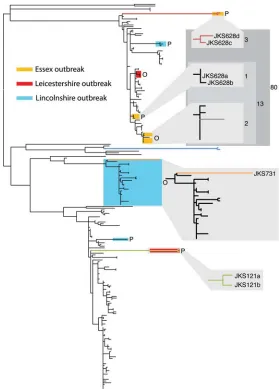
[image:3.612.73.373.67.459.2]JKS731, both active strangles strains and persistent strains from chondroids were identified from horses at the same stables during a strangles out-break (Supplemental Fig. 4). In one case, 10 isolates recovered from a small outbreak in Essex over a 5-mo period all fell into clus-ter 3 on our phylogeny. However, within this clusclus-ter, the isolates grouped into three distinct subclades differentiating an outbreak strain and two persistent strains (Fig. 2). Interestingly, of the four isolates recovered fromJKS628, including the two outliers in our root-to-tip analysis, two fell into each of the persistent clades, possibly reflecting separate, long-standing persistent infections prior to the purchase of this horse some 15 mo before the outbreak. A similar situation was observed for six isolates from an outbreak in Figure 1. Phylogenetic reconstruction and assessment of temporal signal. (A) Maximum-likelihood
phylogeny ofS. equibased on core genome SNPs. Clusters are colored as reconstructed by BAPS. Columns adjacent to the tree represent the BAPS cluster and MLST type associated with the strains. Dashed lines linking branches to these columns are for ease of viewing and are colored with the appro-priate BAPS cluster color. Branch colors represent branches corresponding to isolates from horsesJKS628
Leicestershire in 2007. Four isolates, from both persistent infection and disease, formed a clade in cluster 3, representing the outbreak strain. However, the two root-to-tip outliers fromJKS121were dis-tinct, falling into cluster 1. These two persistent isolates possibly originated from a previous outbreak during the 8-yr residency of this horse on the affected premises. Finally,JKS731was sampled during a large outbreak in Lincolnshire that persisted from 2006 to 2008 and affected more than 200 horses. Twenty-seven isolates from this outbreak formed a single subclade within cluster 2 on our tree. Two of these isolates, including the persistent isolate from
JKS731, which was the final outlier in our root-to-tip analysis, shared a much deeper common ancestor than the rest of the out-break isolates, which suggests these may be persistent isolates from a historic outbreak of a similar genotype, possibly occurring during the 15-yr residency of this horse at the affected premises. The outbreak strain may have been the result of reinfection from an external source, or more likely from a persistent infection
at the stables. As with the Essex and Leicestershire outbreaks, isolates taken during the Lincolnshire outbreak also included two persistent lineages that clustered far away from the main out-break clade, illustrating the prevalence of long-term persistence ofS. equi.
Substitution rates vary between acute
infection and persistence
Remarkably, despite the five clinical iso-lates identified as outliers by our root-to-tip analysis being sampled during out-breaks, all were isolated from chondroids extracted from the guttural pouches of healthy horses, and therefore were repre-sentative of persistent populations that originated from historic acute infections. This observation raised the possibility that the poor temporal signal identified in our root-to-tip analysis was the result of S. equi displaying altered substitu-tion rates during persistent infecsubstitu-tion. To shed further light on this, we analyzed the subset of our data set for which accurate isolation dates were available with the Bayesian phylogenetics soft-ware, BEAST (Drummond and Rambaut 2007), which allows modeling of molec-ular clock rates to provide estimations of divergence dates on nodes of a phy-logenetic tree. Removal of artificially at-tenuated vaccine isolates and isolates without dating information produced a data set of 209 isolates with 1184 poly-morphic core genome positions. BEAST includes a number of relaxed molecular clock models that permit modeling of variation in substitution rates on differ-ent branches of the tree, allowing us to correct for the observed rate variation in our data and also to identify other branches exhibiting particularly high substitution rates. Indeed, the combi-nation of a skyline population model and relaxed-exponential clock model was found to be the best fit to our data based on Bayes factors using the harmonic mean estimator. The topology of the maximum clade credibility (MCC) tree generated from com-bined data post-burn-in from three independent runs of this mod-el was concordant with the ML tree of all isolates (Supplemental Fig. 5). The mean substitution rate per core genome site per year was calculated as 5.22 × 10⁻⁷ (95% highest posterior density [HPD]: 4.04 × 10⁻⁷to 6.51 × 10⁻⁷), slower than the core genome
rates reported for other streptococci, includingS. pyogenes(1.1 × 10⁻⁶) (Davies et al. 2015),Streptococcus pneumoniae(1.57 × 10⁻⁶)
(Croucher et al. 2011), and many other gram-positive bacteria, in-cluding Staphylococcus aureus (3.3 × 10⁻⁶) (Harris et al. 2010;
[image:4.612.87.366.68.457.2]Holden et al. 2013). Interestingly, the mutation rate ofS. equiis closer to those calculated forClostridium difficile(1.47 × 10⁻⁷ to 5.33 × 10⁻⁷) (He et al. 2013) andMycobacterium tuberculosis(8.0 × 10⁻⁸ to 1.25 × 10⁻⁷) (Bryant et al. 2013), gram-positive bacteria
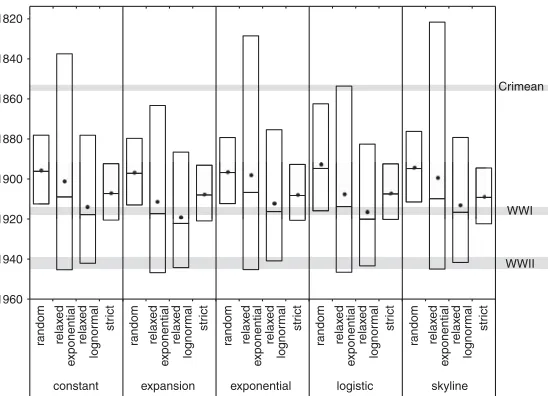
which can undergo periods of dormancy and long-term persis-tence. The analysis provided a median estimate for the time of the most recent common ancestor (tMRCA) of our global sample ofS. equito 1909 (95% HPD: 1819 to 1946). Given that the histor-ical record of strangles suggests thatS. equidates back to at least the 13th Century, our data indicate that a global population replace-ment occurred during the 19th or early 20th Centuries, corre-sponding to a time when horses were a major mode of transport and played important roles in a number of global conflicts (Fig. 3). To ensure this result was not an artifact of the clock or pop-ulation models used in our analysis, we calculated the mean, me-dian, and 95% HPD tMRCA for a range of model combinations and found that our chosen model exhibited the widest HPD, which encompassed the 95% HPDs of all other model combina-tions (Fig. 3).
To test our hypothesis that persistent isolates exhibited in-creased substitution rates, we performed a two-sided Mann-WhitneyUtest of median substitution rates for branches in our BEAST tree leading to persistent isolates against those leading to isolates from acute infection (Supplemental Fig. 6a). We found a significant difference (P= 0.0004) in rates between the two popu-lations, with persistent isolates exhibiting a significantly increased rate. A linear regression of substitution rate against time for persis-tent, acute, and other (where the site was unknown) branches showed an increasing rate over time for persistent isolates (R2= 0.20156,P< 0.0001), whereas the rates for acute (R2= 0.01459,
P= 0.3693) and other (R2= 0.00323,P= 0.3815) branches showed no increase with time (Supplemental Fig. 6b). A similar disparity was identified in the types of substitutions occurring in acute and persistent infection, with more nonsynonymous mutations accruing over time in persistent infection when compared with isolates from acute infection and others (Supplemental Fig. 7a). In fact, whereas acute infection and other branches showed a rela-tively constantdN/dSratio of around 0.5–0.7 over time, persistent
isolates showed an increase indN/dSwith time (Supplemental Fig.
7b), supporting the hypothesis that these isolates are undergoing diversifying selection.
Variation in the accessory genome was not associated
with persistence or infection
Having observed distinct differences in the mutation rates of core genomes of the persistent and acute populations, we undertook a comparative genomic analysis to investigate if there were also differences in the dynamics of the accessory genome. Among the mobile elements described in the referenceSe4047 isolate, the pro-phageswSeq2-4, and the integrative conjugative elements ICESe1
and ICESe2were the most stable, being almost ubiquitously con-served in the population (Supplemental Fig. 8). In contrast, the prophagewSeq1 appeared more dynamic, with evidence of alter-native but related prophages in the accessory genomes of isolates belonging to all four clusters. Although the pattern of presence of these prophage elements generally followed the phylogeny, there was evidence of lateral transfer or convergent gain of some prophages in multiple clusters. The deletion of an ancestral CRISPR locus, prior to the emergence ofS. equifromS. zooepidemi-cus,potentially contributes to the poly-lysogeny of this species (Holden et al. 2009; Waller and Robinson 2013).
Although wSeq2-4, ICESe1, and ICESe2were generally con-served (Supplemental Fig. 8), we found evidence of both deletions and duplications affecting regions of these elements. Several iso-lates showed duplications of the phospholipase A2gene,slaA,on
wSeq2, suggesting that these strains had acquired additional dis-tinct prophages that also contain this putative virulence cargo (Holden et al. 2009). Convergent loss of theseeLandseeM super-antigen-encoding genes in six isolates from three distinct lineages appears to have occurred twice by loss or replacement by diverse alternative prophages ofwSeq3, as evidenced by only <25% of
wSeq3 having matches in the genome sequences of the isolates (Supplemental Fig. 8), and once by horizontal replacement of
wSeq3 with an alternative, similar prophage, as evidenced by 60%–70% ofwSeq3 having matches in the genome sequence of the isolates (Supplemental Fig. 8) and an elevated SNP density (mean of 1 SNP every 168 matched bases versus 1 SNP every 6130 matched bases for other isolates with at least one SNP).
Insertion sequence elements mediate
genome decay and gene amplification
during persistence
Although our comparative analysis re-vealed that, as would be expected, pro-phages were mediating the loss and gain of genes, it also revealed that genes were being lost and duplicated in the core genome. The mechanism that ap-pears to be driving the observed deletion and copy number variation is homolo-gous recombination between insertion sequence (IS) elements. The S. equi ge-nome has large expansions of a limited number of IS families, which is hy-pothesized to result from the evolution-ary bottleneck associated with its host-adaptation and pathogenic specialization (Holden et al. 2009). We identified an additional 37 novel IS element insertions belonging to existing families across the population, eight of which inserted at the same genomic location in multiple lineages (Supplemental Figs. 9, 10). IS
random relax ed e xponential relax ed lognor mal str ict random relax ed e xponential relax ed lognor mal str ict random relax ed e xponential relax ed lognor mal str ict random relax ed e xponential relax ed lognor mal str ict random relax ed e xponential relax ed lognor mal str ict
[image:5.612.88.364.480.678.2]constant expansion exponential logistic skyline 1960 1940 1920 1900 1880 1860 1840 1820 WWII WWI Crimean
elements flanked four of the 15 deleted loci and 10 of the 16 am-plified regions in the core genome, showing that they play an im-portant role in variation of gene content.
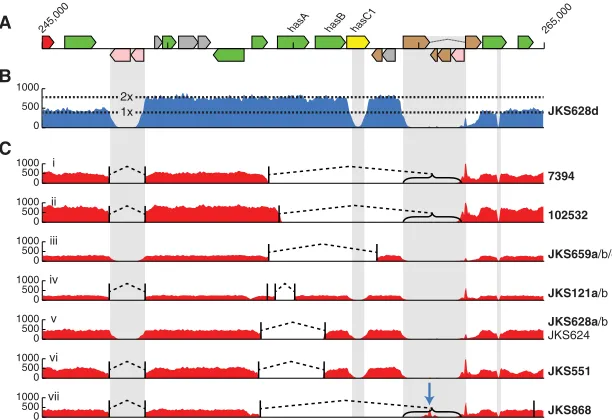
Consistent with our hypothesis that theS. equigenome diver-sifies within the guttural pouch environment, large deletion and duplication events were far more common in persistent isolates than those from acute infection (Supplemental Fig. 9). Within the core genome, thehasoperon, encoding hyaluronic acid cap-sule biosynthesis components, was the locus most frequently af-fected by deletions and duplications, with seven independent deletion variants and eight independent amplifications of the lo-cus, which is bordered by IS3elements (Fig. 4). The same region also exhibited high SNP densities and four independent nonsense mutations. Importantly, the SNPs, deletions and amplifications at this locus were significantly associated with isolates recovered from persistently infected horses rather than those with acute dis-ease (P< 0.0001). To determine the effects of these changes on the production of the hyaluronic acid capsule, we quantified the tran-scription across thehaslocus and the amount of hyaluronic acid present on the surface of five representative strains. The genome of strainSe4047 has been sequenced to completion and was in-cluded as a reference (Holden et al. 2009). Strain JKS551, recovered from a persistently infected horse, contains a deletion ofhasAand the 3′region ofhasB(Fig. 4) relative to strain JKS540a, which was recovered from a horse suffering from acute disease during the same outbreak of strangles as JKS551. Reverse transcription qPCR confirmed a lack of hasA transcription in strain JKS551 (P=
0.0017), and this strain had significantly less hyaluronic acid asso-ciated with its cell surface (P= 0.04) (Supplemental Fig. 11). Strain 851, which contains an amplification of thehaslocus, had signifi-cantly higher levels of transcription of thehasgenes (P= 0.005,
P= 0.0001, andP= 0.001 forhasA,hasB, andhasC, respectively) and a corresponding increase in the amount of hyaluronic acid on its surface (P= 0.0005) relative to strain 1165, which was recov-ered from the same persistently infected animal 2 wk later and con-tains a wild-typehaslocus (Supplemental Fig. 11). A specific PCR that spanned the IS3 element that borders the has locus was used to confirm that the amplification of thehaslocus in strain 851 occurs in tandem.
Comparison of the multiple isolates recovered from persis-tently infected horses showed that even these extremely closely related isolates varied by deletions and/or amplifications (Supple-mental Fig. 12), demonstrating that microevolution ofS. equi
in the guttural pouch yields a mixture of variant strains. One ex-ample is the horseJKS628, within which two of the four persistent isolates, JKS628c and JKS628d, recovered from the right and left guttural pouches, respectively, contained a 39.5-kb deletion (SEQ_1232 to SEQ_1253) in ICESe2that included the entire equi-bactin locus. This locus encodes a putative siderophore, which is known to increase the ability ofS. equito acquire iron (Heather et al. 2008), and may enhance survival within, and abscessation of, lymph nodes (Holden et al. 2009). This siderophore has been proposed to represent the key speciation event in the evolution ofS. equi(Holden et al. 2009). Three other deletion events (Fig. 5) that are predicted to disrupt equibac-tin production were identified in isolates recovered from three more, unrelated persistently infected horses. In contrast, the equibactin region was not deleted in any of the acute isolates (P= 0.0528), suggesting that loss of equibactin may preclude transmission to acute infection. To determine if the loss of the equi-bactin locus represented a dead-end mu-tation that would prohibit these isolates from being able to cause acute disease and therefore continue to be transmitted via the strangles disease cycle, we chal-lenged two groups of seven Welsh moun-tain ponies with 1 × 10⁸cfu ofSe4047 or
aneqbEdeletion mutant, which is unable to produce equibactin (Heather et al. 2008). Ponies were monitored carefully for early signs of disease, such as pyrexia and a preference for hay over pelleted food, and euthanized before the onset of later clinical signs of strangles (Guss et al. 2009). Deletion of eqbE signifi-cantly reduced the amount of pyrexia (P= 0.021) and pathology at post mor-tem examination (P= 0.041) (Fig. 6). However, loss ofeqbEdid not completely prevent abscess formation with two
ΔeqbE-infected ponies developing bilat-eral retropharyngeal lymph node ab-scesses compared with all seven wild-type infected animals (P= 0.021). One
ΔeqbE-challenged pony developed a sub-mandibular lymph node abscess, two 0
500 1000 0 500 1000 0 500 1000 0 500 1000 0 500 1000 0 500 1000 0 500 1000
hasA hasB hasC1
245,000 265,000
0 500 1000
2x 1x
A
B
C
i
ii
iii
iv
v
vi
vii
7394 102532 JKS659a/b/c
JKS628a/b
JKS121a/b JKS624
[image:6.612.74.380.384.594.2]JKS551 JKS868 JKS628d
ponies had microabscesses without clinical signs of disease, and two had no signs of infection. The attenuation of theΔeqbE dele-tion mutant in Welsh mountain ponies demonstrates that the ac-quisition of ICESe2was indeed a key step in the evolution ofS. equi
and that strains containing deletions in the equibactin locus, which are shed from persistently infected horses, have a lower virulence potential.
Discussion
For the first time, analysis of a global collection ofS. equiisolates has allowed important questions regarding the complex epidemi-ology of strangles outbreaks to be resolved and provided com-pelling evidence of coinfection of individual horses. Variation between isolates in the collection was strikingly low given that the historical record of strangles suggestsS. equidates back over 700 yr. Our data indicate that a global population replacement oc-curred during the 19th or early 20th Centuries, corresponding to a period of history during which horses were, for the most part, the major mode of transportation and performed critical roles in a se-ries of global conflicts (Clabby 1976). Strangles was, and remains, a particular problem in army horses (Todd 1910; Bazeley 1940). Indeed, the Leicestershire outbreak represented in this study that included horseJKS121occurred at the Defense Animal Centre in Leicestershire. Large global conflicts, such as World War I, led to the mobilization and mixing of large populations of horses from around the world in conditions ideally suited to the transmission and mixing ofS. equiclones. In conjunction with this, dramatic levels of host mortality would have increased pathogen popula-tion bottlenecks and the potential for loss of populapopula-tion diversity. Later replacement of lost horses, through initiatives such as the es-tablishment of the National Stud in the United Kingdom in 1916 for the breeding of thoroughbreds, produced naïve young horses on an unprecedented scale, providing new hosts for successfulS. equiclones to colonize. Thus, we speculate that the unique circum-stances created by 19th and early 20th Century global conflicts would have provided ideal conditions for the emergence of the contemporary population ofS. equi.
The crucial factor allowingS. equito propagate the disease cycle of strangles is its ability to persist for long periods in a sub-clinical but infectious state. The importance of the establishment of persistent infections to the capability of S. equito transmit to naïve animals was first recognized by Captain Todd of the British Army Veterinary Corps as early as 1910 (Todd 1910) and is undoubtedly a major factor in its continued global success. However, it was not until 1997 that the anatomical site of such per-sistent infections was shown to be the guttural pouch (Newton et al. 1997). Our data suggest that the environment within the gut-tural pouch, and the chondroid in whichS. equipersists, drives both the diversification and decay of its genome and potentially explains the path to host restriction. Although adaptation to the guttural pouch environment, such as loss of the equibactin sidero-phore, may reduce virulence and transmissibility, leading to an evolutionary dead end, it is clear that strangles outbreaks can be founded by long-term persistent strains. Indeed, persistence may also bring beneficial effects beyond simply providing time for con-tact with new naïve hosts. For example, mutation of genes encod-ing the antigenic, sortase-processed surface proteins SeM, SzPSe,
0 200 400 600 0 200 400 600 0 200 400 600 0 200 400 600
eqbE eqbG
eqbF
eqbK
eqbL eqbJ eqbD
eqbM
eqbN eqbB
eqbC eqbI
eqbH
eqbA
1,200,000 1,250,000
A
B
i
ii
iii
iv
3081
JKS659a/b/c
102532
[image:7.612.112.500.71.259.2]JKS628c/d
Figure 5. Convergent deletion of the equibactin locus in seven isolates recovered from four independent persistently infected horses. (A) A representa-tion of the genome annotarepresenta-tion around the equibactin cluster. (B) Read mapping of the equibactin locus in example isolates exhibiting the four deletion variants. Names to therightof the plots indicate isolates exhibiting the same deletion. Isolate names in bold are the examples used for the mapping plot. Read mapping drops to zero in the gray repeat region due to an inability to map reads uniquely to this region.
Se4047 ΔeqbE
0 10 20 30 40 50 60
Pathology score
[image:7.612.357.507.559.671.2]and SEQ_0402 during persistence could assist the evasion of ac-quired immunity facilitating persistence in the guttural pouch and potentially the recrudescence of strangles. Increased shedding and/or more efficient transmission of new variant strains in this manner provides one explanation for the raised SNP densities ob-served in the genes encoding these proteins and highlights further genes that exhibit similar raised SNP densities, such asfneE, which will direct the design of improved vaccines against strangles. An interesting observation from the whole-genome phylogeny is that the increasingly prevalent ST151 clone ofS. equiis found in a distinct clade to both the Equilis StrepE and Pinnacle IN vaccine isolates. The first identified isolates of ST151 were recovered from three horses with strangles <3 mo after they were vaccinated with Equilis StrepE (Kelly et al. 2006), raising the prospect that this lineage may escape current vaccines and should be closely monitored.
The loss and inactivation of genes required for hyaluronic acid capsule biosynthesis exclusively in isolates ofS. equirecovered from persistently infected horses is paralleled by the loss of these genes in human disease isolates ofS. pyogenesserotype M4 and M22 (Flores et al. 2012) and the presence of SNPs in thehaslocus of isolates recovered from cases of pharyngitis rather than invasive disease caused byS. pyogenesserotype M3 (Shea et al. 2011). Our data highlight similarities between these two streptococcal species and provide further evidence thatS. equiinfection can serve as a model for human disease. The tandem amplification of thehas
locus led to increased transcription ofhasA,hasB, andhasCand significantly more hyaluronic acid on the surface of strain 851 rel-ative to strain 1165, which was recovered from the same horse 12 d later. Theoretically the recombination of tandemly arranged amplified loci permits the restoration of a wild-type phenotype. This scenario could explain why later isolates from this animal (2424 and 3446) also contained a wild-typehaslocus. However, we cannot rule out the possibility that the population ofS. equi
from this horse contained more than onehasvariant on each oc-casion. We propose that the amplification of thehaslocus may as-sistS. equito establish a persistent infection within the guttural pouch in the immediate period post-recovery when the equine im-mune response may be at its most effective. However, we speculate that the restoration of a wild-type phenotype or the loss of capsule production may be favored over time during persistent infection, possibly as chondroids form, nutrient levels decline, or the im-mune response becomes gradually less effective. We speculate that amplifications of loci, includinghas, may be present in iso-lates ofS. pyogenesrecovered from cases of pharyngitis, and this strategy provides a novel bet-hedging solution to survival in fluc-tuating environments.
The lifecycles of many pathogens involve both acute and per-sistent phases of infection. Balancing the conflicting genetic re-quirements of transmission and clinical disease with survival in the face of a convalescent immune response represents a signifi-cant biological challenge that may ultimately lead toward host re-striction. By sequencing multiple isolates from the same infected horses our analyses have, for the first time, shed light on the com-plex population dynamics ofS. equiduring persistence within the host. The observation of an increased substitution rate within per-sistent infection mirrors the situation in human immunodeficien-cy virus (HIV) infection where mutations accrue faster within hosts than at the epidemic level (Herbeck et al. 2006; Lemey et al. 2006). Mathematical modeling of this phenomenon supports the hypothesis that ancestral HIV sequences are preferentially transmitted, purifying out mutations generated within the host
and reducing the apparent substitution rate at transmission (Lythgoe and Fraser 2012). Our data suggest a similar process has shaped the evolution ofS. equi, and may be important in all path-ogens with a lifecycle which includes long periods of infection between transmission events. For example, clear parallels can be drawn with the discrepancy between the slow observed substitu-tion rate in M. tuberculosis transmission chains (Bryant et al. 2013; Walker et al. 2013) and its ability to quickly develop antibi-otic resistance mutations within a host (Sun et al. 2012; Casali et al. 2014). ForS. equi, the ability to adapt and persist in healthy ani-mals for long periods while remaining infectious is a crucial com-ponent of the disease cycle of this pathogen. The fluidity of its genome plays a key role in ensuringS. equiremains a persistent threat to equine health with the mobility of modern horse popu-lations facilitating its transmission around the world.
Methods
Study collection
Se4047 was isolated from a horse with strangles in the New Forest, Hampshire, United Kingdom, in 1990. The origins and details of the 224 isolates ofS. equithat were sequenced in this study are list-ed in Supplemental Table 1. Isolates from acute cases of strangles were recovered from clinical samples submitted to the Animal Health Trust’s Diagnostic Laboratory Service citing clinical signs that were indicative of acute disease or were recovered during vet-erinary examination of acute clinical cases in the United Kingdom, Sweden, Belgium, or Saudi Arabia. Persistent isolates were recov-ered from the guttural pouches of horses exhibiting no clinical signs of infection, from chondroids recovered from a guttural pouch, or from swabs of which the attending veterinarian stated that the animal was suspected to be persistently infected. β -Hemolytic colonies ofS. equistrains were recovered from glycerol stocks following overnight growth on COBA strep select plates (bioMérieux). Their identity was confirmed by a lack of fermenta-tion of trehalose, ribose, and sorbitol in Purple broth (Becton Dickinson).
DNA preparation
A single colony of eachS. equistrain was grown overnight in 3 mL Todd Hewitt (TH) broth containing 30 µg/mL hyaluronidase (Sigma) at 37°C in a 5% CO2-enriched atmosphere, centrifuged,
the pellet resuspended in 200 µL Gram +ve lysis solution (GenElute, Sigma) containing 250 units/mL mutanolysin and 2 × 10⁶units/mL lysozyme and incubated for 1 h at 37°C to allow efficient cell lysis. DNA was then purified using GenElute spin col-umns according to the manufacturer’s instructions (all Sigma).
DNA sequencing and variation detection
validated by comparing the mapping of reads spanning indels to the reference genome and to a version of the same reference with the predicted indel included. If the inclusion of the indel im-proved mapping, that indel was retained and reads realigned around it as per the remapping. SNPs were identified using a com-bination of SAMtools (Li et al. 2009) mpileup and BCFtools as previously described (Harris et al. 2010). Large deletions and dupli-cations were identified for each isolate based on read coverage along the reference genome using a continuous hidden Markov model with three states: 0× coverage, 1× coverage, and≥2× cover-age. Initial and transition frequencies were fitted to the data using a Baum-Welch optimization, and the most likely sequence of hid-den states was calculated using the Viterbi algorithm (Viterbi 1967). IS element insertion locations were identified by mapping read data to a set of IS sequences known to occur inS. equiand
S. zooepidemicus. Where one read of a pair mapped to an IS ele-ment, the nonmapping paired read was mapped to the reference
Se4047 genome to identify the insertion site. To remove false pos-itive insertion sites that may be caused by chimeric read pairs, a minimum of five reads were required to map to the same insertion location for it to be accepted.
Phylogenomic analysis
Maximum likelihood phylogenetic reconstruction of variable sites was performed using RAxML v7.0.3 (Stamatakis 2006) under a general time reversible (GTR) evolutionary model using a gamma correction for among-site rate variation. One hundred random bootstrap replicates were run to provide a measure of support for relationships in the maximum likelihood tree. A linear regression of root-to-tip distance versus isolation date was used to assess the fit of a strict molecular clock to the data and gave a weak correla-tion for isolates with known isolacorrela-tion dates, excluding vaccine isolates (coefficient of determination,R2= 0.25). To test the null
hypothesis that such anR2arose by chance alone, we repeated
the root-to-tip analysis 1000 times with the tip dates of the isolates randomly permutated each time (Firth et al. 2010). In all cases, the data with random permutations gave lowerR2values than the real
data, so that we could reject our null hypothesis at the 0.001 level and accept the alternative hypothesis that the real data contains a significant temporal signal. Bayesian reconstruction in BEAST v1.7 (Drummond and Rambaut 2007) was used to estimate sub-stitution rates and times for divergences of internal nodes on the tree under a GTR model with a gamma correction for among-site rate variation. All combinations of strict, relaxed lognormal, relaxed exponential, and random clock models and constant, exponential, expansion, logistic, and skyline population models were evaluated. For each, three independent chains were run for 100 million generations, sampling every 10 generations. On com-pletion, each model was checked for convergence, both by check-ing that ESS values were >200 for key parameters and by checkcheck-ing that independent runs had converged on similar results. Models that failed to converge, including logistic population models, were discarded. Models were compared for their fit to the data us-ing Bayes factors based on the harmonic mean estimator as calcu-lated by the program Tracer v1.4 from the BEAST package. The best-fit model combination was found to be a relaxed exponential clock model and a skyline population model, and so this combina-tion was used for all further analysis. A burn-in of 10 million states was removed from each of the three independent runs of this model before combining the results from those runs with the logcombiner program from the BEAST package. A maximum clade credibility (MCC) tree was created from the resulting combined trees using the treeAnnotator program, also from the BEAST package.
Accessory genome assembly
A pan genome forS. equi was created by identifying novel re-gions from de novo assemblies of each isolate. Assemblies were cre-ated with Velvet v1.2.09 (Zerbino and Birney 2008) using the VelvetOptimiser.pl v2.2.5 (http://bioinformatics.net.au/software. shtml) script to optimize the kmer length, expected coverage, and coverage cutoff parameters based on the N50 statistic. A core genome was defined by removing the mobile prophages,
wSeq1-4, and ICE elements, ICESe1and ICESe2, from theSe4047 reference genome. This core genome was then mapped to each as-sembly using NUCmer (Delcher 2002). All regions >200 bp in each assembly that did not match to the core genome were extracted and retained as accessory regions. All accessory regions for each isolate and the accessory regions from the referenceSe4047 ge-nome were then mapped against one another using NUCmer. Where two regions were identical in length and matched along their entire length, one was retained. Where one region was completely contained within another, the longer region was re-tained. Any region of novel sequence >200 bp was also rere-tained. Using this process for all pairwise comparisons led to production of a nonredundant set of accessory genome contigs. After filter-ing, these accessory contigs were appended to the core genome to form a pan genome. Finally, each assembly and the reference
Se4047 genome were mapped to the pan genome using NUCmer to identify the regions of the pan genome present in each isolate.
Mutation frequency
Cultures of test bacteria were grown overnight in TH broth at 37°C in a 5% CO2enriched atmosphere. Cultures were diluted to an
OD600 nmof 0.5. The number of viable bacteria was enumerated
by plating 100 µL of a 10−6dilution onto each of five TH agar plates
that were grown at 37°C in a 5% CO2enriched atmosphere for
24 h. One hundred microliters of undiluted culture was plated onto each of five TH agar plates containing 0.03 µg mL−1
rifampi-cin and grown at 37°C in a 5% CO2enriched atmosphere for
24 h. Colonies were enumerated, averaged, and the resistance frequency was calculated by dividing the total number of colonies by the number of rifampicin-resistant colonies. The experiment was repeated in triplicate, and an average resistance frequency was calculated across the three experiments. Statistical significance was calculated using an ANOVA test on the whole population.
Extraction of RNA
S. equistrains were inoculated onto COBA plates and grown over-night at 37°C in an atmosphere containing 5% CO2. A single
col-ony of each strain was inoculated into 5 mL Todd Hewitt broth containing 0.2% yeast extract (THY) (Oxoid) and grown overnight at 37°C in an atmosphere containing 5% CO2. Cultures were
dilut-ed 1:10 in fresh THY and grown to an OD600 nmof 0.6. Two
milli-liters of each culture was then mixed with 4 mL of RNA protect (Qiagen) and pelleted by centrifugation for 10 min at 5000g
extraction with an RNeasy mini kit. RNA purity and quantity were determined using a Nanodrop ND1000 spectrophotom-eter (NanoDrop Technologies). Three biological replicates were performed.
Reverse transcription
One hundred nanograms of RNA per sample were used to synthe-size cDNA by reverse transcription (RT) in 20 µL reactions with random hexamers using a Verso cDNA kit (Thermo Scientific) ac-cording to the manufacturer’s instructions.
qPCR to quantify
has
transcription
Transcription of SEQ_0269 (hasA), SEQ_0270 (hasB), SEQ_0271 (hasC), and the housekeeping genegyrA(SEQ_1170) were quanti-fied by quantitative polymerase chain reaction (qPCR). Reactions contained 1× Kapa SYBR Fast qPCR mix (Anachem), 0.3 µM for-ward and reverse primers (Supplemental Table 3), and 6 µL of a 1:10 dilution of cDNA made up to 20 µL with ddH2O and
thermo-cycled for 3 min at 95°C followed by 40 cycles for 30 sec at 95°C, 10 sec at 60°C, then for 15 sec at 95°C. A ramp step from 60°C to 95°C with SYBR reads every 0.3°C was performed to calculate the disso-ciation curves of products. No template and no RT controls were included to confirm the absence of contaminating DNA and RNA in samples. Copy numbers were calculated from standard curves and normalized togyrA. The mean values for the three bio-logical replicates were calculated.
PCR to detect tandem amplification of the
has
locus
PCR reactions contained 1× Sigma Taq buffer, 2 mM deoxyribonu-cleotide triphosphate (dNTP) mix, 2 mM MgCl2, 1 µM forward and
reverse primers (Supplemental Table 3), 0.1 µL Sigma Taq DNA po-lymerase, and 4 µL DNA in a total volume of 20 µL. Reactions were thermocycled for 2 min at 95°C followed by 35 cycles for 30 sec at 95°C, 30 sec at 55°C and 5 min at 72°C, and finally for 5 min at 72°C. Products were resolved on a 0.7% agarose gel.
Quantification of surface hyaluronic acid
S. equistrains were grown overnight in THY at 37°C in an atmo-sphere containing 5% CO2and used to inoculate 10 mL of THY.
Triplicate cultures were grown to an OD600of 0.6 at 37°C in an
at-mosphere containing 5% CO2. Bacteria were washed twice with
wa-ter, resuspended in 0.5 mL of water and hyaluronic acid released by vigorous shaking with 1 mL of chloroform for 15 sec. The mixture was allowed to stand at room temperature for 1 h before centrifuga-tion at 16,000g. The aqueous phase was removed and the amount of capsule determined as described previously (Schrager et al. 1996; Darmstadt et al. 2000). DNA was extracted from 1.5 mL of the OD600 nm0.6 culture using the GenElute spin columns as
de-scribed above. The DNA was quantified using a Nanodrop ND1000 spectrophotometer, and the number of bacteria was deter-mined using the Life Technologies DNA copy number calculator (https://www.lifetechnologies.com/uk/en/home/brands/thermo-scientific/molecular-biology/molecular-biology-learning-center/ molecular-biology-resource-library/thermo-scientific-web-tools/ dna-copy-number-calculator.html). The amount of hyaluronic acid was expressed as femtograms per copy of bacterial DNA.
Allelic replacement
The generation of theeqbEdeletion mutant,ΔeqbE, has been de-scribed previously (Heather et al. 2008).
Experimental infection of ponies
Ponies of 18 mo of age were transferred to a containment unit 3 d before challenge. Each pony was challenged withS. equistrain 4047 or theΔeqbEdeletion mutant via the spraying of a 2 mL cul-ture containing 5 × 10⁷cfu into each nostril. Bacteria were grown overnight in Todd Hewitt broth and 10% fetal calf serum (THBS) in a 5% carbon dioxide enriched atmosphere at 37°C, diluted 40-fold in fresh prewarmed THBS, further cultivated, and harvested at an OD600 nm= 0.3. This infection dose has been shown to
optimize the infection rate, while avoiding overwhelming the host immune response (Hamilton et al. 2006; Guss et al. 2009). Ponies were monitored for the onset of clinical signs of disease over a period of 3 wk post-challenge by daily physical examina-tion, rectal temperature, lymph node swelling, and nasal discharge scoring. Blood samples were taken for quantification of fibrinogen and neutrophil levels by total white blood count performed on a Beckman-Coulter ACTdiff analyzer with a manual differential count to calculate the percentage of neutrophils. Postmortem ex-amination was performed on all ponies following the onset of ear-ly clinical signs of infection such as pyrexia and a reluctance to eat dry pelleted food, preferring haylage or water, and prior to the on-set of later signs according to strict welfare guidelines at the Animal Health Trust or on reaching the study endpoint at 3 wk post-chal-lenge. The severity of disease pathology was quantified according to a scoring system described previously (Guss et al. 2009). This work was conducted under the auspices of a Home Office Project License and following ethical review and approval by the Animal Health Trust’s Animal Welfare and Ethical Review Body (RPP 01_12).
Data access
Short reads for all sequenced isolates have been submitted to the European Nucleotide Archive (ENA; http://www.ebi.ac.uk/ ena/) under study accession number ERP000812. Individual acces-sion numbers of sequences and assemblies for all isolates are listed in Supplemental Table 1.
Acknowledgments
We thank the Horserace Betting Levy Board for funding the anal-ysis of theeqbEmutant (ref: Vet/prj/758). The Horse Trust funded the collection of isolates from United Kingdom outbreaks of strangles (G1606). We are grateful to Prof. John Timoney (Univer-sity of Kentucky), Prof. Tom Buckley (Irish Equine Centre, Ireland), Nicolas De Brauwere (Redwings Horse Sanctuary, United dom), Dr. Jennifer Stewart (Animal Health Trust, United King-dom), Prof. Bengt Guss (Swedish University of Agricultural Sciences, Sweden), Prof. Gunther van Loon (Ghent University, Bel-gium), Maria Cristina Marotti Campi (Al Khaledia Equine Hospital, Saudi Arabia), and Els Acke (Massey University, New Zealand) for contributing isolates to this study. We thank the core sequenc-ing and informatics teams at the Sanger Institute for their assis-tance and The Wellcome Trust for its support of the Sanger Institute Pathogen Genomics and Biology groups. S.R.H., J.P., and M.T.G.H. were supported by Wellcome Trust grant 098051.
References
Anon. 1831. The strangles. InThe horse with a treatise on draught, pp. 149–151. Baldwin and Cradock, London.
Bazeley PL. 1940. Studies with equine streptococci 1.Aust Vet J16:140–146. Blaine D. 1841. Strangles. In Outlines of the veterinary art, 5th ed., pp.
432–433. Longman, Orme and Co., London.
Borst LB, Patterson SK, Lanka S, Barger AM, Fredrickson RL, Maddox CW. 2011. Evaluation of a commercially available modified-liveStreptococcus equisubspequivaccine in ponies.Am J Vet Res72:1130–1138. Bryant JM, Schurch AC, van Deutekom H, Harris SR, de Beer JL, de Jager V,
Kremer K, van Hijum SA, Siezen RJ, Borgdorff M, et al. 2013. Inferring patient to patient transmission ofMycobacterium tuberculosisfrom whole genome sequencing data.BMC Infect Dis13:110.
Casali N, Nikolayevskyy V, Balabanova Y, Harris SR, Ignatyeva O, Kontsevaya I, Corander J, Bryant J, Parkhill J, Nejentsev S, et al. 2014. Evolution and transmission of drug-resistant tuberculosis in a Russian population.Nat Genet46:279–286.
Clabby BJ. 1976. A short history of the Royal Army Veterinary Corps.Proc R Soc Med69:93–96.
Corander J, Marttinen P, Sirén J, Tang J. 2008. Enhanced Bayesian model-ling in BAPS software for learning genetic structures of populations.
BMC Bioinformatics9:539.
Cornejo OE, Lefebure T, Bitar PD, Lang P, Richards VP, Eilertson K, Do T, Beighton D, Zeng L, Ahn SJ, et al. 2013. Evolutionary and population ge-nomics of the cavity causing bacteriaStreptococcus mutans.Mol Biol Evol
30:881–893.
Croucher NJ, Harris SR, Fraser C, Quail MA, Burton J, van der Linden M, McGee L, von Gottberg A, Song JH, Ko KS, et al. 2011. Rapid pneumo-coccal evolution in response to clinical interventions.Science331:
430–434.
Darmstadt GL, Mentele L, Podbielski A, Rubens CE. 2000. Role of group A streptococcal virulence factors in adherence to keratinocytes.Infect Immun68:1215–1221.
Davies MR, Holden MT, Coupland P, Chen JH, Venturini C, Barnett TC, Zakour NL, Tse H, Dougan G, Yuen KY, et al. 2015. Emergence of scarlet feverStreptococcus pyogenes emm12 clones in Hong Kong is asso-ciated with toxin acquisition and multidrug resistance.Nat Genet47:
84–87.
Delcher AL. 2002. Fast algorithms for large-scale genome alignment and comparison.Nucleic Acids Res30:2478–2483.
Drummond AJ, Rambaut A. 2007. BEAST: Bayesian evolutionary analysis by sampling trees.BMC Evol Biol7:214.
Firth C, Kitchen A, Shapiro B, Suchard MA, Holmes EC, Rambaut A. 2010. Using time-structured data to estimate evolutionary rates of double-stranded DNA viruses.Mol Biol Evol27:2038–2051.
Flores AR, Jewell BE, Fittipaldi N, Beres SB, Musser JM. 2012. Human disease isolates of serotype M4 and M22 group A streptococcus lack genes required for hyaluronic acid capsule biosynthesis.MBio3:e00413– e00412.
Graham MR, Smoot LM, Migliaccio CA, Virtaneva K, Sturdevant DE, Porcella SF, Federle MJ, Adams GJ, Scott JR, Musser JM. 2002. Virulence control in group AStreptococcusby a two-component gene reg-ulatory system: global expression profiling andin vivoinfection model-ing.Proc Natl Acad Sci99:13855–13860.
Guss B, Flock M, Frykberg L, Waller AS, Robinson C, Smith KC, Flock JI. 2009. Getting to grips with strangles: an effective multi-component re-combinant vaccine for the protection of horses fromStreptococcus equi
infection.PLoS Pathog5:e1000584.
Hamilton A, Robinson C, Sutcliffe IC, Slater J, Maskell DJ, Davis-Poynter N, Smith K, Waller A, Harrington DJ. 2006. Mutation of the maturase lipoprotein attenuates the virulence ofStreptococcus equito a greater ex-tent than does loss of general lipoprotein lipidation.Infect Immun74:
6907–6919.
Harper M, Lee CJ. 2012. Genome-wide analysis of mutagenesis bias and context sensitivity of N-methyl-N′-nitro-N-nitrosoguanidine (NTG).
Mutat Res731:64–67.
Harris SR, Feil EJ, Holden MT, Quail MA, Nickerson EK, Chantratita N, Gardete S, Tavares A, Day N, Lindsay JA, et al. 2010. Evolution of MRSA during hospital transmission and intercontinental spread.Science
327:469–474.
He M, Miyajima F, Roberts P, Ellison L, Pickard DJ, Martin MJ, Connor TR, Harris SR, Fairley D, Bamford KB, et al. 2013. Emergence and global spread of epidemic healthcare-associatedClostridium difficile.Nat Genet
45:109–113.
Heather Z, Holden MT, Steward KF, Parkhill J, Song L, Challis GL, Robinson C, Davis-Poynter N, Waller AS. 2008. A novel streptococcal integrative conjugative element involved in iron acquisition.Mol Microbiol70:
1274–1292.
Herbeck JT, Nickle DC, Learn GH, Gottlieb GS, Curlin ME, Heath L, Mullins JI. 2006. Human immunodeficiency virus type 1envevolves
to-ward ancestral states upon transmission to a new host.J Virol 80:
1637–1644.
Holden MT, Heather Z, Paillot R, Steward KF, Webb K, Ainslie F, Jourdan T, Bason NC, Holroyd NE, Mungall K, et al. 2009. Genomic evidence for the evolution ofStreptococcus equi: host restriction, increased viru-lence, and genetic exchange with human pathogens.PLoS Pathog5:
e1000346.
Holden MT, Hsu LY, Kurt K, Weinert LA, Mather AE, Harris SR, Strommenger B, Layer F, Witte W, de Lencastre H, et al. 2013. A genomic portrait of the emergence, evolution, and global spread of a methicillin-resistantStaphylococcus aureuspandemic.Genome Res23:653–664. Jacobs AA, Goovaerts D, Nuijten PJ, Theelen RP, Hartford OM, Foster TJ.
2000. Investigations towards an efficacious and safe strangles vaccine: submucosal vaccination with a live attenuatedStreptococcus equi.Vet Rec147:563–567.
Kelly C, Bugg M, Robinson C, Mitchell Z, Davis-Poynter N, Newton JR, Jolley KA, Maiden MC, Waller AS. 2006. Sequence variation of the SeM gene ofStreptococcus equiallows discrimination of the source of strangles outbreaks.J Clin Microbiol44:480–486.
Lefebure T, Richards VP, Lang P, Pavinski-Bitar P, Stanhope MJ. 2012. Gene repertoire evolution ofStreptococcus pyogenesinferred from phyloge-nomic analysis withStreptococcus canisandStreptococcus dysgalactiae.
PLoS One7:e37607.
Lemey P, Rambaut A, Pybus OG. 2006. HIV evolutionary dynamics within and among hosts.AIDS Rev8:125–140.
Li H, Handsaker B, Wysoker A, Fennell T, Ruan J, Homer N, Marth G, Abecasis G, Durbin R. 2009. The Sequence Alignment/Map format and SAMtools.Bioinformatics25:2078–2079.
Lythgoe KA, Fraser C. 2012. New insights into the evolutionary rate of HIV-1 at the within-host and epidemiological levels.Proc Biol Sci 279:
3367–3375.
Marttinen P, Hanage WP, Croucher NJ, Connor TR, Harris SR, Bentley SD, Corander J. 2011. Detection of recombination events in bacterial ge-nomes from large population samples.Nucleic Acids Res40:e6. Miles WJ. 1868. Strangles. InModern practical farriery, a complete system of
the veterinary art, Vol. 3, pp. 290–291. William Mackenzie, London. Newton JR, Wood JL, Dunn KA, DeBrauwere MN, Chanter N. 1997.
Naturally occurring persistent and asymptomatic infection of the gut-tural pouches of horses withStreptococcus equi.Vet Rec140:84–90. Newton JR, Verheyen K, Talbot NC, Timoney JF, Wood JL, Lakhani KH,
Chanter N. 2000. Control of strangles outbreaks by isolation of guttural pouch carriers identified using PCR and culture ofStreptococcus equi.
Equine Vet J32:515–526.
Patty O, Cursons R. 2014. The molecular identification ofStreptococcus equi
subsp.equistrains isolated within New Zealand.N Z Vet J62:63–67. Quail MA, Otto TD, Gu Y, Harris SR, Skelly TF, McQuillan JA, Swerdlow HP,
Oyola SO. 2012. Optimal enzymes for amplifying sequencing libraries.
Nat Methods9:10–11.
Ruffus J, ed. 1251.De Medicina Equorum. http://wellcomelibrary.org/player/ b19689755.
Schrager HM, Rheinwald JG, Wessels MR. 1996. Hyaluronic acid capsule and the role of streptococcal entry into keratinocytes in invasive skin infection.J Clin Invest98:1954–1958.
Schütz JW. 1888. The streptococcus of strangles.J Comp Pathol Therap1:
191–208.
Shea PR, Beres SB, Flores AR, Ewbank AL, Gonzalez-Lugo JH, Martagon-Rosado AJ, Martinez-Gutierrez JC, Rehman HA, Serrano-Gonzalez M, Fittipaldi N, et al. 2011. Distinct signatures of diversifying selection re-vealed by genome analysis of respiratory tract and invasive bacterial populations.Proc Natl Acad Sci108:5039–5044.
Solleysel J. 1664.Le parfait maréchal. Gervais Clousier, Paris.
Stamatakis A. 2006. RAxML-VI-HPC: maximum likelihood-based phyloge-netic analyses with thousands of taxa and mixed models.Bioinformatics
22:2688–2690.
Sun G, Luo T, Yang C, Dong X, Li J, Zhu Y, Zheng H, Tian W, Wang S, Barry CE III, et al. 2012. Dynamic population changes inMycobacterium tuber-culosisduring acquisition and fixation of drug resistance in patients.
J Infect Dis206:1724–1733.
Timoney JF. 1985.Protection of equines against Streptococcus equi. Patent no. US 5183659 A. Cornell Research Foundation, Inc.
Todd AG. 1910. Strangles.J Comp Pathol Therap23:212–229.
Viterbi AJ. 1967. Error bounds for convolutional codes and an asymp-totically optimum decoding algorithm.IEEE Trans Inf Theory13:260– 269.
Walker JA, Timoney JF. 2002. Construction of a stable non-mucoid deletion mutant of theStreptococcus equiPinnacle vaccine strain.Vet Microbiol
89:311–321.
Waller AS, Robinson C. 2013. Streptococcus zooepidemicus and Strepto-coccus equi evolution: the role of CRISPRs. Biochem Soc Trans 41:
1437–1443.
Webb K, Jolley KA, Mitchell Z, Robinson C, Newton JR, Maiden MC, Waller A. 2008. Development of an unambiguous and discriminatory multilo-cus sequence typing scheme for theStreptococcus zooepidemicusgroup.
Microbiology154(Pt 10):3016–3024.
White J. 1825. Strangles. InA compendium of the veterinary art, 14th ed., pp. 180–181. Longman, Hurst, Rees, Orme, Brown and Green, London. White J, with additions by Spooner WC. 1842. Strangles. InA compendium of
the veterinary art, 17th ed., pp. 129–131. Longman, Brown, Green and Longmans, London.
Williams W. 1884. Febra pyogenica, or strangles. InThe principles and prac-tice of veterinary surgery, 5th ed., pp. 43–51. John Menzies and Co., Edinburgh and Glasgow.
Ye K, Schulz MH, Long Q, Apweiler R, Ning Z. 2009. Pindel: a pattern growth approach to detect break points of large deletions and medium sized in-sertions from paired-end short reads.Bioinformatics25:2865–2871. Zerbino DR, Birney E. 2008. Velvet: algorithms for de novo short read
as-sembly using de Bruijn graphs.Genome Res18:821–829.