, 20140229, published 28 May 2014
10
2014
Biol. Lett.
Johanna Dunn, Derek W. Dunn, Michael R. Strand and Ian C. W. Hardy
a polyembryonic wasp
Higher aggression towards closer relatives by soldier larvae in
Supplementary data
ml
http://rsbl.royalsocietypublishing.org/content/suppl/2014/05/22/rsbl.2014.0229.DC1.ht
"Data Supplement"
References
http://rsbl.royalsocietypublishing.org/content/10/5/20140229.full.html#ref-list-1
This article cites 15 articles, 4 of which can be accessed freeThis article is free to access
Subject collections
(761 articles)
evolution
(723 articles)
behaviour
Articles on similar topics can be found in the following collections
Email alerting service
right-hand corner of the article or click Receive free email alerts when new articles cite this article - sign up in the box at the topherehttp://rsbl.royalsocietypublishing.org/subscriptions
go to:
rsbl.royalsocietypublishing.org
Research
Cite this article:
Dunn J, Dunn DW, Strand
MR, Hardy ICW. 2014 Higher aggression
towards closer relatives by soldier larvae in a
polyembryonic wasp.
Biol. Lett.
10
: 20140229.
http://dx.doi.org/10.1098/rsbl.2014.0229
Received: 15 March 2014
Accepted: 8 May 2014
Subject Areas:
behaviour, evolution
Keywords:
aggression, relatedness, polyembryonic wasps
Author for correspondence:
Ian C. W. Hardy
e-mail: [email protected]
Electronic supplementary material is available
at http://dx.doi.org/10.1098/rsbl.2014.0229 or
via http://rsbl.royalsocietypublishing.org.
Animal behaviour
Higher aggression towards closer relatives
by soldier larvae in a polyembryonic wasp
Johanna Dunn
1, Derek W. Dunn
2, Michael R. Strand
3and Ian C. W. Hardy
11School of Biosciences, University of Nottingham, Sutton Bonington, UK
2College of Life Sciences, Northwest University, Xi’an, Shaanxi 710069, People’s Republic of China 3Department of Entomology, University of Georgia, Athens, GA, USA
In the polyembryonic waspCopidosoma floridanum, females commonly lay one male and one female egg in a lepidopteran host. Both sexes proliferate clonally within the growing host larva. Distinct larval castes develop from each wasp egg, the majority being ‘reproductives’ plus some ‘soldiers’ which sacrifice reproduction and attack competitors. Maturing mixed sex broods are usually female biased, as expected when intra-brood mating is common. Pre-mating dispersal followed by outbreeding is expected to increase sexual conflict over brood sex ratios and result in greater soldier attack rates. Owing to sexu-ally asymmetric relatedness, intra-brood conflicts are expected to be resolved primarily via female soldier attack. We observed soldier behaviourin vitroto test whether lower intra-brood relatedness (siblings from either within-strain or between-strain crosses were presented) increased inter-sexual aggression by female as well as male soldiers. As found in prior studies, females were more aggressive than males but, contrary to expectations and previous empiri-cal observations, soldiers of both sexes showed more aggression towards more closely related embryos. We speculate that lower intra-brood relatedness indi-cates maternal outbreeding and may suggest a rarity of mating opportunities for reproductives maturing from the current brood, which may enhance the value of opposite sex brood-mates, or that higher aggression towards relatives may be a side-effect of mechanisms to discriminate heterospecific competitors.
1. Introduction
The degree of relatedness between individuals underpins much of social evol-ution theory [1]. For instance, indirect genetic benefits gained by high relatedness can predict increased likelihood of altruism, even when cooperation involves direct costs. Conversely, aggression will more likely occur between more distantly (or negatively) related individuals, even when this behaviour incurs costs to the actor, i.e. spite [2]. This is most likely to occur in outbred sub-populations in which relatedness between interacting individuals is low. With reduced dispersal between sub-populations and hence increased rates of inbreeding, relatedness increases within sub-populations, meaning that aggres-sion rates are predicted to be reduced [2]. However, these predictions are compounded because increased relatedness in sub-populations also often increases the level of costs of aggression/altruism associated with competition for local resources [3,4]. This leads to difficulty in differentiating between the effects of these two important predictors of social behaviour.
The unusual biology of some encyrtid polyembryonic parasitoid wasps enables the effects of relatedness on aggression to be manipulated experimentally, while costs associated with competition for host resources remain relatively unchanged, i.e. host size [4]. InCopidosoma floridanum, females commonly lay one male and one female egg in a lepidopteran host egg. Both sexes proliferate clonally within the growing host larva. Two distinct larval castes develop from
each wasp egg, the majority being ‘reproductives’ plus some ‘soldiers’ which sacrifice reproduction and attack hetero-specific and conhetero-specific competitors [5–8]. Maturing mixed sex broods are usually female biased, as expected when intra-brood mating is common (local mate competition [9]). Pre-mating dispersal followed by outbreeding is expected to increase sexual conflict over brood sex ratios [2] and, in general, increased conflicts can result in greater numbers of soldiers being produced [6], and higher probabilities of attack by individual soldiers [4,10]. Owing to sexually asymmetric relat-edness, intra-brood conflicts are expected to be resolved primarily via female soldier attack [2].
We observed soldier behaviour in vitro to test whether lower intra-brood relatedness (manipulated by whether or not the father was from the maternal sub-population) increased inter-sexual aggression by female as well as male soldiers. To do this, we used two experiments each using as potential con-specific competitors either: (i) polymorula (tissue that becomes ‘reproductive’ larvae) or (ii) soldiers.
2. Material and methods
We used twoC. floridanumsub-populations that both originated
from the USA. (i) A ‘lab’ strain that had been maintained in the laboratory for over 20 years since original field collection in Sumter County, SC, USA [5]. (ii) A ‘field’ strain, collected specifi-cally for this experiment from Tift County, GA, USA in autumn 2011. This was maintained in the laboratory immediately prior to and during the experiment.
(a) Experiment 1
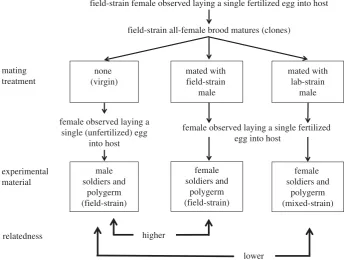
In the Hymenoptera, males are haploid with all genes deriving from their mother, whereas females are biparentally diploid [11]. We let virgin ‘field’ females from a given brood lay male eggs, mean-while mating their (genetically identical) sisters from the same brood with either ‘field’ males or ‘lab’ males. We thus created broods with higher relatedness (within-strain cross) or lower relat-edness (between-strain cross) to broods of males produced by the
virgin mothers (figure 1). As the virgin and mated mothers were identical twin sisters, owing to polyembryonic development, these ‘cousin’ broods were genetically equivalent to ‘sibling’ broods. Iden-tifying the sexual composition of broods produced by mated mothers is possible because females exhibit different behaviours when laying a fertilized or an unfertilized egg [5]. When host larvae had reached their fourth instar they were dissected, and sol-diers and polymorulae (developing ‘reproductives’) were removed forin vitroexperimentation.
In each replicate, a female or a male soldier of known brood
and strain origin was placed in a culture-well containing 50ml of
TC-100 medium with an opposite sex polymorula, also of known origin (table 1). Hence, soldier sex and soldier–polymorulae relatedness were varied in a two-way factorial design. Each
sol-dier was observed with the aid of a stereomicroscope at 20
magnification. Soldier aggression was scored as occurring if the soldier attacked the polymorula, by biting, within a 1 h obser-vation period. Aggressive attack behaviour was distinguished by a soldier’s head lurching towards the polygerm while clearly biting with its mandibles.
(b) Experiment 2
We also performed an experiment to test whether soldiers attack opposite sex soldiers originating from same strain (field versus
field;n¼45) or from a different strain (field versus laboratory;
n¼18). In each replicate, a focal soldier was placed in a
cul-ture-well containing 50ml of TC-100 medium with an opposite sex
(target) soldier, and then observed for 1 h. We stained the target sol-dier in each pair with carboxy-flourescein diacetate succinimidyl ester dye in order to differentiate between morphologically identical soldiers. Focal soldier aggression was assessed as described above, and by the detection of labelled material ingested during an attack by the use of an epiflourescent microscope [4].
(c) Statistical analyses
We calculated the probability of soldier attack using logistic
ana-lyses (GENSTAT, v. 15.1, VSN International Ltd.), with backwards
elimination of non-significant explanatory variables [12]. We first used logistic factorial ANOVA (a generalized linear model,
field-strain female observed laying a single fertilized egg into host
field-strain all-female brood matures (clones)
mating treatment
experimental material
none (virgin)
mated with field-strain
male
mated with lab-strain
male
female soldiers and
polygerm (mixed-strain) female
soldiers and polygerm (field-strain) male
soldiers and polygerm (field-strain)
female observed laying a single fertilized egg into host
relatedness
female observed laying a single (unfertilized) egg
into host
higher
[image:3.595.123.468.44.304.2]lower
Figure 1.
Schematic summary of the method used to prepare biological material of varying relatedness.
rsbl.r
oy
alsocietypublishing.org
Biol.
Lett.
10
:
20140229
GLM), treating each of the 244 replicates as an independent
binary observation (1¼soldier attacked, 0¼soldier did not
attack) and assumed binomially distributed errors, the results of which are reported below.
Owing to practical constraints on biological material avail-ability, not every soldier or polymorula used in the experiment was independent in origin to every other. For instance, some-times several soldiers were taken from the same brood for use in separate replicates. We accounted for the potential for this pseudo-replication to generate false significance (type I error) in two ways. First, we grouped replicates into 48 unique combi-nations of soldier origin plus polymorula origin, and then performed logistic analysis on the number of soldiers that attacked per group. The interpretation of these results was iden-tical to those from analysis of the ungrouped data (see the electronic supplementary material). Because the groupings did not entirely eliminate members of the same brood appearing in multiple rows of the dataset, we further carried out generalized linear mixed modelling [12] with the origins of the biological material fitted as random effects, and soldier sex and relatedness fitted as fixed effects: this also confirmed the interpretation of the initial analysis (see the electronic supplementary material). Here we report results from the initial GLM.
3. Results
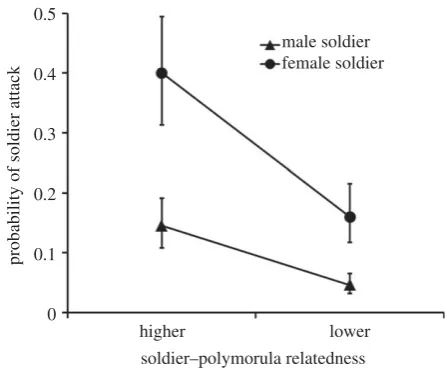
Female soldiers were more likely to attack polymorulae than were male soldiers (G1¼14.74,p,0.001; figure 2). Soldiers
of both sexes showed more aggression towards more closely related polymorulae than towards less closely related poly-morulae (G1¼12.88, p,0.001; figure 2.). There was no
significant interaction effect between soldier sex and soldier relatedness to the polymorula (G1¼2.16, p¼0.14). In our
second experiment involving only soldiers, none attacked any other soldier regardless of sex or relatedness (statistical analyses are thus not presented).
4. Discussion
Our data concur with previous reports showing female
C. floridanumsoldiers are more aggressive than males [4], and are more likely to attack the polymorula of an intra-specific competitor than are males [10]. This is consistent with one func-tion ofC. floridanumsoldiers being to mediate sex ratio conflict within mixed sex broods in favour of females [2]. This is due to the genetic asymmetry of haplodiploid sex determination between brothers, sisters and their mother: under outbreeding the genetic interests of full-sibling sisters align most closely and mother–son relatedness is sexually asymmetric [1] but inbreeding increases mother–daughter, but not mother–son, relatedness, making females more valuable and hence a
reduction in males within broods is predicted [2,13]; inbreed-ing is also associated with local mate competition which also selects for female bias within broods [9]. It has been suggested that male soldiers exist only as a non-adaptive side-effect of the evolution of female soldiers [7,10]. Our finding that male sol-diers have the same relatively low aggression rates towards female competitors thus supports in part a non-adaptive male soldier function.
That male and female soldiers were more likely to attack closer relatives is contrary to expectations and previous empiri-cal observations [4]. While male soldier aggression is much lower than that of females, these data also add to recent evi-dence showing that male soldiers are not entirely passive [14]. Intra-specific competition may be higher between close relatives than more distantly related individuals, which may explain why aggression was shown towards close relatives, but a mechanism for this is unclear.
FemaleC. floridanumsoldiers occur as two types that differ in both morphology and behaviour. Those that emerge prior to hatching of a host egg are extremely small and immobile, which results in these individuals primarily attacking conspe-cifics [7]. By contrast, soldiers that emerge during the host larval stage are much larger and more mobile, which are traits needed for attacking heterospecific competitors [6,7]. Short, early emerging female soldiers may thus be more able to adaptively detect variation between two potential conspeci-fic competitors andvice versa. As our experimental procedure was constrained to use longer, later emerging soldiers, higher aggression towards relatives may thus have been a non-adaptive side-effect of mechanisms that enable discrimination between different species of heterospecific competitors: this requires further research as other species of polyembryonic wasps in which sex ratio conflict rarely occurs produce sol-diers of both sexes that aggressively attack heterospecific competitors but weakly attack conspecifics [15].
[image:4.595.321.545.40.224.2]In the field, wasp broods comprising all female offspring derived from multiple foundresses are extremely rare, consist-ent with the soldiers of a female ‘residconsist-ent’ eliminating competitors prior to hatching [7]. When all-male broods occur in the field, the probability of the offspring being derived from multiple foundresses is higher than for all female broods
Table 1.
Sample sizes of soldier – polymorula encounters.
origin of female brood
soldier sex in trial
male
female
total
within-strain cross
58
64
122
between-strain cross
57
65
122
total
115
129
0.5
0.4
0.3
probability of soldier attack
0.2
0.1
0
higher lower
[image:4.595.41.285.67.159.2]soldier–polymorula relatedness male soldier female soldier
Figure 2.
Attack rate of soldiers against opposite sex polymorulae (+s.e).
The convergence of the lines is due to back-transformation of estimated
proportions from the logit scale (on which they are parallel) and not due
to a statistical interaction (which was non-significant, see main text).
rsbl.r
oy
alsocietypublishing.org
Biol.
Lett.
10
:
20140229
[7], consistent with fewer (and less aggressive) soldiers being present. This suggests that interactions between relatively dis-tantly related soldiers in the field may be very rare, and the patterns we observed may have been due to other, unknown mechanisms. Alternatively, because there is variation in host density and availability, mating opportunities for single sex
C. floridanumbroods can be scarce [5,16]. We speculate that lower intra-brood relatedness indicates maternal outbreeding and may suggest a rarity of mating opportunities for reproduc-tives maturing from the current brood, which may thus enhance the value of opposite sex brood-mates. Further understanding
of solider behaviour in polyembryonic parasitoids will require additional investigation into their roles in inter- and intra-specific competition and also into the mechanisms underlying how soldiers recognize potential competitors [4,6,7,8,10].
Acknowledgements.We thank Andy Gardner and Jeff Harvey for perti-nent comments.
Data accessibility. The datasets supporting this article have been uploaded as part of the electronic supplementary material. Funding statement. J.D. was supported by a Marie Curie Fellowship (PIEF-GA-2010-273819).
References
1. Hamilton WD. 1964 The genetical evolution of social behaviour I and II.J. Theoret. Biol.7, 1 – 52. (doi:10.1016/0022-5193(64)90038-4)
2. Gardner A, Hardy ICW, Taylor PD, West SA. 2007 Spiteful soldiers and sex ratio conflict in polyembryonic parasitoid wasps.Am. Nat.169, 519 – 534. (doi:10.1086/512107)
3. Gardner A, West SA. 2004 Spite among siblings.
Science305, 1413 – 1414. (doi:10.1126/science. 1103635)
4. Giron D, Dunn DW, Hardy ICW, Strand MR. 2004 Aggression by polyembryonic wasp soldiers correlates with kinship but not resource competition.Nature430, 676 – 679. (doi:10.1038/ nature02721)
5. Strand MR. 1989 Oviposition behavior and progeny allocation of the polyembryonic wasp
Copidosoma floridanum(Hymenoptera: Encyrtidae).
J. Insect Behav.2, 355 – 369. (doi:10.1007/ BF01068061)
6. Harvey JA, Corley LS, Strand MR. 2000 Competition induces adaptive shifts in caste ratios of a polyembryonic wasp.Nature406, 183 – 186. 7. Giron D, Ross KA, Strand MR. 2007 Presence of soldier
larvae determines the outcome of competition in a polyembryonic wasp.J. Evol. Biol.20, 165 – 172. (doi:10.1111/j.1420-9101.2006.01212.x) 8. Harvey JA, Poelman EH, Tanaka T. 2013 Intrinsic
inter- and intraspecific competition in parasitoid wasps.Annu. Rev. Entomol.58, 333 – 351. (doi:10. 1146/annurev-ento-120811-153622)
9. Hamilton WD. 1967 Extraordinary sex ratios.Science
156, 477 – 488. (doi:10.1126/science.156.3774.477) 10. Giron D, Harvey JA, Johnson JA, Strand MR. 2007
Male soldier caste larvae are non-aggressive in the polyembryonic waspCopidosoma floridanum.Biol. Lett.3, 431 – 434. (doi:10.1098/rsbl.2007.0199) 11. Heimpel GE, de Boer JG. 2008 Sex determination in
the Hymenoptera.Annu. Rev. Entomol.53, 209 – 230. (doi:10.1146/annurev.ento.53.103106.093441)
12. Briffa M, Hardy ICW, Gammell MP, Jennings DJ, Clarke DD, Goubault M. 2013 Analysis of animal contest data. InAnimal contests(eds ICW Hardy, M Briffa), pp. 47 – 85. Cambridge, UK: Cambridge University Press.
13. Herre EA. 1985 Sex ratio adjustment in fig wasps.
Science228, 896 – 898. (doi:10.1126/science.228. 4701.896)
14. Watanabe K, Nishide Y, Roff DA, Yoshimura J, Iwabuchi K. 2012 Environmental and genetic controls of soldier caste in a parasitic social wasp.
Sci. Rep.3, 729. (doi:10.1038/srep00729) 15. Smith MS, Milton I, Strand MR. 2010 Phenotypically
plastic traits regulate caste formation and soldier function in polyembryonic wasps.J. Evol. Biol.23, 2677– 2684. (doi:10.1111/j.1420-9101.2010.02127.x) 16. Hardy ICW, Ode PJ, Strand MR. 1993 Factors
influencing brood sex ratios in polyembryonic Hymenoptera.Oecologia93, 343 – 348. (doi:10. 1007/BF00317876)