Munich Personal RePEc Archive
On the Maximum Number of Players
Voluntarily Contributing to Two or More
Public Goods
Nakagawa, Shintaro
Konan University
15 March 2019
Online at
https://mpra.ub.uni-muenchen.de/92719/
1
On the Maximum Number of Players Voluntarily Contributing to
Two or More Public Goods
15 March 2019
Shintaro Nakagawa*
Abstract
Cornes and Itaya (2010) showed that in a two-player game of voluntary provision of
two public goods if the players have different preferences, and if both players
simultaneously make positive contributions to both public goods, the system of
equations representing the Nash equilibrium is overdetermined. We extend this
proposition to a model of voluntary provision of two or more public goods and show
that if the players have different preferences, and if the number of players who
contribute simultaneously to two or more public goods is more than the number of
public goods, the system representing the Nash equilibrium is overdetermined. This
result implies that in a large group, the share of players contributing to multiple public
goods may well be quite small and the majority of the players may contribute to at the
most one public good.
Keywords: Voluntary provision, multiple public goods
JEL Classification: H41
* Corresponding author. Faculty of Economics, Konan University, 8-9-1 Okamoto,
2
1.
Introduction
Voluntary provision of public goods has been an important issue in the literature of
public economics. Compared to voluntary provision of one public good, voluntary
provision of two or more public goods has been paid limited attention, except for
several papers such as Kemp (1984); Bergstrom et al. (1986); Cornes and
Schweinberger (1996); Dasgupta and Kanbur (2005); Cornes and Itaya (2010); and
Ihori et al. (2014). However, it has not been sufficiently investigated how many players
contribute to two or more public goods in a Nash equilibrium.1
One exception is Cornes and Itaya (2010). Cornes and Itaya considered an
economy consisting of two players, one private good, and two voluntarily provided
public goods. They then showed that if the players have different preferences, and if
both players simultaneously make positive contributions to both public goods, the
system of equations representing the Nash equilibrium consists of equations strictly
more than unknown variables, i.e., the system of equations is overdetermined. Thus,
they claimed “there “almost surely” does not exist a Nash equilibrium in which both
players simultaneously make positive contributions to both public goods” (Cornes and
Itaya (2010), Proposition 2(i), p. 369).
However, they did not extend their proposition to more general settings. There
remain unsolved questions such as “How is their proposition modified if we introduce a
new player to the model?” or“How about if we introduce another public good?”
In this paper, we extend their model to a model in which many players
voluntarily contribute to many public goods. We assume that H players voluntarily
contribute to J public goods and that every player has different preferences. Then, we
show that the system of equations representing a Nash equilibrium wherein J players
contribute to two or more public goods is overdetermined.
For example, consider an economy wherein players voluntarily provide two
public goods. In this economy, a system of equations representing a Nash equilibrium
wherein two players voluntarily contribute to both public goods is overdetermined
irrespective of the number of players. Even if there exist one hundred players, a Nash
1 The identification of contributors in one public good model has been investigated in
3
equilibrium wherein two players contribute to both public goods is unlikely to exist.
Our result implies that if many players voluntarily contribute to a limited
number of public goods, a limited number of players contribute to two or more public
goods and the majority of players contribute to at the most only one public good.
2.
Model
Let us consider an economy consists of H players. They consume I private goods and
voluntarily provide J public goods. Let h i
c be the amount of private good i consumed
by player h, Gj the amount of public good j, h j
g the contribution to public good j by
player h, h
Y the income of player h, qi the price of private good i, and pj the unit
cost of contribution to public good j. We assume that h
Y , qi, and pj are positive
constants, and that each player considers the contributions made by other players as
given. Following Bergstrom et al. (1986), a Nash equilibrium of this model is defined as
follows.
Definition: A Nash equilibrium of this model is a vector of private goods consumption and contributions to public goods, ( h*, h*),
i j
c g for h=1, , ,H i=1, , ,I j=1, , ,J
such that for each player h{1, , }H , it solves the following problem:
(
)
1 1
1 1
,, ,max, , , , , , , ,
h h h h
I J
h h h
I J
c c g g
U c c G G
subject to
1
,
H h
j j
h
G g
=
=
for j=1, , ,J (1)1 1
,
I J
h h h
i i j j
i j
Y q c p g
= =
=
+
(2)where h(.)
U is strictly increasing, strictly quasi-concave, and twice continuously
differentiable in all arguments.
Following Cornes and Itaya (2010), we assume that all goods are essential, or
0
limh /
i
h h i
c → U = c for i=1, ,I and limj 0 /
h j
4
We now focus on how many players simultaneously contribute to two or more
public goods. Let us consider a list of public goods to which player h contributes
positive amounts. Let h*
S be a set of indexes of public goods that player h
contributes. Index j is in h*
S if and only if player h contributes a positive
amount to public good j:
* *
{ | 0}.
h h
j
S = j g (3)
For example, if player 1 contributes positive amounts to public goods 1 and 2 and does
not contribute to the other public goods, we obtain 1*
{1, 2}
S = . Then, we classify the
players based on the size of h*
S as follows:
Definition: Player h is a noncontributor if h*
S is empty. He/she is a unilateral
contributor if the size of h*
S is one. He/she is a multilateral contributor if the size of
*
h
S is more than one.
Next, we consider how many players are multilateral contributors. Let us form
groups of players according to how many public goods they contribute. We define the
group of noncontributors as N0* and that of unilateral contributors as * 1
N . In general,
we define the group of players contributing to k types of public goods as *
k
N . Note
that the members of group *
k
N may differ in the combination of public goods they
contribute: one member might contribute to public goods 1,...,k , while another
member might contribute to public goods 2,...,k+1. We denote the size of group Nk*
by nk*. By definition, we obtain the following:
* 0 .
J k k
H =
= n (4)The left-hand side of (4) is the number of players in this model, while the right-hand
side is the sum of the number of players contributing to k public goods from k =0
to k=J .
5
Proposition 1: Let us suppose that there is a Nash equilibrium of this model, * *
( h , h ),
i j
c g
for h=1, , ,H i=1, , ,I j=1, , .J We assume that the number of players
contributing to k types of public goods in the equilibrium, *
k
n , satisfies the following
inequality:
* 2
( 1) .
J
k k
k n J
=
−
(5)Then, the system of equations representing the Nash equilibrium is overdetermined.
Proof: The Lagrangian function of player h’s utility maximization problem is defined as follows:
(
1 1)
1 1 1
, , , , , .
I J J
h h h h h h h h h h
I J i i j j j j
i j j
L U c c G G Y q c p g g
= = =
= + − − +
(6)We denote the Lagrange multipliers in the Nash equilibrium by h* and hj*
( j=1, ,J ). Then, c gi*, *j,h*, and hj* satisfy the first order conditions for
'
h sutility maximization, which are given as follows:
*
0, for 1, , .
h h i h i U
q i I
c
− = =
(7)
* *
0, for 1, , .
h
h h
j j j
U
p j J
G
− + = =
(8)
* *
0, for 1, , .
h h
j gj j J
= = (9)
Solving (7) for private good 1, we obtain the following:
* 1 1 1 . h h h U q c =
(10)
Substituting (10) in (7), we obtain the following:
1 1
, for 2, , .
h h i h h i q U U i I
c q c
= =
(11)
If public good j is in set h*
S , which is the set of indexes of public goods to which
6
* 1 1
, for .
h h j h h j p U U j S G q c
=
(12)
If player h is a noncontributor, h’s budget constraint becomes the following:
* *
0 1
, for .
I
h h
i i i
Y q c h N
=
=
(13)By aggregating the budget constraints of unilateral and multilateral contributors, we
obtain the following:
* * 0 0 * * 1 1 I J h h
i i j j
i j
h N h N
Y q c p G
= =
= +
, (14)where G*j is the amount of public good j provided in the Nash equilibrium.
The Nash equilibrium levels of private goods consumption and public goods
provision, * *
( h , )
i j
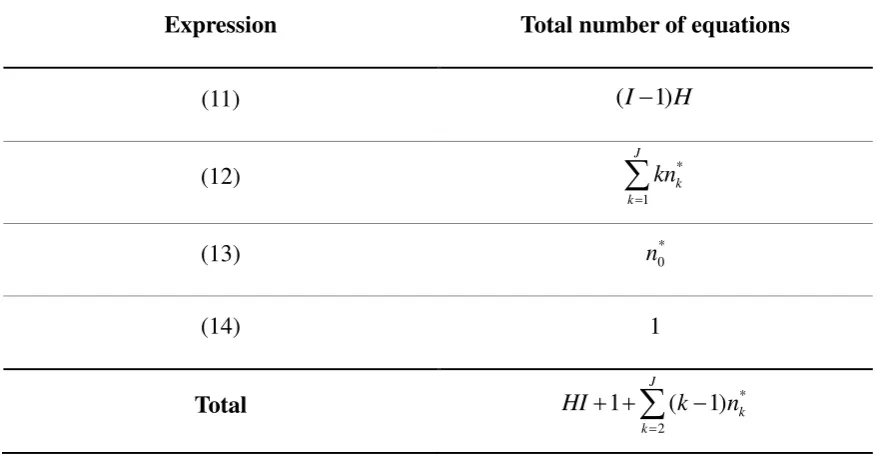
[image:7.595.78.521.412.640.2]c G , must solve the system of (11), (12), (13), and (14).
Table 1. The number of equations to be solved in the Nash equilibrium
Expression Total number of equations
(11) (I−1)H
(12) * 1 J k k kn =
(13) n*0
(14) 1
Total *
2
1 ( 1)
J
k k
HI k n
=
+ +
−In Table 1, we count the numbers of equations in this system. Expression (11)
indicates the first-order conditions on private goods consumption. There are I−1
equations for each player, and there are H players in this economy. Thus, we have a
7
player h to make a positive contribution to public good j. If player h is a unilateral
contributor, he/she has one equation on the efficiency of his/her contribution. Counting
these equations for every unilateral contributor, we have n1* equations. If player h
contributes to k types of public goods, there exist k equations corresponding to the
public goods the player contributes. Counting the equations for every player
contributing to k types of public goods, we obtain *
k
kn equations. Thus, we obtain a
total of *
1
J k k= kn
equations. Expression (13) signifies the budget constraints for noncontributors. Because there are *0
n noncontributors, we obtain * 0
n equations.
Expression (14) describes the budget constraint for unilateral and multilateral
contributors. Summing up the budget constraints for all players contributing to at least
one public good, we obtain only one equation. Computing the total number of equations,
we obtain the following:
* * * * 0 0 1 1 * * 1 1 * 1 * 2
( 1) 1 ( ) 1
1
( 1) 1
1 ( 1) .
J J k k k k J J k k k k J k k J k k
I H kn n HI H n kn
HI n kn
HI k n
HI k n
= = = = = = − + + + = − − + + = − + + = + − + = + + −
(15)The unknown variables of the system of equations are h* i
c and G*j. We have
HI variables for h*
i
c and J variables for G*j. As a total, we have HI+J unknown
variables.
If expression (5) holds, we obtain the following:
* 2
1 ( 1) 1 ,
J
k k
HI k n HI J HI J
=
+ +
− + + + (16)which means that the number of equations is more than the number of unknown
variables. Thus, the system of equations representing the Nash equilibrium is
overdetermined.
8
2(i). Suppose that there are two public goods, J =2. Then, expression (5) becomes
*
2 2
n . (17)
The left-hand side of (17) is the number of players contributing to both public goods.
Then, Proposition 1 means that if two or more players contributing to both public goods,
the system of equations representing the Nash equilibrium is overdetermined.
Proposition 1 also shows how many multilateral contributors can exist in a
model with more than two public goods. Interestingly, the number of multilateral
contributors is bounded not by the number of players but by the number of public goods.
If players consume J public goods in an economy, any Nash equilibrium wherein J
players contribute to two or more public goods is unlikely to exist because the system of
equations representing the equilibrium is overdetermined.
Unlike the number of multilateral contributors, the number of unilateral
contributors and that of noncontributors are not bounded. What is the difference
between the multilateral and unilateral contributors? Let us suppose that player h
contributes to public goods 1 and 2. In this case, the first-order conditions for the player
include one more equation than that for a unilateral contributor because player h
allocates his/her contributions to public goods 1 and 2. Thus, if there are more
multilateral contributors, there are more equations to be solved. However, the number of
unknown variables is fixed. Thus, if the system of equations is not overdetermined, the
number of multilateral contributors is bounded.
From Proposition 1, we immediately obtain the following corollary:
Corollary 1: In the following Nash equilibria, the system of equations representing the equilibrium is overdetermined:
(i) Equilibrium with J or more multilateral contributors.
(ii) Equilibrium wherein two or more players contribute to all the public goods.
(iii) Equilibrium wherein one player contributes to all the public goods, and at least
one player contributes to two or more public goods.
3.
Conclusion
9
to J public goods. Our proposition implies that unless the system is overdetermined,
the number of multilateral contributors, who contribute to two or more public goods, is
at the most J−1. Thus, in a large group, the share of players contributing to multiple
public goods may be quite small, and the majority of the group members may contribute
to at the most one public good.
Acknowledgments
Earlier versions of this paper were presented at Workshop in Honour of Professor
Richard Cornes, on September 2, 2016, at Australian National University and the 74th
Annual Congress of the International Institute of Public Finance on 23 August 2019, at
University of Tampere. The author thanks Toshihiro Ihori, Martin C. McGuire, Yuzo
Higashi, Jun-ichi Itaya, and participants of the workshop and conference for their
insightful comments and questions. This work was supported by JSPS KAKENHI
[grant numbers 26380366, 15H01952].
References
Andreoni, J. and M. C. McGuire (1993) Identifying the free riders: A simple algorithm
for determining who contribute to a public good, Journal of Public Economics, 51(3),
pp. 447-454, https://doi.org/10.1016/0047-2727(93)90076-6.
Bergstrom, T., L. Blume and H. Varian (1986) On the private provision of public goods,
Journal of Public Economics, 29(1), pp. 25-49,
https://doi.org/10.1016/0047-2727(86)90024-1.
Cornes, R. and J. Itaya (2010) On The Private Provision of Two or More Public Goods,
Journal of Public Economic Theory, 12 (2), pp. 363–385,
https://doi.org/10.1111/j.1467-9779.2009.01455.x.
Cornes, R. C. and A. G. Schweinberger (1996) Free riding and the inefficiency of the
private production of pure public goods, Canadian Journal of Economics, 29(1), pp.
70-91, https://doi.org/10.2307/136152.
10
and integration, in C. B. Barrett eds. The Social Economics of Poverty: On identities,
communities, groups and networks, Routledge: Abingdon.
Ihori, T., M. C. McGuire and S. Nakagawa (2014) International Security, Multiple
Public Good Provisions, and The Exploitation Hypothesis, Defence and Peace
Economics, 25(3), pp. 213-229, http://dx.doi.org/10.1080/10242694.2012.752229.
Kemp, M.C.(1984) A note of the theory of international transfers, Economics Letters,
14(2-3), pp. 259-262, https://doi.org/10.1016/0165-1765(84)90092-2.
McGuire, M.C. (1991) Identifying the free riders: How to partition a group into positive
and zero contributors to the common good, University of Maryland Working paper,
91-14.
McGuure, M.C. and C. H. Groth, Jr. (1985) A method for identifying the public good
allocation process within a group, Quarterly Journal of Economics, 100(Supplement),