Proceedings of the 1st International Workshop on Computational Approaches to Historical Language Change, pages 234–239 234
Measuring the compositionality of noun-noun compounds over time
Prajit Dhar
Leiden University
Janis Pagel
University of Stuttgart
Lonneke van der Plas
University of Malta
Abstract
We present work in progress on the temporal progression of compositionality in noun-noun compounds. Previous work has proposed putational methods for determining the com-positionality of compounds. These methods try to automatically determine how transpar-ent the meaning of the compound as a whole is with respect to the meaning of its parts. We hypothesize that such a property might change over time. We use the time-stamped Google Books corpus for our diachronic inves-tigations, and first examine whether the vector-based semantic spaces extracted from this cor-pus are able to predict compositionality rat-ings, despite their inherent limitations. We find that using temporal information helps pre-dicting the ratings, although correlation with the ratings is lower than reported for other cor-pora. Finally, we show changes in compo-sitionality over time for a selection of com-pounds.
1 Introduction
Compositionality is a long debated issue in theo-retical linguistics. The principle of compositional-ity (Partee,1984) states that the meaning of an ex-pression is a function of the meanings of its parts and of the way they are syntactically combined. It is often used to describe how the meaning of a sentence can be derived from the meaning of sin-gle words and phrases, but the principle might also be postulated for compounding, i.e. the process of combining two or more lexemes to form a new concept (Bauer, 2017, p. 1 and 4). Compounds can often be directly derived from the meanings of the involved compound constituents (e.g. grad-uate student, speed limit), however, we also find compounds whose meanings can only be derived
partially from their components (night owl, hot dog).
Surprisingly, diachronic perspectives on com-positionality1 are virtually absent from previous work. To the best of our knowledge, we present the first study on the compositionality of com-pounds over time. We bring two strands of re-search together. On the one hand we are inspired by the synchronic work on predicting the degree of compositionality of compounds by comparing the vector-based representations of the parts to the vector-based representations of the compound as a whole. On the other hand, we rely on meth-ods designed for detecting semantic change, such as presented in Hamilton et al. (2018), to study compositionality in compounds from a diachronic viewpoint.
2 Related Work
From a synchronic perspective, Reddy et al. (2011),Schulte im Walde et al.(2013) andSchulte im Walde et al. (2016a) are closest to our ap-proach, since they predict the compositionality of compounds using vector space representations. However, Schulte im Walde et al. (2013) use German data and do not investigate diachronic changes. They report a Spearman’s ρ of 0.65 for predicting the compositionality of compounds based on the features of their semantic space and find that the modifiers mainly influence the com-positionality of the whole compound, contrary to their expectation that the head should be the main source of influence. This is true for both the human annotation and their vector space model.
Schulte im Walde et al.(2016a) further investigate the role of heads and modifiers on the prediction of compositionality and reportρvalues between 0.35 and 0.61 for their models on German and English data. Reddy et al.(2011) also report Spearman’s
ρbetween their surveyed compositionality values and word vectors. They achieveρvalues of around 0.68, depending on the model.
From a diachronic perspective, we follow the general methodological approach of Hamilton et al.(2018), who use PPMI, SVD and word2vec based vector spaces to investigate a shift in mean-ing for chosen words with a known semantic change (gay, broadcast, etc.). They use time se-ries to detect a significant change-point for two words, using cosine similarity and Spearman’sρ. They also compute the displacement for a single word embedding by calculating the cosine simi-larity between a point in timetand a later point in timet+ ∆. We adapt this methodology and make use of the same corpus (Google Books Ngram).
3 Methods and Data
Several studies have been conducted in order to measure compositionality for compounds in dif-ferent languages (von der Heide and Borgwaldt, 2009;Reddy et al.,2011;Schulte im Walde et al., 2016b). Some of these works have used large corpora to extract vector-based representations of compounds and their parts to automatically deter-mine the compositionality of a given compound. The models were validated on the basis of their correlation with human compositionality ratings for a set of compounds.
Because we are interested in the diachronic per-spective on compounds, we use a time-stamped corpus: the Google Books Ngram corpus2(Michel
et al., 2011) It contains books from the 1500s to the 2000s, from which we retrieve the contextual information of compounds and their constituents per year. We operate on 5-grams, which is the largest unit provided by Google Ngrams and use the words appearing in the 5-grams as both target words and context. We use the Part-of-Speech in-formation already included in the Google Ngram corpus to extract noun-noun patterns. We then regard all other tokens in the 5-gram as context words and from this build up a semantic space
rep-2The data is available from https:// commondatastorage.googleapis.com/books/ syntactic-ngrams/index.html
resentation of noun compounds for each year. We use a sliding window approach, wherein we cap-ture the context of a compound based on its posi-tion in the 5-gram. That means that a bigram (say the compoundgold mine) could occur in four dif-ferent positions in the 5-grams (1-2, 2-3, 3-4 and finally 4-5). We then capture the contexts for each of these positions, in order to enrich the represen-tation of a compound and its constituents (which similarly have five such positions, as they are uni-grams).
Ideally, we would validate our diachronic model on diachronic test data. However, as it is not possible to survey compositionality rating for di-achronic data, we instead use the synchronic data provided by Reddy et al. (2011) (henceforth re-ferred to as REDDY) for evaluating the quality of the Google Books Ngram data as a source for investigating the compositionality of compounds in general. Reddy et al. (2011) compiled a list of 90 English compounds and asked annotators to rate the compositionality of these compounds on a scale from 0 to 5. They provide three mean values of their ratings for the compounds (compound-mean), heads (head-mean) and mod-ifiers (modifier-mean). We make use of REDDY in order to verify that our methods are capable of capturing compositionality (synchronically) and use the diachronic data of Google Books Ngram to investigate the temporal change of compositional-ity.
A common challenge in building semantic spaces on a diachronic scale is that when build-ing the spaces for individual spans of time, the spaces need to be aligned later on in order to com-pare models (see e.g.Kutuzov et al.,2018, Section 3.3). We circumvent this problem by jointly learn-ing the spaces for the target words. To do this, we take the sparse representations of the compounds and their constituents and jointly learn their dense representations using SVD. Similar to Hamilton et al.(2018) we also choose the dimensions of our embeddings to be 300. We carry out row normal-ization on the embeddings, in order to remove the bias of the frequency of the compounds and their constituents.
Plas, 2019). Three features are based on the co-sine similarity between the embeddings of dif-ferent compound parts (seeG¨unther and Marelli, 2016):
1. Similarity between compound constituents (sim-bw-constituents)
2. Similarity of the compound with its head (sim-with-head)
3. Similarity of the compound with its modifier (sim-with-mod)
The three information theory based features given below were proposed by Dhar and van der Plas(2019):
4. Log likelihood-ratio (LLR)
5. Positive Pointwise Mutual Information (PPMI)
6. Local Mutual Information (LMI)
Such formulas have been used prior to calcu-late collocations and associations between words (compareManning and Sch¨utze,1999). Each fea-ture will be tested individually for its ability to capture compositionality.
4 Experiments
We ran a total of two experiments3 (Section 4.2 and4.3) with different goals.
4.1 Experimental Setup
Hyper-parameters We experiment with certain hyper-parameters, in particular we varied thetime span length, e.g. single years, decades or a span of 20 years etc. andfrequency cut-off of compounds and their constituents in a specific time span, i.e. compounds and constituents have to occur above a certain frequency threshold. Choosing a greater time span will increase the observable data per compound and might improve the vector represen-tations. We only consider compounds which retain representations in all time spans starting from the year 1800, which reduces the number of total com-pounds depending on the specific setup.
3The code is available at https://github.com/ prajitdhar/Compounding
Compound-centric setting Dhar and van der Plas (2019) found the compound-centric set up, where the distributional representations of words are based on their usage as constituents in a com-pound to outperform comcom-pound-agnostic setups, for predicting novel compounds in English. They were inspired by research on N-N compounds in Dutch that suggests that constituents such as -molen ‘-mill’ in peper-molen ‘peppermill’ are sep-arately stored as abstract combinatorial structures rather than understood on the basis of their inde-pendent constituents (De Jong et al., 2002). We hence adopt the compound-centric setting.
4.2 Correlation
We first carry out a quantitative experiment, to see if our features bolster the prediction of composi-tionality in noun-noun compounds. To do so, we calculate correlation scores between our proposed metrics and the annotated compositionality ratings of REDDY. LikeReddy et al.(2011) andSchulte im Walde et al.(2013), we opt for Spearman’sρ.
To find the best configuration of a time span and cut-off for the regression models, we use the R2
metric. Table1presents our findings; we will dis-cuss them in the following Section5.
4.3 Progression of Compositionality over Time
Based on the results of our correlation experiment, we proceed to analyze the temporal progression of compositionality. Our goals are two-fold: First, investigate if temporal information helps in pre-dicting the contemporary REDDY data and sec-ond, use the best feature and setup in order to model the progression of compositionality over time.
5 Results
Time span Cut-off R2±sd
NA (Non-temporal)
20 0.343±0.028 50 0.344±0.026 100 0.337±0.035
1 (Year)
20 0.350±0.029 50 0.171±0.039 100 0.326±0.030
10 (Decade)
20 0.332±0.024 50 0.328±0.034 100 0.360±0.062
20 (Score)
20 0.341±0.039 50 0.331±0.031 100 0.370±0.012
50 (Half-century)
20 0.352±0.038 50 0.360±0.029 100 0.364±0.034
100 (Century)
[image:4.595.78.285.69.360.2]20 0.351±0.037 50 0.343±0.033 100 0.344±0.034
Table 1: R2values and standard deviation for the dif-ferent configurations.
from Table2, our correlation values are consider-ably lower than that ofReddy et al.(2011), but on par with a replication study bySchulte im Walde et al.(2016a) forcompound-mean. We speculate that these differences are potentially due to the use of different data sets, the fact that we use a con-siderably smaller context window for construct-ing the word vectors (5 due to the restrictions of Google Ngram corpus vs. 100 in Reddy et al. (2011) and 40 inSchulte im Walde et al.(2016b)) and the use of a compound-centric setting (as de-scribed in4.1).
From Table 1we see that our best reportedR2
value occurs when observing time in stretches of 20 years (scores) and compounds having a fre-quency cut-off of at least 100. A few other ob-servations could be made: In general the cut-off seems to improve theR2metric and the time spans of 10 and 20 years appear to be the most informa-tive and stable for the cut-off values. Also, using temporal information almost always outperforms the setup that ignores all temporal information.
For our following experiment, we choose to use the configuration with the highestR2value: a time span of 20 years and a cut-off of 100. Since LMI
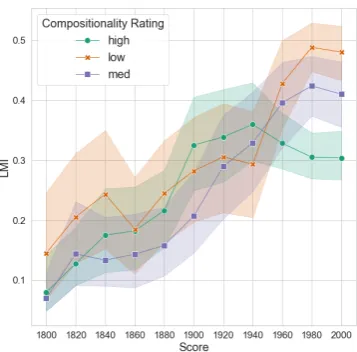
achieved the highestρvalues, we also choose LMI over the other features. We group the compounds of REDDY into three groups based on the human ratings they obtained: low (0-1), med (2-3) and high(4-5). Each group contains around 30 com-pounds. We then plot the LMI values of these three groups with their confidence interval across the time step of 20 years, shown in Figure1. We can observe that there is a separation between the groups towards the later years, and that the pe-riod between 1940s and 1960s caused a notice-able change in the compositionality of the REDDY compounds. We find the same trends for all three information theory based features. Although care should be taken given the small data sets (espe-cially for the earlier decades) on which the models were build and tested, the slope of the lines for the three groups of compounds seems to suggest that less compositional compounds go through a more pronounced change in compositionality than com-positional compounds, as expected.
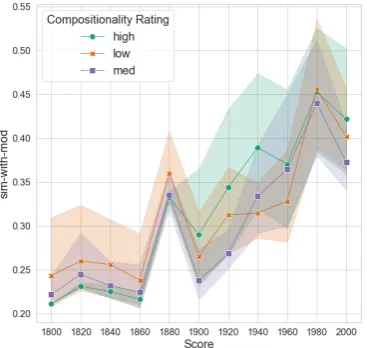
We also show the graphs forsim-with-headand sim-with-mod (Figures 2 and 3) for the different groups of compounds across time, as these under-performed in our previous experiment. Both fig-ures based on cosine based featfig-ures largely con-found the three groups of compounds across time, reinforcing our previous findings.
[image:4.595.322.501.497.673.2]modifier-mean head-mean compound-mean
sim-bw-constituents 0.35 0.41 0.48 sim-with-head 0.26 0.43 0.43
sim-with-mod 0.1 0.18 0.2
LLR 0.36 0.44 0.52
PPMI −0.12 −0.1 −0.14
[image:5.595.85.269.238.410.2]LMI 0.38 0.45 0.54
Table 2: Spearman’sρof our measures and the compositionality ratings of REDDY.
Figure 2:sim-with-headof a compound in time pointt andt+ 1, with a time span of 20 years and a frequency cut-off of 100. Compounds are grouped according to their rating in REDDY.
Figure 3:sim-with-modof a compound in time pointt andt+ 1, with a time span of 20 years and a frequency cut-off of 100. Compounds are grouped according to their rating in REDDY.
6 Future Work
Our current work was limited to English com-pounds from Reddy et al. (2011). We plan to expand our models to other languages for which compositionality ratings are available, such as German. We would also like to further investigate the fact that the information theory based mea-sures outperform the ones based on cosine simi-larity. We intend to do so by incorporating more compounds and their compositionality ratings, as well as by using larger corpora.
Lastly, we will seek to find ways to harvest proxies for compositionality ratings of compounds over time. A possible avenue could be to use the information available in dictionaries.
7 Conclusion
We have shown work in progress on determin-ing the compositionality of compounds over time. We showed that for our current setup, informa-tion theory based measures seem to capture com-positionality better. Furthermore, we showed that adding temporal information increases the predic-tive power of these features to prognosticate syn-chronic compositionality. Finally, we showed how our best performing models trace the composition-ality of compounds over time, delineating the be-havior of compounds of varying levels of compo-sitionality.
Acknowledgements
[image:5.595.84.268.516.690.2]References
Laurie Bauer. 2017. Compounds and Compounding, volume 155 of Cambridge Studies in Linguistics. Cambridge University Press, Cambridge.
Nivja H. De Jong, Laurie B. Feldman, Robert Schreuder, Matthew Pastizzo, and R. Harald Baayen. 2002. The processing and representation of dutch and english compounds: peripheral morpho-logical and central orthographic effects. Brain and
Language, 81:555–67.
Prajit Dhar and Lonneke van der Plas. 2019. Learn-ing to predict novel noun-noun compounds. InJoint Workshop on Multiword Expressions and WordNet
(MWE-WN 2019).
Fritz G¨unther and Marco Marelli. 2016.Understanding Karma Police: The Perceived Plausibility of Noun Compounds as Predicted by Distributional Models of Semantic Representation. PLoS ONE, 11(10):1– 36.
William L. Hamilton, Jure Leskovec, and Dan Ju-rafsky. 2018. Diachronic word embeddings re-veal statistical laws of semantic change. CoRR, abs/1605.09096.
Andrey Kutuzov, Lilja Øvrelid, Terrence Szymanski, and Erik Velldal. 2018. Diachronic word embed-dings and semantic shifts: a survey. InProceedings of the 27th International Conference on Computa-tional Linguistics, pages 1384–1397, Santa Fe, New Mexico, USA.
Christopher D. Manning and Hinrich Sch¨utze. 1999.
Foundations of Statistical Natural Language
Pro-cessing. MIT Press, Cambridge, MA, USA.
Jean-Baptiste Michel, Yuan Kui Shen, Aviva Presser Aiden, Adrian Veres, Matthew K. Gray, The Google Books Team, Joseph P. Pickett, Dale Hoiberg, Dan Clancy, Peter Norvig, Jon Or-want, Steven Pinker, Martin A. Nowak, and Erez Lieberman Aiden. 2011. Quantitative analysis of culture using millions of digitized books. Science, 331(6014):176–182.
Barbara H. Partee. 1984. Compositionality. In Vari-eties of Formal Semantics: Proceedings of the 4th
Amsterdam Colloquium, Sept. 1982, pages 281–311.
Foris Publications.
Siva Reddy, Diana McCarthy, and Suresh Manandhar. 2011. An empirical study on compositionality in compound nouns. In Proceedings of the 5th In-ternational Joint Conference on Natural Language
Processing, pages 210–218, Chiang Mai, Thailand.
AFNLP.
Sabine Schulte im Walde, Anna H¨atty, and Stefan Bott. 2016a. The role of modifier and head properties in
predicting the compositionality of English and Ger-man noun-noun compounds: A vector-space per-spective. In Proceedings of the Fifth Joint Con-ference on Lexical and Computational Semantics
(*SEM 2016), pages 148–158.
Sabine Schulte im Walde, Anna H¨atty, Stefan Bott, and Nana Khvtisavrishvili. 2016b. Ghost-NN: A
Rep-resentative Gold Standard of German Noun-Noun Compounds. In Proceedings of the 10th Interna-tional Conference on Language Resources and Eval-uation, pages 2285–2292, Portoroz, Slovenia. Sabine Schulte im Walde, Stefan M¨uller, and Stephen
Roller. 2013. Exploring Vector Space Models to Predict the Compositionality of German Noun-Noun Compounds. InProceedings of the 2nd Joint
Con-ference on Lexical and Computational Semantics,
pages 255–265, Atlanta, GA, USA.
Nigel Vincent. 2014. Compositionality and change. In Claire Bowern and Bethwyn Evans, editors,
The Routledge Handbook of Historical Linguistics,
pages 103–123. Routledge, United Kingdom.
Claudia von der Heide and Susanne Borgwaldt. 2009.
Assoziationen zu Ober-, Basis- und Unterbegrif-fen. Eine explorative Studie. In Proceedings of
the 9th Norddeutsches Linguistisches Kolloquium,