56
Do Human Rationales Improve Machine Explanations?
Julia Strout, Ye Zhang and Raymond J. Mooney Department of Computer Science
University of Texas at Austin
{jstrout,yezhang,mooney}@cs.utexas.edu
Abstract
Work on “learning with rationales” shows that humans providing explanations to a machine learning system can improve the system’s pre-dictive accuracy. However, this work has not been connected to work in “explainable AI” which concerns machines explaining their rea-soning to humans. In this work, we show that learning with rationales can also improve the quality of the machine’s explanations as evaluated by human judges. Specifically, we present experiments showing that, for CNN-based text classification, explanations gener-ated using “supervised attention” are judged superior to explanations generated using nor-mal unsupervised attention.
1 Introduction
Recently, the need for explainable artificial intel-ligence (XAI) has become a major concern due to the increased use of machine learning in au-tomated decision making (Gunning, 2017; Aha,
2018). On the other hand, work on “learning with rationales” (Zaidan et al.,2007;Zhang et al.,
2016) has shown that humans providing explana-tory information supporting their supervised clas-sification labels can improve the accuracy of ma-chine learning. These human annotations that can explain classification labels are calledrationales. In particular, for text categorization, humans select phrases or sentences from a document that most support their decision as rationales.
However, there is no work connecting “learning from rationales” with improving XAI, although they are clearly complementary problems.
Contribution We explore whether learning from human explanations actually improves a sys-tem’s ability to explain its decisions to human users. Specifically, we show that for explanations for text classification in the form of selected pas-sages that best support a decision, training on
hu-man rationales improves the quality of a system’s explanations as judged by human evaluators.
Attention mechanisms (Bahdanau et al.,2015) have become standard practice in computer vision and text classification (Vaswani et al.,2017;Yang et al., 2016). In both computer vision and text-based tasks, learned attention weights have been shown through human evaluation to be useful ex-planations for a model’s decisions (Park et al.,
2018; Rockt¨aschel et al., 2015; Hermann et al.,
2015; Xu et al., 2015); however, attention’s ex-planatory power has come into question in recent work (Jain and Wallace,2019), which we discuss in Section 2.
Traditional attention mechanisms are unsuper-vised; however, recent work has shown that su-pervising attention with human annotated ratio-nales can improve learning for text classification based on Convolutional Neural Networks (CNNs) (Zhang et al., 2016). While this work alludes to improved explainability using supervised atten-tion, it does not explicitly evaluate this claim. We extend this work by evaluating whether supervised attention using human rationales, rather than unsu-pervised attention, actually improves explanation. Explanations from both models are full sentences that the model has weighted as being most impor-tant to the document’s final classification.
necessary element of explainability research, and in this work, we compare the explanations from the two models through human evaluation on Me-chanical Turk and find that the model trained with human rationales is judged to generate explana-tions that better support its decisions.
2 Related Work
There is a growing body of research on explain-able AI (Koh and Liang, 2017; Ribeiro et al.,
2016;Li et al.,2016;Hendricks et al.,2018), but it is not connected to work on learning with human rationales, which we review below.
As discussed above,Zhang et al.(2016) demon-strate increased predictive accuracy of CNN mod-els augmented with human rationales. Here, we first reproduce their predictive results, and then fo-cus on extracting and evaluating explanations from the models. Lei et al.(2016) present a model that extracts rationales for predictions without train-ing on rationales. They compare their extracted rationales to human gold-standard ones through automated evaluations, i.e., precision and recall.
Bao et al.(2018) extend this work by learning a mapping from the human rationales to continuous attention. They transfer this mapping to low re-source target domains as an auxiliary training sig-nal to improve classification accuracy in the tar-get domain. They compare their learned attention with human rationales by calculating their cosine distance to the ‘oracle’ attention.
None of the above related work asks human users to evaluate the generated explanations. How-ever,Nguyen(2018) does compare human and au-tomatic evaluations of explanations. That work finds that human evaluation is moderately, but sta-tistically significantly, correlated with the auto-matic metrics. However, it does not evaluate any explanations based on attention, nor do the expla-nations make use of any extra human supervision. As mentioned above, there has also been some recent criticism of using attention as explanation (Jain and Wallace,2019), due to a lack of corre-lation between the attention weights and gradient based methods which are more “faithful” to the model’s reasoning. However, attention weights of-fer some insight into at least one point of inter-nal representation in the model, and they also im-pact the training of the later features. Our con-tribution is to measure how useful these attention based explanations are to humans in
understand-ing a model’s decision as compared to a different model architecture that explicitly learns to predict which sentences make good explanations.
In this work, we have human judges evalu-ate both attention based machine explanations and machine explanations trained from human ratio-nales, thus connecting learning from human expla-nations and machine explaexpla-nations to humans.
3 Models and Dataset
3.1 Models
We replicate the work ofZhang et al.(2016) and use a CNN as our underlying baseline model for document classification. To model a document, each sentence is encoded as a sentence vector using a CNN, and then the document vector is formed by summing over the sentence vectors. We use two variations of this baseline model, a rationale-augmented CNN (RA-CNN) and an at-tention based CNN (AT-CNN) (Yang et al.,2016). RA-CNN is trained on both the document label and the rationale labels. In this model, the doc-ument vector is a weighted sum of the composite sentence vectors, where the weight is the probabil-ity of the sentence being a rationale. In AT-CNN, the document vector is still a weighted sum of sen-tence CNN vectors, but the weight is not learned from rationales. Rather, a trainable context vec-tor is introduced from scratch. We calculate the interaction between this context vector and each sentence vector to induce attention weights over the sentences. The only difference between RA-CNN and AT-RA-CNN is that RA-RA-CNN relies on the human annotated rationales to learn the sentence weight at training time, while AT-CNN learns the sentence weight without utilizing any human ra-tionales. For the details of these two models and training see Zhang et al.(2016).
3.2 Explanations
3.3 Dataset
We evaluate the explanations for both models on the movie review dataset from Zaidan et al.
(2007). It contains 1,000 positive reviews and 1,000 negative reviews where 900 of each are an-notated with human rationales. Each review is a document consisting of 32 sentences on average, and each annotated document contains about 8 ra-tionale sentences. We use the 1,800 annotated documents as the training set, and the remaining 200 documents without extra annotation as test. The human rationales are used as supervision in RA-CNN but not in AT-CNN.
3.4 Classification Accuracy
The classification accuracy of each model on the test set is summarized in Table1. Since there is variance across multiple trials, we pick the best performing model across several trials for human evaluation of the explanations.
Table1reproducesZhang et al.(2016)’s finding that providing human explanations to machines at training time (RA-CNN) improves predictive ac-curacy compared to learning explanations without human annotations (AT-CNN). Our results differ slightly from theirs in that our AT-CNN also out-performs the baseline Doc-CNN. We attribute this difference to possible slight variations in our im-plementation of AT-CNN.
Note there are other works on learning attention that could potentially increase the prediction ac-curacy (Lin et al., 2017;Devlin et al.,2018), but none of them are directly comparable to RA-CNN. We introduced the smallest difference (whether the sentence vector is trained using the rationale label) between AT-CNN and RA-CNN to make a fair comparison between their generated explana-tions.
The focus of this work is on evaluating ex-planations rather than predictive accuracy, so we turn our attention to the question: Does humans explaining themselves to machines improve ma-chines explaining themselves to humans? We will explore this in the next section.
4 Explanation Evaluation Methods
We use Amazon Mechanical Turk (AMT) to eval-uate the explanations from both AT-CNN and RA-CNN.
Doc-CNN AT-CNN RA-CNN 86.00% 88.50% 90.00%
Table 1: Classification accuracy for movie reviews.
4.1 HIT Design
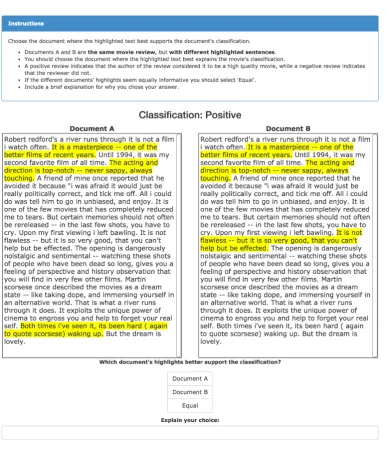
Our Human Intelligence Task (HIT) shows a worker two copies of a test document along with the document’s classification. Each copy of the document has a subset of sentences highlighted as explanations for the final classification. This sub-set is chosen as the 3 sentences with the largest weights from either AT-CNN’s attention weights or RA-CNN’s supervised weighting. We also eval-uated a baseline model that selects 3 sentences at random. Given two randomly ordered docu-ments, a worker must choose which document’s highlighted sentences best support the overall clas-sification. If the worker determines that both are equally supportive (or not supportive), then they can select ‘equal’. We only show workers docu-ments that were correctly classified by both mod-els. This resulted in 166 documents from the 200 in the test set. An example from one HIT is in Appendix A.
4.2 Quality Control
In an effort to receive quality results from the crowd, we employ two strategies from crowd-sourcing research: gold standard questions and majority voting (Hsueh et al.,2009;Eickhoff and de Vries,2013). Gold standard questions are de-signed to weed out unreliable workers who either do not understand the goal of the task or are poor workers. If a worker gets the gold standard ques-tion wrong, then we assume that their other re-sponses are untrustworthy and do not use them.
We also employ majority voting, which requires that at least two workers who pass the gold stan-dard question agree on an answer. For greater than 90% of the test documents, a majority vote was found after having three workers perform the task. Less than 10% of the test documents required a fourth worker who passed the gold question to break a tie. We also chose to require the ‘Master’ qualification that AMT uses to designate the best workers on the platform.
5 Explanation Evaluation Results
Label Rank AT-CNN RA-CNN
1
archer is also bound by the limits of new york soci-ety , which is as intrusive as any other in the world.
the performances are absolutely breathtaking.
Pos 2
the marriage is one which will unite two very pres-tigious families , in a society where nothing is more important than the opinions of others .
there are a few deft touches of filmmaking that are simply outstanding , and joanne woodward’ narra-tion is exquisite.
3
the supporting cast is also wonderful , with several characters so singular that they are indelible in one’s memory .
the supporting cast is also wonderful , with several characters so singular that they are indelible in one’s memory .
1
soon the three guys are dealing dope to raise funds , while avoiding the cops and rival dealer sampson simpson (clarence williams iii) .
it’s just that the comic setups are obvious and the payoffs nearly all fall flat .
Neg 2
only williams stands out (while still performing on the level of his humor-free comedy rocket man) , but that is because he’s imprisoned throughout most of the film , giving a much needed change of pace (but mostly swapping one set of obvious gags for another) .
watching the film clean and sober , you are bound to recognize how truly awful it is .
3
watching the film clean and sober , you are bound to recognize how truly awful it is .
[image:4.595.72.525.60.267.2]the film would have been better off by sticking with the “ rebel” tone it so eagerly tries to claim.
Table 2: Top 3 explanations from both models for both a positive and negative correctly classified test document.
RA-CNN AT-CNN Equal 43.47% 20.48% 36.14%
Table 3: AMT results comparing explanations from RA-CNN to AT-CNN. Workers were asked to choose which document’s highlighted sentences were a better explanation for the final classification.
AT-CNN Random Equal 57.23% 15.66% 27.12%
Table 4: AMT results comparing AT-CNN to the ran-dom baseline.
where the models each correctly classified the doc-ument. The statistics presented are the percentage of times reliable workers agreed that one model’s explanations better supported the document’s clas-sification or were equal.
Overall, it is clear that RA-CNN is providing better explanations for the plurality of test doc-uments (43.47%). The explanations are consid-ered equal 36.14% of the time, and the remaining 20.48% of the documents were better explained by AT-CNN.
After seeing these results, we decided to run another baseline test to ensure that AT-CNN ex-planations are reasonable and can at least beat a weak baseline. The results from comparing AT-CNN explanations to randomly sampled sentences from the test document are in Table4. From these results we can see that AT-CNN is beating the ran-dom baseline the majority of the time, demon-strating that attention, even without human su-pervision, can provide helpful explanations for a
model’s decision.
To further understand the differences between the explanations from AT-CNN and RA-CNN, we calculated statistics to find the amount of overlap in the top three explanatory sentences from each model. In 33.5% of the test documents, the mod-els share no explanation sentences, in 43.1% they share one explanation sentence, in 22.2% they share two explanation sentences, and they share all three in 1.2%. When considering just the most highly weighted sentence, or top explanation, the models agree 18.6 % of the time. So while it is rel-atively rare for the models to produce the same top explanatory sentence, we chose to show humans three explanatory sentences per test document to provide insight even in those matching cases.
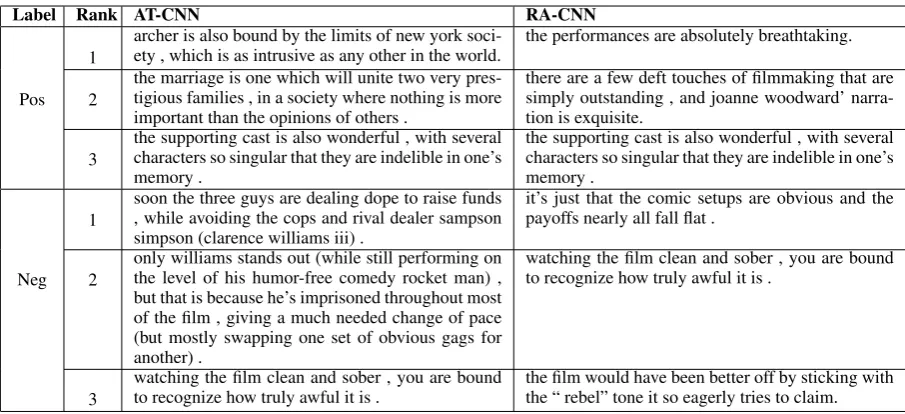
Table 2 contains the top 3 explanations from each model for two test documents. In both ex-amples, AT-CNN extracts sentences that are more plot related and give less insight into the re-viewer’s opinion as compared to RA-CNN. These sentences are generally less helpful for under-standing the classification of the movie review. In the second example, both models have identi-fied a good explanatory sentence: “watching the film clean and sober, you are bound to recognize how truly awful it is.” However, AT-CNN ranks it as less important than two sentences that primar-ily describe the plot of the film while RA-CNN only ranks another, equally explanatory sentence as more important.
make incorrect predictions. We found a trend in the explanations for test documents that both models misclassified where RA-CNN produced explanations that supported the misclassification while AT-CNN produced more explanations that supported the correct classification, despite the model’s decision. While this analysis is too small scale to be conclusive, this raises the question for future work: Do we want our explanation systems to offer the best support for the chosen decision or would it be more beneficial if they provide an explanation that brings the decision into question?
6 Conclusion
This paper has demonstrated that training with human rationales improves explanations for a model’s classification decisions as evaluated by human judges. We show that while an unsuper-vised attention based model does provide some valuable explanations, as proven in the experi-ments comparing to a random baseline, a super-vised attention model that trains on human ratio-nales outperforms those results.
Acknowledgements
This research was supported by the DARPA XAI program through a grant from AFRL. The views and conclusions contained herein are those of the authors and should not be interpreted as necessar-ily representing the official policies or endorse-ments, either expressed or implied, of the U.S. Government.
References
David Aha, editor. 2018. Proceedings of the IJCAI Workshop on Explainable Artificial Intelligence. Melbourne, Australia.
Dzmitry Bahdanau, Kyunghyun Cho, and Yoshua Ben-gio. 2015. Neural machine translation by jointly learning to align and translate. International Con-ference on Learning Representations.
Yujia Bao, Shiyu Chang, Mo Yu, and Regina Barzi-lay. 2018. Deriving machine attention from human rationales. InConference on Empirical Methods in Natural Language Processing.
Abhishek Das, Harsh Agrawal, Larry Zitnick, Devi Parikh, and Dhruv Batra. 2017. Human attention in visual question answering: Do humans and deep networks look at the same regions? Computer Vi-sion and Image Understanding, 163:90–100.
Jacob Devlin, Ming-Wei Chang, Kenton Lee, and Kristina Toutanova. 2018. Bert: Pre-training of deep bidirectional transformers for language understand-ing.arXiv preprint arXiv:1810.04805.
Been Doshi-Velez, Finale; Kim. 2017. Towards a rig-orous science of interpretable machine learning. In
Spring Series on Challenges in Machine Learning: ”Explainable and Interpretable Models in Computer Vision and Machine Learning”.
Carsten Eickhoff and Arjen P de Vries. 2013. Increas-ing cheat robustness of crowdsourcIncreas-ing tasks. Infor-mation retrieval, 16(2):121–137.
David Gunning. 2017. Explainable artificial intelli-gence (XAI). Defense Advanced Research Projects Agency (DARPA).
Lisa Anne Hendricks, Ronghang Hu, Trevor Darrell, and Zeynep Akata. 2018. Grounding visual explana-tions. InEuropean Conference of Computer Vision (ECCV).
Karl Moritz Hermann, Tomas Kocisky, Edward Grefenstette, Lasse Espeholt, Will Kay, Mustafa Su-leyman, and Phil Blunsom. 2015. Teaching ma-chines to read and comprehend. InAdvances in Neu-ral Information Processing Systems, pages 1693– 1701.
Pei-Yun Hsueh, Prem Melville, and Vikas Sindhwani. 2009. Data quality from crowdsourcing: A study of annotation selection criteria. InProceedings of the NAACL HLT 2009 Workshop on Active Learning for Natural Language Processing, HLT ’09, pages 27– 35, Stroudsburg, PA, USA. Association for Compu-tational Linguistics.
Sarthak Jain and Byron C. Wallace. 2019. Attention is not explanation. InProceedings of the 2019 North American Chapter of the Association for Computa-tional Linguistics (NAACL).
Pang Wei Koh and Percy Liang. 2017. Understand-ing black-box predictions via influence functions. In
34th International Conference on Machine Learn-ing.
Tao Lei, Regina Barzilay, and Tommi Jaakkola. 2016. Rationalizing neural predictions. InConference on Empirical Methods in Natural Language Process-ing.
Jiwei Li, Xinlei Chen, Eduard Hovy, and Dan Jurafsky. 2016. Visualizing and understanding neural models in NLP. InProceedings of NAACL-HLT, pages 681– 691.
Dong Nguyen. 2018. Comparing automatic and hu-man evaluation of local explanations for text clas-sification. In Proceedings of the 2018 Conference of the North American Chapter of the Association for Computational Linguistics: Human Language Technologies, Volume 1 (Long Papers), pages 1069– 1078.
Dong Huk Park, Lisa Anne Hendricks, Zeynep Akata, Anna Rohrbach, Bernt Schiele, Trevor Darrell, and Marcus Rohrbach. 2018. Multimodal explanations: Justifying decisions and pointing to the evidence. In
31st IEEE Conference on Computer Vision and Pat-tern Recognition.
Marco Tulio Ribeiro, Sameer Singh, and Carlos Guestrin. 2016. Why should i trust you?: Explain-ing the predictions of any classifier. In Proceed-ings of the 22nd ACM SIGKDD international con-ference on knowledge discovery and data mining, pages 1135–1144. ACM.
Tim Rockt¨aschel, Edward Grefenstette, Karl Moritz Hermann, Tom´aˇs Koˇcisk`y, and Phil Blunsom. 2015. Reasoning about entailment with neural attention.
arXiv preprint arXiv:1509.06664.
Ashish Vaswani, Noam Shazeer, Niki Parmar, Jakob Uszkoreit, Llion Jones, Aidan N Gomez, Łukasz Kaiser, and Illia Polosukhin. 2017. Attention is all you need. InAdvances in Neural Information Pro-cessing Systems, pages 5998–6008.
Kelvin Xu, Jimmy Ba, Ryan Kiros, Kyunghyun Cho, Aaron Courville, Ruslan Salakhudinov, Rich Zemel, and Yoshua Bengio. 2015. Show, attend and tell: Neural image caption generation with visual atten-tion. InInternational conference on machine learn-ing, pages 2048–2057.
Zichao Yang, Diyi Yang, Chris Dyer, Xiaodong He, Alex Smola, and Eduard Hovy. 2016. Hierarchi-cal attention networks for document classification. InProceedings of the 2016 Conference of the North American Chapter of the Association for Computa-tional Linguistics: Human Language Technologies, pages 1480–1489.
Omar Zaidan, Jason Eisner, and Christine Piatko. 2007. Using annotator rationales to improve ma-chine learning for text categorization. In Human Language Technologies 2007: The Conference of the North American Chapter of the Association for Computational Linguistics; Proceedings of the Main Conference, pages 260–267.
A Sample HIT