105
A distantly supervised dataset for automated data extraction from
diagnostic studies
Christopher Norman,1,2Mariska Leeflang,2Ren´e Spijker,3,4 Evangelos Kanoulas,5 and Aur´elie N´ev´eol1
1 LIMSI, CNRS, Universit´e Paris-Saclay
2KEBB, Amsterdam Public Health, Amsterdam UMC, University of Amsterdam 3Medical Library, Amsterdam Public Health, Amsterdam UMC, University of Amsterdam 4Cochrane Netherlands, Julius Center for Health Sciences and Primary Care, UMCU, Utrecht University
5Informatics Institute and Amsterdam Business School, University of Amsterdam
[email protected], [email protected], [email protected], [email protected],
Abstract
Systematic reviews are important in evidence based medicine, but are expensive to produce. Automating or semi-automating the data ex-traction of index test, target condition, and ref-erence standard from articles has the potential to decrease the cost of conducting systematic reviews of diagnostic test accuracy, but rele-vant training data is not available. We create a distantly supervised dataset of approximately 90,000 sentences, and let two experts manu-ally annotate a small subset of around 1,000 sentences for evaluation. We evaluate the per-formance of BioBERTand logistic regression for ranking the sentences, and compare the performance for distant and direct supervision. Our results suggest that distant supervision can work as well as, or better than direct supervi-sion on this problem, and that distantly trained models can perform as well as, or better than human annotators.
1 Background
Evidence based medicine is founded on system-atic reviews, which synthesize all published evi-dence addressing a given research question. By examining multiple studies, a systematic review can examine the variation between different stud-ies, the discrepancies between them, as well as look at the quality of evidence across studies in a way that is difficult in a single trial. Since a sys-tematic review needs to consider the entire body of published literature, producing a systematic re-view is expensive and labor-intensive process, of-ten requiring months of manual work ( O’Mara-Eves et al.,2015).
To ensure that the results of a systematic re-view are as comprehensive and unbiased as pos-sible, their production follows a strict and
sys-tematic procedure. To catch and resolve disagree-ments, all steps of the process are performed in duplicate by at least two reviewers. There have re-cently been examples of systematic reviews using automation in a limited capacity (Bannach-Brown et al., 2019; Przybyła et al., 2018; Lerner et al.,
2019), but the impact of automation on the relia-bility of systematic reviews is not yet fully under-stood. Automation is not part of accepted practice in current guidelines (De Vet et al.,2008).
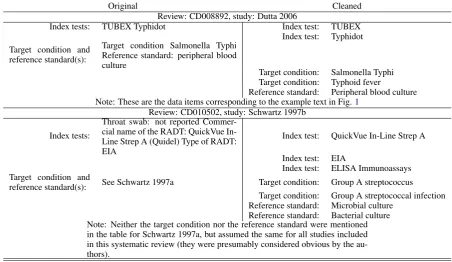
After a set of potentially included studies have been identified, systematic reviewers complete a so-called data extraction form for each study. These forms comprise a semi-structured summary of the studies, identifying and extracting a consis-tent, pre-specified set of data items from abstracts or full-text articles in a coherent format (see the left part of Table1for sample exerpts). The coher-ent format allows the data from the studies to be synthesized qualitatively or quantitatively to ad-dress the research question of the review.
Original Cleaned Review: CD008892, study: Dutta 2006
Index tests: TUBEX Typhidot Index test: TUBEX Index test: Typhidot Target condition and
reference standard(s):
Target condition Salmonella Typhi Reference standard: peripheral blood culture
Target condition: Salmonella Typhi Target condition: Typhoid fever
Reference standard: Peripheral blood culture Note: These are the data items corresponding to the example text in Fig.1
Review: CD010502, study: Schwartz 1997b
Index tests:
Throat swab: not reported Commer-cial name of the RADT: QuickVue In-Line Strep A (Quidel) Type of RADT: EIA
Index test: QuickVue In-Line Strep A
Index test: EIA
Index test: ELISA Immunoassays Target condition and
reference standard(s): See Schwartz 1997a Target condition: Group A streptococcus Target condition: Group A streptococcal infection Reference standard: Microbial culture
Reference standard: Bacterial culture Note: Neither the target condition nor the reference standard were mentioned in the table for Schwartz 1997a, but assumed the same for all studies included in this systematic review (they were presumably considered obvious by the au-thors).
Table 1: Examples of raw data from three data extractions forms in unstructured format (left) and a structured summary of the data intended for distant supervision by pattern matching (right).
Although typhoid fever is confirmed by culture of Salmonella enterica serotype Typhi , rapid and simple diag-nostic serologic tests would be useful in developing coun-tries. We examined the performance of Widal test in a community field site and compared it with Typhidot and Tubex tests for diagnosis of typhoid fever . [...] Sensitiv-ity, specificSensitiv-ity, positive predictive value (PPV), and negative predictive value (NPV) of the 3 serologic tests were calcu-lated using culture-confirmed typhoid fever cases as ”true positives” and paratyphoid fever and malaria cases as ”true negatives”. [...] The sensitivity, specificity, PPV, and NPV of Typhidot and Tubex were not better than Widal test. There is a need for more efficient rapid diagnostic test for typhoid feverespecially during the acute stage of the disease. Until then,culture remains the method of choice.
[image:2.595.71.524.61.323.2]Legend: Target condition Index Test Reference standard
Figure 1: Examples of data items highlighted in text, with supporting context underlined. Based on the man-ual annotation by one expert (ML) on a study by Dutta et al. (2006).
1.1 BERT
BERT (Bidirectional Encoder Representations
from Transformers) is a deep learning model that is unsupervisedly pretrained on a large gen-eral language corpus, then supervisedly
fine-tuned on natural language processing tasks ( De-vlin et al., 2018). Despite being a general ap-proach, with almost no task-specific modifica-tions, BERTachieves state-of-the-art performance across a number of natural language processing tasks, including text classification, question an-swering, inference, and named entity recognition.
Pretrained models like BERT can be used di-rectly for screening automation or automated data extraction. However, by default BERT is trained on a general language corpus, which differs radi-cally in word choice and grammar from the spe-cial language found in biomedicine and related fields (Sager et al.,1980). Pretraining on biomed-ical corpora, rather than general corpora, has been demonstrated to improve performance on several biomedical natural language processing tasks (Lee et al.,2019;Beltagy et al.,2019;Si et al.,2019).
1.2 Objectives
In this study we seek to:
1. Construct a dataset for training machine learning models to identify and extract data from full-text articles on diagnostic test accu-racy. We focus on the target condition, index test, and reference standard.
One of the main aims of our study is to deter-mine how such a dataset should be constructed to allow for training well performing models. In par-ticular, do we need directly supervised data, or can we build reliable models with distantly supervised data? If we do need directly supervised data, how much is necessary?
2 Related Work
There have been attempts to extract several types of data relevant to systematic reviews, most no-tably extractingPICO1statements from article text (Wallace et al., 2016; Kiritchenko et al., 2010;
Kim et al., 2011; Nye et al., 2018). Other data items include background and study design (Kim et al.,2011), as well as automatically performing risk of bias assessments (Marshall et al., 2014). There is also a recentTACtrack for data extraction in systematic reviews of environmental agents.2 Similarly, previous work by Kiritchenko et al. (2010) aimed to extract 21 different kinds of data from articles, including treatment name, sample size, as well as the primary and secondary out-come from article text. Furthermore, the key cri-terion for extraction in a systematic review is not the actual data, but the context it appears in. For instance, both intervention studies and a diagnos-tic studies have target conditions, but these refer to different things: the intervention study seek to treat the condition while the diagnostic study seeks todiagnoseit. As a consequence, in an in-tervention study the inclusion criterion often men-tions the disease, while in a diagnostic study inclu-sion criteria may mention symptoms rather than the actual disease. This means that a data extrac-tion system trained on intervenextrac-tions may not work as well (or at all) for systematic reviews of di-agnostic test accuracy, even though it may seem that the same data is extracted in both. Further-more, unlike the data required in diagnostic re-views, many previously considered data items are mentioned once in articles, often using formulaic expressions (e.g. sex, blinding, randomization).
Conventional methods for automated data ex-traction split articles into sentences and clas-sify these individually using conventional machine learning methods (e.g. SVM, Naive Bayes) (
Jon-nalagadda et al.,2015), or label spans in the text
1
Population, intervention, control group, and outcome.
2https://tac.nist.gov/2018/SRIE/index.
html
and classify these using sequence tagging (e.g. CRF, LSTM) (Nye et al.,2018).
Despite the body of previous work on automa-tion, many data items relevant to systematic re-views have been overlooked. A 2015 systematic review of data extraction found 26 articles de-scribing the attempted extraction of 52 different data items, but almost all focused on interventions (Jonnalagadda et al.,2015). No study considered any data item specific to diagnostic studies, ex-cept for general data items common to both inter-ventions and diagnostic studies, such as age, sex, blinding, or the generation of random allocation sequences. The likely reason for this is that tra-ditional data extraction systems require bespoke training data for each particular data item to tract, which is generally only available through ex-pensive, manual annotation by experts.
A cheaper way to construct datasets for data ex-traction is to use distant supervision, where the dataset is annotated per article or per review, rather than per sentence or per text span. Supervised methods are then trained on fuzzy annotations de-rived heuristically for each sentence. For instance, Wallace et al. (2016) used supervised distant su-pervision to learn to identify PICO statements in full text, and Marshall et al. (2014) used super-vised distant learning with SVMs to identify risk
of bias assessments.
There is likely a trade-off between quality and data size. All else being equal, direct supervision is generally better than distant supervision (dis-tantly supervised training data adds a source of noise not present for direct supervision). At the same time, it may not be feasible for experts to annotate large amounts of data. Crowd-sourcing is sometimes used as an alternative to a group of known experts, but if a high degree of expertise is necessary to annotate, crowd-sourcing may not give sufficient guarantees about the expertise of the annotators.
3 Material
We used data from a previous dataset, the LIMSI -Cochrane dataset (Norman et al.,2018),3to iden-tify references included in previous systematic re-views of diagnostic test accuracy. The LIMSI -Cochrane dataset comprises 1,738 references to
DTAstudies from 63DTAsystematic reviews. The dataset includes the data extraction forms for each
3
Target Condition
pos neg total Distant train 11,336 63,204 74,540 test 2,884 13,572 16,456 total 14,220 77,776 90,996 Annotated by ML 92 889 981 Annotated by RS 48 983 1,031
Index Test
pos neg total Distant train 14,280 63,343 77,623 test 2,675 13,992 16,667 total 16,955 77,335 94,290 Annotated by ML 93 888 981 Annotated by RS 87 944 1,031
Reference Standard
pos neg total Distant train 7,006 56,638 63,644 test 1,258 14,602 15,860 total 8,264 71,240 79,504 Annotated by ML 26 955 981 Annotated by RS 26 1,005 1,031
Table 2: The number of sentences in our dataset, bro-ken into distantly annotated training and test sets, as well as a manually annotated subset. Distant anno-tations for each data type were not available for all studies, and the total number of labelled sentences are therefore different for each data type.
study completed by the systematic review authors. The dataset itself does not contain abstracts or full-texts, but include identifiers in the form of PubMed IDs and DOIs which can be used to re-trieve abstracts or full-texts.
We used the reference identifiers (PMID and/or
DOI) taken from the LIMSI-Cochrane dataset to construct a collection of PDF articles. We used EndNote’s ‘find full text’ feature, which retrieves
PDFarticles from a range of publishers.4 ThePDF
articles were then converted intoXML format us-ing Grobid (Lopez,2009).
We randomly split the dataset into dedicated training and evaluation sets, where we used 48 of the systematic reviews as the training set, and we kept the remaining 15 systematic reviews for eval-uation. For each of the 15 systematic reviews in the evaluation set, we randomly selected one cle to be annotated manually. The remaining arti-cles in the evaluation set were not used for train-ing, since training and testing on the same
system-4https://endnote.com/
atic review is known to overestimate classification performance (Cohen,2008). The goal of this work is to learn the semantics of the context, rather than the semantics of particular terms, and these con-texts should be consistent across reviews.
3.0.1 Distant annotation
The data forms from the systematic reviews were intended to be read by and be useful to the human systematic review authors. The contents are there-fore usually semi-structured rather than structured, and will include different kinds of data depending on what is relevant to the systematic review (see Table1).
We create a dataset of distant annotations from the LIMSI-Cochrane dataset by manually convert-ing the semi-structured data into structured data items, and by ensuring that these items can be found in the corresponding article using pattern matching (see Table1).
We split each of the XMLdocuments into sen-tences using the nltk sentence splitter.5 The sen-tences are then divided into positive and negative depending on whether the relevant data items oc-cur as a partial match in the sentence. Partial matches were calculated using tf·idf cosine sim-ilarity between the data item and the sentence, where we took the 20 top ranking sentences for each pair of data item and article, with a sim-ilarity score of 0.1 or higher. We chose 20 as a target number of sentences since we felt this was a reasonable upper limit on the number of relevant sentences in a single article. We added an absolute threshold of 0.1 to keep the system from annotating obviously non-relevant sentences (scores close to zero) when no matches could be found in the article. For articles that have mul-tiple data items we used the concatenation of all data items. For example, in Table1, the data items for ‘Schwartz 1997b’ would be: target condition: ‘Group A streptococcus; Group A streptococcal infection’, index test: ‘QuickVue In-Line Strep A; EIA; ELISAImmunoassays’, and reference
stan-dard ‘Microbial culture; Bacterial culture’. We excluded all articles where the data items were not provided in the data form (because the reviewers did not extract this data), or where data forms were missing from the systematic review. Since we do not know which sentences were rel-evant or not in these articles we did not use these
articles as either positive or negative data. As a consequence the total amount of sentences differ for the target condition, index test and reference standard.
We repeated the matching precedure for the tar-get condition, the index test and the reference stan-dard, resulting in three distinct datasets.
3.0.2 Expert annotation
We randomly split the evaluation set into three sets of five systematic reviews. Two experts (ML and RS) on systematic reviews of diagnostic test accu-racy manually annotated the 15 articles by high-lighting all sentences in the text that 1) mentions the target condition, index test, and reference stan-dard 2) makes it clear that these are the target con-dition, index test and reference standard, and 3) do not simply mention these same items in an un-related context. The annotation instructions were written and adjusted twice to remove ambiguity, and the reasons for disagreement were discussed and resolved after two rounds of annotation. As a compromise between getting more data and being able to use the agreement between the experts as baseline for the performance, one expert annotated the first five studies, the second expert annotated the next five studies, and both annotated the last five studies.
4 Method
We construct three pipelines, one for each of the target condition, index test, and reference stan-dard, and we train and evaluate these separately.
We varied our experiments in three dimensions: We tried A) two machine learning algorithms, B) two levels of preprocessing, and C) distantly su-pervised training data versus directly susu-pervised training data. The directly and distantly super-vised models were evaluated on the same data.
4.0.1 A1: BioBERT
We here used a pointwise learning-to-rank ap-proach, where we trained a sentence ranking model by using BioBERT, a version of BERT pre-trained on PubMed and PMC (Lee et al., 2019), and fine-tuned the model by training it to regress probability scores. This model was thus trained to map sentences to relevance scores.
To train and evaluate, we used the default BERT
setup for the GLUE datasets,6 modified to output
6https://github.com/google-research/
bert
a relevance score rather than a binary value. We used default parameters.
4.0.2 A2: Logistic Regression
We here used a pairwise learning-to-rank ap-proach, where we trained a logistic regression model using stochastic gradient descent (sklearn). As features we used 1) lowercased,tf·idf weighted word n-grams, 2) lowercased, binary word n-grams, 3) lowercased, tf·idf weighted, stemmed word n-grams, 4) lowercased, stemmed, bi-nary word n-grams, as well as i) lowercased, tf·idf weighted character n-grams, and ii) non-lowercased,tf·idf weighted charactern-grams. We used wordn-grams up to length 3, and character n-grams up to length 6. The first set of features is in-tended to capture contextual information (’for the diagnosis of ...’); the second set of features is in-tended to capture medical technical terms, which are often distinctive at the morpheme level (e.g. ‘ischemia’, ‘anemia’). We deliberately did not use stop-words, since doing so would discard almost all the contextual information. This results in a sparse feature matrix consisting of approximately 1.8 million features for the distantly supervised ex-periments, and approximately 300,000 features for the directly supervised experiments.
We handled class imbalance by setting the weight for the positive class to 80. This was previ-ously determined to be a reasonable weight in ex-periments on screening automation in diagnostic test accuracy systematic reviews, a problem with similar class imbalance.
4.0.3 B1: Raw Sentences
Here we used the sentences as they appear in the articles.
4.0.4 B2: Sentences with UMLS Concepts
In this setup we used the Unified Medical Lan-guage System, a large ontology of medical con-cepts maintained by the National Library of Medicine (Bodenreider, 2004; Lindberg et al.,
1993). We used MetaMap7 to locate concept mentions in the sentences, and to replace these with their corresponding UMLS semantic types. For instance the sentence ‘Typhoid fever is a febrile and often serious systemic illness caused by Salmonella enterica serotype Typhi’ was trans-formed into ‘DSYN is a FNDG and TMCO serious DSYN caused by BACT enterica BACT’.
Target condition Auto ML RS Auto 1.00 0.07 0.04
ML 0.90 1.00 0.38 RS 1.00 0.62 1.00
Index test Auto ML RS Auto 1.00 0.09 0.07
ML 1.00 1.00 0.61 RS 0.93 0.70 1.00
Reference standard Auto ML RS Auto 1.00 0.01 0.03
[image:6.595.85.516.63.134.2]ML 1.00 1.00 0.86 RS 1.00 0.40 1.00
Table 3: Agreement in terms of recall where columns are considered ground truth, e.g. annotator RS chose 62% of ML’s annotations for the target condition.
4.0.5 C1: Directly Supervised Training
We here trained and evaluated on the articles man-ually annotated by our two experts (ML and RS), using leave-one-out cross-validation. In other words, to evaluate on each of the ten articles an-notated by each annotator we used the remaining 9 articles annotated by the same expert as training data. This was done separately for each expert, and the annotations from the other expert was not used.
4.0.6 C2: Distantly Supervised Training
We here trained on the distant annotations from the 48 systematic reviews in the training set, and evaluated on the 15 manually annotated articles in the evaluation set, where each annotator pro-vided annotation data for 10 articles (with a 5 arti-cle overlap). The artiarti-cles used for evaluation were the same as in C1.
4.1 Evaluation
Since our model output ranked sentences, rather than a binary classification, we evaluated all ex-periments in terms of average precision.
As a comparison, we also evaluated the aver-age precision using the ranking given by the other annotator. In plain language, we tried to evaluate how useful it would have been for the expert to highlight sentences for each other. The expert an-notations were binary (Yes/No), rather than a rank-ing score, so we calculated the average precision by interpolating ties in the ranking.
5 Results
Out of the 1,738 references in the LIMSI-Cochrane dataset, 1152 had either a PMIDor DOIassigned.
EndNote was able to retrieve PDFarticles for 666 of these references. A total of 90,996 sentences were distantly labeled for target condition, 94,290 sentences were distantly labeled for index test, and 79,504 sentences were distantly labeled for refer-ence standard. The first annotator (ML) annotated
981 sentences and the second annotator (RS) an-notated 1,031 sentences (Table2).
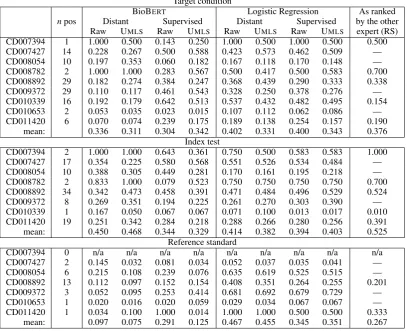
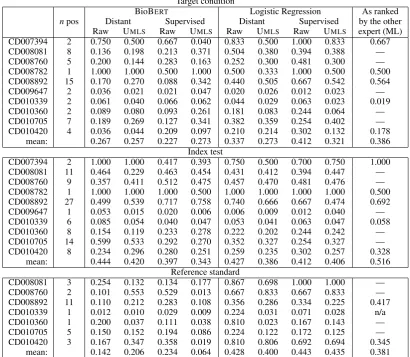
We present the results of our algorithm evalu-ated on the annotations by ML in Table 4, and evaluated on the annotations by RS in Table5.
The ranking performance exhibited large vari-ations. Neither BioBERT or logistic regression were consistently better than the other, neither dis-tant supervision or direct supervision were consis-tently better than the other, and neither raw sen-tence nor sensen-tences augmented with UMLS con-cepts were consistently better than the other. For the target condition, the best performance was achieved by logistic regression on raw sentences using either distant or direct supervision, with a maximum at 0.412 compared to human perfor-mance at 0.376 and 0.386 respectively. For the index test, the performance fell within the range 0.344–0.468 compared to human performance at 0.525 and 0.516 respectively. For the reference standard, BioBERTexhibited substantially inferior
results on the reference standard compared to lo-gistic regression, while lolo-gistic regression perfor-mance fell within the range 0.345–0.467, com-pared to human performance at 0.267 and 0.381 respectively.
The performance also varied between system-atic reviews, with consistently close to perfect performance on a few reviews (CD007394 and CD0008782), and consistently very low perfor-mance on a few (CD009647 and CD010339). These also correspond to the articles with the high-est and lowhigh-est inter-annotator agreement. The consensus of the two experts is that CD010339 is not a diagnostic test accuracy study.
6 Discussion
help-Target condition
BioBERT Logistic Regression As ranked
npos Distant Supervised Distant Supervised by the other Raw UMLS Raw UMLS Raw UMLS Raw UMLS expert (RS) CD007394 1 1.000 0.500 0.143 0.250 1.000 0.500 1.000 0.500 0.500 CD007427 14 0.228 0.267 0.500 0.588 0.423 0.573 0.462 0.509 — CD008054 10 0.197 0.353 0.060 0.182 0.167 0.118 0.170 0.148 — CD008782 2 1.000 1.000 0.283 0.567 0.500 0.417 0.500 0.583 0.700 CD008892 29 0.182 0.274 0.384 0.247 0.368 0.439 0.290 0.333 0.338 CD009372 29 0.110 0.117 0.461 0.543 0.328 0.250 0.378 0.276 — CD010339 16 0.192 0.179 0.642 0.513 0.537 0.432 0.482 0.495 0.154 CD010653 2 0.053 0.035 0.023 0.015 0.107 0.112 0.062 0.086 — CD011420 6 0.070 0.074 0.239 0.175 0.189 0.138 0.254 0.157 0.190
mean: 0.336 0.311 0.304 0.342 0.402 0.331 0.400 0.343 0.376 Index test
CD007394 2 1.000 1.000 0.643 0.361 0.750 0.500 0.583 0.583 1.000 CD007427 17 0.354 0.225 0.580 0.568 0.551 0.526 0.534 0.484 — CD008054 10 0.388 0.305 0.449 0.281 0.170 0.161 0.195 0.218 — CD008782 2 0.833 1.000 0.079 0.523 0.750 0.750 0.750 0.750 0.700 CD008892 34 0.342 0.473 0.458 0.391 0.471 0.484 0.496 0.529 0.524 CD009372 8 0.269 0.351 0.194 0.225 0.261 0.270 0.303 0.390 — CD010339 1 0.167 0.050 0.067 0.067 0.071 0.100 0.013 0.017 0.010 CD011420 19 0.251 0.342 0.284 0.218 0.288 0.266 0.280 0.256 0.391 mean: 0.450 0.468 0.344 0.329 0.414 0.382 0.394 0.403 0.525
Reference standard
CD007394 0 n/a n/a n/a n/a n/a n/a n/a n/a n/a CD007427 2 0.145 0.032 0.081 0.034 0.052 0.037 0.035 0.041 — CD008054 6 0.215 0.108 0.239 0.076 0.635 0.619 0.525 0.515 — CD008892 13 0.112 0.097 0.152 0.154 0.408 0.351 0.264 0.255 0.201 CD009372 3 0.052 0.095 0.253 0.414 0.681 0.692 0.679 0.729 — CD010653 1 0.020 0.016 0.020 0.059 0.029 0.034 0.067 0.067 — CD011420 1 0.034 0.100 1.000 0.014 1.000 1.000 0.500 0.500 0.333
[image:7.595.96.504.66.397.2]mean: 0.097 0.075 0.291 0.125 0.467 0.455 0.345 0.351 0.267
Table 4: Average precision results for the 8 different machine learning models on the data annotated by the first annotator (ML), compared to the performance of an independent human expert (annotator RS). The ‘Raw’ columns denote results for models trained and evaluated on raw sentences. The ‘UMLS’ columns denote results for models trained and evaluated on sentences where the concept mentions have been replaced with their corresponding UMLS semantic types. The ‘npos’ column denotes the number of positive sentences labeled by ML for each article. Rows were omitted for which no sentences were labeled positive. In the baseline results, cells are marked ‘—’ if the article was not annotated by the other expert (RS).
ing the models generalize, this may also remove important semantic information from the sen-tences, keeping the models from ranking accu-rately. We also note that BioBERTalready encodes a language model (similar to word embeddings), and concepts may therefore be unhelpful for the model.
BioBERTperformed consistently better than lo-gistic regression on the index test when using dis-tant supervision (4/4), but not when using direct supervision (0/4). Logistic regression performed consistently better than BioBERTon both the tar-get condition and the reference standard (16/16). On the reference standard the difference in per-formance is substantial, with BioBERT scoring very poorly, and logistic regression performing much better than human performance. The reason for BioBERT’s poor performance on the reference standard may be due to the relative sparsity of the
annotations for this subtask (see Table2).
Distant supervision was consistently on par with or better than direct supervision. The top performing models also outperformed the human annotators on the target condition and the refer-ence standard, and came comparatively close on the index test (0.468 versus 0.525 and 0.444 ver-sus 0.516).
6.1 Limitations
We only manually annotated a small sample of the dataset. The small size is further compounded by problems with convertingPDFto text, which may also bias the training and evaluation in favor of ar-ticles where the conversion works better (mainly articles from big publishers).
con-Target condition
BioBERT Logistic Regression As ranked
npos Distant Supervised Distant Supervised by the other Raw UMLS Raw UMLS Raw UMLS Raw UMLS expert (ML) CD007394 2 0.750 0.500 0.667 0.040 0.833 0.500 1.000 0.833 0.667 CD008081 8 0.136 0.198 0.213 0.371 0.504 0.380 0.394 0.388 — CD008760 5 0.200 0.144 0.283 0.163 0.252 0.300 0.481 0.300 — CD008782 1 1.000 1.000 0.500 1.000 0.500 0.333 1.000 0.500 0.500 CD008892 15 0.170 0.270 0.088 0.342 0.440 0.505 0.667 0.542 0.564 CD009647 2 0.036 0.021 0.021 0.047 0.020 0.026 0.012 0.023 — CD010339 2 0.061 0.040 0.066 0.062 0.044 0.029 0.063 0.023 0.019 CD010360 2 0.089 0.080 0.093 0.261 0.181 0.083 0.244 0.064 — CD010705 7 0.189 0.269 0.127 0.341 0.382 0.359 0.254 0.402 — CD010420 4 0.036 0.044 0.209 0.097 0.210 0.214 0.302 0.132 0.178
mean: 0.267 0.257 0.227 0.273 0.337 0.273 0.412 0.321 0.386 Index test
CD007394 2 1.000 1.000 0.417 0.393 0.750 0.500 0.700 0.750 1.000 CD008081 11 0.464 0.229 0.463 0.454 0.431 0.412 0.394 0.447 — CD008760 9 0.357 0.411 0.512 0.475 0.457 0.470 0.481 0.476 — CD008782 1 1.000 1.000 1.000 0.500 1.000 1.000 1.000 1.000 0.500 CD008892 27 0.499 0.539 0.717 0.758 0.740 0.666 0.667 0.474 0.692 CD009647 1 0.053 0.015 0.020 0.006 0.006 0.009 0.012 0.040 — CD010339 6 0.085 0.054 0.040 0.047 0.053 0.041 0.063 0.047 0.058 CD010360 8 0.154 0.119 0.233 0.278 0.222 0.202 0.244 0.242 — CD010705 14 0.599 0.533 0.292 0.270 0.352 0.327 0.254 0.327 — CD010420 8 0.234 0.296 0.280 0.251 0.259 0.235 0.302 0.257 0.328
mean: 0.444 0.420 0.397 0.343 0.427 0.386 0.412 0.406 0.516 Reference standard
CD008081 3 0.254 0.132 0.134 0.177 0.867 0.698 1.000 1.000 — CD008760 2 0.101 0.553 0.529 0.013 0.667 0.833 0.667 0.833 — CD008892 11 0.110 0.212 0.283 0.108 0.356 0.286 0.334 0.225 0.417 CD010339 1 0.012 0.010 0.029 0.009 0.224 0.031 0.071 0.028 n/a CD010360 1 0.200 0.037 0.111 0.038 0.810 0.023 0.167 0.143 — CD010705 5 0.150 0.152 0.194 0.086 0.224 0.122 0.172 0.125 — CD010420 3 0.167 0.347 0.358 0.019 0.810 0.806 0.692 0.694 0.345
[image:8.595.93.504.66.423.2]mean: 0.142 0.206 0.234 0.064 0.428 0.400 0.443 0.435 0.381
Table 5: Average precision results for the 8 different machine learning models on the data annotated by the second annotator (RS), compared to the performance of an independent human expert (annotator ML). Abbreviations are the same as in Table4. In the baseline results, cells are marked ’—’ if the article was not annotated by the other expert (ML).
tain diagnostic results, while not being diagnostic test accuracy studies. Arguably, these should be excluded from training or evaluation, and possibly even from the dataset.
7 Conclusions
Our results suggest that distant supervision is suf-ficient to train models to identify target condition, index test, and reference standard in diagnostic ar-ticles. Our results also suggest that such models can perform on par with human annotators.
We constructed a dataset of full-text articles of diagnostic test accuracy studies, with distant an-notations for target condition, index test and ref-erence standard, that can be used to train machine learning models. We also provide a subset of the data manually annotated by experts for evaluation. Our dataset cannot be publicly distributed due to copyright restrictions, but will be available upon
request. We also plan to distribute the code for the distant annotations and data preprocessing, as well as the cleaned data extraction forms.
7.1 Future Work
The dataset is being updated, and we plan to in-crease the amount of manually annotated data to improve the statistical reliability of the experi-ments. We also plan to let all experts annotate the same articles to simplify the comparisons.
Acknowledgments
References
Alexandra Bannach-Brown, Piotr Przybyła, James Thomas, Andrew SC Rice, Sophia Ananiadou, Jing Liao, and Malcolm Robert Macleod. 2019. Machine learning algorithms for systematic review: reducing workload in a preclinical review of animal studies and reducing human screening error. Systematic re-views, 8(1):23.
Iz Beltagy, Arman Cohan, and Kyle Lo. 2019. SciB-ERT: Pretrained contextualized embeddings for sci-entific text. arXiv preprint arXiv:1903.10676.
Olivier Bodenreider. 2004. The unified medical language system (UMLS): integrating biomed-ical terminology. Nucleic acids research, 32(suppl 1):D267–D270.
Aaron M Cohen. 2008. Optimizing feature represen-tation for automated systematic review work prior-itization. AMIA Annual Symposium proceedings, pages 121–5.
HCW De Vet, A Eisinga, II Riphagen, B Aertgeerts, D Pewsner, and R Mitchell. 2008. Chapter 7: searching for studies. Cochrane handbook for sys-tematic reviews of diagnostic test accuracy version 0.4 [updated September 2008]. The Cochrane Col-laboration.
Jacob Devlin, Ming-Wei Chang, Kenton Lee, and Kristina Toutanova. 2018. BERT: Pre-training of deep bidirectional transformers for language under-standing. arXiv preprint arXiv:1810.04805.
Shanta Dutta, Dipika Sur, Byomkesh Manna, Bhaswati Sen, Alok Kumar Deb, Jacqueline L Deen, John Wain, Lorenz Von Seidlein, Leon Ochiai, John D Clemens, et al. 2006. Evaluation of new-generation serologic tests for the diagnosis of typhoid fever: data from a community-based surveillance in cal-cutta, india. Diagnostic microbiology and infectious disease, 56(4):359–365.
Siddhartha R Jonnalagadda, Pawan Goyal, and Mark D Huffman. 2015. Automating data extraction in sys-tematic reviews: a syssys-tematic review. Systematic re-views, 4(1):78.
Su Nam Kim, David Martinez, Lawrence Cavedon, and Lars Yencken. 2011. Automatic classification of sentences to support evidence based medicine. In BMC bioinformatics, volume 12, page S5. BioMed Central.
Svetlana Kiritchenko, Berry de Bruijn, Simona Carini, Joel Martin, and Ida Sim. 2010. ExaCT: automatic extraction of clinical trial characteristics from jour-nal publications. BMC medical informatics and de-cision making, 10:56.
Jinhyuk Lee, Wonjin Yoon, Sungdong Kim, Donghyeon Kim, Sunkyu Kim, Chan Ho So, and Jaewoo Kang. 2019. BioBERT: pre-trained biomed-ical language representation model for biomedbiomed-ical text mining. arXiv preprint arXiv:1901.08746.
Ivan Lerner, Perrine Cr´equit, Philippe Ravaud, and Ig-nacio Atal. 2019. Automatic screening using word embeddings achieved high sensitivity and work-load reduction for updating living network meta-analyses. Journal of clinical epidemiology, 108:86– 94.
Donald AB Lindberg, Betsy L Humphreys, and Alexa T McCray. 1993. The unified medical lan-guage system. Yearbook of Medical Informatics, 2(01):41–51.
Patrice Lopez. 2009. Grobid: Combining automatic bibliographic data recognition and term extraction for scholarship publications. In International con-ference on theory and practice of digital libraries, pages 473–474. Springer.
Iain J. Marshall, Jo¨el Kuiper, and Byron C. Wallace. 2014. Automating risk of bias assessment for clin-ical trials. Proceedings of the 5th ACM Confer-ence on Bioinformatics, Computational Biology, and Health Informatics - BCB ’14, pages 88–95.
Christopher Norman, Mariska Leeflang, and Aur´elie N´ev´eol. 2018. Data extraction and synthesis in systematic reviews of diagnostic test accuracy: A corpus for automating and evaluating the process. In AMIA Annual Symposium Proceedings, volume 2018, page 817. American Medical Informatics As-sociation.
Benjamin Nye, Junyi Jessy Li, Roma Patel, Yinfei Yang, Iain J Marshall, Ani Nenkova, and Byron C Wallace. 2018. A corpus with multi-level annota-tions of patients, intervenannota-tions and outcomes to sup-port language processing for medical literature. In Proceedings of the conference. Association for Com-putational Linguistics. Meeting, volume 2018, page 197. NIH Public Access.
Alison O’Mara-Eves, James Thomas, John McNaught, Makoto Miwa, and Sophia Ananiadou. 2015. Us-ing text minUs-ing for study identification in systematic reviews: a systematic review of current approaches.
Systematic reviews, 4(1):5.
Piotr Przybyła, Austin J Brockmeier, Georgios Konto-natsios, Marie-Annick Le Pogam, John McNaught, Erik von Elm, Kay Nolan, and Sophia Ananiadou. 2018. Prioritising references for systematic reviews with robotanalyst: A user study. Research synthesis methods, 9(3):470–488.
Juan C Sager, David Dungworth, Peter F McDonald, et al. 1980. English special languages: principles and practice in science and technology. John Ben-jamins Pub Co.
Yuqi Si, Jingqi Wang, Hua Xu, and Kirk Roberts. 2019. Enhancing clinical concept extraction with contex-tual embedding. arXiv preprint arXiv:1902.08691.