ISSN Online: 2165-3925 ISSN Print: 2165-3917
DOI: 10.4236/ojapps.2017.711043 Nov. 8, 2017 597 Open Journal of Applied Sciences
A Semi-Vectorial Hybrid Morphological
Segmentation of Multicomponent Images
Based on Multithreshold Analysis of
Multidimensional Compact Histogram
Adles Kouassi
1,2,3, Sié Ouattara
1,2, Jean-Claude Okaingni
1,2, Wognin J. Vangah
1,2, Alain Clement
41Laboratory of Signals and Electrical Systems (L2SE), Institut National Polytechnique Houphouët Boigny, Yamoussoukro,
Côte d’Ivoire
2Institut National Polytechnique Houphouët Boigny (INPHB), Yamoussoukro, Côte d’Ivoire
3Ecole Supérieure des Technologies de l’Information et de la Communication (ESATIC), Abidjan, Côte d’Ivoire 4Institut Universitaire de Technologie d’Angers (IUT), Angers, France
Abstract
In this work, we propose an original approach of semi-vectorial hybrid mor-phological segmentation for multicomponent images or multidimensional data by analyzing compact multidimensional histograms based on different orders. Its principle consists first of segment marginally each component of the multicomponent image into different numbers of classes fixed at K. The segmentation of each component of the image uses a scalar segmentation strategy by histogram analysis; we mainly count the methods by searching for peaks or modes of the histogram and those based on a multi-thresholding of the histogram. It is the latter that we have used in this paper, it relies particu-larly on the multi-thresholding method of OTSU. Then, in the case where i) each component of the image admits exactly K classes, K vector thresholds are constructed by an optimal pairing of which each component of the vector thresholds are those resulting from the marginal segmentations. In addition, the multidimensional compact histogram of the multicomponent image is computed and the attribute tuples or ‘colors’ of the histogram are ordered rel-ative to the threshold vectors to produce (K +1) intervals in the partial order giving rise to a segmentation of the multidimensional histogram into K
classes. The remaining colors of the histogram are assigned to the closest class relative to their center of gravity. ii) In the contrary case, a vectorial spatial matching between the classes of the scalar components of the image is pro-duced to obtain an over-segmentation, then an interclass fusion is performed to obtain a maximum of K classes. Indeed, the relevance of our segmentation
How to cite this paper: Kouassi, A., Oua-ttara, S., Okaingni, J.-C., Vangah, W.J. and Clement, A. (2017) A Semi-Vectorial Hy-brid Morphological Segmentation of Mul-ticomponent Images Based on Multithre-shold Analysis of Multidimensional Com-pact Histogram. Open Journal of Applied Sciences, 7, 597-610.
https://doi.org/10.4236/ojapps.2017.711043
Received: October 4, 2017 Accepted: November 5, 2017 Published: November 8, 2017
Copyright © 2017 by authors and Scientific Research Publishing Inc. This work is licensed under the Creative Commons Attribution International License (CC BY 4.0).
http://creativecommons.org/licenses/by/4.0/
DOI: 10.4236/ojapps.2017.711043 598 Open Journal of Applied Sciences method has been highlighted in relation to other methods, such as K-means, using unsupervised and supervised quantitative segmentation evaluation cri-teria. So the robustness of our method relatively to noise has been tested.
Keywords
Morphological Segmentation, Vectorial Orders, Semi-Vectorial Segmentation, Multidimensional Compact Histogram, Multi-Thresholds, Fusion Inter-Class, Classification
1. Introduction
With the advancement of electronics and computing, image has become a fun-damental vector of computing and communication [1].
In view of the technological advances of the sensors and the storage memory capacity, multicomponent images (color, multispectral, hyperspectral and mul-timodal) are more and more solicited in relation to scalar images (gray levels) because of their richness to characterize a given scene [2].
The new challenge facing experts in various fields is the processing of this mass of images in order to extract useful information for the purpose of making decisions [3].
In the field of image processing, segmentation plays a leading role because it is undoubtedly the task which mobilizes more effort [4].
Conceptually, segmentation consists of extracting from the image primitives, either of contour type or of region type [3] [4]. These primitives will be exploited later to perform pattern recognition, registration, matching, compression, etc.
DOI: 10.4236/ojapps.2017.711043 599 Open Journal of Applied Sciences Classification segmentation involves partitioning a set of pixels of vector attributes into k disjoint classes. Each class groups pixels with characteristics as similar as possible. Obviously the pixels of two distinct classes have very differ-ent attributes. In contrast to the previous approaches, this approach only con-siders the characteristic vectors. To conclude, segmentation into regions requires a pixel connectivity analysis in the labeled image.
In addition, those based on the thresholding of monodimensional (1D) histo-grams have shown their efficiency in terms of speed of execution and segmentation quality [9] [10] [11]. Thresholding techniques can be divided into two categories: binary thresholding and multi-thresholding. In binary thresholding, the image is segmented into two class regions. Indeed, pixels with gray values greater than a certain value (threshold) T are classified as object pixels, and others with gray values less than T are classified as background pixels. In multiple thresholding, the image is segmented into several classes. Several contributions have been made in the literature, as is the case of P. Campadelli et al. which proposed a method of segmentation of color images of size M × N using the method of Scale-space filtering [12]. Also note that Tominaga has segmented color images with thresholds also by analysis of scalar histograms, but it works only in a fixed color space [13].
Unfortunately, the vectorial aspect of multicomponent images makes it diffi-cult to apply directly to scalar methods, particularly those based on multivariate histogram analysis for the following reasons: i) order on vectors and ii) topology of connectivity in a discrete multidimensional space.
Indeed, the approach of vectorial morphological segmentation by analysis of multidimensional (nD) compact histograms [14] that we propose in this paper is an extension of the segmentation by classification. It is based on a mul-ti-thresholding of the monodimensional compact histograms resulting from the modal components of the multivariate image and a morphological order of the attributes vectors of its nD compact histogram with respect to constructed thre-shold vectors resulting from the multi-threthre-sholding. Moreover, our method of morphological vectorial segmentation allows the use of different types of order for the classification of tuples and presents an optimal algorithmic complexity and a proven speed of execution. The multi-thresholding segmentation ap-proach used in this work is inspired by the work of Otsu and other authors [8] [9] [10] [11].
To facilitate the manipulation of nD histograms, the nD compact histogram [14] is used. It has the advantage of being computed quickly from the multicomponent image, of having a compactness of the attribute vectors and of occupying a re-duced memory space.
DOI: 10.4236/ojapps.2017.711043 600 Open Journal of Applied Sciences Thus, this paper presents an original method of semi-vectorial hybrid morphological segmentation of multicomponent images based on multi-thresholding analysis of compact multidimensional histograms.
For the understanding of this work, the rest of the document is organized as follows: in section 2, we present the principle and the algorithm of the proposed approach, then in section 3, a theoretical and experimental validation of our ap-proach is presented. We conclude with some prospects for future work.
2. Principle and Algorithm of the Proposed Semi-Vectorial
Morphological Segmentation Method
2.1. Principle
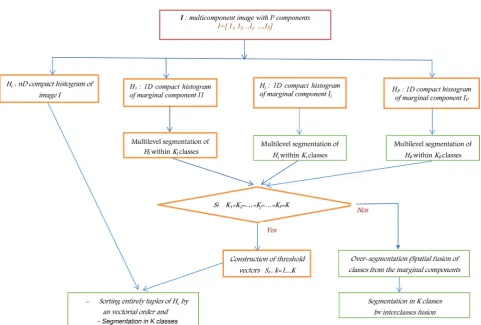
Let I, a P-component image (P ≥ 2). The principle is declined in several steps (see the flowchart in Figure 1).
a) We first construct the compact histogram related to the image I in order to solve the problem of coding and manipulation of nD histograms. Indeed, the compact histogram stores only the E cells actually occupied in clear it removes the empty cells. For an image with P components, a table of size E × P for stor-ing the tuples in the lexicographic morphological order and a table of size E ×1 corresponding to the number of associated pixels (the number of tuples).
[image:4.595.59.541.378.703.2]Let Hc be the nD compact histogram of the image I containing only the tuples
DOI: 10.4236/ojapps.2017.711043 601 Open Journal of Applied Sciences and i a fixed row of Hc.
Let j describing the number of planes of the image varying from 1 to P. A tuple in the nD compact histogram can be described by the triplet
(
i Hc E, i, i)
where
( )
ii
E =card Hc represents the cardinal or the number of a tuple at the
row i in Hc.
Let I=I ,1 ⋅⋅⋅, I ,j ⋅⋅⋅, IP and
i j
Hc
the jth multimodal component of the tuple located at row i of Hc, with Ij the jth component of the image.b) Then we segment each component (Ij) of the image I by multi-thresholding into a fixed number of classes K (K ≥ 2).
Let max
j j
K =K be the number of classes obtained for the component Ij of the
image I. Let be Hj the marginal monodimensionnal compact histogram of the jth
component of the image I(Ij) and Ni the number of pixels of a gray level of Hj at the row i.
To generalize, let us call i j
H
the gray level at the row i of the jth 1D compact histogram of the image I(Ij) and by ij
N
the number of pixels associated. The multi-thresholding used here is inspired by the Otsu method applied to the compact marginal 1D histograms Hj. Thus, for a given component j, it produces1
j
K
−
thresholds denoted 1, ,2 ., 1j j j j
Kmax
t t t − T
…… =
ordered in ascending
or-der for a partition of the image into K classes 1, 2, ,
j j j
K
C C ⋅⋅⋅C
where
max
j
K =K =K . They take their values in Hj. Here, we denotes
T
j the vector of the segmentation thresholds of the component Ij.The thresholds are obtained by the optimization of Equation (1) in which
σ_Intra defines the standard deviation intra-classes whose expression is explicitly given by Equation (2) and other parameters defined by Equations ((3) and (4)).
{
}
2{
}
1, ,2 , 1 arg max 1, ,2 , 1
j
j j j j j j
K Intra K
t H
t t ⋅⋅⋅t − = ∈
σ
t t ⋅⋅⋅t −
(1)
(
)
2
1
K
Intra n wn n T
σ
=∑
=µ
−µ
(2)1 j n j n t
n m t m
w P
−
=
=
∑
(3)
1 . j n j n t m
n m t
n m P w
µ
− ==
∑
(4)
where Pm and µT are respectively the probability of a gray level pixel m and the total average of the gray levels of the jth component of the image I.
c) On the basis of the thresholds calculated on each component of the image,
if 1 2
. 1
j
K =K = ⋅⋅⋅ =K = ⋅⋅⋅ =K− then we construct
K
−
1
threshold vectorsSk with k varying from 1 to K − 1, such that the threshold vector of rank k (Sk) has the scalar thresholds of rank k ( j
k
t ) from each component of the image I,
with
(
1 2)
, , P
k k k k
S = t t ⋅⋅⋅t .
In the contrary case, a cross product combination of the partitions of the components of the image is realized.
par-DOI: 10.4236/ojapps.2017.711043 602 Open Journal of Applied Sciences titions are created. In the case of a complete order, all tuples are immediately as-signed to the different classes, otherwise the remaining pixels are asas-signed to the nearest class. In the second case where the number of classes is variable by class, an over-segmentation is performed and then an interclass fusion is applied to obtain at a maximum the K desired classes.
Note that in this paper, we used the marginal vectorial order, the lexicographic vectorial order and the hybrid vectorial order.
2.2. Algorithm
[Iseg]=Fonction FonctSegMorphologiqSemiVectorial (I, K) // I : Multicomponent image
// K : Number of classes
// Iseg : Segmented image into K classes
P = FonctNberComponents (I) // Return the number of components of I
Hc_nD = FonctHistoCompactnD (I) // Return the nD compact histogram of I For j =1 to P
H(j).Histo_1D = HistoCompactnD (Ij) // return the 1D compact histogram of components of I
T(j).T = FonctSegMultiThresold (H(j).Histo_1D) // Multi-thresholding of His-to_1D
K(j).K = FonctNberComponents (T(j).T) // Return the number of threshold of Hj End
If ( K(1).K = K(2).K =….= K − 1 ) then
For k =1 to K − 1
S(k).S = FonctVectorsThresold(T(j).T) // Construction of threshold vectors (K-uplets)
End
H = [Hc_nD ; S(1 à K − 1).S] // concatenation of Hc_nD tuples and thre-shold vectors
H_ord =FonctOrdonnement (H, ChoiceOrder) // Order tuples according to ChoiceOrder
Classes.C=FonctConstructionClasses (H_ord, S(1 à K − 1).S ) // Classification into K classes
Iseg=FonctImageSegmentée (I, Classes.C) // Image segmentée Else
ClassesSurSegmente.C=FonctCombinatorial (H_ord, S(1 à K − 1).S ) // over-segmentation
Classes.C=FonctFusionInterClasses (ClassesSurSegmente.C) // Fusion interclasses into
K classes
Iseg=FonctImageSegmentée (I, Classes.C) // Segmented image
DOI: 10.4236/ojapps.2017.711043 603 Open Journal of Applied Sciences
3. Segmentation Results and Evaluation of the Proposed
Approach
In this section, we first present some segmentation results on synthetic and real images from our proposed segmentation method using some vectorial orders and compared with those of the K-means method [17]. Then a quantitative evaluation through supervised evaluation methods and unsupervised evaluation of the quality of the segmentation through different vectorial orders with respect to K-means is performed. We conclude this section with an assessment of the robustness of our approach to noise.
3.1. Segmentation Results
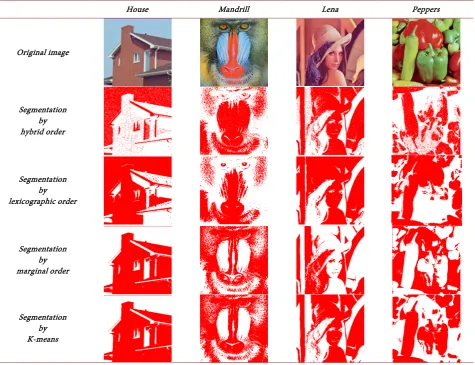
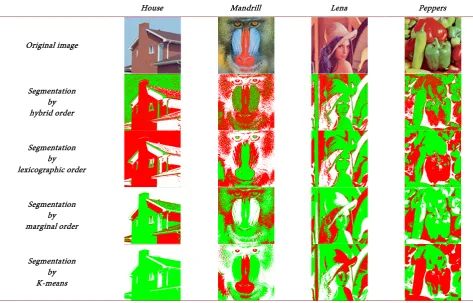
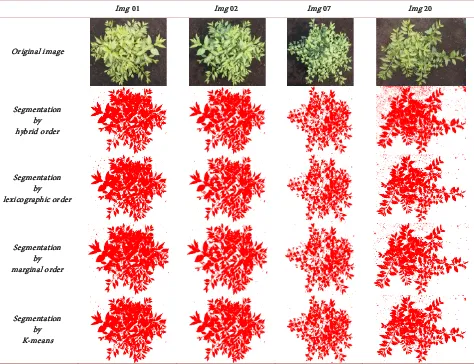
In order to highlight the relevance of the proposed approach, segmentations have been performed on natural images using marginal order, lexicographic or-der and hybrid oror-der with absolute referent. Some original images and their segmentation results by the proposed method and the K-means method are pre-sented in Figures 2-4 by varying the number of classes from 2 to 4. Moreover, a series of images of forsythia of which we have the ground truths (reference
House Mandrill Lena Peppers
Original image
Segmentation by hybrid order
Segmentation by lexicographic order
Segmentation by marginal order
[image:7.595.63.539.342.707.2]Segmentation by K-means
DOI: 10.4236/ojapps.2017.711043 604 Open Journal of Applied Sciences
House Mandrill Lena Peppers
Original image
Segmentation by hybrid order
Segmentation by lexicographic order
Segmentation by marginal order
[image:8.595.58.532.72.375.2]Segmentation by K-means
Figure 3. Segmentation into 3 classes by the proposed method and K-means.
House Mandrill Lena Peppers
Original image
Segmentation by hybrid order
Segmentation by lexicographic order
Segmentation by marginal order
[image:8.595.55.542.399.710.2]Segmentation by K-means
DOI: 10.4236/ojapps.2017.711043 605 Open Journal of Applied Sciences
Img 01 Img 02 Img 07 Img 20
Original image
Segmentation by hybrid order
Segmentation by lexicographic order
Segmentation by marginal order
[image:9.595.60.534.71.435.2]Segmentation by K-means
Figure 5. Segmentation of Forsythia images into 2 classes by the proposed method and K-means.
expert segmentations from [18]) have been segmented into two classes as shown in Figure 5.
These segmentation results clearly show the visual relevance of our approach through its various variants. However, a quantitative evaluation is required to validate our method, hence the following section.
3.2. Evaluation of Segmentation Results
Different assessment methods exist in the literature and can be grouped into two classes: supervised methods and unsupervised methods. In this work, on the one hand for the supervised evaluation, we used Vinet’s criterion [14] which calcu-lates the rate of conformity errors of the segmentation maps by an optimal matching; this criterion has been applied to the series of images of Forsythia, of which we have ground truths. On the other hand, for the unsupervised evalua-tion, we have retained the Levine-Nazif Intra-region criterion and the Zeboudj criterion [14] because they are commonly used and also because of their relev-ance.
DOI: 10.4236/ojapps.2017.711043 606 Open Journal of Applied Sciences classes and relies on intra-class energy. However, Zeboudj’s criterion takes into account intra-class energy and inter-class energy, thus favoring segmentations with homogeneous and well-separated classes.
The latter two criteria give the best score to the best segmentation. The evalu-ation results of our segmentevalu-ation approach and those of K-means are presented in the tables below with an accuracy of 10−4.
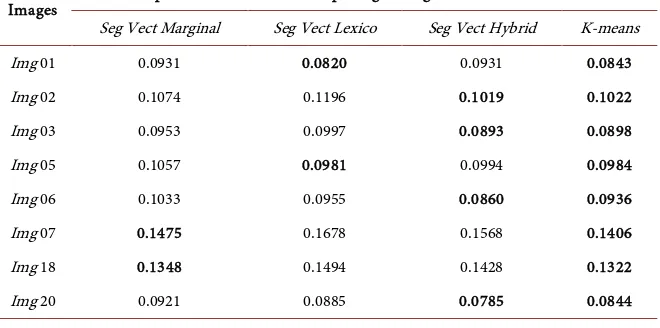
In Table 1, we present some results of supervised evaluation by the criterion of Vinet, in green the best segmentation and in red the second best segmentation. The values recorded in the table correspond to the error rate between the seg-mented image and the ground truth. It appears that the proposed method presents better segmentations globally than K-means. On the three variants of the proposed method, vectorial morphological segmentation in hybrid order is the best, then comes the lexicographic order.
Table 2 presents the unsupervised evaluation of natural images by the Le-vine-Nazif criterion. This table shows that for k varying from 2 to 3 the vectorial morphological segmentation in marginal order and K-means have the same performances and are the best on all the images processed. When the number of classes k ≥ 4, the three variants converge to the same interclass fusion giving identical segmentations and a performance identical to K-means.
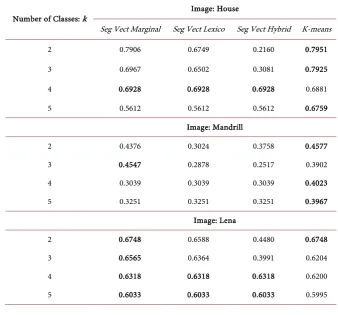
Table 3 illustrates the non-supervised evaluation by the Zeboudj criterion. It is found that for this criterion, the proposed approach gives better results and inversely, it is the case of the images House and Lena.
Consequently, it could be said that the relevance of the segmentation methods is related to the content of the image and the criterion used.
3.3. Performance at Noise
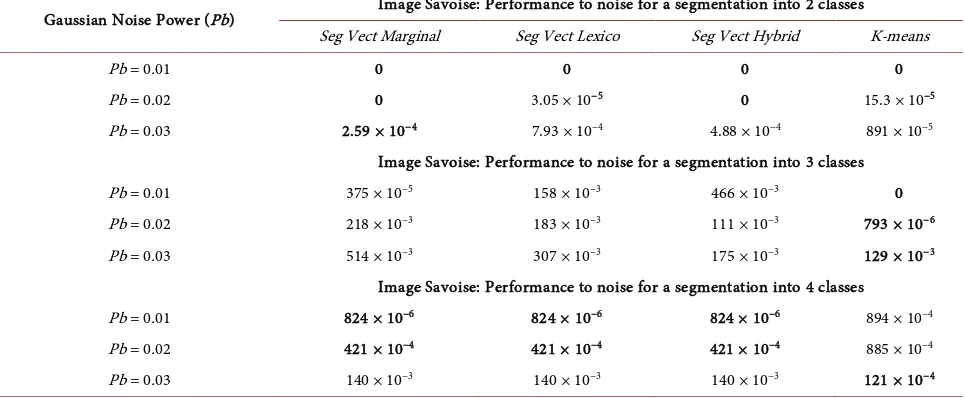
[image:10.595.209.539.564.728.2]In order to demonstrate the robustness to the noise of our approach, we first added Gaussian noise of different average powers Pb to the synthetic image Sa-voise [15]. An example of adding noise is illustrated in Figure 6. Then, the noisy images have been segmented into different number of classes k varying
Table 1. Supervised evaluation of a series of Forsythia color images.
Images Proposed semi-vectorial morphological segmentation and K-means
Seg Vect Marginal Seg Vect Lexico Seg Vect Hybrid K-means
Img 01 0.0931 0.0820 0.0931 0.0843
Img 02 0.1074 0.1196 0.1019 0.1022
Img 03 0.0953 0.0997 0.0893 0.0898
Img 05 0.1057 0.0981 0.0994 0.0984
Img 06 0.1033 0.0955 0.0860 0.0936
Img 07 0.1475 0.1678 0.1568 0.1406
Img 18 0.1348 0.1494 0.1428 0.1322
DOI: 10.4236/ojapps.2017.711043 607 Open Journal of Applied Sciences Table 2. Evaluation of natural color images by the Levine-Nazif intra-region criterion.
Number of Classes: k Image: House
Seg Vect Marginal Seg Vect Lexico Seg Vect Hybrid K-means
2 0.9675 0.9154 0.9416 0.9675
3 0.9732 0.9046 0.9460 0.9732
4 0.9640 0.9640 0.9640 0.9640
5 0.9638 0.9638 0.9638 0.9638
Image: Mandrill
2 0.9040 0.8756 0.8928 0.9040
3 0.9145 0.8585 0.8642 0.9145
4 0.8880 0.8880 0.8880 0.8880
5 0.9007 0.9007 0.9007 0.9007
Image: Lena
2 0.9547 0.9516 0.9497 0.9547
3 0.9636 0.9526 0.9529 0.9636
4 0.9542 0.9542 0.9542 0.9542
5 0.9685 0.9685 0.9685 0.9685
Table 3. Evaluation of natural color images by the Zeboudj criterion.
Number of Classes: k Image: House
Seg Vect Marginal Seg Vect Lexico Seg Vect Hybrid K-means
2 0.7906 0.6749 0.2160 0.7951
3 0.6967 0.6502 0.3081 0.7925
4 0.6928 0.6928 0.6928 0.6881
5 0.5612 0.5612 0.5612 0.6759
Image: Mandrill
2 0.4376 0.3024 0.3758 0.4577
3 0.4547 0.2878 0.2517 0.3902
4 0.3039 0.3039 0.3039 0.4023
5 0.3251 0.3251 0.3251 0.3967
Image: Lena
2 0.6748 0.6588 0.4480 0.6748
3 0.6565 0.6364 0.3991 0.6204
4 0.6318 0.6318 0.6318 0.6200
[image:11.595.202.541.420.735.2]DOI: 10.4236/ojapps.2017.711043 608 Open Journal of Applied Sciences
Image Savoise Noisy Savoise image (Pb = 0.02) Segmentation by marginal order
Segmentation by
lexicographic order Segmentation by hybrid order Segmentation by K-means
Noisy Savoise image
[image:12.595.62.539.75.274.2](Pb = 0.03) Segmentation by marginal order lexicographic order Segmentation by Segmentation by hybrid order Segmentation by K-means
Figure 6. Original Savoise image, noisy Savoise images and their segmentations into 3 classes by the proposed method and
K-means.
Table 4. Robustness of the proposed semi-vector morphological segmentation and K-means with respect to Gaussian noise.
Gaussian Noise Power (Pb) Image Savoise: Performance to noise for a segmentation into 2 classes
Seg Vect Marginal Seg Vect Lexico Seg Vect Hybrid K-means
Pb = 0.01 0 0 0 0
Pb = 0.02 0 3.05 × 10⁻⁵ 0 15.3 × 10⁻⁵
Pb = 0.03 2.59 × 10⁻⁴ 7.93 × 10⁻⁴ 4.88 × 10⁻⁴ 891 × 10−5
Image Savoise: Performance to noise for a segmentation into 3 classes
Pb = 0.01 375 × 10−5 158 × 10−3 466 × 10−3 0
Pb = 0.02 218 × 10−3 183 × 10−3 111 × 10−3 793 × 10−6
Pb = 0.03 514 × 10−3 307 × 10−3 175 × 10−3 129 × 10−3
Image Savoise: Performance to noise for a segmentation into 4 classes
Pb = 0.01 824 × 10−6 824 × 10−6 824 × 10−6 894 × 10−4
Pb = 0.02 421 × 10−4 421 × 10−4 421 × 10−4 885 × 10−4
Pb = 0.03 140 × 10−3 140 × 10−3 140 × 10−3 121 × 10−4
from 2 to 5, an illustration of which is given in Figure 6.
Indeed, an evaluation of the relevance of the segmented images is presented in Table 4 where the best segmentation is the one whose criterion value is the smallest and indicated in green. Moreover, when the value of the criterion is less than 5%, the segmentation is qualified as good. On the whole of the images processed, it can be seen through this table, for some, that the proposed method is robust to the noise K-means and inversely. This could be related to the con-tent of the image.
4. Conclusion
[image:12.595.59.541.342.541.2]DOI: 10.4236/ojapps.2017.711043 609 Open Journal of Applied Sciences strategy with different variants capable of segmenting color images and more generally multicomponent images. The performance of our approach was eva-luated and demonstrated its relevance to K-means through quantitative criteria for supervised and unsupervised evaluation of segmentation. On the other hand, the robustness to the Gaussian noise of the proposed segmentation method was highlighted. We also find that the relevance of the quality of a segmentation is on the one hand to the evaluation criterion used and on the other hand to the content of the image. In perspective, we plan to develop a purely vectorial mor-phological segmentation method.
References
[1] Bitam Abdelmadjid, (2013) Multispectral Image Analysis and Segmentation: Appli-cation to MSG Images. PhD Thesis, Mouloud Mammeri University of Tizi-Ouzou, Tizi-Ouzou, Algerie.
[2] Ouattara, S. (2009) Multicomponent Image Segmentation Strategies by Analyzing Multidimensional Histograms: Application to Color Images of Histological Sec-tions. PhD Thesis, University of Angers, Angers, France.
[3] Philip, S. and Cocoquevez, J.P. (1995) Image Analysis and Segmentation. Masson, Paris.
[4] Ouardia, A. (2011) Segmentation of Images by Bidimensional Histogram Thre-sholds. Memory of Magister, Mouloud Mammeri University of Tizi-Ouzou, Ti-zi-Ouzou, Algerie.
[5] Busin, L. (2003) Segmentation of Color Images by Analysis of Histogram Monodi-mensional Colors. Memory of DEA, University of Science and Technology of Lille and Central School of Lille, Lille, France.
[6] Herbulot, A. (2007) Non-Parametric Statistical Measurements for the Segmentation of Images and Videos and Minimization by Active Contours. Ph.D. Thesis, The University of Nice-Sophia Antipolis, Nice.
[7] El Merabet, Y. (2014) Segmentation of Color Images by Combination LPE-Regions/ LPE-Contours and Fusion of Regions. Application to the Segmentation of Roofs from Orthophotoplans. Ph.D. Thesis, University of Technology Belfort Montonber-liard, Belfort.
[8] Ghandour, A. (2010) Segmentation of Color Images by Mathematical Morphology: Application to Images Microscopies. Ph.D. Thesis, The University of Toulouse, Toulouse.
[9] Madhava Raja, N.Sri, Rajinikanth, V. and Latha, K. (2014) Otsu Based Optimal Multilevel Image Thresholding Using Firefly Algorithm. Modelling and Simulation in Engineering, 2, Article ID: 794574.https://doi.org/10.1155/2014/794574
[10] Rajinikanth, V., Aashiha, J.P. and Atchay, A. (2014) Gray-Level Histogram based Multilevel Threshold Selection with Bat Algorithm. International Journal of Com-puter Applications (IJCA), 93, 1-8.https://doi.org/10.5120/16296-6035
[11] Arora, S., Acharya, J., Verma, A. and Panigrahi, P.K. (2008) Multilevel Threshold-ing for Image Segmentation through a Fast Statistical Recursive Algorithm. Pattern Recognition Letters, 29, 119-125. https://doi.org/10.1016/j.patrec.2007.09.005
[12] Campadelli, P., Medici, D. and Schettini, R. (1997) Color Image Segmentation Us-ing Hopfield Networks. Image and Vision Computing, 15, 161-166.
DOI: 10.4236/ojapps.2017.711043 610 Open Journal of Applied Sciences
[13] Tominaga, S. (1992) Color Classification of Natural Color Images. Color Research and Application, 17, 230-239.https://doi.org/10.1002/col.5080170405
[14] Ouattara, S., Loum, G.L. and Clément, A. (2011) Unsupervised Segmentation Me-thod of Multicomponent Images Based on Fuzzy Connectivity Analysis in the Mul-tidimensional Histograms. Engineering, 3, Article ID: 4141.
[15] Ouattara, S., Kouassi, A., Okaingni, J.C., Koffi, A., Loum, G. and Clement, A. (2016) A New Hybrid Order Approach to Morphological Color Image Processing Based on Reduced Order with Adaptive Absolute Reference. Engineering, 8, 633-645. https://doi.org/10.4236/eng.2016.89057
[16] Kouassi, A.F., Ouattara, S., Okaingni, J.-C., Koné, A., Vangah, W.J., Loum, G. and Clement, A. (2017) A New Vectorial Order Approach Based on the Classification of Tuples Attribute and Relative Absolute Adaptive Referent: Applications to Multi-component Images. Journal of Software Engineering and Applications, 10, 546-563. https://doi.org/10.4236/jsea.2017.106030
[17] Wang, X. and Bai, Y. (2016) The Global Minmax k-Means Algorithm. Springerplus, 5, 1665-1679.https://doi.org/10.1186/s40064-016-3329-4
[18] Clément, A. and Vigouroux, B. (2003) Unsupervised Segmentation of Scenes Con-taining Vegetation (Forsythia) and Soil by Hierarchical Analysis of Bi-Dimensional Histograms. Pattern Recognition Letters, 24, 1951-1957.