Using Tweets to Help Sentence Compression for News Highlights
Generation
Zhongyu Wei1, Yang Liu1, Chen Li1, Wei Gao2
1Computer Science Department, The University of Texas at Dallas
Richardson, Texas 75080, USA
2Qatar Computing Research Institute, Hamad Bin Khalifa University, Doha, Qatar
{zywei,yangl,chenli}@hlt.utdallas.edu1
Abstract
We explore using relevant tweets of a given news article to help sentence com-pression for generating compressive news highlights. We extend an unsupervised dependency-tree based sentence compres-sion approach by incorporating tweet in-formation to weight the tree edge in terms of informativeness and syntactic impor-tance. The experimental results on a pub-lic corpus that contains both news arti-cles and relevant tweets show that our pro-posed tweets guided sentence compres-sion method can improve the summariza-tion performance significantly compared to the baseline generic sentence compres-sion method.
1 Introduction
“Story highlights” of news articles are provided by only a few news websites such as CNN.com. The highlights typically consist of three or four succinct itemized sentences for readers to quickly capture the gist of the document, and can dramat-ically reduce reader’s information load. A high-light sentence is usually much shorter than its orig-inal corresponding news sentence; therefore ap-plying extractive summarization methods directly to sentences in a news article is not enough to gen-erate high quality highlights.
Sentence compression aims to retain the most important information of an original sentence in a shorter form while being grammatical at the same time. Previous research has shown the effective-ness of sentence compression for automatic doc-ument summarization (Knight and Marcu, 2000; Lin, 2003; Galanis and Androutsopoulos, 2010; Chali and Hasan, 2012; Wang et al., 2013; Li et al., 2013; Qian and Liu, 2013; Li et al., 2014). The compressed summaries can be generated through
a pipeline approach that combines a generic tence compression model with a summary sen-tence pre-selection or post-selection step. Prior studies have mostly used the generic sentence compression approaches, however, a generic com-pression system may not be the best fit for the summarization purpose because it does not take into account the summarization task in the com-pression module. Li et al. (2013) thus proposed a summary guided compression method to address this problem and showed the effectiveness of their method. But this approach relied heavily on the training data, thus has the limitation of domain generalization.
Instead of using a manually generated corpus, we investigate using existing external sources to guide sentence compression for the purpose of compressive news highlights generation. Nowa-days it becomes more and more common that users share interesting news content via Twitter to-gether with their comments. The availability of cross-media information provides new opportuni-ties for traditional tasks of Natural Language Pro-cessing (Zhao et al., 2011; Subaˇsi´c and Berendt, 2011; Gao et al., 2012; Kothari et al., 2013; ˇStajner et al., 2013). In this paper, we propose to use relevant tweets of a news article to guide the sentence compression process in a pipeline frame-work for generating compressive news highlights. This is a pioneer study for using such parallel data to guide sentence compression for document sum-marization.
Our work shares some similar ideas with (Wei and Gao, 2014; Wei and Gao, 2015). They also attempted to use tweets to help news highlights generation. Wei and Gao (2014) derived external features based on the relevant tweet collection to assist the ranking of the original sentences for ex-tractive summarization in a fashion of supervised machine learning. Wei and Gao (2015) proposed a graph-based approach to simultaneously rank the
original news sentences and relevant tweets in an unsupervised way. Both of them focused on using tweets to help sentence extraction while we lever-age tweet information to guide sentence compres-sion for compressive summary generation.
We extend an unsupervised dependency-tree based sentence compression approach to incorpo-rate tweet information from the aspects of both in-formativeness and syntactic importance to weight the tree edge. We evaluate our method on a public corpus that contains both news articles and rele-vant tweets. The result shows that generic com-pression hurts the performance of highlights gen-eration, while sentence compression guided by relevant tweets of the news article can improve the performance.
2 Framework
We adopt a pipeline approach for compressive news highlights generation. The framework in-tegrates a sentence extraction component and a post-sentence compression component. Each is described below.
2.1 Tweets Involved Sentence Extraction
We use LexRank (Erkan and Radev, 2004) as the baseline to select the salient sentences in a news article. This baseline is an unsupervised extractive summarization approach and has been proved to be effective for the summarization task.
Besides LexRank, we also use Heterogeneous Graph Random Walk (HGRW) (Wei and Gao, 2015) to incorporate relevant tweet information to extract news sentences. In this model, an undirected similarity graph is created, similar to LexRank. However, the graph is heterogeneous, with two types of nodes for the news sentences and tweets respectively.
Suppose we have a sentence setS and a tweet setT. By considering the similarity between the same type of nodes and cross types, the score of a news sentencesis computed as follows:
p(s) = d
N+M + (1−d)
X
m∈T
sim(s, m)
P
v∈Tsim(s, v)p(m)
+(1−d)
(1−) X
n∈S\{s}
sim(s, n)
P
v∈S\{s}sim(s, v)p(n)
(1)
whereN andM are the size ofS andT, respec-tively,dis a damping factor,sim(x, y)is the simi-larity function, and the parameteris used to con-trol the contribution of relevant tweets. For a tweet
nodet, its score can be computed similarly. Both dandsim(x, y)are computed following the setup of LexRank, wheresim(x, y) is computed as co-sine similarity:
sim(x, y) =
P
w∈x,ytfw,xtfw,y(idfw)2
qP
wi∈x(tfwi,xidfwi)2×
qP
wi∈y(tfwi,yidfwi)2
(2)
wheretfw,xis the number of occurrences of word
win instancex,idfw is the inverse document
fre-quency of wordwin the dataset. In our task, each sentence or tweet is treated as a document to com-pute the IDF value.
Although both types of nodes can be ranked in this framework, we only output the top news sen-tences as the highlights, and the input to the sub-sequent compression component.
2.2 Dependency Tree Based Sentence Compression
We use an unsupervised dependency tree based compression framework (Filippova and Strube, 2008) as our baseline. This method achieved a higher F-score (Riezler et al., 2003) than other sys-tems on the Edinburgh corpus (Clarke and Lap-ata, 2006). We will introduce the baseline in this part and describe our extended model that lever-ages tweet information in the next subsection.
The sentence compression task can be defined as follows: given a sentences, consisting of words w1, w2, ..., wm, identify a subset of the words of
s, such that it is grammatical and preserves es-sential information of s. In the baseline frame-work, a dependency graph for an original sentence is first generated and then the compression is done by deleting edges of the dependency graph. The goal is to find a subtree with the highest score:
f(X) =X
e∈E
xe×winfo(e)×wsyn(e) (3)
wherexe is a binary variable, indicating whether
a directed dependency edgeeis kept (xe is 1) or
removed (xeis 0), andEis the set of edges in the
dependency graph. The weighting of edgee con-siders both its syntactic importance (wsyn(e)) as
well as the informativeness (winfo(e)). Suppose
edgeeis pointed from headhto nodenwith de-pendency label l, both weights can be computed from a background news corpus as:
winfo(e) = PPsummary(n)
wsyn(e) =P(l|h) (5)
where Psummary(n) andParticle(n) are the
uni-gram probabilities of wordnin the two language models trained on human generated summaries and the original articles respectively. P(l|h) is the conditional probability of label l given head h. Note that here we use the formula in (Filip-pova and Altun, 2013) for winfo(e), which was
shown to be more effective for sentence compres-sion than the original formula in (Filippova and Strube, 2008).
The optimization problem can be solved under the tree structure and length constraints by integer linear programming1. Given that L is the
maxi-mum number of words permitted for the compres-sion, the length constraint is simply represented
as: X
e∈E
xe≤L (6)
The surface realizatdion is standard: the words in the compression subtree are put in the same or-der they are found in the source sentence. Due to space limit, we refer readers to (Filippova and Strube, 2008) for a detailed description of the baseline method.
2.3 Leverage Tweets for Edge Weighting
We then extend the dependency-tree based com-pression framework by incorporating tweet infor-mation for dependency edge weighting. We in-troduce two new factors, wT
info(e) and wTsyn(e),
for informativeness and syntactic importance re-spectively, computed from relevant tweets of the news. These are combined with the weights ob-tained from the background news corpus defined in Section 2.2, as shown below:
winfo(e) = (1−α)·wNinfo(e) +α·winfoT (e) (7)
wsyn(e) = (1−β)·wNsyn(e) +β·wTsyn(e) (8)
whereαandβare used to balance the contribution of the two sources, andwN
info(e)andwsynN (e)are
based on Equation 4 and 5.
The new informative weightwT
info(e) is
calcu-lated as:
wT
info(e) = PPrelevantT(n)
backgroundT(n) (9)
1In our implementation we use GNU Linear
Pro-gramming Kit (GULP) (https://www.gnu.org/ software/glpk/)
PrelevantT(n) and PbackgroundT(n) are the
uni-gram probabilities of word n in two language mod-els trained on the relevant tweet dataset and a background tweet dataset respectively.
The new syntactic importance score is:
wsynT (e) = NTNT(h, n) (10)
NT(h, n) is the number of tweets where n and headhappear together within a window frame of K, and NT is the total number of tweets in the relevant tweet collection. Since tweets are always noisy and informal, traditional parsers are not reli-able to extract dependency trees. Therefore, we use co-occurrence as pseudo syntactic informa-tion here. NotewN
info(e), wTinfo(e),wNsyn(e) and
wT
syn(e)are normalized before combination. 3 Experiment
3.1 Setup
We evaluate our pipeline news highlights gen-eration framework on a public corpus based on CNN/USAToday news (Wei and Gao, 2014). This corpus was constructed via an event-oriented strat-egy following four steps: 1) 17 salient news events taking place in 2013 and 2014 were manually identified. 2) For each event, relevant tweets were retrieved via Topsy2 search API using a set of
manually generated core queries. 3) News arti-cles explicitly linked by URLs embedded in the tweets were collected. 4) News articles from CNN/USAToday that have more than 100 explic-itly linked tweets were kept. The resulting cor-pus contains 121 documents, 455 highlights and 78,419 linking tweets.
We used tweets explicitly linked to a news ar-ticle to help extract salience sentences inHGRW
and to generate the language model for computing wT
info(e). The co-occurrence information
com-puted from the set of explicitly linked tweets is very sparse because the size of the tweet set is small. Therefore, we used all the tweets re-trieved for the event related to the target news arti-cle to compute the co-occurrence information for wT
syn(e). Tweets retrieved for events were not
pub-lished in (Wei and Gao, 2014). We make it avail-able here3. The statistics of the dataset can be
found in Table. 1.
2http://topsy.com
3http://www.hlt.utdallas.edu/˜zywei/
Event Doc # HLight # Tweet #Linked RetrievedTweet # Event Doc # HLight # Tweet #Linked RetrievedTweet # Aurora shooting 14 54 12,463 588,140 African runner murder 8 29 9,461 303,535 Boston bombing 38 147 21,683 1,650,650 Syria chemical weapons use 1 4 331 11,850 Connecticut shooting 13 47 3,021 213,864 US military in Syria 2 7 719 619,22
Edward Snowden 5 17 1,955 379,349 DPRK Nuclear Test 2 8 3,329 103,964
Egypt balloon crash 3 12 836 36,261 Asiana Airlines Flight 214 11 42 8,353 351,412
Hurricane Sandy 4 15 607 189,082 Moore Tornado 5 19 1,259 1,154,656
Russian meteor 3 11 6,841 239,281 Chinese Computer Attacks 2 8 507 28,988 US Flu Season 7 23 6,304 1,042,169 Williams Olefins Explosion 1 4 268 14,196
[image:4.595.79.521.62.151.2]Super Bowl blackout 2 8 482 214,775 Total 121 455 78,419 6,890,987
Table 1: Distribution of documents, highlights and tweets with respect to different events
Method F(%) ROUGE-1P(%) R(%) Rate(%)Compr.
LexRank 26.1 19.9 39.1 100
LexRank + SC 25.2 22.4 29.6 63.0 LexRank + SC+wT
info 25.7 22.8 30.1 62.0
LexRank + SC+wT
syn 26.2 23.5 30.4 63.7
LexRank + SC+both 27.5 25.0 31.4 61.5
HGRW 28.1 22.6 39.5 100
HGRW + SC 26.4 24.9 29.5 66.1
HGRW + SC+wT
info 27.5 25.7 30.8 65.4
HGRW + SC+wT
syn 27.0 25.3 30.2 66.7
HGRW + SC+both 28.4 26.9 31.2 64.8
Table 2: Overall Performance. Bold: the best value in each group in terms of different metrics.
Following (Wei and Gao, 2014), we output 4 sentences for each news article as the highlights and report the ROUGE-1 scores (Lin, 2004) using human-generated highlights as the reference.
The sentence compression rates are set to 0.8 for short sentences containing fewer than 9 words, and 0.5 for long sentences with more than 9 words, fol-lowing (Filippova and Strube, 2008). We empiri-cally use 0.8 forα,β andsuch that tweets have more impact for both sentence selection and com-pression. We leveraged The New York Times An-notated Corpus (LDC Catalog No: LDC2008T19) as the background news corpus. It has both the original news articles and human generated sum-maries. The Stanford Parser4is used to obtain
de-pendency trees. The background tweet corpus is collected from Twitter public timeline via Twitter API, and contains more than 50 million tweets.
3.2 Results
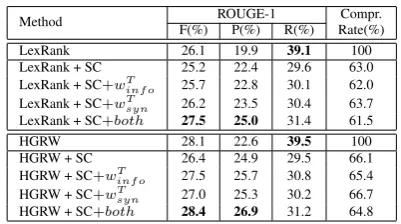
Table 2 shows the overall performance5. For
sum-maries generated by both LexRank and HGRW, “+SC” means generic sentence compression
base-4http://nlp.stanford.edu/software/
lex-parser.shtml
5The performance of HGRW reported here is different
from (Wei and Gao, 2015) because the setup is different. We use all the explicitly linked tweets in the ranking process here without considering redundancy while a redundancy filtering process was applied in (Wei and Gao, 2015) .
line (Section. 2.2) is used, “+wT
info” and “+wTsyn”
indicate tweets are used to help edge weighting for sentence compression in terms of informative-ness and syntactic importance respectively, and “+both” means both factors are used. We have several findings.
• The tweets involved sentence extraction model
HGRW can improve LexRank by 8.8% rela-tively in terms of ROUGE-1 F score, showing the effectiveness of relevant tweets for sentence selection.
• With generic sentence compression, the ROUGE-1 F scores for both LexRank and
HGRW drop, mainly because of a much lower recall score. This indicates that generic sen-tence compression without certain guidance removes salient content of the original sentence that may be important for summarization and thus hurts the performance. This is consistent with the finding of (Chali and Hasan, 2012). • By adding either wT
info or wTsyn, the
perfor-mance of summarization increases, showing that relevant tweets can be used to help the scores of both informativeness and syntactic im-portance.
• +SC+bothimproves the summarization perfor-mance significantly6 compared to the
corre-sponding compressive summarization baseline
+SC, and outperforms the corresponding origi-nal baseline,LexRankandHGRW.
• The improvement obtained by
LexRank+SC+both compared to LexRank
is more promising than that obtained by
HGRW+SC+both compared to HGRW. This may be because HGRW has used tweet in-formation already, and leaves limited room for improvement for the sentence compres-sion model when using the same source of information.
6Significance throughout the paper is computed by two
[image:4.595.80.281.197.309.2]● ● ● ● ● ● ● ● ● ● ●
0.0 0.2 0.4 0.6 0.8 1.0
0.25 0.26 0.27 0.28 0.29 0.30
α
R
OUGE−1 F score
● LexRank LexRank+SC LexRank+SC+both HGRW HGRW+SC HGRW+SC+both
(a) Impact ofα
● ● ● ● ● ● ● ● ● ● ●
0.0 0.2 0.4 0.6 0.8 1.0
0.25 0.26 0.27 0.28 0.29 0.30
β
R
OUGE−1 F score
● LexRank LexRank+SC LexRank+SC+both HGRW HGRW+SC HGRW+SC+both
[image:5.595.99.502.61.212.2](b) Impact ofβ
Figure 1: The influence ofαandβ. Solid lines are used for approaches based on LexRank; Dotted lines are used for HGRW based approaches.
Method Example 1 Example 2
LexRank Boston bombing suspect Tamerlan Tsarnaev,killed in a shootout with police days after the Three people were hospitalized in critical condition,according to information provided by hospitals blast, has been buried at an undisclosed who reported receiving patients from the blast. location, police in Worcester, Mass., said.
LexRank+SC suspect Tamerlan Tsarnaev, killed in ashootout after the blast, has been buried at an Three people were hospitalized,according to information provided by hospitals location, police in Worcester Mass. said. who reported receiving from the blast.
LexRank+SC+both Boston bombingkilled in a shootout after the blast, has beensuspect Tamerlan Tsarnaev, Three people were hospitalized inaccording to information provided by hospitals.critical condition, buried at an location police said.
Ground Truth Boston bombinghas been buried at an undisclosed locationsuspect Tamerlan Tsarnaev Hospitals report three people incritical condition
Table 3: Example highlight sentences from different systems
• By incorporating tweet information for both sentence selection and compression, the per-formance of HGRW+SC+both outperforms
LexRanksignificantly.
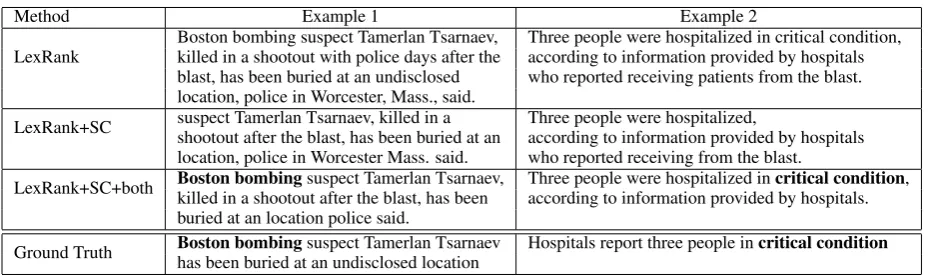
Table 3 shows some examples. As we can see in Example 1, with the help of tweet informa-tion, our compression model keeps the valuable part “Boston bombing” for summarization while the generic one abandons it.
We also investigate the influence ofαandβ. To study the impact of α, we fix β to 0.8, and vice versa. As shown in Figure 1, it is clear that larger αorβ, i.e., giving higher weights to tweets related information, is generally helpful.
4 Conclusion and Future Work
In this paper, we showed that the relevant tweet collection of a news article can guide the process of sentence compression to generate better story highlights. We extended a dependency-tree based sentence compression model to incorporate tweet information. The experiment results on a public corpus that contains both news articles and
rele-vant tweets showed the effectiveness of our ap-proach. With the popularity of Twitter and increas-ing interaction between social media and news media, such parallel data containing news and re-lated tweets is easily available, making our ap-proach feasible to be used in a real system.
There are some interesting future directions. For example, we can explore more effective ways to incorporate tweets for sentence compression; we can study joint models to combine both sen-tence extraction and compression with the help of relevant tweets; it will also be interesting to use the parallel dataset of the news articles and the tweets for timeline generation for a specific event.
Acknowledgments
[image:5.595.71.539.247.387.2]References
YLlias Chali and Sadid A Hasan. 2012. On the effec-tiveness of using sentence compression models for query-focused multi-document summarization. In
Proceedings of the 25th International Conference on Computational Linguistics, pages 457–474.
James Clarke and Mirella Lapata. 2006. Models for sentence compression: A comparison across do-mains, training requirements and evaluation mea-sures. InProceedings of the 21st International Con-ference on Computational Linguistics and the 44th annual meeting of the Association for Computa-tional Linguistics, pages 377–384. Association for Computational Linguistics.
G¨unes Erkan and Dragomir R Radev. 2004. Lexrank: Graph-based lexical centrality as salience in text summarization. Journal of Artificial Intelligence Research, 22:457–479.
Katja Filippova and Yasemin Altun. 2013. Overcom-ing the lack of parallel data in sentence compression. In Proceedings of the 2013 Conference on Empiri-cal Methods in Natural Language Processing, pages 1481–1491. Association for Computational Linguis-tics.
Katja Filippova and Michael Strube. 2008. Depen-dency tree based sentence compression. In Proceed-ings of the Fifth International Natural Language Generation Conference, pages 25–32. Association for Computational Linguistics.
Dimitrios Galanis and Ion Androutsopoulos. 2010. An extractive supervised two-stage method for sentence compression. In Human Language Technologies: The 2010 Annual Conference of the North American Chapter of the Association for Computational Lin-guistics, pages 885–893. Association for Computa-tional Linguistics.
Wei Gao, Peng Li, and Kareem Darwish. 2012. Joint topic modeling for event summarization across news and social media streams. InProceedings of the 21st ACM International Conference on Information and Knowledge Management, pages 1173–1182. Kevin Knight and Daniel Marcu. 2000.
Statistics-based summarization-step one: Sentence compres-sion. In Proceedings of The 7th National Confer-ence on Artificial IntelligConfer-ence, pages 703–710. Alok Kothari, Walid Magdy, Ahmed Mourad
Ka-reem Darwish, and Ahmed Taei. 2013. Detecting comments on news articles in microblogs. In Pro-ceedings of The 7th International AAAI Conference on Weblogs and Social Media, pages 293–302. Chen Li, Fei Liu, Fuliang Weng, and Yang Liu. 2013.
Document summarization via guided sentence com-pression. InProceedings of the 2013 Conference on Empirical Methods in Natural Language Process-ing, pages 490–500. Association for Computational Linguistics.
Chen Li, Yang Liu, Fei Liu, Lin Zhao, and Fuliang Weng. 2014. Improving multi-documents summa-rization by sentence compression based on expanded constituent parse trees. InProceedings of the 2014 Conference on Empirical Methods in Natural Lan-guage Processing, pages 691–701. Association for Computational Linguistics.
Chin-Yew Lin. 2003. Improving summarization per-formance by sentence compression: a pilot study. In
Proceedings of the sixth international workshop on Information retrieval with Asian languages-Volume 11, pages 1–8. Association for Computational Lin-guistics.
Chin-Yew Lin. 2004. Rouge: A package for automatic evaluation of summaries. In Text Summarization Branches Out: Proceedings of the ACL-04 Work-shop, pages 74–81.
Xian Qian and Yang Liu. 2013. Fast joint compres-sion and summarization via graph cuts. In Proceed-ings of the 2013 Conference on Empirical Methods in Natural Language Processing, pages 1492–1502. Association for Computational Linguistics.
Stefan Riezler, Tracy H King, Richard Crouch, and An-nie Zaenen. 2003. Statistical sentence condensa-tion using ambiguity packing and stochastic disam-biguation methods for lexical-functional grammar. InProceedings of the 2003 Conference of the North American Chapter of the Association for Computa-tional Linguistics on Human Language Technology, pages 118–125. Association for Computational Lin-guistics.
Tadej ˇStajner, Bart Thomee, Ana-Maria Popescu, Marco Pennacchiotti, and Alejandro Jaimes. 2013. Automatic selection of social media responses to news. InProceedings of the 19th ACM International Conference on Knowledge Discovery and Data Min-ing, pages 50–58. ACM.
Ilija Subaˇsi´c and Bettina Berendt. 2011. Peddling or creating? investigating the role of twitter in news reporting. In Advances in Information Retrieval, pages 207–213. Springer.
Lu Wang, Hema Raghavan, Vittorio Castelli, Radu Flo-rian, and Claire Cardie. 2013. A sentence com-pression based framework to query-focused multi-document summarization. In Proceedings of the 48th Annual Meeting of the Association for Compu-tational Linguistics, pages 1384–1394. Association for Computational Linguistics.
Zhongyu Wei and Wei Gao. 2014. Utilizing microblog for automatic news highlights extraction. In Pro-ceedings of the 25th International Conference on Computational Linguistics, pages 872–883.