Proceedings of the 55th Annual Meeting of the Association for Computational Linguistics (Short Papers), pages 324–329 Proceedings of the 55th Annual Meeting of the Association for Computational Linguistics (Short Papers), pages 324–329
Feature-Rich Networks for Knowledge Base Completion
Alexandros Komninos
Department of Computer Science University of York
York, YO10 5GH United Kingdom [email protected]
Suresh Manandhar
Department of Computer Science University of York2
York, YO10 5GH United Kingdom [email protected]
Abstract
We propose jointly modelling Knowledge Bases and aligned text with Feature-Rich Networks. Our models perform Knowl-edge Base Completion by learning to rep-resent and compose diverse feature types from partially aligned and noisy resources. We perform experiments on Freebase uti-lizing additional entity type information and syntactic textual relations. Our eval-uation suggests that the proposed mod-els can better incorporate side information than previously proposed combinations of bilinear models with convolutional neu-ral networks, showing large improvements when scoring the plausibility of unob-served facts with associated textual men-tions.
1 Introduction
Knowledge Bases (KB) are an important resource for many applications such as question answer-ing (Reddy et al.,2014), relation extraction (Mintz et al., 2009) and named entity recognition (Ling and Weld, 2012). While large collaborative KBs like Freebase (Bollacker et al., 2008) and DBpe-dia (Auer et al.,2007) contain facts about million of entities, they are mostly incomplete and contain errors. A large amount of research has been ded-icated to automatically extend knowledge bases, a task called Entity Linking or Knowledge Base Completion (KBC). Proposed approaches to KBC either reason about the internal structure of the KB, or utilize external data sources that indicate relations between the entities in the KB.
A very successful approach to KBC is latent feature models (Nickel et al.,2011;Bordes et al., 2013; Socher et al., 2013; Nickel et al., 2016). Such models embed the symbols of the KB into
a low dimensional space and assign a score to unseen triples as a function of the latent feature representations. Most approaches define a scor-ing function as a linear or bilinear operator. La-tent feature models have shown good performance when considering the internal structure of KBs and are scalable to very large datasets.
Utilizing textual data or other external resources for KBC is a challenging task but has the poten-tial of constantly updating KBs as new informa-tion becomes available. A line of work uses the KB as a means to obtain distant supervision to train relation extraction systems that classify tex-tual mentions into one of the KBs relations (Mintz et al.,2009;Hoffmann et al.,2011;Surdeanu et al., 2012). State-of-the-art approaches for KBC with external textual data are obtained by latent feature models that jointly embed the KB symbols and text relations into the same space (Riedel et al., 2013; Toutanova et al., 2015). The benefit of such models over relation extraction systems is that they can combine both the internal structure of the KB and textual information to reason about the plausibility of unobserved facts.
A commonly used approach for augmenting a KBC given an aligned text corpus is by adopting a Universal Schema (Riedel et al., 2013), where extracted textual relations between entities are di-rectly added to the knowledge graph and treated the same as KB relations. This allows appli-cation of any latent variable model defined over triples to jointly embed the KB and text relations to the same space. An extension to the Univer-sal Schema approach was proposed by (Toutanova et al., 2015), where representations of text re-lations are formed compositionally by Convolu-tional Neural Networks (CNNs) and then com-posed with entity vectors by a bilinear model to score a fact. However, these models show only moderate improvement when incorporating
Subject Entity
Object Entity
Subject Entity Types
Object Entity Types
Relation Text
[image:2.595.146.458.63.218.2]Features
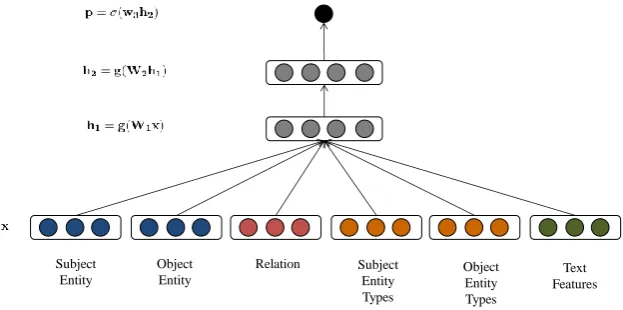
Figure 1: Feature-Rich Network with all the aligned feature types associated with a fact.
tual relations.
A limitation of the Universal Schema approach for joint embedding of KBs and text is that infor-mation about the correspondence between KB and text relations is only implicitly available through their co-occurrence with entities. Text relations can often be noisy and pairs of entities can co-occur in the same sentence without sharing a se-mantic relation. In addition, there is usually a mis-match in the relations found in the KB and those expressed in text. The model has to learn the align-ment between KB and text relations without ex-plicit evidence of co-occurrence between the two, and then propagate that information through the entity embeddings in order to score unseen KB triples.
We propose a different approach to combine KB and textual evidence, where the textual relations are not part of the same graph but are treated as side evidence. In our setting, a fact does not nec-essarily consist of a (sbj, rel, obj) triple, but as
an n-tuple where extra elements are formed by ex-tracting additional information from the KB and aligned side resources such as text. We score the probability of the tuple being true by learn-ing latent representations for each element of the tuple, and then learning a composition and scor-ing function parameterized by a Multilayer Per-ceptron (MLP). We choose MLPs as they are a generic method to model interactions between la-tent features without having to specify the form of a composition operator for tuples of different ar-ity. When scoring the plausibility of unseen facts, all the side evidence associated with that fact be-comes explicit through the n-tuple.
We evaluate the ability of the proposed
Feature-Rich Networks (FRN) for KBC on the challenging FB15k-237 (Toutanova et al.,2015). We compare the performance of bilinear models to an MLP when facts are represented as simple triples, and the contribution of two additional types of aligned information: entity types and textual relation men-tions from a side corpus. We also evaluate the contribution of initializing feature representations from external models. Evaluation suggests that while MLPs and bilinear models perform simi-larly when treating facts as triples of KB symbols, the proposed approach can better utilize additional textual data than a combination of CNNs with bi-linear models, showing large improvements in pre-dicting unseen facts when they have linked rela-tion menrela-tions in text.
2 Model Definition
Knowledge Bases can be represented as a directed graph where nodes are entities e ∈ E and edges are typed relationsr ∈R. A fact in the KB is en-coded as a triple(es, r, eo), whereesis the subject entity andeois the object entity. Starting with an existing KB consisting of a set of observed facts, our goal is to reason about the plausibility of un-observed facts, given some additional external re-source. In our proposed model, we expand the representation of a fact to an n-tuple by consider-ing alignments of the additional resource with ele-ments of the triple. Our most expressive model en-codes a fact asX = (es, r, eo, ts, to, To,s), where
Francis Ford Coppola, director of The Godfather, … appos nmod:of
subject entity /m/02vyw
object entity /m/07g1sm
relation /film/director/film
subject entity types /people/person /film/director/ /award/award winner
object entity types /film/film /award/award winning work
text features appos−1 Esbj director appos director of nmod:of−1 director nmod:of Eobj
Extracted features for a KB fact with a single associated textual relation mention.
2.0.1 Feature Rich Networks
We model the probability of an n-tuple being true with an MLP that learns to compose and score the compatibility of the features associated with it. Features for each individual element of the tuple are assigned low dimensional embeddings which are concatenated to form the input to the MLP. The embeddings are jointly learned with the composi-tion and scoring model through back-propagacomposi-tion. The probability of a fact being true is given by:
p(X = 1) =σ(w3·g(W2·g(W1·x)) (1)
x=v(es);v(r);v(eo);v(ts);v(to);v(Ts,o) (2)
whereW1,W2,w3are the weights of the network,
g(•) is a non-linear function applied
element-wise, σ(•) is the sigmoid function and v(•) are latent feature representations of each element of the tuple. We use Rectified Linear Units as non-linearities (Nair and Hinton,2010).
2.1 Additional Features
We create compositional representations for the entity types and textual relation mentions with simple aggregation functions of their feature embeddings. Although not considered in this work, the overall approach is highly modular allowing for each component to be modelled by a different kind of network.
Freebase Entity Types
Entities in Freebase can have multiple types assigned to them. While entity types are explicitly provided in Freebase, we instead learn type representations by considering observed relations in the training set. Each relation in Freebase is
encoded as adomain/type/propertyof the subject entity. We extract the set of all triples where an entity takes the subject position, and keep the domain/type part as a type feature of that entity. We aggregate embeddings of all the observed discrete features using summation followed by L2-normalization to create the final representation of an entity’s type. We use a special
UNKNOWN symbol for entities with no observed types in the training set (i.e., entities that do not appear as subject of a triple). We create entity type representations for both subject and object entities and concatenate them to the input vector of the network.
Text Relations
We use a side corpus where pairs of entities are linked to the KB and take the shortest dependency path connecting them as a textual relation mention. Since textual relations are tied to entity pairs, we collect all mentions for a given entity pair and as-sociate them with a fact. This results in a set of phrases that act as textual evidence for relations of an entity pair.
We create a representation of the associated text for each entity pair by using a Neural Bag of Words model augmented with dependency fea-tures. A dependency feature is a symbol for a word having a specific dependency relation, such as
compound knowledge, compound−1 base
All With Mentions Without Mentions Model MRR H@10 MRR H@10 MRR H@10
KB only
F 16.9 24.5 26.4 49.1 13.3 15.5
E 33.2 47.6 25.5 37.8 36.0 51.2
DistMult 35.7 52.3 26.0 39.0 39.3 57.2
E + DistMult 37.3 55.2 28.6 42.9 40.5 59.8
FRN trp 35.8 55.3 28.7 44.3 38.6 59.7
FRN trp + types 36.0 56.0 28.2 45.0 39.0 60.3 FRN trp + types + init 37.6 57.5 30.5 48.3 40.4 61.1
KB and text
Conv-F 19.2 28.4 34.9 63.7 13.3 15.4
Conv-E 33.2 47.6 25.5 37.8 36.0 51.2
[image:4.595.108.491.59.297.2]Conv-DistMult 36.6 53.5 28.3 43.4 39.7 57.2 Conv-E + Conv-DistMult 40.1 58.1 33.9 49.9 42.2 61.1 FRN trp + types + text 38.1 58.3 45.4 68.8 35.2 54.2 FRN trp + types + text + init 40.3 62.0 44.1 68.3 38.7 59.5
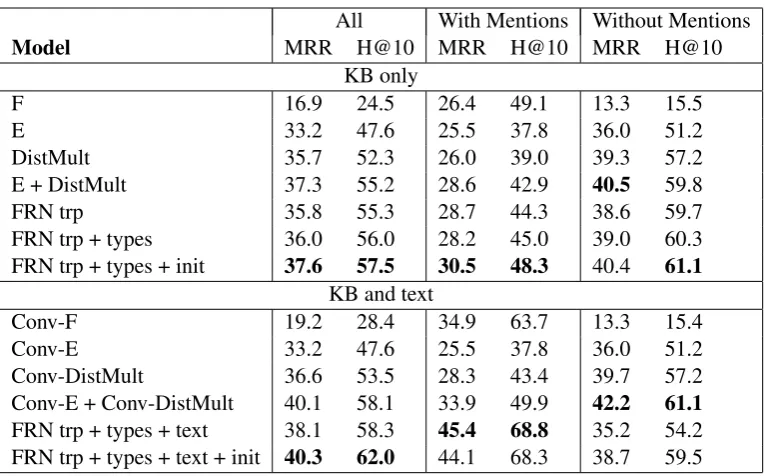
Table 1: Evaluation results on the FB15k-237 dataset. Results for F,E,DistMult and their CNN versions are reported from (Toutanova et al., 2015). With/Without Mentions indicates KB facts with/without aligned textual relations for their entity pair.
not have textual relation mentions. While our text representation component is quite simple, similar models have shown competitive performance on modelling short text (Komninos and Manandhar, 2016).
Initialization with Pre-trained Embeddings We experiment with pre-trained embeddings to initialize the entity vectors and text feature em-beddings of our model. Text feature emem-beddings are initialized from an available dependency based skip-gram model trained on Wikipedia (Komninos and Manandhar, 2016). Features that are not in-cluded in the vocabulary of the pre-trained model are initialized with a random vector from a nor-mal distribution with zero mean and same variance as the set of pre-trained embeddings. For entity vectors, we retrieve the English name of the en-tity from Freebase and construct a representation by averaging the embeddings of the words appear-ing in the name. Entities that do not have a name property are initialized randomly.
2.2 Training
The network weights are optimized by mizing the binary cross-entropy loss over mini-batches using the AdaM optimizer (Kingma and Ba,2014). To avoid the large computational cost of training with all possible unobserved facts, we
make use of negative sampling. The loss function is:
L(Θ) =−X
|Xp|
logp(Xp)−X |Xn|
log(1−p(Xn))
(3) whereΘare all the parameters of the network
in-cluding the feature embeddings, Xp are the ob-served facts in the training set and Xn are ran-domly drawn unobserved facts. We construct the negative samples by fixing the subject entity and relation, and uniformly sampling an object entity with the restriction that the resulting triple is not included in the training set. We then expand the triple with entity type and text alignments. This negative sampling schedule follows the evaluation procedure, where the network has to rank triples that only differ in the object entity position. Ex-periments in the validation set indicated that for a fixed number of negative samples, only consider-ing negative samples that differ in the object po-sition performs better than also including negative samples for the subject position.
3 Evaluation
3.1 Dataset and Evaluation Protocol
sub-set of relations does not contain redundant re-lations that can be easily inferred, resulting in a more challenging task compared to the origi-nal FB15k dataset. There are 310,116 triples in the dataset split into 272,115/17,535/20,466 for training/validation/testing. In addition to the KB, the dataset includes dependency paths of approxi-mately 2.7 million relation instances of linked en-tity mentions extracted from the ClueWeb corpus (Gabrilovich et al.,2013).
Evaluation follows the procedure of (Toutanova et al.,2015). Given a positive fact in the test set, the subject entity and relation are fixed and models have to rank all facts formed by the object entities appearing in the training set. The reported met-rics are mean reciprocal rank (MRR) and hits@10. Hits@10 is the fraction of positive facts ranked in the top 10 positions. Positive facts in the training, validation and test set are removed before ranking.
3.2 Implementation Details
Hyperparameters of the model were chosen by maximizing MRR on the validation set. We use two 300-dimensional hidden layers for the MLP, and dimensions of feature embeddings are: 300 for entity and text features, 100 for relations and 20 for entity type features. The number of nega-tive samples was set to 20 as increasing their num-ber only resulted in minor gains, and the batch size was set to 420. Best models were chosen among 20 epochs of training by monitoring valida-tion MRR. Models with embedding initializavalida-tions converged within the first 10 epochs. Initialization in the text model includes initializing entity and re-lation embeddings from a model without text men-tions.
3.3 Results
We compare our Feature-Rich Networks with the bilinear models F and E (Riedel et al., 2013), model DistMult (Yang et al.,2014) and their CNN augmented versions (Toutanova et al.,2015). Re-sults can be seen in Table 1.
We first observe that when modelling just KB triples, the MLP model outperforms individual bi-linear formulations, performing similarly to the best combination of DistMult + E. This shows that an additive combination of bilinear models is a strong baseline even though it does not use addi-tional parameters other than embeddings to com-pose and score triples. The addition of entity type information has a positive but small contribution
to performance. This is not surprising as entity type information is extracted from observed re-lations, and latent feature models can effectively learn that during training. On the other hand, ini-tializing entity embeddings with averaged word embeddings of their names results in a substan-tial performance gain of about 1.5 points in both MRR and hits@10. In general, we observe that all models perform worse on facts with textual rela-tion menrela-tions when they have not access to such mentions.
When textual relation mentions are added, we observe that our proposed model increases its per-formance score about 3 points in MRR and 4.5 in hits@10 compared to the best model that does not include text. Contrary to the conv-bilinear models, the performance gain is much larger for facts with textual mentions, reaching an additional 15/20 in MRR/hits@10 respectively. We attribute this gain to the explicitly represented textual relation align-ments with the KB symbols as encoded by the ex-panded tuple representations, and the non-linear composition of its elements by the MLP. We also notice that embedding initialization performs bet-ter overall.
4 Conclusion
In this paper, we propose joint modelling of Knowledge Bases and text with Feature-Rich Net-works. Our models can learn to combine informa-tion from different sources and better utilize noisy information from text than bilinear models aug-mented with convolutional neural networks. Be-sides text, we experiment with entity types and initialization with pre-trained embeddings, getting positive gains in performance. An interesting di-rection for future work is to combine our models with additional aligned information, such as mul-tiple KBs and to experiment with different compo-nents such as CNNs or LSTMs for text encoding.
Acknowledgements
References
S¨oren Auer, Christian Bizer, Georgi Kobilarov, Jens Lehmann, Richard Cyganiak, and Zachary Ives. 2007. Dbpedia: A nucleus for a web of open data. InThe semantic web, Springer, pages 722–735. Kurt Bollacker, Colin Evans, Praveen Paritosh, Tim
Sturge, and Jamie Taylor. 2008. Freebase: a collab-oratively created graph database for structuring hu-man knowledge. In Proceedings of the 2008 ACM SIGMOD international conference on Management of data. AcM, pages 1247–1250.
Antoine Bordes, Nicolas Usunier, Alberto Garcia-Duran, Jason Weston, and Oksana Yakhnenko. 2013. Translating embeddings for modeling multi-relational data. In Advances in neural information processing systems. pages 2787–2795.
Evgeniy Gabrilovich, Michael Ringgaard, and Amar-nag Subramanya. 2013. Facc1: Freebase annotation of clueweb corpora, version 1 (release date 2013-06-26, format version 1, correction level 0). Note: http://lemurproject. org/clueweb09/FACC1/Cited by
5.
Raphael Hoffmann, Congle Zhang, Xiao Ling, Luke Zettlemoyer, and Daniel S Weld. 2011. Knowledge-based weak supervision for information extraction of overlapping relations. InProceedings of the 49th Annual Meeting of the Association for Computa-tional Linguistics: Human Language Technologies-Volume 1. Association for Computational Linguis-tics, pages 541–550.
Diederik Kingma and Jimmy Ba. 2014. Adam: A method for stochastic optimization. arXiv preprint arXiv:1412.6980.
Alexandros Komninos and Suresh Manandhar. 2016. Dependency based embeddings for sentence classifi-cation tasks. InProceedings of NAACL:HLT. Asso-ciation for Computational Linguistics, pages 1490– 1500.
Xiao Ling and Daniel S Weld. 2012. Fine-grained en-tity recognition. InAAAI. Citeseer.
Mike Mintz, Steven Bills, Rion Snow, and Dan Ju-rafsky. 2009. Distant supervision for relation ex-traction without labeled data. In Proceedings of the Joint Conference of the 47th Annual Meeting of the ACL and the 4th International Joint Conference on Natural Language Processing of the AFNLP: Volume 2-Volume 2. Association for Computational Linguistics, pages 1003–1011.
Vinod Nair and Geoffrey E Hinton. 2010. Rectified linear units improve restricted boltzmann machines. InProceedings of the 27th international conference on machine learning (ICML-10). pages 807–814. Maximilian Nickel, Kevin Murphy, Volker Tresp, and
Evgeniy Gabrilovich. 2016. A review of relational machine learning for knowledge graphs. Proceed-ings of the IEEE104(1):11–33.
Maximilian Nickel, Volker Tresp, and Hans-Peter Kriegel. 2011. A three-way model for collective learning on multi-relational data. InProceedings of the 28th international conference on machine learn-ing (ICML-11). pages 809–816.
Siva Reddy, Mirella Lapata, and Mark Steedman. 2014. Large-scale semantic parsing without question-answer pairs. Transactions of the Association for Computational Linguistics2:377–392.
Sebastian Riedel, Limin Yao, Andrew McCallum, and Benjamin M Marlin. 2013. Relation extraction with matrix factorization and universal schemas . Richard Socher, Danqi Chen, Christopher D Manning,
and Andrew Ng. 2013. Reasoning with neural ten-sor networks for knowledge base completion. In
Advances in neural information processing systems. pages 926–934.
Mihai Surdeanu, Julie Tibshirani, Ramesh Nallapati, and Christopher D Manning. 2012. Multi-instance multi-label learning for relation extraction. In Pro-ceedings of the 2012 joint conference on empirical methods in natural language processing and compu-tational natural language learning. Association for Computational Linguistics, pages 455–465.
Kristina Toutanova, Danqi Chen, Patrick Pantel, Hoi-fung Poon, Pallavi Choudhury, and Michael Gamon. 2015. Representing text for joint embedding of text and knowledge bases. In EMNLP. Citeseer, vol-ume 15, pages 1499–1509.