134
(Almost) Unsupervised Grammatical Error Correction
using a Synthetic Comparable Corpus
Satoru Katsumata and Mamoru Komachi
Tokyo Metropolitan University
[email protected],[email protected]
Abstract
We introduce unsupervised techniques based on phrase-based statistical machine transla-tion for grammatical error correctransla-tion (GEC) trained on a pseudo learner corpus created by Google Translation. We verified our GEC sys-tem through experiments on a low resource track of the shared task at Building Educa-tional Applications 2019 (BEA2019). As a re-sult, we achieved anF0.5score of 28.31 points
with the test data.
1 Introduction
Research on grammatical error correction (GEC) has gained considerable attention recently. Many studies treat GEC as a task that involves translation from a grammatically erroneous sentence (source-side) into a correct sentence (target-(source-side) and thus, leverage methods based on machine translation (MT) for GEC. For instance, some GEC systems use large parallel corpora and synthetic data (Ge et al., 2018; Xie et al., 2018).
We introduce an unsupervised method based on MT for GEC that does not use parallel learner data. In particular, we use methods proposed by Marie and Fujita (2018), Artetxe et al. (2018b), and Lample et al. (2018). These methods are based on phrase-based statistical machine trans-lation (SMT) and phrase table refinements. For-ward refinement used by Marie and Fujita (2018) simply augments a learner corpus with automatic corrections. We also use forward refinement for improvement of phrase table.
Unsupervised MT techniques do not require a parallel but a comparable corpus as training data. Therefore, we use comparable translated texts us-ing Google Translation as the source-side data. Specifically, we use News Crawl written in En-glish as target-side data and News Crawl writ-ten in another language translated into English as source-side data.
We verified our GEC system through exper-iments for a low resource track of the shared task at Building Educational Applications 2019 (BEA2019). The experimental results show that our system achieved anF0.5score of 28.31 points.
2 Unsupervised GEC
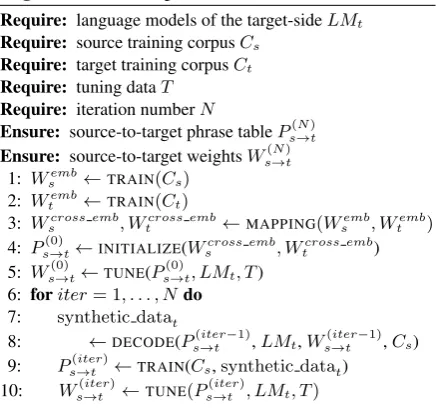
Algorithm 1 shows the pseudocode for unsuper-vised GEC. This code is derived from Artetxe et al. (2018b). First, the cross-lingual phrase em-beddings are acquired. Second, a phrase table is created based on these cross-lingual embeddings. Third, the phrase table is combined with a lan-guage model trained by monolingual data to ini-tialize a phrase-based SMT system. Finally, the SMT system is updated through iterative forward-translation.
Cross-lingual embeddings First, n-gram em-beddings were created on the source- and target-sides. Specifically, each monolingual embedding was created based on the source- and target-sides using a variant of skip-gram (Mikolov et al., 2013) for unigrams, bigrams, and trigrams with high fre-quency1in the monolingual data. Next, the mono-lingual embeddings were mapped onto a shared space to obtain cross-lingual embeddings. The self-learning method of Artetxe et al. (2018a) was used for unsupervised mapping.
Phrase table induction A phrase table was cre-ated based on the cross-lingual embeddings. In particular, this involved the creation of phrase translation models and lexical translation models.
The translation candidates were limited in the source-to-target phrase translation model ϕ(f|e)
for each source phraseeto its 100 nearest neigh-bor phrases f on the target-side. The score of
1We used the most frequent 200K unigrams, 400K
Algorithm 1Unsupervised GEC
Require: language models of the target-sideLMt Require: source training corpusCs
Require: target training corpusCt Require: tuning dataT
Require: iteration numberN
Ensure: source-to-target phrase tablePs(→N)t Ensure: source-to-target weightsWs(→N)t
1: Wemb
s ←TRAIN(Cs) 2: Wtemb←TRAIN(Ct)
3: Wscross emb, Wtcross emb←MAPPING(Wsemb, Wtemb) 4: Ps(0)→t←INITIALIZE(Wcross emb
s , Wtcross emb) 5: Ws(0)→t←TUNE(Ps(0)→t, LMt, T)
6: foriter= 1, . . . , Ndo 7: synthetic datat
8: ←DECODE(Ps(→itert−1),LMt,Ws(→itert−1),Cs) 9: Ps(→itert)←TRAIN(Cs,synthetic datat)
10: Ws(→itert)←TUNE(Ps(→itert), LMt, T)
the phrase translation model was calculated based on the normalized cosine similarity between the source and target phrases.
ϕ(f|e) = ∑exp(cos(e, f)/τ)
f′exp(cos(e, f
′)/τ) (1)
f′represents each phrase embedding on the target-side and τ is a temperature parameter that con-trols the confidence of prediction2. The backward phrase translation probability ϕ(e|f) was deter-mined in a similar manner.
The source-to-target lexical translation model
lex(f|e)considers the word with the highest trans-lation probability in a target phrase for each word in a source phrase. The score of the lexical trans-lation model was calculated based on the product of respective phrase translation probabilities.
lex(f|e) =∏
i
max (
ϵ,max
j ϕ
( fi|ej
)) (2)
ϵis a constant term for the case where no align-ments are found. As in Artetxe et al. (2018b), the term was set to 0.001. The backward lexical trans-lation probabilitylex(e|f)is calculated in a simi-lar manner.
Refinement of SMT system The phrase table created is considered to include noisy phrase pairs. Therefore, we update the phrase table using an SMT system. The SMT system trained on syn-thetic data eliminates the noisy phrase pairs using
2As in Artetxe et al. (2018b),τis estimated by
maximiz-ing the phrase translation probability between an embeddmaximiz-ing and the nearest embedding on the opposite side.
Corpus Sent. Learner
Fi News Crawl 1,904,880 No En News Crawl 2,116,249 No One-Billion 24,482,651 No
tuning data 2,191 Yes
[image:2.595.332.498.63.143.2]dev data 2,193 Yes
Table 1: Data statics: train and dev data size.
language models trained on the target-side corpus. This process corresponds to lines 6—10 in Algo-rithm 1. The phrase table is refined with forward refinement (Marie and Fujita, 2018).
For forward refinement, target synthetic data were generated from the source monolingual data using the source-to-target phrase table Ps(0)→t and target language modelLMt. A new phrase table
Ps(1)→t was then created with this target synthetic corpus. This operation was executedN times.
Construction of a comparable corpus This un-supervised method is based on the assumption that the source and target corpora are comparable. In fact, Lample et al. (2018), Artetxe et al. (2018b) and Marie and Fujita (2018) use the News Crawl of source and target language as training data.
To make a comparable corpus for GEC, we use translated texts using Google Translation as the source-side data. Specifically, we use Finnish News Crawl translated into English as source-side. English News Crawl is used as the target-side as is. Finnish data is used because Finnish is not similar to English.
This translated data does not include misspelled words. To address these words, we use a spell checker as a preprocessing step before inference.
3 Experiment of low resource GEC
3.1 Experimental setting
Table 1 shows the training and development data size. Finnish News Crawl 2014—2015 trans-lated into English was used as source training data and English News Crawl 2017 was used as target training data. To train the extra language model of the target-side (LMt), we used training data
of One Billion Word Benchmark (Chelba et al., 2014). We used googletrans v2.4.03 for Google Translation. This module did not work sometimes and thus, we obtained 2,122,714
[image:2.595.72.291.75.279.2]Team TP FP FN P R F0.5
UEDIN-MS 2,312 982 2,506 70.19 47.99 64.24
Kakao&Brain 2,412 1,413 2,797 63.06 46.30 58.80
LAIX 1,443 884 3,175 62.01 31.25 51.81
CAMB-CUED 1,814 1,450 2,956 55.58 38.03 50.88
UFAL, Charles University, Prague 1,245 1,222 2,993 50.47 29.38 44.13
Siteimprove 1,299 1,619 3,199 44.52 28.88 40.17
WebSpellChecker.com 2,363 3,719 3,031 38.85 43.81 39.75
TMU 1,638 4,314 3,486 27.52 31.97 28.31
[image:3.595.134.465.63.174.2]Buffalo 446 1,243 3,556 26.41 11.14 20.73
Table 2: GEC results with test data.
lated sentences4. We sampled the 3,000,000 sen-tences from English News Crawl 2017 and ex-cluded the sentences with more than 150 words for either source- and target-side data. Finally, the synthetic comparable corpus comprises pro-cessed News Crawl data listed in Table 1. The low resource track permitted to use W&I+LOCNESS (Bryant et al., 2019; Granger, 1998) development set, so we split it in half; tune data and dev data5.
These data are tokenized byspaCy v1.9.06
and theen_core_web_sm-1.2.0model. We used moses truecaser for the training data; this truecaser model is learned from processed English News Crawl. We used byte-pair-encoding (Sen-nrich et al., 2016) learned from processed English News Crawl; the number of operations is 50K.
The implementation proposed by Artetxe et al. (2018b)7 was modified to conduct the experi-ments. Specifically, some features were added; word-level Levenshtein distance, word-, and character-level edit operation, operation sequence model, (Durrani et al., 2013)8 and 9-gram word class language model, similar to Grundkiewicz and Junczys-Dowmunt (2018) without sparse fea-tures. Word class language model was trained with One Billion Word Benchmark data; the number of classes is 200, and the word class was estimated with fastText(Bojanowski et al., 2017). The distortion feature was not used.
Moses (Koehn et al., 2007) was used to train the SMT system. FastAlign (Dyer et al., 2013) was used for word alignment and KenLM
(Heafield, 2011) was used to train the 5-gram lan-guage model over each processed English News
4Finnish News Crawl 2014—2015 have 6,360,479
sen-tences.
5
Because W&I+LOCNESS data had four types of learner level, we split it so that each learner level is equal.
6
https://github.com/explosion/spaCy
7
https://github.com/artetxem/monoses
8Operation sequence model was used in refinement step.
Crawl and One Billion Word Benchmark. MERT (Och, 2003) was used with the tuning data for
Mˆ2 Scorer (Dahlmeier and Ng, 2012). Syn-thetic sentence pairs with a [3, 80] sentence length were used at the refinement step. The number of iterationsN was set to 5, and the embedding di-mension was set to 300. We decided best iteration using the dev data and submitted the output of the best iteration model.
We used pyspellchecker9 as a spell checker. This tool uses Levenshtein distance to obtain permutations within an edit distance of 2 over the words included in a word list. We made the word list from One Billion Word Benchmark and included words that occur more than five times.
We report precision, recall, andF0.5score based on the dev data and official test data. The output of dev data was evaluated using ERRANT scorer (Bryant et al., 2017) similarly to official test data.
3.2 Results
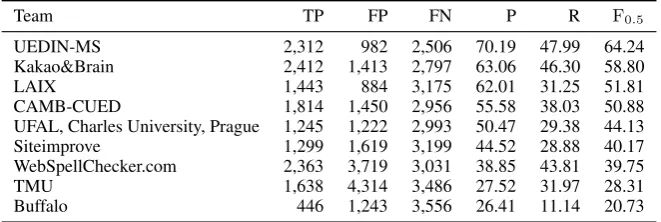
Table 2 shows the results of the GEC experiments with test data. The F0.5 score for our system (TMU) is 28.31; this score is eighth among the nine teams. In particular, the number of false pos-itives of our system is 4,314; this is the worst result of all.
4 Discussion
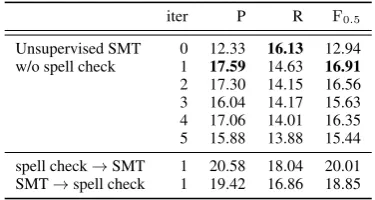
Table 3 shows the results of the dev data listed in Table 1. On the dev data, the system of itera-tion 1 is the best among all. According to the im-provement of iteration from 0 to 1, it is confirmed that the refinement method works well. However, it is observed that the system is not improved af-ter iaf-teration 1. The source-side data is fixed, and target-side data is generated from the source-side for each iteration. Therefore, the quality of the
iter P R F0.5
Unsupervised SMT 0 12.33 16.13 12.94
w/o spell check 1 17.59 14.63 16.91
2 17.30 14.15 16.56
3 16.04 14.17 15.63
4 17.06 14.01 16.35
5 15.88 13.88 15.44
spell check→SMT 1 20.58 18.04 20.01
[image:4.595.87.275.62.162.2]SMT→spell check 1 19.42 16.86 18.85
Table 3: GEC results with dev data. The bold scores represent the best score without the spell checker.
source-side data is important for this refinement method. In this study, we use the automatically translated text as source-side data; thus, it is con-sidered that the quality is not high and the refine-ment after iteration 1 does not work.
The results of Table 3 confirm that the spell checker works well. We also investigate the im-portance of the order; SMT or spell check, which is suitable for the first system for a better result? As a result, it is better to use the SMT system af-ter using the spell checker. That is because the source-side data does not include the misspelled words as mentioned above.
Table 4 shows the error types that our system corrected well or mostly did not correct on the dev data. SPELL means the misspell errors; the cor-rection of these errors depends only on the spell checker. PUNCT means the errors about the punc-tuation; e.g., ‘Unfortunately when we...→ Unfor-tunately, when we...’. It is considered that our sys-tem can correct errors such as these owing to the n-gram co-occurrence knowledge derived from the language models.
In contrast, our system struggled to correct con-tent word errors. For example, NOUN includes an error like this; ‘way→ means’ and VERB in-cludes an error like this; ‘watch→see’. It is con-sidered that our system is mostly not able to cor-rect the errors regarding word usage based on the context because the phrase table was still noisy. Although we observed some usage error examples of ‘watch’ in the synthetic source data, our model was not able to replace ‘watch’ to ‘see’ based on the context.
5 Related Work
Unsupervised Machine Translation Studies on unsupervised methods have been conducted for both NMT (Lample et al., 2018; Marie and Fu-jita, 2018) and SMT (Artetxe et al., 2018b). In
P R F0.5
Top2
SPELL 39.93 59.24 42.71 PUNCT 28.91 38.14 30.38
Bottom2
NOUN 0.87 1.74 0.97
[image:4.595.340.492.63.153.2]VERB 2.13 0.99 1.73
Table 4: Error types for which our best system cor-rected errors well or mostly did not correct on the dev data. Top2 denotes the top two errors, and Bottom2 denotes the lowest two errors in terms of theF0.510.
this study, we apply the USMT method of Artetxe et al. (2018b) and Marie and Fujita (2018) to GEC. The UNMT method (Lample et al., 2018) was in-effective under the GEC setting in our preliminary experiments.
GEC with NMT/SMT Several studies that in-troduce sequence-to-sequence models in GEC heavily rely on large amounts of training data. Ge et al. (2018), who presented state-of-the-art re-sults in GEC, proposed a supervised NMT method trained on corpora of a total 5.4 M sentence pairs. We mainly use the monolingual corpus because the low resource track does not permit the use of the learner corpora.
Despite the success of NMT, many stud-ies on GEC traditionally use SMT (Susanto et al., 2014; Junczys-Dowmunt and Grund-kiewicz, 2014). These studies apply an off-the-shelf SMT toolkit, Moses, to GEC. Junczys-Dowmunt and Grundkiewicz (2014) claimed that the SMT system optimized for BLEU learns to not change the source sentence. Instead of BLEU, they proposed tuning an SMT system using the
M2 score with annotated development data. In this study, we also tune the weights with an F0.5 score measured by theM2scorer because the offi-cial score is anF0.5 score.
6 Conclusion
In this paper, we described our GEC system for the low resource track of the shared task at BEA2019. We introduced an unsupervised approach based on SMT for GEC. This track prohibited the use of learner data as training data, so we created a synthetic comparable corpus using Google Trans-lation. The experimental results demonstrate that
10We investigate the frequent error types; the errors occur
our system achieved anF0.5score of 28.31 points with the test data.
Acknowledgments
This work was partially supported by JSPS Grant-in-Aid for Scientific Research (C) Grant Number JP19K12099.
References
Mikel Artetxe, Gorka Labaka, and Eneko Agirre. 2018a. A robust self-learning method for fully un-supervised cross-lingual mappings of word embed-dings. InProc. of ACL, pages 789–798.
Mikel Artetxe, Gorka Labaka, and Eneko Agirre. 2018b. Unsupervised statistical machine transla-tion. InProc. of EMNLP, pages 3632–3642.
Piotr Bojanowski, Edouard Grave, Armand Joulin, and Tomas Mikolov. 2017. Enriching word vectors with subword information. Transactions of the Associa-tion for ComputaAssocia-tional Linguistics, 5:135–146.
Christopher Bryant, Mariano Felice, Øistein E. Ander-sen, and Ted Briscoe. 2019. The BEA-2019 Shared Task on Grammatical Error Correction. InProc. of BEA.
Christopher Bryant, Mariano Felice, and Ted Briscoe. 2017. Automatic annotation and evaluation of error types for grammatical error correction. InProc. of ACL, pages 793–805.
Ciprian Chelba, Tomas Mikolov, Mike Schuster, Qi Ge, Thorsten Brants, Phillipp Koehn, and Tony Robin-son. 2014. One billion word benchmark for mea-suring progress in statistical language modeling. In
Proc. of INTERSPEECH, pages 2635–2639.
Daniel Dahlmeier and Hwee Tou Ng. 2012. Bet-ter evaluation for grammatical error correction. In
Proc. of NAACL-HLT, pages 568–572.
Nadir Durrani, Alexander Fraser, Helmut Schmid, Hieu Hoang, and Philipp Koehn. 2013. Can Markov models over minimal translation units help phrase-based smt? InProc. of ACL, pages 399–405.
Chris Dyer, Victor Chahuneau, and Noah A. Smith. 2013. A simple, fast, and effective reparameteri-zation of IBM model 2. In Proc. of NAACL-HLT, pages 644–648.
Tao Ge, Furu Wei, and Ming Zhou. 2018. Reaching human-level performance in automatic grammatical error correction: An empirical study. arXiv preprint arXiv:1807.01270.
Sylviane Granger. 1998. The computer learner corpus: A versatile new source of data for SLA research. In Sylviane Granger, editor,Learner English on Com-puter, pages 3–18. Addison Wesley Longman, Lon-don and New York.
Roman Grundkiewicz and Marcin Junczys-Dowmunt. 2018. Near human-level performance in grammati-cal error correction with hybrid machine translation. InProc. of NAACL-HLT, pages 284–290.
Kenneth Heafield. 2011. KenLM: Faster and smaller language model queries. In Proc. of WMT, pages 187–197.
Marcin Junczys-Dowmunt and Roman Grundkiewicz. 2014. The AMU system in the CoNLL-2014 shared task: Grammatical error correction by data-intensive and feature-rich statistical machine translation. In
Proc. of CoNLL, pages 25–33.
Philipp Koehn, Hieu Hoang, Alexandra Birch, Chris Callison-Burch, Marcello Federico, Nicola Bertoldi, Brooke Cowan, Wade Shen, Christine Moran, Richard Zens, Chris Dyer, Ondrej Bojar, Alexandra Constantin, and Evan Herbst. 2007. Moses: Open source toolkit for statistical machine translation. In
Proc. of ACL Demo Sessions, pages 177–180.
Guillaume Lample, Myle Ott, Alexis Conneau, Lu-dovic Denoyer, and Marc’Aurelio Ranzato. 2018. Phrase-based & neural unsupervised machine trans-lation. InProc. of EMNLP, pages 5039–5049.
Benjamin Marie and Atsushi Fujita. 2018. Unsuper-vised neural machine translation initialized by un-supervised statistical machine translation. arXiv preprint arXiv:1810.12703.
Tomas Mikolov, Kai Chen, Greg Corrado, and Jeffrey Dean. 2013. Efficient estimation of word represen-tations in vector space. InICLR Workshop.
Franz Josef Och. 2003. Minimum error rate training in statistical machine translation. InProc. of ACL, pages 160–167.
Rico Sennrich, Barry Haddow, and Alexandra Birch. 2016. Neural machine translation of rare words with subword units. InProc. of ACL, pages 1715–1725.
Raymond Hendy Susanto, Peter Phandi, and Hwee Tou Ng. 2014. System combination for grammatical er-ror correction. InProc. of EMNLP, pages 951–962.