Munich Personal RePEc Archive
Rationality and Capitalist Schooling
Lambert, Thomas
University of Louisville
5 March 2019
Online at
https://mpra.ub.uni-muenchen.de/92594/
1
Rationality and Capitalist Schooling
Thomas Lambert, PhD Lecturer, Economics Department
College of Business University of Louisville Louisville, KY 40292 USA [email protected]
502-852-7838
Abstract
In the field of philosophy of mind, the concepts of rational behavior, rational choice
theory, and instrumental rationality (the “practical reasoning” version of rationality) are
important in trying to make statements and conclusions about human thinking and behavior in
general. Rational choice theory is also considered a normative but not a descriptive or positive
theory. Much of economic theory is based on the principle that economic agents usually or
always behave rationally in maximizing the benefits and/or minimizing the costs of their
decisions. Developments in behavioral economics over the last several decades have begun to
question this principle with much of the questioning about rationality and rational behavior
centering on whether individuals can correctly and adequately assess probabilities and
risk/reward. The inability to correctly assess risk/reward limits rational behavior and can yield
sub-optimal outcomes for economic agents. This exploratory paper examines the linkages
between schooling in a capitalist society and limits on rationality in a monopoly capital
economic system.
Key words: behavioral economics, capitalist schooling, monopoly capital, rationality, rational choice JEL Codes: B51, I24
2 Introduction
Jaworski (2011) writes that “intentionality and rationality are central to a public
conception of mental phenomena” (page 30) and that “[T]o describe people’s behavior in terms
of their beliefs, desires, and other intentional mental states is to classify that behavior as
something that is explainable by appeal to reasons” (page 31). One who acts consistently with
his/her beliefs, desires, and other intentional mental states are thought or deemed to be behaving
rationally. Irrational behavior is when one does not act consistently with his/her beliefs, desires,
or attitudes (BDA) or acts contrary to her/his beliefs or goals.
In the field of economics, rationality is an important concept to many economists in that
rationality is used to explain the actions of agents/participants in different markets at the
microeconomic (individual market) and macroeconomic (aggregate markets) levels. The MIT
Dictionary of Modern Economics states,
Rationality. Behavior by an economic agent (consumer, producer, government, etc.) which is consistent with a set of rules governing preferences. In consumer demand theory, for example, the rules, or axioms, would include the axioms of completeness, transitivity, and selection. Additional axioms are necessary to establish a testable theory of rational economic behavior. (page 360).
And to go along with this, there is the definition or concept of “economic man/woman” in which
each person is assumed to maximize his/her utility (happiness) subject to such constraints as
income, available information for decision making, and his/her preferences. An economic
person is rational by maximizing his/her utility subject to his/her constraints, although if one
does not pursue utility maximization, the main point is that each individual pursues his/her goals
in a consistent manner1 (MIT Dictionary of Modern Economics 1989). This concept is applied
1 One can moderate her/his utility maximization by acts of charity or altruism. However, if this gives one happiness
3
to consumers, producers, managers, political leaders, and all participants in a market economy.
By each person pursuing his/her own utility maximization, an entire society is made better off in
as many ways possible along the lines of Adam Smith’s notion of each person pursuing his/her
self-interest, and this in turn increases societal wealth (Smith 2000).
But whether one looks at rationality from a philosophy of mind point of view or from the
discipline of economics point of view, there exists a debate about whether humans act rationally,
and if they do act rationally, do they act sufficiently rational? In other words, the latter point
refers to the question of how rational is rational enough, or to what degree should rationality be
evaluated and held to be consistent. That is, if we believe that most people act and behave
rationally, should the rationality of human behavior hold 100% of the time, 90% of the time, etc.,
and how can or how should rationality be evaluated? Should it be evaluated according to
humans never making mistakes or never appearing to do or say things contrary to their BDA, or
should it be evaluated according to humans mostly never making mistakes, etc.? Should
incorrectly estimating the probabilities of the occurrences of certain events be considered
irrational, or is this something to be considered rational within certain reasons or bounds?
Should one’s preferences be allowed to change, or is this a sign of inconsistency, and thus a sign
of irrationality? Is one’s trying to think, act and behave rationally and consistently sufficient for
rationality, or should a higher standard hold for rationality? In surveying the literature on
rationality, the answers to these questions are not entirely clear, although economics is criticized
in a morally hazardous way often do so because they know someone will come to their rescue despite their reckless behavior. Acting under conditions of asymmetric information is also not considered irrational behavior in that under conditions of asymmetric information one is at a disadvantage in an exchange with another party due to his/her having less information than the other party. For example, in buying a used car, one cannot know
everything about the car’s past history and performance whereas the original owner would. For this reason, many
4
as assuming that most or all market participants act with either full or bounded rationality,
assumptions which some argue are not realistic. This is especially true, according to the critics,
when one considers the educational backgrounds of different economic agents. This paper
discusses the assumption of rationality and how it is influenced in a capitalist society through an
educational system challenged by class differences and poverty.2
The Debate or “War” Over Rationality
In reviewing the literature on the so-called rationality debate, most of the controversy
appears to center around the path-breaking work of the psychologists Daniel Kahneman and
Amos Tversky (Kahneman and Tversky 1979, Kahneman, Slovic, and Tversky 1982, Kahneman
2003, Kahneman 2011) as well as to a lesser but still important degree the work of the economist
Richard Thaler (2015).3 Neoclassical economics has always argued that most human agents
think and act in a rational manner as the MIT Dictionary definition cited above indicates. This is
different from heterodox economics views of human thinking and behavior. Karl Marx and
Frederick Engels (1932) are credited with seeing human action and thought as mostly being
influenced and dominated by a society arranged according to social class where societal values
and norms are those of the wealthiest and most powerful political class. In contrast to
economists who subscribed to full rationality, the iconoclastic economist Thorstein Veblen
rejected the idea of a calculating robot as an economic person and thought a better view of
human thinking and behavior was mostly along the lines of humans engaging in pragmatic action
and having habits and instincts which were strongly influenced by human and societal
2 This paper will mostly focus on the theme of rationality at the level of the individual with some discussion of
collective action.
3 Kahneman won the Nobel Prize in Economics in 2002, and Thaler won it in 2017. Tversky did not receive an
5
institutions (Yilmaz 2007, Brette, Lazaric, and da Silva 2017). In the field of macroeconomics,
John Maynard Keynes (1936) is noted for his concept of “animal spirits” in which investors and
industry leaders can act either too cautiously (bearish behavior) or too optimistically (bullish
behavior) when such behavior is not warranted or even irrational from a rational agent’s
perspective. Herbert Simon’s (1978 and 1997) concept of bounded rationality modifies the
concept of full rationality or perfect rationality by stating that agents in complex situations often
do not have all of the information, time, or cognitive abilities needed to make the best decisions
possible, and so reaching optimal decisions is often illusive. Therefore, most agents choose to
“satisifice” in their decision making regarding their goals and pursuits. That is, and for example,
instead of trying to attain profit maximization, private sector managers will often try to attain a
satisfactory level of profits given their organization’s constraints, competitors, etc.
Despite Veblen’s,Keynes’, Simon’s and other non-mainstream economists’ appeals to
realism in rationality, they have mostly been ignored. In Simon’s concept of bounded
rationality, the economics profession is accused of celebrating the idea (Simon won a Nobel
Prize in Economics in 1978) but mostly ignoring it by continuing to teach and practice the
concept of full rationality in its models and theories because using the concept of bounded
rationality complicates many of these models which center around optimization and an attempt
to make economics as similar to physics as possible (Thaler 2015, pages 5 and 23).4
4 While the author was in a graduate school economics program, most of the textbooks and instructors pretty
6
The work of Kahneman and Tversky, as well as the subsequent work of Thaler, created
quite a stir in the rationality debate and especially in the field of economics. These men are
considered pioneers in the field of behavioral economics. Kahneman and Tversky (1979)
developed the concept of “prospect theory”, which in general held that people set the framework
for a decision according to their past experiences and the outcomes of those past experiences
(Barberis 2013). This helps to make the decision-making process easier and helps one to
understand the degree of risk and uncertainty in a situation according to his/her “heuristics and
biases.” They showed in their experiments that most people have a great degree of difficulty in
assessing the probability of certain events, and people often used simple heuristics and biases in
making a decision. That is, people tended to make decisions based on how they made decisions
in the past using certain rules of thumb or experience and according to the outcomes of those
past decisions. Perhaps more importantly, the successful outcome (a subjective matter) of the
decisions may not have been based so much on the practicality or rationality of the heuristic or
bias but in some cases due to chance.
Additionally, they found that the alternatives that one faces in making a decision are
analyzed according to 1) whether there will be gains or losses in reference to one’s present state
of wealth or income; 2) one’s attitude toward risk where it is usually found in experiments that
most people are risk averse and fear potential losses much more than potential gains whereas
neoclassical (mainstream) economic theory predicts that most people should be neutral toward
risk and weigh gains and losses equally; 3) probability estimates of future events wherein most
participants in experiments tend to overestimate low probabilities and underestimate high
7
be estimated with a high degree of accuracy;5 and 4) how much the gain or loss is relative to
one’s income or wealth since experiments show that the greater one’s wealth or income, one has
decreasing sensitivity to gains or losses whereas mainstream theory indicates that wealth or
income levels should not matter. Yet Kahneman and Tversky show research where two people
have the same level of wealth and income, yet one has less utility or overall happiness than the
other, all else held constant, because one has just suffered a loss of income whereas the other has
just enjoyed a gain or raise in his/her income or wealth. Mainstream theory would indicate that
their levels of utility would be the same, although behavioral economists would say that the
levels of utility are not equal even though their levels of wealth/income are the same.6 In
experiments and games that Thaler conducted, people were much more generous in giving
money to others than what standard orthodox theory would have predicted.
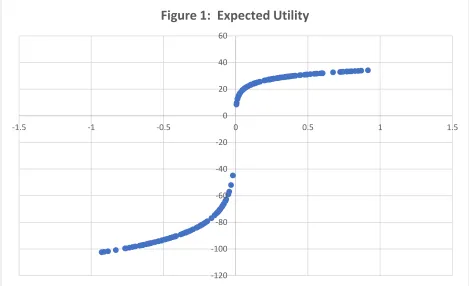
(Insert Figure 1 around here)
Figure 1 is a replica of a diagram commonly used in the literature to represent
Kahneman’s and Tversky’s thinking and brings the ideas listed in points 1 to 4 together.
Essentially, in reading from left to right and from the bottom to the top of the diagram, one’s
expected utility of making a decision increases and at an increasing rate (increasing utility and
convexity) as his/her risk of loss decreases (smaller negative utility numbers on the vertical axis
in going from bottom to top and smaller probabilities of loss on the horizontal axis in going from
left to right), yet when it comes to gains, one’s expected utility only increases at a decreasing rate
5 Kahneman and Tversky found that most people are not very good at estimating probabilities. But is this really so
surprising when so many people have trouble balancing their checkbooks (which is a matter of arithmetic).
6 However, the concept of utility could cover this anomaly by indicating that the individual who has just suffered
8
(concavity in the utility function to the right of the origin) as the probability of gain goes up.
Neoclassical/mainstream theory would argue that since most people are risk neutral in their
decision making (gains and losses are evaluated equally), the figure below should have a straight
line passing through the origin at a 45-degree angle according to Jacob Bernoulli’s theory of
expected utility (Kahneman 2011). Risk neutrality is supposed to be rational, not risk aversion
or risk loving behavior.
An example from the Kahneman and Tversky research can explain this phenomenon. If
people are asked if they prefer either 1) $500 given to him/her with certainty or 2) a coin flip
which has a 50% probability of giving them zero dollars or a 50% probability of $1200, they
almost always choose the $500 with certainty even though the expected payoff (and expected
utility) from the gamble is $600 (=0.50 * 0 + 0.50 * $1000). Hence, smaller gains with certainty
are preferred to larger ones with greater degrees of uncertainty. Conversely, if asked whether
one prefers to lose $500 with certainty versus taking a flip of the coin wherein one can 1) lose
zero dollars with 50% probability or 2) lose $1000 with 50% probability, most will choose flip of
the coin. People prefer avoiding losses more than obtaining gains. Since no money is actually
involved in these experiments, Kahneman and Tversky have been criticized for writing about lab
results and not actual real-life events, yet they contend that their results accurately reflect how
people would actually behave in reality (Kahneman 2003, Kahneman 2011).
Heuristics and biases appear to mostly be used when the consequences or costs of making
a decision are low and are routine and if a decision needs to be made fairly soon. For example,
people often buy certain things at a particular retailer because they believe the quality of the
items may be better there than at other retailers when in fact the quality may or may not be that
9
instead rely upon past experiences to make future decisions especially if using past experiences
save them time in decision making and if the costs are inconsequential. The demand for the
retailer’s services and products by such types of individuals can also be deemed to be inelastic in
that not much thought is given by many of the customers’ decisions to shop there. On the other
hand, when given more time and when making a large purchase decision, such as buying a home,
people seek more information and do more research in addition to perhaps using some of their
heuristics and biases from past experiences. Their demand becomes more elastic, and they
become more fastidious and judicious in making a decision. The concept of elasticity in
economics is a traditional, mainstream one, but is tempered by behavioral economics findings
that often people make mis-estimations in their calculations and decision making. For example,
most would claim that the demand for an adequate retirement is inelastic. That is, everyone
should try to save as much money as possible given his/her budget constraints for retirement.
Yet, as behavioral economics points out, many do not do this because of not correctly
estimating their future needs or overestimating their future earnings because many people are not
good at estimating probabilities or weighing gains and losses.7 Additionally, there are those who
continue to live in a particular home or stay in his/her current occupation because of costs
incurred in the past to obtain and keep the home or occupation, or people are risk averse to
moving or changing occupations even if to do so would be an improvement for them financially
perhaps (Clark and Lisowski 2017). These are sunk costs which neoclassical economists say
should not and do not matter to people, yet the behavioral economists in their experiments find
that people find these relevant in decision making. This is another way in which people are
sometimes irrational, and according to Thaler (2015, pages 93-94) markets often do not
7 This paper argues that this is also a symptom of income and wealth inequality, which is a societal and not
10
encourage rationality but instead encourage a certain degree of irrationality due to hype, greed,
and exuberance. Finally, behavioral economics also shows that even after committing an error
in decision making, people often continue to commit the same error by using their same set of
heuristics and biases.
Samuels, Stich and Bishop (2002) mention that the evolutionary psychologists point out
that in experiments where respondents are asked to estimate probabilities of the occurrences of
certain events using frequencies rather than probabilities, the portion of respondents getting an
answer correct is much higher than using decimal numbers or percentages for probabilities. The
evolutionary psychologists claim that this is so because our primordial ancestors learned how to
assess probability from experiences and encounters with repeated and similar situations/events,
an aspect of our evolutionary learning which would be based on frequencies and not decimal
numbers or percentages. That is, an anthropoid who saw one of his/her hunting mates attacked
after ten hunting excursions would think that the chances of his/her being attacked during the
next expedition are 1 in 10, not 10% or 0.10, and this estimate is based on his/her learned
experience. To give someone a problem involving a single case situation, such as the probability
of someone having an inherited disease based on a stated, percentage probability value, is
something that most of us cannot calculate or resolve very well because we are not programmed
as such by evolution.8
In contrast to Samuels, Stich, and Bishop, the philosopher Sturm (2012) claims that there
are profound differences between the two sides of the rationality debate and that bounded
8 Sloman, Over, Slovak and Stibel (2003) claim that the reason why people perform better with frequencies is
illusory in that stating a problem in terms of frequencies is just another way of framing a problem or situation in
terms of “nested sets”, which in turn makes the problem under consideration more transparent. That is, in general
11
rationality is distinct from irrational behavior. He does not see people making errors in
estimating probabilities or clinging to sunk costs as forms of irrational behavior because people
are still attempting to weigh costs and benefits when making decisions, although their
calculations may be imperfect. Sturm agrees with other critics of the heuristics and biases
approach that the reason why people make mistakes in the Kahneman and Tversky research are
what he calls “experimental artifacts”—particular wording of the problems, no use of outside
sources to help subjects to work problems, etc. Sturm mostly favors the bounded rationality
approach to decision making, although he sees problems with this approach as well. He sees the
key difference between the two schools of thought, one seeing more rational behavior among
people than the other, revolving around their normative assumptions with heuristics and biases
assuming irrationality, and bounded rationality assuming mostly rational, albeit weakly rational,
behavior and decision making.
Schooling and Rationality
(Insert Table 1 here)
According to some literature, educational and income levels affect risk taking behavior
(the higher one’s level of age, wealth and income, the more risk averse one is), and the greater
one’s education, the more risk loving one is and the greater one’s ability to be able to correctly
estimate probabilities (Gächter, Johnson, and Herrmann 2007, Booij, van Praag, and van de
Kuilen 2009, Kim, Kim, Syngioo, Booyuel, Pop-Eleches 2018). In analyzing data from the
General Social Survey (GSS) from the National Opinion Research Center (NORC) at the
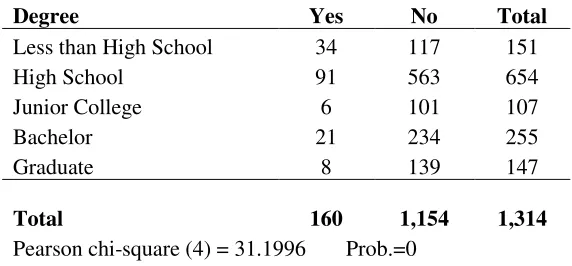
University of Chicago it appears that education matters in estimating probabilities. See Table 1.
Using a Chi-square test, it appears that one’s level of education is statistically significant and
12
question is worded. This indicates that education and learned abilities are important in decision
making, and hence, people perhaps can be educated to be more “rational.” This is a line of
thought that does not appear to be explored that much in the behavioral economics literature.
These findings also raise questions regarding social class and rationality as well. In
Table 2, again using GSS data from 2016, the higher one’s self-identified social class, the better
one is at estimating odds. The results are statistically significant at an alpha of 5% using the
Pearson Chi-square test. Yet, the behavioral economists, although critical of neoclassical
economists regarding rationality, never really challenge the neoclassical economists on how
education and social class may influence rationality, although Thaler (2015) notes that many
public policies need to be re-examined due to the fact that there exists less rationality and
rational behavior among the general public than what is commonly assumed by policy makers.
He lists as examples policies on retirement, social security, and consumer lending.
(Insert Table 2 around here)
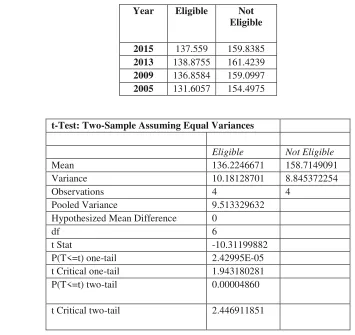
In looking at Table 3, there appears to be a pattern between poverty levels and
mathematical achievement by seniors in US high schools since 2005. High school seniors who
participated in the Free/Reduced Lunch Program because of their families’ low income levels
scored lower on standardized mathematics exams than their peers who did not participate in the
program because of their higher household income levels. Part B of Table 3 shows these
differences to be statistically significant. People in general may be bad overall in estimating
probabilities, but if a symptom of poor decision making is incorrect mathematical calculations,
then the bulk of those making errors could be from poor and less educated backgrounds. If those
13
they may be considered “irrational” in their decision making, but their irrationality could be
driven by class and income considerations.
(Insert Table 3 around here)
Monopoly Capital and Capitalist Schooling
In heterodox economics, there has always been the complaint against the
neoclassical/mainstream/orthodox economics assumption of full rationality in most if not all
microeconomic and macroeconomic models. Many non-mainstream economists would contend
that Kahneman, Tversky and Thaler in their experiments simply supported what many heterodox
economists already knew about and assumed regarding flaws in rationality and rational behavior
theory in economics. Heterodox economists have mostly assumed that individuals think and act
with bounded rationality while being influenced by societal and environmental factors (Sen
1977, Wolozin 2004, Marnet 2005, Pressman 2006, Lee 2009, Tolwer 2017).
Markey-Towler (2017) claims that the best view of rationality in economics is one that is more similar to
weak artificial intelligence, which is closest to a form of bounded rationality.
Additionally, Tversky, Kahneman, and Thaler only consider things from an
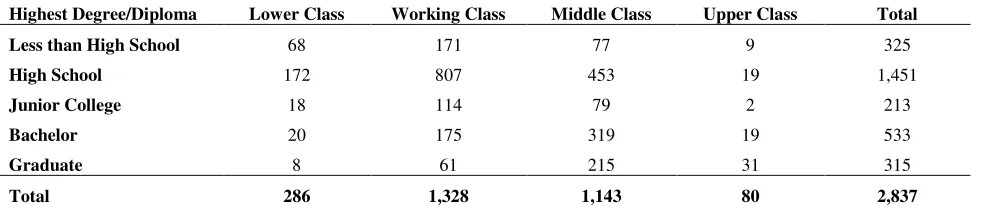
atomistic/individualistic point of view, which is a severe weakness. As Tables 1 to 3 show, it
appears that one’s level of education and social class are statistically significant and related to
one’s being able to answer questions regarding probability regardless of how the question is
worded. This indicates that education and learned abilities are important in decision making, and
hence, in this way people can probable be educated to be more rational and to make better
decisions.
So why are more people not educated to be more rational? Perhaps one answer lies in the
14
(1976 and 2002) as well in the writings of Baran and Sweezy (1966) on the prevailing social and
economic climate that exists in the United States. Bowles and Gintis have argued that public
schools in the United States have never really been designed or funded to be successful, and so
bad to mediocre results are tolerated by US school systems despite periodic “school reform”
efforts. Instead, they write that US public schools reflect the interests of the dominant capitalist
class in conditioning students as future workers to be accepting of workplace conditions where
hierarchies of authority exist. Schools are set up as hierarchies with strict rules which mirror
many workplace settings in which employees do not question managerial authority just as
students do not question school authority. A system of rewards and punishments (e.g., good
grades versus bad grades, recognition for good students) instills a notion of meritocracy in the
thinking of students, which more easily allows them to accept social inequality when they join
the workforce. Most of all, learning technical and knowledge skills on the part of the students is
not as important as students learning personal skills which help them in the workplace to get
along with managers and fellow employees. Although learning math and communication skills
are emphasized as important by school leaders, the personal skills are more important. Finally,
poor and low-income students usually live in poor and underfunded school districts. Since
school districts are mostly locally funded, inequality is allowed to persist in the poorer ones.
According to Baran and Sweezy (1966), a main tenet of their theory of monopoly capital
is that there is a lot of waste in capitalistic economic system, and much of the waste is funneled
into government spending on the military and public infrastructure which supports and
perpetuates urban sprawl. Additionally, there is wasteful business spending on advertising,
promotions, product packaging, and financing. Although the state, local, and federal
15
schools as well as welfare and other social programs, these forms of spending are not considered
as effective forms of public investment since too much spending on education and social
programs can lead to a less compliant labor force and working class, an argument similar to that
of Bowles and Gintis. Therefore, spending is never adequate for these types of government
programs, and so public schools in the US lag behind their private school counterparts which are
mostly patronized by upper income families and students. The underfunding of public schools
reinforces class differences among the different social classes in the United States, and for this
reason most never rise above the socioeconomic status of their parents. Educational “tracks”
within public schools classify students according to their academic abilities, which are basically
a reflection of their socioeconomic status (see Baran and Sweezy, 1966, Chapter 10, “On the
Quality of Monopoly Capitalist Society). Along the lines of the monopoly capital school of
thought, O’Connor (1973) believes that one effect of so little spending on public schooling is to
provide the more competitive sectors of the US economy (restaurants, retail stores, cleaning
services, etc.) with a sufficient number of low-skilled and less educated workers. An ample
supply of such workers permits this sector to pay low wages when compared to other industries
which need a greater number of more highly skilled and educated workers who are often college
graduates.
The notion that less education leads to less rational behavior or decisions not in the
decision maker’s interest is indirectly argued by behavioral economists by their showing how
some respondents in their surveys mis-estimate probabilities, something which is supposed to
indicate less than rational decision making. If this is the case, then we would expect those with
less education and lower socioeconomic status to perhaps more frequently make decisions
16
data that indicates that although a higher percentage of lesser educated (and probably lower
income) individuals agree that the government should do something to lessen inequality to a
greater degree than their more educated peers, there are still some among the lesser educated
who think the government should not do anything. These responses could be indicative of a
healthy skepticism of government action by some lesser educated individuals, or they could be
indicative of acting against one’s self-interest by incorrectly estimating the benefits or expected
payoff/utility of supporting greater government action to reduce inequality. Also, recall that
Kahneman and Tversky claim that most people are risk averse. Given the results of Tables 1 and
2, and in using the logic of the behavioral economists, one could conclude that an irrational
response is being indicated in the responses of the lesser educated survey participants.
(Insert Table 4 around here)
Conclusion
Kahneman, Tversky and Thaler should be congratulated for pointing out inconsistencies
in mainstream theories, and they offer reasons why people are so inconsistent and make errors in
decision making. They argue that sub-optimal decision-making warrants better public policies,
such as not cutting or eliminating a government program such as Social Security, because most
people cannot rationally plan for retirement. However, they do not consider the inequalities in a
capitalist system which give rise to many not being able to adequately save for retirement, which
is perhaps a bigger factor in the need for Social Security. In this way their analysis is
incomplete, which is often the case with the neoclassical school of thought that they criticize. If
educational and socioeconomic factors matter significantly in the rationality debate, then these
17
This paper has tried to emphasize the role that education and class can possibly play in
rational decision making if one uses the assumption that correctly estimating probabilities and
outcomes is important to better decision making on the part of economic agents and households.
As the behavioral economists point out, the implications of poor decision making on the part of
many presents challenges not only to mainstream economic theory but also to policy making.
Perhaps if the US educational system is somehow improved, better decision making on the part
of the public will result, although this may result in a threat to the existing economic and social
order in the US in that more members of the public could become more aware of the economic
18 References:
Baran, Paul A. Paul M. Sweezy. (1966). Monopoly Capital: An Essay on the American Economic and Social Order. New York: Monthly Review Press.
Barberis, Nicholas C. (2013). “Thirty Years of Prospect Theory in Economics: A Review and Assessment,: Journal of Economic Perspectives, 27(1): 173-196.
Booij, Adam S., Bernard M.S. van Praag, and Gijs van de Kuilen. (2009). “A Parametric Analysis of Prospect Theory's Functionals for the General Population.” DISCUSSION PAPER SERIES Forschungsinstitut zur Zukunft der Arbeit Institute for the Study of Labor April 2009
Brette, Olivier, Nathalie Lazaric, and Victor Vieiera da Silva. (2017). “Habit, Decision-Making, and Rationality.” Journal of Economic Issues, 51(3): 567-587.
Bowles, Samuel and Herbert Gintis. (1976). Schooling in Capitalist America. London: Routledge and Kegan Paul.
Bowles, Samuel and Herbert Gintis. (2002). “Schooling in Capitalist America Revisited,”
Sociology of Education, 75(1): 1-18.
Clark, William A. V. and William Lisowski. (2017). “Prospect Theory and the Decision to Stay or Move.” Proceedings of the National Academy of Sciences, United States of America.
Published online August 21, 2017. https://www.pnas.org/content/114/36/E7432 . Accessed on December 8, 2018.
Cordes, Christian. (2005). “Veblen’s ‘Instinct of Workmanship,’ Its Cognitive Foundations, and Some Implications for Economic Theory.” Journal of Economic Issues, 49(1): 1-20.
Cosmides, Leda and John Tooby. (1994). “Better than Rational: Evolutionary Psychology and the Invisible Hand.” American Economic Review, 84(2): 327-332.
Evans, Jonathan St. B. T. (2014). “Two Minds Rationality.” Thinking and Reasoning, 20(2): 129-146.
Gächter, Simon, Eric J. Johnson, and Andreas Herrmann. (2007). “Individual-level Loss Aversion in Riskless and Risky Choices.” Institute for the Study of Labor, Discussion Paper 2960 (IZA DP No. 2961). http://ftp.iza.org/dp2961.pdf . Accessed on December 9, 2018. Jaworski, William. (2011). Philosophy of Mind: A Comprehensive Introduction. Chichester, West Sussex, UK: John Wiley and Sons, Ltd.
Kahneman, Daniel. (2003). “Maps of Bounded Rationality: Psychology for Behavioral Economics,” American Economic Review, 93(5): 1449-1475.
Kahneman, Daniel. (2011). Thinking, Fast and Slow. New York, NY: Farrar, Straus, and Giroux Publishers.
Kahneman, Daniel and Amos Tversky. (1979). "Prospect Theory: An Analysis of Decision Under Risk," Econometrica, 47(2): 263-291.
19
Keynes, John Maynard. (1936). The General Theory of Employment, Interest and Money. New York, NY: Harcourt, Brace and Company. First Published: Macmillan Cambridge University Press, for Royal Economic Society in 1936.
https://www.marxists.org/reference/subject/economics/keynes/general-theory/ . Accessed on December 6, 2018.
Kim, Hyuncheol, Bryant Kim, Choi Syngioo, Kim Booyuel, Cristian Pop-Eleches. (2018). “The
Role of Education Interventions in Improving Economic Rationality.” Science, 362(6410): 83 -86. http://science.sciencemag.org/content/362/6410/83 . Accessed on December 9, 2018.
Lee, Frederic S. (2009). ”The Emergence of Heterodox Economics, 1990 – 2006.” From the Association of Heterodox Economics website,
https://hetecon.net/?page=about&side=history_of_heterodox_economics . Accessed on December 9, 2018.
Markey-Towler, Brendan. “I, Roboticus Oeconomicus. The Philosophy of Mind in Economics
and Why It Matters.” Cambridge Journal of Economics, 41(1): 200-237.
Marnet, Oliver. (2005) “Behavior and Rationality in Corporate Governance,” Journal of Economic Issues, 39:3, 613-632, DOI: 10.1080/00213624.2005.11506837 . Accessed on November 28, 2018.
Marx, Karl and Frederich Engels. (1932). The German ideology.
https://www.marxists.org/archive/marx/works/1845/german-ideology/index.htm . Accessed on December 8, 2018.
MIT Dictionary of Modern Economics, 3rd Edition. (1989). Edited by David W. Pearce. Cambridge, MA: The MIT Press.
Nicholson, Walter. (1989). Microeconomic Theory: Basic Principles and Extensions, 4th Edition. Chicago, IL: The Dryden Press.
O'Connor, James. (1973). The Fiscal Crisis of the State. New York: St. Martin's Press
Pressman, Steven. (2006). Kahneman, Tversky and Institutional Economics.” Journal of Economic Issues, 50(2): 501-506.
Samuels, Richard, Stephen Stich, and Michael Bishop. (2002). “Ending the Rationality Wars: How to Make Disputes About Human Rationality Disappear.” In Renee Elio, Editor, Common Sense, Reasoning and Rationality. New York, NY: Oxford University Press.
Sen, Amartya. (1977). “Rational Fools: A Critique of the Behavioral Foundations of Economic Theory.” Philosophy & Public Affairs, 6(4): 317-344.
Simon, Herbert A. (1978). “Rationality as Process and as Product of Thought.” American Economic Review, 68(2): 1-16.
20 Sloman, Steven A., David Over, Lila Slovak, and Jeffrey M Stibel. (2003). “Frequency
Illusions and Other Fallacies.” Organizational Behavior and Human Decision Process, 91(2): 296-309.
Smith, Adam. (2000). The Wealth of Nations. Introduction by Robert Reich. New York, NY: Modern Library,
Smith, Tom W., Davern, Michael, Freese, Jeremy, and Hout, Michael, General Social Surveys, (1972-2016). [machine-readable data file] /Principal Investigator, Smith, Tom W.; Co-Principal Investigators, Peter V. Marsden and Michael Hout; Sponsored by National Science Foundation. --NORC ed.-- Chicago: NORC, 2018: NORC at the University of Chicago [producer and
distributor]. Data accessed from the GSS Data Explorer website at gssdataexplorer.norc.org.
Sturm, Thomas. (2012). “The ‘Rationality Wars’ in Psychology: Where They Are and Where They Could Go.” Inquiry, 55(1): 66-81.
Thaler, Richard H. (2015). Misbehaving: The Making of Behavioral Economics. New York, NY: W. W. Norton & Company.
U.S. Department of Education, Institute of Education Sciences, National Center for Education Statistics. 2005, 2009, 2013, and 2015. National Assessment of Educational Progress (NAEP), 2005, 2009, 2013, and 2015 Mathematics Assessments.
https://nces.ed.gov/programs/digest/d16/tables/dt16_221.12.asp . Accessed on March 4, 2019. Varian, Hal R. (1992). Microeconomic Analysis, 3rd Edition. New York, NY: W.W. Norton and Company.
Wolozin, Harold. (2004). “The Human Mind, Institutions, and Economic Behavior.” Journal of
Economic Issues, 48(2): 563-570.
21 -120
-100 -80 -60 -40 -20 0 20 40 60
[image:22.612.71.540.204.490.2]-1.5 -1 -0.5 0 0.5 1 1.5
22 Table 1—Estimating Odds by Educational Levels
“Now, think about this situation. A doctor tells a couple that their genetic makeup means that they’ve got
one in four chances of having a child with an inherited illness. Does this mean that if their first child has
the illness, the next three will not have the illness?”
Correct Answer: No
Degree Yes No Total
Less than High School 34 117 151
High School 91 563 654
Junior College 6 101 107
Bachelor 21 234 255
Graduate 8 139 147
Total 160
1,154 1,314
Pearson chi-square (4) = 31.1996 Prob.=0
“Now, think about this situation. A doctor tells a couple that their genetic makeup means that they’ve got
one in four chances of having a child with an inherited illness. Does this mean that each of the couple’s children will have the same risk of suffering from the illness?”
Correct Answer: Yes
Degree No Yes Total
Less than High School 57 102 159
High School 169 489 658
Junior College 27 82 109
Bachelor 46 207 253
Graduate 18 128 146
Total 317
1,008 1,325
Pearson chi-square (4) = 28.9542 Prob. = 0
23 Table 2—Estimating Odds by Class Identification
“Now, think about this situation. A doctor tells a couple that their genetic makeup means that they’ve got
one in four chances of having a child with an inherited illness. Does this mean that if their first child has
the illness, the next three will not have the illness?”
Correct Answer: No
Answer Lower Class Working Class Middle Class Upper Class Total
Yes 23 81 55 2 161
No 101 510 490 42 1,143
Total 124 591 545 44 1,304
Pearson chi-square (3) = 10.4503 Prob. = 0.015
“Now, think about this situation. A doctor tells a couple that their genetic makeup means that they’ve got
one in four chances of having a child with an inherited illness. Does this mean that each of the couple’s children will have the same risk of suffering from the illness?”
Correct Answer: Yes
Answer Lower Class Working Class Middle Class Upper Class Total
No 42 145 113 12 312
Yes 81 456 430 34 1,001
Total 123 601 543 46 1,313
Pearson chi-square (3) = 10.1143 Pr = 0.018
24 Table 3--Average scale scores for grade 12 Mathematics, by National School Lunch
Program eligibility, 2015, 2013, 2009, and 2005
Part A;
Year Eligible Not
Eligible
2015 137.559 159.8385
2013 138.8755 161.4239 2009 136.8584 159.0997 2005 131.6057 154.4975
Part B:
t-Test: Two-Sample Assuming Equal Variances
Eligible Not Eligible
Mean 136.2246671 158.7149091
Variance 10.18128701 8.845372254
Observations 4 4
Pooled Variance 9.513329632
Hypothesized Mean Difference 0
df 6
t Stat -10.31199882
P(T<=t) one-tail 2.42995E-05
t Critical one-tail 1.943180281
P(T<=t) two-tail 0.00004860
t Critical two-tail 2.446911851
25 Table 4—Education, Opinions on Income Differences, and Social Class
Part A: Education by Degree and Response to Question “On the whole, do you think it should or should not be the government's responsibility to . . . Reduce income differences between the rich
and poor?”
Highest Education Definitely Should Probably Should Probably Should Not Definitely Should Not Total
Less than High School 58 57 26 20 161
High School 178 183 175 124 660
Junior College 29 31 26 24 110
Bachelor Degree 61 71 63 64 259
Graduate Degree 39 40 48 19 146
Total 365 382 338 251 1,336
Pearson chi2(12) = 29.5695 Pr = 0.003
Part B: Education Level of Respondents by Class Self-Identification.
Highest Degree/Diploma Lower Class Working Class Middle Class Upper Class Total
Less than High School 68 171 77 9 325
High School 172 807 453 19 1,451
Junior College 18 114 79 2 213
Bachelor 20 175 319 19 533
Graduate 8 61 215 31 315
Total 286 1,328 1,143 80 2,837
Pearson chi2(12) = 417.9719 Pr = 0.000