4214
Multi-Relational Script Learning for Discourse Relations
I-Ta LeeandDan Goldwasser
Department of Computer Science, Purdue University {lee2226, dgoldwas}@purdue.edu
Abstract
Modeling script knowledge can be useful for a wide range of NLP tasks. Current statistical script learning approaches embed the events, such that their relationships are indicated by their similarity in the embedding. While in-tuitive, these approaches fall short of repre-senting nuanced relations, needed for down-stream tasks. In this paper, we suggest to view learning event embedding as a multi-relational problem, which allows us to capture different aspects of event pairs. We model a rich set of event relations, such as Cause andContrast, derived from the Penn Discourse Tree Bank. We evaluate our model on three types of tasks, the popular Mutli-Choice Narrative Cloze and its variants, several multi-relational prediction tasks, and a related downstream task—implicit discourse sense classification.
1 Introduction
Representing world knowledge that can be used for commonsense reasoning is a long-standing AI goal. Scripts (Schank and Abelson, 1977) are structured knowledge representations captur-ing the relationships between prototypical event sequences and their participants in a given sce-nario. For example, given the event “John shot
Jim with a gun”, we can infer that “he got arrested
by police” is more probable than “he fell asleep”.
In recent years, the problem of extracting script knowledge from text has attracted significant at-tention. Early works (Chambers and Jurafsky, 2008) focused on symbolic event representations and used Pointwise Mutual Information (PMI) be-tween events to capture their relationships. Recent works (Pichotta and Mooney, 2016a; Granroth-Wilding and Clark, 2016;Wang et al.,2017;Lee and Goldwasser,2018; Li et al., 2018) represent events using dense vectors, based on event co-occurrence, and use vector similarity over their embeddings to measure their relationship.
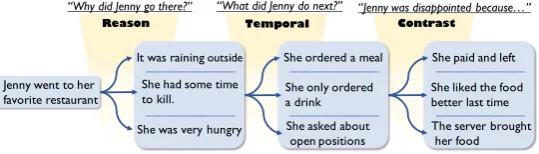
Our main observation in this paper is that while models for learning script knowledge improved significantly over the last decade, these models can essentially represent only a single event rela-tionship, co-occurrence. That is, events appearing in similar contexts tend to have similar represen-tations. Although this idea works well for a lot of NLP tasks, it is too coarse for modeling com-monsense, which should account for fine-grained relationships. To better understand this, consider the example described in Figure1. Given the first event, corresponding to the sentence “Jenny went
to her favorite restaurant.”, called Step 1, any of
the following events in Step 2 would be highly re-lated, and thus similar, to the input event. That is,
“It was raining outside” and “She was very
hun-gry” are both possible NEXTevents. Using event similarity alone is too coarse to support many rel-evant inferences. However, if the relation between the events is given, more clues can be applied to support reliable inferences. In Figure 1, given Step 2 is a Reason to Step 1, analogous to ask-ing the question “Why did Jenny go there?”, the event “She was very hungry” is clearly a more rea-sonable choice. Therefore, using event similarity alone is too coarse to support many relevant in-ferences, i.e., capturing theReasonfor the event, should produce a different set of relevant events, compared toTemporal(next) events
To help prioritize between showing diverse types of event relations and providing a frame-work for this discussion, we focus on a set of discourse relations, introduced by Penn Discourse Tree Bank (PDTB) (Prasad et al., 2007). Tradi-tional script learning models would fall short of making the inferences here. For example, the last inference step in Figure 1 asks for an event that
Contrasts with the previous step. Based on
re-Jenny went to her
favorite restaurant She only ordered a drink
She asked about open positions She ordered a meal
She liked the food better last time She paid and left
The server brought her food She had some time
to kill.
She was very hungry It was raining outside
Reason Temporal Contrast
[image:2.595.165.435.66.143.2]“Why did Jenny go there?” “What did Jenny do next?” “Jenny was disappointed because…”
Figure 1: Multi-relational commonsense inference requires different relation types, beyond similarity.
lation type helps us capture different expectations about subsequent events. We use the fact that these relations are often indicated by discourse markers (e.g., “but”, capturing the contrasting relation) to extract supervision for learning these relations.
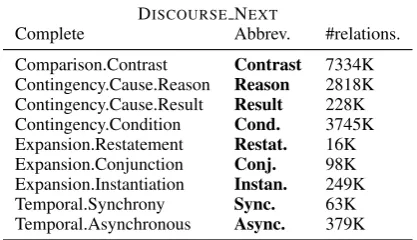
Our goal in this paper is to support such in-ferences. We introduce a multi-relational event embedding approach, which generalizes the no-tion of event embedding, by allowing it to cture multiple fine-grained relationships. Our ap-proach builds on recent translation-based embed-dings (Bordes et al.,2013;Lin et al.,2015), orig-inally introduced in the context of knowledge graph completion. We adapt these methods to the textual inputs, and suggest a compositional neu-ral network used for capturing the event’s internal linguistic structure, while using the translation-based embedding objective to capture different re-lationships between events. We include 11 rela-tion types, capturing the progression of the narra-tive: COREF NEXT, the next event in the corefer-ence chain; NEXT, the next event that occurs sub-sequently in text; and 9 discourse relations, collec-tively refer to as DISCOURSE NEXT.
We evaluate our model in three settings. In the first, we evaluate it on a common benchmark, Multiple-Choice Narrative Cloze (MCNC) task (Granroth-Wilding and Clark, 2016), and its se-quential variants proposed byLee and Goldwasser (2018). We show that we can outperform previ-ously published work by a large margin. In the second setting, we further examine our model’s characteristics on three intrinsic tasks. In the last setting, we conduct a challenging downstream task—implicit discourse sense classifications, ex-amplifying the model’s applicability.
2 Related Work
Statistical Script Learning was popularized by Chambers and Jurafsky(2008), framing the prob-lem as an unsupervised learning probprob-lem, using a PMI-based learning model to approximate a con-ditional probability of event occurrence. Recent
approaches build on representation learning tech-niques, by learning event embeddings with neu-ral networks. Granroth-Wilding and Clark(2016) utilized Skip-Gram (Mikolov et al.,2013) and an event compositional neural network to adjust event representations. Pichotta and Mooney (2016b; 2016a) applied a LSTM Recurrent Neural Net-work (RNN), coupled with Beam Search, to model event sequences and their representations. Weber et al.(2017) used three-dimensional tensor-based networks to construct the event representations. Lee and Goldwasser(2018) trained the event em-bedding with additional features in a hierarchi-cal architecture. Li et al. (2018) constructed an event graph and utilized its network information to make script event predictions. In this paper we combine GRU (Chung et al.,2014), for encoding fine-grained argument information, with a compo-sitional network to generate event representations. GRU was shown to be a competitive alternative to LSTM while requiring less parameters (Kiros et al.,2015;Hochreiter and Schmidhuber,1997).
Modeling multi-relational data was originally explored for Knowledge Graph Completion, typ-ically focusing on a family of translation-based embedding models which view relations as trans-lations in the vector space. For example,TransE
(Bordes et al., 2013), captures the relation be-tween h, t, r (embedding of arg0, arg1, and rela-tion), by minimizing the distance betweenh+r
and t. TransH (Wang et al., 2014) and TransR
(Lin et al.,2015) projects the entities into relation-specific spaces. Recent models address issues, such as maintaining structures (Xie et al., 2016; Yoon et al., 2016) and capturing richer interac-tions (Nickel et al.,2016). In this paper, we adapt
TransE and TransR for narrative script learning,
which is an innovative generalization of relation embedding for commonsense inference.
events;Sap et al.(2018) focused on If-Then rela-tions and showed that their joint multi-task model outperforms the models trained in isolation, based on human evaluations. Peng and Roth(2016) uti-lized discourse markers to extract relations be-tween semantic frames and modeled them with prevalent language models. Event2Mind (Rashkin et al., 2018) created a dataset capturing the rela-tionship between an event description and its par-ticipants’ intent and emotional reaction. This idea is related to our work, as the intent and reaction can correspond toReasonandResultdiscourse re-lations in our case. Our goal in this paper is to present a relational generalization over such rela-tionships using a shared embedding space.
The Narrative Cloze (NC) task (Chambers and Jurafsky,2008) was introduced to evaluate statis-tical script models by removing an event from a chain, and observing the ranking of the correct an-swer over the entire event vocabulary, given the rest of the chain. However when complex event structures were considered, e.g., multi-argument events (Pichotta and Mooney,2014), the large vo-cabulary size introduced both computational is-sues and ambiguity into the evaluation. As a result, Granroth-Wilding and Clark (2016) pro-posed a multiple-choice variation, called MCNC. It simplifies the evaluation process and reduces its computational burden. A similar choice of the multiple-choice adaptation could also be found in recent works, such as Story Cloze (Mostafazadeh et al.,2017) and SWAG (Zellers et al.,2018). In this paper, we evaluate our models on MCNC, and two recent variants (Lee and Goldwasser, 2018) turning MCNC into a sequential inference task. We also introduce relation-specific evaluation cap-turing the ability of our model to account for nu-anced relations beyond co-occurrence.
3 Model
We propose a learning framework, which accounts for the internal predicate-argument structure of events, tuning it to respect different relation types.
Overview Our framework has two
preprocess-ing phases: Event Extraction and Relational Triplet Extraction. In Event Extraction, we aim to identify events from free-form text. The pro-cess builds on a dependency parser and corefer-ence resolution. Once events are extracted, we ad-dress their relations, specifically three types: (1) events with coreferent entities, (2) events located
near each other, and, more importantly, (3) events connected with discourse relations.
The output of the preprocessing phases is a set of relation triplets(eh, et, r), whereeh andetare head and tail events, andr is their relation type. We then feed them to a neural network for learn-ing event and relation embeddlearn-ings. The network objective is an energy functionf(et, eh, r), which can be used to approximate the conditional prob-abilitiesp(et|eh, r) orp(r|et, eh). This objective captures commonsense knowledge expressed in event relations and embeds it in a vector space, which can be utilized in downstream tasks. Two model variants are proposed in this paper. The first model,EventTransE, assumes that all the rela-tions are in the same embedding space and jointly learns representations for events and relations. It works well in some cases, though it might not be expressive enough in others. The second model,
EventTransR, addresses this issue by introducing
relation-specific parameters, which project events into relation-specific spaces when measuring their relatedness.
3.1 Event Extraction
We construct a preprocessing pipeline to extract events and relations over a large text collection. Each eventeconsists of three components: pred-icate (pred(e)), subject (subj(e)), and object (obj(e)). Due to computational considerations we restrict the event representation to two arguments. We use a special empty argument representation,
NONE, for events that have fewer arguments. To obtain the event representation from text, we first run a dependency parser and coreference resolu-tion1to acquire the needed information.
Events are extracted by connecting entity men-tions on the coreference chain with their cor-responding predicate and additional argument, based on the dependency tree. E.g., given, “Jenny
went into her favorite restaurant,” we extract
(go into, jenny, her favorite restaurant).
Unlike the previous works (Lee and Gold-wasser,2018;Granroth-Wilding and Clark,2016; Pichotta and Mooney, 2016a), which only con-sider headwords of entity mentions, we use com-plete mention spans. In our running example, we consider the object as “her favorite restaurant”, rather than just “restaurant”. This allows the mod-els to capture the nuanced information relevant for
DISCOURSENEXT
[image:4.595.77.286.64.184.2]Complete Abbrev. #relations. Comparison.Contrast Contrast 7334K Contingency.Cause.Reason Reason 2818K Contingency.Cause.Result Result 228K Contingency.Condition Cond. 3745K Expansion.Restatement Restat. 16K Expansion.Conjunction Conj. 98K Expansion.Instantiation Instan. 249K Temporal.Synchrony Sync. 63K Temporal.Asynchronous Async. 379K
Table 1: DISCOURSE NEXTrelations from PDTB and the number of relations extracted for training.
many commonsense inferences, such as the “fa-vorite” here. Other preprocessing steps follow the previous works and are detailed in the appendix.
3.2 Relational Triplet Extraction
Relations are expressed as triplets (eh, et, r), where r is the relation type, and eh and et are events that have an internal structure of
(pred(e), subj(e), obj(e)). 11 types of relations are considered in this paper for demonstrations: COREF NEXT, NEXT, and 9 discourse relations, which collectively refer to as DISCOURSE NEXT. COREF NEXTcaptures sequential relationships between events on the same coreference chain. The NEXTrelation is defined between events pairs that co-occurr in a fixed-sized (wcontext) context window. It aims to capture related events that do not share arguments. For example, in “The
for-est was on fire. Trees burned.”, the two events
do not share arguments, but they often co-occur, and thus are related. Previous works about script learning (Pichotta and Mooney,2016a; Granroth-Wilding and Clark, 2016;Wang et al.,2017;Lee and Goldwasser, 2018; Li et al., 2018) use ei-ther COREF NEXTor NEXTindependently, which failed to leverage the shared information.
For DISCOURSE NEXT, 9 discourse relations, taken from PDTB, are denoted in Table1. These relations correspond to commonsense judgments. For example, we can do causal inference with the
ReasonandResult; or we can identify the
juxtapo-sition between events by utilizingContrast. The discourse relations can be represented with a relation type and a pair of argument spans (Xue et al., 2016). For example, “Jenny went to a
restaurant, because she was hungry” has a
re-lation Reason and the spans are the two clauses (omitting the connective “because”). Since train-ing event embeddtrain-ing requires significantly more
data than annotated in the PDTB corpus, we ap-proximate this by building a rule-based annota-tor. We first identify explicit discourse connec-tives, such as “because,” and assume that the sur-rounding clauses are their argument spans. To de-termine the relation type, we map the connectives to their most probable type based on the PDTB data. To mitigate the noise, we only take connec-tives that are highly indicative of their type (85% of connective occurrences are of that type). Note that in our setup a given pair of events might have up to three relations annotated: a discourse rela-tion, NEXT, and COREF NEXT. We create neg-ative examples by corrupting the positive triplets, randomly replacing eh, et, or r with an event or relation. For each positive triplet we sample one negative triplet. While our weakly supervised re-lation extraction is noisy, we demonstrate empiri-cally its ability to capture these relations.
3.3 Compositional Event Representation
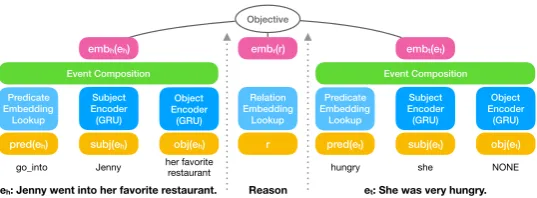
Figure 2 shows the architecture of our mod-els. Each event e has a raw representa-tion (pred(e), subj(e), obj(e)). The predicate pred(e)is given in an embedding lookup table, a matrix with size|P| ×da, whereP denotes pred-icate vocabulary. subj(e)andobj(e)are encoded with two separate Bi-GRUs (Chung et al.,2014). We call them subject encoder and object encoder, as shown in the figure. The outputs of the encoders areda-dimensional respectively. Each GRU is de-fined as follows:
zt=σ(W(z)xt+U(z)ht−1)
rt=σ(W(r)xt+U(r)ht−1)
¯
ht=tanh(W xt+rtU ht−1)
~
ht=zth~t−1+ (1−zt)h¯t,
where xt is the input token at timestamp t; W(z), U(z), W(r), U(r), W, Uare parameters to be trained;h~t∈R
dr
2 is the hidden memory at
times-tampt;ztandrtare update and reset gates for con-trolling purposes. The final argument representa-tion is the concatenarepresenta-tion of GRU hidden represen-tations trained in two directions, i.e.,ht= [h~t, t~h]. The encoded representations for each event component are then fed into a Event Composition network. The network is fully-connected and has one hidden layer, defined as follows:
h1 =relu(W1xe+b1)
pred(et) subj(et) obj(et)
Object Encoder
(GRU) Subject
Encoder (GRU) Predicate
Embedding Lookup
Event Composition embt(et)
Relation Embedding
Lookup
r embr(r) Objective
pred(eh) subj(eh) obj(eh)
Object Encoder
(GRU) Subject
Encoder (GRU) Predicate
Embedding Lookup
Event Composition embh(eh)
eh: Jenny went into her favorite restaurant. et: She was very hungry.
go_into Jenny her favoriterestaurant hungry she NONE
[image:5.595.165.434.61.160.2]Reason
Figure 2: Multi-Relational Script Learning Architecture: the left and right networks encode the event embeddings forehandet; the middle part encodes the relationr. The training objective on top jointly learn these embeddings.
wherexeis the concatenation of the encoded pred-icate, subject, and object; W1 ∈ Rdh×3da, b1 ∈
Rdh, W
2 ∈Rdr×dh, b2 ∈ Rdr are model
parame-ters. The outpute∈Rdr is the event embedding.
For the relations, we embed them using another embedding lookup table. The table size isnrel× dr, wherenrelis the number of relation types. In our case,nrel= 11.
3.4 Model: EventTransE
EventTransE is an event embedding model
in-spired byTransE(Bordes et al., 2013). The idea is to embed nodes and their relations in the same vector space so that the distance between nodes re-flects their relations. This is called translating op-erations in the original paper. Based on this idea, we explore a new possibility of learning event em-beddings that can make inferences conditioned on different relations. We connect theTransE objec-tive to the previous compositional network out-puts, which can be formulated as follows:
ftranse(t) =ftranse((eh, et, r))
=keh+r−etkpp, (1)
whereeh, et, r∈Rdr are the embeddings from the Event Composition network. Note that Equation1 is a dissimilarity measure. Lower scores mean that the given two events are strongly related.
3.5 Model: EventTransR
A known issue ofEvenTransE is its limited abil-ity to deal with reflexive, 1-to-N, to-1, or N-to-N relations (Wang et al., 2014). Consider a simple example illustrating the problem: given Equation (1), it is possible to learn a zero rela-tion vectorr and two arbitrary but identical event representations eh and et, which minimize the loss.EventTransRis proposed to address these is-sues by separating the event and relation spaces as
TransR (Lin et al., 2015). It introduces
relation-specific parameters to model the interactions be-tween the spaces. EventTransR is defined as fol-lows:
ftransr(t) =ftransr((eh, et, r))
=kehMr+r−etMrkpp, (2)
wherer∈Rdr,e
h, et∈Rde are the input embed-dings, andMr ∈ Rde×dr is the relation-specific parameters introduced.
3.6 Training Objective
The objective is the Margin-Based Ranking Loss:
L(t) =X
t∈T
X
t∗∈T∗
max(0, δ+f(t)−f(t∗)), (3)
where T is the set of positive relational triplets; T∗ is the set of corrupted relational triplets; δ is the margin, and f ∈ {ftranse, ftransr}. At test time, we can leverage the dissimilarity measures to either predict the tail event given the head event and relation, or predict the relation given the head and tail events:
ˆ
et= arg min
e∗∈E f(eh, e
∗
, r);
ˆ
r= arg min
r∗∈R f(eh, et, r
∗).
EandRare the event and relation vocabulary.
4 Experiments
? ? ? ? ?
(a) MCNC
? ? ? ? ?
? ? ? ? ?
? ? ? ? ?
? ? ? ? ?
(b) MCNS
? ? ? ? ?
? ? ? ? ?
? ? ? ? ?
[image:6.595.75.291.61.119.2](c) MCNE
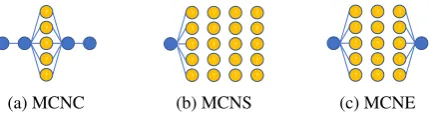
Figure 3: Comparing single-step prediction (MCNC) and multiple-step inference (MCNS and MCNE).
with ELMo (Peters et al.,2018), a contextualized word embedding model. We provide additional qualitative analysis, showing inferences made by our model, in the appendix.
For training, we use the New York Times (NYT) section of the English Gigaword (Parker et al., 2011). It contains 2M newswire articles and splits into train/dev/test sets, replicating the setup given by Granroth-Wilding and Clark (2016). 500M triplets are extracted from the training set. All the experimental results are averaged over 5 runs. We leave the details about hyperparameter tuning in the appendix. The source code and pre-trained models are publicly available2.
4.1 Multiple Choice Narrative Cloze Tasks
We begin by evaluating our model on three event representation tasks: Multiple-Choice Nar-rative Cloze (MCNC), Multiple-Choice NarNar-rative Sequence (MCNS), and Multiple-Choice Narra-tive Explanation (MCNE). MCNC, proposed by Granroth-Wilding and Clark (2016), measures script learning models’ ability to predict a missing event, given its context, in a multiple-choice set-ting. This evaluation task is not perfect, as noise would be introduced by automatic extraction tools, but not so common as to invalidate the results, and thus this evaluation is widely accepted. Lee and Goldwasser (2018) generalized this single-step task, and suggested two sequence inference versions—MCNS and MCNE. Figure 3 explains the three tasks. Given an event chain, MCNC chooses one step as a multiple-choice question and generates four negative choices for that step. MCNS turns it into a sequence prediction prob-lem by creating multiple-choice questions for each step, except the start event. MCNE provides an additional clue, which is the end event. The in-ference model has to connect the start and end by explaining things happened in between.
Following the setup in (Granroth-Wilding and Clark, 2016), we evaluate on top of coreferenced
2https://github.com/doug919/multi_
relational_script_learning
event chains, where a protagonist participates each event. The minimum length of the event chains is 9, as short chains are likely to be caused by parsing errors. Our models naturally score the candidates with our training objectivef ∈ {ftrane, ftransr} using COREF NEXT relation, while other base-lines use cosine similarity.
4.1.1 Multiple-Choice Narrative Cloze
We compared two versions of our models, using the entire argument span, or just its headword, with several recently published results.
We compare our models with the following baselines on the MCNC:
• Randomuniformly selects a candidate.
• PPMI (Chambers and Jurafsky, 2008) uses co-occurrence information and calculates Positive PMI for event pairs.
• BiGram (Jans et al., 2012) calculates
bi-gram conditional probabilities P(e2|e1)
based on event term frequencies.
• Word2Vec (Mikolov et al., 2013) refers
to the pre-trained word embeddings from Word2Vec SkipGram. The summation of word embeddings of predicates and argument mentions are used to represent events.
• EvSkipGram(Granroth-Wilding and Clark,
2016) uses SkipGram to learn representations from “sentences” formed by predicates and argument headwords.
• EventComp (Granroth-Wilding and Clark,
2016) uses a neural network to learn a com-positional function for EvSkipGram and out-puts a coherence score for event pairs. • SGNN (Li et al., 2018) is a graph-based
model specifically designed for MCNC. It considers each event chain as a sub-graph, and feed it into their GRU-based recurrent networks, which outputs relatedness scores for the candidates.
• FEEL (Lee and Goldwasser, 2018) is an event embedding model that does multi-task learning for inter-event relations and intra-event features.
• PairLSTM (Wang et al., 2017) is an event
embedding model that considers event order information and uses a LSTM network’s hid-den states for event representations.
proce-Methods Accuracy
Random* 20.00
PPMI(Chambers and Jurafsky,2008) 30.52
BiGram(Jans et al.,2012) 29.67
Word2Vec*(Mikolov et al.,2013) 37.39
EvSkipGram*(Granroth-Wilding et al., 2016) 46.28
EventComp(Granroth-Wilding et al., 2016) 49.57
FEEL*(Lee et al., 2018) 51.62
SGNN(Li et al.,2018) 52.45
PairLSTM(Wang et al.,2017) 55.12
EventTransE-headword* 60.50
EventTransR-headword* 59.38
EventTransE* 63.67
EventTransR* 62.86
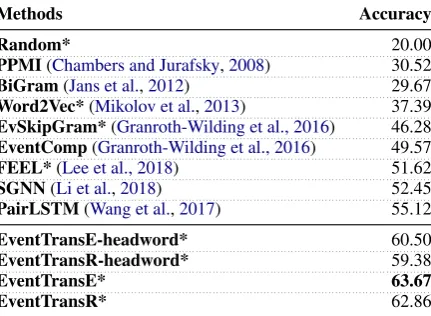
Table 2: Accuracy scores (%) of MCNC.-headword stands for using headwords only in argument mentions. The star sign (*) denotes that the results are based on the newly sampled evaluation set.
dure, we re-implement the event extraction step by carefully following their procedure. We mark the results based on the newly sampled evaluation set with a star sign (*). We released the newly sam-pled evaluation set for future comparisons. Table 2shows the results.
Our models outperform the best baseline model for more than 7% absolute accuracy score. We attribute the improvement to three factors: (1) our models encode complete argument men-tions rather than just headwords,
EventTranseE-headwordandEventTransR-headword, which are
our models’ variants that use only headwords for arguments, show that about 3% of the improve-ment is from this; (2) our models have shared event representations over multiple relations, which regularize the representations in diverse as-pects, while other baselines do not make use of relations other than COREF NEXT. (3) our mod-els’ training objective directly measures relation-specific dissimilarity between events, while most others are based on simple cosine similarity.
4.1.2 Multiple-Choice Narrative Sequence
The MCNC looks at a single transition between events; however, it does not capture the flow of the entire narrative. Lee and Goldwasser (2018) proposed MCNS, which instead of sampling can-didate options for one event, it samples options for all the events on the chain, except the first event which is used as the starting point for predictions (Figure3b). Based on the dissimilarity scores cal-culated by our models, we can compute transition probabilities for each step. Then we can find the
Methods NS-V Base-Inf Sky-Inf NE-V
GloVe 29.38 27.60 38.50 31.29
FEEL 41.60 38.50 46.00 44.80
EventTransE 59.48 51.22 64.47 60.94
[image:7.595.74.290.64.222.2]EventTransR 58.66 50.73 63.65 60.00
Table 3: Acc (%) of MCNS (NS) and MCNE (NE) tasks.{NS,NE}-Vuse Viterbi for inference. Base-Inf is a local greedy model using the previous prediction only, and Skyline-Infis given gold contextual events when calculating transition probabilities.
most likely sequence using Viterbi inference al-gorithm (Viterbi, 1967). We follow the evalua-tion setting used in (Lee and Goldwasser, 2018) and compare three decision models: (1) Viterbi, which finds the most probable sequence of predic-tions; (2) Baseline-Inf, which greedily picks the best transition at each step based on the previous prediction; (3) Skyline-Inf, which breaks down a sequence of decisions into local decisions, each using the gold states of all the contextual events.
Table3 shows the results. Our models outper-form FEEL (Lee and Goldwasser,2018), who in-troduced the task. The same set of reasons given in the section MCNC explain the improvement. We also note thatEventTransE is especially strong in making predictions for COREF NEXT.
4.1.3 Multiple-Choice Narrative Explanation
MCNE is another extension to MCNC. Essen-tially, in addition to the first event, the final event is also given (Figure3c). Intuitively, the goal of this evaluation task is to capture explanations, con-sisting of event sequences, that connect the start and end points. The same inference algorithms as MCNS are adopted. The right three columns of Table 3 gives the result (Note that the
Baseline-Inf andSkyline-Inf are shared with MCNS). The
result shows a similar trend as MCNS, but with higher scores, due to the additional information brought by the last event. Note that when cal-culating the accuracy, we only consider the event blanks in the middle (ignoring the last prediction made in MCNS) for both MCNS and MCNE. This ensures a fair comparison.
4.2 Intrinsic Discourse Relations Evaluation
e1 e2 r
(a) (e1, ?, r)
e1 e2
r
(b) (e1, e2, ?)
e1 e2
r
True?
[image:8.595.74.291.64.114.2](c) (e1, e2, r)?
Figure 4: Three intrinsic tasks for evaluating our mod-els: (4a) predicts the next event given an event and a re-lation; (4b) predicts the relation given a pair of events; (4c) binary classification for triplets.
Methods Accuracy (%)
Random 20.00
ELMo(Peters et al.,2018) 42.97
EventTransE-Random 52.78
EventTransR-Random 26.11
EventTransE-NEXT 51.80
EventTransR-NEXT 51.71
EventTransE 54.83
EventTransR 55.08
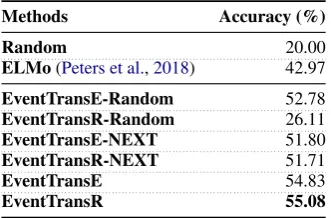
Table 4: Accuracy scores (%) of the next event predic-tion, given an event and a relation. ELMois a con-textualized word embedding model. -Randomand -NEXTare our model variants that replace the given relation with a random and NEXTrelation respectively.
(3) predict its correctness (triplet classification).
Predict the Next Event Similar in spirit to the
setup described in Fig.1, we ask whether knowing the relation, connecting the head to the tail event, would change the expectation about the tail event. Given a set of triplets that have discourse re-lations, for each triplet, we corrupt et and sam-ple four extra negative choices to form a multisam-ple- multiple-choice question. We compare our model vari-ants with a strong baseline model—ELMo (Peters et al.,2018). ELMo is a context-aware word em-bedding model that has shown strong performance in language understanding tasks. To get the con-textualized word embeddings, we have to provide the context, usually the sentence where the target words appear. To retrieve the context, for each evente, we re-construct its “sentence” by concate-nating itssubj(e), pred(e), and obj(e). The av-eraged word embedding of the context is used to represent the event. ELMo predicts the next event based on cosine similarity, disregarding the rela-tion. We also make two variants to show our mod-els’ awareness to relation types. One replaces the correct discourse relation with a random relation; the other replaces it with a NEXTrelation.
Table 4 shows the results. We can see that all our model variants outperform the ELMo baseline, as our models are aware of the relation between
Methods Accuracy F1 MRR Recall@4
Random 11.11 - -
-EventTransE 49.93 50.00 70.05 83.05
EventTransR 50.84 51.00 70.62 81.65
Table 5: Predicting relation type given two events, a 9-class classification task.F1is micro averaged.
ELMo EventTransE EventTransR
Acc. F1 Acc. F1 Acc. F1
Reason 60.82 59.02 70.04 69.65 69.35 67.46
Contrast 63.04 58.69 73.09 73.22 74.07 74.90
Cond. 61.92 60.48 71.16 71.22 71.46 72.25
Conj. 65.56 66.01 66.86 68.32 65.42 65.58
Result 60.68 60.84 73.26 73.41 72.69 72.98
Async. 61.25 60.59 71.25 69.61 73.22 74.27 Sync. 64.71 62.96 70.20 69.60 72.44 72.49
Instan. 62.64 58.84 74.80 74.39 73.30 71.83
Restat. 62.86 61.41 74.68 73.35 75.37 73.70
[image:8.595.305.529.162.303.2]Average 62.61 60.98 71.70 71.42 71.92 71.72 Table 6: Triplet Classification for discourse relations.
events. Similarity-based models that can capture frequently co-occurred events fail to consider the nuanced relations. EventTransRperforms the best as it has relation-specific parameters emphasiz-ing the relational nuances. Interestemphasiz-ingly, usemphasiz-ing -NEXTrelation only is also very indicative for pre-dicting the next event, which explains why previ-ous works failed to address the nuanced relations. The results for -Random relations indicates that
EventTranRis very sensitive to incorrect relations.
This is due to the separation between the relation and event embedding spaces, useful for relation-sensitive tasks. Also, thatEventTranE-Random
model works better thanEventTranE-NEXT sug-gests that our models with discourse relations do capture their fine-grained differences. Note that
evenEventTranRwith scrambled relations
outper-form ELMo with a large margin. We hypothesize that ELMo emphesizes similarity rather than nu-anced discourse relations between sentences.
Predict the Relation We predict the correct
re-lation out of the 9 discourse rere-lations (Table 1), given two events. Table5shows the result. With additional relation-specific parameters introduced,
EventTransR performs better than EventTransE.
[image:8.595.98.264.178.287.2]Triplet Classification This task is inspired by Triplet Classifications in Knowledge Graph Com-pletion (Socher et al.,2013;Wang et al.,2014). It predicts whether a given triplet(eh, et, r)is valid or not. We sample positive triplets from our dev and test splits and negative triplets by corrupt-ing et. We use the dev split to develop a set of relation-specific thresholds λr. The score is cal-culated using f ∈ {ftrane, ftransr}. If the score is lower than λr, the triplet is classified as pos-itive; otherwise, it is negative. We sample 500 positive and negative triplets for each relation. The ELMo baseline is similar to previous exper-iments. We also develop a set of relation-specific thresholds based on ELMo’s similarity scores to make predictions. Table6summarizes the results and shows that the similarity-based model, ELMo, cannot represent the nuanced relations informa-tion as good as our model. Interestingly, both our models excelled at predicting theExpansion rela-tions (Instant. and Restat.). EventTransRget high scores onTemporalrelations (Async.) which im-plies its applicability on tasks like event order in-ference (Ning et al., 2018). In general, for tasks requiring nuanced relations, EventTransR works better; if we only need to know the NEXT or COREF NEXT events, EventTransE is better. In addition, EventTransE has less trainable parame-ters, converging way faster.
4.3 Implicit Discourse Sense Classifications
The final evaluation task is a subtask in CoNLL 2016 Shared Task (Xue et al., 2016) on implicit discourse sense classification. We follow the same setting as the shared task, with 15 sense classes. More details can be found in (Xue et al.,2016).
Three baselines, the best and median system of each subtask, are provided. In addition, we also trained a strong baseline based on ELMo. We first create word embeddings for words in the argument spans using ELMo and put an attention layer on top of the words. The attention layer weights the words and create the argument representation. We feed the representations of the two arguments to a neural classifier, where two fully-connected hid-den layers with dimensions 256 and128 are ap-plied. ReLU (Nair and Hinton, 2010) are used as activation functions and AdaGrad (Duchi et al., 2011) is used for optimizing the parameters. We combineEventTransEwith the ELMo baseline by having another attention layer on top of the event embeddings and concatenating all the argument
Methods Dev Test Blind
PurdueNLP(Pacheco et al.,2016) 38.05 34.45 29.10
ecnucs(Wang and Lan,2016) 46.42 40.91 34.18
ttr(Rutherford and Xue,2016) 40.32 36.13 37.67
ELMo 45.60 37.65 36.72
ELMo+EventTransE 46.81 39.05 38.35
Table 7: micro F1 scores (%) for Implicit Discourse Sense Classifications. Evaluated against the best and median systems in CoNLL’16, and ELMo contextual-ized word embedding with attention layers, which can be improved by incorporating ourEventTransE.
representations in the network.
Table 7 shows the results. The ELMo base-line is highly competitive, comparable to the win-ners of the task (ecnucs and ttr). Our combined model (ELMo+EventTransE) consistently con-tributes to performance, demonstrating the benefit of our model to downstream tasks.
5 Summary
We consider the problem of learning relation-aware event embeddings for commonsense infer-ence, which can account for different relations be-tween events, beyond simple event similarity. We include several event relations, identifying, for ex-ample, the causes for them. We show that weak supervision, provided by a rule-based annotator is enough for training our models.
We evaluated and compared two models,
Event-TransE and EventTransR, on several narrative
cloze and relation-specific tasks, and showed the learned embedding can capture relation-specific information as well as improve performance for a downstream task.
This work lays the foundation for reasoning over narratives and explaining how sentences combine to form them. In the future we would like to expand this direction, and find ways to connect event and relation representation, learning and in-ference in a unified framework.
Acknowledgements
We thank the anonymous reviewers of this paper for their insightful comments.
References
Antoine Bordes, Nicolas Usunier, Alberto Garcia-Duran, Jason Weston, and Oksana Yakhnenko. 2013. Translating embeddings for modeling multi-relational data. In Advances in neural information processing systems, pages 2787–2795.
Nathanael Chambers and Daniel Jurafsky. 2008. Unsu-pervised learning of narrative event chains. InACL, volume 94305, pages 789–797.
Junyoung Chung, Caglar Gulcehre, KyungHyun Cho, and Yoshua Bengio. 2014. Empirical evaluation of gated recurrent neural networks on sequence model-ing. arXiv preprint arXiv:1412.3555.
John Duchi, Elad Hazan, and Yoram Singer. 2011. Adaptive subgradient methods for online learning and stochastic optimization. JMLR, 12(Jul):2121– 2159.
Mark Granroth-Wilding and Stephen Clark. 2016. What happens next? event prediction using a com-positional neural network model. In AAAI, pages 2727–2733.
Sepp Hochreiter and J¨urgen Schmidhuber. 1997. Long short-term memory. Neural computation, 9(8):1735–1780.
Bram Jans, Steven Bethard, Ivan Vuli´c, and Marie Francine Moens. 2012. Skip n-grams and ranking functions for predicting script events. In Proceedings of the 13th Conference of the European Chapter of the Association for Computa-tional Linguistics, pages 336–344. Association for Computational Linguistics.
Ryan Kiros, Yukun Zhu, Ruslan R Salakhutdinov, Richard Zemel, Raquel Urtasun, Antonio Torralba, and Sanja Fidler. 2015. Skip-thought vectors. In NIPS, pages 3294–3302.
I-Ta Lee and Dan Goldwasser. 2018. Feel: Featured event embedding learning.AAAI, pages 4840–4847.
Zhongyang Li, Xiao Ding, and Ting Liu. 2018. Constructing narrative event evolutionary graph for script event prediction. arXiv preprint arXiv:1805.05081.
Yankai Lin, Zhiyuan Liu, Maosong Sun, Yang Liu, and Xuan Zhu. 2015. Learning entity and relation em-beddings for knowledge graph completion. InAAAI, volume 15, pages 2181–2187.
Christopher D Manning, Mihai Surdeanu, John Bauer, Jenny Rose Finkel, Steven Bethard, and David Mc-Closky. 2014. The stanford corenlp natural lan-guage processing toolkit. In ACL (System Demon-strations), pages 55–60.
Tomas Mikolov, Kai Chen, Greg Corrado, and Jef-frey Dean. 2013. Efficient estimation of word representations in vector space. arXiv preprint arXiv:1301.3781.
Nasrin Mostafazadeh, Michael Roth, Annie Louis, Nathanael Chambers, and James F Allen. 2017. Ls-dsem 2017 shared task: The story cloze test. LSD-Sem 2017, page 46.
Vinod Nair and Geoffrey E Hinton. 2010. Rectified linear units improve restricted boltzmann machines. InICML, pages 807–814.
Maximilian Nickel, Lorenzo Rosasco, Tomaso A Pog-gio, et al. 2016. Holographic embeddings of knowl-edge graphs. InAAAI, volume 2, pages 3–2.
Qiang Ning, Zhili Feng, Hao Wu, and Dan Roth. 2018. Joint reasoning for temporal and causal relations. In Proceedings of the 56th Annual Meeting of the As-sociation for Computational Linguistics (Volume 1: Long Papers), volume 1, pages 2278–2288.
Maria Leonor Pacheco, I-Ta Lee, Xiao Zhang, Abdul-lah Khan Zehady, Pranjal Daga, Di Jin, Ayush Paro-lia, and Dan Goldwasser. 2016. Adapting event em-bedding for implicit discourse relation recognition. Proceedings of the CoNLL-16 shared task, pages 136–142.
Robert Parker, David Graff, Junbo Kong, Ke Chen, and Kazuaki Maeda. 2011. English gigaword fifth edi-tion ldc2011t07. dvd. Philadelphia: Linguistic Data Consortium.
Haoruo Peng and Dan Roth. 2016. Two discourse driven language models for semantics. arXiv preprint arXiv:1606.05679.
Matthew E Peters, Mark Neumann, Mohit Iyyer, Matt Gardner, Christopher Clark, Kenton Lee, and Luke Zettlemoyer. 2018. Deep contextualized word rep-resentations. arXiv preprint arXiv:1802.05365.
Karl Pichotta and Raymond J Mooney. 2014. Statis-tical script learning with multi-argument events. In EACL, volume 14, pages 220–229.
Karl Pichotta and Raymond J Mooney. 2016a. Learn-ing statistical scripts with lstm recurrent neural net-works. InAAAI.
Karl Pichotta and Raymond J Mooney. 2016b. Using sentence-level lstm language models for script infer-ence. arXiv preprint arXiv:1604.02993.
Rashmi Prasad, Eleni Miltsakaki, Nikhil Dinesh, Alan Lee, Aravind Joshi, Livio Robaldo, and Bonnie L Webber. 2007. The penn discourse treebank 2.0 an-notation manual.
Hannah Rashkin, Maarten Sap, Emily Allaway, Noah A Smith, and Yejin Choi. 2018. Event2mind: Commonsense inference on events, intents, and re-actions. arXiv preprint arXiv:1805.06939.
Maarten Sap, Ronan LeBras, Emily Allaway, Chan-dra Bhagavatula, Nicholas Lourie, Hannah Rashkin, Brendan Roof, Noah A Smith, and Yejin Choi. 2018. Atomic: An atlas of machine commonsense for if-then reasoning. arXiv preprint arXiv:1811.00146.
Roger C Schank and Robert P Abelson. 1977. Scripts, plans, goals and understanding: An inquiry into hu-man knowledge structures.
Richard Socher, Danqi Chen, Christopher D Manning, and Andrew Ng. 2013. Reasoning with neural ten-sor networks for knowledge base completion. In NIPS.
Andrew Viterbi. 1967. Error bounds for convolutional codes and an asymptotically optimum decoding al-gorithm. IEEE transactions on Information Theory, 13(2):260–269.
Jianxiang Wang and Man Lan. 2016. Two end-to-end shallow discourse parsers for english and chinese in conll-2016 shared task. Proceedings of the CoNLL-16 shared task, pages 33–40.
Zhen Wang, Jianwen Zhang, Jianlin Feng, and Zheng Chen. 2014. Knowledge graph embedding by trans-lating on hyperplanes. In AAAI, volume 14, pages 1112–1119.
Zhongqing Wang, Yue Zhang, and Ching-Yun Chang. 2017. Integrating order information and event rela-tion for script event predicrela-tion. InProceedings of the 2017 Conference on Empirical Methods in Nat-ural Language Processing, pages 57–67.
Noah Weber, Niranjan Balasubramanian, and Nathanael Chambers. 2017. Event represen-tations with tensor-based compositions. arXiv preprint arXiv:1711.07611.
Ruobing Xie, Zhiyuan Liu, and Maosong Sun. 2016. Representation learning of knowledge graphs with hierarchical types. InIJCAI, pages 2965–2971.
Nianwen Xue, Hwee Tou Ng, Sameer Pradhan, At-tapol Rutherford, Bonnie Webber, Chuan Wang, and Hongmin Wang. 2016. Conll 2016 shared task on multilingual shallow discourse parsing. CoNLL-16 shared task.
Hee-Geun Yoon, Hyun-Je Song, Seong-Bae Park, and Se-Young Park. 2016. A translation-based knowl-edge graph embedding preserving logical property of relations. InNAACL.
Rowan Zellers, Yonatan Bisk, Roy Schwartz, and Yejin Choi. 2018. Swag: A large-scale adversarial dataset for grounded commonsense inference. arXiv preprint arXiv:1808.05326.
Sendong Zhao, Quan Wang, Sean Massung, Bing Qin, Ting Liu, Bin Wang, and ChengXiang Zhai. 2017. Constructing and embedding abstract event causality networks from text snippets. InProceedings of the Tenth ACM International Conference on Web Search and Data Mining, pages 335–344. ACM.
A Details of Event Preprocessing
This section notes the detailed preprocessing steps for extracting event predicate and arguments. It follows the previous work (Lee and Goldwasser, 2018), except the argument mention part.
• Unlike the previous works (Lee and Gold-wasser, 2018; Granroth-Wilding and Clark, 2016; Pichotta and Mooney, 2016a), which only consider the headword of entity men-tions, we use the entire mention span. This change gives the models a possibility to cap-ture the nuanced information in the entity mentions, relevant for many commonsense inferences. For example, capturing the rela-tionships between “a hungry man walked on a street” and “he grabbed some food” hinges on capturing the modifier “hungry.”
• Predicates are lemmatized and in lower-case. • Predicates are not only verbs but also pred-icative adjectives. For instance, “Jenny was hungry. She ordered a big meal.” The predi-cate “hungry” plays an important role here.
• Negations should be applied to predicates, e.g., “She didn’t eat dinner,” results in a new predicate: “not eat.”
• Particles and clausal complements (xcomp) are included in verb predicates, since verbs, such as “go” and “have” are not strong enough to give meaningful information. For instance, in “He went shopping last night,” the predicate is “go shop,” rather than “go.”
• Low-frequency predicates and words in the entity mentions are considered as Out-Of-Vocabulry (OOV) during training. As the vo-cabulary size is related to memory limitation and rare words are highly likely to introduce noise, only the most active npred predicates andnargwordargument words are considered.
• For the same reason given above, the max-imum entity mention lengths,lsubj andlobj, are set.
B Negative Sampling for Event Triplets
and the relations are from the 11 types we sup-port. We have experimented with different nega-tive sampling strategies, such as corrupting the tail event only or sampling with different event distri-butions. None of them perform better.
C Hyperparameters
We have experimented with different sets of hy-perparameters, and came up with the following setting: the number of active predicates and argu-ment words, npred and nargword, are both set to 25000; the maximum argument lengths,lsubj and lobj, are set to 15; the event contextual window size wcontext for extracting NEXT relation is 5; the event composition hidden layer has the
dimen-siondh= 1000and Rectified Linear Unit (ReLU)
(Nair and Hinton, 2010) is used as the activation function.; embedding dimensionsda = 500, de =
500, and dr = 500; the margin δ is empirically set to 1; the optimizer is Adagrad (Duchi et al., 2011) with initial learning rate0.01; the word em-beddings for entity mention encoders are initial-ized as the word embeddings pre-trained in Skip-Thoughts (Kiros et al.,2015); all the experimental results are averaged over 5 runs.
D Qualitative Analysis
The experiments in the paper provide quantitative evaluations of our models. To give more compre-hensive understanding, we also perform a quali-tative analysis, which instantiates exact inferences our models make.
In this analysis, our models make inferences in grounded scenarios, where we have clearer expec-tations about possible events and outcomes. To do so, we create two confined “worlds,” where each world only have limited numbers of entities and predicates, and hence a limited number of candi-date events. This limitation is enforced as it helps examine quality of the inferences.
Table 8 shows the entities and predicates that are selected for the two worlds. The topic of the first world (a) is about a murderer and the topic of the second world (b) is about stock markets. Both are common topics in newswire articles, which we use for training the model. Note that since each event triplet has two entity components (subject and object) and one predicate, the number of can-didate events is calculated asnpred ·n2ent, where npredis number of predicates andnentis the num-ber of entities. In these two worlds, we have1100
and1400candidate events.
To conduct the inference, our model ranks the candidate events according to their relevance to a given starting scenario, which is a sequence of events. We useEventTransRto embed and rank all the events. For each candidate, we jointly consider its relevance to each start event. The dissimilarity scoring functions(.)is defined as follows:
s(ec) =
X
es∈S
ftransr(es, ec, r), ∀ec∈C,
where S is all events in the starting scenario, C is the set of possible candidate events, and r is the embedding of the interested discourse rela-tion. We rank all the candidates based on this function. Candidates with lower scores will be ranked higher. In addition, we consider four dis-course relations—Contrast, Reason, Result, and
Asynchronous—in this analysis, as they are
par-ticularly interesting for commonsense inference. Table9summarizes the analysis. In each case, we only list the top 2-3 events. In world (a),
Event-TransRcan precisely predict events in three out of
four relations. In particular, we can contrast the fact that “John died” with “John survived,” which has not been addressed in previous works. For
Asynchronous, on which EventTransR fails, the
signal for temporal relations is noisier as many possible outcomes are reasonable. In world (b), our model succeeds in all four relations. Also, our model is able to tell the difference between
ResultandReason, as indicated by the prediction
that “the stock has soared” leads to “CEO made money,” and “Becauseshares increased, the stock soared.” They show that we are able to control the inferences over different discourse perspectives, which is useful for tasks like story generations.
World Possible Entities Possible Predicates #Candidate Events
(a)
jim, john, a girl the officer, he, a nurse, a man, a pedestrian, the gun, NOA
safe, hit, stop, hate, gone, happy, angry, smile, change, survive, sad
1100
(b)
shares, money, CEO, the price, CTO, police, employees, a dog, a girl, NOA
strike, hire, sell, buy, happy, sad, angry, smile, make, survive, adjust, increase, good, decrease
[image:13.595.160.445.147.324.2]1400
Table 8: Small worlds for qualitative analysis: (a) murderer scenario; (b) stock market scenario. NOAstands for “No Argument.”
Triplets (a) Interpretations (a) Triplets (b) Interpretations (b) Starting
Scenarios
(shot, jim, john), (die, john, NOA), (arrest, police, him)
Jim shot John. Police arrested him. Jim died.
(invest, company, fund), (have soar, stock, NOA)
Company invested fund. The stock has soared. Inference
Contrast
(survive, john, jim),
(survive, john, NOA)
John survived Jim. John survived.
(increase, the price, ceo),
(strike, the price, shares)
The price increased CEO.
The price stroke shares.
Inference Result
(sad, jim, NOA), (sad, john, jim)
Jim was sad.
John sad Jim.
(increase, the price, ceo),
(make, ceo, shares),
(make, ceo, money)
The price increases CEO.
CEO made shares. CEO made money.
Inference Reason
(angry, NOA, john),
(angry, jim, NOA)
angry John.
Jim was angry.
(increase, shares, NOA), (buy, employees, ceo)
Shares increased.
Employees bought CEO. Inference
Async.
(survive, NOA, john), (survive, jim, john)
survived John. Jim survived John.
(make, shares, ceo),
(make, money, ceo)
[image:13.595.83.515.480.635.2]CEO made shares. CEO made money.